RAG as a Service: What Pipeline Builders and Agent Developers Actually Need to Know
Most rag as a service content reads like a vendor brochure. You know the pattern: three bullet points about scale, a pricing page, and zero mention of what breaks. Pipeline builders and agent developers don't need another pitch. They need to know whether a managed retrieval layer will hold up when an agent loops through memory lookups at sub-second latency, or whether it'll quietly add 300ms per call and blow the whole interaction budget. This guide is written for people who run RAG pipelines and build agent memory, not for people shopping on a landing page. GigaRAG is one tool in this space, and it gets no free pass here. You'll learn what rag as a service actually is, where it fails, how to evaluate it against your own latency and cost numbers, and when self-hosting is the honest answer.
| At a glance | Details |
|---|---|
| What it is | Managed retrieval-augmented generation pipeline |
| Core components | Ingestion, chunking, embeddings, vector store, retrieval, generation |
| Best for | Teams without infra or ML engineers |
| Main trade-off | Speed vs control and lock-in |
| Key limitation | Cannot fix bad data or poor evaluation |
| Agent memory fit | Good for simple, poor for complex state |
In This Guide
- What Is RAG as a Service?
- Managed RAG as a Service vs Self-Hosted RAG
- Why Agent Memory Changes the RAG as a Service Conversation
- Rag As A Service: A Step-by-Step Guide
- Approaches to RAG as a Service
- What RAG as a Service Cannot Do
- Managed vs. Self-Hosted RAG: An Honest Comparison
- How to Evaluate a RAG as a Service for Your Pipeline
- Common Mistakes When Building with RAG as a Service
- RAG as a Service in Production: Realistic Use Cases
- Final Thoughts: Choosing the Right RAG as a Service
What Is RAG as a Service?
RAG as a Service (RAGaaS) is a managed platform that handles retrieval augmented generation for you: it stores your documents, converts them into embeddings, retrieves the most relevant chunks at query time, and feeds them to an LLM as context. You bring the data and the prompt. The vendor runs the pipeline.
RAG itself is simple. You take a question, search a knowledge base for relevant text, stuff that text into the LLM's context window, and let it generate an answer grounded in what you retrieved. No fine-tuning. No retraining. The model stays frozen; only the retrieval layer changes.
RAGaaS takes that pattern and productizes it. Instead of wiring together a vector database, an embedding model, a chunking strategy, and a retrieval loop yourself, you call an API. The service handles ingestion, indexing, and retrieval. Some also handle generation.
RAG vs. RAG as a Service: the core difference
Raw RAG is an architecture you build. RAGaaS is a product you rent. The difference is who owns the moving parts: chunking, embedding, index management, retrieval logic, and monitoring. With raw RAG, that's you. With RAGaaS, it's the vendor, which means less control and less operational burden.
How RAGaaS fits into the LLM stack
Think of it as sitting between your application and the LLM. Your app sends a query to the RAGaaS endpoint. The service retrieves context from its managed index, assembles a prompt, and either returns the augmented prompt or calls the LLM itself. You never touch the vector store directly. That's the trade: convenience for visibility.
[!note] RAG as a Service typically manages the pipeline but does not guarantee answer accuracy; retrieval quality depends heavily on your data and chunking strategy.
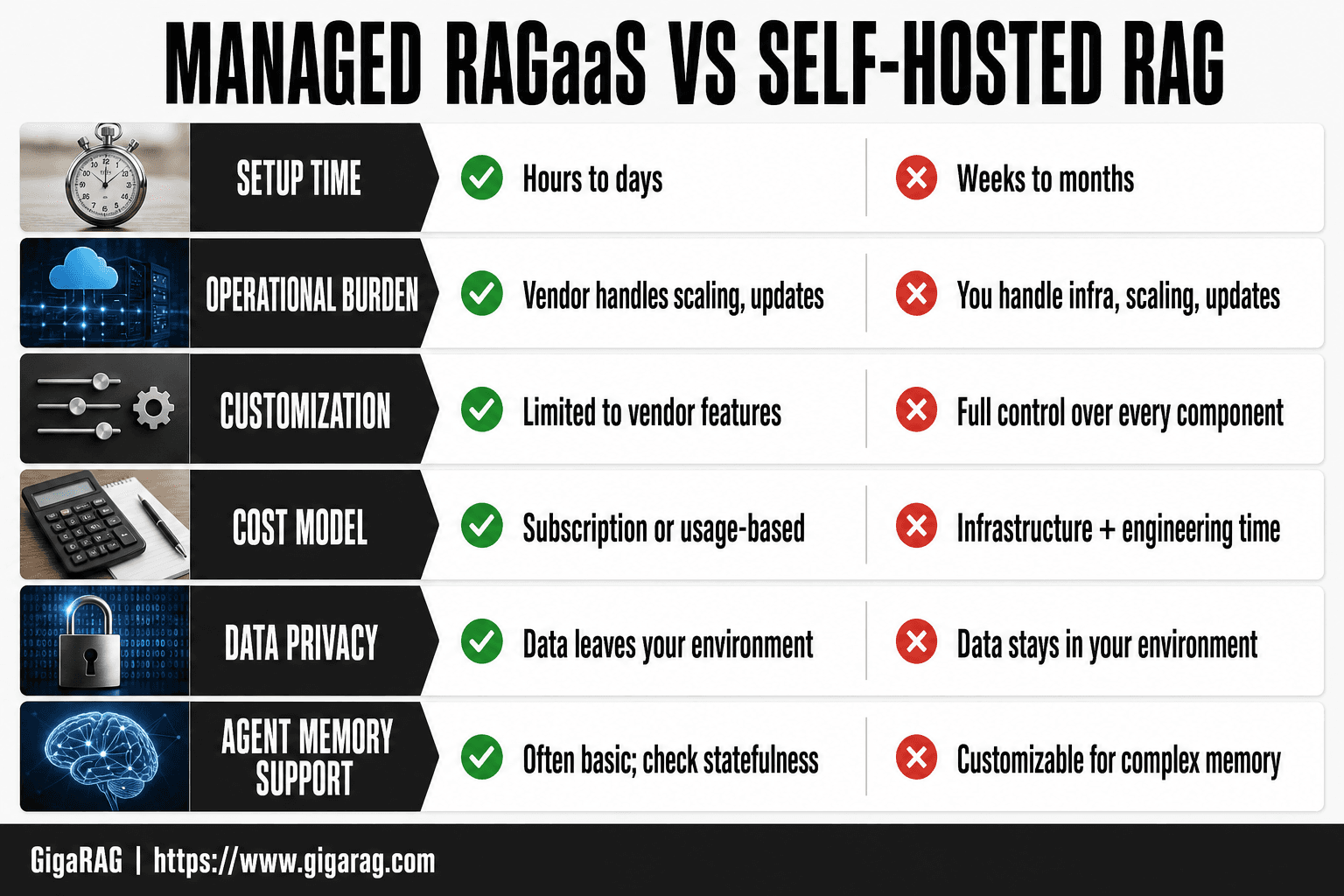
Managed RAG as a Service vs Self-Hosted RAG
| Factor | Managed RAGaaS | Self-Hosted RAG |
|---|---|---|
| Setup time | Hours to days | Weeks to months |
| Operational burden | Vendor handles scaling, updates | You handle infra, scaling, updates |
| Customization | Limited to vendor features | Full control over every component |
| Cost model | Subscription or usage-based | Infrastructure + engineering time |
| Data privacy | Data leaves your environment | Data stays in your environment |
| Agent memory support | Often basic; check statefulness | Customizable for complex memory |
Why Agent Memory Changes the RAG as a Service Conversation
Most RAG as a Service platforms are built for a stateless question-answer pattern: query in, context out, done. Agent memory breaks that assumption. An agent doesn't just retrieve once and answer. It retrieves, acts, observes, and retrieves again across a conversation that might span minutes or hours. The retrieval layer has to remember what came before.
That's the gap. Most RAGaaS offerings treat every query as independent. They don't persist retrieval state between turns, and they don't track what the agent already knows. If you're building an agent that needs memory, you'll hit that wall fast.
Stateless vs. stateful RAG pipelines
A stateless pipeline is the default. Each query hits the retriever cold, with no awareness of prior turns. That works for single-shot Q&A: a customer asks about a return policy, the system retrieves the policy, the LLM answers. Nothing carries over.
A stateful pipeline is different. The retriever needs to know what the agent has already seen, what it decided, and what context is still relevant. That means storing retrieval history, tracking which chunks were used, and updating the context window as the conversation evolves. Most RAGaaS products don't expose that state. They give you an API call, not a memory.
What agent memory actually requires from a RAG service
Agent memory isn't just a longer context window. It's a set of mechanisms: short-term working memory for the current task, long-term memory for facts that persist across sessions, and episodic memory for what happened in prior interactions. A RAG service that supports agent memory needs to handle all three.
In practice, that means the service has to let you write to memory, not just read from an index. It has to support session-scoped retrieval, where the agent can pull context from earlier in the same conversation. And it has to expose enough state that you can inspect what the agent retrieved and why. Most RAGaaS platforms treat the index as read-only. That's fine for a chatbot. It's not enough for an agent that learns as it works.
[!tip] Before committing, test the service with a small, representative dataset and run your own evaluation metrics (e.g., retrieval recall, answer faithfulness) to avoid vendor lock-in based on demos.
Rag As A Service: A Step-by-Step Guide
- Map your retrieval and agent memory requirements (data volume, query types, statefulness).
- List must-have features: connectors, chunking options, embedding models, vector store, APIs.
- Check evaluation and monitoring capabilities: can you run your own evals? Are metrics exposed?
- Assess data privacy and compliance: where does data reside? What are retention policies?
- Run a proof of concept with your own data and queries; measure retrieval accuracy and latency.
- Compare costs at scale, including potential overage fees and exit costs.
- Decide based on trade-offs: if you need deep customization or strict data control, self-host.
Approaches to RAG as a Service
RAGaaS vendors split into four architectural camps. The difference matters because each one trades off retrieval quality, latency, and how much control you keep. You can't evaluate a vendor without knowing which camp it sits in.
Vector search RAG
This is the default. Documents get chunked, embedded into vectors, and stored in an index. At query time, the service embeds your query and finds the nearest chunks by cosine similarity. It's fast and cheap to run, which is why most managed offerings start here.
The catch: vector search retrieves by semantic similarity, not by relationship. If your agent needs to follow a chain of facts across documents, vector search will miss the connections. It returns chunks that look similar, not chunks that are actually related.
Graph-based RAG
Graph RAG stores entities and their relationships as nodes and edges. When an agent queries, the service traverses the graph to find connected facts. That's useful for knowledge bases where the relationship between things matters more than surface similarity: legal citations, medical ontologies, supply chains.
The trade-off is cost and complexity. Building and maintaining a knowledge graph takes real engineering time. Most graph-based RAGaaS products charge more per query, and they're slower than vector search.
Hybrid retrieval
Hybrid combines vector search with keyword search, usually BM25. The idea is to catch both semantic matches and exact term matches. A query like "return policy for damaged items" benefits from both: vector search finds related concepts, keyword search finds the literal phrase.
Most serious RAGaaS platforms now offer hybrid as a toggle. It's the pragmatic default for production pipelines, though it costs more than pure vector search.
Serverless RAG
Serverless RAG abstracts the infrastructure entirely. You upload documents, the service handles chunking, embedding, and indexing, and you pay per query. No servers to manage, no index to tune.
The honest answer is that serverless works well for prototypes and low-traffic internal tools. For agent memory with high query volume or strict latency requirements, the per-query pricing and cold-start latency will bite. You're trading control for convenience, and that trade gets expensive at scale.
What RAG as a Service Cannot Do
Vendor pages will tell you RAGaaS solves retrieval. They won't tell you what it doesn't solve. Here's the honest list, because you'll find out anyway once your pipeline is in production.
RAGaaS does not eliminate hallucination
RAG reduces hallucination by grounding the model in retrieved context. It does not remove it. If the retrieved chunks are wrong, incomplete, or irrelevant, the model will confidently generate an answer from bad material. Worse, a model can ignore the retrieved context entirely and answer from its training data. RAGaaS gives you a retrieval pipeline. It does not give you a truth guarantee.
The failure mode you'll actually hit: your agent retrieves the right document but the wrong section, then answers as if that section were authoritative. No managed service catches that for you.
RAGaaS is not a replacement for fine-tuning
Fine-tuning changes how the model responds. RAG changes what the model sees. They solve different problems. If your agent needs a specific tone, a narrow output format, or domain-specific reasoning patterns, fine-tuning is the tool. If it needs access to fresh or private data, RAG is the tool.
Most production systems use both. RAGaaS vendors rarely say this because they're selling the retrieval layer. Don't buy a RAG service expecting it to fix a model that doesn't know how to use retrieved context well.
RAGaaS does not automatically solve memory persistence
This is the gap that matters most for agent builders. A standard RAGaaS stores documents and retrieves chunks. It does not store conversation state, user preferences, or what the agent learned three turns ago. That's memory persistence, and it's a separate problem.
You can build memory on top of a RAG service by writing conversation summaries back into the index. But the service won't do it for you. If you need stateful agent memory across sessions, you're building that layer yourself, regardless of which RAGaaS you pick.
RAGaaS cannot guarantee retrieval quality
No vendor can promise you good retrieval without seeing your data. Retrieval quality depends on chunk size, embedding model choice, query phrasing, and how clean your source documents are. A managed service gives you defaults. Defaults are not guarantees.
The only way to know if retrieval works for your use case is to evaluate it: run real queries, check what comes back, measure precision and recall. RAGaaS gives you the infrastructure. Evaluation is still your job.
Managed vs. Self-Hosted RAG: An Honest Comparison
The previous section covered what RAGaaS can't do. Now the question every pipeline builder actually faces: should you pay a vendor or run it yourself? The honest answer is it depends on your query volume, your team size, and how much control you need over the retrieval layer.
Cost: per-query pricing vs. infrastructure costs
Managed RAG charges per query or per token. That's predictable at low volume and painful at high volume. A pipeline doing 10 million queries a month will pay far more to a vendor than it costs to run a vector database on your own hardware.
Self-hosted flips the math. You pay for compute, storage, and engineering time regardless of query count. The break-even point varies, but the pattern holds: managed wins at low volume, self-hosted wins at scale.
Control and customization
Self-hosted gives you everything: chunking strategy, embedding model, reranking, index structure. You can swap any component. Managed services lock you into their defaults, and their defaults are tuned for generic document retrieval, not agent memory.
That control gap matters when your retrieval quality depends on domain-specific chunking. A managed service won't let you change how it splits your documents.
Latency and performance
Managed RAG adds a network hop. For a single query, that's 50 to 200 milliseconds. Fine for a chatbot. For an agent loop making five retrieval calls per turn, that's a second or more of added latency per response.
Self-hosted keeps retrieval inside your network. You control the hardware, the index placement, and the caching. The performance ceiling is higher, but you're the one responsible for reaching it.
Maintenance and operational burden
This is where managed earns its price. The vendor handles index updates, scaling, failover, and security patches. Your team writes queries, not infrastructure.
Self-hosted means you own the database, the embedding pipeline, the monitoring, and the on-call rotation. That's real work. If you don't have a team to do it, managed is the only sane choice.
When to choose managed vs. self-hosted
Choose managed when query volume is low or unpredictable, your team is small, and you need something working this week. Choose self-hosted when volume is high, latency is critical, or your retrieval needs custom chunking and reranking that vendors don't expose.
The middle ground: start managed, instrument your cost per query, and move to self-hosted when the numbers justify it. Most teams never hit that threshold.
How to Evaluate a RAG as a Service for Your Pipeline
You've decided managed or self-hosted. Now you need a way to compare vendors without falling for their demo. Here's the evaluation framework I use when a pipeline builder asks me what to check before signing.
Retrieval quality metrics that matter
Don't accept "state-of-the-art retrieval" as an answer. Ask for numbers. The two that matter most are recall@k and MRR. Recall@k tells you whether the right chunk shows up in the top k results. MRR tells you how high it ranks. A vendor that won't share these on your data, not theirs, is hiding something.
Run your own eval set. Take 50 to 100 real queries from your domain, label the correct chunks, and test every vendor against the same set. That's the only comparison that counts.
Latency and throughput requirements
Measure p50 and p99 latency, not average. An average hides the slow tail that kills agent loops. For a single-turn chatbot, 300 milliseconds p99 is fine. For an agent making five retrieval calls per turn, you need p99 under 100 milliseconds or the whole loop drags.
Ask about throughput limits too. Some managed services throttle concurrent requests at tiers that will choke a multi-agent system.
Cost per query and token usage
Get the full cost breakdown: embedding cost, storage cost, retrieval cost, and any reranking surcharge. Vendors quote the retrieval price and bury the rest. Calculate your monthly cost at projected volume before you commit.
Token usage matters because embeddings and reranking both consume tokens. A service that reranks every query by default will cost more than one that only reranks when confidence is low.
Monitoring and observability
You need to see what the retrieval layer is doing in production. Ask whether the service exposes query logs, retrieval latency per call, and relevance scores. If it doesn't, you're flying blind when retrieval quality degrades.
The minimum bar: can you trace a bad answer back to the specific chunks that were retrieved? If not, debugging is guesswork.
Integration with agent frameworks
Check whether the service works with your agent framework without a custom wrapper. LangChain and LlamaIndex integrations are common, but they vary in quality. A thin integration that only supports basic retrieval won't handle memory persistence or multi-agent routing.
Test the integration before you buy. Build a minimal agent loop against the service and see what breaks. That one afternoon will tell you more than any vendor demo.
Common Mistakes When Building with RAG as a Service
Most RAGaaS failures aren't vendor problems. They're pipeline problems. Here are the five mistakes I see repeatedly when builders adopt a managed service and assume it handles the hard parts.
Poor chunking strategy
Chunking is the single biggest lever on retrieval quality, and most builders leave it at vendor defaults. A 500-token chunk works for prose but destroys code or tabular data. A 100-token chunk fragments context and breaks semantic coherence.
Test chunk sizes on your own data before you commit. The vendor default is a starting point, not an answer.
Skipping evaluation entirely
Builders ship a RAGaaS integration without ever measuring retrieval quality. Then they wonder why answers are wrong. You need a labeled eval set from day one. Fifty real queries with known-correct chunks is enough to catch most failures.
Without eval, you can't tell whether a bad answer came from retrieval, generation, or your chunking. You're debugging blind.
Underestimating latency in agent loops
A single retrieval call at 200 milliseconds feels fine. An agent making five calls per turn now takes a full second before it responds. That's the difference between a snappy assistant and one users abandon.
Measure p99 latency across a full agent loop, not a single query. Managed services quote single-call numbers because they look better.
Over-relying on vendor defaults
Vendor defaults are tuned for generic use cases. Your domain isn't generic. Default embedding models, default rerankers, default top-k values, all of them need tuning against your eval set.
The honest answer is that a managed service reduces infrastructure work but not tuning work. You still own retrieval quality.
Neglecting memory state management
RAGaaS gives you retrieval. It doesn't give you memory. Builders assume the service persists conversation state, then discover their agent forgets everything between turns.
You need a separate memory layer: session state, user profiles, long-term context. The RAG service retrieves from that layer, but it doesn't maintain it. That's your job.
RAG as a Service in Production: Realistic Use Cases
RAGaaS works best when retrieval is a component, not the product. The pattern that holds up in production: a managed service handles embeddings and vector search, while your application owns state, memory, and the agent loop.
Customer support agents with persistent memory
A support agent that remembers a customer's last three tickets needs more than retrieval. It needs session state. The RAG service pulls relevant policy docs and past ticket resolutions. Your memory layer tracks what the customer already told you. The two work together, but they're separate systems.
The main catch is latency. A support agent making three retrieval calls per turn at 150 milliseconds each adds half a second before the customer sees a response. That's acceptable for chat. It's not acceptable for voice.
Internal knowledge retrieval for multi-agent systems
Multi-agent setups fail when every agent hits the same index with the same query. You need per-agent namespaces: one index for the billing agent, another for the onboarding agent. Most managed services support this through metadata filtering, but you have to configure it. The default is a single shared index, and that produces cross-talk.
Document-heavy workflows (legal, finance, healthcare)
These are the strongest RAGaaS fits. Documents are static, chunking is predictable, and retrieval quality is measurable. A legal team querying 50,000 contracts gets real value from a managed vector index.
The honest answer is that compliance changes the calculus. Healthcare data under HIPAA or financial data under SOC 2 may force you into a self-hosted deployment or a vendor with specific certifications. Check that before you build.
Final Thoughts: Choosing the Right RAG as a Service
You don't need a vendor's checklist. You need four answers.
First, is your retrieval stateless or stateful? If every query stands alone, most managed services work. If your agents need memory across turns, you'll build that layer yourself regardless of what the vendor promises.
Second, what's your latency budget? Agent loops multiply retrieval calls. Three calls per turn at 150 milliseconds each is fine for chat, dead for voice. Measure before you commit.
Third, can you evaluate retrieval quality on your own data? If the vendor doesn't expose metrics you can inspect, you're buying a black box. Walk away.
Fourth, what does it cost per query at your expected volume? Per-query pricing looks cheap at prototype scale and gets expensive fast. Run the numbers at ten times your current traffic.
The honest answer is that most rag as a service offerings are built for stateless document retrieval. Agent memory is a different problem, and no managed service solves it out of the box. You'll bolt on state management, evaluation, and monitoring yourself.
That's the work GigaRAG is built for: pipeline builders who need agent memory and retrieval in one place, with evaluation hooks that don't hide the numbers. It's not the only option. It's the one built for the stateful case most vendors ignore.
Frequently Asked Questions
What can RAG stand for?
In this context, RAG stands for Retrieval-Augmented Generation, an AI technique that combines a retrieval system with a language model to generate grounded responses. It is not to be confused with other meanings like the red-amber-green status or the Ruby gem.
What is AI as a service (AIaaS)?
AIaaS is a cloud-based model for accessing AI capabilities (like machine learning, NLP, or computer vision) via APIs without building models in-house. RAG as a Service is a specialized subset of AIaaS focused on retrieval-augmented generation pipelines.
What are the top 10 RAG frameworks?
Popular frameworks include LangChain, LlamaIndex, Haystack, and others, but the list evolves quickly. Rather than chasing a top 10, evaluate frameworks based on your need for customization, community support, and integration with your existing stack.
Is ChatGPT a RAG?
No, ChatGPT is a standalone language model. However, when combined with retrieval tools (like browsing or custom knowledge bases), it can be part of a RAG system. RAG as a Service typically provides the retrieval infrastructure around such models.
Can RAG as a Service handle agent memory?
It can handle simple memory like storing conversation history, but complex agent memory (e.g., episodic, semantic, procedural) often requires custom state management. Check if the service supports persistent, queryable memory stores before relying on it for agents.
What are the main limitations of RAG as a Service?
Limitations include limited control over retrieval algorithms, potential data privacy concerns, vendor lock-in, and difficulty in debugging retrieval failures. It also cannot compensate for poor data quality or missing evaluation metrics.
How do I evaluate a RAG as a Service provider?
Run a proof of concept with your own data and queries. Measure retrieval accuracy, latency, and cost. Check for transparency in evaluation metrics, support for custom embeddings, and clear data governance policies.
About GigaRAG
GigaRAG is for agent memory and RAG pipeline builders. get this right. Whether you are working through rag as a service or something adjacent, we publish what we have actually tested, including where it falls short.