RAG Evaluation Metrics That Correlate With Quality: A Practical Guide for Pipeline Builders
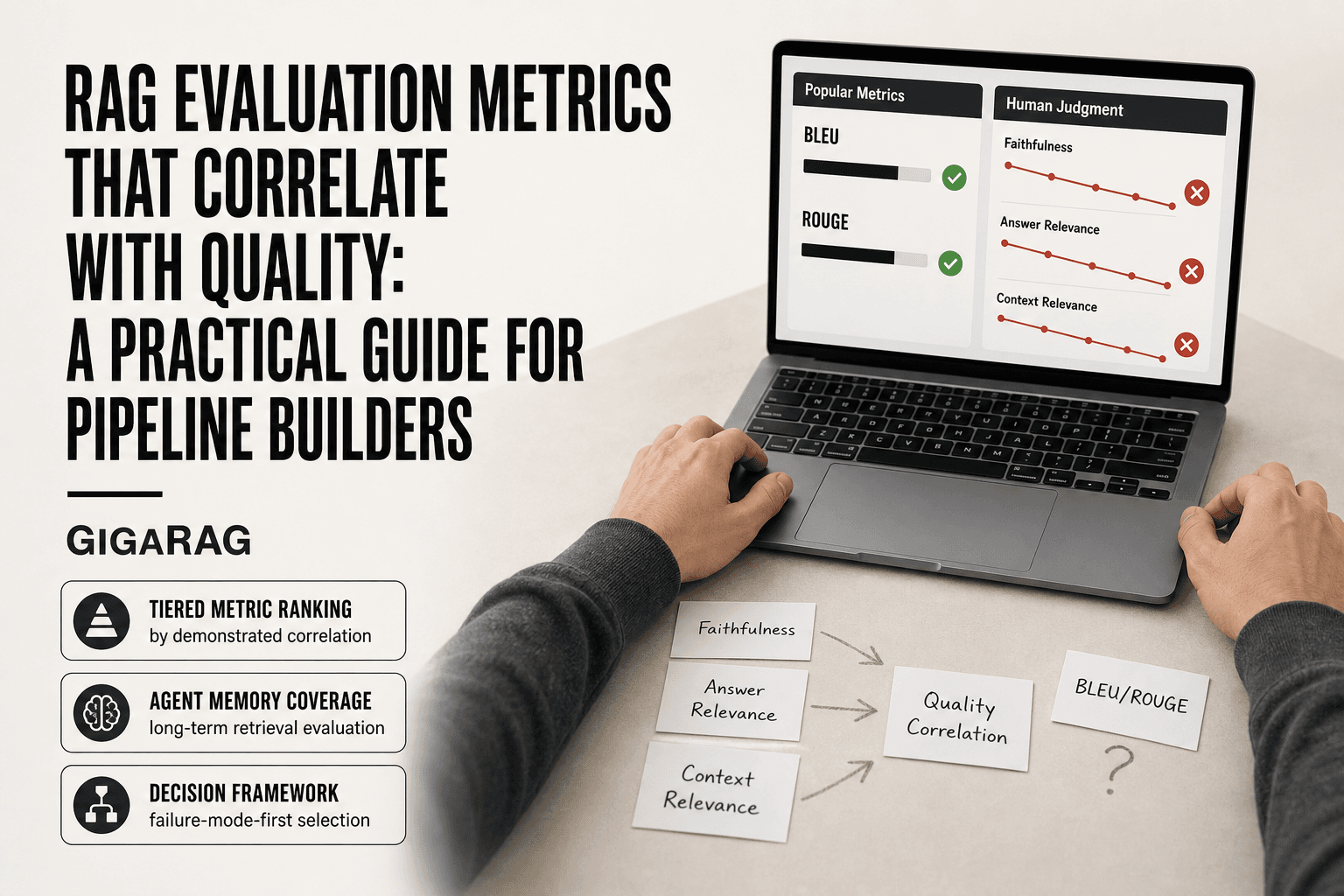
RAG evaluation metrics that correlate with quality are what pipeline builders want, but most of what's available is popular for the wrong reason: it's easy to compute, not proven to predict whether users actually get good answers. You're building agent memory or a retrieval pipeline, and you've got RAGAS, DeepEval, TruLens, custom LLM judges, and a dozen more options screaming for your attention. Almost none of them come with evidence that their scores track human judgment in production. That's the uncomfortable truth. This guide is vendor-neutral and built for the work we do at GigaRAG, where agent memory evaluation is a daily problem, not a blog topic. Here's what you'll get: a tiered ranking of RAG evaluation metrics by demonstrated correlation with human-judged quality, honest labels where evidence is missing, a dedicated section on evaluating long-term agent memory that no top-three competitor covers, and a decision framework for choosing metrics based on your failure modes and budget. Some popular metrics will be flagged as unproven. That's the point.
| At a glance | Details |
|---|---|
| Core problem | Popular metrics aren't always validated against human judgment |
| Best-validated metrics | Faithfulness, answer relevance, context relevance |
| Weakest evidence | BLEU, ROUGE, exact match for RAG quality |
| Key frameworks | RAGAS, DeepEval, TruLens, custom LLM judges |
| Biggest blind spot | Agent memory and long-term retrieval quality |
| Practical rule | Pair automated metrics with human spot-checks |
In This Guide
- What Is RAG Evaluation?
- LLM-as-Judge Metrics vs Traditional Overlap Metrics for RAG
- Why Most RAG Evaluation Metrics Don't Actually Correlate With Quality
- Rag Evaluation Metrics That Correlate With Quality: A Step-by-Step Guide
- Retrieval Evaluation Metrics
- Generation Evaluation Metrics
- LLM-as-a-Judge: The Current Best Proxy for Quality
- Evaluating Agent Memory and Long-Term Retrieval Quality
- A Decision Framework for Choosing RAG Evaluation Metrics
- RAG Evaluation Tools and Frameworks
- Best Practices for RAG Evaluation
- What RAG Evaluation Metrics Cannot Tell You
- Final Thoughts: Building a Quality-First RAG Evaluation Strategy
What Is RAG Evaluation?
RAG evaluation is the systematic measurement of how well a retrieval-augmented generation system retrieves relevant context and uses it to produce accurate, grounded answers. It scores two separate things: what the system pulled from your knowledge base, and what it generated from that material.
The two components: retrieval quality and generation quality
Retrieval quality asks whether the right chunks came back. Did the system find the documents that actually answer the question? Did it miss critical context or pull irrelevant passages that muddy the response?
Generation quality asks whether the final answer is faithful to what was retrieved. Did the model use the context correctly, or did it invent details that weren't there? Did it actually answer the question asked?
You can't fix what you don't measure separately. A system can retrieve perfectly and still generate garbage. It can also retrieve poorly and produce a lucky answer. Scoring both components tells you where the failure lives.
Why RAG evaluation is harder than traditional LLM evaluation
Traditional LLM evaluation checks one output against one prompt. RAG adds a retrieval step in the middle, which means you're evaluating a pipeline, not a model. The answer depends on what came back from the vector store, how the chunks were ordered, and how the model used them.
That's three failure points instead of one. A bad answer could come from bad embeddings, bad chunking, bad prompting, or bad generation. RAG evaluation has to separate those.
[!note] No single RAG evaluation metric is universally validated across domains; correlation with human judgment is task- and dataset-dependent, so you should measure it on your own data rather than assuming a metric transfers.
LLM-as-Judge Metrics vs Traditional Overlap Metrics for RAG
| Factor | LLM-as-Judge Metrics | Traditional Overlap Metrics |
|---|---|---|
| What they measure | Semantic faithfulness, relevance, groundedness | Lexical overlap with a reference answer |
| Correlation with human judgment | Generally stronger where validated, but judge-dependent | Weak for open-ended RAG answers |
| Cost and latency | Higher per evaluation due to LLM calls | Very low, fast to compute |
| Best fit | Answer quality, hallucination detection, context relevance | Regression tests, smoke tests, deterministic checks |
| Main risk | Judge bias, prompt sensitivity, inconsistent scoring | Passes while users still report poor answers |
Why Most RAG Evaluation Metrics Don't Actually Correlate With Quality
Here's the uncomfortable truth: most RAG metrics are popular because they're cheap to compute, not because anyone proved they predict what users actually experience. A metric can pass while your users still report garbage answers. That gap is the whole problem.
The correlation problem: easy to compute ≠ predictive of quality
BLEU and ROUGE take milliseconds and need no human input. Embedding similarity is one cosine calculation. Those properties made them defaults. But none of that says anything about whether a high score means a good answer.
Correlation with human judgment is the test that matters. You measure it by scoring a dataset with both the metric and human raters, then checking whether they agree. Most RAG metrics have never been through that test. Some have failed it.
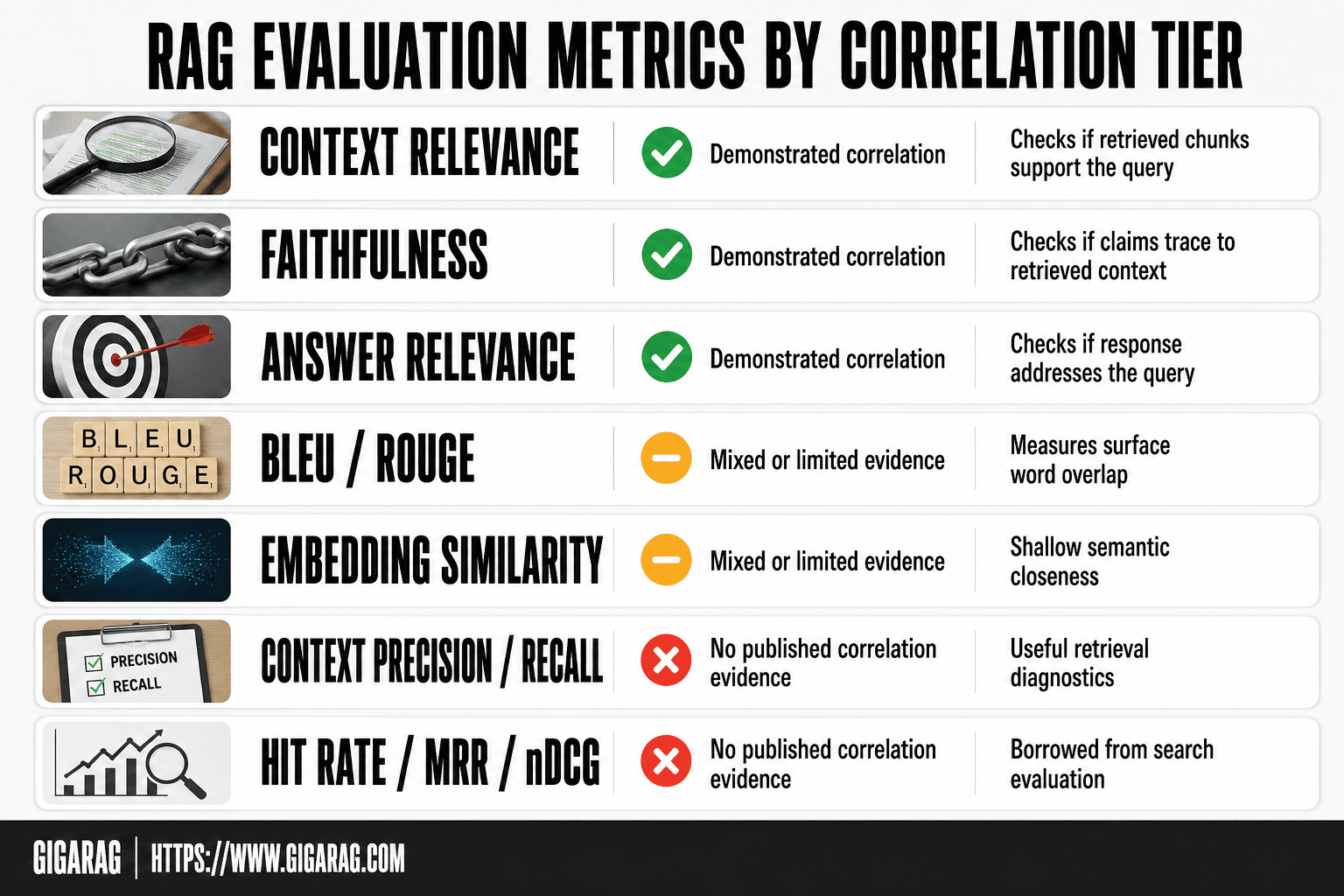
Tier 1: Metrics with demonstrated correlation (context relevance, faithfulness, answer relevance)
These three have published evidence linking them to human judgment. Context relevance asks whether retrieved chunks actually support the question. Faithfulness checks whether every claim in the answer traces back to retrieved context. Answer relevance measures whether the response addresses what was asked.
They correlate because they target the failure modes humans notice. A user doesn't care about n-gram overlap. They care whether the answer used the right source material and stayed on topic.
Tier 2: Metrics with mixed or limited evidence (BLEU, ROUGE, embedding similarity)
BLEU and ROUGE were built for machine translation, not open-ended generation. They reward surface-level word overlap, which punishes legitimate paraphrasing and rewards verbose repetition. Studies show weak correlation with human quality judgments for generative tasks.
Embedding similarity is better but still shallow. Two answers can be semantically close in vector space while one contains a critical factual error. The embedding doesn't know.
Tier 3: Metrics with no published correlation evidence
Most newer metrics fall here. Context precision, context recall, hit rate, MRR, nDCG. They're useful diagnostics for retrieval mechanics. But no published study I can find demonstrates they predict whether a user judges the final answer as good.
That doesn't make them useless. It makes them unproven for the claim most teams want to make: "our quality improved."
What the research actually says — and where it's silent
The honest summary: faithfulness and answer relevance have the strongest published correlation with human judgment. Context relevance follows. Everything else is either borrowed from adjacent fields or too new to have evidence.
The silence is just as important. No major study establishes correlation for agent memory systems, multi-turn retrieval, or long-horizon context retention. If you're building those, you're operating without validated metrics. Plan accordingly.
[!tip] For agent memory engineers: evaluate long-term retrieval separately from single-turn RAG by testing whether the agent recalls facts from earlier sessions, not just whether it answers the current question well — most popular RAG metric suites do not cover this.
Rag Evaluation Metrics That Correlate With Quality: A Step-by-Step Guide
- Define what 'quality' means for your use case — factual accuracy, completeness, tone, or task success.
- Build a small human-labeled golden set of queries, retrieved contexts, and ideal answers.
- Shortlist candidate metrics from RAGAS, DeepEval, TruLens, or a custom LLM judge.
- Score your golden set with each candidate metric and compare against human labels.
- Keep metrics that correlate with human judgment; flag or drop the rest as 'unknown correlation'.
- Add regression checks for deterministic properties like citation presence and retrieval recall.
- Re-validate your metric stack whenever you change models, prompts, or retrieval strategy.
Retrieval Evaluation Metrics
Retrieval metrics measure whether your system pulled the right chunks before generation ever started. They're diagnostic, not verdicts. A perfect retrieval score with a garbage answer means your generator is the problem. A great answer with terrible retrieval means you got lucky.
Context relevance: the metric that matters most for retrieval
Context relevance asks one question: does each retrieved chunk actually help answer the query? It's usually scored by an LLM judge that reads the question and each chunk, then rates relevance on a scale. Chunks that are topically adjacent but useless get flagged.
This is the retrieval metric with the strongest link to downstream quality. If your context is relevant, the generator has good material to work with. If it's not, no amount of prompt engineering saves you. In practice, context relevance catches the most common retrieval failure: pulling chunks that mention the right keywords but miss the actual intent.
Context precision and context recall
These two split retrieval quality into what you got right and what you missed.
Context precision measures the proportion of retrieved chunks that are relevant. High precision means little noise. Context recall measures the proportion of all relevant chunks in your corpus that you actually retrieved. High recall means you didn't leave the answer on the table.
They trade off against each other. Retrieving more chunks raises recall but lowers precision. Retrieving fewer does the opposite. Most RAG systems over-retrieve to protect recall, then rely on the generator to filter noise. That works until the noise drowns the signal.
Traditional IR metrics: hit rate, MRR, nDCG
Hit rate is the simplest: did the correct chunk appear anywhere in the top-k results? It's binary and blunt. A system that puts the right chunk at position 10 scores the same as one that puts it at position 1.
MRR fixes that by rewarding correct chunks that appear earlier. It averages the reciprocal of the rank of the first correct result. Position 1 scores 1.0, position 2 scores 0.5, position 10 scores 0.1.
nDCG goes further by allowing graded relevance. A partially useful chunk scores more than zero but less than a perfect match. It's the most nuanced of the three, but it requires relevance judgments per chunk, which means building a labeled dataset.
These metrics come from search engine evaluation. They measure ranking quality, not answer quality. A perfect MRR doesn't guarantee the final answer is good. It guarantees the right chunk was findable.
When retrieval metrics mislead: chunking artifacts and embedding bias
Chunking strategy distorts every retrieval metric. If you chunk by fixed token count, a relevant passage might split across two chunks. Your recall drops, but not because retrieval failed. The chunking cut the answer in half. Metrics can't tell the difference.
Embedding bias is subtler. Embedding models favor chunks that are stylistically similar to the query, not necessarily factually relevant. A chunk that paraphrases the question scores high on vector similarity while adding nothing. Context relevance catches this if you use an LLM judge. Embedding similarity alone won't.
The honest takeaway: retrieval metrics tell you whether the right information was findable. They don't tell you whether the generator used it well. That's the next section's problem.
Generation Evaluation Metrics
Retrieval metrics tell you whether the right chunks were findable. Generation metrics tell you whether the answer built from those chunks is any good. They're the metrics users actually feel. A user never says "your context precision was low." They say "this answer is wrong" or "this doesn't answer my question."
Faithfulness and groundedness: the non-negotiables
Faithfulness measures whether every claim in the answer is supported by the retrieved context. Groundedness is the same idea from the other direction: does the answer stay anchored to source material, or does it drift into plausible-sounding invention?
These two are non-negotiable because they catch the failure mode users hate most: confident nonsense. An LLM will happily generate a fluent, authoritative answer that has no basis in your documents. Faithfulness scoring, usually via an LLM judge that checks each sentence against the context, flags that.
The good news is faithfulness is one of the few generation metrics with demonstrated correlation to human judgment. When humans rate an answer as "made up," faithfulness scores drop. That's not true for every metric in this section.
Answer relevance: measuring whether the answer actually answers
Answer relevance asks a different question than faithfulness. Faithfulness checks if the answer is true to the context. Answer relevance checks if the answer addresses the query at all.
You can have a perfectly faithful answer that's completely irrelevant. Ask "what's the refund policy" and get a faithful summary of the shipping policy. Every claim is grounded. Nothing answers the question.
Answer relevance is typically scored by an LLM judge that compares the query to the answer and rates how directly the answer addresses what was asked. It catches a failure mode that retrieval metrics miss entirely: the system retrieved relevant chunks, but the generator wandered.
Hallucination detection: what it can and cannot catch
Hallucination detection is faithfulness scoring with a specific target. Instead of rating overall groundedness, it flags specific spans or claims that aren't supported by context.
What it catches well: fabricated facts, invented citations, numbers that don't appear in the source. These are the obvious hallucinations.
What it cannot catch: subtle distortions. An answer that technically stays within the context but changes the emphasis, omits a critical caveat, or implies a causal relationship the source never made. These pass hallucination detectors while still misleading users. The detector sees grounded claims. The user sees a wrong answer.
Why BLEU and ROUGE are still used (and why you should be skeptical)
BLEU and ROUGE come from machine translation and summarization. They measure n-gram overlap between the generated answer and a reference answer. They're fast, cheap, and deterministic. That's why they're still everywhere.
Here's the problem: they reward word-for-word similarity to a single reference. RAG answers can be correct in dozens of different phrasings. A faithful, accurate answer that uses different words scores terribly. A wrong answer that happens to share vocabulary with the reference scores well.
The honest answer is BLEU and ROUGE measure surface similarity, not correctness. They persist because they're easy to compute and easy to explain. For RAG evaluation, they're a legacy habit. Use them for regression testing if you must. Don't use them to judge quality.
LLM-as-a-Judge: The Current Best Proxy for Quality
Faithfulness and answer relevance both rely on a judge. That judge is usually another LLM. It's the closest thing we have to automated human judgment, and it's worth understanding how it works before you trust it.
How LLM-as-a-judge works
You give an LLM a prompt that says: here's the query, here's the retrieved context, here's the generated answer. Rate the answer on faithfulness, relevance, or whatever dimension you care about. Return a score from 1 to 5, or a pass/fail, or a list of unsupported claims.
The judge returns a number. You log that number. You track it over time. That's the whole mechanism.
Why LLM judges correlate better with human judgment than traditional metrics
Traditional metrics like BLEU compare text to a reference answer. They measure surface similarity. LLM judges evaluate meaning. A judge can tell that "the refund takes 5 business days" and "you'll get your money back within a week" say the same thing, even though they share almost no vocabulary.
That's the core advantage. Meaning, not wording. When humans rate answers as high quality, LLM judges tend to agree more often than n-gram metrics do. The correlation isn't perfect, but it's the strongest we have among automated methods.
Limitations: judge bias, prompt sensitivity, and cost
LLM judges have their own problems. They prefer longer answers, even when shorter ones are better. They're sensitive to prompt wording: change the scoring rubric slightly and scores shift. They can be inconsistent, giving different scores to the same answer on different runs.
Cost is real too. Every judged answer is an extra LLM call, often with a large context window. At production scale, that adds up fast.
Best practices for reliable LLM judging
Use a fixed rubric. Don't ask the judge to "rate quality" in the abstract. Give it specific criteria: does every claim trace to the context? Does the answer address the query?
Run the judge multiple times and average scores. Use a stronger model as judge than the model being evaluated. And spot-check judge decisions against human ratings periodically. The judge is a proxy, not a replacement.
Evaluating Agent Memory and Long-Term Retrieval Quality
Single-turn RAG evaluation assumes each query starts fresh. Agent memory breaks that assumption. An agent that remembers what you told it three turns ago, or last week, is a different system than one that retrieves from a static corpus. Evaluating it requires different metrics, and some of those metrics don't exist yet.
Why agent memory evaluation is different from single-turn RAG
In single-turn RAG, you score one query against one set of retrieved chunks. The context is fixed. In agent memory, the context changes with every turn. What the agent retrieved earlier becomes part of what it should retrieve now. A correct answer on turn four might depend on context from turn one.
That means you can't evaluate turns in isolation. You have to evaluate the session as a whole. Did the agent carry forward the right information? Did it drop something important? Did it confuse this user's preferences with another user's?
Session-level and multi-turn retrieval metrics
The closest existing metric is session-level recall: across all turns in a conversation, what fraction of the information needed for correct answers was retrieved at the right time? You can compute this by annotating each turn with the set of facts required to answer it, then checking whether those facts were present in the agent's working context.
Cross-turn consistency is another practical metric. Ask the agent the same question in different phrasings across turns, or ask follow-ups that depend on earlier answers. Score whether the agent's responses stay consistent or contradict themselves. Contradiction rate is a number you can actually measure.
The main catch is annotation cost. You need human-labeled sessions, and that's expensive. Synthetic sessions help, but they miss real-world messiness.
Memory decay and staleness: metrics that don't exist yet
Here's the honest problem. We don't have a standard metric for memory decay. How quickly should an agent forget that you prefer short answers? When should a fact from three months ago stop being retrieved? No published metric answers this.
What you can do is measure staleness indirectly. Track how often retrieved context contains outdated information that contradicts newer information in the memory store. If the agent retrieves the old version of a policy after you've updated it, that's a staleness failure. Count those failures per session.
But decay rate, the ideal forgetting curve for an agent, is unsolved. Anyone who tells you otherwise is selling something.
Practical approaches: synthetic multi-turn benchmarks and human eval
Build a synthetic benchmark with scripted sessions. Each session has a defined set of facts, some introduced early, some late, some contradictory. Score the agent on whether it uses the right facts at the right time. This gives you a repeatable number.
Then run periodic human eval on real sessions. Have a human read the full conversation and rate: did the agent remember what it should have? Did it forget anything critical? Did it retrieve stale information? Human judgment is still the only reliable measure of memory quality. The synthetic benchmark tells you if you're regressing. The human eval tells you if the benchmark means anything.
A Decision Framework for Choosing RAG Evaluation Metrics
You've read about the metrics. Now you need to pick them. The honest answer is that no single metric works for every RAG system. What you measure should follow from what breaks.
Step 1: Identify your dominant failure mode
Start by looking at your production logs or your eval set. Where do users complain? Where do answers go wrong?
There are three common failure modes. Retrieval misses: the right chunk isn't in the top-k results. Generation hallucination: the right chunk is retrieved, but the model ignores it or adds facts that aren't there. Relevance failure: the answer is factually fine but doesn't address what the user actually asked.
Don't guess. Pull 50 failed examples and categorize them. If 60% of failures are retrieval misses, you have a retrieval problem. If most failures are hallucinations with correct context present, you have a generation problem. The distribution tells you what to measure.
Step 2: Map failure modes to metrics
Retrieval misses map to context recall and hit rate. You want to know: was the needed chunk actually retrieved? Context precision matters less here. If the right chunk is buried among irrelevant ones, the model can still use it.
Hallucination maps to faithfulness and groundedness. These metrics check whether the answer is supported by the retrieved context. If faithfulness is low, your generation step is broken, not your retrieval.
Relevance failure maps to answer relevance. This checks whether the answer addresses the question, independent of factual accuracy.
The mapping is direct. Don't measure context precision if your problem is hallucination. Don't measure faithfulness if your problem is retrieval misses. Measure the thing that's broken.
Step 3: Budget reality check — what you can actually afford to measure
LLM-as-a-judge metrics cost money. Every evaluation call is an API call. If you're evaluating 10,000 queries per day, faithfulness scoring with GPT-4 adds up fast.
Here's the math. A faithfulness check on one answer costs roughly $0.01 to $0.05 depending on model and prompt length. At 10,000 queries per day, that's $100 to $500 daily. Over a month, $3,000 to $15,000. That's real money.
Cheaper options: sample. Evaluate 5% of production traffic instead of 100%. Or use a smaller, cheaper judge model for routine checks and reserve the expensive judge for weekly deep dives. Traditional IR metrics like hit rate and MRR cost almost nothing to compute. Use those for continuous monitoring, and run LLM judges on a schedule.
Step 4: When to use human evaluation instead of automated metrics
Some things automated metrics can't catch. Tone, brand voice, whether an answer feels helpful, whether it anticipates the user's next question. These matter for user satisfaction, but no metric measures them well.
Use human evaluation when you're changing something fundamental: a new chunking strategy, a new embedding model, a new prompt template. Automated metrics will tell you if you broke something obvious. A human will tell you if you made it worse in ways the metrics can't see.
A practical cadence: run automated metrics continuously, run human eval on 50 to 100 samples whenever you ship a significant change. If human scores drop while automated scores stay flat, your metrics are missing something. That's a signal to revisit what you're measuring.
RAG Evaluation Tools and Frameworks
You can compute metrics by hand, but most teams use a framework. The tools below implement the metrics from earlier sections, with different tradeoffs. None of them is perfect.
RAGAS: the most popular, but understand its metric assumptions
RAGAS is the default choice for many teams. It implements context relevance, context recall, faithfulness, and answer relevance as LLM-judged metrics. You feed it questions, retrieved contexts, and generated answers, and it scores each one.
The main catch is that RAGAS metrics are prompt-based. The quality of your scores depends on the judge model and the prompts RAGAS uses under the hood. If you swap the judge from GPT-4 to a smaller model, scores shift. RAGAS also assumes a single-turn retrieval setup. Multi-turn agent memory evaluation isn't what it's built for.
Best for teams starting out who want a standard metric set without building their own judges.
DeepEval: modular and CI/CD-friendly
DeepEval positions itself as a testing framework, not just a metrics library. You write evaluation tests as code, and they run in your CI pipeline. It supports RAGAS-style metrics plus its own, including hallucination and answer relevancy checks.
The modular design means you can pick individual metrics rather than running the whole suite. DeepEval also supports custom metrics with your own prompts, which matters if you need domain-specific evaluation.
Keep in mind that DeepEval's CI/CD focus means more setup than RAGAS. You're writing test files, not just calling a scoring function.
TruLens: strong for tracing and debugging
TruLens comes from TruEra and focuses on tracing what happens inside a RAG pipeline. It records which chunks were retrieved, what the model saw, and what it generated. The evaluation metrics are built on top of that trace data.
The tracing is the real value. When a faithfulness score is low, you can see exactly which retrieved chunks the model ignored or contradicted. That debugging loop is harder with RAGAS or DeepEval alone.
The tradeoff is that TruLens is more opinionated about pipeline structure. If your RAG setup doesn't fit its tracing model, you'll fight the framework.
LangSmith and Arize Phoenix: observability-first approaches
LangSmith (from LangChain) and Arize Phoenix both treat evaluation as part of broader observability. They log every step of your pipeline, then let you run evaluations on logged traces.
LangSmith integrates tightly with LangChain and LangGraph. If you're already in that ecosystem, it's the path of least resistance. Phoenix is open-source and works with any framework, with a focus on tracing and embedding drift detection.
Both are heavier than a metrics library. You're adopting an observability platform, not just installing a pip package.
What to look for in any evaluation framework
Three things matter. First, can you swap the judge model? If a framework locks you into one LLM for scoring, you can't control cost or bias. Second, does it support custom metrics? Your domain has failure modes the framework authors didn't anticipate. Third, does it log enough context to debug failures? A score without the underlying trace tells you something is wrong, but not why.
Best Practices for RAG Evaluation
Metrics don't fix a broken evaluation process. The practices below matter more than which framework you pick.
Build a gold standard dataset before choosing metrics
You need a set of questions with known-good answers and known-good retrieved contexts before you can trust any metric. Build it from real user queries, not synthetic ones. Include edge cases: ambiguous questions, multi-hop questions, questions where the answer isn't in your knowledge base.
The dataset doesn't need to be huge. Fifty to a hundred well-chosen examples beat a thousand random ones. What matters is that each example has a human-verified answer and the correct source chunks identified.
Without this, you're measuring your metrics against nothing.
Combine automated metrics with periodic human evaluation
Automated metrics are fast but noisy. Human evaluation is slow but grounded. You need both.
Run automated metrics on every change. Then, on a schedule (weekly or monthly), have a human review a sample of scored examples. Look for cases where the metric said "good" but the human says "bad." Those mismatches tell you where your metrics are blind.
The human review doesn't need to be large. Twenty to thirty examples per cycle is enough to catch systematic drift.
Monitor metric drift in production
Your evaluation scores will shift over time. That's normal. What matters is catching the shift early.
Track your key metrics (context relevance, faithfulness, answer relevance) on a dashboard. Set thresholds for when scores drop below a baseline. When they do, investigate before users notice.
Drift usually comes from one of three places: your knowledge base changed, your embedding model changed, or user queries shifted to new topics. Knowing which one matters for the fix.
Integrate evaluation into CI/CD pipelines
If evaluation only runs manually, it won't run. Wire it into your pipeline so every change to retrieval logic, prompts, or chunking triggers a metric run.
Start small: run a subset of your gold standard dataset on every pull request. If scores drop below a threshold, block the merge. This catches regressions before they reach production.
The catch is that CI/CD evaluation only works if your dataset is stable. If you're constantly rewriting your gold standard, the thresholds become meaningless. Lock the dataset, then automate.
What RAG Evaluation Metrics Cannot Tell You
Metrics measure what you tell them to measure. Nothing else. A faithfulness score of 0.95 tells you the answer is grounded in retrieved context. It tells you nothing about whether the answer was useful, clear, or what the user actually needed.
Metrics pass, users still unhappy: the silent failure modes
The most dangerous failure mode is the one where every dashboard is green and users are still complaining. It happens more than teams admit.
A retrieval system can return the right chunk and still fail. The chunk might be technically relevant but written for a different audience. The answer might be faithful but buried in three paragraphs of preamble. The tone might be correct but the response misses the user's actual intent. None of these show up in context relevance or answer faithfulness scores.
The honest answer is that metrics measure proxies. A proxy is only as good as its correlation with the thing you actually care about. When the proxy drifts from reality, you get confident scores and unhappy users.
What no automated metric currently measures well
User satisfaction is the obvious one. No metric reads a user's face or hears the sigh when an answer is technically correct but practically useless.
Factual accuracy in open-domain settings is another gap. Faithfulness checks whether the answer matches the retrieved context. It doesn't check whether the retrieved context itself is true. If your knowledge base contains an error, a perfectly faithful answer repeats that error. The metric passes. The answer is wrong.
Reasoning quality is largely unmeasured. Multi-step answers that require inference, comparison, or synthesis can be faithful and relevant while still being logically broken. Current metrics don't catch bad reasoning unless it produces an obviously wrong final answer.
Tone and brand voice are invisible to automated metrics. An answer can be perfectly grounded and still sound like it was written by a different company. If your product has a voice, you need humans checking it.
The cost of over-relying on metrics
When metrics become the target, they stop being useful. Teams optimize for the score, not the outcome. You see this in retrieval systems tuned to maximize context relevance while ignoring whether users actually find answers faster.
The cost shows up as technical debt in your evaluation pipeline. You accumulate metrics that don't predict anything, dashboards nobody reads, and a false sense of confidence. The fix is periodic human review, not more metrics.
Signs you need human evaluation, not more metrics
You need human evaluation when users report problems your metrics don't catch. You need it when scores are stable but satisfaction is dropping. You need it when you're about to ship a change that affects tone, reasoning, or multi-turn behavior.
Start with twenty to thirty examples reviewed by a human. Look for mismatches between scores and judgment. Those mismatches are where your metrics are blind.
Final Thoughts: Building a Quality-First RAG Evaluation Strategy
The takeaway is simple. Pick metrics because they've shown correlation with human judgment on your failure modes, not because they're popular or easy to compute. Context relevance, faithfulness, and answer relevance earn their place. BLEU and ROUGE mostly don't.
Start with your dominant failure mode. If users complain about wrong answers, measure faithfulness. If they complain about irrelevant context, measure context relevance. If they complain about answers that miss the point, measure answer relevance. Then add human evaluation on a small sample to check that your metrics still track reality.
The honest answer is that no metric stack replaces periodic human review. Metrics catch regressions. Humans catch the rest.
If you're building agent memory or RAG pipelines and want to apply these principles without building evaluation infrastructure from scratch, GigaRAG is built for that. It handles long-term memory and retrieval for agents, with evaluation hooks that let you measure the rag evaluation metrics that correlate with quality rather than guessing. Start with your failure modes. The metrics follow.
Frequently Asked Questions
Which RAG evaluation metrics correlate best with human-judged quality?
In practice, LLM-as-judge metrics for faithfulness, answer relevance, and context relevance tend to track human judgment better than lexical overlap metrics like BLEU or ROUGE. However, correlation varies by domain and judge prompt, so validate on your own labeled data before trusting any metric.
What is the difference between RAGAS, DeepEval, and TruLens for RAG evaluation?
All three provide LLM-based evaluation for RAG pipelines, but they differ in metric coverage, integration style, and how judges are configured. RAGAS focuses on retrieval and generation quality metrics, DeepEval offers a broader testing framework with unit-test-like assertions, and TruLens emphasizes tracing and feedback functions. The right choice depends on whether you need offline scoring, CI integration, or production monitoring.
Can RAG evaluation metrics pass while users still report poor quality?
Yes. Metrics can pass when the retrieved context is technically relevant but incomplete, when the answer is faithful but unhelpful, or when the judge model shares the same blind spots as the generator. This is why automated metrics should be paired with human spot-checks and user feedback signals.
How do I evaluate agent memory and long-term retrieval quality?
Design multi-session test scenarios where the agent must recall facts, preferences, or decisions from earlier interactions. Measure recall accuracy over time, staleness of retrieved memories, and whether the agent correctly ignores outdated information. Most standard RAG metric suites do not cover this, so you will likely need custom evaluations.
What are the most common RAG evaluation metrics?
Common metrics include faithfulness, answer relevance, context precision, context recall, answer correctness, and groundedness. Traditional overlap metrics like BLEU, ROUGE, and exact match are also used but correlate weakly with open-ended answer quality.
Do I need a golden dataset for RAG evaluation?
A small human-labeled golden set is the most reliable way to check whether your chosen metrics actually correlate with quality. Without it, you are trusting metric definitions rather than evidence, which is the core problem this guide addresses.
How often should I re-evaluate my RAG metric choices?
Re-validate whenever you change the underlying LLM, embedding model, retrieval strategy, or prompt templates, because these changes can shift what the metrics measure. A lightweight correlation check against your golden set after each major change is a practical cadence.
About GigaRAG
GigaRAG is for agent memory and RAG pipeline builders. get this right. Whether you are working through rag evaluation metrics that correlate with quality or something adjacent, we publish what we have actually tested, including where it falls short.


