How to Run a RAG Platform Bake-Off
Most RAG platform comparisons are anecdotal, biased, or buried inside a build guide for one specific stack. If you're an engineer or technical lead building agent memory systems, that leaves you guessing. This guide gives you a repeatable, step-by-step methodology for how to run a RAG platform bake-off, built for exactly your use case: agent memory and RAG pipelines. You'll design a controlled experiment, lock down variables, pick metrics that matter, and read results without fooling yourself. GigaRAG is one platform that supports this kind of structured evaluation, but the framework here is vendor-neutral. Be clear about what a bake-off is not: it's not a one-hour task, and you won't get a definitive winner from a single run.
| At a glance | Details |
|---|---|
| Time to run | 1–3 weeks depending on scope |
| Team needed | 1–3 engineers plus a stakeholder |
| Core artifact | A frozen eval dataset and rubric |
| Key metrics | Retrieval quality, answer faithfulness, latency, cost |
| Agent memory focus | Persistence, context recall, tool integration |
| Common pitfall | Vendor-run demos and cherry-picked prompts |
In This Guide
- What a RAG Platform Bake-Off Actually Is
- Synthetic Benchmarks vs Your Own Bake-Off Dataset
- Why Most RAG Comparisons Fail
- How To Run A Rag Platform Bake-off: A Step-by-Step Guide
- Step 1: Define Your Evaluation Goals
- Step 2: Select a Representative Test Dataset
- Step 3: Lock Down Control Variables
- Step 4: Choose Metrics That Matter for Agent Memory
- Step 5: Run the Bake-Off and Collect Results
- Step 6: Interpret Results Honestly
- Common Mistakes When Running a RAG Platform Bake-Off
- Final Thoughts on Running a RAG Platform Bake-Off
What a RAG Platform Bake-Off Actually Is
A RAG platform bake-off is a controlled, repeatable comparison of two or more RAG platforms using the same dataset, the same metrics, and the same operating conditions. You hold every variable constant except the platform itself, then measure which one performs better on tasks that matter to your workload.
That last clause is the load-bearing one. A bake-off is not a demo, where you show one platform working on one happy-path query. It's not a proof-of-concept, where you confirm a platform can technically retrieve and generate. And it's not a single anecdotal test, where you try a query or two and form an impression. A bake-off produces numbers you can defend.
Bake-off vs. benchmark vs. demo
A demo answers one question: does this thing work at all? A benchmark answers a different question: how does this thing score on a standardized test someone else designed? A bake-off answers the question you actually have: which of these platforms works better for my data, my queries, and my agent memory requirements?
The difference is control. Benchmarks use fixed datasets and fixed metrics that may not match your workload. A bake-off lets you bring your own dataset, define your own success criteria, and compare platforms under conditions you set. That's the whole point.
Why controlled comparison matters for agent memory
Agent memory makes this harder than standard RAG. You're not just testing retrieval and generation. You're testing whether the platform remembers context across turns, persists relevant information, and feeds the right context back into an agentic loop. If you don't control for dataset, embedding model, chunking strategy, and LLM, you can't tell whether a difference in memory performance comes from the platform or from one of those variables.
That's why the bake-off structure matters. It isolates the platform as the only thing that changes. Everything else stays locked.
[!note] A bake-off measures performance on your dataset under your conditions; it does not predict long-term reliability, vendor roadmap, or total cost of ownership beyond the tested scope.
Synthetic Benchmarks vs Your Own Bake-Off Dataset
| Factor | Synthetic Benchmarks | Your Own Bake-Off Dataset |
|---|---|---|
| Realism | Generic, may not match your domain | Mirrors your actual queries and documents |
| Bias risk | Can be gamed by vendors | Harder to game if kept private |
| Setup effort | Low, often pre-built | High, requires curation and labeling |
| Agent memory coverage | Rarely tests persistence or context recall | Can include multi-turn memory tasks |
| Decision value | Useful for sanity checks | Directly informs platform choice |
Why Most RAG Comparisons Fail
Most RAG comparisons you'll read are not comparisons. They're demos with extra steps. A vendor runs their platform on a dataset they chose, with metrics they defined, against a competitor configured by someone who doesn't care. Then they publish the chart. The chart is meaningless.
The failure modes are predictable. Once you know them, you can spot a bad comparison in under a minute.
Inconsistent test data
Two platforms tested on different datasets tell you nothing. One vendor runs their system on clean, pre-chunked documents. The other gets raw PDFs with tables and broken headers. The first platform wins, and the vendor writes a blog post about it.
The fix is boring but non-negotiable: same dataset, same preprocessing, same query set. If the data isn't identical, the comparison isn't a comparison. It's two separate demos stapled together.
Undefined or cherry-picked metrics
"Accuracy" is not a metric. It's a vibe. Without a definition of what counts as a correct answer, you can score any result however you like. A platform that returns a plausible-sounding wrong answer scores the same as one that returns the right answer, if the metric is "did it return something."
Cherry-picking is worse. A vendor runs twenty metrics, finds the one where they win, and publishes only that one. The other nineteen stay in a spreadsheet. You never see them.
Ignoring memory persistence and context management
Standard RAG comparisons test single-turn retrieval. You ask a question, the system retrieves chunks, it generates an answer. That's fine for a search box. It's not fine for agent memory.
Agent memory workloads are multi-turn. The platform has to remember what happened three turns ago, decide what's still relevant, and manage a context window that fills up fast. A platform that scores well on single-turn retrieval can fall apart when the conversation spans twenty turns. Most comparisons never test that, because testing it is harder. So the results look great and tell you nothing about the workload you actually run.
[!tip] For agent memory evaluation, include tasks that require recalling information from earlier turns and persisting context across sessions — this is where platforms often diverge most, and it is rarely covered by standard benchmarks.
How To Run A Rag Platform Bake-off: A Step-by-Step Guide
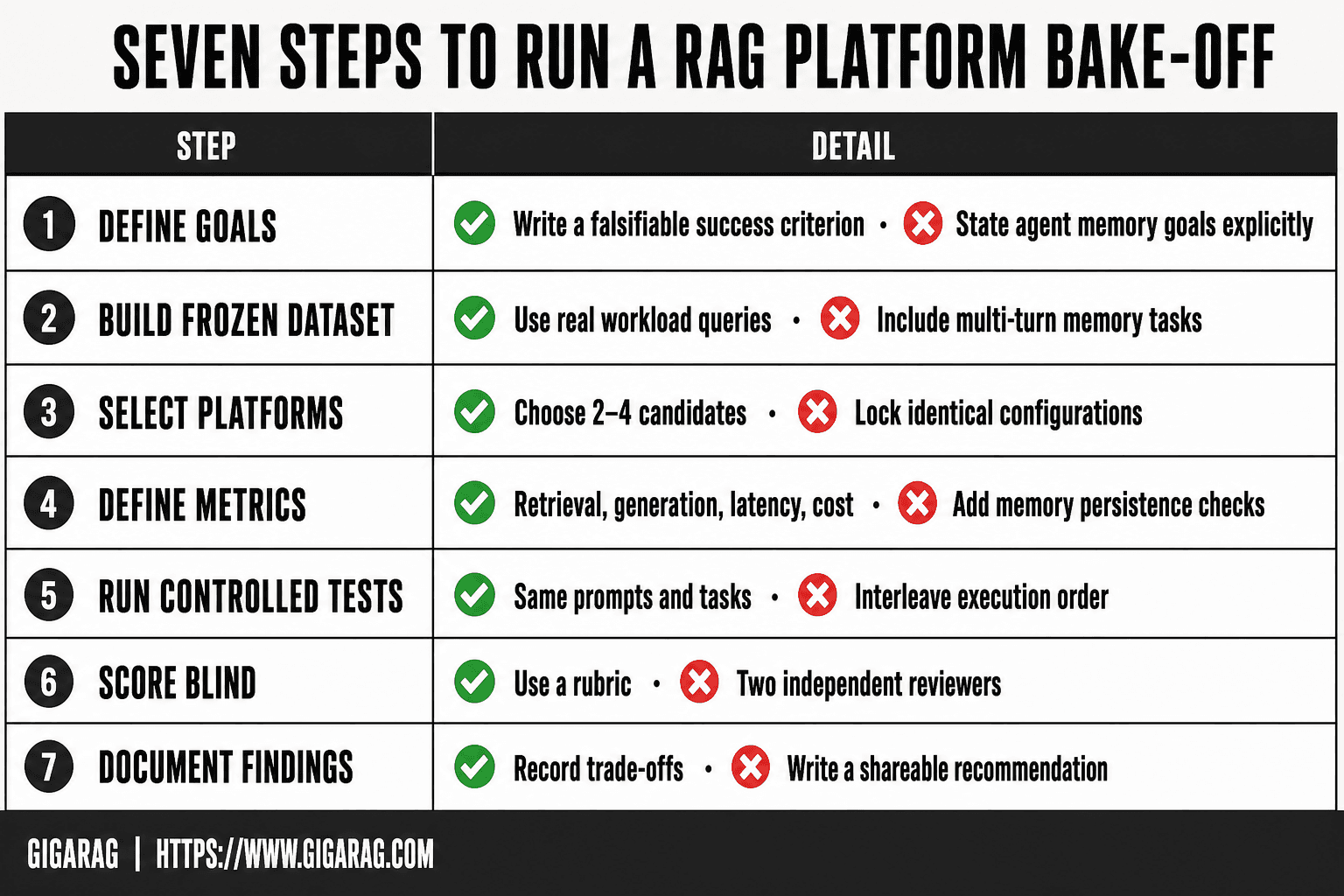
- Define the decision and success criteria before contacting any vendor.
- Build a frozen evaluation dataset from your own domain, including multi-turn agent memory tasks.
- Select 2–4 platforms and lock down identical configurations, models, and hardware where possible.
- Define metrics for retrieval, generation, latency, cost, and memory persistence.
- Run the same prompts and tasks across all platforms in a controlled environment.
- Score results blind using a rubric, and have at least two reviewers independently rate outputs.
- Document findings, trade-offs, and a recommendation in a shareable report.
Step 1: Define Your Evaluation Goals
Before you touch a platform, write down what you're testing. Not a vague goal like "see which one is better." A specific, falsifiable claim. The goal determines your dataset, your metrics, your controls, and how long the whole thing takes. Get this wrong and every later step compounds the error.
Retrieval quality vs. generation quality
These are different systems with different failure modes. Retrieval quality asks: did the platform pull the right chunks? Generation quality asks: did the LLM turn those chunks into a correct, grounded answer? A platform can retrieve perfectly and still generate nonsense if the prompt is bad. Another can retrieve poorly but have a strong LLM that papers over the gaps. You need to know which one you're actually measuring, because the fixes are different.
Agent memory-specific goals
If you're building agent memory, standard retrieval benchmarks won't catch your failures. You need to test memory persistence: does the platform remember a fact from turn 3 at turn 17? Context management: does it drop irrelevant information without dropping critical context? Multi-turn coherence: does the answer at turn 12 still make sense given what happened at turn 5? These are the goals that separate a search tool from an agent memory system. State them explicitly.
Writing a one-paragraph success criterion
Here's the test. Write one paragraph that starts with "Platform X wins if..." and ends with a number. Not "Platform X wins if it's better at retrieval." That's unfalsifiable. Write: "Platform X wins if it achieves at least 0.85 retrieval precision on our 200-query dataset while maintaining answer groundedness above 0.9 and p95 latency under 800ms, with memory persistence accuracy above 0.8 across 20-turn conversations." If you can't write that paragraph, you don't know what you're testing yet. Don't start the bake-off until you can.
Step 2: Select a Representative Test Dataset
Your dataset is the ground truth. If it doesn't look like your real workload, your results don't transfer. The Reddit bake-off that used a single Survivor dataset never explained why that dataset matched anyone's actual use case. Don't repeat that.
Real workload vs. synthetic data
Start with real data. Pull actual queries from your logs, actual documents from your knowledge base, actual conversations from your agent. Synthetic data is fine for stress-testing edge cases, but it won't catch the messiness of real user questions: typos, implicit context, half-formed follow-ups. If you must use synthetic data, generate it from real examples, not from scratch. A synthetic-only dataset tells you how platforms handle clean, well-formed queries. That's not your workload.
Minimum dataset size and diversity
You need enough queries to see a difference, and enough variety to trust it. A minimum of 100 queries is workable; 200 is better. Spread them across query types: fact lookup, multi-hop reasoning, entity relationship questions, and multi-turn follow-ups. Include long documents, not just short passages. Agent memory workloads involve context that spans turns, so your dataset needs conversations, not isolated question-answer pairs. If every query is a single-turn fact lookup, you're testing search, not memory.
Creating a golden answer set
You need a reference answer for every query. This is the slow part. Write the correct answer yourself, or have two people agree on it before the bake-off starts. Don't generate golden answers with any platform you're testing; that bakes in bias. Store them as plain text with the query ID. You'll use these to score retrieval precision and answer groundedness later. If you can't write a golden answer for a query, drop the query. A query you can't score is noise.
Step 3: Lock Down Control Variables
A bake-off is only as fair as the variables you hold still. Change two things at once and you won't know which one caused the difference. That's the whole game here: isolate the platform as the only moving part.
Embedding model and chunking
Use the same embedding model across every platform. If Platform A runs text-embedding-3-large and Platform B runs bge-small, you're comparing embedding models, not platforms. Same rule for chunking. Chunk size, overlap, and splitting strategy all change what the retriever sees. A 256-token chunk with no overlap retrieves differently than a 1,024-token chunk with 10% overlap. Pick one chunking config and apply it everywhere. If a platform won't let you control chunking, that's a finding, not an excuse to vary it. Note it and move on.
LLM and prompt template
The generation model matters as much as the retriever. Run every platform with the same LLM, same temperature, same max tokens. If Platform A uses GPT-4o and Platform B uses Claude 3.5 Sonnet, you can't tell whether answer quality differences come from the RAG pipeline or the model. Same for the prompt template. The system prompt, the instruction format, how retrieved context is injected: all of it stays identical. If a platform hardcodes its own prompt and won't let you override it, that's a real limitation. Log it. But don't silently accept different prompts and then compare groundedness scores.
Hardware, budget, and timeout limits
Latency and cost are part of the comparison, so cap them. Give each platform the same hardware tier or the same dollar budget per query. If one platform runs on a GPU cluster and another on a single CPU, the latency numbers mean nothing. Set a timeout limit too, say 30 seconds per query. A platform that times out at 30 seconds is slower than one that returns in 2 seconds, and that's a legitimate result. But if you let one platform run for 5 minutes while another gets cut off at 10 seconds, you've rigged the test. Same query set, same order, same number of retries. Randomize the order if you're worried about caching effects, but keep the set identical.
Step 4: Choose Metrics That Matter for Agent Memory
Metrics are where bake-offs get honest or get rigged. Pick them before you run anything, and pick the same set for every platform. For agent memory, you need three groups: retrieval, generation, and operational.
Retrieval metrics: precision, recall, MRR
Precision is the share of retrieved chunks that are actually relevant. Recall is the share of relevant chunks you got back. Both matter, and they trade off. MRR, or mean reciprocal rank, tells you where the first relevant chunk landed. If the right chunk is always at position 5, MRR catches that even when recall looks fine. You can compute all three with a golden set of relevant chunk IDs per query. No special tooling needed. A Python script and a CSV of query-to-chunk mappings will do it.
Generation metrics: groundedness, relevance, correctness
Groundedness asks whether the answer stays inside the retrieved context. You can check it with an LLM judge: feed the answer plus the context, ask for a yes/no on whether every claim is supported. Relevance asks whether the answer actually addresses the query. Correctness asks whether the answer is factually right. These three are not the same thing. An answer can be grounded but wrong, or correct but irrelevant. Score each separately, on a 1 to 5 scale or a pass/fail, and keep the raw judgments.
Operational metrics: latency, cost, memory persistence
Latency is end-to-end time per query, p50 and p95. Cost is dollars per query or per 1,000 queries. Memory persistence is the agent-specific one: does the platform remember facts across turns, and for how long? Test it with a multi-turn script that plants a fact in turn 1 and asks about it in turn 5. If the platform drops it, that's a real failure mode, not a rounding error. Log all three per run.
Step 5: Run the Bake-Off and Collect Results
Execution is where most comparisons fall apart. You've locked the variables and picked the metrics. Now run every platform the same way, or the whole thing means nothing.
Execution order and randomization
Don't run Platform A on all queries, then Platform B. Fatigue, rate limits, and model drift will skew the later runs. Interleave instead: run query 1 on A, then B, then C, then query 2 on A, then B, then C. Randomize the query order once, then apply that same order to every platform. If you have 50 queries and 3 platforms, that's 150 runs. Script it. A manual run invites mistakes you can't trace.
Logging outputs and errors
Log everything to a flat file or database: platform name, query ID, timestamp, full prompt, full response, retrieved chunk IDs, latency in milliseconds, token counts, and cost. Don't summarize. Raw outputs let you re-score later if your metric definitions shift. Log errors too. A platform that fails on 8 of 50 queries is telling you something real. Record the error type, not just "failed."
Running multiple trials for variance
LLM outputs are not deterministic. Run each query at least 3 times per platform. Three runs gives you a spread: if Platform A scores 0.82, 0.81, 0.83 and Platform B scores 0.79, 0.80, 0.78, the gap is probably real. If the ranges overlap heavily, it isn't. Log the raw scores per trial, not just the average. Averages hide variance, and variance is the thing you're trying to see.
Here's a results table template to fill in as you go:
| Platform | Query ID | Trial | Latency (ms) | Cost ($) | Precision | Recall | Groundedness | Correctness |
|---|---|---|---|---|---|---|---|---|
| A | 001 | 1 | ||||||
| A | 001 | 2 | ||||||
| A | 001 | 3 | ||||||
| B | 001 | 1 |
One row per trial, not per query. That's what makes variance visible.
Step 6: Interpret Results Honestly
You've got 150 rows of scores. The temptation now is to crown a winner and move on. Don't. The numbers only mean something if you read them with the same discipline you used to collect them.
When differences are not meaningful
A 0.81 versus a 0.78 is not a win. It's noise. With three trials per query, you can eyeball the spread: if the ranges overlap, the platforms are tied on that metric. If you want a real number, compute a confidence interval. For 50 queries and 3 trials, a simple bootstrap (resample your 150 scores 1,000 times, take the 2.5th and 97.5th percentiles) takes ten lines of Python and tells you whether the gap is real. If the intervals overlap, you cannot claim a difference. Say that plainly in your writeup.
The honest answer is that most bake-offs end in ties on most metrics. That's not a failure. It means the platforms are interchangeable on those dimensions, and you should decide on cost, latency, or operational fit instead.
Failure case analysis
Averages hide the interesting stuff. Pull the 10 worst-scoring queries for each platform and read them yourself. What broke? Did the retrieval return the wrong chunks? Did the generator hallucinate a fact that was never in the context? Did the platform drop a turn from the conversation history?
Patterns matter more than counts. If Platform B fails on every query that requires reasoning across more than two turns, that's a memory persistence problem, not a retrieval problem. If Platform A fails on queries with entity names that look like common words, that's an embedding issue. You can't fix what you don't name.
What a bake-off cannot conclude
A bake-off tells you how these platforms performed on your dataset, with your metrics, on the day you ran it. It does not tell you which platform is "better" in general. It does not predict production performance. It does not measure how the platform will behave when your data changes, when your query mix shifts, or when the vendor updates their model under you.
It also cannot tell you which platform your team will enjoy maintaining. That's a real factor, and it's invisible to a benchmark.
Common Mistakes When Running a RAG Platform Bake-Off
You've done the work. The results are in. Now the real risk starts: reading them wrong because the experiment itself was built wrong. These are the errors I see most often, and they're all avoidable.
Changing multiple variables at once
You swap the embedding model, the chunk size, and the LLM all at once because it's faster. Now you have no idea which change moved the score. The fix is boring but non-negotiable: change one thing per run. If you must test a new embedding model, keep the chunking and the LLM identical to the previous run. Otherwise you're not comparing platforms, you're comparing stacks.
Ignoring latency and cost
A platform that returns perfect answers in 9 seconds loses to one that returns good answers in 400 milliseconds, at least for any interactive agent. Latency compounds across multi-turn agent loops. Cost compounds across every query in production. If you only track groundedness and relevance, you'll pick the slow, expensive option and find out in week one of deployment. Log p50 and p95 latency per query, and log token spend per query. Both are cheap to capture and expensive to ignore.
Overfitting to a single metric
Retrieval precision looks great. Groundedness looks great. But the platform drops the third turn of every conversation, and your agent keeps asking the user to repeat themselves. No single number catches that. Run the full metric set from Step 4, and read the failure cases from Step 6. A platform that wins on one metric and loses on three is not a winner.
The most common way to ruin a RAG platform bake-off is to skip the controls, skip the operational metrics, and then trust a single headline number. Don't. The whole point of running a bake-off is to make a decision you can defend six months later.
Final Thoughts on Running a RAG Platform Bake-Off
A controlled bake-off takes a week of setup and a day of runs. It won't tell you which platform is "best" in general. It will tell you which one handles your agent's memory workload under your constraints. That's the decision you actually need to make.
The six steps are the same every time: define goals, pick a dataset, lock controls, choose metrics, run with variance, read results honestly. Skip one and the comparison collapses.
GigaRAG supports this kind of structured evaluation: fixed embedding and chunking controls, per-query latency and cost logging, and memory persistence checks across turns. It's built for the workflow, not bolted on after.
Run the bake-off before you commit. The week you spend now is cheaper than the migration you'll face later. That's how to run a RAG platform bake-off that gives you a decision you can defend.
Frequently Asked Questions
How many RAG platforms should I include in a bake-off?
Two to four platforms is usually manageable. Fewer than two gives no comparison; more than four multiplies setup and scoring effort without proportional insight. Start with the platforms most likely to fit your use case.
How long does a RAG platform bake-off take?
A focused bake-off can take one to three weeks, depending on dataset size, number of platforms, and how much of your own infrastructure you use. Budget extra time for dataset curation and blind scoring.
What metrics matter most for agent memory in a RAG bake-off?
Look at memory persistence across sessions, context recall accuracy over multiple turns, and how well the platform integrates with your agentic workflow tools. Also track latency and cost per interaction, since memory operations can add overhead.
Can I use synthetic benchmarks instead of my own data?
Synthetic benchmarks are useful for quick sanity checks but rarely reflect your domain's quirks or agent memory needs. For a decision that commits your team to a platform, invest in a small, high-quality dataset from your own use case.
How do I avoid bias when comparing RAG platforms?
Keep your evaluation dataset private, run all platforms in the same environment, and use blind scoring with multiple reviewers. Avoid relying on vendor-run demos or cherry-picked examples.
What should I do if two platforms perform similarly?
Tie-break on operational factors: ease of integration with your existing stack, documentation quality, support responsiveness, pricing model, and roadmap alignment with your agent memory goals. A small performance difference may not justify a harder integration.
About GigaRAG
GigaRAG is for agent memory and RAG pipeline builders. get this right. Whether you are working through how to run a rag platform bake-off or something adjacent, we publish what we have actually tested, including where it falls short.


