Cost Drivers in a RAG System, Explained
Cost drivers in a RAG system are the thing most builders only map after the first surprise invoice. If you're building agent memory or production pipelines, you've likely felt the gap between prototype excitement and production cost shock. Most cost breakdowns aren't written for you. They list token pricing and vector database fees, then stop before state management, long-term memory storage, and the always-on index tax that agents quietly rack up. GigaRAG works with builders who hit exactly this wall, and the pattern is consistent: costs aren't discovered, they're stumbled into. This is a builder's map, not a vendor pitch. It names the real drivers, surfaces the hidden fees, and states plainly what you cannot avoid and should not expect.
| At a glance | Details |
|---|---|
| Biggest cost driver | LLM inference tokens per query |
| Hidden cost | Agent memory and state persistence |
| Vector storage | Ongoing, scales with embeddings |
| Prototype vs production | Costs grow with traffic and memory |
| No universal number | Costs depend on architecture and usage |
| Main lever | Retrieval precision and caching |
In This Guide
- What Is a Cost Driver in a RAG System?
- Stateless RAG vs Agent Memory RAG: Cost Profile
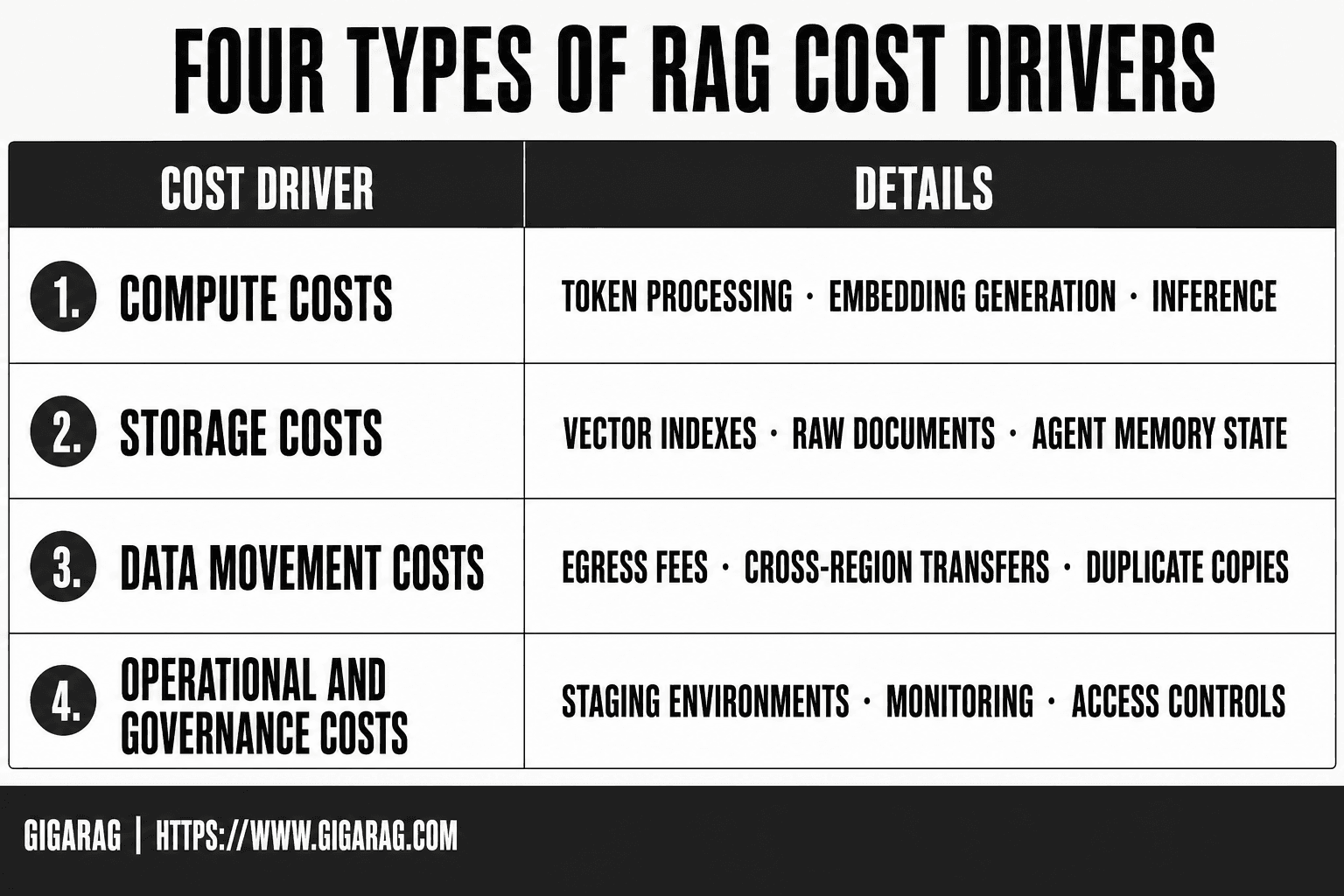
- The Four Types of Cost Drivers in a RAG System
- Cost Drivers In A Rag System: A Step-by-Step Guide
- LLM Inference and Token Costs
- Embedding and Re-Embedding Costs
- Vector Database and Storage Costs
- Hidden Cost Drivers in a RAG System
- Agent Memory and State Management Costs
- What You Cannot Do or Should Not Expect
- How to Estimate Your RAG System Costs
- Cost Driver Rates and Pricing Ranges
- Final Thoughts on Cost Drivers in a RAG System
What Is a Cost Driver in a RAG System?
A cost driver is any input or activity that changes how much you pay to run a RAG system. More queries, longer prompts, bigger indexes, more frequent re-embedding: each one moves the bill. The driver is the thing you can measure and, sometimes, control.
Cost driver vs. cost category
A cost category is a bucket: compute, storage, data movement. A cost driver is the specific activity that fills the bucket. Token count is a driver. Query volume is a driver. Content change frequency is a driver. Categories tell you where money goes. Drivers tell you why.
Why RAG cost drivers differ from traditional SaaS costs
Traditional SaaS bills scale with seats or requests. RAG bills scale with tokens, index size, and retrieval depth. You don't pay per user. You pay per word processed, per vector stored, per memory recall. That changes how you budget.
[!note] There is no single cost number for a RAG system; total cost depends on your architecture, traffic, model choice, and how much persistent memory your agents maintain. Any figure you see quoted is an example, not a universal benchmark.
Stateless RAG vs Agent Memory RAG: Cost Profile
| Factor | Stateless RAG | Agent Memory RAG |
|---|---|---|
| Token usage per query | Fixed: one retrieval + one generation | Variable: multiple reasoning steps and memory reads/writes |
| Storage growth | Vector index only | Vector index plus persistent memory store |
| Latency and compute | Predictable, single pass | Higher, multi-step with state management |
| Cost predictability | Easier to forecast | Harder; depends on agent behavior |
| Main cost risk | Embedding and index refresh | Runaway memory writes and context bloat |
The Four Types of Cost Drivers in a RAG System
Every RAG cost driver falls into one of four buckets. You'll see each one again in later sections, mapped to a specific line item.
Compute costs
Token processing, embedding generation, and inference. This is the bill you see first because it scales directly with usage.
Storage costs
Vector indexes, raw documents, and agent memory state. Storage grows with data volume, not query volume.
Data movement costs
Egress fees, cross-region transfers, and duplicate copies across systems. These show up late and surprise builders.
Operational and governance costs
Staging environments, monitoring, access controls, and the human time spent keeping agents from running wild. Hard to measure, impossible to ignore.
[!tip] For agent memory builders: cap memory write frequency and compress or summarize stored state before it enters the context window. Unbounded memory growth is one of the most common hidden cost drivers in production RAG systems.
Cost Drivers In A Rag System: A Step-by-Step Guide
- Instrument every pipeline stage to log token counts, embedding calls, and storage operations.
- Separate one-time costs (indexing, backfills) from recurring costs (inference, storage, memory).
- Measure cost per query and cost per active user under realistic load, not prototype traffic.
- Audit agent memory: how often state is written, read, and how large it grows over time.
- Set retrieval precision targets to avoid over-fetching context that inflates token costs.
- Add caching for repeated queries and stable context to cut redundant inference.
- Review costs monthly and re-forecast as usage patterns and memory size change.
LLM Inference and Token Costs
Token consumption is the most visible cost driver in a RAG system because every query, every retrieved chunk, and every generated answer passes through a model that charges per token. The bill scales directly with usage, so it's the first place builders notice cost creep.
Input vs. output token pricing
Input tokens are cheaper than output tokens at most providers. You pay for every retrieved chunk you stuff into the prompt, plus every word the model generates. A query that retrieves 10 chunks of 500 tokens each burns 5,000 input tokens before the model writes a single word.
Why agent memory increases token consumption
Agent memory systems amplify token usage through repeated context injection. Every turn in a conversation re-sends the accumulated memory, prior messages, and retrieved context. A 10-turn agent session doesn't cost 10x a single query. It costs far more, because turn 10 re-processes everything from turns 1 through 9.
Prompt and context bloat
Prompts grow quietly. System instructions, few-shot examples, tool definitions, and memory summaries all add tokens to every call. Most teams don't measure prompt size until a bill surprises them. Cut what you don't need, and measure tokens per query before scaling.
Embedding and Re-Embedding Costs
Embedding is not a one-time cost. Every time your content changes, you pay to re-embed it.
Initial embedding vs. ongoing re-embedding
The first pass converts your documents into vectors. That's a fixed cost you can estimate upfront: document count times tokens per document times the embedding model's per-token rate. The ongoing cost is harder to predict. Any update to a source document means re-embedding that document, deleting the old vectors, and inserting the new ones. For a corpus that changes daily, you'll re-embed a meaningful fraction of it every month.
Content change frequency as a cost multiplier
A static knowledge base costs almost nothing to maintain after the initial pass. A knowledge base that updates hourly costs roughly the same as re-embedding the entire corpus every few weeks. Agent memory makes this worse: every new memory, every consolidated summary, every state update triggers another embedding call. The churn is invisible until you audit your embedding API bill.
Embedding model choice and pricing
Cheaper models produce smaller vectors and cost less per token, but they retrieve worse. The tradeoff is real: a $0.02 per 1M token model may miss context that a $0.13 per 1M token model catches. Test retrieval quality before you optimize for price.
Vector Database and Storage Costs
Vector databases are always on. Unlike serverless functions that scale to zero, a hosted vector index runs continuously, and you pay for that uptime whether queries arrive or not.
Always-on index tax
The index itself consumes memory. For HNSW indexes, every vector sits in RAM for fast approximate nearest neighbor search. A million 1536-dimension vectors at 4 bytes per float needs roughly 6 GB of RAM just to hold the index. That's before any query load. You pay for that RAM every hour, even at 3 a.m. with zero traffic.
Storage vs. compute in vector databases
Storage is cheap. Compute is not. Most vector database pricing separates the two: you pay per GB for disk, but the real cost is the memory-resident index and the CPU cycles for each query. A 10 GB index might cost $50 per month in raw storage, but the instance running it costs $200 to $400 per month. Don't budget for storage alone.
Long-term memory storage for agents
Agent memory grows without bound. Every conversation, every retrieved context, every consolidated summary becomes a new vector. Without a retention policy, your index expands indefinitely and your always-on cost climbs with it. The fix is compaction: periodically merge and summarize old memories, then delete the raw vectors. That trades re-embedding cost for storage cost, which is usually the right trade.
Hidden Cost Drivers in a RAG System
The visible costs are tokens, embeddings, and the vector index. The ones that surprise you show up on the invoice after you've already shipped.
Data movement and egress fees
Cloud providers charge you to move data out. Every retrieval that pulls context from one region to another, every backup, every sync between your vector store and your app server adds egress. The rate looks small per GB. It isn't small at scale. Keep retrieval and storage in the same region, or you'll pay for the same bytes twice.
Duplicate storage across systems
You'll store the same document in three places: the source database, the vector index, and often a cache. Each copy has its own storage fee and its own sync problem. When the source changes, you re-embed and rewrite the vector. That's a hidden multiplier, not a one-time cost.
Governance and staging overhead
Staging environments aren't free. You'll run a full copy of the pipeline for testing, which doubles your infrastructure before you've served a single production query. Access controls, audit logs, and compliance checks add operational hours that never appear in a pricing calculator.
Ungoverned agent behavior
Agents that can call tools and retrieve freely will burn tokens in loops. A single agent stuck retrying a failed query can consume thousands of tokens before you notice. Without rate limits and budget caps, one misbehaving agent can outspend your entire production traffic for a day.
Agent Memory and State Management Costs
Most RAG cost guides stop at retrieval. They assume each query is stateless: embed, search, return, done. Agents don't work that way. An agent carries state across turns, remembers past interactions, and rebuilds context every time it runs. That persistence is a cost driver on its own, and it compounds with every other driver in this article.
Persistent state storage
An agent's memory isn't a cache you can clear. It's a growing store of conversation history, task results, and learned preferences. You pay for storage every month, whether the agent uses that memory or not. The longer an agent lives, the larger the store gets. There's no automatic cleanup unless you build one.
Memory retrieval and context assembly
Every turn, the agent retrieves relevant memory and assembles it into context before calling the LLM. That retrieval costs compute. The assembly costs tokens. If the agent pulls too much memory, you pay for tokens the model doesn't need. If it pulls too little, the agent fails and retries, which costs even more. The sweet spot is narrow and workload-specific.
Memory consolidation and summarization
Long-term memory doesn't stay raw. You'll summarize old conversations, merge duplicate facts, and compress context to keep token counts manageable. Each consolidation pass is an LLM call. Each summarization is an LLM call. You're paying to reduce future costs, which is worth it, but it's a recurring expense that generic RAG budgets never include.
What You Cannot Do or Should Not Expect
No guide can hand you a single cost number. Your workload, provider, region, and memory design all change the math. Anyone quoting a universal cost per query is guessing.
No universal cost per query
Cost per query depends on token counts, embedding dimensions, retrieval depth, and whether the agent hits memory. A simple FAQ lookup and a multi-turn agentic task are not the same price. You'll need to measure your own pipeline.
No zero-cost scaling path
Scaling always costs something. You can reduce token waste, cache embeddings, and consolidate memory. You cannot make infrastructure free. Expect to pay more as usage grows.
No single optimization that fixes everything
Token reduction helps. So does memory summarization. Neither eliminates storage, compute, or egress. You'll need several optimizations working together, and even then, costs don't disappear.
How to Estimate Your RAG System Costs
You can't get a precise number without measuring your own pipeline. But you can get close enough to budget. Start with a simple formula, then plug in real numbers as you collect them.
The core cost formula
Monthly cost = (queries per month × cost per query) + (documents indexed × embedding cost) + (storage × storage rate) + (egress × egress rate) + fixed infrastructure.
That's it. Five terms. Most builders get the first two right and miss the last three.
Variables to measure first
Measure queries per month, average tokens per query, documents indexed, and storage in GB. Don't guess. Pull these from logs before you estimate anything else.
Simple worked example
Say you run 100,000 queries a month at $0.002 per query. That's $200. Add 10,000 documents embedded at $0.0001 each: $1. Storage of 50 GB at $0.10 per GB: $5. Egress of 200 GB at $0.09 per GB: $18. Fixed hosting: $50. Total: $274 a month.
Your numbers will differ. The formula won't.
Cost Driver Rates and Pricing Ranges
There's no single pricing range for a RAG engine. Rates depend on the LLM provider, the embedding model, the vector database, and your region. Anyone quoting one number is guessing.
Typical token and embedding rates
LLM input tokens run from roughly $0.15 to $3 per million tokens, depending on the model. Output tokens cost 3 to 5 times more. Embedding models sit between $0.02 and $0.13 per million tokens for smaller models, with larger ones higher. These are list prices. Volume discounts change them.
Vector database pricing models
Managed vector databases charge one of three ways: per vector-hour, per GB stored, or per query. Some charge all three. Serverless options bill per request and per GB, which suits low or spiky traffic. Dedicated instances bill a flat monthly rate regardless of usage.
Why published rates mislead
Published rates assume clean, predictable workloads. Agent memory systems break that assumption. Repeated context injection, memory consolidation, and re-embedding multiply token and query counts in ways a pricing page never shows. Your real cost per query will be higher than the sticker math suggests.
Final Thoughts on Cost Drivers in a RAG System
The cost drivers in a RAG system come down to four things: tokens, embeddings, storage, and the hidden fees around data movement and governance. Agent memory makes all four worse because state persists and context gets reassembled on every turn.
There's no universal number and no single fix. You measure, you trim, you watch the bill.
GigaRAG helps agent memory and RAG pipeline builders track these costs before they scale into surprises. That's the honest pitch.
Frequently Asked Questions
What are the four types of cost drivers?
In a RAG system, the four broad categories are inference (LLM tokens), retrieval and embedding (vector search and embedding calls), storage (vector index and agent memory), and operational overhead (orchestration, monitoring, and engineering time). Each scales differently with traffic and memory size.
What is a cost driver in simple terms?
A cost driver is any factor that causes your costs to increase or decrease. In RAG, the main drivers are how many tokens you send to the model, how often you retrieve and embed, and how much persistent state your agents store.
What is the pricing range for the RAG Engine?
Pricing varies widely by provider and usage pattern, so no single range applies to every setup. Costs typically scale with token volume, embedding calls, and storage; check your provider's current pricing page and model your own usage rather than relying on generic estimates.
What are cost driver rates?
A cost driver rate is the cost per unit of activity, such as price per 1,000 tokens, per embedding call, or per GB of storage per month. Multiplying each rate by your expected volume gives a usage-based cost estimate.
Why do RAG costs surprise builders in production?
Prototypes run at low volume with small indexes and no persistent memory. In production, traffic grows, indexes expand, and agent memory accumulates, so token usage, storage, and retrieval calls all rise together, often faster than expected.
How does agent memory affect RAG costs?
Agent memory adds storage costs for persisted state and inference costs each time that state is read into the context window. Frequent writes and large memory stores can become a significant, ongoing cost driver that stateless RAG pipelines do not have.
Can you reduce RAG costs without hurting quality?
Often yes, to a degree: improve retrieval precision so you send less context, cache stable results, and summarize or prune agent memory. There are limits, though; aggressive cuts to retrieval or context can degrade answer quality, so measure both cost and quality together.
About GigaRAG
GigaRAG is for agent memory and RAG pipeline builders. get this right. Whether you are working through cost drivers in a rag system, explained or something adjacent, we publish what we have actually tested, including where it falls short.