Ragas and Eval Frameworks Compared: A Practical Guide for Agent Memory and RAG Pipeline Builders
Ragas and eval frameworks compared for agent memory and RAG pipeline builders is a topic drowning in shallow takes. Most write-ups list the same four metrics, paste the same hello-world snippet, and skip the part you actually care about: whether any of these tools can tell you if your agent remembers the right thing at the right time. They can't, mostly. Not yet, not fully. If you build agent memory systems or RAG pipelines, you already suspect this. GigaRAG builds both, so we hit the same wall. The honest answer is that no framework on the market handles agent memory evaluation end to end. Some get closer than others. This guide covers four frameworks: Ragas, DeepEval, TruLens, and ARES. You'll get a code example for each, a feature-by-feature breakdown, a section on when automated evaluation actively misleads you, and a decision framework that maps your use case to the right tool.
| At a glance | Details |
|---|---|
| Frameworks compared | Ragas, DeepEval, TruLens, ARES |
| Best for agent memory | DeepEval and TruLens |
| Best for RAG pipelines | Ragas |
| Evaluation approach | LLM-as-judge vs synthetic data |
| Key limitation | No native agent memory support |
| Decision factor | Workflow fit over feature count |
In This Guide
- What Are RAG Evaluation Frameworks?
- Ragas vs DeepEval: Which Fits Agent Memory and RAG Pipelines?
- Ragas: Strengths, Weaknesses, and Agent Memory Fit
- Ragas And Eval Frameworks Compared: A Step-by-Step Guide
- DeepEval: Strengths, Weaknesses, and Pipeline Builder Fit
- TruLens and ARES: The Production Monitoring and Academic Options
- Ragas and Eval Frameworks Compared: Feature-by-Feature Breakdown
- Building Evaluation Datasets for Agent Memory
- When NOT to Use Automated RAG Evaluation
- How to Choose: A Decision Framework for Agent Memory and Pipeline Builders
- Key Takeaways
What Are RAG Evaluation Frameworks?
RAG evaluation frameworks are software libraries that score how well a retrieval-augmented generation pipeline retrieves relevant context and generates accurate answers. They turn "does this work?" into numbers you can track across code changes.
Why RAG evaluation matters for production
A RAG pipeline can fail in two places: it pulls the wrong documents, or it writes a bad answer from good documents. Frameworks measure both. Without them, you're eyeballing outputs and hoping. With them, you catch regressions before users do.
The core quality dimensions: retrieval vs generation
Retrieval metrics ask: did we get the right context? Generation metrics ask: did the answer match that context? Faithfulness, relevancy, precision, recall. Each framework weights these differently. That's the whole comparison.
[!note] Ragas and DeepEval are not mutually exclusive; some teams use Ragas for retrieval evaluation and DeepEval for agent behavior, combining results in a custom dashboard.
Ragas vs DeepEval: Which Fits Agent Memory and RAG Pipelines?
| Factor | Ragas | DeepEval |
|---|---|---|
| Primary focus | RAG pipeline evaluation | LLM and agent evaluation |
| Agent memory support | Limited, via custom metrics | Better, with stateful test cases |
| Ease of integration | High for RAG, low for agents | Moderate for both |
| Metric customization | Extensible but RAG-centric | Highly extensible for agents |
| Community and docs | Strong RAG community | Growing, agent-focused |
Ragas: Strengths, Weaknesses, and Agent Memory Fit
Ragas is the most widely adopted RAG evaluation framework. It scores pipelines on four core metrics: faithfulness, answer relevancy, context precision, and context recall. Faithfulness checks whether the answer is grounded in retrieved context. Answer relevancy checks whether the answer addresses the question. Context precision and recall check retrieval quality.
Core Ragas metrics explained
Faithfulness is the metric that catches hallucination. It breaks the answer into claims, then checks each claim against the retrieved context. Any claim not supported by context lowers the score. Context precision measures whether retrieved documents are relevant, and context recall measures whether all relevant documents were retrieved.
How Ragas handles agent memory (or doesn't)
Ragas does not evaluate agent memory. It evaluates single-turn RAG pipelines. If your agent retrieves from a memory store across multiple turns, Ragas has no built-in metric for memory retention, relevance, or staleness. You can hack around this by treating each turn as a separate RAG evaluation, but that misses cross-turn context and memory decay.
Code example: basic Ragas evaluation setup
from ragas import evaluate
from ragas.metrics import faithfulness, answer_relevancy

result = evaluate(
    dataset,
    metrics=[faithfulness, answer_relevancy]
)
This gives you a score per metric. It won't tell you if your agent remembered something from three turns ago.
[!tip] For agent memory, start by instrumenting your memory retrieval calls to log context and responses; then use DeepEval's custom metrics to assert on memory recall, rather than relying on generic RAG metrics.
Ragas And Eval Frameworks Compared: A Step-by-Step Guide
- Define your evaluation goals: what aspects of agent memory (recall, precision, relevance) matter most?
- List your pipeline components: retrieval, memory storage, generation, and how they interact.
- Map framework capabilities to your needs: check if the framework supports stateful evaluation and custom metrics.
- Prototype with a small dataset: implement a basic eval loop for your top two framework choices.
- Measure integration effort: time to set up, maintain, and extend for your specific agent memory use case.
- Decide based on workflow fit: choose the framework that minimizes friction for your team's daily workflow.
DeepEval: Strengths, Weaknesses, and Pipeline Builder Fit
DeepEval is the CI/CD-friendly option. It's built by Confident AI and positions itself as a testing framework for LLM outputs, not just a metrics library. You write test cases, run them in pytest, and gate deploys on the results.
Core DeepEval metrics explained
DeepEval covers the standard RAG metrics: faithfulness, answer relevancy, contextual precision, and contextual recall. It adds hallucination detection and bias checks. The metric library is broader than Ragas, but the real difference is how you run it.
CI/CD integration for pipeline builders
DeepEval runs as pytest tests. That's the main catch for pipeline builders: if your team already uses pytest for unit tests, DeepEval slots in without new infrastructure. You can fail a build when faithfulness drops below a threshold. Ragas doesn't offer this natively.
Code example: basic DeepEval evaluation setup
from deepeval import evaluate
from deepeval.metrics import FaithfulnessMetric

metric = FaithfulnessMetric(threshold=0.7)
evaluate(test_cases, [metric])
The threshold is the key difference. You set a pass/fail line, and CI enforces it. For agent memory, DeepEval still doesn't evaluate cross-turn retention out of the box. You'd need custom metrics for that.
TruLens and ARES: The Production Monitoring and Academic Options
TruLens and ARES sit at opposite ends of the evaluation spectrum. TruLens is for production monitoring. ARES is for academic-grade benchmarking. Most comparisons skip ARES entirely, which leaves a gap if you need defensible, reproducible numbers.
TruLens: production monitoring and feedback loops
TruLens, built by TruEra, tracks RAG app quality after deployment. It instruments your pipeline and records feedback functions: groundedness, context relevance, answer relevance. You can log user feedback alongside automated scores. That feedback loop is the point. Ragas and DeepEval evaluate test sets. TruLens watches live traffic.
The main catch: TruLens doesn't evaluate agent memory out of the box. You'd write custom feedback functions for cross-turn retention.
ARES: academic rigor and RAG-specific benchmarks
ARES comes from Stanford. It uses a judge LLM trained on synthetic data, then validates against a small human-labeled set. The result: scores that correlate better with human judgment than naive LLM-as-judge. It's slower and heavier to set up. Not a production tool. But if you're publishing results or need defensible numbers, ARES is the option.
Code example: TruLens setup for monitoring
from trulens_eval import Tru, Feedback
from trulens_eval.feedback import Groundedness

tru = Tru()
grounded = Feedback(Groundedness()).on_input_output()
tru.run_dashboard()
You attach feedback functions to your app, then watch the dashboard. For agent memory, you'd add a custom feedback function that scores whether the agent remembered context from earlier turns. That's manual work. TruLens won't do it for you.
Ragas and Eval Frameworks Compared: Feature-by-Feature Breakdown
The four frameworks split cleanly on two axes: what they measure and where they run. Ragas and DeepEval cover retrieval and generation metrics. TruLens adds live monitoring. ARES adds statistical validation.
Comparison table: metrics, ease of use, agent memory support
| Framework | Core metrics | Ease of use | Agent memory | CI/CD |
|---|---|---|---|---|
| Ragas | Faithfulness, answer relevancy, context precision/recall | Moderate | No native support | Manual |
| DeepEval | 14+ metrics, G-Eval | High | Custom metrics only | Built-in |
| TruLens | Groundedness, context relevance | Moderate | Custom feedback functions | Partial |
| ARES | RAG-specific, statistically validated | Low | None | None |
Agent memory evaluation: which frameworks actually support it
None of the four ship native agent memory evaluation. You build it yourself. DeepEval makes this easiest: custom metrics are first-class. TruLens lets you write feedback functions for cross-turn retention. Ragas and ARES don't support it without significant work.
Pipeline builder workflow fit: CI/CD, datasets, monitoring
DeepEval wins for CI/CD. It has pytest integration and a built-in test runner. TruLens wins for monitoring. Ragas fits dataset-driven evaluation but needs glue code for pipelines. ARES doesn't fit production workflows at all.
The honest answer: if agent memory is your focus, expect to write custom evaluation logic regardless of framework.
Building Evaluation Datasets for Agent Memory
Most RAG eval datasets test single-turn retrieval. Agent memory breaks that assumption. You need datasets where the answer depends on what happened three turns ago.
Synthetic data generation for agent memory tests
Generate conversation transcripts, not question-answer pairs. Each transcript needs a fact introduced early, a distractor turn in the middle, and a question at the end that only works if the agent retained the fact. Use a second LLM to write these. Vary the gap between fact and question from one turn to twenty.
Golden datasets: what to include for memory evaluation
A golden dataset needs three things: the conversation, the expected memory state after each turn, and the correct final answer. The expected memory state is the part most teams skip. Without it, you can't tell whether the agent retrieved the right memory or guessed.
Code example: generating a small evaluation dataset
import json

def generate_memory_case(fact, distractor, question, answer, gap_turns):
    turns = [{"role": "user", "content": fact}]
    for _ in range(gap_turns):
        turns.append({"role": "user", "content": distractor})
    turns.append({"role": "user", "content": question})
    return {
        "conversation": turns,
        "expected_memory": [fact],
        "expected_answer": answer,
        "gap_turns": gap_turns
    }

dataset = [
    generate_memory_case(
        fact="My dog's name is Biscuit",
        distractor="What's the weather like?",
        question="What's my dog's name?",
        answer="Biscuit",
        gap_turns=5
    )
]

with open("memory_eval.json", "w") as f:
    json.dump(dataset, f, indent=2)
Start with twenty cases. Run them manually before scaling to hundreds.
When NOT to Use Automated RAG Evaluation
Automated metrics score what they can measure. They can't measure whether an answer was actually useful.
Scenarios where automated metrics mislead
Faithfulness scores reward answers that stick to retrieved context. A correct answer that retrieves nothing scores zero, even if the model knew it. Context recall rewards retrieval overlap, not retrieval quality. You'll pass metrics while shipping wrong answers.
Agent memory evaluation: current limitations
No framework scores memory retention directly. You can test whether a fact survives twenty turns, but not whether the agent retrieved the right memory at the right time. Memory relevance scoring is still a research problem.
When human evaluation is non-negotiable
Use humans when the cost of a wrong answer is high: medical, legal, financial. Use humans when you're tuning prompts, not regression testing. One hour of human review catches what a hundred automated runs miss.
How to Choose: A Decision Framework for Agent Memory and Pipeline Builders
Most teams don't need a framework. They need one question answered: what are you actually testing?
Decision criteria: agent memory, CI/CD, monitoring, cost
Four criteria matter. Agent memory support: can the framework evaluate multi-turn recall, or only single-shot retrieval? CI/CD fit: does it run in a pipeline without a human in the loop? Monitoring: does it track drift in production, or only score offline datasets? Cost: LLM-as-judge metrics burn tokens per evaluation run.
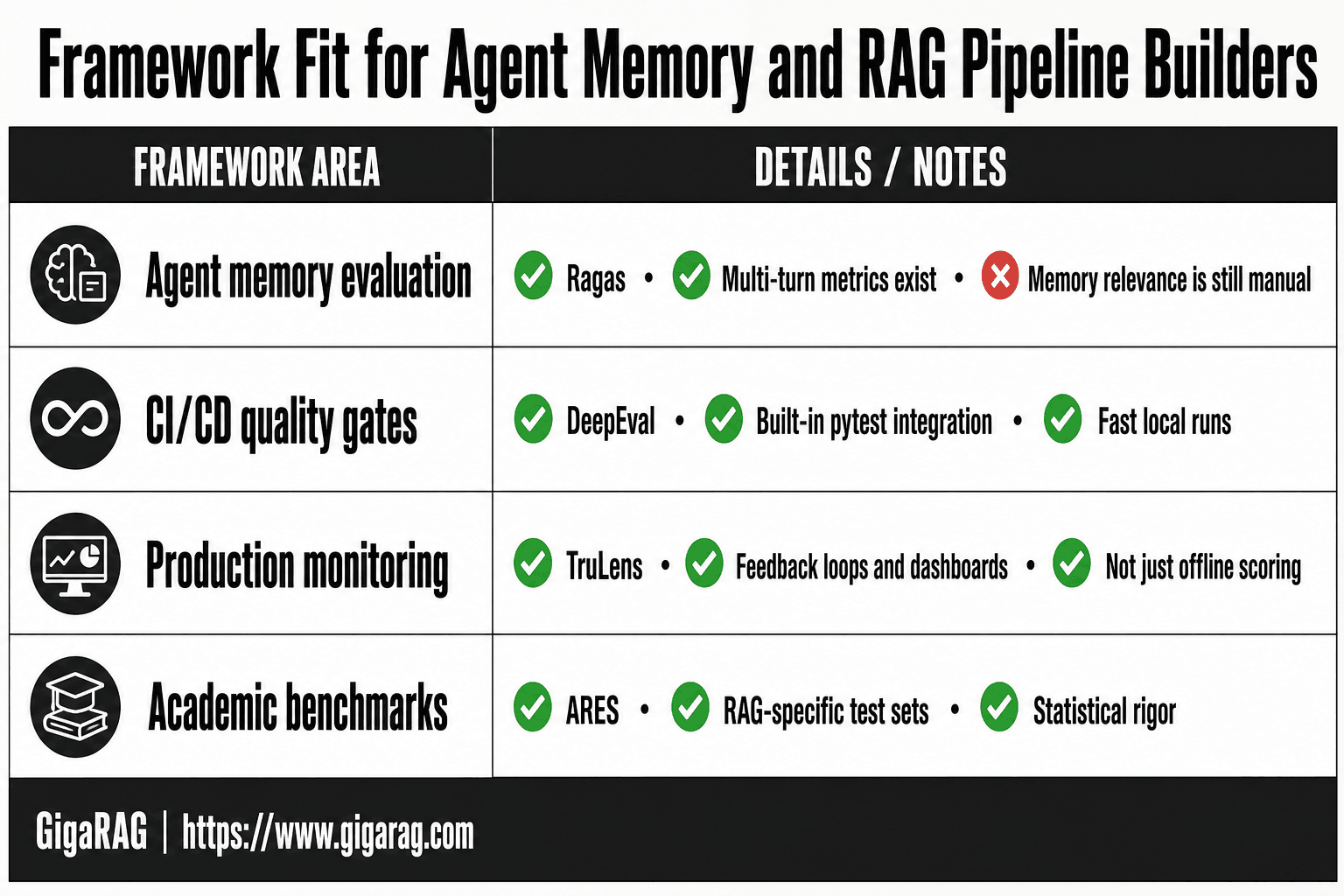
Scoring matrix: which framework wins for which use case
| Use case | Winner | Why |
|---|---|---|
| Agent memory evaluation | Ragas | Multi-turn metrics exist, though memory relevance is still manual |
| CI/CD quality gates | DeepEval | Built-in pytest integration, fast local runs |
| Production monitoring | TruLens | Feedback loops and dashboards, not just offline scoring |
| Academic benchmarks | ARES | RAG-specific test sets, statistical rigor |
Recommended starting point for most readers
Start with DeepEval if you're shipping pipelines. It's the fastest to wire into CI/CD, and its metric library covers the basics. Add Ragas when agent memory becomes a real requirement. Skip ARES unless you're publishing results. TruLens earns its place only when you need production drift alerts, not before.
Key Takeaways
Ragas and eval frameworks compared side by side: the choice comes down to what you're testing, not which tool has the most stars on GitHub.
- Ragas wins for agent memory scenarios. Its multi-turn metrics exist, but memory relevance scoring is still manual work.
- DeepEval is the fastest path to CI/CD quality gates. Pytest-native, runs locally, covers the basics without ceremony.
- TruLens earns its keep only when you need production drift alerts and feedback loops.
- ARES is for publishing results, not shipping pipelines.
The honest catch: automated evaluation doesn't replace human judgment. It catches regressions. It doesn't catch subtle memory failures.
GigaRAG's agent memory and RAG pipeline tooling benefits directly from this approach. Wire DeepEval into your CI/CD early, add Ragas when multi-turn recall becomes a requirement, and keep a human in the loop for anything that touches memory.
Frequently Asked Questions
What is the difference between Ragas and DeepEval?
Ragas focuses on evaluating RAG pipelines with metrics like faithfulness and answer relevance, while DeepEval is a broader LLM evaluation framework that supports agent workflows and custom metrics. Ragas is more specialized for retrieval-augmented generation, whereas DeepEval offers more flexibility for agent memory scenarios.
Can Ragas evaluate agent memory?
Ragas does not natively support agent memory evaluation, but you can extend it with custom metrics that check memory recall or precision. However, this requires significant custom code and may not integrate smoothly with stateful agent loops.
Which eval framework is best for RAG pipelines?
Ragas is often the best choice for pure RAG pipelines due to its out-of-the-box metrics tailored to retrieval and generation quality. It has a strong community and documentation focused on RAG use cases.
Is DeepEval suitable for production?
Yes, DeepEval is designed for production use with features like dataset management, CI/CD integration, and support for custom metrics. It is particularly useful for agent memory because it can handle stateful evaluations.
How do I choose between Ragas and DeepEval?
Choose Ragas if your primary need is RAG pipeline evaluation and you want minimal setup. Choose DeepEval if you need to evaluate agent memory, require custom metrics, or want a more general LLM evaluation framework. Prototyping with both on a small dataset can help you decide based on integration effort and workflow fit.
What are the limitations of Ragas?
Ragas lacks native support for agent memory and stateful evaluation, so you cannot directly measure memory recall or precision without custom extensions. It also assumes a standard RAG architecture, which may not fit complex agent workflows.
Can I use multiple eval frameworks together?
Yes, many teams combine Ragas for retrieval evaluation and DeepEval for agent behavior, aggregating results in a custom dashboard. This allows leveraging the strengths of each framework, though it adds integration overhead.
About GigaRAG
GigaRAG is for agent memory and RAG pipeline builders. get this right. Whether you are working through ragas and eval frameworks compared or something adjacent, we publish what we have actually tested, including where it falls short.


