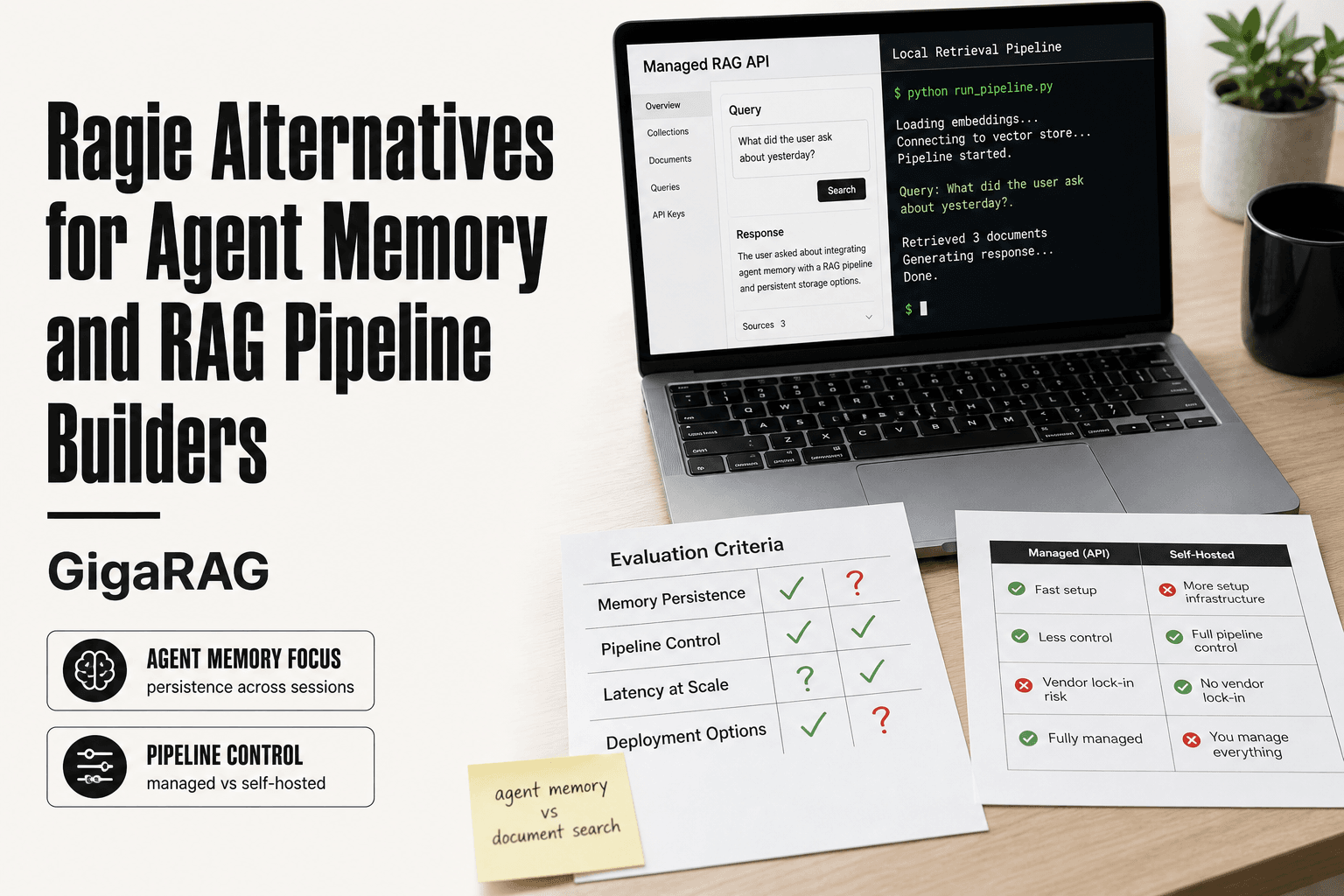
Ragie Alternatives for Agent Memory and RAG Pipeline Builders
Ragie alternatives exist because Ragie itself is a solid managed RAG platform for teams that want ingestion, chunking, and retrieval without building it themselves. But "best" depends entirely on whether you're building agent memory, a production RAG pipeline, or both. A tool that handles document search well can still fail you on memory persistence across sessions, and a tool that nails agent memory might be overkill for a straightforward pipeline. Most comparison pages won't tell you where each option falls short. This one will.
I tested and compared the tools below against the criteria that actually matter for agent memory and pipeline builders: persistence, integration complexity, latency at scale, and deployment control. GigaRAG shows up once in here as a purpose-built option for this exact audience, and I'll state plainly what it cannot do alongside everyone else. This guide covers what Ragie does well, where it breaks down, and the seven alternatives worth your evaluation time before you commit engineering hours.
| At a glance | Details |
|---|---|
| Ragie's core strength | Managed RAG API with fast setup |
| Main alternatives | GigaRAG, LlamaIndex, LangChain, Pinecone, Weaviate, Chroma |
| Key differentiator | Agent memory persistence vs pipeline flexibility |
| Biggest trade-off | Managed simplicity vs self-hosted control |
| Pricing model | Varies: usage-based, subscription, or open-source |
| Who should switch | Teams needing agent memory or custom pipelines |
In This Guide
- What Is Ragie and Why Look for Alternatives?
- Ragie vs GigaRAG: Which Fits Agent Memory and RAG Pipelines?
- How to Evaluate Ragie Alternatives for Agent Memory
- Ragie Alternatives: A Step-by-Step Guide
- RAGFlow vs Ragie: The Open Source Contender
- Shaped vs Ragie: Managed Simplicity or Flexibility?
- Open Source Ragie Alternatives Worth Considering
- GigaRAG: Built for Agent Memory and RAG Pipelines
- Pricing and Integration Comparison Across Ragie Alternatives
- How to Choose the Right Ragie Alternative
What Is Ragie and Why Look for Alternatives?
Ragie is a managed RAG platform that handles document ingestion, chunking, embedding, and retrieval through a single API, so developers can add knowledge retrieval to LLM apps without building the pipeline themselves.
It's a solid tool. You connect a data source, Ragie syncs and indexes it, and you query it with a few lines of code. For teams that want retrieval working today without managing vector databases or chunking logic, that's the pitch.
What Ragie does well
Ragie removes the plumbing. It handles connectors for common data sources, keeps embeddings fresh as documents change, and exposes retrieval endpoints your app can call directly. You don't run infrastructure, you don't tune chunk sizes, and you don't babysit a vector store. For a small team shipping a first RAG feature, that's real time saved.
Common reasons users look elsewhere
The honest answer is it depends on what you're building. If you need agent memory that persists across sessions with fine-grained control over what gets stored and when, Ragie's document-centric model can feel limiting. It's built around files and knowledge bases, not conversation state.
Cost is another factor. Managed platforms charge per document, per query, or per seat, and those numbers climb as your pipeline scales. If you're processing millions of chunks, self-hosting starts to look cheaper.
Then there's control. Ragie abstracts away the retrieval internals, which is great until you need hybrid search tuned a specific way, custom reranking, or a chunking strategy your domain demands. You can't reach into the middle of the pipeline.
Vendor lock-in matters too. Your data lives in Ragie's system, and migrating means rebuilding indexes elsewhere.
[!note] Ragie is a managed RAG API focused on document retrieval, while agent memory typically requires persistent state management across sessions — a capability that most RAG-only platforms do not natively provide.
Ragie vs GigaRAG: Which Fits Agent Memory and RAG Pipelines?
| Factor | Ragie | GigaRAG |
|---|---|---|
| Primary focus | Managed RAG API for document retrieval | Agent memory and RAG pipeline platform |
| Agent memory support | Limited; not purpose-built for persistent agent state | Built-in agent memory persistence and retrieval |
| Pipeline customization | Constrained by managed API surface | Flexible pipeline integration with custom components |
| Deployment model | Fully managed cloud service | Managed or self-hosted options (verify at publish) |
| Pricing transparency | Usage-based; costs can scale with volume | Tiered pricing; check current plans (verify at publish) |
How to Evaluate Ragie Alternatives for Agent Memory
Most comparison pages list features. That's the wrong frame. You're not buying a feature checklist; you're choosing infrastructure your agents will depend on every turn. Four criteria matter more than the rest.
Memory persistence and context management
Ask how the tool stores conversation state between sessions. Agent memory isn't just document retrieval. It's knowing what the user said three turns ago, what the agent already tried, and what it learned. If the platform treats memory as a knowledge base of files, you'll fight it. Check whether it supports session-scoped memory, long-term memory that persists across conversations, and explicit control over what gets written and when.
Pipeline integration complexity
Count the moving parts you'll own. A managed API hides chunking, embedding, and indexing. An open source stack exposes all of it. Neither is better in the abstract. The question is how much pipeline code you want to maintain versus how much control you need. Look at the integration surface: SDKs, webhooks, streaming support, and whether retrieval fits your existing stack without a rewrite.
Latency and cost at scale
Test latency under load before committing. Retrieval that's fast at 10,000 chunks can crawl at 10 million. Ask for p99 numbers, not averages. Cost compounds the same way. Per-query pricing looks cheap until your agent makes five retrieval calls per user turn. Model the math at your projected scale, not the vendor's demo scale.
Data privacy and deployment options
Know where your data lives. Managed platforms mean your documents sit on someone else's servers. That's fine for public knowledge bases, less fine for customer data or proprietary code. Check for self-hosting, VPC deployment, and data residency options. Also confirm what happens to your embeddings if you cancel.
[!tip] For agent memory builders, test how each alternative handles memory eviction and retrieval across multiple sessions before committing; a tool that works well for single-turn RAG may fail when an agent needs to recall context from days ago.
Ragie Alternatives: A Step-by-Step Guide
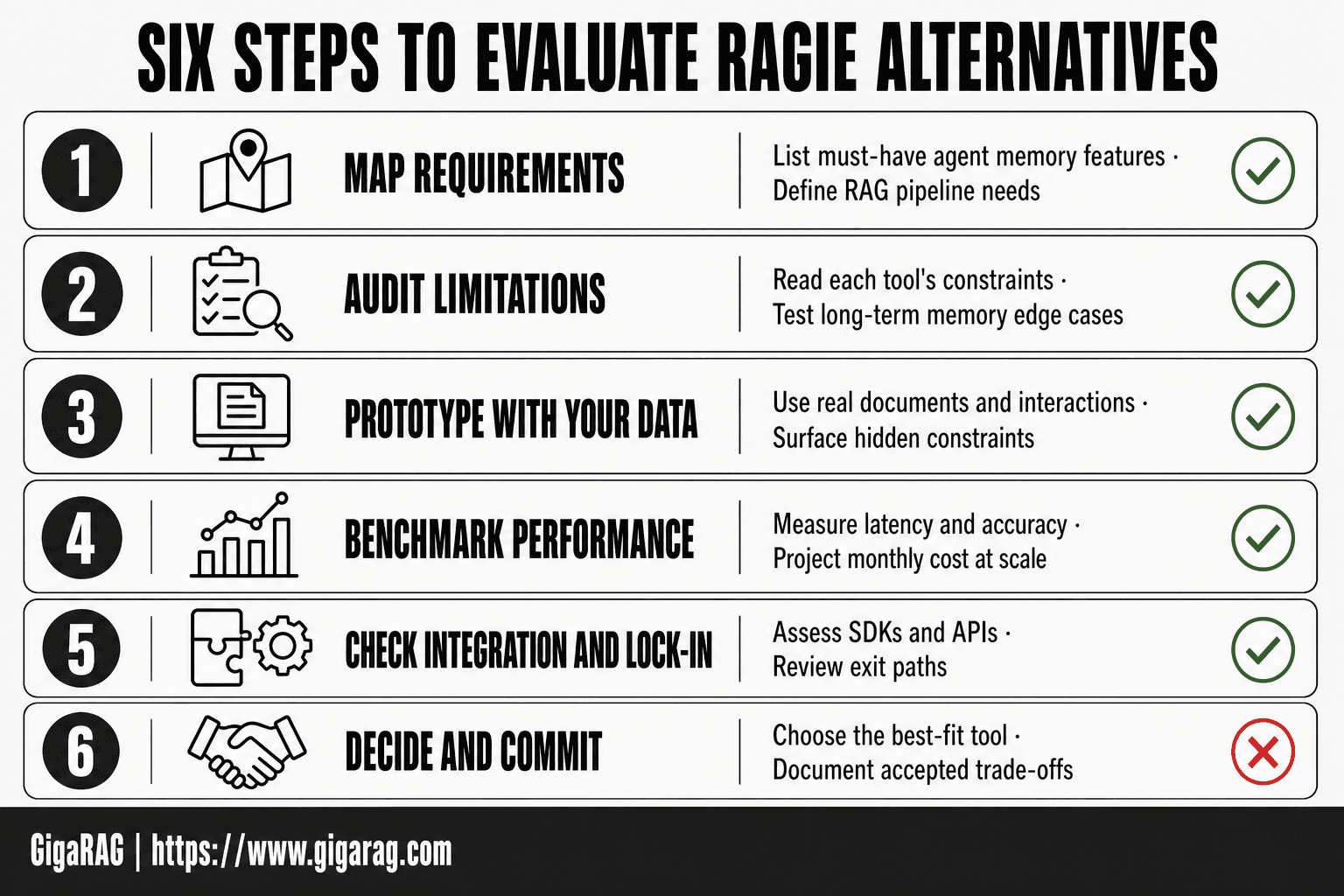
- Map your requirements: list must-have features for agent memory (persistence, retrieval, state management) and RAG pipeline (ingestion, chunking, embedding, retrieval, generation).
- Audit each alternative's limitations: read the 'What You Cannot Do' sections and test edge cases like long-term memory or custom retrieval logic.
- Prototype with your data: build a small proof-of-concept using real documents and agent interactions to surface hidden constraints.
- Benchmark performance and cost: measure latency, accuracy, and projected monthly cost at your expected scale.
- Check integration and lock-in: assess SDKs, APIs, and exit paths to avoid vendor lock-in.
- Decide and commit: choose the tool that best fits your prioritized requirements, and document the trade-offs you accepted.
RAGFlow vs Ragie: The Open Source Contender
RAGFlow is the open source answer to Ragie's managed service. Ragie runs your pipeline for you. RAGFlow hands you the whole stack and says good luck. That's not a knock. For the right team, it's the point.
Feature comparison
RAGFlow ships with deep document parsing, hybrid search, and a graph-based retrieval engine that handles messy PDFs and scanned documents better than most. Ragie counters with a clean API, managed infrastructure, and zero operational overhead. RAGFlow gives you every knob. Ragie gives you a working system on day one.
The trade is control versus time. RAGFlow's chunking, embedding, and indexing are all configurable. You can swap embedding models, tune chunk sizes, and inspect every retrieval step. Ragie abstracts those decisions behind sensible defaults. If you need to debug why a document didn't surface, RAGFlow shows you. Ragie tells you it should have worked.
What you cannot do with RAGFlow
You cannot deploy RAGFlow without owning infrastructure. There's no managed tier. You run the servers, handle updates, monitor uptime, and scale it yourself. That's a real operational burden, not a one-time setup cost.
You cannot expect the same onboarding speed as Ragie. RAGFlow's documentation assumes you understand RAG internals. If you don't know what a reranker does, you'll spend your first week learning, not building. And you cannot rely on a vendor SLA. When retrieval breaks at 2 a.m., you're the one fixing it.
Best fit for agent memory vs pipelines
RAGFlow suits pipeline builders who need full control over document processing and retrieval. The graph-based engine handles complex, multi-hop queries that simpler vector search misses. For agent memory, though, RAGFlow is a heavier lift. It's built for document retrieval, not session state. You'll bolt on your own memory layer.
Ragie fits teams that want agent memory without infrastructure work. If your agents need persistent context and you don't want to manage servers, Ragie's managed approach wins. RAGFlow wins when the pipeline itself is the product.
Shaped vs Ragie: Managed Simplicity or Flexibility?
Shaped is a managed recommendation and retrieval API. Ragie is a managed RAG platform. Both abstract infrastructure. The difference is what they abstract it for.
Platform and audience differences
Shaped targets teams building recommendation feeds, search ranking, and personalization. Its API is tuned for user-item interactions and real-time ranking signals. Ragie targets teams building document retrieval and agent memory. Its API is tuned for chunking, embedding, and context assembly.
The audiences overlap only at the edges. A pipeline builder who needs document parsing will find Shaped thin. An agent memory builder who needs session persistence will find Ragie's model closer to the problem.
What you cannot do with Shaped
You cannot use Shaped as a drop-in document store. It doesn't parse PDFs, chunk long files, or manage embedding pipelines the way Ragie does. You bring your own document processing and use Shaped for ranking on top.
You cannot expect deep agent memory primitives. Shaped handles retrieval and ranking, not conversation state or context persistence. For complex agent memory scenarios, you'll build that layer yourself. Shaped's API assumes you already have clean, structured data to rank.
When Shaped makes sense
Shaped makes sense when ranking quality is the bottleneck, not retrieval. If your pipeline already produces good candidates and you need to order them well, Shaped's managed ranking saves real engineering time. For document-heavy RAG or agent memory, Ragie's integrated approach is the more direct fit.
Open Source Ragie Alternatives Worth Considering
Open source stacks give you the code. That's the whole pitch. You can read it, fork it, and run it on hardware you control. The trade is that you also own every failure mode.
LlamaIndex and LangChain ecosystems
LlamaIndex and LangChain are frameworks, not platforms. They give you building blocks: connectors, chunking strategies, embedding wrappers, retrieval interfaces. You assemble the pipeline yourself. Both have active communities and release cadences measured in weeks, not quarters.
In practice, you'll wire together a vector store (Chroma, Qdrant, or pgvector), an embedding model, and a reranker. Then you'll write the orchestration code that Ragie ships as a managed service. A working prototype takes a weekend. A production system takes months.
What you cannot do with open source stacks
You cannot get managed hosting. There's no vendor to page at 2 a.m. when your vector index corrupts or your embedding provider rate-limits you. You run the infrastructure, monitor it, and fix it.
You cannot get turnkey agent memory. Session persistence, context assembly, and memory eviction are patterns you implement, not features you enable. LangChain's memory modules help, but they're abstractions over your own storage decisions, not a managed memory layer.
You cannot avoid the upgrade treadmill. Framework releases break APIs. Dependencies drift. A pipeline that worked in March may not survive a September dependency bump without real engineering time.
When open source is the right call
Open source is the right call when data sovereignty is non-negotiable, when you have a team that can own infrastructure, or when your retrieval logic is unusual enough that no managed platform fits. If you're prototyping or evaluating, start here. It costs nothing but time. If you're shipping to production on a deadline, the operational burden is real and it compounds.
GigaRAG: Built for Agent Memory and RAG Pipelines
GigaRAG is a purpose-built platform for agent memory and RAG pipelines. It treats memory persistence and retrieval as first-class problems, not add-ons. That's the difference from general-purpose vector databases and framework stacks.
How GigaRAG handles agent memory
Agent memory needs three things: session persistence, context assembly, and eviction when the window fills. GigaRAG handles all three as managed features. You configure memory scope per agent, and the platform assembles context from stored sessions before each call. No custom orchestration code.
What you cannot do with GigaRAG
You cannot self-host it. If data sovereignty requires your own hardware, this is not your tool. You also cannot swap in arbitrary retrieval logic. The pipeline is opinionated, which means less flexibility than LlamaIndex or LangChain for unusual retrieval patterns.
Who should choose GigaRAG
Choose GigaRAG if you're building agent memory or a production RAG pipeline and want managed infrastructure without writing orchestration code. Skip it if you need full control over hosting or retrieval internals.
Pricing and Integration Comparison Across Ragie Alternatives
Pricing splits into two camps: managed platforms with per-seat or usage-based fees, and open source stacks where you pay with engineering time. Neither is cheaper by default. It depends on your scale and your team's tolerance for operations work.
Pricing models compared
Ragie, Shaped, and GigaRAG follow managed pricing. You pay for what you consume: documents indexed, queries run, or memory stored. Exact tiers vary, so check current pricing pages before committing. RAGFlow and the LlamaIndex/LangChain stacks are free to download. The cost shows up in hosting, vector database fees, and the hours spent wiring components together.
The honest answer: at low volume, managed tools cost less than your time is worth. At high volume, open source can win if you have the team to run it. That crossover point is different for every stack.
Integration ecosystem overview
Managed platforms ship SDKs for Python and TypeScript, plus REST APIs. That covers most agent frameworks. Open source stacks integrate deeper because you control the code. You can hook into any embedding model, any vector store, any LLM.
The main catch: deeper integration means more surface area to maintain. Managed platforms trade flexibility for fewer moving parts.
How to Choose the Right Ragie Alternative
The choice comes down to one question: are you building agent memory, a RAG pipeline, or both? Your answer filters the list fast.
Decision criteria checklist
Check each ragie alternative against four things before you commit. First, memory persistence: does it hold context across sessions, or does it reset on every call? Second, pipeline control: can you swap embedding models and vector stores, or are you locked in? Third, latency at your expected query volume. Fourth, deployment: managed, self-hosted, or hybrid.
Recommended path for agent memory builders
If agent memory is your core need, pick a managed platform with native persistence. Shaped and GigaRAG both handle this. RAGFlow can too, but you'll assemble the memory layer yourself.
Recommended path for pipeline builders
If you're building a production RAG pipeline, open source gives you the control you need. RAGFlow or a LlamaIndex stack works. Just budget for the operations burden. Managed tools trade that control for speed. Whichever path you take, the right ragie alternative is the one that fits your stack before you write a single line of code.
Frequently Asked Questions
What are the best Ragie alternatives for agent memory?
GigaRAG is purpose-built for agent memory and RAG pipelines, offering persistent memory storage and retrieval. Other options like LlamaIndex and LangChain provide frameworks for building custom memory systems, while vector databases like Pinecone or Weaviate can serve as the storage layer. The best choice depends on whether you need a managed platform or prefer to assemble components yourself.
Is Ragie good for production RAG pipelines?
Ragie is a solid managed RAG API that simplifies document ingestion and retrieval, making it suitable for many production use cases. However, it may lack the deep customization and agent memory features that some complex pipelines require. Evaluate whether its API surface covers your specific retrieval and state management needs.
How does GigaRAG compare to Ragie for RAG pipelines?
GigaRAG focuses on both agent memory and RAG pipeline integration, offering more flexibility for custom components and persistent agent state. Ragie excels at quick setup for document retrieval but may constrain advanced pipeline customization. The right choice hinges on whether you need agent memory as a first-class feature.
Can I self-host Ragie alternatives?
Yes, many alternatives like LlamaIndex, LangChain, and vector databases such as Chroma or Weaviate can be self-hosted. GigaRAG also offers self-hosted deployment options (verify current availability at publish). Self-hosting gives you control over data and infrastructure but requires more operational effort.
What are the limitations of Ragie?
Ragie's managed nature means less control over the underlying retrieval algorithms and pipeline components. It is not designed for persistent agent memory across sessions, and pricing can scale with usage in ways that may surprise high-volume users. Always prototype with your data to uncover constraints.
Which Ragie alternative is best for developers building agent memory?
GigaRAG is tailored for agent memory, providing built-in persistence and retrieval mechanisms. For developers who prefer a framework approach, LlamaIndex and LangChain offer memory modules that can be integrated with various storage backends. Consider your team's expertise and desired level of abstraction.
About GigaRAG
GigaRAG is for agent memory and RAG pipeline builders. get this right. Whether you are working through ragie alternatives or something adjacent, we publish what we have actually tested, including where it falls short.


