The Retrieval Quality Problem, Explained
The retrieval quality problem, explained for RAG pipeline builders, usually shows up as a scene you already recognize: you raised recall from 0.71 to 0.89, and the agent still hallucinates. Or you swapped embedding models, and agent memory still forgets what it retrieved two turns ago. That's the honest starting point. Retrieval quality is one link in a chain, and it's not always the broken one.
The good news is that most retrieval quality problems are diagnosable, and many are fixable with the right metric pointed at the right pipeline decision. The main catch is that some are not fixable at all, and no amount of re-ranking will help.
This guide covers what retrieval quality is, how to measure it without drowning in metrics, what it can and cannot fix, and when retrieval is not your bottleneck. It's built for agent memory and RAG pipeline builders, and it's the framing I use when diagnosing systems on GigaRAG. No tool pitch. Just the decision map.
| At a glance | Details |
|---|---|
| Core question | Is the failure retrieval or generation? |
| Key metrics | Recall, precision, MRR, nDCG, context relevance |
| First diagnostic | Check if the answer exists in retrieved chunks |
| Common plateau | Recall improves but answers still hallucinate |
| Hard limits | Ambiguity, cold start, cost ceilings |
| Agent twist | Memory decay and cross-agent context sharing |
In This Guide
- What Is the Retrieval Quality Problem?
- Retrieval Problem vs Generation Problem: How to Tell Them Apart
- Types of Retrieval and Where Quality Breaks Down
- The Retrieval Quality Problem, Explained: A Step-by-Step Guide
- How to Measure Retrieval Quality
- A RAG Example: Seeing Retrieval Quality in Action
- Retrieval Quality in Agent Memory and Multi-Agent Systems
- Common Retrieval Quality Failure Modes
- Practical Fixes for the Retrieval Quality Problem
- What You Cannot Fix with Retrieval Quality Alone
- When Retrieval Is Not Your Problem
- Final Thoughts on the Retrieval Quality Problem
What Is the Retrieval Quality Problem?
Retrieval quality is the measure of whether your retrieval system returns the right context, in the right order, for a given query. It is not whether the final answer is correct. It is not whether the language model writes well. It is only about what comes back from the index before generation starts.
Retrieval quality vs. answer quality
Answer quality asks: did the model produce a correct, useful response? Retrieval quality asks a narrower question: did the system pull the right documents, chunks, or memory entries from the store?
You can have perfect retrieval and a wrong answer. The model might ignore the context, misread it, or follow a bad instruction. You can also have a right answer with poor retrieval, if the model happens to know the fact from pretraining. The two measures move independently, and treating them as one number hides which part of your pipeline is failing.
Why retrieval quality is a distinct failure surface
Retrieval fails for reasons generation never sees. Chunk boundaries cut a key sentence in half. The embedding model maps two different concepts to nearby vectors. A metadata filter excludes the only document that matters. None of these are language model problems. They are index, embedding, and filtering problems.
That is why you measure retrieval separately. If you only track end-to-end answer accuracy, a retrieval regression can hide behind a stronger generation model. You will think the pipeline improved when the index actually got worse.
The two core components: relevance and groundedness
Relevance is whether the retrieved context actually addresses the query. A chunk about vector database pricing is not relevant to a query about chunk overlap strategies, even if both mention embeddings.
Groundedness is whether the answer the model produces is supported by the retrieved context. It is the bridge metric. High relevance with low groundedness means the model is ignoring good context. Low relevance with high groundedness means the model is faithfully using bad context, which is its own failure.
Both matter. Relevance is a retrieval problem. Groundedness is where retrieval quality meets generation quality, and where most pipeline builders lose track of which one they are actually fixing.
[!note] Retrieval quality is necessary but not sufficient for answer quality: a system can retrieve the perfect chunk and still generate a wrong answer if the model misreads or ignores it. Always separate retrieval metrics from generation metrics before deciding what to optimize.
Retrieval Problem vs Generation Problem: How to Tell Them Apart
| Factor | Retrieval Problem | Generation Problem |
|---|---|---|
| Symptom | Answer is missing from retrieved chunks | Answer is present but response is wrong or vague |
| Diagnostic test | Check recall and context relevance on failed queries | Check if the correct chunk was in the context window |
| Primary fix | Chunking, embeddings, metadata filters, hybrid search | Prompting, model choice, context ordering, output constraints |
| Metric to watch | Recall@k and nDCG | Faithfulness and answer relevance |
| When it plateaus | Corpus lacks the answer or query is ambiguous | Model cannot reason over noisy or conflicting context |
Types of Retrieval and Where Quality Breaks Down
There are three retrieval types you'll actually encounter in production: dense, sparse, and hybrid. Each one fails in a predictable way. Knowing the failure mode before you pick a type saves you a debugging cycle later.
Dense retrieval: semantic strength, precision weakness
Dense retrieval embeds your query and your documents into vector space, then finds the nearest neighbours. It's built on embedding models that capture meaning, not exact wording. A query for "how do I reduce memory usage in my agent" will match a chunk about "lowering context overhead" even though no words overlap.
That semantic strength is real. It's also the problem.
Dense retrieval returns neighbours, not matches. When two concepts sit close in vector space, the model can't always tell them apart. "Refund policy for cancelled orders" and "cancellation policy for refunded orders" are different things, but an embedding model may place them within a few degrees of each other. You get back the wrong chunk with high confidence.
Precision suffers most. Dense retrieval over-returns plausible-but-wrong context, especially in narrow domains where many chunks share vocabulary. You'll see it as answers that sound right but cite the wrong section, or agents that confidently act on adjacent-but-incorrect memory entries.
Sparse retrieval: exact match strength, recall weakness
Sparse retrieval is the older approach: BM25, TF-IDF, keyword matching. It scores documents by how many query terms appear, weighted by how rare those terms are. If your query says "chunk overlap" and the document says "chunk overlap", sparse retrieval finds it.
Exact match is the strength. It's also the ceiling.
Sparse retrieval misses anything that doesn't share vocabulary with the query. "How do I stop my agent from forgetting earlier context" will not match a document titled "memory decay in stateful retrieval" unless those exact words appear. The concept is there. The words are not. Recall drops.
This hits hard in agent memory systems, where the same memory gets described differently each time it's queried. One agent writes "user prefers short answers." Another queries "how does the user like responses formatted." Sparse retrieval returns nothing, even though the memory is sitting in the index.
Hybrid retrieval: why it helps and what it still misses
Hybrid retrieval runs dense and sparse in parallel, then merges the results. You get semantic matches from the dense side and exact matches from the sparse side. Most production systems use some form of this, often with a re-ranker on top.
It helps because the two failure modes are complementary. Dense catches the paraphrase. Sparse catches the literal term. When one misses, the other often hits.
What hybrid still misses is the hard part.
Neither side handles queries that are genuinely ambiguous, or context that spans multiple chunks, or information that isn't in the index at all. Hybrid fixes the dense-versus-sparse tradeoff. It does not fix bad chunking, stale data, or a query that no retrieval method could answer. You'll still get wrong context back, just from two directions instead of one.
[!tip] For agent memory builders: log retrieval scores alongside agent actions so you can spot when memory decay — not retrieval failure — is causing forgotten context. A simple threshold on recency-weighted scores often reveals whether the agent needs better retrieval or better memory consolidation.
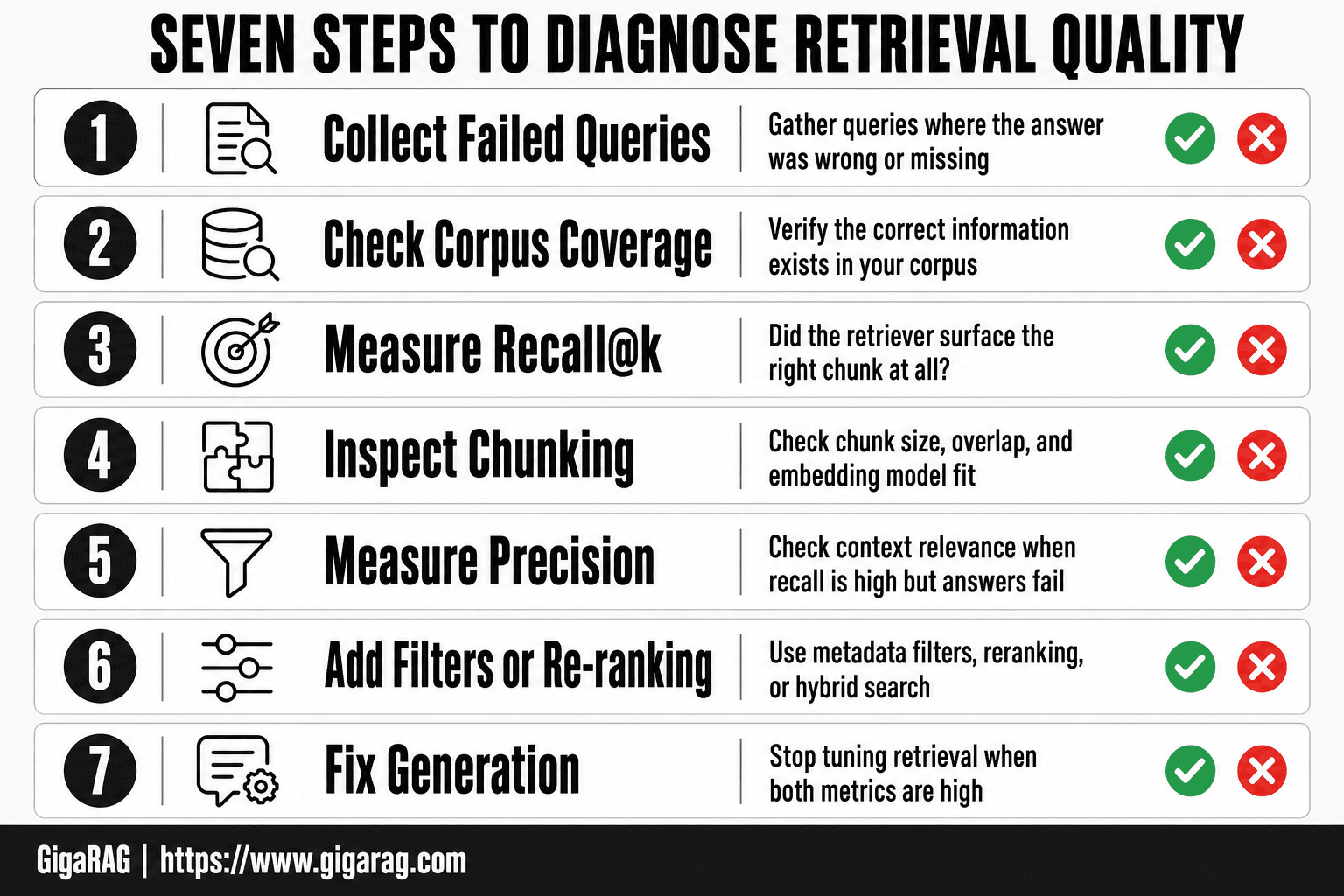
The Retrieval Quality Problem, Explained: A Step-by-Step Guide
- Collect a set of failed queries where the answer was wrong or missing.
- For each failure, check whether the correct information exists anywhere in your corpus.
- Measure recall@k: did the retriever surface the right chunk at all?
- If recall is low, inspect chunk size, overlap, and embedding model fit.
- If recall is high but answers fail, measure precision and context relevance.
- If precision is low, add metadata filters, reranking, or hybrid search.
- If both are high and answers still fail, stop tuning retrieval and fix generation.
How to Measure Retrieval Quality
You can't fix what you can't measure, and retrieval quality has four metrics that actually drive decisions. Each one maps to a specific pipeline change. Learn the mapping and you stop guessing.
Recall: when it matters and what it should change
Recall measures whether the right chunk came back at all. If your top-k results contain the chunk that answers the query, recall is 1. If they don't, it's 0. Across a test set, you average those hits.
Recall matters most when missing context causes downstream failure. An agent that can't find the memory entry about a user's preference will act on nothing, or worse, on the wrong memory. A support bot that misses the refund policy chunk will hallucinate a policy.
Low recall should change your chunking strategy first. Chunks that are too small split context across boundaries. Chunks that are too large bury the relevant sentence in noise. It should also push you toward query expansion or hybrid retrieval before you touch the embedding model.
A good recall target for a RAG pipeline is 0.9 or above on your evaluation set. Below that, fix retrieval before you touch generation.
Precision: the metadata filtering signal
Precision measures how many of your returned chunks are actually relevant. If you return 10 chunks and 3 are useful, precision is 0.3. High recall with low precision means you're flooding the context window with noise.
Low precision should drive metadata filtering. If your index has structured fields like document type, date, or source, filter on them before you embed. A query about "2024 pricing" should never return chunks from 2022, no matter how semantically similar they are. Metadata filters are cheaper than model changes and they fix precision immediately.
The main catch: metadata only works if you built it into the index. Retro-fitting filters onto an existing index means re-indexing.
MRR and nDCG: ranking quality for top-k retrieval
Recall and precision treat every position in your top-k equally. They don't. If the right chunk is at position 9 and your pipeline only sends the top 3 to the generator, you've failed even though recall says you succeeded.
MRR (Mean Reciprocal Rank) measures where the first relevant chunk lands. If it's at position 1, MRR is 1. Position 3 gives 0.33. Position 9 gives 0.11. nDCG does the same but weights relevance grades, so a partially relevant chunk at position 1 scores lower than a fully relevant one.
Low MRR should drive re-ranking. Your retriever found the right chunk, just in the wrong order. A cross-encoder re-ranker or a simple recency boost fixes ordering without touching the index.
Answer groundedness: the bridge to generation quality
Groundedness measures whether the generated answer is supported by the retrieved context. It's not a retrieval metric in the strict sense. It's the bridge between retrieval and generation.
Here's why it matters: you can have perfect recall and precision, and the model still hallucinates. Groundedness catches that. If the answer cites a chunk that doesn't exist in your top-k, retrieval didn't fail. Generation did.
Measure groundedness with an LLM judge that checks each claim in the answer against the retrieved context. Low groundedness with high retrieval scores means your problem is in the prompt or the model, not the index. Stop optimizing retrieval and look downstream.
A RAG Example: Seeing Retrieval Quality in Action
Here's a concrete flow. A user asks a support bot: "Can I get a refund if I cancel after 14 days?" The system embeds the query, retrieves the top 5 chunks from the knowledge base, and sends them to the generator. What happens next depends on what came back.
Query → embedding → top-k retrieval
The query gets embedded into a vector. That vector is compared against every chunk in the index using cosine similarity. The top 5 most similar chunks come back. In this case, the retriever returns: the refund policy page, a blog post about cancellation, a pricing FAQ, a terms of service excerpt, and a changelog entry from 2023.
The refund policy chunk is at position 1. The cancellation blog post is at position 2. The other three are noise. Recall is 1 because the right chunk came back. Precision is 0.4 because only 2 of 5 chunks are relevant. MRR is 1 because the first relevant chunk is at position 1.
Where the example succeeds
The generator receives the refund policy chunk and produces: "Refunds are available within 14 days of purchase. After 14 days, cancellations are non-refundable." That answer is grounded. Every claim traces back to the retrieved context. Retrieval quality did its job.
The metrics confirm it. Recall of 1 means nothing was missed. MRR of 1 means the right chunk was first. The answer is correct, and groundedness checks pass.
Where the example fails and which metric catches it
Now change one thing. The user asks: "What's your refund policy for annual plans?" The retriever returns the same 5 chunks. The refund policy chunk is there, but it only covers monthly plans. The annual plan policy is in a different chunk that didn't make the top 5.
Recall drops to 0 because the chunk that answers this specific query is missing. Precision stays at 0.4. The generator, working with what it got, produces an answer about monthly plans and applies it to annual plans. The answer is wrong, and groundedness catches it: the claim about annual plans isn't supported by any retrieved chunk.
The fix here is not a better embedding model. It's chunking. The annual plan policy was buried in a chunk that didn't surface for this query. Splitting policy chunks by plan type, or adding metadata filters for plan type, fixes the recall gap without touching the model.
Retrieval Quality in Agent Memory and Multi-Agent Systems
Agent memory changes the retrieval problem. A stateless RAG pipeline answers each query from scratch. An agent carries context from earlier turns, earlier tasks, earlier sessions. That context is itself retrieved, and it can be wrong, stale, or irrelevant in ways a fresh index never is.
Stateful retrieval: why agent memory is not a stateless index
A stateless index stores documents. An agent memory stores documents plus the agent's own history: prior queries, prior answers, prior tool calls, prior user corrections. When the agent retrieves from memory, it is not just matching a query against a knowledge base. It is matching a query against a record of what the agent already said and did.
That creates a new failure mode. The agent retrieves its own earlier answer and treats it as ground truth, even when that answer was wrong. Or it retrieves a tool call from three turns ago and reuses it in a context where it no longer applies. The retrieval quality problem is not just "did we find the right document." It is "did we find the right version of our own history."
The fix is to treat agent memory as a separate index with its own quality checks. Track which memory entries came from verified sources and which came from the agent's own generation. Filter or downrank the latter. Stateful retrieval needs provenance, not just similarity.
Memory decay: when old context hurts retrieval quality
Memory decay is the problem of old context staying too long. An agent that remembers everything retrieves everything, and most of it is noise. A user's preferences from six months ago may still be in memory, but they may no longer be true. A task plan from a previous project may surface in a new project and pull the agent in the wrong direction.
The retrieval quality metric that catches this is precision. When precision drops, the first thing to check is not the embedding model. It is whether the memory index is holding entries past their useful life. Decay is a filtering problem, not a ranking problem.
In practice, decay means setting a time-to-live on memory entries, or downweighting entries by age and usage. An entry the agent has not retrieved in 30 days should not compete equally with an entry retrieved yesterday. The honest answer is that decay tuning is domain-specific. A support agent's memory decays faster than a research agent's. There is no universal half-life.
Cross-agent context sharing: retrieval across agent boundaries
Multi-agent systems add another layer. One agent retrieves context that another agent produced. That context may be in a different format, built for a different task, or grounded in a different knowledge base. The retrieving agent has no way to know whether the context it pulled is trustworthy.
The failure mode is silent context mismatch. Agent A writes a summary of a customer conversation. Agent B retrieves that summary and treats it as a verified fact. But Agent A's summary was a paraphrase, and the paraphrase dropped a critical qualifier. Agent B's answer is now wrong, and the retrieval metrics look fine because the summary was retrieved correctly.
Cross-agent retrieval needs a trust signal. Tag shared context with its source agent, its confidence level, and whether it is a direct quote or a paraphrase. Downrank paraphrases when the downstream task requires exact facts. Retrieval quality across agent boundaries is not just about similarity. It is about whether the retrieved context is safe to act on.
Common Retrieval Quality Failure Modes
Most retrieval quality problems are not exotic. They repeat across teams, stacks, and domains. You'll recognize the symptoms before you know the cause.
Chunking failures: too large, too small, wrong boundaries
Chunks that are too large bury the answer. The retriever finds the right document but returns 4,000 tokens of surrounding context, and the generator drowns in it. Precision drops because the relevant sentence is one line inside a wall of irrelevant prose.
Chunks that are too small break the opposite way. A 100-token chunk may contain the keyword but not the reasoning. The retriever returns a fragment that looks relevant but lacks the qualifier, the condition, or the example that makes it usable. Recall looks fine. Answer quality doesn't.
Wrong boundaries are the sneakiest failure. A chunk that splits a procedure across two chunks, or cuts a definition from its example, returns context that is technically retrieved but functionally broken. The fix is boundary-aware chunking: split on headers, list items, or semantic breaks, not on raw token count. Check your chunk boundaries before you touch your embedding model.
Embedding mismatch: model not aligned with domain
A general-purpose embedding model encodes "cell" as a biological unit. Your legal corpus uses "cell" as a prison room. The retriever returns biology documents for a criminal law query. Nothing is broken in the pipeline. The model just doesn't speak your domain.
The symptom is high recall with low precision that doesn't improve with re-ranking. The retriever keeps finding documents that are semantically close in the model's space but wrong in yours. The fix is a domain-tuned embedding model, or a hybrid setup where sparse retrieval catches the exact terms the dense model misses. Test your embedding model on 50 domain-specific queries before you trust it in production.
Metadata neglect: ignoring structured filters
Metadata is the precision lever most teams leave on the floor. A query for "Q3 revenue by region" should filter on date and geography before any semantic matching happens. When metadata is ignored, the retriever returns revenue documents from every quarter and every region, and the generator has to sort it out.
The symptom is answers that are plausible but wrong in a specific, checkable way: the right number, the wrong quarter. The fix is to apply structured filters before embedding search, not after. Date, source, document type, and access level are filters, not ranking signals. If your metadata is missing or inconsistent, retrieval quality will cap out no matter how good your embeddings are.
Stale index: retrieval quality decay over time
An index is a snapshot. The moment you build it, it starts going stale. New documents don't appear. Deleted documents still surface. Updated documents return old versions. The retriever keeps finding things that were true last month and aren't true now.
The symptom is a slow, steady drop in answer groundedness that no model change fixes. The retriever is doing its job. The index isn't. The fix is a re-indexing schedule tied to your data's change rate. A knowledge base that updates daily needs daily re-indexing. A policy manual that updates quarterly can re-index quarterly. Check your index freshness before you blame your retrieval quality.
Practical Fixes for the Retrieval Quality Problem
The failure modes above all have fixes. The order matters: start with the cheapest change that moves the metric you're stuck on, not the most impressive one.
Chunking strategy: what to change and when
Chunk size is the first lever to pull because it's free and reversible. If recall is low, your chunks are probably too small. The retriever can't find the answer because the answer is split across three chunks, each missing the context that makes it match the query. Increase chunk size until recall stops improving, then stop.
If precision is low, your chunks are probably too large. The retriever returns the right document but the relevant sentence is buried. Shrink chunks or switch to boundary-aware splitting: cut on headers, list items, and semantic breaks instead of raw token count. One team I worked with moved from 500-token fixed chunks to header-aware chunks and watched precision climb 12 points without touching the embedding model. The metric to watch is precision at k, not recall.
Metadata filtering: precision without model changes
Metadata filtering is the highest-leverage fix for precision because it doesn't require re-embedding anything. You apply structured filters before semantic search runs. A query for "Q3 revenue by region" filters on date and geography first, then runs embedding search on the remaining candidates.
The metric this moves is precision. Recall stays the same because you're not changing what the retriever can find, only what it's allowed to return. The catch is that your metadata has to exist and be consistent. If half your documents are missing date fields, filtering on date silently drops them. Check metadata coverage before you rely on it.
Re-ranking: fixing top-k ordering
Re-ranking fixes the case where the right document is in the top 50 but not the top 5. A cross-encoder or a second embedding pass scores the candidates against the query directly, not against the query embedding. This reorders the list so the relevant document moves up.
The metric this moves is MRR and nDCG, not recall. The retriever already found the document. Re-ranking just puts it where the generator can use it. The cost is latency: a second scoring pass adds 50 to 200 milliseconds per query. Worth it when top-k ordering is your bottleneck. Not worth it when recall is the problem.
Query expansion: improving recall without re-indexing
Query expansion fixes low recall when the query vocabulary doesn't match the document vocabulary. You rewrite the query before embedding it: add synonyms, expand acronyms, or generate hypothetical answers and embed those instead. The retriever then finds documents it would have missed.
The metric this moves is recall. Precision may drop slightly because the expanded query matches more documents, some of them wrong. Pair query expansion with re-ranking to recover the precision. The main catch is that expansion quality depends on your expansion source. A thesaurus is cheap but shallow. A language model is better but adds latency and cost. Start with rule-based expansion and only escalate if recall is still stuck.
What You Cannot Fix with Retrieval Quality Alone
Retrieval quality improvements have a ceiling. You can tune chunking, add metadata filters, re-rank, and expand queries, and still hit problems that no retrieval change will touch. Knowing where that ceiling is saves you months of wasted optimization.
Irreducible ambiguity: when the query itself is unclear
Some queries are ambiguous in a way no retriever can resolve. A user types "the report" with no other context. Which report? From when? For which team? The retriever can return the most recently accessed report, or the most semantically similar one, but it's guessing. No embedding model, no re-ranker, no hybrid setup fixes a query that doesn't contain enough information to disambiguate.
The fix here is not retrieval. It's clarification. Ask the user a follow-up question, or use conversation history to infer what "the report" refers to. If your system can't ask, you accept the ambiguity and return the best guess with a confidence signal. Retrieval quality metrics will not tell you this is happening. You'll see decent recall and precision, and still get wrong answers, because the query itself was underspecified.
Cold-start problems: no data, no retrieval quality
A retriever can only return what's in the index. When a new user, new agent, or new domain has no documents yet, retrieval quality is zero regardless of how well-tuned your pipeline is. No amount of embedding model selection or chunking strategy creates data that doesn't exist.
This shows up in agent memory systems most sharply. A new agent with an empty memory has nothing to retrieve. The first few interactions are pure generation, not retrieval. The honest answer is that cold-start is a data acquisition problem, not a retrieval quality problem. You need a fallback: a default knowledge base, a human handoff, or a policy that says "I don't have information on this yet." Building better retrieval on top of an empty index is wasted effort.
Cost ceilings: quality improvements that stop paying off
Every retrieval quality improvement has a cost curve, and the curve flattens. Moving from no re-ranking to a cross-encoder re-ranker might buy you 15 points of nDCG. Moving from a cross-encoder to a larger cross-encoder might buy you 2 points, at 3x the latency and 4x the compute cost. At some point, the next quality point costs more than the entire pipeline did before.
The main catch is that cost ceilings are specific to your workload. A customer-facing chatbot with 10 queries per second can afford expensive re-ranking. A batch pipeline processing 10 million documents a night cannot. You have to decide what a quality point is worth in your context. Retrieval quality metrics tell you what you gained. They don't tell you whether the gain was worth the bill. That's a business decision, not an engineering one.
When Retrieval Is Not Your Problem
You've tuned chunking, added filters, re-ranked. Answers still fail. Before you touch retrieval again, check whether retrieval is even the bottleneck. It often isn't.
Generation failures: the model has the context but still fails
Run this test: log the retrieved context for 50 failed answers. If the correct information is in the context and the answer is still wrong, retrieval is not your problem. The model read the right text and produced the wrong output.
This happens more than most builders admit. A model might summarize incorrectly, ignore a key sentence, or hallucinate a number that contradicts the retrieved passage. No retrieval change fixes that. You need a better generation prompt, a stronger model, or output validation against the context.
Prompt issues: the retrieval is fine, the instruction is wrong
The retriever returns exactly what you asked for. The prompt then tells the model to do the wrong thing with it. Maybe the instruction says "summarize" when you need "extract exact figures." Maybe it doesn't tell the model to prefer retrieved text over its own training data. Maybe it buries the context under five paragraphs of system instructions.
Check your prompt before you check your embeddings. A one-line change to the instruction often moves answer quality more than a week of retrieval tuning.
Data staleness: the index is current but the source data is not
Your index updates every hour. The source database it reads from was last updated in March. Retrieval is working perfectly. It's retrieving stale facts with high precision.
This is a data pipeline problem. The fix is upstream: refresh the source, add a freshness check, or timestamp documents so the model can flag old information. Re-indexing stale data just serves stale data faster.
Final Thoughts on the Retrieval Quality Problem
The retrieval quality problem, explained across this article, is a chain of decisions, not a single dial. Chunk size drives recall. Metadata filters drive precision. Re-ranking fixes ordering. Each metric maps to one pipeline change, and tuning the wrong one wastes weeks.
Retrieval quality has hard limits. It cannot fix a bad prompt, a stale source database, or a model that ignores the context it was given. When the correct passage is already in the top-k results and the answer still fails, stop optimizing retrieval.
That's the honest read. If you're building agent memory or a RAG pipeline and want a platform that treats retrieval quality as a diagnosable problem rather than a black box, GigaRAG is built for exactly that. It won't fix your generation model. It will show you where retrieval ends and everything else begins.
Frequently Asked Questions
How do you measure retrieval quality?
Use recall@k to check if the right chunk appears, precision@k to check how much noise comes with it, and nDCG or MRR to measure ranking quality. For RAG specifically, context relevance and faithfulness scores connect retrieval to final answer quality. No single metric is enough — pair at least one recall metric with one ranking metric.
What is a RAG example?
A RAG example is a pipeline where a user query triggers retrieval from a knowledge base, and the retrieved chunks are passed to a language model to generate an answer. For instance, a support bot retrieves relevant help articles before answering a customer question. The retrieval step grounds the model in your data rather than relying on its training alone.
What problems does retrieval augmented generation (RAG) primarily solve?
RAG primarily solves knowledge staleness and hallucination by grounding generation in retrieved documents. It lets a model answer questions about private or recent data without retraining. It also reduces the need to fine-tune for every new fact, though it does not eliminate reasoning errors or ambiguity.
What are the types of retrieval?
Common types include sparse retrieval (keyword-based like BM25), dense retrieval (embedding-based like vector search), and hybrid retrieval that combines both. Graph-based retrieval and late-interaction models like ColBERT are also used. Each type trades off recall, precision, latency, and cost differently.
What can retrieval quality not fix?
Retrieval quality cannot fix irreducible ambiguity in the query, cold-start problems where the corpus lacks the answer, or cost ceilings that limit how much context you can retrieve. It also cannot compensate for a generation model that ignores or misreads the retrieved context. Recognizing these limits prevents wasted optimization effort.
How does retrieval quality work in agent memory and multi-agent systems?
In agent memory, retrieval quality determines whether an agent recalls relevant past interactions, which affects stateful behavior and memory decay. In multi-agent systems, it governs how context is shared across agents without duplication or loss. Poor retrieval here leads to forgotten context or conflicting actions between agents.
About GigaRAG
GigaRAG is for agent memory and RAG pipeline builders. get this right. Whether you are working through the retrieval quality problem, explained or something adjacent, we publish what we have actually tested, including where it falls short.


