Technical Skills for FDEs: What Actually Matters for RAG and Agent Memory Builders
Most technical skills content for FDEs reads like a checklist from a career fair: communication, stakeholder management, "ability to work in a fast-paced environment." That's not what you need if you're deploying retrieval-augmented generation pipelines and agent memory systems into production for paying customers. You need to know which technical skills for FDEs actually matter, which ones are noise, and which ones you can safely ignore. At GigaRAG, we've watched enough FDEs succeed and fail at this to know the difference.
Here's the honest answer: the skills that matter are specific, technical, and often invisible in job descriptions. Vector database selection, embedding model tradeoffs, retrieval optimization, context engineering, and the debugging instincts that only come from breaking things in production. Not model training. Not core research. Not building the next transformer.
This guide covers the technical skills that actually matter for AI-native FDEs working with RAG and agent memory systems, the limitations you should accept early, and a practical path to build those skills without wasting months on theory.
| At a glance | Details |
|---|---|
| Core stack | Python, APIs, vector DBs, orchestration |
| RAG must-haves | Chunking, embeddings, retrieval, evaluation |
| Agent memory | Short/long-term stores, summarization, eviction |
| Not expected | Model training or core ML research |
| Customer-facing | Scoping, demos, debugging in their env |
| Learning path | Ship small RAG apps, then harden |
In This Guide
- What Is a Forward Deployed Engineer?
- RAG Pipeline Skills vs Agent Memory Skills for FDEs
- Core Technical Skills for FDEs in RAG and Agent Memory
- Technical Skills For FDEs: A Step-by-Step Guide
- What FDEs Cannot Do: Honest Limitations
- How to Build These Technical Skills for FDEs
- FDE Salary and Career Path
- Common Mistakes When Building Technical Skills for FDEs
What Is a Forward Deployed Engineer?
A forward deployed engineer (FDE) is a software engineer who works directly at customer sites to deploy, configure, and adapt a company's product to real customer environments. The role started at Palantir, where engineers embedded with government and enterprise clients to make complex software actually work in production.
FDE vs. traditional software engineer
A traditional software engineer builds features for a product team. An FDE ships the product into a specific customer's environment and makes it work there. The difference is context: FDEs deal with messy customer data, legacy systems, and constraints nobody anticipated. They write code, but they also sit in customer meetings, debug production issues live, and translate between what the customer needs and what the product does.
The AI-native FDE: deploying RAG and agent memory
AI-native FDEs deploy retrieval-augmented generation pipelines and agent memory systems for customers. That means wiring up vector databases, tuning embeddings, and building context that actually helps a customer's LLM answer correctly. The work is applied, not research. You're not training models. You're making existing models useful inside someone else's stack.
What FDEs actually do day-to-day
A typical day mixes customer calls, production debugging, and integration work. You might spend the morning diagnosing why a customer's RAG pipeline returns irrelevant chunks, then the afternoon writing a connector for their internal document store. The honest catch: you're on the hook when things break in production, and "production" is someone else's environment you don't fully control.
[!note] FDEs are not expected to train foundation models or conduct core ML research; those tasks belong to ML researchers and platform teams. An FDE's value is integrating, adapting, and operating existing models and retrieval systems inside a customer's environment.
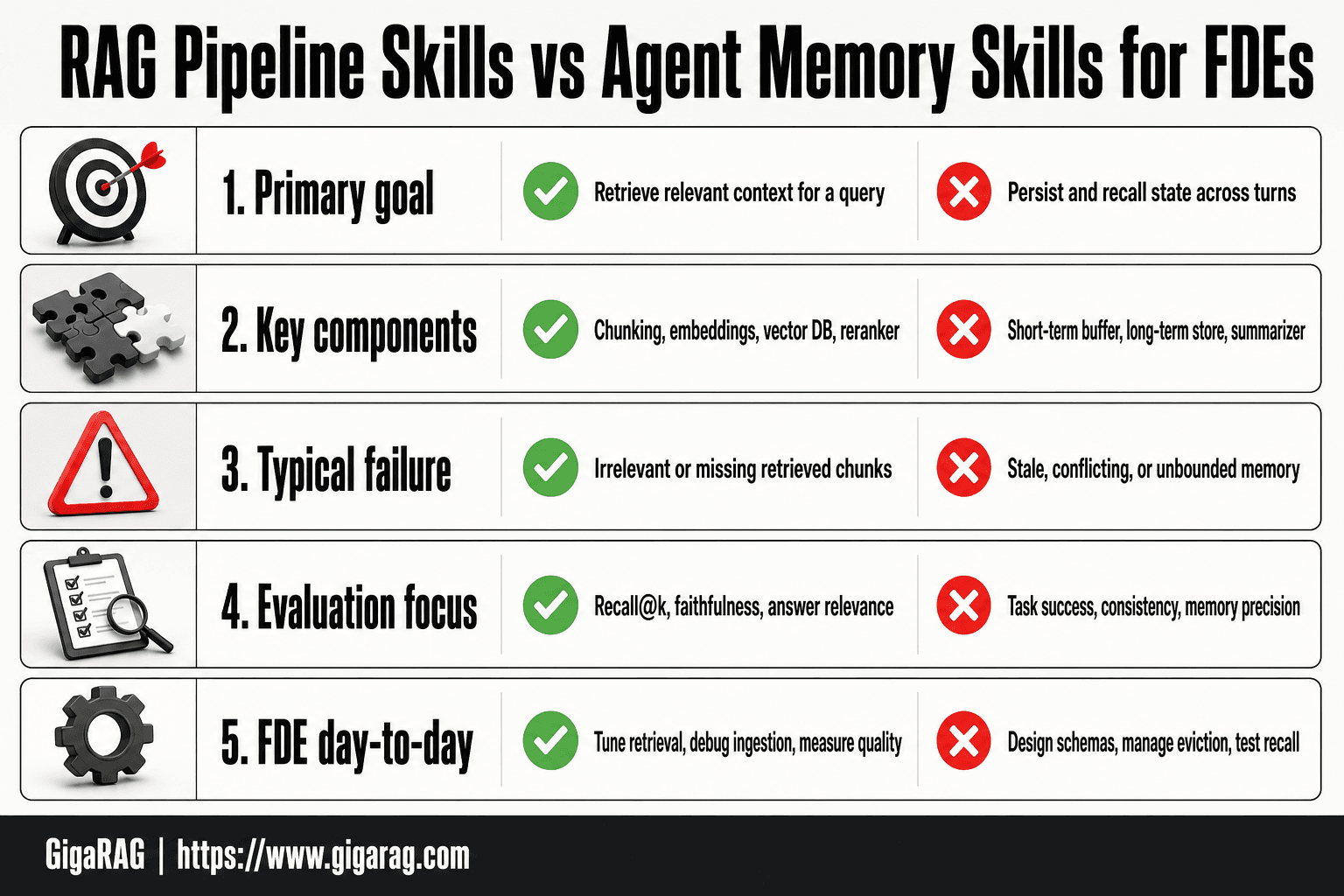
RAG Pipeline Skills vs Agent Memory Skills for FDEs
| Factor | RAG Pipeline Skills | Agent Memory Skills |
|---|---|---|
| Primary goal | Retrieve relevant context for a query | Persist and recall state across turns |
| Key components | Chunking, embeddings, vector DB, reranker | Short-term buffer, long-term store, summarizer |
| Typical failure | Irrelevant or missing retrieved chunks | Stale, conflicting, or unbounded memory |
| Evaluation focus | Recall@k, faithfulness, answer relevance | Task success, consistency, memory precision |
| FDE day-to-day | Tune retrieval, debug ingestion, measure quality | Design schemas, manage eviction, test recall |
Core Technical Skills for FDEs in RAG and Agent Memory
Most FDE skill lists stop at "Python, SQL, communication." That's table stakes. The skills that actually separate AI-native FDEs from generic engineers are narrower and more specific. Here's what you'll touch every week.
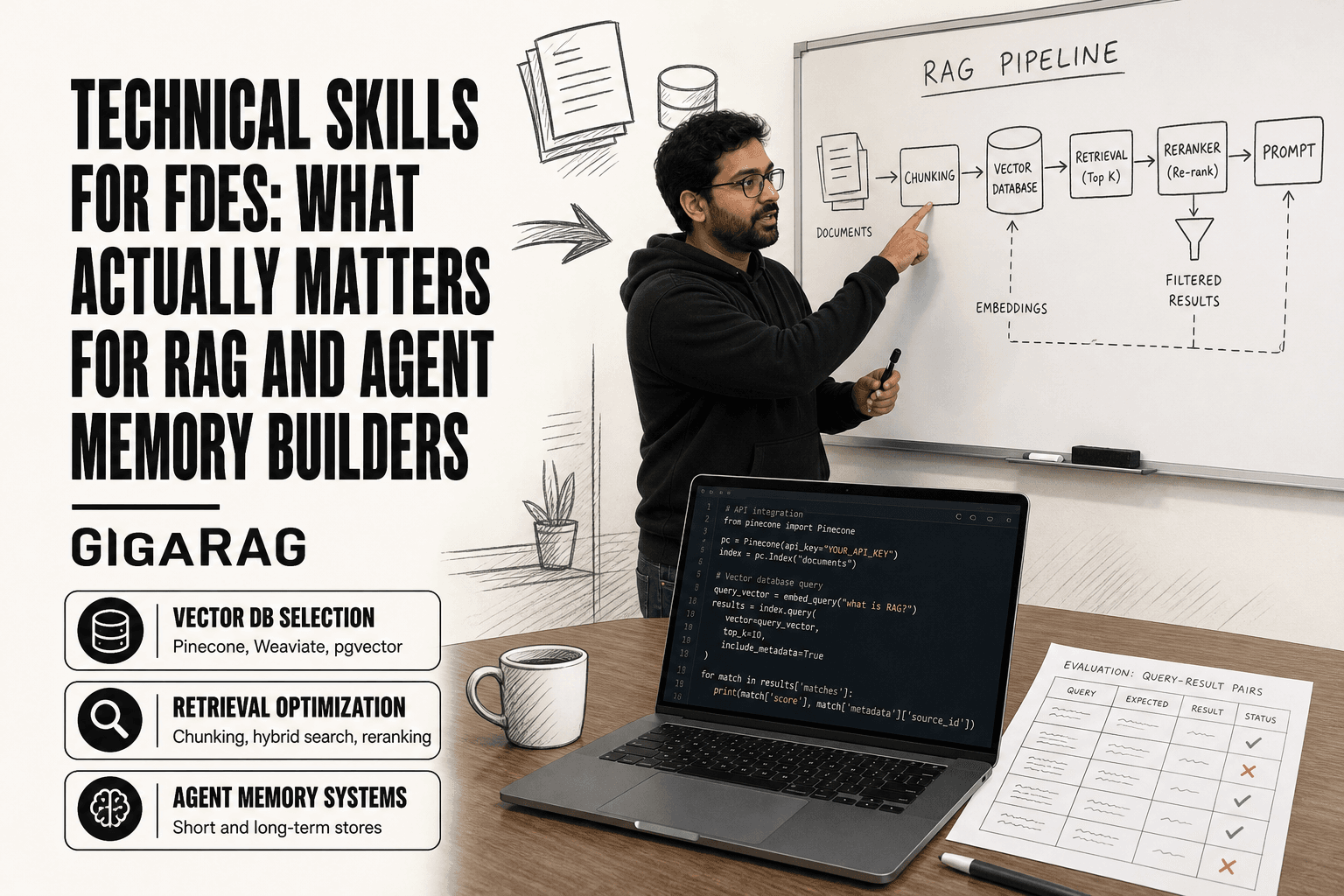
Vector databases: Pinecone, Weaviate, pgvector
You need to know how vector indexes work under the hood: how embeddings get stored, how similarity search finds nearest neighbors, and what happens when your index grows past memory. Pinecone is managed and fast but costs real money. Weaviate gives you hybrid search out of the box. pgvector lives inside Postgres, which means your customer's existing database team can maintain it. You should be able to choose between them based on scale, latency budget, and who's on call when it breaks.
Embedding strategies and model selection
Embeddings turn text into numbers a vector database can search. The skill is picking the right model for the customer's data. A general model like OpenAI's text-embedding-3 works fine for English prose. Legal or medical documents often need domain-specific models. You also need to know when to re-embed: every time the customer changes their chunking strategy or swaps models, the old vectors become garbage.
Retrieval optimization: chunking, hybrid search, reranking
Chunking is where most RAG pipelines fail. Too big and you stuff irrelevant text into the context window. Too small and you lose the surrounding meaning. Hybrid search combines keyword matching with vector similarity, which catches exact product codes and names that embeddings miss. Reranking takes the top 50 retrieved chunks and uses a cross-encoder to pick the 5 that actually answer the question. You'll tune all three per customer.
Context engineering and prompt construction
Retrieval is only half the problem. You have to assemble the retrieved chunks into a prompt that makes the LLM answer correctly. That means ordering chunks by relevance, trimming noise, and writing system prompts that tell the model when to say "I don't know" instead of hallucinating. Agent memory adds another layer: you're deciding what the agent remembers across turns and what it forgets.
API integration and LLM orchestration
FDEs live in other people's APIs. You'll wire together embedding endpoints, LLM calls, vector database queries, and customer auth systems. Orchestration means handling retries, timeouts, rate limits, and fallbacks when one model is down. The code isn't glamorous. It's the plumbing that keeps a RAG pipeline from falling over at 2 a.m.
[!tip] For FDEs working with RAG and agent memory, keep a personal 'failure log' of retrieval and memory bugs you encounter across deployments — patterns like chunk boundary issues or stale memory writes repeat, and this log becomes your fastest debugging playbook.
Technical Skills For FDEs: A Step-by-Step Guide
- Pick a narrow customer use case and define success metrics before writing code.
- Build a minimal ingestion pipeline: load documents, chunk with overlap, embed, and store in a vector DB.
- Implement retrieval with metadata filters and a reranker; log queries and retrieved chunks.
- Add a short-term conversation buffer and a long-term memory store with explicit write rules.
- Create an evaluation set of real questions and measure retrieval and answer quality.
- Instrument latency, cost, and failure modes; add fallbacks for empty or low-confidence retrievals.
- Document the architecture and hand off with runbooks, dashboards, and known limitations.
What FDEs Cannot Do: Honest Limitations
Most FDE job descriptions read like a wish list. They want someone who can train models, run research, close deals, and debug production at 3 a.m. The honest answer is that the role is narrower than that. Here's what falls outside your scope.
Model training is not your job
You won't pretrain a foundation model. You won't fine-tune one from scratch either, in most cases. That work belongs to research teams with GPU clusters and months of runway. Your job starts after the model exists: you take a trained model and make it useful for a specific customer's data. If a customer asks you to improve the model itself, the answer is usually "we can tune retrieval, not the weights."
Core research vs. applied deployment
Research teams ask "can we make the model better?" You ask "can we make this pipeline work for this customer by Friday?" The skills don't overlap much. Researchers live in PyTorch, papers, and ablation studies. You live in API docs, customer environments, and error logs. If you want to publish papers, the FDE track will frustrate you. If you want to ship things that real users touch, it won't.
What "customer-facing" really means
Customer-facing doesn't mean sales. You won't negotiate contracts or own a quota. It means you sit on calls where the customer describes a broken retrieval pipeline, and you figure out what's actually wrong. You translate between "the search results feel off" and "your chunk size is 4,000 tokens and your reranker is disabled." The skill is diagnosis, not persuasion. You're the engineer in the room, not the account executive.
How to Build These Technical Skills for FDEs
Reading about vector databases won't make you useful. Building things will. The skills from the previous section come from repetition on real problems, not from courses. Here's a path that works.
Hands-on projects: build a RAG pipeline from scratch
Start with a single PDF. Chunk it, embed it, store it in a vector database, and query it. That's the whole pipeline. Use pgvector if you already know Postgres, or Pinecone's free tier if you don't want to manage infrastructure. The first version will be bad. That's the point.
Then break it on purpose. Feed it a question the chunks don't cover. Watch it hallucinate. Change the chunk size from 500 to 2,000 tokens and see what happens to retrieval quality. Add a reranker and measure whether it helps. You'll learn more from one broken pipeline than from ten tutorials.
The next project: give the system memory. Store conversation history, retrieve relevant past turns, and inject them into the prompt. That's agent memory in miniature. It's also where most RAG demos fall apart, because context windows fill up fast and retrieval gets noisy.
Practice with real customer scenarios
Invent a customer. Give them messy data: PDFs with tables, Slack exports, a wiki with broken links. Now make retrieval work on that. Real deployments are 80% data cleaning and 20% model work. You need to feel that ratio.
Time-box yourself. A customer doesn't wait three weeks for a pipeline. Give yourself two days to go from raw data to a working demo. The constraint forces you to make tradeoffs: which embedding model, which chunking strategy, which retrieval method. Those tradeoffs are the actual job.
Learning resources that actually help
Skip the certification courses. They teach vocabulary, not deployment. What helps: the documentation for Pinecone, Weaviate, and LangChain, read while building. The OpenAI cookbook has working RAG examples you can copy and break. Simon Willison's blog covers embeddings and retrieval with real code and honest benchmarks.
For agent memory specifically, read the LangChain memory docs and then ignore half of what they recommend. Most of it is overengineered. Build the simplest version first: a list of past messages, a summary, and a retrieval step. You'll know when you need more.
FDE Salary and Career Path
Salary data for FDEs is messy. Most job boards lump the role in with solutions engineering or technical consulting, so published ranges swing wildly. What's consistent: AI-native FDEs command a premium over traditional FDEs because the skill set is rarer and the deployment surface is newer.
Salary ranges for AI-native FDEs
In the US, FDE roles at AI companies typically land between $140,000 and $220,000 base, with equity pushing total compensation higher at startups. (verify at publish) The spread depends on three things: whether you're at a seed-stage company or a Series C, whether the role is customer-facing or internal, and how much of the RAG and agent memory stack you own end-to-end.
The technical skills from earlier sections map directly to earning power. An FDE who can debug a retrieval pipeline, tune embeddings, and ship a working agent memory system is worth more than one who can only wire up APIs. Companies pay for the person who unblocks a customer deployment in days, not weeks.
Career progression: from FDE to solutions architect
The most common path runs FDE to senior FDE to solutions architect or technical account manager. Some move into product management, because FDEs see customer pain up close. A smaller number go deep on infrastructure and become platform engineers.
The honest answer: FDE is not a terminal role at most companies. You'll either move toward architecture and pre-sales, or toward product and engineering. If you want to stay hands-on with RAG and agent memory systems, look for companies where the FDE track has a senior IC path. Not all of them do.
Common Mistakes When Building Technical Skills for FDEs
Most FDE skill-building fails for the same three reasons. You spend months on the wrong thing, you skip the part that actually gets you hired, or you optimize for a role that doesn't exist. Here's what goes wrong and how to avoid it.
Focusing on theory instead of deployment
Reading papers on retrieval algorithms feels productive. It isn't, not for this job. An FDE gets measured on whether a customer's RAG pipeline works in production, not whether you can explain HNSW graph construction from memory.
The fix: build first, read second. Deploy a working pipeline with pgvector and a basic embedding model. Break it. Fix it. Then go back and read why your fix worked. Theory sticks when it explains a bug you already hit.
Ignoring customer communication skills
You can be the best RAG engineer on your team and still fail as an FDE. The role is customer-facing by definition. If you can't explain why a retrieval result was wrong, or why latency spiked, or what "good enough" means for a specific use case, your technical skill doesn't matter.
Practice writing incident summaries. Practice explaining chunking strategy to a non-technical stakeholder in under two minutes. These are skills you build deliberately, not things that happen by accident.
Over-indexing on model training
The biggest time sink I see: engineers learning to fine-tune models when the job is deployment and integration. You don't need to train a model to be an FDE. You need to pick the right embedding model, wire it into a pipeline, and tune retrieval parameters.
Spend your time on vector databases, chunking strategies, and evaluation metrics. Those are the skills that show up in every RAG deployment. Model training shows up in almost none.
If you're building RAG pipelines or agent memory systems and want to know which technical skills for FDEs will actually move the needle, start with the five skills above. Skip the model training. Skip the certification courses. Build a broken pipeline, fix it, and do it again.
Frequently Asked Questions
What is AI forward deployed engineering?
AI forward deployed engineering is a customer-facing role where engineers embed with a client to design, build, and operate AI systems such as RAG pipelines and agent memory in the client's environment. It blends software engineering, ML integration, and consultative problem-solving. The focus is on making models work reliably on real data, not on training new models.
What are the technical skills for a software developer?
Core software developer skills include programming (often Python or JavaScript), data structures, APIs, databases, version control, testing, and debugging. For AI-native roles, add familiarity with vector databases, embedding models, prompt/context engineering, and evaluation tooling. System design and clear communication matter as much as coding.
What are the big 4 of engineering?
The 'big 4' of engineering is not a standard industry term and varies by context; it is sometimes used informally to refer to major engineering disciplines (civil, mechanical, electrical, chemical) or to large engineering firms. In software, there is no universally agreed 'big 4' skill set. Treat such lists as directional, not definitive.
How much do FDEs get paid?
Forward deployed engineer compensation varies widely by company, location, and seniority, and often includes a base salary plus equity. Because pay is highly context-dependent, we recommend checking current levels on sites like Levels.fyi or Glassdoor and verifying ranges at publish time. Avoid relying on a single number.
Do FDEs need to know how to train models?
No — FDEs generally do not train foundation models. They work with existing models and focus on retrieval, context engineering, evaluation, and integration. Understanding model behavior and limitations is important, but core research and pretraining are typically out of scope.
Which vector database should an FDE learn first?
Start with one widely used vector database and learn its indexing, filtering, and scaling behavior rather than sampling many. Concepts like approximate nearest neighbor search and metadata filtering transfer across databases. The specific choice matters less than understanding retrieval trade-offs.
How do FDEs evaluate RAG and agent memory systems?
FDEs build small, domain-specific evaluation sets from real user questions and measure retrieval quality (for example, recall of relevant chunks) and answer quality (faithfulness, relevance). For agent memory, they test consistency and recall across turns. Evaluation is iterative and should be tied to the customer's success metrics.
About GigaRAG
GigaRAG is for agent memory and RAG pipeline builders. get this right. Whether you are working through technical skills for FDEs or something adjacent, we publish what we have actually tested, including where it falls short.