The True Cost of an In-House RAG Team
The true cost of an in-house RAG team is almost never what your first estimate says it is. If you're a senior engineer or technical founder building agent memory systems, building in-house feels like the obvious call: you control the stack, the evals, the data, the latency budgets. No vendor lock-in, no per-token surprises. The logic is seductive. It's also incomplete.
Here's the catch. Most internal estimates capture salaries and a vector database, then stop. They miss the five cost lines that actually compound: eval infrastructure you have to maintain forever, data ingestion and re-chunking as a permanent job, on-call rotation for retrieval failures, model and embedding migrations, and the technical debt from pipeline experiments that shipped. GigaRAG exists as a managed alternative for teams who want to skip those costs, but this isn't a pitch. It's a line-item breakdown of what a 2-3 person in-house RAG team actually costs over 24 months, including the numbers most estimates miss, and a plain statement of what you cannot do or should not expect. The core question: build or buy?
| At a glance | Details |
|---|---|
| Team size | 2-3 engineers, 24-month horizon |
| Salary range | Mid-to-senior RAG engineers, varies by market |
| Infra & tooling | Vector DB, embeddings, LLM API, observability |
| Hidden costs | Evals, maintenance, on-call, re-indexing |
| Build timeline | Months to first usable pipeline |
| Break-even | Depends on scale and differentiation needs |
In This Guide
- The Case for Building In-House Is Stronger Than Vendors Admit
- In-House RAG Team vs Managed RAG Platform
- The Five Cost Lines Internal Estimates Miss
- The True Cost Of An In-house Rag Team: A Step-by-Step Guide
- Line-Item Budget: What a 2-3 Person In-House RAG Team Actually Costs
- Agent Memory Breaks the Assumptions Standard RAG Is Built On
- What You Cannot Do or Should Not Expect from an In-House Build
- Build vs Buy: A Decision Framework for Agent Memory Teams
- What Buying Gets You, and What It Costs You
- Common Mistakes When Estimating the True Cost of an In-House RAG Team
The Case for Building In-House Is Stronger Than Vendors Admit
Let's be honest about the build side first. If you're building agent memory systems, you have real reasons to keep RAG in-house. Control over evaluation data. Custom chunking strategies tuned to your documents. No per-token pricing that scales with every retrieval. Data residency when compliance demands it. These aren't rationalizations. They're legitimate engineering constraints.
When building in-house genuinely makes sense
You should build when your retrieval problem is genuinely unusual. If your documents have a structure no off-the-shelf chunker handles, or your latency budget is tight enough that you need to tune every hop in the pipeline, a vendor's defaults will fight you. Same if your eval set is proprietary and can't leave your network. Those cases exist. They're just rarer than most teams assume.
The control argument: evals, data, and latency budgets
Control is the strongest argument for building. You own the eval harness, so you can measure exactly what "good retrieval" means for your product. You own the data pipeline, so nothing gets sent to a third party. You own the latency budget, so you can shave milliseconds where it matters. That control is real. It also has a price, and the next section puts a number on it.
What "owning the stack" actually buys you
Owning the stack buys you the ability to change anything. That's it. It doesn't buy you faster shipping, better retrieval out of the gate, or fewer pages at 2 a.m. It buys optionality. Whether that optionality is worth the cost depends on how often you'll actually exercise it. Most teams won't.
[!note] All cost figures are directional and vary significantly by market, seniority, and cloud provider; validate with current quotes and salary data before finalizing a budget.
In-House RAG Team vs Managed RAG Platform
| Factor | In-House Team | Managed Platform |
|---|---|---|
| Upfront cost | High: salaries, benefits, infra setup | Low: subscription or usage-based |
| Time to first pipeline | Months, including hiring and ramp-up | Days to weeks |
| Ongoing maintenance | Engineer time on evals, re-indexing, upgrades | Vendor handles updates and scaling |
| Customization | Full control over models, retrieval, evals | Constrained by platform capabilities |
| Hidden costs | On-call, tooling sprawl, knowledge loss | Vendor lock-in, usage spikes |
The Five Cost Lines Internal Estimates Miss
The build case is real, but the estimate you take to leadership is almost certainly wrong. Not because you're bad at math. Because the expensive parts of running a RAG team are the parts nobody puts in the initial spreadsheet. Here are the five that show up anyway.
Evaluation infrastructure and ongoing eval maintenance
You'll need an eval harness before you can trust any retrieval change. That means building or adopting a framework, writing golden datasets, and maintaining them as your documents drift. Eval maintenance is not a one-time task. Every time your data changes, your eval set needs updating, or your metrics stop meaning anything. Budget for a permanent half-time engineer on this alone.
Data ingestion, cleaning, and re-chunking as a permanent job
Your documents are not static. They get updated, reformatted, and replaced. Every change means re-ingesting, re-cleaning, and re-chunking. If your chunking strategy changes, you re-process everything. This is not a setup cost. It's a recurring job that never ends, and it's the first thing internal estimates leave out.
Observability, debugging, and on-call rotation
Production RAG fails in ways that are hard to trace. A bad retrieval might be the embedding model, the chunking, the re-ranker, or the query itself. Debugging that takes instrumentation you have to build. Then someone has to carry the pager. For a two-person team, on-call rotation means every other week is yours.
Model and embedding version migrations
Embedding models change. LLM APIs deprecate versions. When you migrate, every vector in your database needs re-embedding. That's a full re-processing job, plus re-running your entire eval suite to confirm the new model didn't regress anything. Plan for this at least once a year.
Technical debt from pipeline experiments that shipped
You'll try things. Some will work well enough to ship, but not well enough to be proud of. That code stays in the pipeline. Six months later, nobody remembers why the chunker has three special cases. Every experiment that ships becomes maintenance burden. The debt compounds monthly.
[!tip] For technical founders justifying this to leadership, build a 24-month total cost of ownership model that includes a 20-30% buffer for hidden costs like evals and on-call — leadership trusts ranges more than single-point estimates.
The True Cost Of An In-house Rag Team: A Step-by-Step Guide
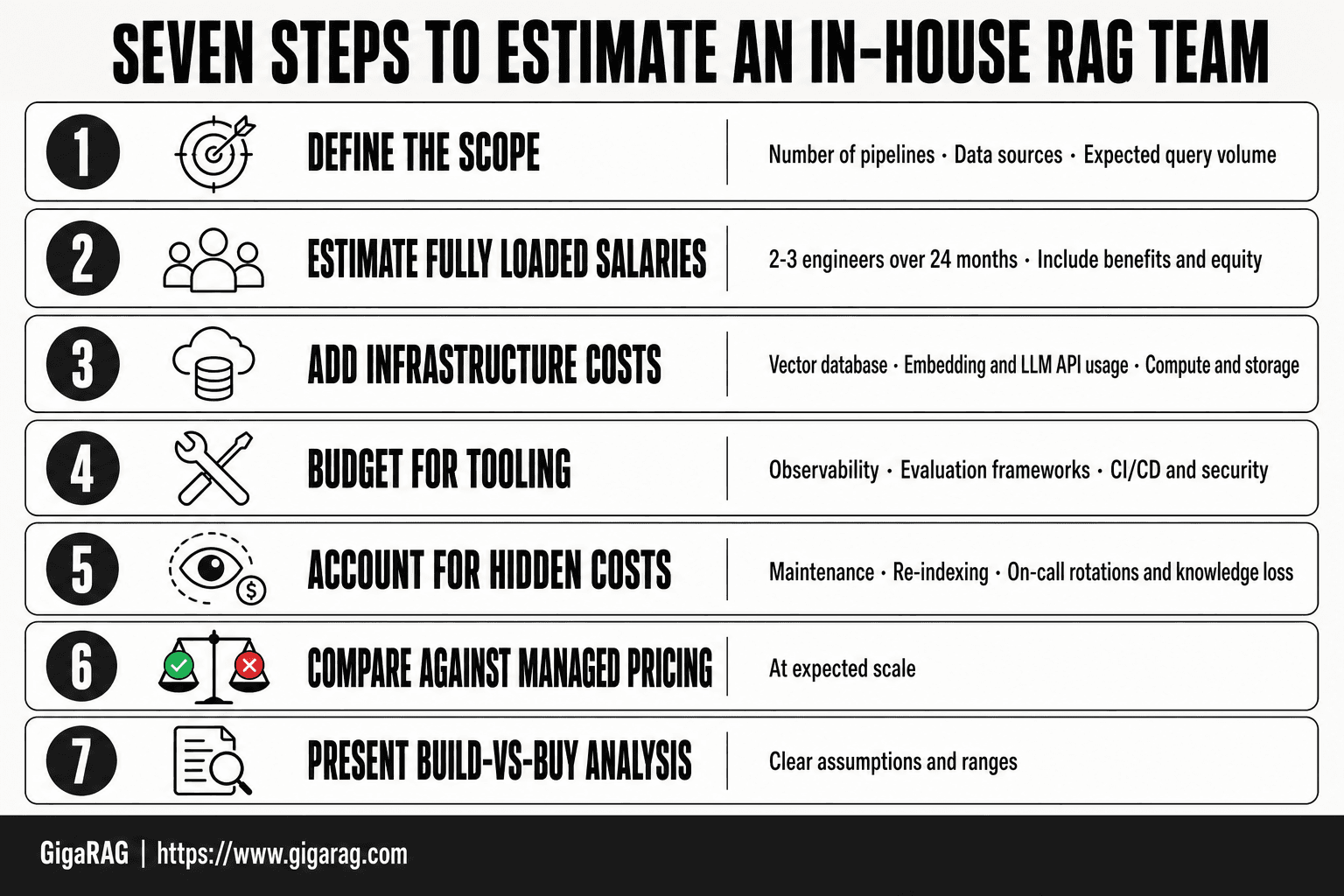
- Define the scope: number of pipelines, data sources, and expected query volume.
- Estimate fully loaded salaries for 2-3 engineers over 24 months, including benefits and equity.
- Add infrastructure costs: vector database, embedding and LLM API usage, compute, and storage.
- Budget for tooling: observability, evaluation frameworks, CI/CD, and security.
- Account for hidden costs: maintenance, re-indexing, on-call rotations, and knowledge loss.
- Compare the total against a managed platform's pricing at your expected scale.
- Present the build-vs-buy analysis to leadership with clear assumptions and ranges.
Line-Item Budget: What a 2-3 Person In-House RAG Team Actually Costs
A 2-3 person in-house RAG team costs roughly $450,000 to $650,000 over 24 months, all-in. That's salaries, benefits, infrastructure, and the hidden costs most estimates miss. The number lands higher if you're in a major metro or need GPU time for embedding fine-tuning.
Salaries and benefits for 2-3 engineers
Two senior engineers plus one mid-level is the realistic minimum for production RAG. Senior engineers who can build retrieval pipelines and run evals command $160,000 to $200,000 base in US markets. The mid-level lands around $120,000 to $140,000. Benefits add 25-30% on top: health insurance, payroll taxes, 401(k) match, equipment. That's $550,000 to $650,000 in loaded salary cost per year for three people. For two people, you're at $380,000 to $450,000. You can hire cheaper. You'll pay for it in slower iteration and more on-call burnout.
Infrastructure: vector DB, embedding API, LLM API, GPU
Infrastructure is the line item that looks small and isn't. A managed vector database like Pinecone or Weaviate runs $200 to $800 per month at modest scale. Embedding API calls for re-embedding your corpus cost $50 to $300 per month depending on volume. LLM API costs for generation and re-ranking add another $100 to $500. If you self-host anything, add a GPU instance at $1,500 to $3,000 per month. Total infrastructure: $500 to $4,500 per month, or $12,000 to $108,000 over 24 months. The range is wide because scale varies. The point is it's never zero.
Hidden costs: evals, maintenance, on-call, data pipeline
The previous section covered these in detail. Here's what they cost in dollars. Eval infrastructure and maintenance: half an engineer's time, roughly $80,000 to $100,000 per year. Data ingestion and re-chunking: another quarter to half engineer, $40,000 to $80,000. On-call and debugging: this is nights and weekends, but the real cost is context-switching. Budget $30,000 to $50,000 in lost velocity. Model migrations happen at least once a year and cost $20,000 to $40,000 in re-embedding and re-eval time. These aren't optional. They're the job.
24-month total cost of ownership table
| Line item | 2-person team | 3-person team |
|---|---|---|
| Salaries + benefits | $760,000-$900,000 | $1,100,000-$1,300,000 |
| Infrastructure | $12,000-$108,000 | $12,000-$108,000 |
| Eval maintenance | $160,000-$200,000 | $160,000-$200,000 |
| Data pipeline | $80,000-$160,000 | $80,000-$160,000 |
| On-call + debugging | $60,000-$100,000 | $60,000-$100,000 |
| Model migrations | $40,000-$80,000 | $40,000-$80,000 |
| Total | $1,112,000-$1,548,000 | $1,452,000-$1,948,000 |
The honest answer is that a two-person team is the floor, and it still crosses a million dollars over two years. A three-person team gets you closer to $1.5 to $2 million. These are loaded costs, not just salaries. If your internal estimate came in under $500,000, you missed the maintenance tax.
Agent Memory Breaks the Assumptions Standard RAG Is Built On
Standard RAG assumes stateless retrieval: a query comes in, you pull relevant chunks, you generate an answer, you're done. Agent memory doesn't work that way. An agent carries context across turns, across sessions, across days. The retrieval problem becomes stateful, and every cost line shifts with it.
Why agent memory is not a standard RAG problem
Standard RAG optimizes for one thing: retrieving the right chunk for a single query. Agent memory optimizes for continuity. You're not just retrieving facts. You're retrieving what the agent already knows about this user, this task, this conversation thread. That means your index includes conversation history, task state, and consolidated memories, not just documents. Your evals have to test whether the agent remembers the right thing at the right time, not just whether it retrieved a relevant passage. The failure modes are different. A standard RAG system fails by returning the wrong chunk. An agent memory system fails by returning the right chunk at the wrong time, or forgetting it entirely.
Stateful context and memory consolidation costs
Memory consolidation is the expensive part nobody budgets for. An agent accumulates raw interactions. Those interactions have to be summarized, deduplicated, and written back to long-term storage. That's a pipeline job that runs continuously, not a one-time ingestion. You need a consolidation step that decides what's worth keeping, what's stale, and what contradicts something already stored. Each of those decisions is an LLM call. Each LLM call costs tokens. And each consolidation run needs its own evals, because a bad consolidation silently corrupts the agent's memory over time. Standard RAG cost estimates don't include this line item because standard RAG doesn't have it.
What pipeline builders need that generic RAG teams don't
Pipeline builders need versioned memory schemas. When you change how memories are stored, you have to migrate everything the agent has already learned. Generic RAG teams can re-embed a corpus from scratch. Agent memory teams can't, because the memories are generated artifacts, not source documents. You also need retrieval that respects recency and relevance together. A memory from last week might be more important than a memory from last year, even if the older one scores higher on cosine similarity. That's a re-ranking problem standard RAG doesn't solve. Budget for it anyway.
What You Cannot Do or Should Not Expect from an In-House Build
The honest answer is that a 2-3 person team cannot ship what a managed provider already runs in production. Not in the first quarter. Not in the first year, in some cases.
You cannot ship production-grade evals in the first quarter
Evals are the thing everyone says they'll build and nobody budgets time for. A production-grade eval suite means golden datasets, regression tests for retrieval quality, hallucination checks, and latency budgets. That's a full-time job on its own. Your first quarter goes to standing up the pipeline, not measuring whether it works. You'll ship something that retrieves. You won't know if it retrieves well.
You should not expect to beat managed services on time-to-value
A managed RAG service gets you to a working retrieval endpoint in days. An in-house team gets you there in weeks, assuming nothing breaks. The gap widens when you add agent memory. Consolidation, re-ranking, schema migrations, all of it has to be built before you can test whether your approach even works. Managed services have already made those mistakes. You'll make them again, on your own clock.
You cannot avoid the maintenance tax, it compounds monthly
Every model upgrade breaks your embeddings. Every new data source breaks your ingestion. Every schema change breaks your memory. Someone has to fix each break, and that someone is on your payroll. The maintenance tax isn't a one-time cost. It's a monthly line item that grows as your system accumulates state. Budget for it or don't build.
Build vs Buy: A Decision Framework for Agent Memory Teams
You've seen the cost lines. The question now is whether your team should absorb them or hand them to someone else. Here's a test you can defend in a room with a CFO.
The CFO-defensible decision test
Run three numbers before you commit to anything. First, your fully loaded cost per engineer per year: salary, benefits, equity, equipment, and the manager time you spend on them. Second, your expected time to a production retrieval endpoint with evals you trust. Third, the cost of a managed alternative over the same window, including per-token pricing at your projected query volume.
If your in-house estimate beats the managed price by less than 30%, buy. The margin is your buffer for the cost lines you missed. If it beats it by more than 50%, build, but only if you have a named owner for evals and on-call. Anything between is a hybrid call.
When to build, when to buy, when to hybrid
Build when your data cannot leave your infrastructure, or when your retrieval quality depends on chunking strategies no vendor exposes. Buy when time-to-value is the constraint and your query volume is predictable enough to price. Hybrid when agent memory is the differentiator but commodity retrieval is not: buy the retrieval layer, build the memory consolidation on top.
Questions to ask before committing to in-house
Who owns evals after the initial build? What happens when the embedding model you chose gets deprecated? Who gets paged at 3am when ingestion stalls? If you cannot name a person for each, you are not ready to build. The maintenance tax from the previous section does not care about your roadmap.
What Buying Gets You, and What It Costs You
The buy side has a different failure mode. You won't get surprised by a maintenance tax you forgot to budget. You'll get surprised by the bill you did budget, and by the things you can no longer change.
Time-to-value: weeks vs quarters
A managed RAG layer gets you to a production retrieval endpoint in days to weeks, not quarters. The evals, the ingestion pipeline, the on-call rotation: someone else runs them. For a team whose constraint is shipping agent memory before a competitor does, that gap is the whole decision. GigaRAG and similar managed options exist precisely for teams that want the retrieval layer without owning it.
What you give up: control, custom evals, data residency
You lose the ability to change the chunking strategy when your data demands it. You lose custom evals tuned to your domain. And if your data cannot leave your infrastructure, most managed options are off the table entirely. The honest answer is that buying trades control for speed, and you should only make that trade when speed is the binding constraint.
Pricing models: per-token, per-seat, retainer
Managed pricing comes in three shapes. Per-token scales with query volume and gets expensive fast if your agent memory system queries often. Per-seat is predictable but punishes teams that grow. Retainers buy you a fixed cost but often cap usage. Run your projected query volume through each model before you sign.
Common Mistakes When Estimating the True Cost of an In-House RAG Team
Most build-vs-buy failures aren't engineering failures. They're estimation failures. The team gets built, the pipeline ships, and then the real budget shows up. Here are the four mistakes that cause it.
Underestimating the maintenance tax
Maintenance isn't a line item. It's a percentage of everything you built, due every month. Chunking strategies drift as your data changes. Embedding models get deprecated. Vector indexes need re-tuning. Budget 20-30% of your initial build cost per year just to keep the thing running.
Ignoring eval infrastructure as a first-class cost
Evals are not a nice-to-have you add after launch. They're the thing that tells you whether retrieval is working at all. Building a production eval harness takes weeks, and maintaining it as your data shifts takes ongoing effort. Skip it and you're flying blind.
Assuming agent memory is just RAG with extra steps
It isn't. Agent memory needs stateful context, consolidation across sessions, and retrieval that respects conversation history. Standard RAG cost estimates don't cover any of that. The true cost of an in-house RAG team for agent memory runs higher than generic RAG benchmarks suggest.
Forgetting the opportunity cost of delayed shipping
Every month your team spends building retrieval infrastructure is a month they're not shipping the product that retrieval was supposed to enable. That's the cost no spreadsheet captures. It's also the reason the true cost of an in-house RAG team rarely shows up in a budget review until the product is already late.
Frequently Asked Questions
Is RAG still relevant in 2026?
Yes, RAG remains a core pattern for grounding LLM outputs in private or up-to-date data. While long-context models and fine-tuning have advanced, RAG is still widely used for its cost-effectiveness, transparency, and ability to cite sources.
How much does RAG cost?
Costs vary widely based on scale, data volume, and whether you build or buy. In-house RAG involves salaries, infrastructure, and maintenance, while managed platforms charge subscription or usage-based fees. Expect a wide range, and model your specific scenario.
How much does a team cost?
A 2-3 person in-house RAG team over 24 months includes fully loaded salaries (base, benefits, equity), infrastructure, and tooling. Total cost depends heavily on market rates and seniority; use ranges and validate with current data.
How much does it actually cost to use AI?
AI usage costs include API calls, compute, storage, and human oversight. For RAG, embedding and LLM API usage scale with query volume and data size. Managed platforms bundle these, while in-house builds expose them as line items.
What hidden costs do in-house RAG teams miss?
Common hidden costs include ongoing evaluation and re-indexing, on-call support, tooling sprawl, and knowledge loss when engineers leave. These can add 20-30% or more to the initial estimate.
When does building an in-house RAG team make sense?
In-house makes sense when RAG is core to your product, you need deep customization, and you have the scale to amortize costs. Otherwise, a managed platform may be more cost-effective and faster to deploy.
About GigaRAG
GigaRAG is for agent memory and RAG pipeline builders. get this right. Whether you are working through the true cost of an in-house rag team or something adjacent, we publish what we have actually tested, including where it falls short.


