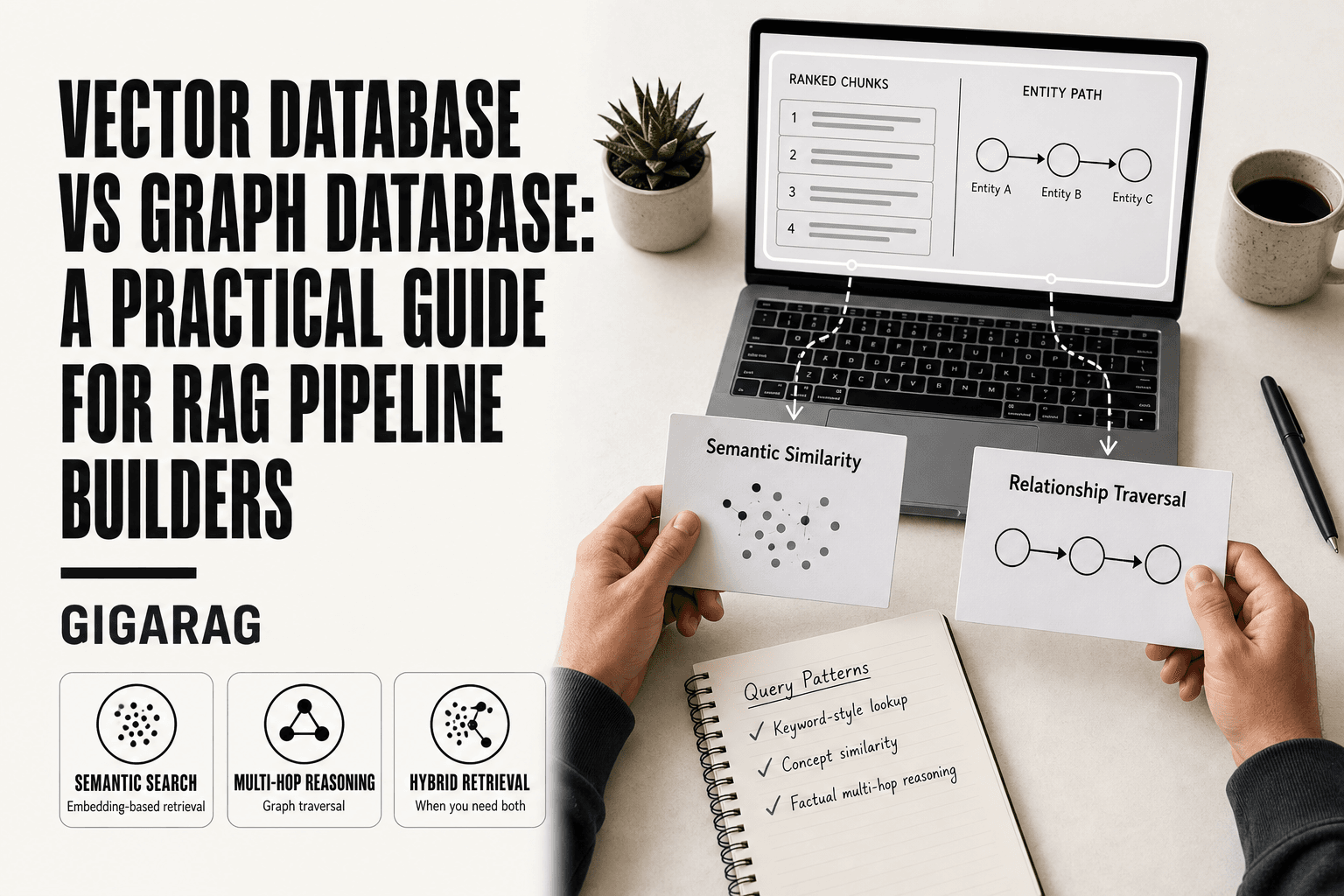
Vector Database vs Graph Database: A Practical Guide for RAG Pipeline Builders
Vector database vs graph database: the search results for this question are a mess. Most of what ranks is either a vendor pitch dressed up as a comparison, or a shallow definition piece that tells you what each database is without telling you which one to pick for your RAG pipeline and agent memory. That's a problem when you're the one who has to ship the thing.
The honest answer is that it depends on what your retrieval actually needs to do. Semantic similarity points one way. Entity relationships and multi-hop reasoning point another. Sometimes you need both, and sometimes neither is sufficient on its own. At GigaRAG, we've watched builders wrestle with this exact decision, and the wrong call shows up fast in retrieval quality and latency.
This guide covers what each database type can and cannot do for agent memory, the specific scenarios where you should not use each one, when hybrid retrieval is worth the added complexity, and a four-step framework to make the call for your pipeline.
| At a glance | Details |
|---|---|
| Core model | Vector: embeddings; Graph: nodes and edges |
| Best for | Vector: semantic similarity; Graph: relationship traversal |
| Agent memory fit | Vector: recall; Graph: state and reasoning |
| Hybrid option | Graph databases with vector indexes |
| Main trade-off | Similarity vs. structure and explainability |
| Decision driver | Query type: similarity vs. multi-hop |
In This Guide
- What Is a Vector Database?
- Vector Database vs Graph Database: Which Fits Your Agent Memory?
- What Is a Graph Database?
- Vector Database Vs Graph Database: A Step-by-Step Guide
- Vector Database vs Graph Database: Key Differences
- Agent Memory: What Each Database Type Can and Cannot Do
- RAG Pipeline Considerations: Retrieval Quality, Latency, and Maintenance
- When NOT to Use a Vector Database
- When NOT to Use a Graph Database
- Hybrid Retrieval: When You Need Both
- Decision Framework: Choosing the Right Database for Your RAG Pipeline
- Common Mistakes When Choosing a Vector Database vs Graph Database
- Final Thoughts
What Is a Vector Database?
A vector database stores embeddings — fixed-length arrays of numbers that represent meaning — and retrieves them by similarity, not by exact match. When you query it, you get back the items whose vectors sit closest to your query vector in high-dimensional space.
That's the whole trick. Everything else is engineering around it.
How vector databases store embeddings
An embedding is a list of floats, typically 384 to 3,072 of them, produced by an embedding model. Each dimension captures some abstract feature of the text, image, or audio it represents. You can't read these dimensions directly. What matters is the distance between vectors.
The database stores each embedding alongside its original payload: the chunk of text, the metadata, the document ID. When you insert data, you run it through the same embedding model, store the vector, and keep the payload for retrieval later.
Similarity search and approximate nearest neighbor (ANN)
Exact nearest-neighbor search over millions of vectors is too slow. You'd compare your query against every stored vector, and at 100 million rows that's a non-starter.
So vector databases use ANN indexes. The most common is HNSW, a graph-based index that skips most of the space and lands on vectors that are close enough. You trade a little recall for a lot of speed. Typical settings get you 95-99% recall at single-digit millisecond latency.
Cosine similarity is the default distance metric for text embeddings. Dot product and Euclidean distance show up too, but cosine is what most RAG pipelines use.
What vector databases excel at in RAG
Semantic search is the core job. You ask "how do I reset a user's password" and the database returns chunks about password recovery even when the words don't overlap with your query. That's the mechanism behind retrieval-augmented generation: find relevant context by meaning, stuff it into the LLM's context window, generate an answer grounded in what you retrieved.
Vector databases also handle scale well. Billions of vectors is routine for the dedicated engines. Filtering by metadata works too, though it adds complexity when you combine it with ANN search.
What they don't do: follow relationships between entities. If you need multi-hop reasoning across connected facts, a vector database alone won't get you there.
[!note] Vector databases and graph databases are not mutually exclusive; many modern graph databases now include vector indexes, and some vector databases support metadata filtering that mimics simple relationships.
Vector Database vs Graph Database: Which Fits Your Agent Memory?
| Factor | Vector Database | Graph Database |
|---|---|---|
| Primary strength | Semantic similarity search | Relationship traversal and multi-hop queries |
| Query style | Nearest-neighbor on embeddings | Pattern matching over nodes and edges |
| Agent memory use | Episodic recall, semantic cache | Entity state, reasoning chains, knowledge graphs |
| Explainability | Similarity scores only | Explicit paths and connections |
| Hybrid support | Some add metadata filters | Some add native vector indexes |
What Is a Graph Database?
A graph database stores data as nodes and edges, not rows and columns. Nodes are entities: a person, a document, a product. Edges are the relationships between them: "works at," "cites," "purchased." Both can carry properties, which are key-value pairs that describe them.
The model matters because it matches how relationships actually work. In a relational database, a "friend of a friend" query means joining a table to itself, then joining again. In a graph database, you start at a node and walk the edges. The query is the traversal.
Nodes, edges, and properties
A node is a thing. An edge connects two nodes and has a direction and a type. Properties attach to either one.
Here's a concrete example. You have a node for "Alice" and a node for "Acme Corp." An edge labeled "EMPLOYED_BY" points from Alice to Acme. That edge carries properties: start_date: 2021-03-15, role: engineer. Alice's node carries name, email, location.
The structure is explicit. You don't infer the relationship from a foreign key buried in a column. You see it as a first-class object in your data model.
Graph traversal vs. similarity search
Vector search asks: "What is similar to this?" Graph traversal asks: "What is connected to this, and what is connected to that?"
The difference shows up in query patterns. A vector database finds chunks that mean roughly the same thing as your query. A graph database follows paths: Alice works at Acme, Acme is headquartered in Berlin, Berlin is in Germany. Three hops, one query, no joins.
Traversal is deterministic. You get exactly the nodes and edges that match your pattern. Similarity search is probabilistic: you get results that are probably relevant, ranked by distance. Neither is better in general. They answer different questions.
What graph databases excel at in RAG
Multi-hop reasoning is the headline use case. When an answer requires connecting facts across multiple entities, a graph database retrieves the full path. You can see why the answer is what it is, because the edges are explicit.
Entity resolution also works well here. If your agent needs to know that "Alice Smith" in one document and "A. Smith" in another are the same person, a graph lets you merge those nodes and keep the connections intact. Vector search alone can't do that.
The main catch: graph databases don't do semantic similarity natively. You need a separate vector index or a hybrid setup if you want both.
[!tip] For RAG pipeline builders, start by prototyping with the database type that matches your most frequent query pattern, then add the other only if you hit a clear limitation—this avoids premature complexity.
Vector Database Vs Graph Database: A Step-by-Step Guide
- List your agent's memory and retrieval requirements (e.g., semantic recall, multi-hop reasoning, state tracking).
- Map each requirement to the database strength: similarity → vector, relationships → graph.
- Prototype with a small dataset using your actual queries to test performance and accuracy.
- Evaluate hybrid options if you need both similarity and structured traversal.
- Benchmark latency, cost, and operational complexity for your expected scale.
- Decide on a primary store and consider a secondary store for complementary needs.
- Document the decision and revisit as your agent's capabilities evolve.
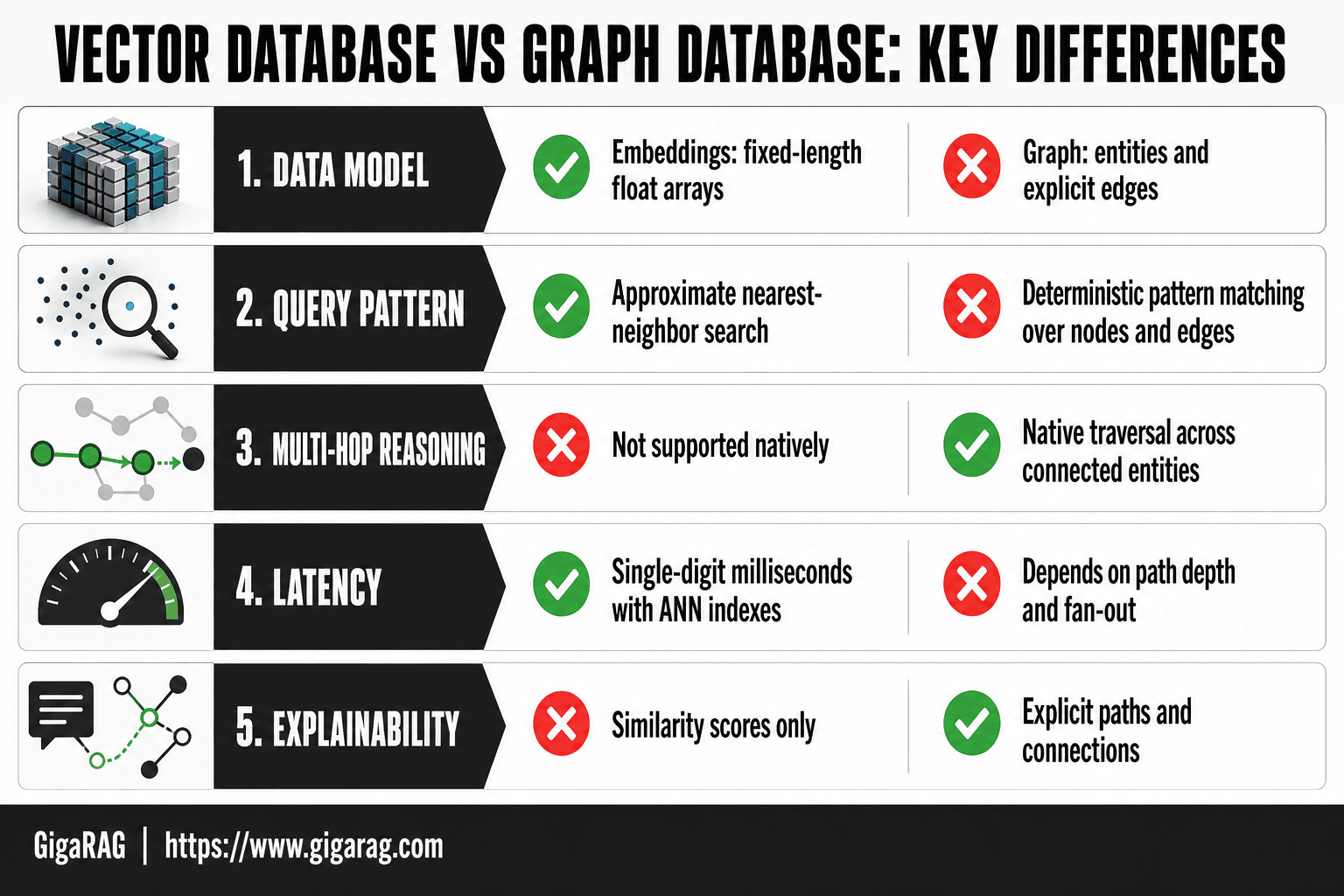
Vector Database vs Graph Database: Key Differences
The two database types answer different questions. A vector database asks, "What is similar to this?" A graph database asks, "What is connected to this?" That single distinction drives every other difference.
Data model: embeddings vs. entities and relationships
A vector database stores embeddings: fixed-length arrays of floats that represent meaning. Each chunk of text becomes a point in high-dimensional space. Relationships between chunks are implicit, encoded by proximity.
A graph database stores entities and edges explicitly. The relationship is the data. You can inspect it, query it, and traverse it. Nothing is inferred.
Query pattern: similarity search vs. graph traversal
Vector search is approximate. You get the k nearest neighbors, ranked by cosine similarity or another distance metric. Results are probably relevant, not guaranteed.
Graph traversal is deterministic. You specify a pattern: "find all documents cited by papers written by authors who work at Acme." You get exactly the nodes and edges that match. No ranking, no approximation.
Strength in multi-hop reasoning
This is where graph databases win outright. A three-hop query across entities is native to the model. Vector databases can't do multi-hop at all without external logic.
The honest answer: if your retrieval requires connecting facts across entities, a vector database alone won't get you there. You'll need a graph or a hybrid setup.
Latency and scalability considerations
Vector search scales horizontally with approximate nearest neighbor indexes like HNSW. Latency stays low even at billions of vectors, typically single-digit milliseconds. The trade-off is recall: ANN indexes sacrifice some accuracy for speed.
Graph traversal latency depends on path depth and fan-out. A shallow traversal is fast. A deep traversal across highly connected nodes can blow up. Graph databases don't scale as predictably as vector indexes when the graph gets dense.
Storage overhead and indexing
Vector indexes are memory-hungry. HNSW stores the graph structure plus the vectors themselves. Expect significant RAM usage at scale.
Graph databases store nodes, edges, and properties. Indexing is on properties and labels, not on the graph structure itself. Storage grows with the number of edges, which can exceed nodes by an order of magnitude in relationship-heavy data.
The main catch: neither is a drop-in replacement for the other. Choosing wrong means rebuilding your retrieval layer.
Agent Memory: What Each Database Type Can and Cannot Do
Agent memory is not one thing. It's conversation history, user preferences, entity relationships, and episodic recall. Each of those has a different shape. A database that handles one well can fail at another.
Storing conversation history and episodic memory
Conversation history is sequential text. Each turn has a timestamp, a speaker, and content. Episodic memory is the same, but chunked into meaningful episodes: "the time the user asked about refunds," "the project we discussed last Tuesday."
Vector databases handle this reasonably well. You embed each turn or episode, store it, and retrieve by semantic similarity. When the agent needs to recall "what did the user say about pricing," a similarity search surfaces relevant turns without exact keyword matching.
The catch is ordering. Vector search doesn't preserve sequence. If the agent needs the last five turns in order, you're adding a timestamp filter on top of the vector index. That works, but it's bolted on, not native.
Graph databases can store conversation turns as nodes with NEXT edges. Traversal preserves order. But semantic recall ("find turns about pricing") requires either full-text search or a vector index layered on top. Neither is free.
Modeling entity relationships and user preferences
This is where the two approaches diverge sharply.
User preferences are relational. "Alice prefers email over phone." "Alice works at Acme." "Acme is in the healthcare sector." Each of those is an edge between entities. A graph database stores them directly. Querying "what does Alice prefer" is a one-hop traversal.
A vector database can store preferences as text chunks and retrieve them by similarity. But it can't tell you that Alice works at Acme and Acme is in healthcare without you encoding that relationship somewhere else. The connection is implicit, not queryable.
The honest answer: if your agent needs to reason across entities, a graph database is the right tool. If it only needs to recall preferences by similarity, a vector database works.
What vector databases cannot do for agent memory
Vector databases can't traverse relationships. They can't answer "who else at Acme has the same preference as Alice" without external logic.
They can't preserve conversation order natively. You add timestamps and filter, but the index doesn't understand sequence.
They can't explain why a result was retrieved. The similarity score tells you how close, not why. For agent memory, that means debugging retrieval failures is guesswork.
They also struggle with sparse data. If an agent has few interactions with a user, there's little to embed. Similarity search on near-empty space returns noise.
What graph databases cannot do for agent memory
Graph databases can't do semantic similarity out of the box. If the agent needs to recall "turns that feel similar to this one," a pure graph database has no mechanism for that. You need embeddings and a vector index, which means you're running a hybrid anyway.
They're also heavier to operate. Schema design, edge modeling, and traversal optimization require real expertise. For a simple agent with a few hundred users, a graph database is overkill.
The main catch: neither database type solves agent memory alone. Conversation history leans vector. Entity relationships lean graph. Most production agents need both, which is why hybrid retrieval keeps coming up.
RAG Pipeline Considerations: Retrieval Quality, Latency, and Maintenance
The database choice matters less than what you do around it. Retrieval quality, latency, and maintenance are where pipelines actually fail. Here's what to weigh before you commit.
Retrieval quality: semantic relevance vs. relational precision
Semantic relevance and relational precision pull in different directions. Vector search finds passages that mean similar things. Graph traversal finds entities connected by explicit edges. Neither does both well.
The honest answer: it depends on what your queries look like. If users ask "what's the refund policy," semantic search is enough. If they ask "which of my teammates worked on the Acme deal," you need edges. Most production RAG pipelines see both query types. That's the argument for hybrid, but hybrid has its own cost, which we'll get to.
A practical test: log 50 real queries from your agent. Tag each one as semantic or relational. If more than 20% are relational, a pure vector database will fail those queries. If more than 20% are semantic, a pure graph database will fail those. That ratio tells you what you're actually building.
Latency budgets for real-time agent responses
Agents have a latency budget. Users tolerate about 2 to 3 seconds for an agent response. That includes retrieval, prompt assembly, and LLM generation. Retrieval gets maybe 200 to 500 milliseconds.
Vector search with HNSW indexes runs in single-digit milliseconds for millions of vectors. That's comfortable. Graph traversal is also fast for shallow queries: one or two hops complete in milliseconds. The problem is deep traversal. A five-hop query across a dense graph can take hundreds of milliseconds or more, depending on index quality and hardware.
The main catch: hybrid retrieval adds both latencies. You run vector search, then graph traversal, then merge results. If each takes 100 milliseconds, you've spent 200 before the LLM sees anything. That's workable, but you need to measure it. Don't assume.
Index maintenance and update frequency
Vector indexes degrade as data changes. HNSW indexes are built for static or slowly-changing datasets. If you're adding thousands of embeddings per hour, you need incremental indexing or periodic rebuilds. Rebuilds cost time and compute. Incremental indexing can reduce recall.
Graph databases have their own maintenance burden. Edge updates are cheap. Schema changes are not. Adding a new relationship type or property means migration, and migration on a live graph is riskier than adding a column to a vector store.
The honest answer: if your data changes constantly, budget for index maintenance. It's not a one-time cost. It's a recurring operational expense that most comparisons skip.
Operational complexity and team expertise
Vector databases are operationally simpler. You store embeddings, you query by similarity. Most teams can run one without a dedicated database engineer.
Graph databases are different. Schema design, edge modeling, and traversal optimization require real expertise. Cypher or Gremlin is a new query language to learn. Debugging slow traversals is harder than debugging slow vector queries.
If your team has no graph experience, a graph database will cost you months. If your team has graph experience, the relational queries become straightforward. It depends on who you have, not just what you're building.
When NOT to Use a Vector Database
Vector databases solve one problem well: finding things that are semantically similar. They solve nothing else. If your retrieval depends on explicit relationships, multi-step reasoning, or explaining why a result came back, a vector database will fail you in ways that are expensive to fix later.
When relationships drive the retrieval
Vector search treats every chunk as an independent point in space. It has no concept of "this person works for that company" or "this invoice belongs to that order." If your agent needs to answer "who approved this expense," embeddings won't help. The relationship isn't in the text. It's in the structure.
The honest answer: if more than a fifth of your real queries are relational, you're building on the wrong foundation. You'll end up bolting a graph on later anyway.
When multi-hop reasoning is required
Multi-hop questions need chains: "What policy covers the vendor that filed this complaint?" That's two hops. Vector search can retrieve the complaint and the policy separately, but it can't connect them. The LLM has to do the reasoning with whatever chunks happen to rank high enough to fit in the context window.
That works sometimes. It fails when the intermediate entity isn't in the top-k results. If the vendor's name doesn't appear in the complaint chunk, the chain breaks. A graph traversal follows the edge directly. Vector search hopes the embedding happens to be close.
When explainability matters
Vector databases can't tell you why a result came back. Cosine similarity is a number, not a reason. If you're building a system where users or auditors need to understand retrieval decisions, that's a problem.
Graph databases give you a path: this node, via this edge, to that node. You can show the trail. Vector search gives you a score and a shrug. For regulated industries or anything where a wrong answer has consequences, that difference matters more than raw retrieval quality.
When NOT to Use a Graph Database
Graph databases solve relationship problems. They don't solve similarity problems. If your agent memory is mostly unstructured text and your queries are "find me things like this," a graph database adds cost without adding value.
When semantic similarity is the primary need
Graph traversal matches exact structure. It follows edges that exist. It does not find "close enough" meaning. If your agent needs to retrieve "that conversation where the user was frustrated about billing," a graph won't help unless someone already tagged that conversation with a frustration node and a billing edge.
Vector search handles this natively. You embed the query, find the nearest chunks, done. Building the same capability in a graph means maintaining an embedding index alongside the graph anyway. At that point you're running a hybrid system with extra steps.
When data is unstructured and relationship-light
Most RAG pipelines start with documents, PDFs, support tickets, meeting notes. These are blobs of text with no clean entity structure. Extracting nodes and edges from them requires an entity resolution pipeline: named entity recognition, coreference resolution, relationship classification. That's real engineering work.
If your data doesn't have obvious entities that connect to each other, you're spending weeks building a graph that adds nothing. The honest answer: if you can't name the specific relationships your queries will traverse, you don't need a graph yet.
When operational simplicity is a priority
Graph databases are harder to run. Cypher is a new query language for most teams. Indexing strategies differ from relational or vector databases. Tuning traversal performance is a skill that takes months to build.
A vector database is simpler: store embeddings, run similarity search, return results. If you're a small team shipping an agent this quarter, the operational overhead of a graph may cost you more than the retrieval quality gain is worth. Start with vectors. Add a graph when a specific relationship-driven query pattern proves itself necessary.
Hybrid Retrieval: When You Need Both
Vector search finds meaning. Graph traversal finds connections. Most real agent memory problems need both. A user asks "what did I say about the Smith account last month?" That's semantic similarity plus a relationship constraint. Neither database type answers it alone.
What hybrid retrieval looks like in practice
You run two indexes. The vector index holds embeddings for every chunk of conversation, document, or memory. The graph holds entities and edges: users, accounts, projects, and the relationships between them.
A query hits both. The vector index returns the 20 most semantically similar chunks. The graph expands from the entities mentioned in the query, pulling connected nodes and their properties. You merge the two result sets, re-rank, and send the top chunks to the LLM.
The merge is where the value lives. Vector results that also appear in the graph expansion get boosted. Graph results that are semantically distant get filtered out. You get precision from the graph and recall from the vectors.
When hybrid is worth the added complexity
Hybrid retrieval doubles your infrastructure. Two databases, two indexing pipelines, two query paths, and a merge layer. That's real operational cost.
It's worth it when your queries consistently mix similarity and relationship constraints. Agent memory for customer support is the classic case: "find previous conversations about this product issue from this customer." The product issue is semantic. The customer is a relationship. Neither index handles both well.
It's also worth it when multi-hop reasoning is a hard requirement. If your agent needs to answer "who else on the team worked with this vendor," that's traversal. If it also needs "and what did they say about the contract," that's similarity. Hybrid is the only path.
Common hybrid architectures for agent memory
The simplest architecture: one database that does both. Neo4j supports vector indexes alongside graph traversal. MongoDB and PostgreSQL do the same. You store embeddings as node properties or document fields, run ANN search, then traverse from the hits.
The trade-off: these combined systems are rarely best-in-class at either task. A dedicated vector database like Pinecone or Qdrant will beat Neo4j's vector search on raw ANN performance. A dedicated graph database will beat MongoDB's traversal on deep multi-hop queries.
The alternative: two specialized systems with a merge layer. More moving parts, but each component does one thing well. You pay for it in integration work and operational complexity.
Start with one database. Add the second when a specific query pattern fails repeatedly. Hybrid is a response to measured pain, not a default.
Decision Framework: Choosing the Right Database for Your RAG Pipeline
You've seen what each database type can and cannot do. Now you need a way to decide for your specific case. This framework walks through four checks. Run them in order. Each one eliminates options.
Step 1: Assess your data structure
Look at what you're actually storing. Is it mostly unstructured text: conversation logs, documents, support tickets? That's vector territory. Embeddings capture meaning without you having to define a schema.
Is your data mostly entities with known relationships: users, accounts, products, permissions? That's graph territory. The relationships are the data, not an afterthought.
Most agent memory systems have both. The question is which dominates. If 80% of your queries need semantic similarity and 20% need relationship traversal, start with a vector database. If the split is closer to 50/50, you're heading toward hybrid.
Step 2: Define your query patterns
Write down the five most common queries your agent will run. Not the ones you hope it runs. The ones it actually runs every day.
"Find similar past conversations" is a vector query. "Who reported to this manager during Q3" is a graph query. "Find what this customer said about billing issues" is both.
Count them. If four of five are similarity queries, a vector database handles your workload. If three of five require traversal or multi-hop reasoning, a graph database earns its complexity. If the split is even, hybrid is the honest answer.
Step 3: Evaluate latency and scale requirements
Vector search is fast. ANN indexes return results in single-digit milliseconds at millions of embeddings. Graph traversal is slower, especially multi-hop queries that fan out across thousands of nodes.
If your agent responds in real time and every query hits the database, latency matters. A 50ms vector lookup is fine. A 400ms graph traversal might not be.
Scale matters too. Vector indexes grow linearly with your data. Graph databases grow with your relationships, which can explode combinatorially. A user with 50 connections is trivial. A user with 5,000 edges across a shared graph is a different problem.
Step 4: Consider your team's operational capacity
This is where most decisions actually get made, whether you admit it or not.
A vector database is operationally simple. You index embeddings, you query embeddings. One moving part.
A graph database requires schema design, relationship modeling, and a query language like Cypher or Gremlin. That's a skill set most teams don't have on staff. If you're the only person who can write graph queries, you've built a single point of failure.
Hybrid doubles the operational surface. Two systems, two failure modes, two upgrade cycles.
The honest rule: pick the simplest database that handles your top five queries. Add complexity only when a measured query pattern fails.
Common Mistakes When Choosing a Vector Database vs Graph Database
Most bad database decisions happen before any code is written. The team picks a tool based on a conference talk or a vendor benchmark, then spends six months working around the mismatch. Here are the three mistakes I see most often.
Assuming vector search solves all retrieval problems
Vector search is good at one thing: finding text that means something similar to your query. It is not good at following relationships, enforcing constraints, or explaining why something was retrieved.
If your agent needs to answer "which of this user's past orders shipped late," embeddings won't help. That's a traversal question. The vector index will return vaguely related chunks and you'll patch the gap with prompt engineering. It won't hold.
Overlooking index maintenance costs
Vector indexes are not free after the initial build. Every new document, every updated conversation, every deleted record changes the index. ANN structures like HNSW degrade as data shifts. You rebuild, you re-tune, you monitor recall.
Teams budget for storage and compute. They don't budget for the person who owns index quality. That person is you, and it's a recurring cost, not a one-time setup.
Ignoring the operational complexity of graph databases
Graph databases look elegant in diagrams. Nodes, edges, clean traversal paths. In production, you're designing schemas, writing Cypher, debugging fan-out queries that touch 10,000 nodes, and explaining to your team why the graph is slow this week.
If nobody on your team has run a graph database in production before, you're signing up for a learning curve that lands during your busiest quarter. That's not a reason to avoid graphs. It's a reason to be honest about the cost before you commit.
Final Thoughts
The vector database vs graph database decision comes down to one question: what is your retrieval actually asking for? If it's "find text similar to this query," a vector database does the job. If it's "follow the relationships between these entities," you need a graph.
Most agent memory systems need both. Conversation history and preferences are episodic, unstructured, and embedding-friendly. Entity relationships and multi-hop reasoning are structural, and embeddings alone won't get you there. The honest answer is that neither database type is sufficient for every agent memory workload.
Start with your query patterns. If you can't name the traversal your agent will run, don't buy a graph database. If you can't name the similarity search your agent will run, don't buy a vector database.
If you're building a RAG pipeline and want to see how these pieces fit together, GigaRAG is a resource worth checking. It's built for people shipping retrieval systems, not for people reading vendor benchmarks.
Frequently Asked Questions
Are vector databases still a thing?
Yes, vector databases remain widely used for semantic search and retrieval-augmented generation. They are particularly effective when your primary need is finding similar items based on meaning rather than exact matches.
Is Neo4j a vector database?
Neo4j is primarily a graph database, but recent versions have added vector index capabilities. This allows you to perform similarity searches alongside graph traversals, making it a hybrid option for some RAG use cases.
Is MongoDB a vector DB?
MongoDB is a document database that has introduced vector search features in some offerings. It can handle vector similarity queries, but its core strength remains flexible document storage rather than pure vector operations.
Is SQL a vector database?
Traditional SQL databases are not vector databases, but some have added vector extensions or data types. They can store vectors and perform similarity searches with additional tooling, though they may not match dedicated vector databases in performance.
Can I use a graph database for RAG?
Yes, graph databases can be used for RAG, especially when your retrieval needs involve relationships between entities. They excel at multi-hop reasoning and providing explainable paths, which can enhance agent memory.
What is the best database for agent memory?
The best database depends on your agent's memory requirements. If you need to recall similar past interactions, a vector database is often suitable. If you need to track state and relationships, a graph database may be better. Hybrid approaches are increasingly common.
About GigaRAG
GigaRAG is for agent memory and RAG pipeline builders. get this right. Whether you are working through vector database vs graph database or something adjacent, we publish what we have actually tested, including where it falls short.


