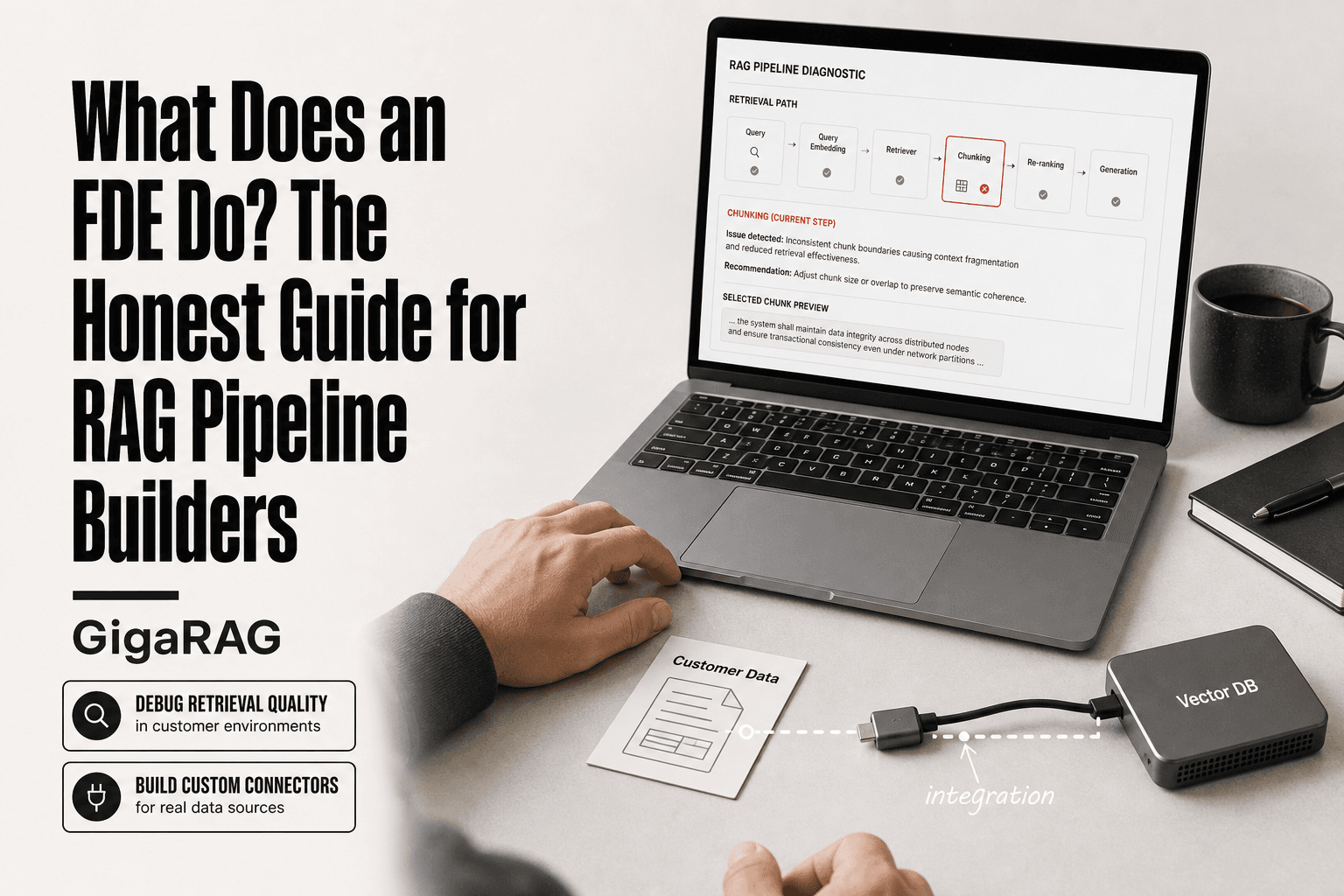
What Does an FDE Do? The Honest Guide for RAG Pipeline Builders
What does an FDE do? It's a fair question, because the title gets thrown around a lot and most of what you'll read is either Palantir mythology or vague consulting-speak. An FDE is an engineer who sits between your product team and your customer, writing integration code and debugging real environments instead of shipping features from a desk. If you build RAG pipelines or agent memory systems, this role matters to you for one reason: your retrieval quality problems don't show up in your test suite. They show up in a customer's vector database, with their chunking strategy, their embeddings, and their data. An FDE is the person who goes in and fixes it. Tools like GigaRAG can help, but the FDE is the one who knows where to point it. Here's what an FDE actually does day-to-day, what they can't do, and whether the role is worth it for your team.
| At a glance | Details |
|---|---|
| Role | Embedded engineer solving customer problems |
| Focus | Deploy, adapt, and harden AI systems |
| Key Skills | Coding, communication, domain learning |
| Typical Background | Software engineering plus customer-facing experience |
| Compensation | Competitive; varies by company and location |
| Not For | Those avoiding travel or ambiguous problems |
In This Guide
- What Is a Forward Deployed Engineer?
- FDE vs. Core Software Engineer: What's the Difference?
- What Does an FDE Actually Do Day-to-Day?
- What Does An FDE Do: A Step-by-Step Guide
- FDE Work on RAG Pipelines and Agent Memory Systems
- What an FDE Cannot Do (and Should Not Be Expected to Do)
- FDE vs. Solutions Engineer vs. Consultant: What's the Difference?
- What Skills Does an FDE Need?
- How Much Do FDEs Get Paid?
- Is a Forward Deployed Engineer Worth It?
What Is a Forward Deployed Engineer?
A forward deployed engineer (FDE) is a software engineer who works inside customer environments, building and debugging integrations between a vendor's product and the customer's actual data, infrastructure, and workflows. They sit between product engineering and customer success, but they write real code.
The one-sentence definition
An FDE is an engineer assigned to a customer, not a codebase. They take whatever the product team shipped and make it work in the customer's environment, which is always messier than the demo.
Where the role came from (briefly, without the Palantir worship)
Palantir popularized the title in the late 2000s. The company sent engineers to government and enterprise clients because its data integration tools needed heavy customization to work on real deployments. The pattern spread to other infrastructure and AI companies because the problem it solved was universal: products that work in a sandbox often fail on real customer data.
What FDEs are not
They are not sales engineers running demos. They are not customer support triaging tickets. They are not consultants writing reports and leaving. An FDE writes code in production environments, often under the customer's security constraints, and stays attached to the account long enough to see the integration through.
The main catch is that the role varies wildly between companies. Some FDEs spend 80% of their time on customer calls. Others are heads-down building connectors. The title tells you less than the company's actual deployment model does.
[!note] An FDE is not a sales engineer or a support engineer; the role blends engineering, consulting, and product feedback, and responsibilities vary widely by company.
FDE vs. Core Software Engineer: What's the Difference?
| Factor | Forward Deployed Engineer | Core Software Engineer |
|---|---|---|
| Primary Focus | Customer-specific deployment and adaptation | Product development and scalability |
| Work Environment | Often on-site or embedded with customer teams | Usually in company offices or remote |
| Success Metric | Customer satisfaction and successful deployment | Product quality, performance, and adoption |
| Skill Emphasis | Broad technical and strong communication | Deep technical specialization |
| Travel Expectation | High; frequent customer visits | Low; occasional travel |
What Does an FDE Actually Do Day-to-Day?
The honest answer: it depends on the company, the customer, and the week. But the shape is consistent. An FDE splits time between three things: fixing what's broken in customer environments, building what's missing, and telling the product team what they learned.
Morning: triaging customer issues and reading production logs
Most FDEs start the day in the customer's logs. A pipeline failed overnight, a query returned empty results, an embedding job timed out. The FDE's job is to figure out whether the problem is the product, the customer's data, or the integration between them.
In practice, this means reading stack traces, checking API rate limits, and reproducing the failure locally. You'll often find the issue is not the vendor's code. It's a schema change the customer made without telling anyone, or a firewall rule that blocks outbound calls.
Midday: writing integration code and debugging customer environments
The middle of the day is for building. An FDE writes connectors between customer systems and the vendor's product, custom scripts for data transformation, or patches to work around quirks in the customer's infrastructure.
Here's a concrete example. A customer stores documents in a legacy SharePoint instance with non-standard metadata. The FDE writes a connector that extracts the documents, normalizes the metadata, and feeds them into the vector database. Then they debug why the connector fails on files over 50MB. Then they fix it.
Afternoon: translating customer feedback into product requirements
The afternoon is for closing the loop. An FDE takes what they saw in the morning and turns it into something the product team can act on. Not "the customer is unhappy" but "the customer's retrieval quality drops 40% on PDFs with scanned tables because the chunking strategy splits rows across chunks."
This is the part of the job most people miss. The FDE is not just a firefighter. They're the person who knows, with specificity, where the product breaks on real data.
What this looks like on a RAG pipeline team specifically
On a RAG pipeline team, the day-to-day is even more concrete. You'll spend time debugging why retrieval returns irrelevant chunks for a specific customer's query patterns. You'll tune embedding models for domain-specific vocabulary that general models handle poorly. You'll help customers design agent memory schemas that balance recall against context window limits.
The work is hands-on and technical. You're not advising from a distance. You're in the code, in the logs, and in the customer's data, making the pipeline actually work.
[!tip] If you're building RAG pipelines, treat your FDE as a shortcut to real-world usage patterns—ask them to share anonymized query logs and failure cases to improve your retrieval and ranking.
What Does An FDE Do: A Step-by-Step Guide
- Understand the customer's data sources and retrieval needs.
- Design and prototype a RAG pipeline tailored to their use case.
- Integrate the pipeline with existing systems and APIs.
- Test and iterate based on real-world queries and feedback.
- Deploy to production and monitor performance.
- Train customer teams on usage and maintenance.
- Document customizations and hand off to support.
FDE Work on RAG Pipelines and Agent Memory Systems
Most FDE guides stop at the generic. Here's what the work actually looks like when the product is a RAG pipeline or an agent memory system.
Debugging retrieval quality in customer environments
Retrieval quality is the first thing customers complain about, and the hardest thing to debug remotely. An FDE sits in the customer's environment, runs their actual queries, and watches what comes back.
The work is systematic. You start with a query that returns bad results. You check whether the right chunks exist in the vector database at all. If they don't, the problem is ingestion. If they do but retrieval misses them, the problem is embedding or indexing. If retrieval finds them but the LLM ignores them, the problem is prompting or context assembly.
Most retrieval bugs are not model problems. They're data problems: duplicate chunks, stale documents, metadata that doesn't match what the query expects.
Tuning chunking and embedding strategies for specific customer data
General-purpose chunking fails on real customer data. Legal contracts need clause-level chunks. Code repositories need function-level chunks. Support tickets need thread-level chunks.
An FDE tests chunk sizes and overlap on the customer's actual documents, not a benchmark dataset. They measure recall on a sample of the customer's own queries. Then they tune the embedding model, often switching from a general model to one fine-tuned on the customer's domain vocabulary.
The honest answer: this is iterative. You run a chunking strategy, evaluate, adjust, repeat. There's no one-size-fits-all setting.
Helping customers design agent memory schemas
Agent memory is where most teams get stuck. What should the agent remember? For how long? Where does it live?
An FDE helps the customer answer these concretely. Short-term memory goes in the conversation context. Long-term memory goes in a vector store with metadata for time, source, and confidence. Episodic memory gets summarized and compressed to fit context windows.
The main catch: memory schemas are product decisions, not just technical ones. An FDE can build the schema, but the customer has to decide what's worth remembering.
Writing custom connectors between customer data sources and vector databases
Every customer has a weird data source. A legacy CRM with no API. A file share with inconsistent formats. A database with a schema nobody documented.
The FDE writes the connector. They handle authentication, rate limits, incremental sync, and error handling. They normalize the data into a shape the vector database can index. Then they document what they built so the customer's team can maintain it.
This is the most underrated part of FDE work on RAG pipelines. The model and the vector database are commodities. The connectors are where the real integration work happens.
What an FDE Cannot Do (and Should Not Be Expected to Do)
The FDE role gets oversold. Here's the honest list of what it won't fix, no matter how good the engineer is.
FDEs are not a replacement for product engineering
An FDE works on customer deployments. They don't own the core product roadmap, and they shouldn't. When a customer asks for a feature that belongs in the product itself, the FDE can prototype it, document the need, and push it back to the product team. They cannot ship it into the main codebase without becoming product engineers themselves.
The line blurs in practice. Small startups sometimes use FDEs as de facto product engineers because they're short-staffed. That's a staffing decision, not a job description. It burns people out and produces inconsistent code.
FDEs cannot fix fundamental product flaws
If your retrieval quality is bad for every customer, an FDE won't save you. They can tune chunking for one customer's data. They can't rewrite your ingestion pipeline or replace your embedding model across the board.
Here's what happens behind the scenes: the FDE patches the symptom for one account, the same issue shows up for the next account, and the FDE becomes a permanent bandage. The fix belongs in the product, not in the deployment.
FDEs should not be expected to be on-call forever
Deployment is a phase. It ends. If an FDE is still answering production pages six months after go-live, something is wrong with the handoff.
The goal is to make the customer self-sufficient. The FDE documents what they built, trains the customer's team, and steps back. If the customer can't run the system without the FDE, the deployment failed.
FDEs are not a substitute for good documentation
An FDE can explain your product to one customer at a time. Documentation explains it to every customer at once. If your docs are thin, the FDE becomes a human FAQ, which is the most expensive support channel you can build.
The honest answer: hire an FDE to handle the messy, customer-specific integration work. Don't hire one to compensate for a product that's hard to understand or a pipeline that breaks under real data.
FDE vs. Solutions Engineer vs. Consultant: What's the Difference?
The titles blur because all three roles sit between engineering and customers. The difference is in what they own and how long they stay.
FDE vs. solutions engineer
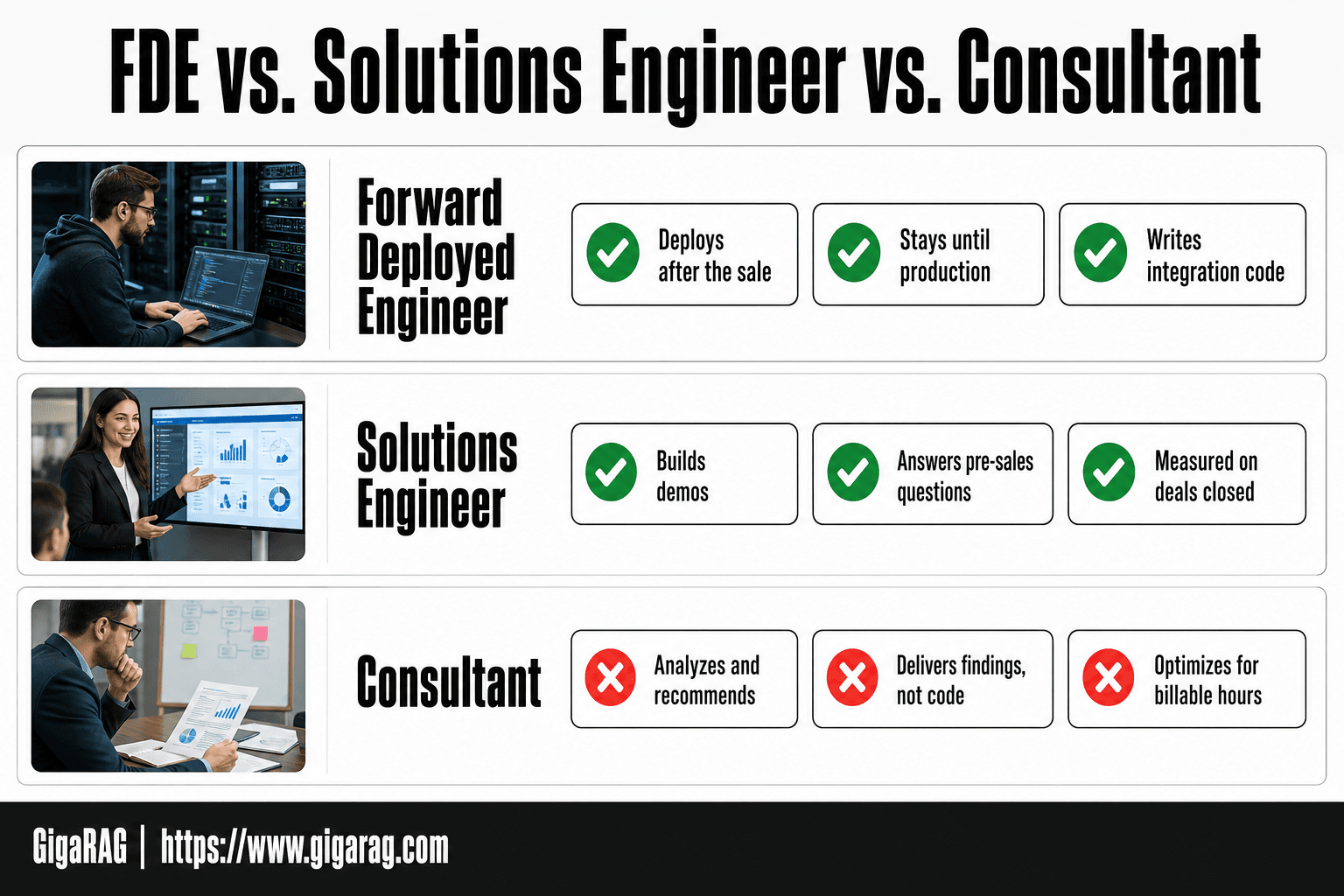
A solutions engineer sells. They build demos, answer technical questions during procurement, and prove the product can work for a prospect. Once the contract is signed, they move to the next deal.
An FDE deploys. They show up after the sale and stay until the customer is running in production. The SE's demo is a stage set. The FDE's integration is the actual building, with real data, real security constraints, and real failure modes.
The overlap is real. At small companies one person does both jobs. But the incentives differ: an SE is measured on deals closed, an FDE on customers successfully deployed.
FDE vs. consultant
A consultant advises. They analyze, recommend, and leave. The customer's team implements the recommendations, or doesn't.
An FDE builds. They write the connector, tune the chunking strategy, and debug the retrieval failure themselves. The deliverable is working code in the customer's environment, not a slide deck or a findings report.
Consultants optimize for billable hours. FDEs optimize for the customer not needing them anymore. That's the cleanest way to separate the two.
FDE vs. AI engineer
An AI engineer builds the models, the training pipelines, or the core retrieval system. They work on the product itself.
An FDE applies that product to a specific customer's mess. The AI engineer asks "does this model work?" The FDE asks "does this model work on this customer's legal documents, which are scanned PDFs with handwritten margin notes?"
The FDE needs enough AI knowledge to debug embeddings and retrieval quality. They don't need to train models from scratch. When the AI engineer's system breaks on real data, the FDE is the one who finds out first and patches the gap.
What Skills Does an FDE Need?
The skill set splits into three buckets. You need enough of each to be dangerous, and depth in at least one.
Technical skills: coding, debugging, infrastructure
You'll write Python or TypeScript daily. Not production-grade systems code, but integration code: connectors, scripts, small services that move data between customer systems and yours. Debugging matters more than building. You'll spend hours tracing why a retrieval call returns empty results in one customer's environment but not another. Infrastructure knowledge means you can read logs, check environment variables, and understand why a container won't start. You don't need to be a DevOps engineer, but you need to not be afraid of a terminal.
Customer-facing skills: communication, expectation setting
The hard skill is saying no without losing trust. Customers ask for things the product can't do. You have to say "that won't work" and explain why in plain language, then offer what will work. Expectation setting is the difference between a customer who renews and one who churns. You'll write more Slack messages than code some weeks. That's the job.
AI-specific skills: embeddings, retrieval, vector databases
For RAG work specifically, you need to understand what an embedding is, why chunk size changes retrieval quality, and how to debug a vector search that returns irrelevant results. You should be able to read a similarity score and know if it's meaningful. You don't need to train models. You need to know when the retrieval is broken and roughly why.
What you don't need
A PhD. Model training experience. Deep learning research. Most FDEs learn embeddings and vector databases on the job. The core skill is debugging under pressure with a customer watching.
How Much Do FDEs Get Paid?
The honest answer is: it depends on the company, the location, and whether you count equity. Base salary alone tells you half the story.
Salary ranges at major FDE employers
Palantir, the company that coined the role, pays FDEs roughly $120,000 to $180,000 base in the US (verify at publish). Total compensation with equity and bonuses can push past $200,000. OpenAI and other AI companies hiring FDEs for RAG and agent work tend to pay higher, often $180,000 to $250,000 base for senior FDEs (verify at publish). Early-stage startups pay less in cash, more in equity. A seed-stage FDE might take $90,000 base with meaningful ownership.
How FDE compensation compares to other engineering roles
FDEs typically earn 10 to 20 percent less than product engineers at the same level. The gap closes when you factor in travel bonuses, customer success incentives, and the faster path to leadership roles. FDEs move into management or solutions architecture sooner because they see more of the business. That's the trade: slightly lower cash now, broader options later.
Is a Forward Deployed Engineer Worth It?
The honest answer is: it depends on what you're buying. For a RAG pipeline team, an FDE is worth it when customer deployments keep failing in ways your product engineers can't see from inside the building. Not worth it when you're hiring one to paper over a product that isn't ready.
When hiring an FDE makes sense
Hire an FDE when you have paying customers whose data is messy, whose environments are locked down, and whose retrieval quality drops the moment they go to production. That's the signal. An FDE who can sit in a customer's VPC, read their logs, and tune chunking parameters on real data will pay for themselves in renewals. If you're selling agent memory systems, the FDE is the person who figures out why a customer's embeddings drift after three weeks.
When it doesn't
Don't hire an FDE if you have no customers yet. Don't hire one to write your core product. Don't hire one because Palantir has them. An FDE amplifies what already works. If your RAG pipeline breaks on clean data, an FDE won't fix it. They'll just document the breakage faster.
Career considerations for aspiring FDEs
The role is worth it if you want breadth over depth. You'll touch infrastructure, product, sales, and support in one week. You won't go as deep on any single system as a product engineer. The travel is real. The context switching is constant. If you like fixing things in other people's houses more than building your own, it's a good fit.
What does an FDE do? The honest answer is that they make your product work on real customer data, and they tell you exactly where it breaks. Tools like GigaRAG can help with the retrieval layer, but the FDE is the one who knows which customer, which data source, and which failure mode needs attention first. If you build RAG pipelines or agent memory systems, that's the person you want in the room when the demo ends and the real deployment starts.
Frequently Asked Questions
How much do FDEs get paid?
FDE compensation varies by company, location, and experience. It typically includes a base salary and may include equity or bonuses. For accurate ranges, check levels.fyi or Glassdoor for specific companies.
Is a forward deployed engineer a high paying job?
Yes, FDE roles are generally well-compensated, often comparable to or higher than core engineering roles due to the combination of technical and customer-facing skills. However, exact figures depend on the employer and market.
What skills does an FDE need?
Key skills include software engineering (e.g., Python, APIs), system design, data handling, and strong communication. Domain knowledge and the ability to learn quickly are also crucial.
Is a forward deployed engineer worth it?
For companies selling complex technical products, FDEs can accelerate adoption and reduce churn by ensuring customers succeed. For individuals, it's a rewarding role if you enjoy variety and direct impact.
What does an FDE do in AI?
In AI, FDEs help customers deploy and customize AI models and pipelines, such as RAG systems. They bridge the gap between the core AI product and the customer's specific data and workflows.
What is the difference between an FDE and a solutions engineer?
FDEs are typically more hands-on with coding and system integration, while solutions engineers focus more on pre-sales technical support. The lines can blur, but FDEs often stay involved post-sale.
About GigaRAG
GigaRAG is for agent memory and RAG pipeline builders. get this right. Whether you are working through what does an FDE do or something adjacent, we publish what we have actually tested, including where it falls short.


