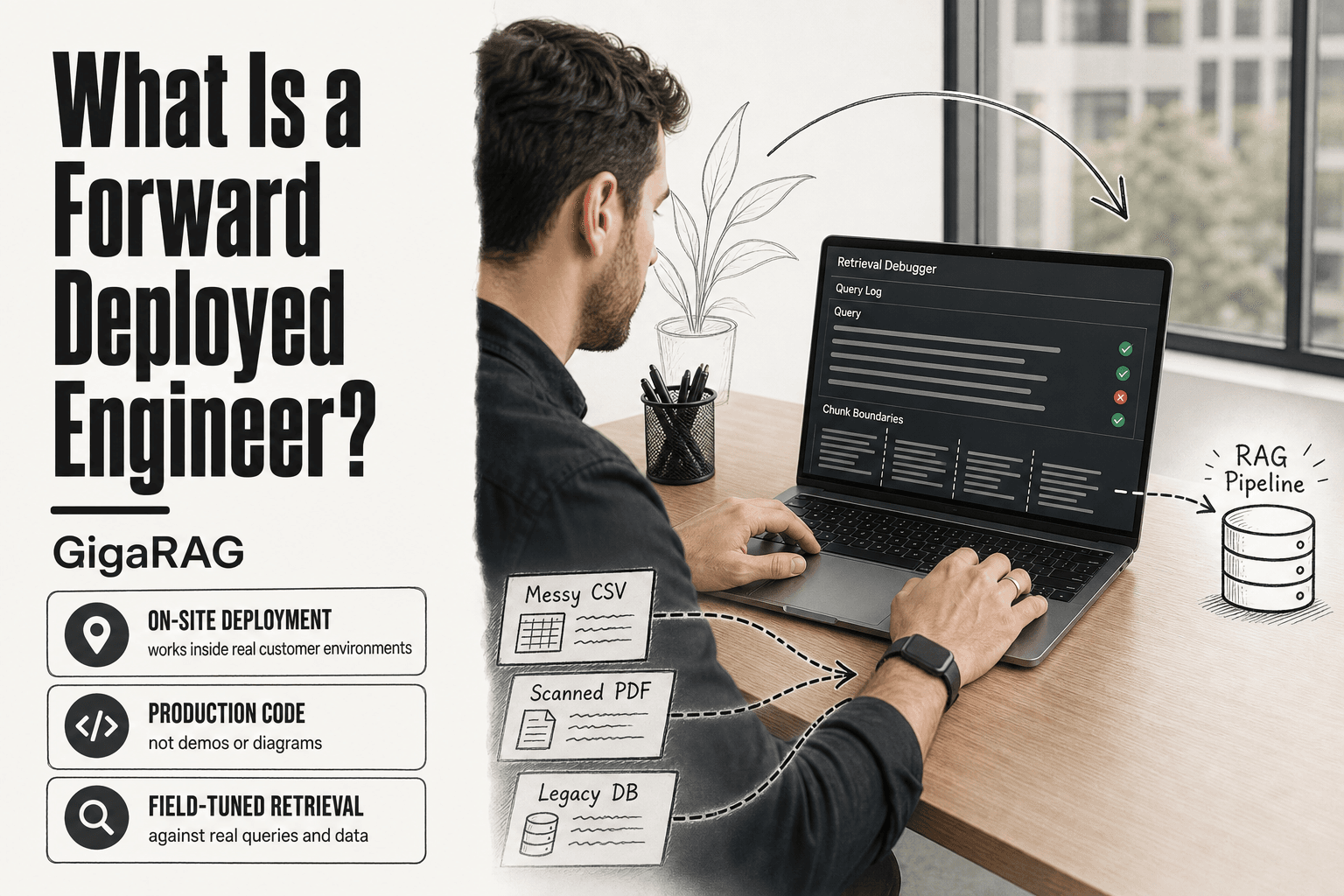
What Is a Forward Deployed Engineer?
What is a forward deployed engineer? For technical builders working on RAG pipelines and agent memory systems, the term shows up constantly now, usually attached to AI startups hiring for roles that sound like engineering plus consulting plus sales. The honest answer is simpler than the buzz suggests. An FDE is an engineer who works on-site with a customer to deploy, integrate, and customize a product, then brings what they learned back to the product team. Palantir coined the title, but the model has spread because AI infrastructure breaks in customer-specific ways that no internal test suite catches. If you're building retrieval systems or memory layers, you may already be doing FDE-style work without the title. GigaRAG, for instance, is a tool for agent memory and RAG pipeline builders who often find themselves debugging a customer's vector store at 11pm. This guide covers what FDEs actually do, how the role differs from sales engineers and solutions architects, what it means for retrieval and memory work, and where the model fails.
| At a glance | Details |
|---|---|
| Core definition | Engineer embedded at customer site to build and ship solutions |
| Origin | Popularized by Palantir; now common in AI infrastructure |
| Key difference | Customer-facing, deployment-focused, not just product engineering |
| Typical background | Software engineering with strong communication and domain skills |
| Main trade-off | High impact and travel vs. deep product ownership |
| Relevance to RAG | Directly applicable to retrieval tuning and memory architecture |
In This Guide
- What Is a Forward Deployed Engineer?
- Forward Deployed Engineer vs. Product Engineer
- Where the Role Came From: Palantir and the FDE Origin Story
- What Is A Forward Deployed Engineer: A Step-by-Step Guide
- What a Forward Deployed Engineer Actually Does
- How an FDE Differs From a Sales Engineer or Solutions Architect
- What a Forward Deployed Engineer Means for RAG Pipeline Builders
- FDE Work in Agent Memory Systems
- What FDEs Cannot Do: Honest Limitations
- An Actionable Checklist for Applying FDE Principles to Your RAG Work
- Forward Deployed Engineer Salary and Career Path
- Final Thoughts on the Forward Deployed Engineer Role
What Is a Forward Deployed Engineer?
A forward deployed engineer (FDE) is a software engineer who works on-site with a customer to build, integrate, and deploy a product inside that customer's environment, not just hand over code and walk away. The role blends engineering with implementation, and it started at Palantir before spreading to AI companies.
The one-sentence definition
An FDE ships working software inside a real customer's systems, then stays to make it work in production. That's the whole job. Not demos. Not slide decks. Working code, deployed where the customer actually runs it.
Why the "forward" part matters
"Forward" means the engineer sits with the customer, not back at headquarters. You see the data as it actually exists: messy, incomplete, structured in ways nobody documented. That changes what you build. A product team working from clean sample data ships something that breaks on contact with reality. An FDE builds against the real thing from day one.
What FDEs are not
They're not sales engineers closing deals. They're not solutions architects drawing diagrams. They're not customer support triaging tickets. An FDE writes code, debugs integration failures, and owns the deployment until it holds. The title confuses people because the role overlaps with all three. The distinction is ownership: an FDE is accountable for the thing working, not just for explaining it or selling it.
[!note] A forward deployed engineer is not a support engineer or a sales engineer; the role involves writing production code and making architectural decisions, often under tight deadlines.
Forward Deployed Engineer vs. Product Engineer
| Factor | Forward Deployed Engineer | Product Engineer |
|---|---|---|
| Primary focus | Customer-specific deployment and integration | General product features and scalability |
| Work location | Often on-site or embedded with customer teams | Usually at company headquarters or remote |
| Feedback loop | Immediate, direct from customer usage | Indirect, via product managers and analytics |
| Success metric | Customer outcomes and adoption | Product adoption and feature performance |
| Skill emphasis | Adaptability, communication, rapid prototyping | Deep technical specialization, long-term architecture |
Where the Role Came From: Palantir and the FDE Origin Story
Palantir didn't invent the idea of engineers working alongside customers. It did something more specific: it made that work the product. The company's early contracts with intelligence agencies and large banks involved data so sensitive it couldn't leave the building. So the engineers had to go to it.
Palantir's "Delta" model
Palantir's internal name for an FDE was "Delta." The term came from the military: a Delta is the operator embedded with a unit, not the analyst back at base. Palantir Deltas lived at customer sites for months at a time, wiring Palantir's Gotham and Foundry platforms into whatever databases, spreadsheets, and legacy systems the customer actually used. The work was unglamorous: schema mapping, data cleaning, building the connectors nobody had built yet. But it was the only way the product could function. Palantir's software was a shell without the Delta to fill it.
Why the model spread beyond Palantir
The model spread because it solved a real problem: enterprise software fails at integration. A customer buys a tool, the vendor hands over an API key and a docs page, and six months later the tool sits unused because nobody connected it to the customer's actual systems. Palantir's answer was to make the integration engineer part of the sale. Other companies noticed. Stripe, Scale AI, and Anduril all hired FDEs in the 2010s. The title carried weight because Palantir alumni carried it into new companies and built the same playbook.
The AI-era revival
The role is resurging now because AI products have the same integration problem, only worse. A RAG pipeline doesn't work until it's pointed at the customer's real documents, with their real formatting quirks and their real permission structures. An agent memory system doesn't work until it's wired into the customer's actual tools and workflows. That's FDE territory. The good news is the playbook transfers. The main catch is that most AI companies are still figuring out whether they can afford it.
[!tip] For RAG builders, adopt the FDE mindset by spending a day shadowing a user of your pipeline. You'll likely discover that retrieval quality issues stem from mismatched chunking or embedding choices, not just model size.
What Is A Forward Deployed Engineer: A Step-by-Step Guide
- Embed with the end-user team to understand their actual retrieval needs and pain points.
- Audit your current retrieval pipeline: chunking strategy, embedding model, and vector database performance.
- Identify gaps between user expectations and system outputs, such as irrelevant results or slow response times.
- Prototype targeted fixes, like hybrid search or re-ranking, directly in the customer's environment.
- Measure impact with user-centric metrics (e.g., task completion rate) rather than just technical benchmarks.
- Document and generalize successful patterns into reusable components for your broader infrastructure.
- Iterate based on continuous feedback, treating each deployment as a learning opportunity.
What a Forward Deployed Engineer Actually Does
The job is not a sales role with a technical title. It's not a consulting role with a coding hobby. An FDE is an engineer whose primary deliverable is a working integration inside a specific customer's environment. The code ships to one place, not to everyone.
Core responsibilities
The work splits into three buckets. First, discovery: sitting with the customer's engineers and operators to find out what systems actually exist, what data lives where, and what the customer thinks they need versus what they actually need. Second, building: writing the connectors, scripts, and configuration that make the product work inside the customer's stack. Third, hardening: turning a demo that worked once into something that runs unattended, handles errors, and survives the customer's security review.
Here's what that means in practice. An FDE might spend a morning reading a customer's database schema, an afternoon writing a Python script to pull records out of a legacy system, and the next day walking the customer's data team through why the output looks the way it does. The code is real. It's just scoped to one customer.
A typical week
Monday starts with a call where the customer reports that the integration broke over the weekend. The FDE reproduces the failure, finds a malformed date field in a CSV export, and patches the parser. Tuesday is spent on a new feature the customer requested: a custom field mapping between their CRM and the product's data model. Wednesday is a security review with the customer's IT team, followed by rewriting the integration to use their preferred authentication method. Thursday is documentation and a handoff call with the customer's internal engineers. Friday is writing up what was learned and feeding it back to the product team.
The pattern is consistent: most of the week is spent on the customer's problems, not on the product's roadmap. The FDE is the person who makes the product work in a place where it doesn't work yet.
The dual technical and customer-facing skill set
The role demands two skills that rarely show up in the same person. The technical side is straightforward: you need to write code, read other people's code, and debug systems you didn't build. The customer-facing side is harder to teach: you need to sit in a room with a frustrated customer, figure out what they actually need, and translate that into a technical plan without promising something you can't deliver.
The honest answer is that most engineers are good at one of these and passable at the other. FDEs have to be good at both. That's why the role is hard to hire for, and why companies that get it right treat FDEs as a scarce resource rather than a cost center.
How an FDE Differs From a Sales Engineer or Solutions Architect
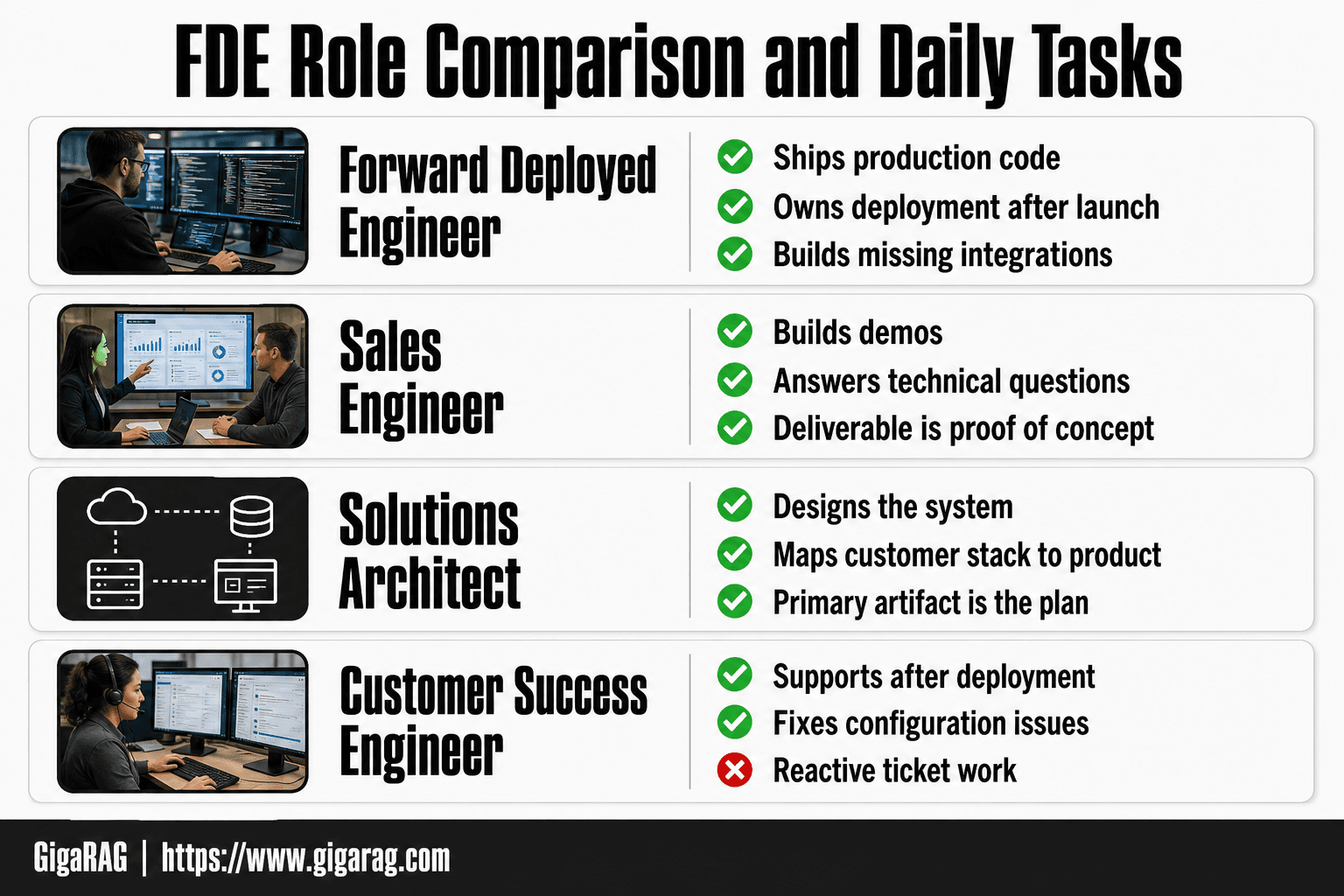
The titles sound close. The work doesn't. An FDE ships code into a customer's production environment and owns it after it's live. A sales engineer proves the product can work. A solutions architect designs how it should work. A customer success engineer keeps it working after the sale. The FDE does all three, but the emphasis is different: the FDE's primary output is a working integration, not a demo, a diagram, or a support ticket.
FDE vs sales engineer
A sales engineer's job is to get to "yes." They build demos, answer technical questions during the sales cycle, and show the customer what the product could do. The demo is the deliverable. Once the contract is signed, the sales engineer moves to the next prospect.
An FDE's job starts after the contract is signed. The deliverable is a working deployment, not a proof of concept. The FDE writes the integration code, handles the customer's weird data formats, and stays until the thing runs in production. The sales engineer proves it's possible. The FDE makes it true.
FDE vs solutions architect
A solutions architect designs the system. They draw the architecture diagram, map the customer's existing stack to the product's components, and hand off a plan. They may write some code, but the plan is the primary artifact.
The FDE executes the plan and discovers where it's wrong. The architect says "connect the CRM to the data warehouse through this API." The FDE finds out the CRM's API rate-limits at 100 requests per minute, the data warehouse uses a custom authentication scheme, and the customer's data team refuses to grant read access to the production schema. The architect's diagram doesn't survive contact with the customer's environment. The FDE's job is to make it survive.
FDE vs customer success engineer
A customer success engineer supports the product after deployment. They answer tickets, fix configuration issues, and help the customer use features that already exist. The work is reactive: something breaks, they fix it.
The FDE is proactive and build-oriented. They don't just fix what's broken. They build what's missing: the custom connector, the data transformation script, the integration that the product doesn't ship out of the box. Once the FDE's work is done, the customer success engineer takes over the ongoing maintenance. The handoff is the boundary between the two roles.
What a Forward Deployed Engineer Means for RAG Pipeline Builders
Most FDE writing assumes you're selling enterprise software to a bank. You're not. You're building retrieval systems, and the FDE model maps onto your work in ways the generic job descriptions miss. Here's the translation.
Retrieval optimization as FDE work
Retrieval quality is not a product feature you ship once. It's a field problem. An FDE-style approach means you sit with the customer's actual queries, watch what the retriever returns, and tune against real failures. Not benchmark failures. Real ones.
The work looks like this: a customer says "search doesn't find what I need." You pull the query logs, find the retrieval misses, and trace them back. Is the embedding model failing on domain terms? Is the chunk size splitting answers across boundaries? Is the vector index returning neighbors that are semantically close but useless? Each failure has a different fix, and none of them show up in a lab evaluation.
Embedding and chunking decisions
Chunking strategy is where FDE work gets concrete. A customer's documents are not clean markdown. They're PDFs with headers in images, tables that span pages, and legal text where a 512-token chunk cuts a clause in half. The FDE's job is to figure out what chunk size and overlap actually work for that data, then write the preprocessing code to make it happen.
Embedding quality is the same story. A general-purpose embedding model might score fine on MTEB and still fail on a customer's internal acronyms or product names. The FDE tests the model against the customer's real queries, finds the failure cases, and decides whether the fix is a different model, a fine-tune, or a hybrid retrieval approach with keyword search as a fallback.
Vector database integration in the field
Vector databases are easy to demo and hard to deploy. The demo uses 10,000 vectors. The customer has 40 million, with new documents arriving every hour. The FDE handles the parts the docs don't cover: index build times, memory pressure, filtering behavior when you combine metadata filters with vector search, and what happens when the index needs a rebuild.
The honest answer is that most vector database problems are not vector database problems. They're data pipeline problems. The FDE spends more time fixing the ingestion path than tuning the index.
When the customer's data breaks your pipeline
Every RAG pipeline works on the demo data. Then the customer uploads a 200-page scanned PDF with no text layer, or a CSV where one column contains JSON blobs, or documents in three languages mixed together. The pipeline breaks. The FDE's job is to make it not break, or to fail loudly enough that the customer knows why.
This is the part no one writes about. The FDE doesn't just build the pipeline. They build the error handling, the retry logic, the fallback paths, and the logging that tells you which document failed and why. That's not glamorous work. It's the difference between a pipeline that works in a demo and one that works in production.
FDE Work in Agent Memory Systems
Agent memory is where FDE work gets hardest. A RAG pipeline answers one query at a time. An agent has to remember what happened five turns ago, what the user said last week, and which facts it already retrieved. Memory architecture is not a feature you bolt on. It's the system.
Memory architecture as FDE territory
The FDE's job starts with a question most teams skip: what should the agent remember, and for how long? Short-term memory holds the current conversation. Long-term memory holds facts, preferences, and past decisions. The FDE decides what goes where, and what gets forgotten.
Forgetting is the part nobody designs for. An agent that remembers everything retrieves garbage. An agent that remembers nothing repeats itself. The FDE sets the retention rules, the summarization triggers, and the eviction policy. Those are architecture decisions, not prompt tweaks.
Retrieval from agent memory
Retrieval from memory is different from document retrieval. The agent isn't searching a corpus. It's searching its own past, and the query is often implicit. The user says "that thing we talked about" and the agent has to figure out which thing, from which conversation, and whether it's still relevant.
The FDE tunes this by watching real sessions. Which memories get retrieved and ignored? Which ones should have been retrieved but weren't? The fix is usually not a better embedding model. It's better memory metadata: timestamps, topic tags, user IDs, conversation context. Without that metadata, the retriever has nothing to filter on.
Production memory challenges
Memory systems fail in production in ways demos never show. Memory grows. The index gets slower. Old memories conflict with new ones. The agent retrieves a fact the user corrected three weeks ago and acts on it.
The FDE handles the parts the docs skip: memory compaction, deduplication, conflict resolution, and what happens when the memory store hits its size limit. The honest answer is that most agent memory problems are not model problems. They're data lifecycle problems. The FDE spends more time deciding what to forget than deciding what to remember.
What FDEs Cannot Do: Honest Limitations
The FDE model sounds like a fix for everything. It isn't. An FDE is one engineer embedded with one customer. The moment you try to scale that across fifty customers, the math breaks. You can't clone the person who knows your product's internals and the customer's data model.
Scaling limits
One FDE can carry two, maybe three accounts deeply. Beyond that, they become a firefighter, not a builder. The work is inherently high-touch. Every customer has different schemas, different compliance rules, different legacy systems. You can't template your way out of it.
The honest answer is that FDEs don't scale linearly. Hiring ten FDEs doesn't give you ten times the coverage. It gives you ten people each learning a different customer's mess, with no shared playbook.
Dependency and vendor lock-in risks
The customer gets dependent on the FDE, not the product. When the FDE rotates off the account, the customer's team often can't run the system themselves. That's a retention problem disguised as a service win.
Vendor lock-in cuts both ways. The customer builds workflows around your FDE's custom code. Leaving means rewriting that integration. Staying means paying for the person, not just the software.
Unrealistic expectations around AI timelines
AI companies hire FDEs expecting them to make the model work in production in weeks. The model doesn't cooperate. Retrieval quality, memory conflicts, embedding drift: these are iteration problems, not deployment problems. An FDE can't compress six months of tuning into a two-week engagement.
When the FDE model is the wrong choice
If your product is self-serve, skip FDEs. If your customers have homogeneous data, skip FDEs. If your margin can't absorb a senior engineer per account, skip FDEs. The model works when the integration is genuinely hard and the contract value justifies the cost. Otherwise you're paying engineer salaries for work a support team could handle.
An Actionable Checklist for Applying FDE Principles to Your RAG Work
You don't need the FDE title to use the FDE method. The core habit is simple: treat the customer's data as the spec, and treat the field as your test environment. Here's the checklist I'd run.
Pre-deployment checklist
Before you ship a RAG pipeline to a customer, run these checks.
- Pull a real data sample. Not synthetic data. Ask for 50 actual documents from their production system. If they won't give you real data, that's your first red flag.
- Map the schema yourself. Don't trust the customer's description of their data. Open it. Look for nested fields, nulls, duplicate IDs, and encoding surprises.
- Test retrieval on their vocabulary. Run ten queries in the customer's own words. If your embeddings miss their domain terms, fix the chunking or add a reranker before you deploy.
- Set a baseline metric. Pick one number: retrieval hit rate, answer accuracy, or latency. Measure it on their data before you touch anything. You need a before to prove an after.
- Write the rollback plan. Know how to revert to the customer's old system in under an hour. If you can't roll back, you're not deploying, you're gambling.
In-the-field debugging checklist
When the pipeline breaks at the customer site, work in this order.
- Reproduce with their exact input. Get the query and the document that failed. Don't debug on your laptop with clean data.
- Check the data before the model. Most RAG failures are data problems: bad chunk boundaries, missing metadata, stale embeddings. Look there first.
- Isolate the layer. Retrieval, generation, or memory? Change one variable at a time. If you tweak three things and it works, you don't know which one fixed it.
- Log the failure. Capture the query, the retrieved chunks, and the model output. You'll need this pattern later.
- Ship the smallest fix. Don't rebuild the pipeline in the field. Patch the chunking rule or add a filter. Deploy. Measure. Move on.
Post-deployment follow-up
The work doesn't end when the pipeline runs.
- Review the failure log weekly. Look for patterns: repeated query types, recurring document formats, embedding drift. Fix the pattern, not the instance.
- Re-measure the baseline. Run the same metric you set pre-deployment. If it dropped, find out why before the customer notices.
- Document the customer's quirks. Their data has personality. Write down what you learned so the next engineer doesn't rediscover it.
- Hand off the runbook. The customer's team should be able to handle the top three failure modes without you. If they can't, you've built a dependency, not a solution.
Forward Deployed Engineer Salary and Career Path
The honest answer is that FDE pay tracks senior software engineering, plus a premium for the travel and customer-facing load. You won't get rich off the title alone. You'll get paid for the combination of coding skill and the willingness to sit in a customer's office.
Salary ranges
At Palantir, FDEs start around $130,000 to $160,000 base, with total compensation reaching $200,000 to $250,000 after equity and bonuses (verify at publish). At AI startups, the range is wider. Early-stage companies pay $120,000 to $180,000 base but offer more equity. Big tech FDE-style roles at places like OpenAI or Anthropic can push total comp past $300,000 for senior people. The spread comes down to company stage, location, and how much travel the role demands.
Is the role high paying?
Yes, relative to most engineering jobs. An FDE earns more than a typical backend engineer at the same level because the role bundles sales, support, and implementation into one headcount. But you're not paid for the title. You're paid for the fact that you can close a deal and make it work in production. That's rare, and companies pay for rare.
Is the role good?
It depends on what you want. If you like variety, customer contact, and seeing your code run in the real world, it's a strong role. If you want deep, uninterrupted technical work, it's a poor fit. The travel and context-switching burn people out. Many FDEs leave for product engineering after two to three years.
Career progression
The typical path: FDE to senior FDE, then either FDE lead, product manager, or back into core engineering. The customer exposure makes the PM transition easier than from pure engineering. Some FDEs become founders. The pattern recognition from seeing ten different companies' data problems is genuinely useful for spotting a market gap.
Final Thoughts on the Forward Deployed Engineer Role
The FDE model works when the customer's problem is messy, specific, and won't fit a clean API. That's most enterprise AI work. It fails when the problem is standard enough that a self-serve product handles it, or when the customer won't let an outside engineer touch their data.
For RAG pipeline and agent memory builders, the takeaway is simpler than the title suggests. You don't need the FDE job title to do FDE work. You need to sit with the customer's data, find where retrieval breaks, and fix it in place. That's the whole job.
The honest answer is that a forward deployed engineer is a bridge role, and bridges get walked on from both sides. Product teams want you to ship the roadmap. Customers want you to solve their problem today. You'll disappoint someone most weeks.
If you're building RAG systems or agent memory and find yourself doing this kind of work anyway, tools like GigaRAG help with the parts you can automate: retrieval tuning, memory store integration, and pipeline debugging. The parts you can't automate, the customer conversations and the judgment calls, are what make the role worth having.
Frequently Asked Questions
What is a forward deployed engineer's salary?
Salaries for forward deployed engineers vary widely by company, location, and experience. In the US, they often range from $120,000 to $200,000+ in total compensation, with higher figures at top AI companies. Check current market data for precise figures.
How much do FDEs get paid?
Compensation for FDEs is typically competitive with senior software engineers, often including equity. At AI-focused firms, total compensation can exceed $250,000 for experienced hires. Again, this depends on the specific company and role.
Is a forward deployed engineer a high paying job?
Yes, it is generally considered a high-paying role, especially in the AI and enterprise software sectors. The combination of engineering and customer-facing skills commands a premium. However, exact pay depends on the employer and location.
Is a forward deployed engineer good?
It can be an excellent role for engineers who enjoy variety, direct customer impact, and rapid problem-solving. It may be less ideal for those who prefer deep, uninterrupted technical work. The fit depends on your career goals and work style.
How does a forward deployed engineer differ from a solutions architect?
A solutions architect focuses on high-level design and may not write production code, while an FDE is hands-on, building and deploying code directly. FDEs are more embedded in the customer's technical stack and often work on-site.
Can a forward deployed engineer work remotely?
While some FDE roles offer remote flexibility, the essence of the role often requires on-site presence with customers. Travel is common, and being physically embedded can be crucial for understanding context and building trust.
What skills are essential for a forward deployed engineer?
Key skills include strong software engineering fundamentals, proficiency in relevant languages (e.g., Python, Java), experience with cloud and data infrastructure, and excellent communication. Adaptability and a consulting mindset are also critical.
About GigaRAG
GigaRAG is for agent memory and RAG pipeline builders. get this right. Whether you are working through what is a forward deployed engineer or something adjacent, we publish what we have actually tested, including where it falls short.


