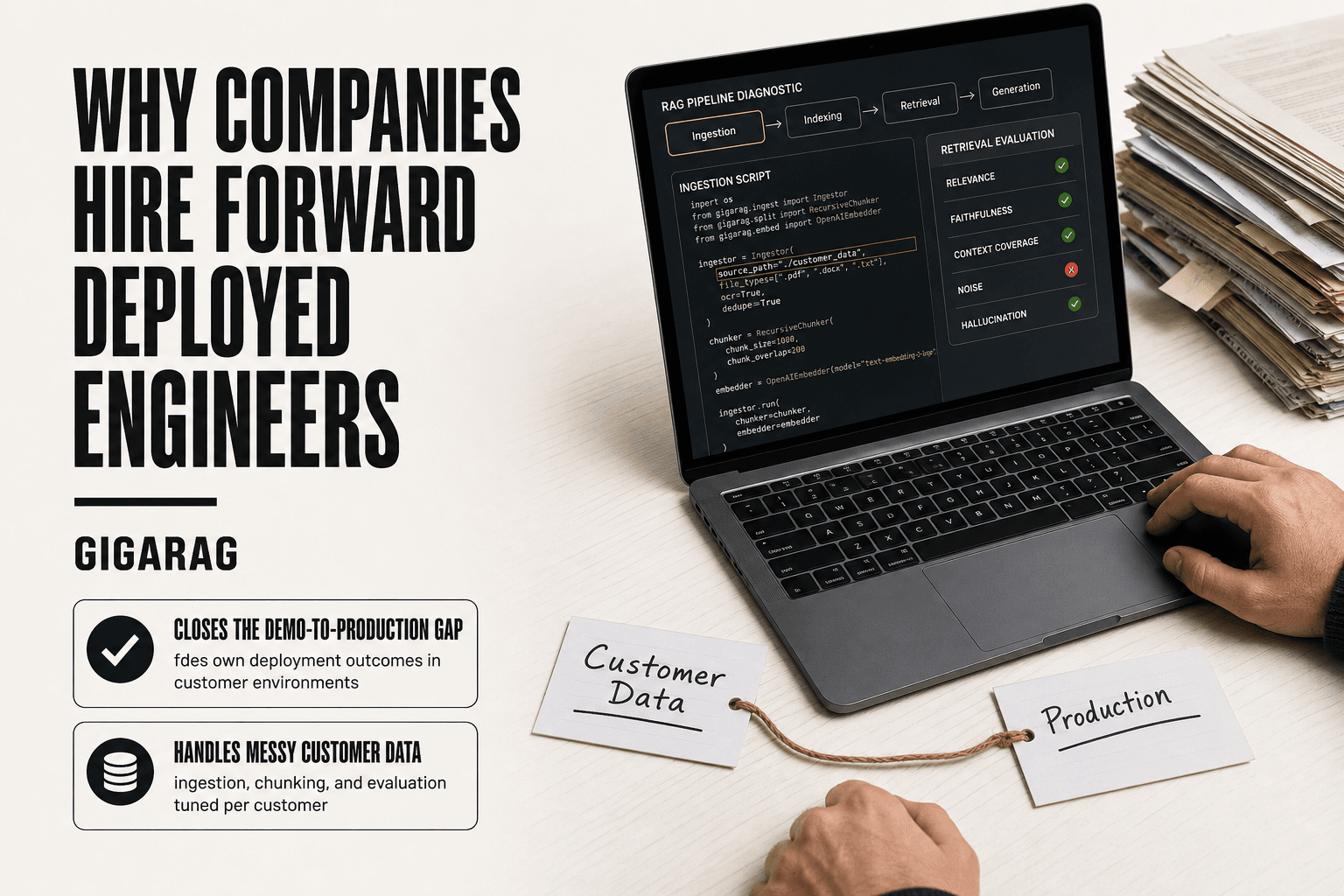
Why Companies Hire Forward Deployed Engineers
Why companies hire forward deployed engineers isn't a mystery once you've shipped an AI product into a real customer environment. You've built the RAG pipeline. The demo runs clean in a notebook. Then the customer's data shows up: inconsistent schemas, duplicate records, retrieval that returns irrelevant chunks when it matters most. The prototype worked. The deployment didn't. That gap is the entire reason the FDE role exists, and it's why AI infrastructure founders are hiring them faster than they can define the job. The honest answer is that an FDE won't fix a broken product or discover product-market fit for you. What they do is close the distance between what your system does in isolation and what it does inside a customer's messy, domain-specific reality. GigaRAG exists to make the agent memory layer of that problem easier, but the human work remains. This guide covers why companies hire FDEs, when they actually make sense for RAG and agent memory builders, and when they're a waste of money.
| At a glance | Details |
|---|---|
| Core reason | Embed engineers where the product must actually work |
| Best fit | Complex, data-heavy AI deployments |
| Biggest value | Closing prototype-to-production gap |
| Common misread | FDEs are not a substitute for PMF |
| Typical background | Software engineering plus customer-facing skills |
| When to skip | Simple, self-serve, or already-stable products |
In This Guide
- What Is a Forward Deployed Engineer?
- Forward Deployed Engineer vs Traditional Software Engineer
- Why Companies Hire Forward Deployed Engineers: The AI Implementation Gap
- Why Companies Hire Forward Deployed Engineers: A Step-by-Step Guide
- The RAG and Agent Memory Angle: Why AI Infrastructure Builders Hire FDEs
- Forward Deployed Engineer vs. Software Engineer vs. Solutions Engineer
- A Practical Framework: The Deployment Complexity Score
- When You Should NOT Hire a Forward Deployed Engineer
- What Forward Deployed Engineers Earn (And What That Means for Your Budget)
- Which Companies Hire Forward Deployed Engineers?
- Is Forward Deployed Engineer a Good Career?
- The Future of Forward Deployed Engineers in AI Infrastructure
What Is a Forward Deployed Engineer?
A forward deployed engineer (FDE) is a software engineer who works inside a customer's environment to get a product deployed, integrated, and working on real data, not just in a demo. They own the gap between what your product does in a controlled setting and what it does in production.
The one-sentence definition
An FDE is an engineer you send to the customer's side of the table. They write code, configure infrastructure, and debug integration issues where the problems actually live: in the customer's data, their systems, their constraints. They're not sales. They're not support. They ship.
Where the name comes from (Palantir's model)
Palantir coined the term. Their engineers deployed forward, into government and enterprise sites, because the data was classified or siloed and couldn't come to them. The model worked well enough that it spread. Now AI infrastructure companies use the same playbook for a different reason: customer data is messy, domain-specific, and never matches the training set.
[!note] A forward deployed engineer is not a sales engineer, a support engineer, or a solutions architect by another name. The role is defined by writing production code inside the customer's environment, not by demoing or troubleshooting the vendor's product.
Forward Deployed Engineer vs Traditional Software Engineer
| Factor | Forward Deployed Engineer | Traditional Software Engineer |
|---|---|---|
| Primary focus | Customer-specific deployment and outcomes | Product features and platform reliability |
| Work location | Often embedded with the customer | Usually internal product team |
| Success metric | Customer system works in production | Feature shipped and stable |
| Data exposure | Hands-on with messy customer data | Mostly synthetic or sanitized data |
| Feedback loop | Direct, fast, field-driven | Indirect, roadmap-driven |
Why Companies Hire Forward Deployed Engineers: The AI Implementation Gap
Companies hire FDEs because building AI is no longer the hard part. Deploying it is. A model that scores 95% on a benchmark can fall to 60% on a customer's actual data, and no amount of prompt tweaking fixes that from your office.
The demo-to-production cliff
You've seen it. The notebook works. The demo works. Then the customer loads their real data and everything breaks. Their files are PDFs with scanned tables. Their IDs don't match your schema. Their security rules block your API calls. The gap between "works on our data" and "works on their data" is where deals die.
That gap is not a research problem. It's an implementation problem. And implementation problems need an engineer physically or virtually present in the customer's environment, reading their logs, inspecting their data, and writing the glue code that makes your product function.
Why AI products fail at the customer's data layer
Most AI products assume clean inputs. Real customers have none. Their data lives in legacy systems, gets exported in weird formats, and contains edge cases nobody documented. An FDE's job is to find those edge cases before they become churn.
What FDEs actually do to close the gap
They write custom ingestion scripts. They tune chunking for the customer's document types. They swap embedding models when the default one underperforms on domain language. They build evaluation sets from real user queries. Each of these is a deployment task, not a product feature. That's why the role exists.
[!tip] If you are building agent memory or RAG pipelines, have your FDE instrument retrieval quality from day one: log chunking strategy, embedding model version, and retrieval evaluation scores per customer. That data turns one-off deployments into a reusable memory layer instead of a pile of bespoke scripts.
Why Companies Hire Forward Deployed Engineers: A Step-by-Step Guide
- Score deployment complexity: data messiness, integration count, compliance needs, and domain specificity.
- Check whether your product already works in at least one real customer environment.
- Identify whether the blocker is product capability or deployment friction.
- Estimate how many customers share the same deployment pattern.
- Define what the FDE owns: integration, tuning, evaluation, or training.
- Set a time-boxed engagement with clear exit criteria and knowledge transfer.
- Decide whether to hire, contract, or productize the deployment path instead.
The RAG and Agent Memory Angle: Why AI Infrastructure Builders Hire FDEs
For RAG and agent memory builders, that gap gets sharper. Your product is not a chatbot with a nice UI. It's a pipeline that has to survive contact with customer data, and every stage of that pipeline can fail in ways your tests never caught.
Customer data ingestion is never clean
Customers say they have "documents." What they mean is 40,000 PDFs with scanned tables, a SharePoint folder with broken permissions, and a Slack export where half the threads are missing. An FDE writes the connectors and cleanup scripts that turn that mess into something your vector database can actually index. You can't ship a generic PDF parser and call it done. Someone has to sit in the customer's environment and handle the files your parser chokes on.
Chunking and embedding decisions are domain-specific
The chunk size that works for legal contracts fails on medical records. The embedding model that handles general English struggles with a customer's internal acronyms and product codes. These are not settings you expose in a config file and hope the customer picks right. An FDE tests chunking strategies against the customer's actual documents, measures retrieval quality, and picks the embedding model that performs on their domain language. That work happens in deployment, not in your research lab.
Retrieval evaluation requires ground truth from real users
You can't evaluate retrieval quality without knowing what a good answer looks like for this customer. An FDE builds evaluation sets from real user queries, not synthetic ones. They sit with the customer's support team, collect the questions that actually come in, and label what a correct retrieval should return. That ground truth is the only way to know if your pipeline works in production. Benchmarks won't tell you.
Agent memory persistence is a deployment problem, not a research problem
The research papers assume memory works. In production, it doesn't. Sessions time out. Context windows overflow. The agent forgets what the user said three turns ago because your persistence layer wasn't built for their concurrency patterns. An FDE debugs why memory isn't persisting in the customer's environment, fixes the storage layer, and tunes the memory eviction policy for their usage. None of that is a research breakthrough. All of it is required for the product to function.
Forward Deployed Engineer vs. Software Engineer vs. Solutions Engineer
A software engineer builds the product. A solutions engineer helps customers adopt it. An FDE does both, but owns the outcome in the customer's environment.
Where the roles overlap
All three write code. All three talk to customers at some point. The overlap is real, which is why hiring managers blur the lines. A solutions engineer might write a custom integration script. A software engineer might join a sales call. An FDE does both every week.
The key difference: ownership of deployment outcomes
The software engineer is done when the feature merges. The solutions engineer is done when the customer signs or the ticket closes. The FDE is done when the product works in production for that specific customer. That's the line. If the RAG pipeline returns garbage on a customer's legal contracts, the FDE owns fixing it. Not the core team. Not support.
Why the distinction matters for hiring
Hiring a solutions engineer when you need an FDE gets you demos that work and deployments that don't. Hiring a software engineer gets you features that ship but never get adopted. The FDE role exists because someone has to sit in the messy middle, where your product meets a customer's data and breaks. If nobody owns that, the customer churns.
A Practical Framework: The Deployment Complexity Score
You can't decide whether to hire an FDE without measuring how hard your deployments actually are. Here's a scoring tool that forces the question into numbers.
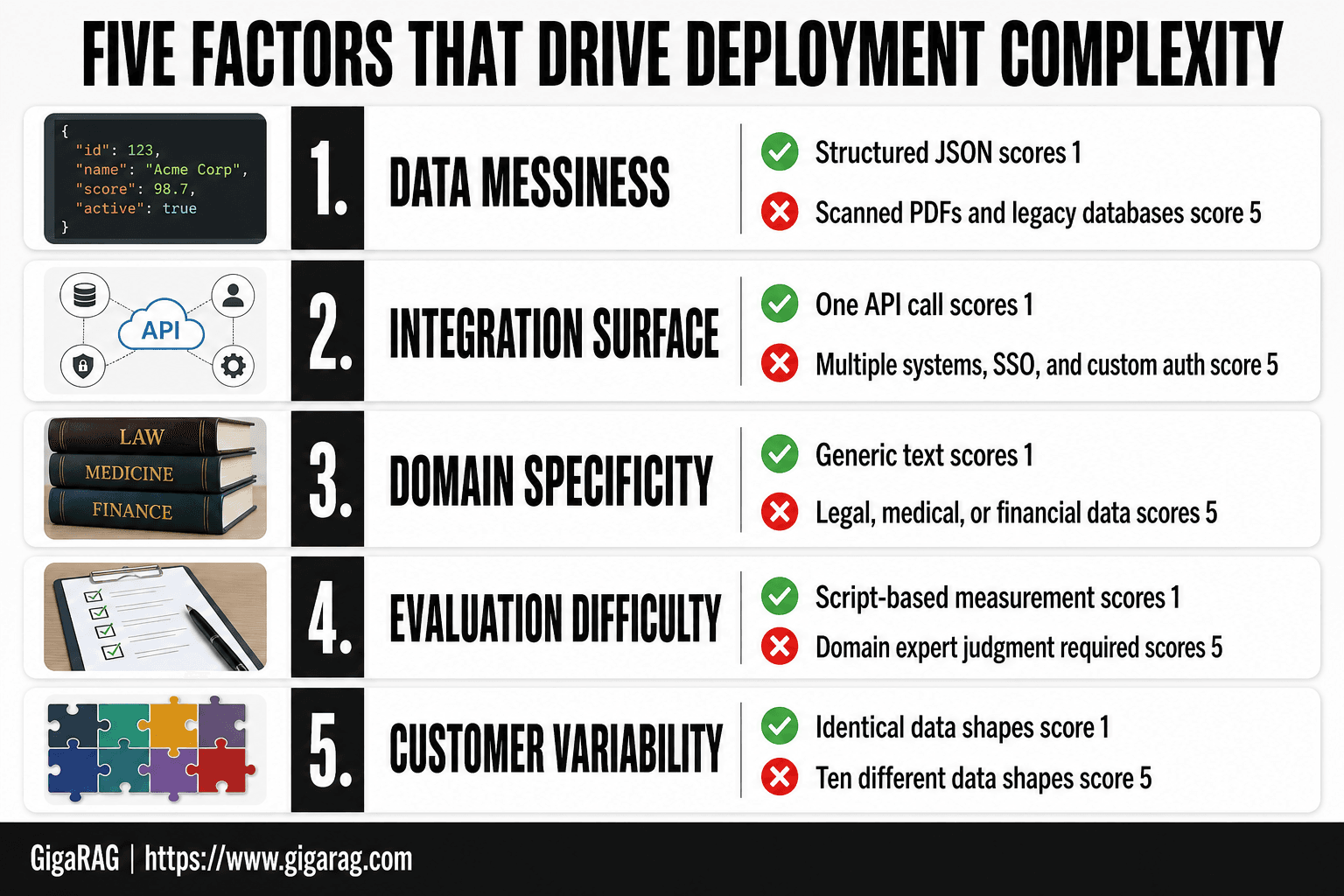
The five factors that drive deployment complexity
Score each from 1 (trivial) to 5 (brutal):
- Data messiness. How clean is customer data on arrival? Structured JSON in a known schema scores 1. Scanned PDFs, legacy databases, and inconsistent schemas score 5.
- Integration surface. One API call scores 1. Multiple systems, SSO, permissions, and custom auth scores 5.
- Domain specificity. Generic text scores 1. Legal contracts, medical records, or financial filings where wrong answers cost money score 5.
- Evaluation difficulty. If you can measure retrieval quality with a script, score 1. If you need a domain expert to judge whether the answer is right, score 5.
- Customer variability. Ten customers with identical data shapes score 1. Ten customers with ten different data shapes score 5.
Scoring your product (1-5 per factor)
Add the five scores. A product scoring 5-8 has low deployment complexity. A product scoring 9-15 sits in the middle. A product scoring 16-25 has high deployment complexity.
Be honest. Most RAG and agent memory products score 12 or higher because customer data is never clean and evaluation needs ground truth from real users.
What your score means: hire now, wait, or never
5-8: Don't hire. Your product deploys without a dedicated engineer. Save the salary.
9-15: Hire when revenue justifies it. You need deployment help, but a solutions engineer with strong technical skills may cover it. Hire an FDE when you have 3-5 paying customers stuck in deployment.
16-25: Hire now. Your product cannot reach production without someone owning customer deployments. Every month without an FDE is churn you haven't measured yet.
When You Should NOT Hire a Forward Deployed Engineer
An FDE is a deployment accelerator, not a product fixer. If your product doesn't work in a clean environment, an FDE won't make it work in a messy one. They'll just burn salary while documenting the same failures you already know about.
Your product is still finding product-market fit
If you're still guessing who your customer is, an FDE adds cost without signal. They deploy a product that changes every two weeks, and the deployment work gets thrown away each time. Find the fit first. Then hire for scale.
Your customers don't require custom integration
Some products deploy with a webhook and an API key. If your customers onboard themselves in under an hour, you don't need an FDE. You need better docs. A solutions engineer can handle the occasional stuck customer at a fraction of the cost.
Your sales motion is low-touch or self-serve
FDEs earn their salary in high-touch enterprise deals where deployment is part of the sale. If your average contract is $500 a month and customers sign up with a credit card, an FDE's time costs more than the revenue they'd protect.
You can't afford the salary (and what to do instead)
FDEs cost $150,000 to $250,000 plus equity at most AI startups. If that's more than 20% of your runway, don't stretch. Hire a strong solutions engineer, write better onboarding docs, and build deployment tooling that reduces the need for a human in the loop. Your product should get easier to deploy over time, not stay hard forever.
What Forward Deployed Engineers Earn (And What That Means for Your Budget)
FDE compensation tracks the deployment complexity you just scored. The harder the integration, the more companies pay to put a human in the customer's environment.
Salary ranges by company stage
Early-stage startups pay $130,000 to $180,000 base, leaning on equity to close the gap. Series B and C companies land between $170,000 and $220,000. Palantir and other public companies push total cash past $250,000 for senior FDEs. (verify at publish)
Equity and total compensation reality
Equity is where FDE packages diverge from standard software engineering. A startup FDE might get 0.1% to 0.5%, because their deployment work directly drives revenue retention. Total comp at growth-stage AI companies runs $200,000 to $350,000. The honest catch: that equity is worth zero if the product doesn't survive contact with customers.
Which Companies Hire Forward Deployed Engineers?
Palantir started the category and still hires the most. But the list has expanded well beyond defense and government work. Any company selling complex infrastructure into enterprise customers is a candidate.
The usual suspects (Palantir and beyond)
Palantir remains the reference point. Their FDEs embed with customers for months, often on-site, building on top of Foundry. Scale AI, Anduril, and Applied Intuition all run similar models for defense and autonomous systems work. Stripe and Plaid hire FDEs for fintech integrations where customer data schemas never match the docs.
AI infrastructure startups hiring FDEs
This is where the role is growing fastest. Companies building vector databases, agent frameworks, and RAG tooling need FDEs because their products fail or succeed on customer data quality. Pinecone, Weaviate, and Chroma all list forward deployed or solutions engineering roles that read like FDE jobs. LangChain and LlamaIndex hire deployment-focused engineers to help customers get past the demo stage. Agent memory startups are the newest entrants: companies building persistence layers for AI agents need someone inside the customer's stack to wire up retrieval, chunking, and evaluation against real data. That's the exact gap FDEs fill.
Is Forward Deployed Engineer a Good Career?
It depends on what you want your week to look like. If you want deep, uninterrupted building time, this role will frustrate you. If you want ownership of outcomes and direct customer contact, it's hard to beat.
The upside: ownership, impact, and compensation
You own the deployment. Not a ticket queue. When the customer's RAG pipeline works, you made it work. That visibility compounds fast. FDEs get pulled into product decisions because they've seen what breaks in the field. Compensation tracks accordingly: base salaries run ahead of standard SWE roles at the same level, and equity at AI infrastructure startups can be meaningful. The path to founder or head of solutions is short.
The downside: travel, customer pressure, and ambiguity
You'll travel. Not every week, but enough that it shapes your life. Customer pressure lands on you directly: when their agent memory system fails at 2 a.m., you're the call. And the job is ambiguous by design. Nobody hands you a spec. You figure out what the customer actually needs, then build it. Some people thrive there. Others burn out in a year.
The Future of Forward Deployed Engineers in AI Infrastructure
The role isn't going anywhere. It's shifting.
Will FDEs be automated away?
- The parts of the job that get automated are the parts FDEs already hate: boilerplate integrations, standard API wiring, repetitive data cleanup. What remains is the judgment work. Deciding which chunking strategy fits a customer's legal documents. Knowing when a retrieval score of 0.7 is good enough and when it isn't. That doesn't automate.
How the role evolves as AI infrastructure matures
As RAG pipelines and agent memory systems become more standardized, the FDE shifts from builder to architect. Less custom code, more configuration and evaluation. The job becomes faster, but not smaller. Companies hiring forward deployed engineers now are betting that deployment complexity won't disappear, it'll just move up the stack. The FDE follows it.
Frequently Asked Questions
Is forward deployed engineer a good career?
It can be excellent for engineers who enjoy variety, customer contact, and shipping under real constraints. The trade-off is less deep platform work and more context switching. It is often a strong path toward founding, product leadership, or solutions architecture.
Why are forward-deployed engineers the rage?
AI products are easy to prototype and hard to deploy because customer data is messy and domain-specific. FDEs close that gap by embedding with the customer and adapting the system in place. The model gained visibility through companies that used it to land complex enterprise deals.
Which companies have forward-deployed engineers?
The model is most associated with Palantir and has spread across AI infrastructure, data platforms, and enterprise software companies. Many startups now use the title or a close variant. Check individual company career pages for current roles.
What is the future of a forward deployed engineer?
As deployment patterns repeat, much of the work gets productized and the role shifts toward harder, more novel deployments. Expect the title to persist but the scope to narrow over time. Some companies split it into deployment engineering and solutions architecture.
What is the difference between a forward deployed engineer and a software engineer?
A traditional software engineer builds for many users through the product roadmap. An FDE builds for one customer at a time, often inside that customer's environment. The FDE role trades platform depth for deployment speed and direct feedback.
What skills does a forward deployed engineer need?
Strong software engineering fundamentals, comfort with ambiguity, and the ability to communicate with both technical and non-technical stakeholders. For AI work, add retrieval evaluation, data pipeline debugging, and prompt or memory design. Customer empathy matters as much as coding speed.
When should a company not hire a forward deployed engineer?
Skip the role if your product is self-serve, your deployments are simple, or you have not yet found product-market fit. An FDE cannot fix a fundamentally broken product or replace discovery work. Hiring one too early often produces bespoke work that never becomes a product.
About GigaRAG
GigaRAG is for agent memory and RAG pipeline builders. get this right. Whether you are working through why companies hire forward deployed engineers or something adjacent, we publish what we have actually tested, including where it falls short.


