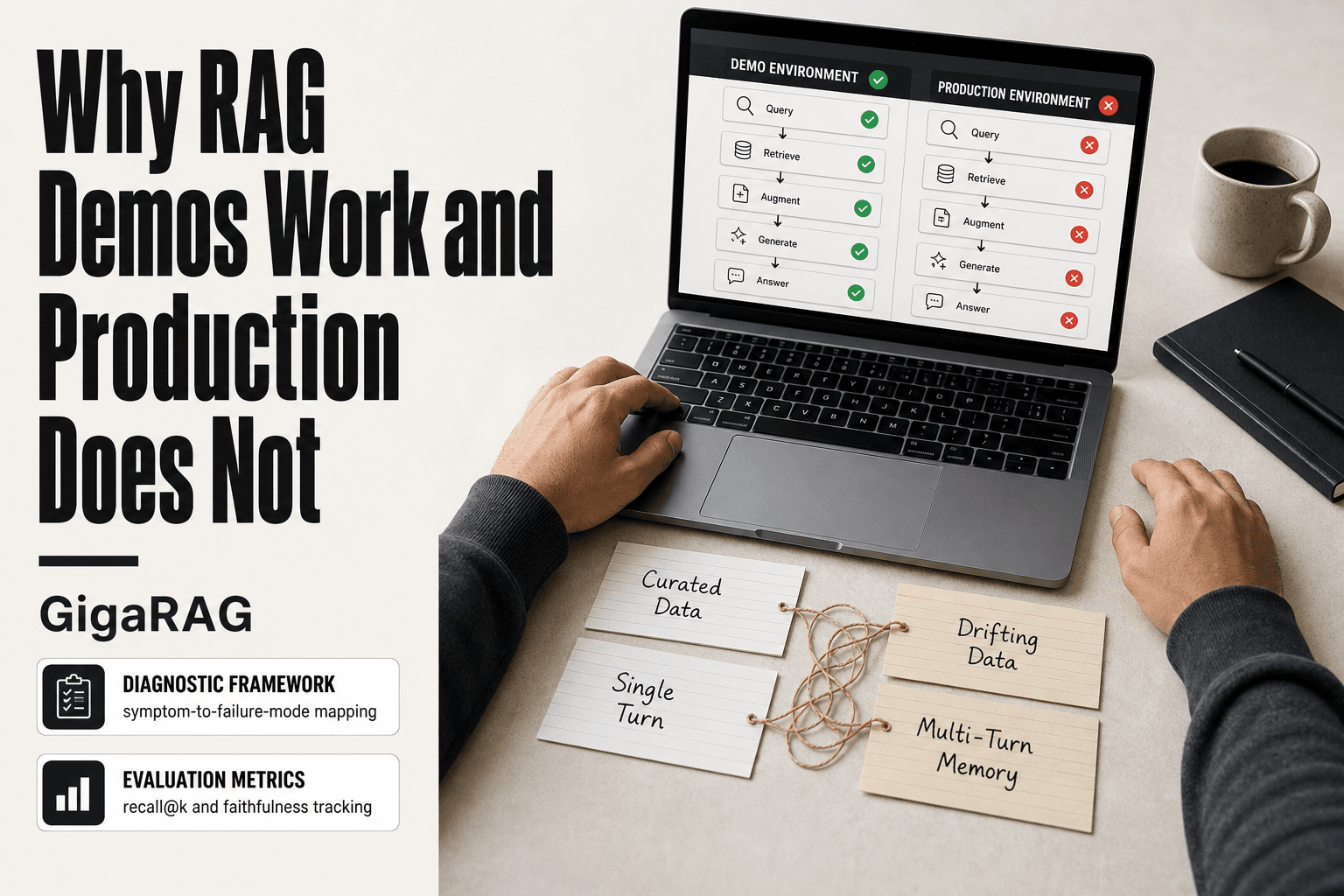
Why RAG Demos Work and Production Does Not
Why RAG demos work and production does not is the question every agent memory engineer and pipeline builder asks after the Tuesday demo ran flawlessly and the Wednesday deploy fell apart under real traffic. The demo wasn't lying. It just wasn't testing anything that matters. A notebook with fifty curated documents, a clean embedding, a top-k of three, and a human reading the output will make any retrieval system look competent. Production is different. Your users ask questions the demo never anticipated. Your data drifts. Your context window fills with stale turns. And suddenly the system that answered perfectly on Tuesday returns a confident wrong answer on Wednesday. The good news is that these failures are diagnosable. This guide walks through the specific failure modes, chunking, retrieval, reranking, evaluation, and agent memory, and it ends with something no top result will tell you: what RAG cannot do, no matter how carefully you build it.
| At a glance | Details |
|---|---|
| Core problem | Demos test happy paths; production tests everything else |
| Biggest gap | Evaluation and observability, not model quality |
| Data reality | Messy, duplicated, stale documents break retrieval |
| Latency trap | Retrieval and reranking add hidden latency at scale |
| Agent memory | Persistent context amplifies staleness and drift |
| Fix priority | Measure retrieval quality before tuning prompts |
In This Guide
- The Demo-to-Production Gap Is a Testing Gap, Not a Technology Gap
- RAG Demo vs RAG Production: What Actually Changes
- How RAG Technically Works, and Where It Breaks
- Why Rag Demos Work And Production Does Not: A Step-by-Step Guide
- Chunking Strategy: The First Silent Killer
- Vector Search Limitations: Why Semantic Similarity Is Not Enough
- Re-ranking: The Fix Most Demos Skip
- Data Quality and Governance: The Root Cause Most Teams Ignore
- Evaluation and Testing: The Metrics That Actually Matter
- Agent Memory: Why RAG Failures Amplify in Multi-Turn Systems
- A Diagnostic Framework: Matching Symptoms to Failure Modes
- What RAG Cannot Do: Plain Truths and Honest Expectations
- Final Thoughts: Building RAG That Survives Production
The Demo-to-Production Gap Is a Testing Gap, Not a Technology Gap
The demo worked. The production system didn't. Most teams blame the model, the embeddings, or the vector database. They're usually wrong. The technology didn't change between Tuesday and Wednesday. What changed was what got tested.
What a demo actually validates
A demo proves one thing: retrieval works on a curated set of queries against a clean, small dataset. You picked the questions. You knew the answers were in there. That's not a test of retrieval quality. It's a test of whether the pipeline runs end to end without crashing.
What production actually demands
Production throws queries you never anticipated at data that drifts, duplicates, and contradicts itself. Users ask things in ways you didn't script. Documents get added, removed, and edited. The embedding model that worked on 500 chunks behaves differently on 5 million. None of this shows up in a demo.
Why the gap feels unpredictable
It feels unpredictable because demos never measure the things that break. You didn't test recall on rare terms. You didn't test latency under concurrent load. You didn't test what happens when the source data changes. The failures were always there, waiting. The demo just never looked for them.
[!note] A RAG demo is not a smaller version of production; it is a different system with different data, query distribution, and failure tolerance. Treating demo success as evidence of production readiness is the most common and most expensive mistake in RAG engineering.
RAG Demo vs RAG Production: What Actually Changes
| Factor | Demo Environment | Production Environment |
|---|---|---|
| Data | Small, clean, curated document set | Large, messy, duplicated, and stale sources |
| Queries | Hand-picked questions that match the docs | Unpredictable, ambiguous, multi-intent user queries |
| Evaluation | Eyeballed a few good answers | Needs retrieval and answer metrics tracked over time |
| Latency | Single user, warm cache, no queue | Concurrent users, cold starts, reranking overhead |
| Memory | Single-turn, no persistence | Multi-turn context that can go stale or drift |
| Failure mode | Silent, unnoticed | Visible, costly, and hard to reproduce |
How RAG Technically Works, and Where It Breaks
RAG works by retrieving relevant text chunks from a knowledge base, then feeding those chunks to an LLM as context for generating an answer. The retrieval step grounds the model in source data. The generation step turns that data into prose.
The retrieval-augmented generation pipeline in six steps
Ingest documents. Split them into chunks. Embed each chunk into a vector. At query time, embed the question and retrieve the most similar chunks. Rerank those candidates for relevance. Generate an answer from the top chunks.
Where each step can silently fail
Chunking can split meaning across boundaries. Embeddings can miss exact matches. Retrieval can return the wrong chunks. Reranking can reorder them badly. Generation can ignore the context entirely. Every step is a failure point.
[!tip] For agent memory engineers: version your memory store alongside your index and log the timestamp of every retrieved memory. Most 'the agent forgot' bugs are actually 'the agent remembered something that was true three weeks ago.'
Why Rag Demos Work And Production Does Not: A Step-by-Step Guide
- Reproduce the failure with the exact user query and log the retrieved chunks.
- Check whether the correct information exists in the index at all.
- If it exists but wasn't retrieved, inspect chunking, embeddings, and filters.
- If it was retrieved but the answer is wrong, inspect the prompt and context window.
- If the answer is right but slow, profile retrieval, reranking, and generation separately.
- If failures appear only in multi-turn sessions, audit memory persistence and staleness.
- Add the failing case to a regression evaluation set before shipping any fix.
Chunking Strategy: The First Silent Killer
Chunking is where most RAG systems fail before they even start. Split a document at the wrong place and you've destroyed the meaning the model needs to answer correctly.
Symptoms of bad chunking
Answers that miss context. Partial information that sounds right but isn't. Contradictory responses across similar queries. If your system returns chunks that start mid-sentence or cut off a definition, retrieval is working fine. The chunks themselves are broken.
Chunk size, overlap, and semantic boundaries
Start with 256 to 512 tokens per chunk. Add 10 to 20 percent overlap so context doesn't get sliced at the edges. But size alone won't save you. Split on semantic boundaries: paragraphs, sections, list items. Never split mid-sentence.
What to test before changing your chunking strategy
Run the same query against different chunk sizes and compare answer quality. Check whether retrieved chunks contain complete thoughts. If answers improve with larger chunks, your current split is too aggressive.
Vector Search Limitations: Why Semantic Similarity Is Not Enough
Vector search finds what's similar, not what's right. That distinction costs you in production.
What vector search gets wrong
Exact matches fail first. A query for "invoice 4471" returns invoices 4470 and 4472 because embeddings blur precise identifiers. Rare terms suffer too: product codes, error numbers, proper names. The embedding model has never seen them, so it guesses.
When hybrid search is worth the complexity
It depends on your data. If queries include IDs, codes, or exact phrases, add keyword search alongside vectors. Combine results with reciprocal rank fusion. The complexity is real, but missed exact matches are worse.
Embedding model drift and staleness
Your embedding model encodes meaning as it understood it at training time. New terminology, renamed products, shifted jargon: all invisible to the old vectors. Re-embed when your domain vocabulary changes, not just when your documents do.
Re-ranking: The Fix Most Demos Skip
Vector search returns candidates. Reranking decides which ones matter.
What reranking actually does
A reranker takes the top 50 or 100 retrieved chunks and scores them against the query using a cross-encoder. Unlike embeddings, which compare query and document separately, a cross-encoder reads them together. That joint reading catches nuance the vector search missed.
When reranking is worth the latency cost
It depends on your failure tolerance. If wrong answers cost money or trust, reranking pays for itself. A reranker adds 50 to 200 milliseconds per query. For customer-facing chat, that's acceptable. For high-volume search, batch it or skip it.
Reranking thresholds that work in production
Retrieve 50 to 100 candidates, rerank, keep the top 5 to 10. That ratio gives the reranker enough material without bloating your context window. Start with a small cross-encoder like ms-marco-MiniLM. It's fast and cheap. Move to a larger model only when you measure a real accuracy gain.
Data Quality and Governance: The Root Cause Most Teams Ignore
Reranking fixes retrieval order. It can't fix garbage input. Most production RAG failures trace back to data that changed, drifted, or was never clean to begin with.
Why data quality failures are invisible in demos
Demos run on curated data. You picked the documents, checked the answers, and froze the dataset. Production data moves. Teams add files, edit pages, delete records. The embeddings you built last month now point at content that no longer exists or means something different. Nothing breaks loudly. Answers just get slightly worse, query by query.
Stale embeddings and data drift
Source data changes without telling you. A policy doc updates, a product spec shifts, a codebase refactors. Your vector index doesn't know. It keeps retrieving the old chunk and generating confident, wrong answers. Drift is silent. By the time users complain, the damage is weeks old.
Governance practices that catch degradation early
Track when each source document last changed. Re-embed on a schedule tied to that change rate, not on a fixed calendar. Log retrieval misses and low-confidence answers. Sample production queries weekly and check them by hand. Governance isn't a one-time cleanup. It's the ongoing work of keeping your index honest.
Evaluation and Testing: The Metrics That Actually Matter
Most teams can't tell you if their RAG system got worse last week. They don't have numbers. They have vibes. Here's how to fix that.
Recall@k and MRR: measuring retrieval quality
Recall@k asks: did the right chunk show up in the top k results? Set k to 5 or 10. If recall@5 is below 0.8, your retrieval is broken before generation even starts. MRR measures where the right chunk lands. A correct chunk at position 1 scores 1.0. At position 5, it scores 0.2. Track both. They catch different failures.
Faithfulness and answer relevancy: measuring generation quality
Faithfulness checks whether the answer matches the retrieved context. Relevancy checks whether the answer matches the question. A faithful answer can still be irrelevant. An answer can be relevant but hallucinated. You need both scores. Use an LLM judge for these. It's imperfect but better than nothing.
Building an evaluation harness that runs in production
Build a golden set: 100 to 500 real queries with known-good answers. Run it on every deploy. Log scores over time. Alert when recall@5 drops below your threshold. This is not a one-time check. It's the only way to know if you're improving.
Agent Memory: Why RAG Failures Amplify in Multi-Turn Systems
Single-turn RAG fails quietly. Agent memory fails loudly, because each turn depends on the last. A retrieval miss in turn one poisons every turn after it.
Context persistence and multi-turn retrieval failures
Agents carry context across turns. When retrieval runs again each turn, it can pull chunks that contradict what the agent already said. The model then has to reconcile two sources: its own prior output and the new retrieval. Most models pick the new retrieval. The agent changes its answer mid-conversation. Users notice.
Memory staleness: when the agent remembers wrong
Stored context ages. A fact retrieved in turn two may be wrong by turn eight. The agent doesn't know it's stale. It just keeps using it. Worse, stale memory compounds: the agent retrieves from its own memory store, which was built from earlier retrievals, which were already imperfect. Errors stack.
Why agent memory makes evaluation harder
Single-turn metrics don't capture this. Recall@5 on turn one says nothing about turn six. You need multi-turn eval sets that track answer consistency across a conversation. Most teams don't have them. That's the gap.
A Diagnostic Framework: Matching Symptoms to Failure Modes
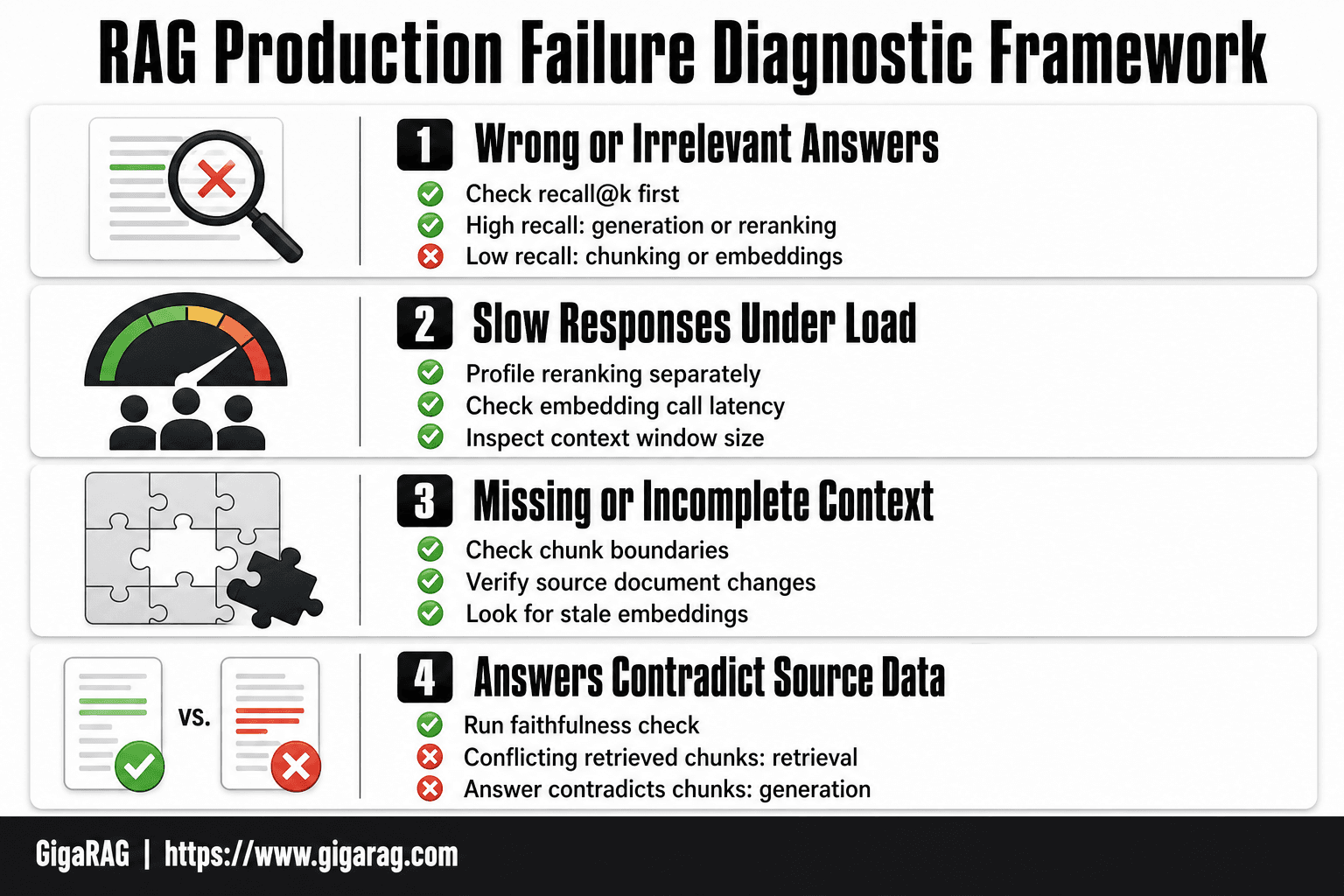
Stop guessing. Start with the symptom, then trace backward. Wrong answers point one direction. Slow responses point another. Missing context points somewhere else entirely. Here's the map.
Symptom: wrong or irrelevant answers
Retrieval pulled the wrong chunks, or generation ignored the right ones. Check recall@k first. If recall is high but answers are still wrong, the problem is generation or reranking. If recall is low, the problem is chunking or embeddings.
Symptom: slow responses under load
Latency has three usual suspects: reranking, embedding calls, or context stuffing. Measure each stage separately. If reranking adds 400ms, that's your bottleneck. If the context window is full, you're paying for tokens you don't need.
Symptom: missing or incomplete context
The chunk that should have been retrieved wasn't. This is almost always chunking boundaries or stale embeddings. Check whether the source document changed since you embedded it. Then check whether your chunk size splits the relevant fact across two chunks.
Symptom: answers that contradict the source data
Two possibilities. Either retrieval pulled conflicting chunks, or the model hallucinated over the retrieved context. Run a faithfulness check. If the answer contradicts the retrieved chunks, it's generation. If the retrieved chunks contradict each other, it's retrieval.
What RAG Cannot Do: Plain Truths and Honest Expectations
RAG retrieves text and feeds it to a model. That's the whole mechanism. It doesn't understand your data, verify it, or reason about it. Expecting more is how production systems fail quietly.
RAG won't fix bad source data
If your documents are wrong, contradictory, or outdated, RAG will retrieve them confidently and the model will repeat them confidently. Garbage in, garbage retrieved, garbage out. No chunking strategy or reranking model fixes a source document that says the wrong thing. Clean the data first.
RAG won't guarantee zero hallucinations
Retrieval reduces hallucinations. It doesn't eliminate them. The model can still ignore retrieved context, blend facts from multiple chunks, or invent details when the context is thin. Faithfulness metrics measure this, but they don't prevent it. You need guardrails and monitoring, not trust.
RAG won't replace fine-tuning for domain reasoning
RAG gives the model facts. It doesn't teach the model how to think about those facts. If your domain requires specialized reasoning patterns, legal analysis, medical diagnosis, financial modeling, RAG alone won't get you there. Fine-tuning changes how the model processes information. RAG only changes what information it sees.
Final Thoughts: Building RAG That Survives Production
Production RAG is an operational discipline, not a one-time build. The demo worked because nothing changed. Production breaks because everything does: data drifts, queries shift, models update. The fix isn't a better chunk size. It's a diagnostic habit: name the symptom, trace the failure mode, measure the metric.
That's why RAG demos work and production does not. Demos test retrieval once. Production tests it continuously. Tools like GigaRAG help agent memory builders manage that ongoing load, but no tool removes the need to watch, test, and fix.
Frequently Asked Questions
How to make a production level RAG?
Start by treating evaluation and observability as first-class components, not afterthoughts. Build a regression set from real user queries, track retrieval precision and answer faithfulness over time, and version your index and prompts together. Production readiness is a measurement problem before it is a modeling problem.
What are the limitations of RAG systems?
RAG cannot reason beyond what is in the retrieved context, cannot reliably handle queries that require synthesizing many documents at once, and cannot fix a knowledge base that is wrong, stale, or contradictory. It also struggles with multi-hop questions and with queries whose vocabulary does not match the source documents.
How does RAG technically work?
A query is embedded into a vector, compared against an index of document embeddings, and the top matches are passed as context to a language model that generates the answer. In production, additional stages like reranking, filtering, and memory retrieval are typically inserted between search and generation.
How to improve RAG performance?
Improve retrieval before you touch the prompt. Better chunking, hybrid search, and reranking usually move the needle more than prompt tweaks. Then measure answer faithfulness separately from retrieval recall so you know which stage is actually failing.
Why does my RAG demo work but production fail?
Demos use clean data, friendly queries, and a single user. Production introduces messy documents, ambiguous multi-intent queries, concurrency, and persistent memory. The demo was not lying; it simply was not testing the conditions that cause most production failures.
Does agent memory make RAG failures worse?
Yes, in most cases. Persistent memory adds another retrieval layer that can return stale or contradictory context, and multi-turn sessions compound small retrieval errors over time. Memory amplifies existing RAG weaknesses rather than creating entirely new ones.
About GigaRAG
GigaRAG is for agent memory and RAG pipeline builders. get this right. Whether you are working through why rag demos work and production does not or something adjacent, we publish what we have actually tested, including where it falls short.


