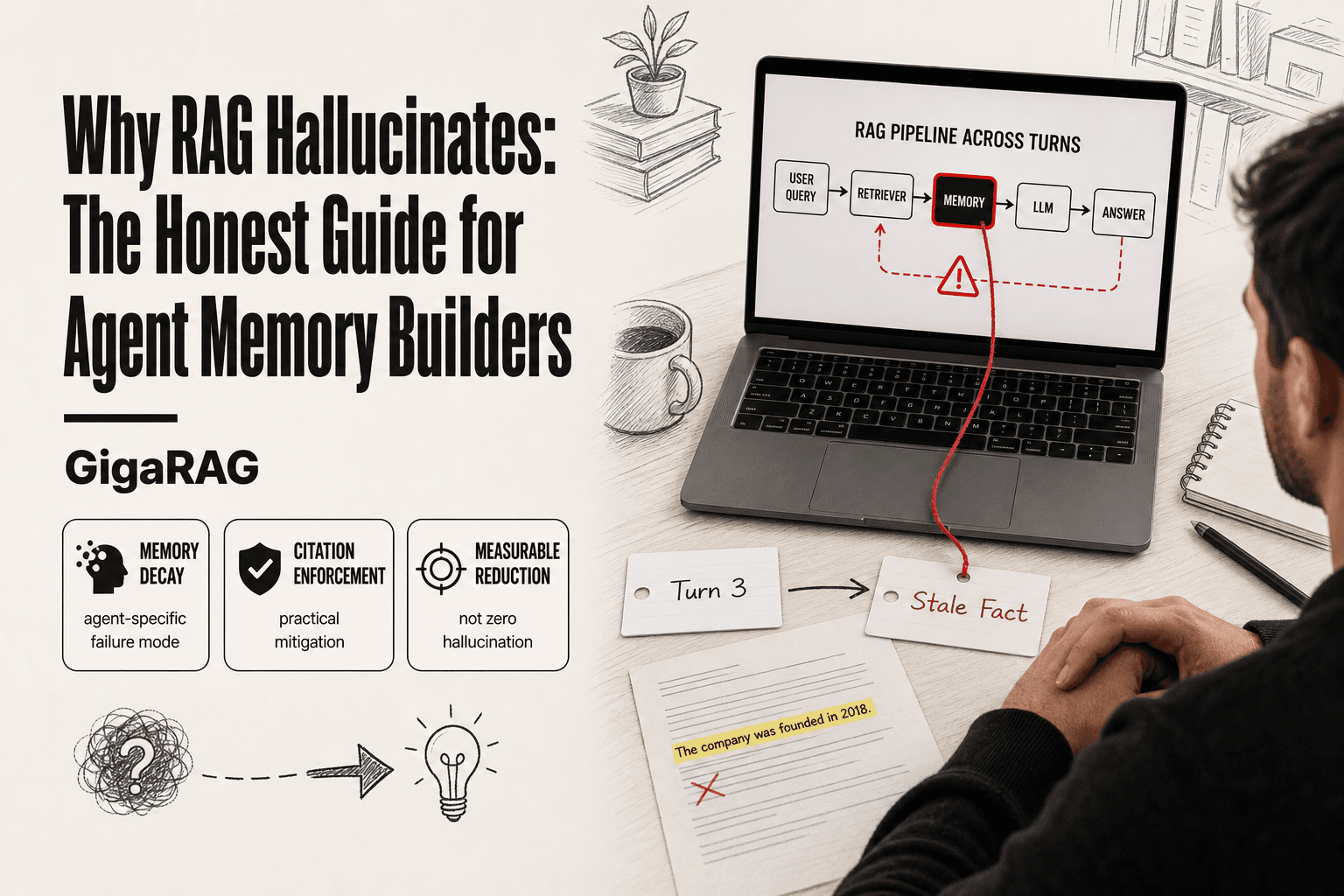
Why RAG Hallucinates: The Honest Guide for Agent Memory Builders
Your RAG agent just cited a document that doesn't say what it claims. If you build agent memory pipelines, you've seen this exact failure: the retrieval worked, the context window had the right chunk, and the model still produced an answer the source can't support. Why RAG hallucinates is not a mystery, but most guides stop at the single-shot explanation and never touch what happens when an agent carries memory across turns. The honest answer is that agent memory makes hallucination worse in ways standard RAG doesn't have to deal with. Memory decay, context contamination, retrieval staleness: these are the failure modes that show up only when your system remembers. GigaRAG's agent memory infrastructure was built to address some of them, but this isn't a pitch. This guide covers the real failure points, what you can't fix, and the mitigations that actually move the needle for pipeline builders.
| At a glance | Details |
|---|---|
| Core cause | Retrieval gaps plus generation overconfidence |
| Agent-specific | Memory decay and context contamination |
| Fixable | Retrieval quality and grounding checks |
| Not fixable | Inherent LLM uncertainty and gaps |
| Key metric | Hallucination rate per query type |
| Best defense | Citations, evals, and memory hygiene |
In This Guide
- What Is RAG Hallucination?
- Stateless RAG vs Agent Memory RAG: Hallucination Risk
- Why RAG Hallucinates: The Failure Points You Already Know
- Why Rag Hallucinates: A Step-by-Step Guide
- The Agent Memory Problem: Why RAG Hallucinates More in Multi-Turn Systems
- What You Cannot Fix: The Honest Limits of RAG
- Practical Mitigations That Actually Move the Needle
- How to Reduce Hallucinations in RAG for Agent Memory Specifically
- How RAG Hallucination Is Measured, and Why You Should Care
- Final Thoughts: Building RAG Systems You Can Actually Trust
What Is RAG Hallucination?
RAG hallucination is when a retrieval-augmented system produces an answer that contradicts or goes beyond its retrieved sources, even though those sources were available in the index. The model cites a document, but the document doesn't say what the answer claims.
RAG hallucination vs. LLM hallucination
Plain LLM hallucination is the model inventing facts from its training data. RAG hallucination is different: the system had the right context and still got it wrong. The failure isn't missing knowledge. It's a breakdown between retrieval and generation.
Why grounding should work, but doesn't always
Grounding means the model answers from retrieved text, not from memory. In theory, that constrains the output. In practice, retrieval can pull the wrong chunk, the model can ignore the chunk it got, or the chunk itself can be stale. The document is in the index. The answer is still wrong.
[!note] RAG cannot eliminate hallucination entirely because the generator can still produce unsupported text even with perfect retrieval; the goal is measurable reduction, not zero.
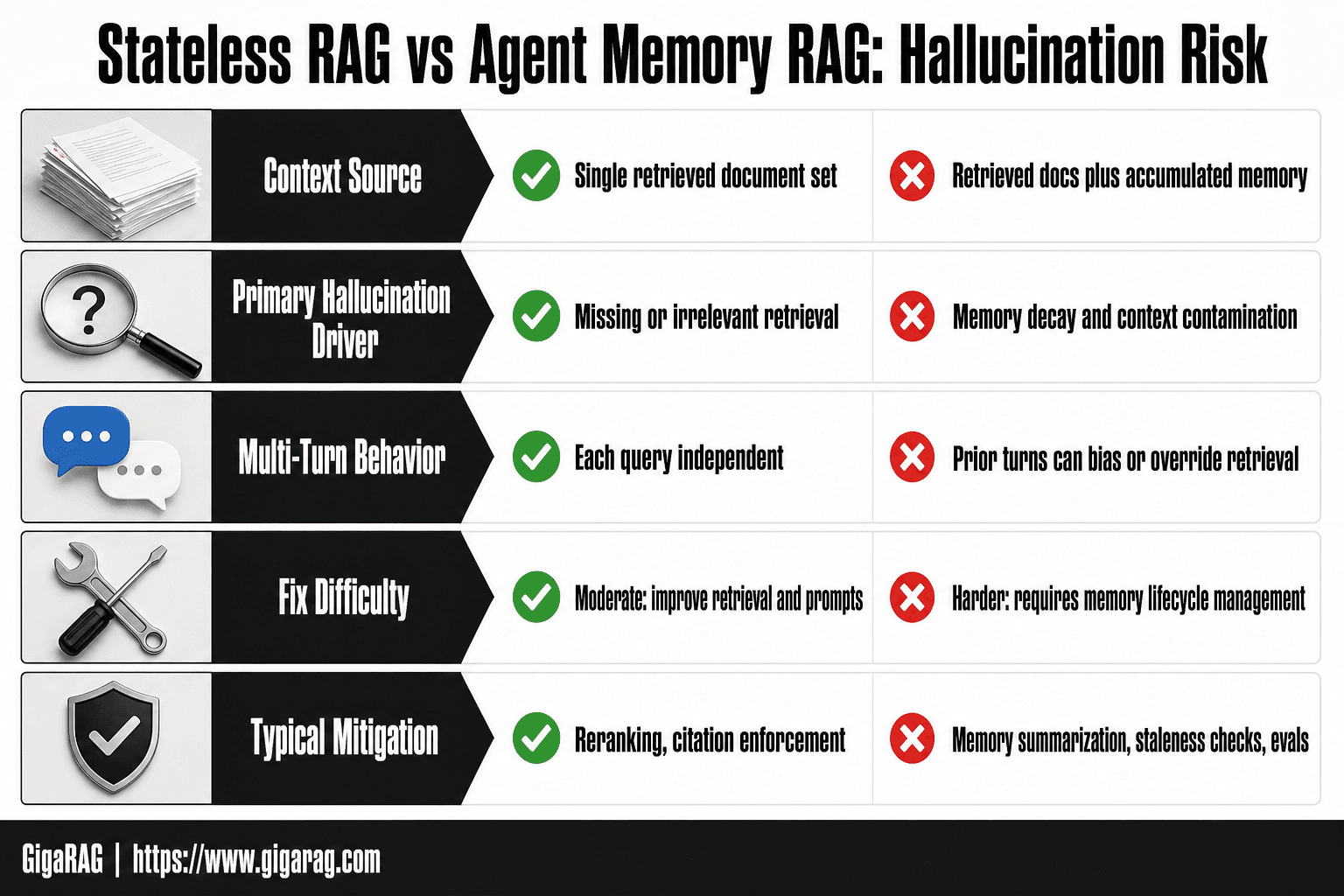
Stateless RAG vs Agent Memory RAG: Hallucination Risk
| Factor | Stateless RAG | Agent Memory RAG |
|---|---|---|
| Context source | Single retrieved document set | Retrieved docs plus accumulated memory |
| Primary hallucination driver | Missing or irrelevant retrieval | Memory decay and context contamination |
| Multi-turn behavior | Each query independent | Prior turns can bias or override retrieval |
| Fix difficulty | Moderate: improve retrieval and prompts | Harder: requires memory lifecycle management |
| Typical mitigation | Reranking, citation enforcement | Memory summarization, staleness checks, evals |
Why RAG Hallucinates: The Failure Points You Already Know
You've seen the failure. The question is where it starts. Most pipeline builders blame the model, but the model is usually the last domino. The breakdown happens earlier, and by the time generation runs, the damage is already done.
Ingestion and chunking failures
Bad chunks produce bad answers. If you split documents at arbitrary character counts, you cut sentences in half. The embedding model then encodes fragments that don't mean anything on their own. Retrieval pulls a chunk that looks relevant but lacks the context to answer the question. The model fills the gap with a guess.
The other ingestion failure is garbage in the index. Duplicate documents, outdated versions, and unprocessed formatting all compete for retrieval attention. The system retrieves the wrong version of a policy and answers confidently from it. The answer is grounded. The source is wrong.
Embedding and retrieval mismatches
Embedding models map text to vectors, but they don't understand your domain. A general-purpose embedding model treats "cell" in biology and "cell" in telecom as similar. Your retrieval returns the wrong sense of the word. The model then answers the wrong question entirely.
Retrieval also fails when the query and the document use different vocabulary. A user asks about "agent memory decay." Your index stores "context expiration policies." Semantic search should bridge that gap, but embedding models miss domain-specific synonyms. The right chunk never gets retrieved.
Generation-time overconfidence
Even with the right chunk in context, the model can ignore it. LLMs are trained to produce fluent, confident answers. When the retrieved chunk is ambiguous or incomplete, the model doesn't say "I don't know." It fills the gap with plausible-sounding text.
The model also struggles with multiple retrieved chunks that contradict each other. Give it three conflicting sources and it may blend them into a single answer that matches none of them. The sources are all in the prompt. The output is still wrong.
[!tip] For agent memory builders: treat every stored memory as a potential stale fact. Add a 'last verified' timestamp and re-retrieve before trusting memory in high-stakes answers.
Why Rag Hallucinates: A Step-by-Step Guide
- Instrument your pipeline to log retrieval scores, memory reads, and final answers per turn.
- Separate retrieval failures from generation failures by testing with gold context.
- Add citation enforcement so every claim must map to a retrieved span.
- Implement memory decay policies: summarize, expire, or re-verify stored facts.
- Run multi-turn evals that simulate long conversations with topic shifts.
- Track hallucination rate by query type and memory age, then iterate on the worst buckets.
The Agent Memory Problem: Why RAG Hallucinates More in Multi-Turn Systems
Single-shot RAG retrieves once and answers once. Agent memory systems retrieve across turns, store context between calls, and carry conversation history forward. Every one of those extra steps adds a new failure point. The result: agents hallucinate more, not less, as conversations get longer.
Memory decay: when stored context goes stale
Agents store facts from earlier turns in memory. That memory doesn't update itself. A user says their budget is $5,000 in turn one. By turn six, they've changed it to $8,000. If the agent still retrieves the old figure, it answers from stale context. The answer is grounded. The grounding is wrong.
Decay also hits long-term memory stores. Documents get updated, policies change, product specs shift. If your agent memory doesn't refresh against the source index, it keeps citing versions that no longer exist. The model can't tell the difference between fresh and stale memory. It just retrieves what's there.
Context contamination: when one turn poisons the next
A wrong answer in turn three doesn't stay in turn three. Agents write their own outputs back into memory. If the model hallucinated a fact and that fact gets stored, the next retrieval pulls the hallucination as if it were source material. One bad turn compounds.
Contamination also happens through prompt assembly. When you stuff the last ten turns into the context window, an early misread gets repeated verbatim. The model sees its own error as established context and builds on it. The conversation drifts further from the source documents with every turn.
Retrieval staleness: when the index lags behind the conversation
The conversation moves faster than the index. A user asks about a document they just uploaded. The index hasn't ingested it yet. Retrieval returns nothing relevant, so the model answers from general knowledge. That's hallucination by omission.
Staleness also hits when the agent learns new information mid-conversation. The user corrects the agent in turn four. The correction lives in the conversation transcript, not in the vector index. Next retrieval still pulls the old, wrong chunk. The agent repeats the error it was just told to fix.
The honest answer is that agent memory turns RAG from a single retrieval problem into a state management problem. You're not just retrieving documents. You're maintaining a moving picture of what the user said, what the agent said, and what the index contains. When those three drift apart, hallucination is the default outcome.
What You Cannot Fix: The Honest Limits of RAG
Some failure modes are structural. You can reduce them. You can't engineer them away.
Zero hallucination is not a realistic goal
No pipeline configuration guarantees faithful output. The model samples from a probability distribution. Sometimes it picks the wrong token. Grounding narrows the space, but it doesn't close it. A retrieval system that returns perfect chunks still feeds a model that can paraphrase badly, merge two sources, or invent a connector sentence. If your SLA requires zero hallucinations, RAG is the wrong architecture. Plan for detection and correction, not elimination.
Bad source data in, bad answers out
RAG inherits every error in your knowledge base. Outdated policies, contradictory documents, poorly written chunks: the model will faithfully reproduce all of them. Retrieval quality doesn't fix source quality. If two documents disagree, the agent picks one or blends both. You can't prompt your way out of a messy index. Clean the source data first, or accept that some answers will be wrong because the documents are wrong.
When RAG is the wrong tool entirely
RAG helps when the answer lives in your documents. It doesn't help when the question needs reasoning across documents that don't share vocabulary, when the answer requires real-time data not in the index, or when the user needs a judgment call, not a lookup. For those cases, a database query, an API call, or a human is the right tool. Don't force retrieval where retrieval adds nothing.
Practical Mitigations That Actually Move the Needle
You can't eliminate hallucination. You can cut the rate. Here's what works, organized by where it applies in the pipeline.
Retrieval-side fixes: reranking, hybrid search, better chunking
Most retrieval failures happen because the vector search returns chunks that are semantically adjacent but factually wrong. Reranking fixes this: a cross-encoder scores each candidate chunk against the query, pushing the relevant ones up. It adds 50-200ms of latency, but it cuts hallucination rates measurably. Hybrid search helps too. Combine dense embeddings with BM25 keyword matching so exact terms like error codes or product names don't get lost in semantic drift.
Chunking matters more than most builders admit. Chunks that split a definition across two boundaries guarantee a bad retrieval. Overlap helps. So does chunking by document structure, not fixed token counts.
Generation-side fixes: grounding prompts, constrained decoding
Tell the model what to do when it doesn't know. A grounding prompt that says "answer only from the provided context, and say you don't know if the context doesn't contain the answer" cuts invented answers sharply. It won't eliminate them. The model can still paraphrase badly.
Constrained decoding goes further. Force the model to cite a chunk ID before it writes each sentence. If it can't cite, it can't answer. This catches hallucination at generation time instead of after the fact.
Detection-side fixes: when to measure instead of prevent
Sometimes prevention costs more than detection. For high-volume, low-stakes queries, run an LLM-as-judge check after generation. Flag answers where the judge scores faithfulness below a threshold, then route those to a human or a retry. It's cheaper than reranking every query.
The honest trade-off: reranking and constrained decoding add latency. Detection adds a second model call. You pick based on your latency budget and your tolerance for wrong answers.
How to Reduce Hallucinations in RAG for Agent Memory Specifically
Agent memory changes the math. In a single-shot RAG query, you retrieve once and generate once. In a multi-turn agent, every turn adds new context that can poison the next retrieval. The mitigations from the previous section still apply, but they need memory-specific handling.
Memory refresh and expiration policies
Stored context goes stale. A fact your agent learned three turns ago may no longer be true, or may conflict with what the user just said. Set an expiration policy: time-based for volatile data, event-based for things like "the user changed their plan." Refresh memory by re-retrieving against the current conversation state, not just appending new turns. The honest answer: no policy is perfect. You're trading freshness against the cost of re-retrieval.
Per-turn context window budgeting
Every turn competes for the same context window. If you stuff the full conversation history plus retrieved chunks into every prompt, you'll hit the limit and truncate something important. Budget explicitly: reserve a fixed share for system instructions, a share for retrieved evidence, and a share for recent turns. Older turns get summarized, not pasted verbatim. Summarization loses detail, but it beats silent truncation.
When to reset the conversation vs. persist memory
Reset when the topic shifts hard. Persist when the user is building on earlier turns. A good rule: if the current query shares no entities with the last three turns, start a fresh context and rely on long-term memory for anything worth keeping. Don't try to carry everything forward.
How RAG Hallucination Is Measured, and Why You Should Care
You can't fix what you don't measure. Hallucination rates give you a baseline before you change chunking, reranking, or memory policies, and a way to confirm the change actually helped.
LLM-as-judge for faithfulness
You use a second LLM to check whether the generated answer is supported by the retrieved context. It reads the answer and the source chunks, then scores faithfulness. It's fast and catches semantic drift that keyword matching misses. The catch: judges have their own biases, and they're only as good as the prompt you give them.
Semantic similarity and token overlap
Semantic similarity embeds the answer and the source, then measures cosine distance. Token overlap counts shared words. Both are cheap and deterministic. Neither catches a confident wrong answer that happens to share vocabulary with the source.
Building a hallucination eval loop
Keep a fixed set of test queries with known-good answers. Run them after every pipeline change. Track the rate, not just pass/fail. A 2% drop after switching chunk sizes tells you something real. A single anecdote doesn't.
Final Thoughts: Building RAG Systems You Can Actually Trust
RAG hallucination is a systems problem, not a model problem. You can swap in a better LLM and still get confident wrong answers if your chunks are bad, your embeddings drift, or your agent's memory carries stale context into the next turn.
Agent memory adds real complexity. Memory decay, context contamination, and retrieval staleness don't exist in single-shot RAG, so the standard advice doesn't cover them. But that same memory is where the opportunity lives: an agent that remembers the right things, and forgets the rest, grounds better than one that treats every turn as a blank slate.
The honest answer is that you'll never hit zero hallucinations. You can measure the rate, push it down with reranking and memory policies, and catch the worst failures before users do. That's the job. GigaRAG's memory infrastructure is built for exactly that: tracking what your agent should keep, expire, and retrieve across turns. Why RAG hallucinates is a problem you can manage, not eliminate.
Frequently Asked Questions
What causes sudden hallucinations in elderly people?
In clinical contexts, sudden hallucinations in elderly people are often linked to delirium, infections, medication side effects, or sensory deprivation. This is unrelated to RAG systems, but the lesson for builders is that sudden changes usually have a trigger — in agents, that trigger is often a memory update or context shift.
Is it normal to hallucinate after a stroke?
Hallucinations can occur after a stroke depending on the affected brain region, but they are a medical symptom requiring professional evaluation. For RAG builders, the analogy is that a single bad retrieval or corrupted memory can cause persistent hallucinations until the underlying issue is fixed.
What are the 7 types of hallucinations?
In AI, hallucination taxonomies vary, but common categories include factual fabrication, unsupported extrapolation, citation errors, context confusion, temporal errors, entity mix-ups, and instruction-following failures. In agent memory systems, add memory decay and context contamination as distinct failure modes.
Can I hallucinate without using drugs?
Yes, hallucinations can occur without drugs due to factors like sleep deprivation, migraines, or psychiatric conditions. In RAG, the equivalent is that hallucinations can occur without any adversarial input — just from retrieval gaps or stale memory.
Does RAG reduce hallucinations?
RAG can reduce hallucinations by grounding responses in retrieved documents, but it does not eliminate them. In agent memory systems, RAG may even introduce new hallucination modes if memory is stale or contaminated.
How to reduce hallucinations in RAG?
Reduce hallucinations by improving retrieval quality (reranking, hybrid search), enforcing citations, adding hallucination detection, and managing memory lifecycle. Multi-turn evals are essential for agentic systems.
What is hallucination detection?
Hallucination detection is the process of identifying when a model's output is unsupported by retrieved evidence or known facts. Methods include entailment checks, self-consistency, and citation verification.
About GigaRAG
GigaRAG is for agent memory and RAG pipeline builders. get this right. Whether you are working through why rag hallucinates or something adjacent, we publish what we have actually tested, including where it falls short.


