Is “Acronyms and Internal Jargon Breaking Retrieval” Your RAG Issue?
Use this worksheet when acronyms and internal jargon breaking retrieval is the problem you are trying to investigate in a RAG workflow. Start by recording the user’s wording, the relevant source wording, available scope, and the retrieved material before deciding what to change.
Quick answer
Treat short terms, aliases, and team-specific language as a diagnostic prompt rather than an automatic expansion rule. Compare the original wording with a fuller phrase or known alternate wording, then inspect the source material and retrieved candidates.
- Record the query exactly as submitted.
- Record the wording used in the source material.
- Record any available team, product, region, or document context.
- Keep ambiguous terms unresolved until appropriate context is available.
What terminology mismatch means in RAG
For this worksheet, a terminology mismatch is a case in which a user query and a source use different wording that may refer to the same subject. The purpose is to identify what additional evidence is needed before changing retrieval behavior.
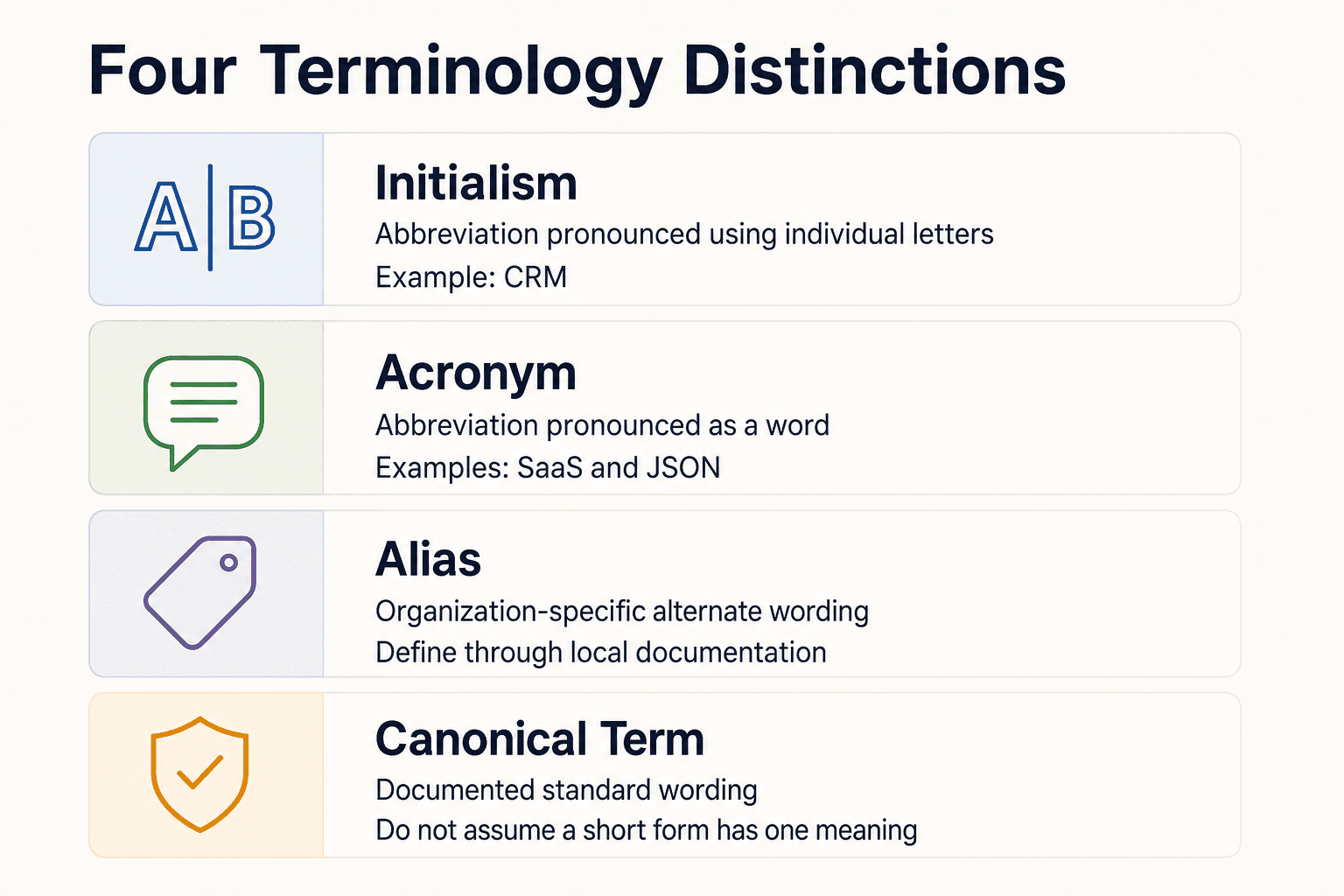
Acronym, initialism, alias, and canonical term
The supplied Daxtra reference describes initialisms as abbreviations pronounced using individual letters, such as CRM, and acronyms as abbreviations pronounced as words, such as SaaS or JSON.
Use local documentation to define any organization-specific alias or canonical term. Do not assume that a short form has one meaning outside its documented context.
Which terminology question are you investigating?
| Investigation question | What to record |
|---|---|
| Does the source use different wording? | Query text, source text, and any documented alternate wording |
| Could the short term have multiple meanings? | Candidate meanings and their scopes |
| Is there sufficient request context? | Team, product, region, task, or document type supplied with the request |
| Does the source exist in the corpus? | Source location, indexing status, and relevant passage |
| Does retrieved text contain the needed passage? | Candidate text and the passage available to the answer step |
Why acronyms and internal jargon need careful investigation
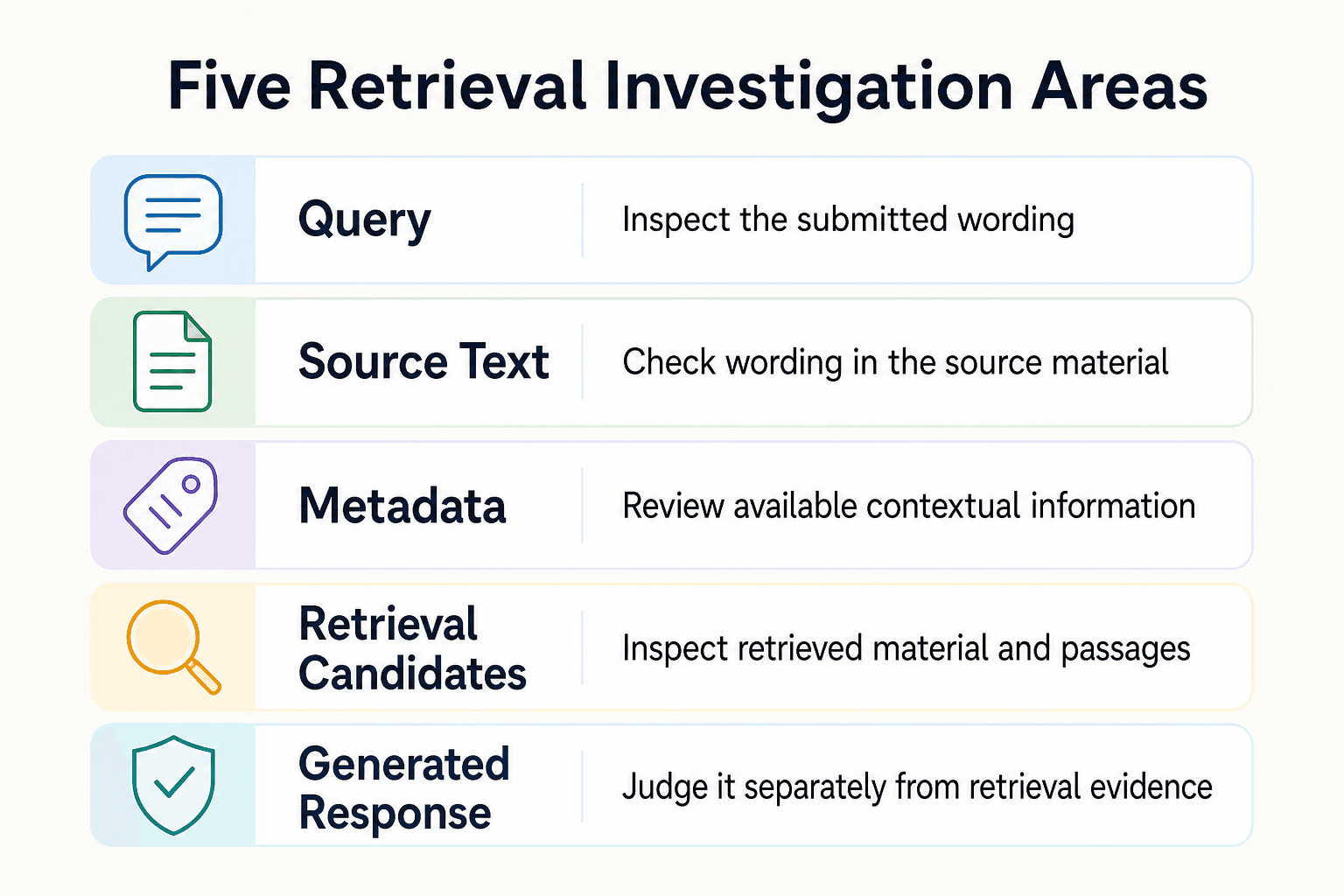
A short term can be evaluated differently depending on the system design, corpus, and available context. Rather than presuming a single failure point, inspect the query, source text, metadata, retrieval candidates, and generated response separately.
Approximate matching and spelling variation
The supplied NJIT paper describes an approach in which inserts, deletes, and mismatches are allowed when matching a query with words or phrases in messages. Use this as a reminder to distinguish spelling variation from a documented terminology mapping.
Short terms and context
Record the surrounding words in the request. If the available information does not distinguish between documented meanings, preserve the ambiguity and request clarification rather than selecting an expansion by assumption.
Candidate review
Review the retrieved material before judging a generated response. Note whether the relevant source, passage, and contextual details are present in the material supplied to the answering step.
Acronyms and internal jargon breaking retrieval: A step-by-step guide
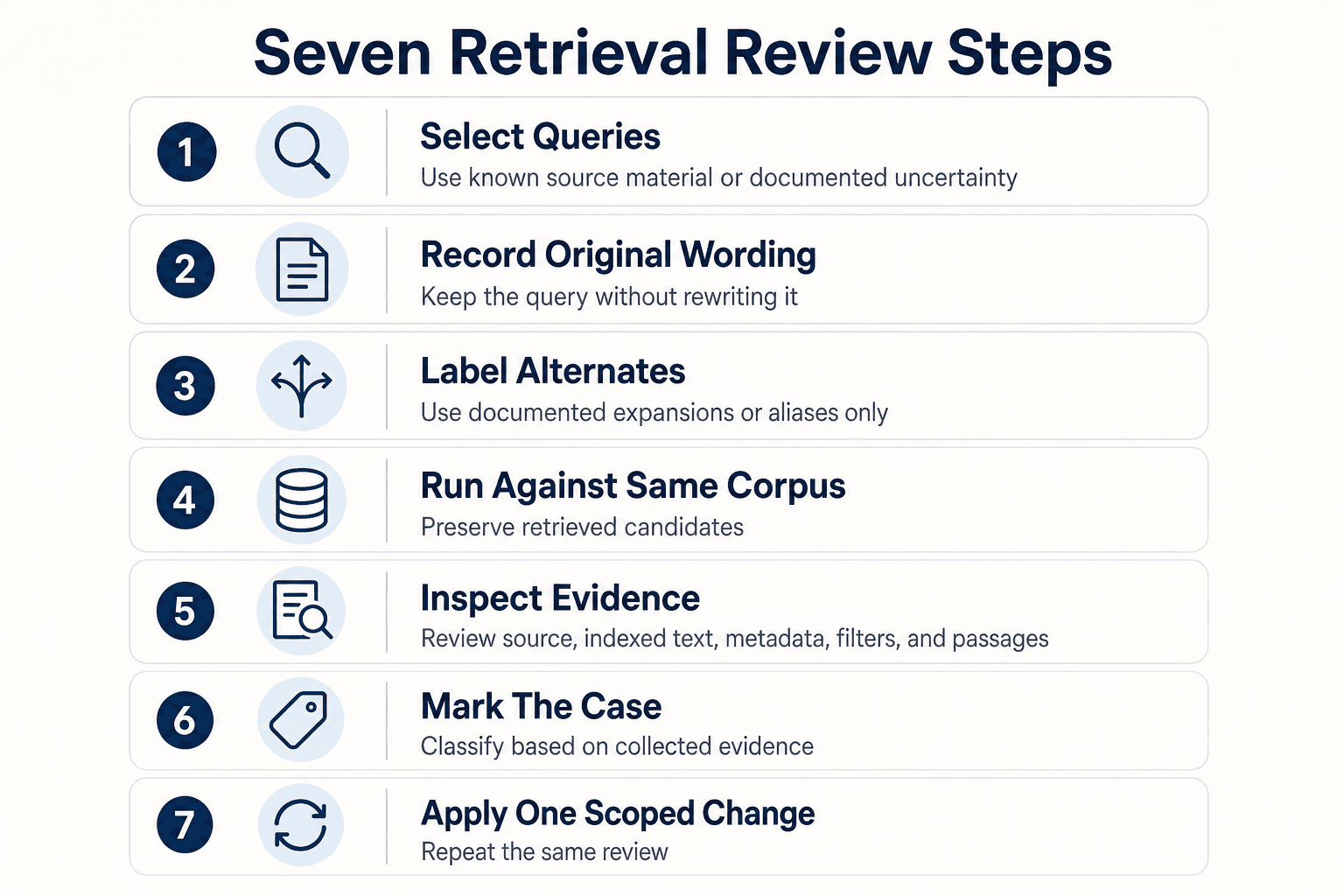
- Select a small set of queries with known source material or clearly documented uncertainty.
- Record the original query without rewriting it.
- Create separately labeled alternate queries only when you have documented expansions or aliases.
- Run the queries against the same corpus and preserve the retrieved candidates.
- Inspect source text, indexed text, metadata, filters, and candidate passages.
- Mark each case as unresolved, source-related, terminology-related, context-related, or candidate-related based on the evidence you collected.
- Apply one scoped change at a time and repeat the same review.
Diagnose the question before changing the workflow
Build a documented query set, vary one term at a time, and inspect the source and retrieved material before drawing conclusions.
Create a known-answer query set
For each case, record the query, expected source where known, relevant passage, applicable scope, and date of review. Keep hypothetical examples clearly labeled as hypothetical.
Compare original and alternate wording
Keep the original query separate from any expanded or alias-based version. Label each alternate version with the document or terminology record that supports it.
Inspect retrieved candidates
Review retrieved documents, applied filters, metadata, and available passages. Record what the system received rather than inferring what it should have received.
Use clear investigation labels
Use labels such as:
- Source question: Is there relevant material to review?
- Terminology question: Does documentation connect the two terms?
- Context question: Is there enough information to distinguish candidate meanings?
- Candidate question: Is relevant material present in the retrieved set?
- Answer-support question: Does the available material support the response?
Record terminology and scope
Maintain terminology records only for mappings that an appropriate owner has documented or approved.
[!note] The supplied Daxtra reference distinguishes between acronyms and initialisms. Record pronunciation and expansion only when they are relevant to the terminology you are documenting.
Suggested terminology record
For each term, record:
- Canonical wording
- Short form or alias
- Definition or source excerpt
- Owner
- Applicable team, product, region, or system
- Source document
- Review date
- Terms that require clarification instead of automatic expansion
Preserve source wording
Keep source wording available for review. If additional terminology fields are used, identify them as annotations rather than replacing the source text.
Keep scope explicit
If a term is used in more than one context, record each documented meaning separately with its applicable scope. Do not merge meanings merely because they share the same letters.
Handle short terms at query time
Use the original query as a distinct input. Any alternate wording should remain traceable to a documented mapping or to a clarification supplied by the requester.
Identify terms that need review
Flag short uppercase strings, organization-specific labels, and terms that appear in user language but lack a documented mapping. A flag is a request for review, not a conclusion about meaning.
Use scoped alternate wording
When a documented alias or expansion applies to the supplied context, test it separately from the original wording. Preserve which query produced each candidate.
Ask for clarification when needed
When more than one documented meaning remains plausible, ask a concise follow-up question that names the relevant scopes or full terms.
[!example] “Which PA do you mean: Platform Access or Purchase Approval?”
Examples: one documented alias and one unresolved abbreviation
These are hypothetical examples for planning a terminology review.
Hypothetical alias case
Suppose a runbook uses the phrase “contractor credential recovery,” while a support request uses “Blue Badge.” Before adding a mapping, document whether the two phrases refer to the same process, who approves the mapping, and where it applies.
Hypothetical ambiguity case
Suppose “PA” appears in records for two separately scoped processes. If the request does not provide enough information to choose between them, ask for the applicable team, product, or full term.
What to record next
For either example, retain the original request, any clarification, the terminology record, the retrieved material, and the source passage used to support a response.
What glossaries and query expansion should document
A glossary or terminology record can document approved names and relationships. It should also record uncertainty, scope, ownership, and review history.
[!tip] Use the same query cases when reviewing a proposed terminology change so that the before-and-after records are comparable.
Missing material
If relevant material cannot be located, record that as a source-coverage question rather than treating an alias entry as source content.
Ambiguous requests
If a glossary lists multiple meanings, use the documented scope or request context before selecting one. Where the context remains insufficient, ask for clarification.
Review expanded queries separately
Keep original and alternate queries distinct in logs and evaluation records. This makes the terminology decision visible during later review.
A practical rollout plan
Start with a small, documented set of cases.
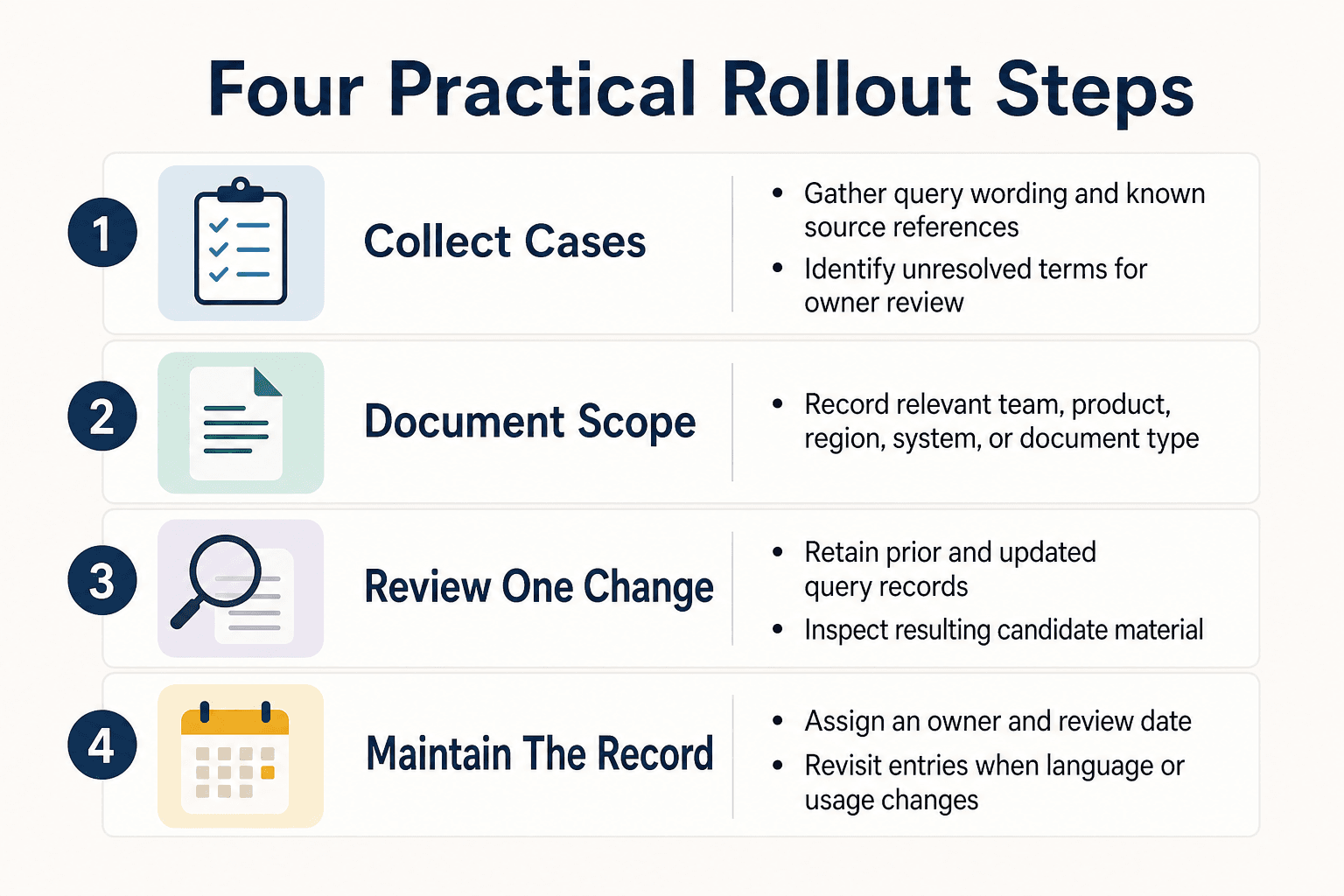
1. Collect cases
Collect query wording, source references where known, and unresolved terms requiring owner review.
2. Document scope
Record the team, product, region, system, or document type when that information is relevant and available.
3. Review one change at a time
For each proposed mapping or workflow change, retain the prior and updated query records and inspect the resulting candidate material.
4. Maintain the record
Assign an owner and review date to high-impact terminology records. Revisit entries when source language or organizational usage changes.
Continue using acronyms and internal jargon breaking retrieval as a review prompt: preserve the original wording, document the available context, and avoid treating an ambiguous short term as settled without supporting records.
Frequently asked questions
What does ): mean in text?
Provide the surrounding text, source, and intended audience before interpreting the symbol in a retrieval workflow.
What is the word for an acronym that helps you remember something?
A memory-related term may need its own definition and source. The supplied Daxtra reference distinguishes acronyms from initialisms by pronunciation.
What is the 3 letter abbreviation?
Provide the phrase, source, and surrounding context before documenting an abbreviation.
What are some common acronyms used in recovery?
Specify the relevant domain, team, and source material before creating or using a recovery-related terminology list.
What does “acronyms and internal jargon breaking retrieval dental” mean in this search context?
Treat “dental” as a possible scope signal and inspect the relevant source material before expanding any term.
What does “acronyms and internal jargon breaking retrieval ati” mean in this search context?
Request surrounding context or consult scoped documentation before assigning a meaning to “ati.”
About GigaRAG
GigaRAG is for agent memory and RAG pipeline builders. get this right. Whether you are working through ragie alternatives or something adjacent, we publish what we have actually tested, including where it falls short.