How to Turn Software Engineering Experience Into an FDE Resume
An FDE title isn't required to apply for a Forward Deployed Engineer role, but a code-only software engineering resume usually won't show that you're ready. FDE work can involve turning unclear needs into integrations, deployments, fixes, and follow-up, so recruiters need context alongside technical skill. You can't claim client discovery, production deployments, or business results you didn't personally support.
That doesn't make your work irrelevant. A backend service, production incident, internal API integration, or AI prototype can show the same parts of the job when you name the constraint, decision, and verified result. The main catch is customer empathy: internal users, support tickets, and cross-functional partners are credible evidence, but they aren't the same as owning a client relationship.
Quick answer
You don't need a previous FDE title to apply. Translate your engineering work into evidence of context, technical decisions, ownership, and outcomes, without claiming customer impact you can't substantiate.
- Show the problem or need the work addressed.
- Explain your role in integrations, deployment, debugging, or iteration.
- Use direct customer evidence only when you have it. Otherwise, describe truthful internal or project-based proxies.
What Forward Deployed Engineers Do Differently From Software Engineers
An FDE can't claim customer discovery, deployment ownership, or business impact they didn't support. Coding skill alone also won't prove readiness. The role sits closer to a user's messy problem, where requirements shift and the system has to work outside a neat backlog.
The FDE loop: understand the problem, build, deploy, debug, and iterate
FDE work starts with context: what the user needs, what systems already exist, and what constraints could break the plan. Then you build an integration or service, deploy it, investigate failures, and adjust from what the user or internal partner reports.
Here's what happens behind the scenes: a technically sound feature may still fail because data is missing, an API behaves differently in production, or the workflow doesn't fit how people work. Your resume needs to show that you can handle the whole loop.
Where software engineering and FDE work overlap
The overlap is real. Both roles can involve system design, APIs, cloud infrastructure, testing, code review, incident response, and production debugging.
The main difference is the center of gravity. A software engineer may own a bounded product area, while an FDE often connects technical choices to a specific deployment problem and explains trade-offs to people outside engineering.
What an FDE resume needs to prove that a standard SWE resume may not
A standard SWE resume can focus on what you built. An FDE resume needs the surrounding evidence: why the work mattered, who supplied the constraints, what you integrated with, how you shipped it, and what happened after release.
Keep it truthful. Internal users, support tickets, partner teams, and production incidents can show this kind of ownership when you don't have direct client work.
How engineering experience can map to FDE evidence
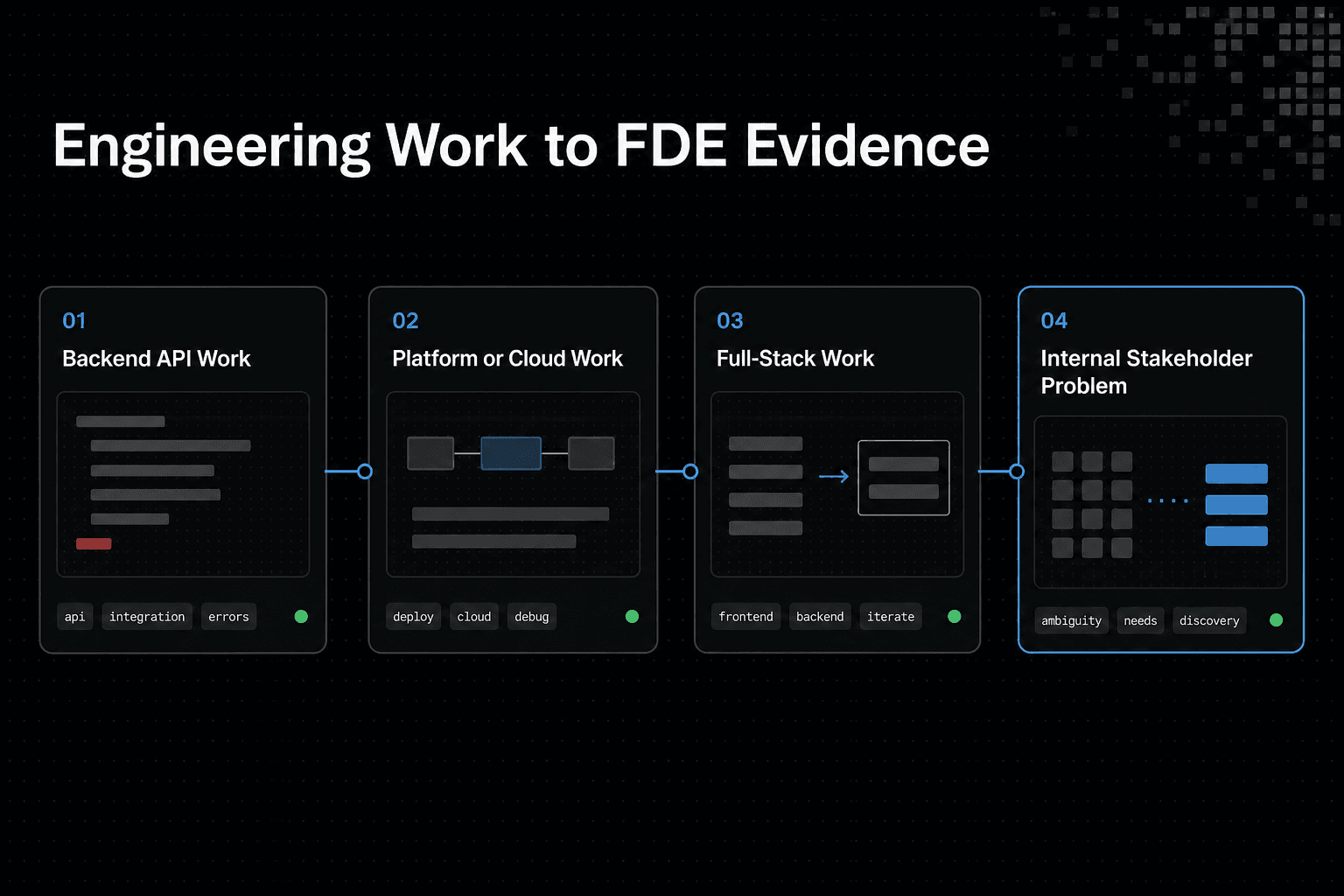
| Engineering experience | FDE-relevant evidence | Truthful framing |
|---|---|---|
| Backend API work | Integration design, data flow, error handling | Name the systems and your implementation work. Don't imply a customer deployment if there was none. |
| Platform or cloud work | Deployment, reliability, production debugging | Describe the environment, incident or constraint, and your actions. |
| Full-stack work | End-to-end ownership and user-facing iteration | Identify the user or stakeholder only as specifically as your experience supports. |
| AI/ML work | Prototype development, evaluation, and iteration | State what you built and evaluated. Don't imply production use without evidence. |
| Internal stakeholder problem | Ambiguity handling and needs discovery | Describe the stakeholder request and how you clarified or addressed it. |
The FDE Skills Recruiters Look For
Recruiters aren't only looking for a long tool list. They need evidence that you can turn an unclear problem into working software, deal with failures, and keep technical and non-technical partners aligned.
Technical execution: coding, APIs, data flows, and cloud systems
Show the work at the boundary. That can mean designing an API integration, mapping fields between systems, handling authentication and retries, or tracing data from input to storage to a user-facing result.
Name tools only when they explain your contribution. A bullet that says you built a cloud service is thin. One that explains the service's inputs, failure handling, and deployment path gives a recruiter something to assess.
Operational judgment: debugging, reliability, and trade-offs
FDE work rarely arrives as a clean ticket. You may need to reproduce a production issue, isolate the root cause across services, and decide what to fix now versus what needs a larger redesign.
Trade-offs matter. State why you chose a simpler integration, a queue, caching, extra logging, or a manual fallback when your work supports that choice.
Customer-facing execution: discovery, technical communication, and iteration
You don't need direct client experience to show these skills. Internal users, product managers, support teams, and partner engineers can supply real constraints and feedback.
Be exact about your role. If you gathered requirements from an internal team and revised a workflow after feedback, say that. Don't turn it into customer discovery or claim adoption results you can't verify.
How AI/ML, RAG, agent, and MCP work can be relevant evidence
These projects can help, but the model alone isn't the proof. Show the surrounding engineering: data preparation, retrieval design for RAG, evaluation cases, tool permissions for an agent, or how an MCP server exposes a system safely.
The main catch is that a prototype without limits looks shallow. Include what it couldn't handle, how you checked output quality, and where human review or a fallback remained necessary.
Step-by-step: Translate an Engineering Project Into FDE Evidence
- Choose a project involving an integration, deployment, debugging task, prototype, or unclear stakeholder need.
- State the problem, user, or constraint, using only details you can verify.
- Describe the technical decisions and your individual contribution.
- Explain how you tested, deployed, debugged, or iterated on the work.
- Add a concrete outcome when you can support it. Otherwise, describe the delivered artifact or resolved issue.
- Review each bullet for customer-contact or impact claims your experience doesn't substantiate.
[!note] A prior FDE title is not required to present relevant engineering experience, but a code-only description may leave context, ownership, and outcomes unclear.
How to Turn Software Engineering Experience Into an FDE Resume
You can turn software engineering experience into an FDE resume by showing the problem context, your technical choices, how you handled deployment or feedback, and a verified result. You can't claim client discovery, customer deployments, or business impact you didn't directly support. Strong framing is truthful framing.
The FDE resume formula: context + action + technical decision + result
Start with the situation, not the programming language. Name the user, system boundary, failure, or unclear request that made the work matter.
Then show what you did, the decision you made, and what changed. For example: "Investigated failed partner API syncs, added idempotent retry handling and request logging, and reduced repeat failures in the monitored workflow." Include the final result only when you can verify it.
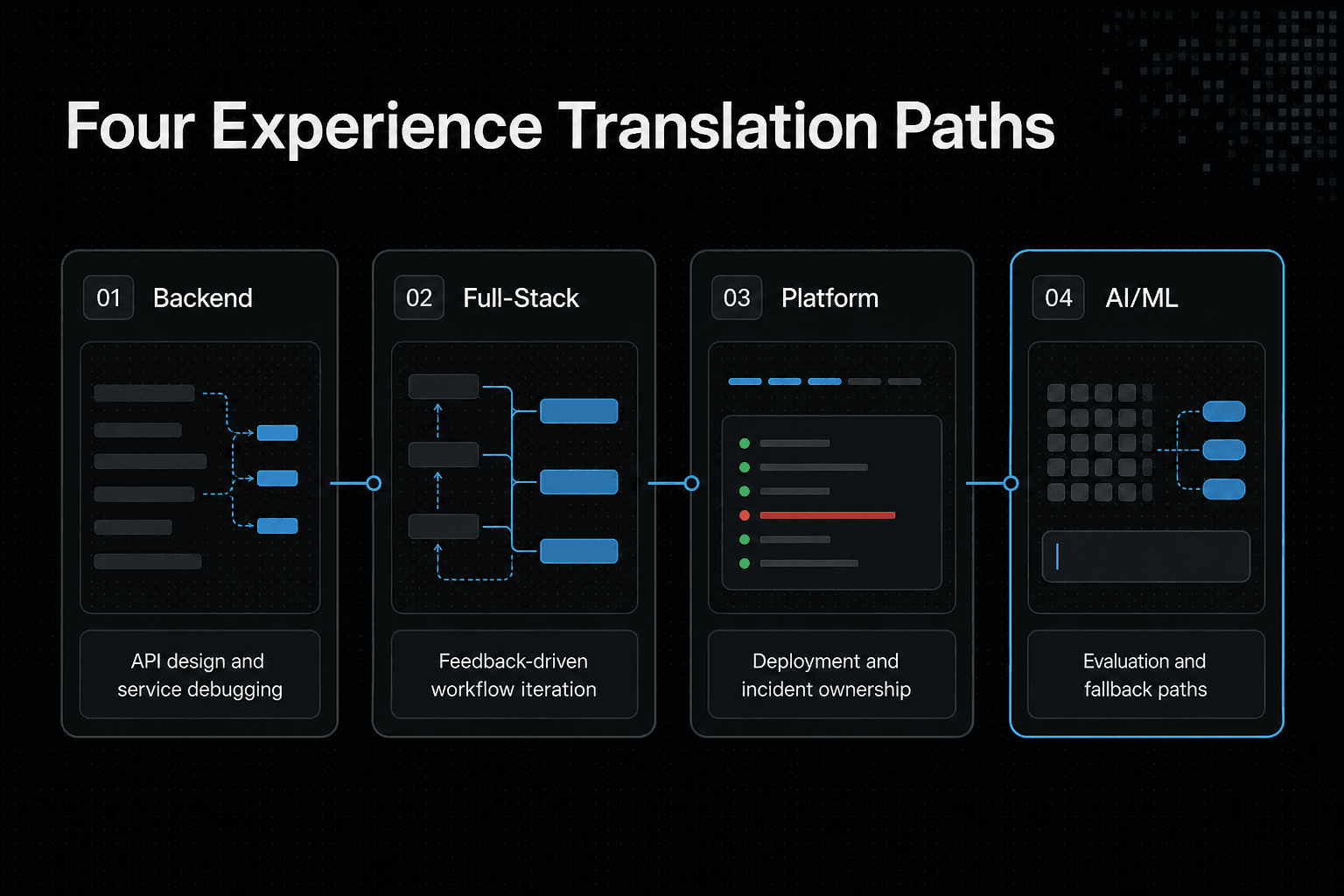
Translation matrix: backend, full-stack, platform, and AI/ML experience
Translate the work you already have:
- Backend: API design, data mapping, authentication, retries, and service debugging can show integration delivery.
- Full-stack: turning feedback into a usable workflow can show requirements handling and iteration.
- Platform: deployment pipelines, observability, access controls, and incident response can show operational ownership.
- AI/ML: evaluation cases, retrieval design, model limits, and human fallback paths can show applied AI implementation.
The key is the link between the technical work and the problem it solved. A tool list can't make that link for you.
How to quantify results without inventing revenue, adoption, or customer metrics
Don't attach revenue, user growth, or time saved to work unless you have a source and can explain your role. "Improved customer satisfaction" isn't worth using if it came from guesswork.
Use numbers you observed: requests processed, endpoints integrated, test cases added, incidents resolved, error-rate changes, deployment frequency, or manual steps removed. Keep the scope clear, especially when a number covers one service or internal team.
Use observable evidence when a business metric is unavailable
A result doesn't have to be a headline metric. You can state that you shipped a workflow, wrote a runbook, traced a root cause, added monitoring, or incorporated feedback from named internal partners.
Be specific. "Built dashboard" says little. "Built an internal dashboard that exposed failed imports and gave support staff error details" shows a problem, an implementation, and a practical outcome.
Build an FDE Resume That Recruiters Can Scan Quickly
Your resume won't prove FDE readiness if relevant evidence is buried under a long tool list or generic coding bullets. Put work that shows judgment near the top. A recruiter should quickly find what you built, who needed it, and how you got it into use.
Header and summary: position yourself without claiming an FDE title
Use a clear title such as "Software Engineer | API Integrations, Cloud Systems, Production Debugging." Don't write "Forward Deployed Engineer" unless you held that role.
Keep the summary to two or three lines. State your engineering focus, the systems you worked on, and any real cross-functional or user-facing context: "Backend engineer with experience shipping API workflows, resolving production issues, and working with product and support teams on internal tools."
Experience: prioritize ownership, integrations, deployment, and cross-functional delivery
Lead each role with bullets closest to FDE work: ambiguous requirements, system boundaries, deployment, incidents, feedback, and handoffs. Put routine feature work lower unless it involved a meaningful technical decision.
Use plain verbs: built, traced, deployed, integrated, documented, fixed. "Collaborated with stakeholders" is weak unless you name what that collaboration changed.
Technical skills: group tools by the work they enabled
Don't make skills the longest part of the page. Group them by practical work: Languages, APIs and data, Cloud and deployment, Observability, AI/ML.
List only tools you can discuss. A keyword you can't explain in an interview won't help you.
Projects and education for internships and early-career applications
For early-career applications, projects can carry real weight when paid experience is limited. Give each project a problem, constraint, design choice, validation method, and result, not just a repository link.
Keep education brief unless coursework, research, or a capstone directly supports the role. A project that handles API failures, deployment, or feedback is more useful than a long list of classes.
Rewrite Software Engineering Bullets for FDE Impact
A strong FDE bullet shows more than code shipped. It gives the problem, system boundary, choice you made, and what changed afterward. Don't add customer impact, revenue, or adoption claims unless you can verify that you personally supported them.
[!tip] For internal projects, name the stakeholder group and the need you clarified. Then describe the integration, prototype, or workflow you delivered. Don't relabel internal stakeholders as customers.
Before and after: API integration and third-party dependency work
Weak: "Integrated with a third-party API."
Stronger: "Built an integration with [provider] to sync [record type], added retry handling for [failure mode], and documented the data contract for [team] before release."
Name the boundary. If you only wrote a client library, say that. Don't imply you owned vendor selection, deployment, or user onboarding when someone else did.
Before and after: production bug, incident, or reliability improvement
Weak: "Fixed production bugs and improved reliability."
Stronger: "Traced [user-visible failure] to [service, query, queue, or dependency], shipped [fix], and added [alert, log, test, or runbook] so the team could detect the issue earlier."
The main catch is attribution. You can state the incident's observed effect and the fix you delivered, but don't claim you prevented all future incidents or improved uptime without records that support it.
Before and after: AI/ML prototype or agent workflow
Weak: "Built an AI chatbot using RAG."
Stronger: "Prototyped a retrieval workflow for [internal use case], compared [retrieval or prompting approaches] against [test set or review method], and added [citation display, fallback, or guardrail] for unsupported answers."
A prototype isn't a deployed product. If it wasn't used in production, say "prototyped," "evaluated," or "demonstrated," not "launched."
Before and after: ambiguous request from an internal stakeholder
Weak: "Worked with stakeholders to build a dashboard."
Stronger: "Turned a broad request from [operations, support, or finance team] into [specific workflow], clarified [open requirement], and delivered [tool or report] with [validation method]."
Here's why this works: it shows problem framing without pretending the stakeholder was an external customer. Name what you clarified, such as data ownership, access rules, or the decision the tool needed to support.
Keep examples realistic: use placeholders and replace them only with verified facts
Use placeholders while drafting: [system], [failure mode], [team], [metric], [result]. Replace each one only with something you can explain in an interview or confirm from tickets, pull requests, incident notes, or project records.
No proof, no claim.
Choose Projects That Demonstrate FDE Readiness
A project list full of tool names won't do much. Choose work that shows how you handled a real boundary, constraint, or failure, then make the evidence easy to inspect.
API and integration projects: show the system boundary and failure handling
Describe what crossed the boundary: records, events, files, or requests. State who owned each system, how you handled bad responses or duplicate data, and what happened when the dependency was unavailable.
A basic API client is rarely enough. A small integration with retries, idempotency, validation, and clear error logs gives you more useful material for an FDE resume.
Cloud and infrastructure projects: show deployment, observability, and trade-offs
Don't just write "deployed on AWS." Explain the deployment path, configuration or secret handling, logs and alerts, and the trade-off behind your design.
Keep it grounded. If you chose a managed service to reduce operational work, say so. If you didn't run it in production, don't imply you operated a live service.
AI/ML, RAG, and agent projects: show evaluation, memory or context design, and limitations
An AI demo is not proof of sound judgment. Show the input data, retrieval or context design, evaluation method, and cases where the system failed or should defer to a person.
For an agent, name its tools and permissions. For RAG, explain how you tested retrieval quality or checked whether answers were supported by source material.
A strong project description: problem, constraints, design, validation, and result
Use this order: problem, constraints, design choice, validation, and result. The result can be a measured outcome, but it can also be a completed workflow, review feedback, or a documented limitation.
It depends on what evidence you kept. If you have no reliable metric, describe what you verified instead of making one up.
Optional proof artifacts: repository, short design document, and root-cause analysis
Link a repository only if it's readable: setup steps, a clear README, and enough code to show your contribution. A short design document can explain choices the code can't, such as data boundaries and rejected options.
A root-cause analysis is useful too. It shows how you reason when a system breaks, which can be more convincing than another framework list.
Show Customer Empathy and Ownership Without Inventing Experience
A project can show sound technical judgment without proving you have led customer work. Don't turn internal requests, class projects, or open-source issues into client deployments. A recruiter can spot the gap when they ask who you spoke with and what changed.
Claims you should not make without evidence
Don't claim you owned discovery, managed customer relationships, deployed to a client environment, or drove adoption unless you did that work. Don't attach revenue, user, or business outcomes to your contribution unless you can explain the source and your role.
Strong framing is still possible. Name the actual audience and boundary: "partnered with the support team" is credible when "worked directly with customers" is not.
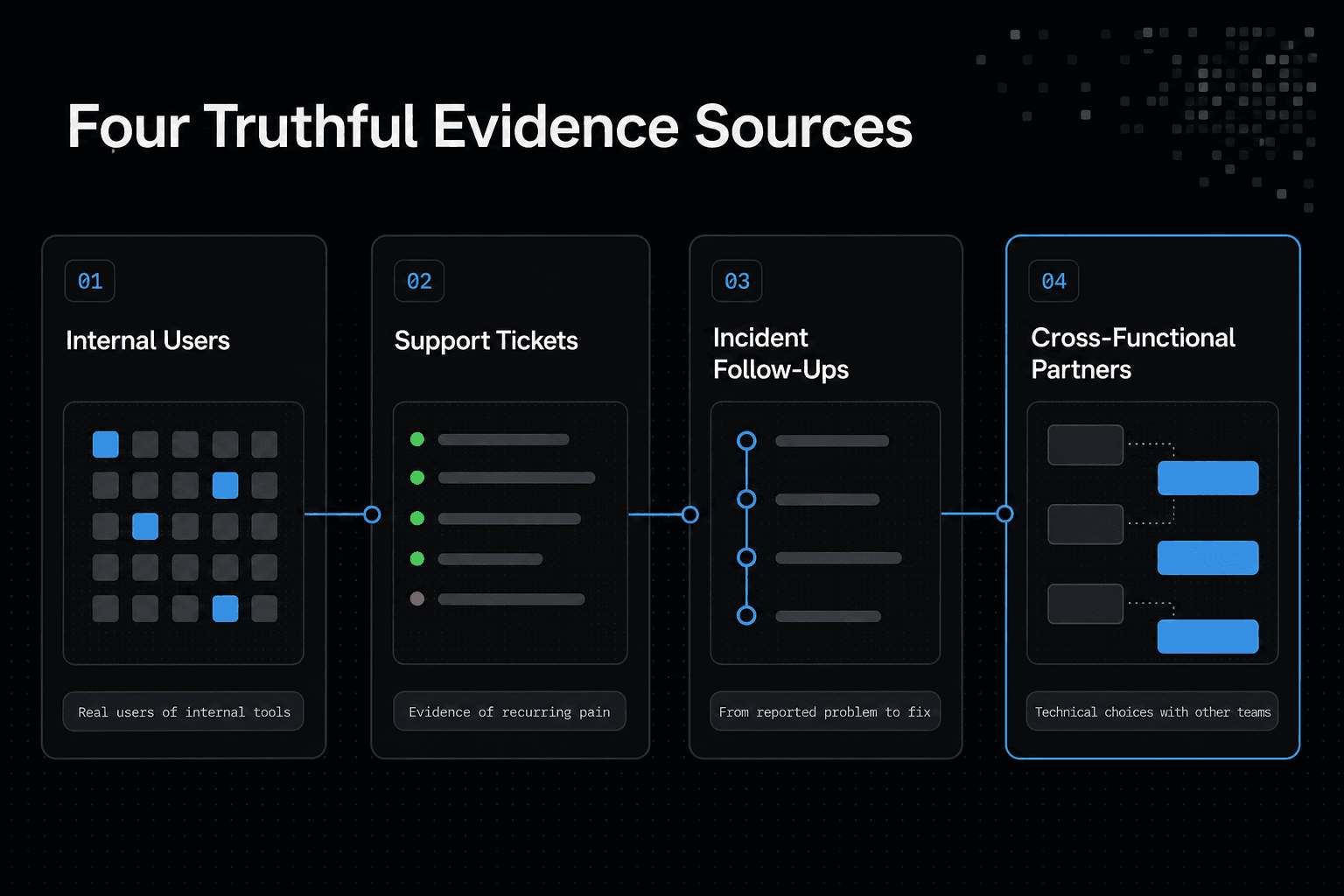
Truthful proxy evidence: internal users, support tickets, incident follow-ups, and cross-functional partners
Internal users count as users. Support tickets can show recurring pain. Incident follow-ups can show that you traced a problem from report to fix, while design reviews with product, security, or operations can show how you made technical choices with other teams in mind.
Be precise about distance. If a support engineer passed on the issue, write that you used support reports to reproduce and fix it. That shows you considered user impact without claiming the conversation was yours.
How to describe ambiguity, ownership, and iteration accurately
Use facts you can defend: an unclear request, the questions you asked, options you compared, the decision you made, and what you changed after feedback. Short and concrete works.
For example: "Clarified an incomplete reporting request with finance and operations partners, mapped required data fields, and revised the export flow after review feedback." It shows ownership of the work, not ownership of a customer account.
When a project does not demonstrate FDE readiness
A project isn't enough when it only proves that you followed a tutorial, copied a reference architecture, or built a polished interface around an untested workflow. Keep it if it shows relevant skills, but don't make it your main FDE evidence.
The main catch is validation. If nobody used, reviewed, or challenged the work, state the limitation and build a project with a real constraint before relying on it in an FDE application.
Use FDE Keywords Without Writing for the ATS Alone
An ATS can match words. It can't tell whether you owned the work those words describe, and neither can a recruiter who only gets a vague skills list. Mirror the language of a role when it fits, then support it with a bullet that shows what you built, decided, deployed, or fixed.
Keywords to look for in FDE job descriptions
Look for repeated work terms: API integration, technical discovery, deployment, production debugging, cloud infrastructure, system design, stakeholder communication, incident response, and customer requirements. Note the stack too, but don't let Python, AWS, or Kubernetes crowd out the work itself.
Where keywords belong: summary, skills, experience, and projects
Put your strongest match in the summary, then prove it in experience or projects. Group tools by use, such as "Cloud and deployment: AWS, Docker, Kubernetes." Use phrases from the posting naturally in bullets: "debugged production API failures" is clearer than a keyword pile.
Terms to avoid when they do not match your actual work
Don't add customer discovery, client deployment, RAG, MCP, or machine learning because they appear in the posting. The honest answer is simple: if you can't explain your contribution and the constraint you handled, leave the term out. A close match with proof beats a crowded resume that fails in an interview.
FDE Resume Mistakes to Avoid and a Final Checklist
A tailored keyword list won't fix a resume that hides the work behind generic software engineering language. Make the technical context, people affected, and your own decisions easy to find. Keep it true.
Mistakes that make an FDE resume read like a generic SWE resume
Don't lead every bullet with "built" or "developed." Name the system boundary, integration, production issue, or unclear request that shaped the work, then state what you did. Cut tools that never appear in your experience or projects. A long skills list can't stand in for proof.
Internship and early-career evidence versus experienced-hire evidence
It depends on what work you have had access to. For internships, coursework, and new-grad roles, a well-documented project can show design choices, debugging, deployment thinking, and feedback-driven changes. For experienced hires, recruiters will expect more evidence from shipped systems, cross-functional work, incidents, or user-facing constraints.
Don't invent a larger scope. Explain the part you owned.
Submission checklist: relevance, truthfulness, scannability, and proof
Before you submit, check four things:
- Does each bullet match work named in the job description?
- Can you explain every claim, metric, and technical term in an interview?
- Can a reader find integrations, deployment, debugging, and stakeholder work quickly?
- Does each project show a problem, constraint, decision, and result?
- Have you removed claims of client ownership or business impact you didn't directly support?
If a bullet only says you wrote code, rewrite it or drop it.
Put Transferable FDE Evidence First
Don't send one broad resume to every FDE role. Start with one job description, then move its real priorities to the top of your resume: integrations, production debugging, technical discovery, deployment, or AI/ML delivery.
The main catch is that tailoring doesn't mean copying claims you can't support. If the role asks for customer discovery and your evidence is internal stakeholder work, say that plainly. Build stronger evidence through real projects, support work, incident follow-ups, or cross-functional delivery.
The next practical step before applying
Print the job description or keep it beside your resume. For each requirement, find one verified bullet, project, or skill that proves it. Put your strongest match near the top.
If you can't find evidence, don't fill the gap with buzzwords. Build a small project that forces you to make the missing technical decision and explain it in your next application.
Frequently Asked Questions
Can I apply for an FDE role if I have never worked as a Forward Deployed Engineer?
Yes. Present relevant engineering work through evidence of context, technical decisions, ownership, and outcomes rather than relying on an FDE title.
What is the difference between a software engineer resume and an FDE resume?
For an FDE application, connect implementation details to the problem, constraints, integration, deployment, debugging, or iteration involved. A list of technologies or code contributions alone may not show that context.
How do I show customer empathy on an FDE resume if I have not worked directly with customers?
Don't claim direct customer experience. Use truthful proxies, such as clarifying an internal stakeholder's needs, responding to feedback you received, or adapting a project to a documented constraint.
Which technical skills should I include on an FDE resume?
Prioritize skills you can connect to your experience, such as API integration, cloud or production work, debugging, prototyping, and iteration. Show how you used them instead of relying on an unsupported keyword list.
How should I describe API integration work for an FDE application?
Name the systems or interfaces involved when you can, explain your contribution to the integration, and describe relevant data flow, error handling, testing, or deployment. Don't imply a customer rollout unless one occurred.
Can an AI/ML, RAG, or agent project help me qualify for an FDE role?
It can provide relevant project evidence when you explain what you built, the problem or constraint it addressed, and how you evaluated or iterated on it. Don't present a prototype as a production deployment without evidence.
How should a new graduate or intern tailor a resume for an FDE role?
Use projects, internships, and other engineering work to show technical decisions, problem context, implementation, and iteration. Clearly distinguish coursework or prototypes from deployed work.
Should I include a portfolio repository or design document with my FDE resume?
Include one when it provides evidence relevant to the role, such as an integration, prototype, or technical decision. Make sure the material accurately describes your contribution and doesn't expose confidential information.
About GigaRAG
GigaRAG is a shared memory platform for AI agents that helps developers and teams keep project knowledge available across sessions and tools.
You can connect agents to a central Hive Mind through MCP or the API, with access controls to manage what each agent can use.