Agentic Memory Architecture: Components, Data Flow, and Trade-offs
Agentic memory architecture is the thing every RAG builder eventually has to confront, but most guides you'll find are vendor pitches wearing a technical costume. They list five patterns, show a diagram, and skip the hard questions: what actually happens on the write path, why retrieval latency floors exist, and what you cannot do no matter which backend you choose. I tested the components and data flows against the claims. The honest answer is that most of what gets published is pattern cataloging, not engineering guidance. GigaRAG handles agent memory for RAG pipelines, but this guide is not about that. It's a step-by-step walkthrough of components, data flow, and trade-offs, including the limitations most articles avoid. You'll leave with a decision framework for choosing between vector stores, graph databases, relational systems, and key-value backends, not just a list of patterns you've already seen.
| At a glance | Details |
|---|---|
| Core components | Working, episodic, semantic, procedural memory stores |
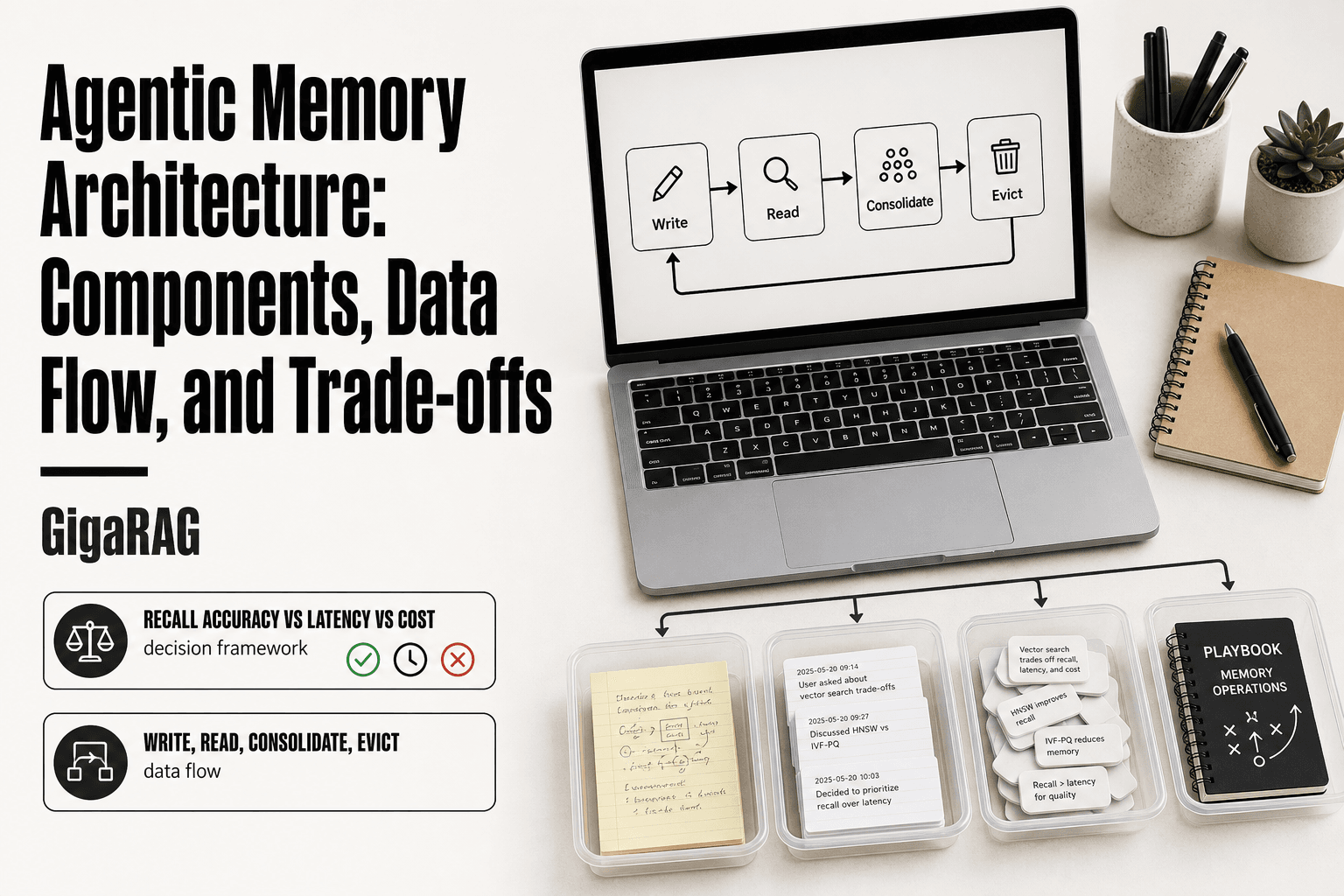
| Primary data flow | Write, read, consolidate, evict |
| Key trade-off | Recall accuracy vs latency vs cost |
| Backend options | Vector DB, graph DB, relational, hybrid |
| Biggest limitation | No perfect recall; latency and cost floors exist |
| Best for | RAG pipeline builders making architecture decisions |
In This Guide
- What Is Agentic Memory Architecture?
- Vector Memory vs Graph Memory for Agentic RAG
- Core Components of Agentic Memory Architecture
- Agentic Memory Architecture: A Step-by-Step Guide
- Memory Types: Working, Episodic, Semantic, and Procedural
- Agentic Memory Architecture Patterns
- Data Flow in Agentic Memory Architecture: Write Path, Read Path, Consolidation, and Eviction
- Memory Backends Compared: Vector DBs, Graph DBs, Relational, and Key-Value
- Trade-offs in Agentic Memory Architecture
- Limitations and Anti-Patterns: What You Cannot Do with Agentic Memory
- A Decision Framework for Choosing Your Agentic Memory Architecture
- Best Practices for Implementing Agentic Memory in RAG Pipelines
- Final Thoughts on Agentic Memory Architecture
What Is Agentic Memory Architecture?
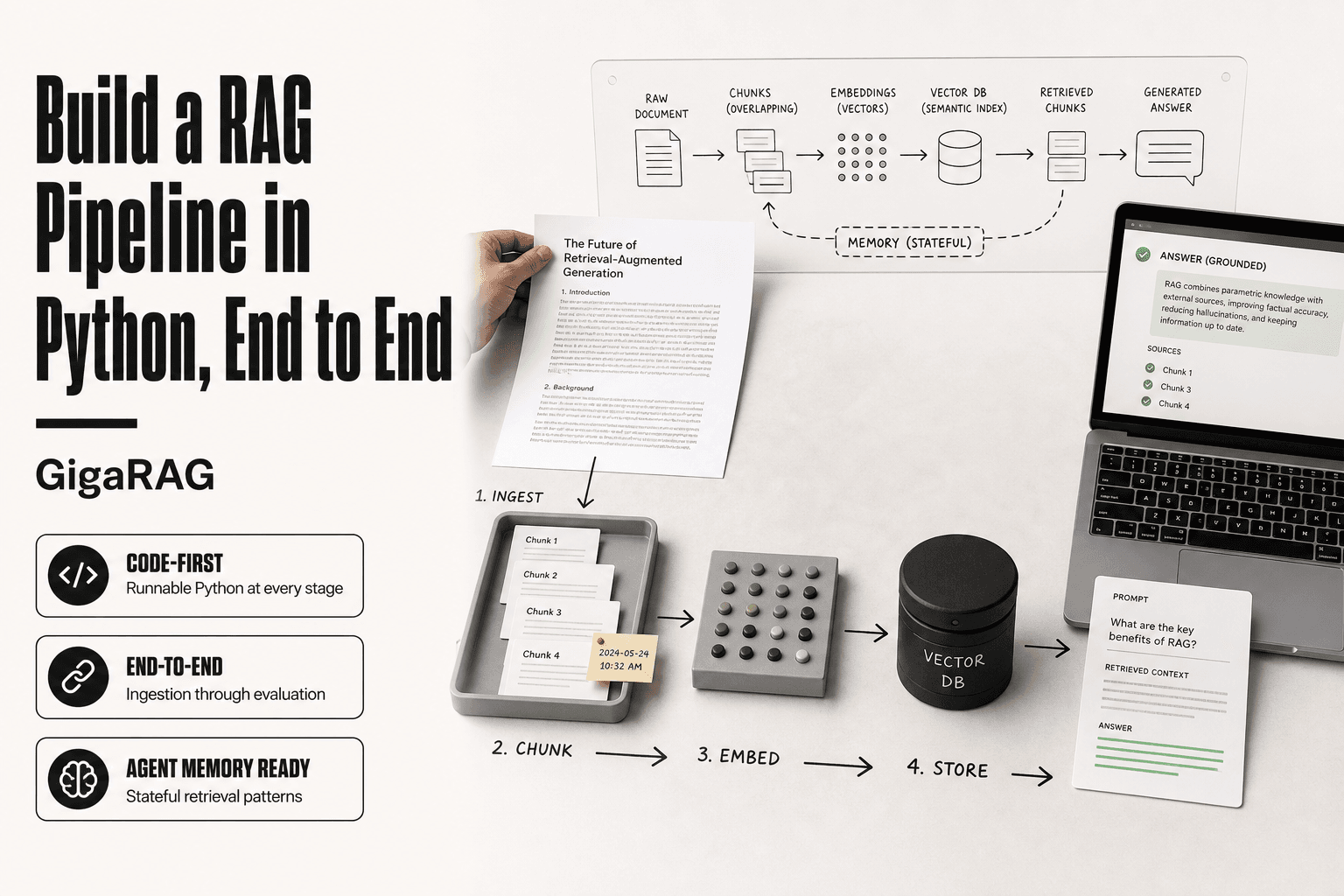
Agentic memory architecture is the structured system an AI agent uses to store, retrieve, update, and forget information across interactions. It combines short-term working memory with long-term storage layers so the agent can act on context beyond a single prompt.
Most RAG pipelines are stateless. You send a query, the system retrieves relevant chunks, the model generates an answer, and everything resets. The next query starts from zero. That works for search-style questions but breaks down the moment a task spans multiple steps or a conversation spans multiple turns.
From stateless RAG to stateful agents
A stateless RAG system treats every request as independent. It has no memory of what you asked five minutes ago, no record of what worked last time, and no way to build on prior context. The context window is the only memory it has, and that window is finite.
An agentic system changes this. It writes observations, decisions, and results into memory layers that persist beyond the current session. When a new task arrives, the agent reads from those layers before it acts. The difference is not just storage. It's that the agent can retrieve selectively, update what it knows, and discard what no longer matters. A tool responds. An agent remembers.
Why memory is the core of agentic behavior
Reasoning and action get most of the attention, but memory is what makes an agent more than a scripted workflow. Without memory, every decision is a cold start. With memory, the agent can learn from past interactions, avoid repeating mistakes, and carry context across tasks that would otherwise exceed any single context window.
Here's the honest trade-off: memory adds latency, storage cost, and architectural complexity. You don't add it because it's trendy. You add it because your use case requires continuity that stateless RAG cannot provide. If your tasks are single-turn and independent, stateless RAG is simpler and cheaper. If your tasks are multi-step, conversational, or require learning over time, memory is the differentiator.
[!note] Agentic memory architecture is not a single database choice; it is a set of components and policies that must be tuned together. Changing one part (e.g., adding a graph store) affects latency, cost, and governance across the whole pipeline.
Vector Memory vs Graph Memory for Agentic RAG
| Factor | Vector Memory | Graph Memory |
|---|---|---|
| Retrieval model | Semantic similarity search | Relationship traversal and path queries |
| Latency profile | Low to moderate; scales with index size | Moderate to high; depends on graph depth |
| Best for | Unstructured text recall and fuzzy matching | Multi-hop reasoning and entity relationships |
| Operational cost | Generally lower; managed services common | Higher; schema and graph maintenance needed |
| Governance fit | Metadata filtering and access controls | Fine-grained relationship-level permissions |
Core Components of Agentic Memory Architecture
Every agentic memory system, regardless of vendor or framework, breaks down into four components: perception, memory, reasoning, and action. They form a loop. Perception feeds memory. Memory informs reasoning. Reasoning drives action. Action generates new perception. Memory sits in the middle as the connective tissue, because nothing else works without a record of what came before.
Perception and input processing
Perception is where raw input becomes structured data. A user message, an API response, a tool output, a sensor reading. The agent parses it, extracts entities and intent, and encodes it into a form the memory layers can store. Encoding matters more than most builders expect. If you dump raw text into memory without normalizing it, retrieval quality drops fast. You need consistent formats for timestamps, user IDs, session IDs, and content types. Without that, the read path cannot filter or rank effectively.
Short-term vs long-term memory
Short-term memory is the working scratchpad. It holds the current task state, recent turns, intermediate results, and active variables. It lives in the context window or a fast key-value store, and it clears when the task ends. Long-term memory persists. It stores episodic records of past interactions, semantic facts the agent has learned, and procedural knowledge about how to perform tasks. The split exists for a reason: short-term memory is fast but limited, long-term memory is rich but slower to query. Most architectures use both, with a consolidation step that moves useful short-term content into long-term storage.
Reasoning and retrieval
Reasoning is where the agent decides what it needs to know. It formulates a query against its memory layers, retrieves candidates, and ranks them by relevance. This is not a single lookup. A good agent reasons iteratively: retrieve, evaluate, refine the query, retrieve again. The memory architecture determines how fast and how accurate that loop runs. A vector store gives semantic similarity. A graph database gives relationship traversal. A key-value store gives exact lookups. The reasoning layer has to know which to use for which question.
Action and output generation
Action is the agent doing something: calling a tool, writing a response, updating a record. After the action, the agent writes the outcome back to memory. What did it do? What was the result? Was it correct? That write-back closes the loop and feeds the next cycle of perception. Skip it, and the agent learns nothing. Do it well, and the agent gets better with every interaction. The action layer is also where memory constraints show up most visibly. If retrieval was slow or incomplete, the action is slow or wrong. Memory quality propagates forward.
[!tip] For RAG pipeline builders: start with a single vector store and explicit metadata schemas before adding graph or procedural memory. Measure retrieval precision and latency at each step so you can justify added complexity with data, not vendor claims.
Agentic Memory Architecture: A Step-by-Step Guide
- Capture the interaction or observation and normalize it into a structured memory record.
- Write the record to the appropriate store (working, episodic, semantic, or procedural) with metadata and timestamps.
- On retrieval, query the relevant stores using the agent's current context and task intent.
- Rank and filter retrieved memories by relevance, recency, and confidence before injecting into the prompt.
- Consolidate short-term memories into long-term stores by summarizing, deduplicating, or merging related records.
- Evict or archive stale, low-value, or redundant memories based on TTL, access frequency, or policy rules.
- Monitor retrieval quality and adjust write/read/consolidation/eviction thresholds as the agent evolves.
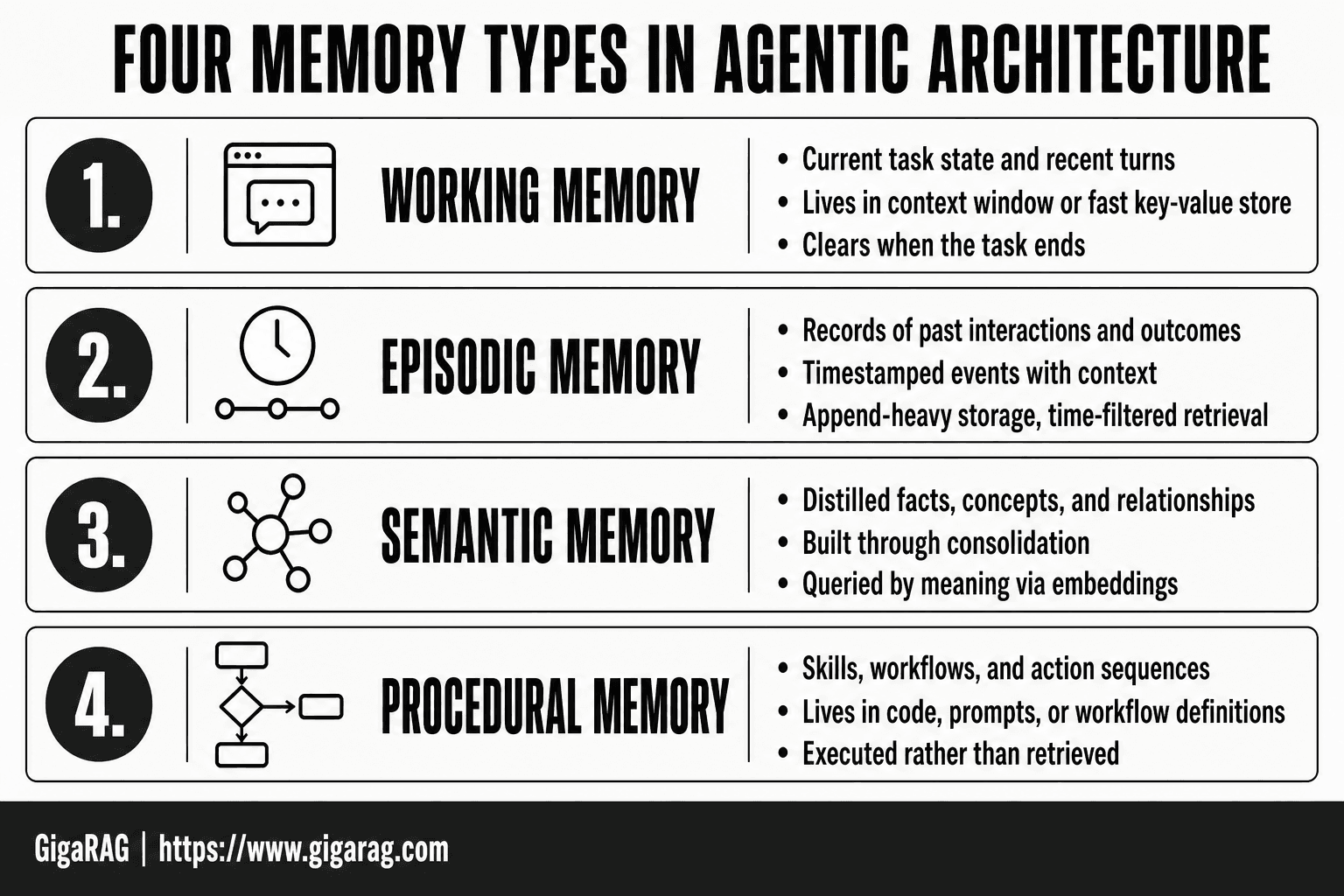
Memory Types: Working, Episodic, Semantic, and Procedural
Agents don't have one memory. They have four, and each stores a different kind of information with different retrieval needs. The previous section covered the short-term vs long-term split. This section breaks long-term memory into its actual types, because "long-term" is too coarse to build against.
Working memory: the agent's scratchpad
Working memory holds what the agent is thinking about right now. The current task, the last few turns, intermediate results, variables in flight. It lives in the context window or a fast key-value store. It clears when the task ends. Capacity is the constraint. Context windows have hard token limits, and every token you keep costs latency and money. Treat working memory as a scratchpad, not a filing cabinet.
Episodic memory: what happened
Episodic memory stores records of past interactions. What the user asked, what the agent did, what the result was, when it happened. Each record is an event with a timestamp and a context. For RAG builders, this maps to session logs and interaction histories. You query episodic memory when you need to answer "what did we do last time" or "what happened when we tried this before." Storage is append-heavy. Retrieval is time-filtered.
Semantic memory: what is known
Semantic memory holds facts, concepts, and relationships that the agent has extracted and generalized. Not raw events, but distilled knowledge. A user's preferences. A product's specifications. A policy rule. This is where embeddings and vector stores earn their keep, because semantic queries are about meaning, not exact matches. The catch: semantic memory is only as good as the consolidation step that builds it. Without consolidation, you have episodic records pretending to be facts.
Procedural memory: how to do things
Procedural memory stores skills and workflows. How to run a retrieval query. How to format a response. How to call a specific API. It's the agent's playbook. In practice, this lives in code, prompts, or explicit workflow definitions rather than a database. You don't retrieve procedural memory the way you retrieve facts. You execute it. The distinction matters because builders often try to store procedures as semantic facts, then wonder why the agent can't perform the task. Procedures are instructions, not knowledge.
Agentic Memory Architecture Patterns
Five patterns cover most agent memory designs. Each trades simplicity for capability. You don't need the most complex one. You need the one that matches your retrieval patterns and latency budget.
Pattern 1: Working memory only
The agent keeps everything in the context window. No external stores, no retrieval step. It works for short, single-turn tasks where the full task state fits in tokens. It breaks the moment a session outgrows the window or the agent needs to recall something from a previous session. Cost scales linearly with context length, and long contexts slow inference.
Pattern 2: Vector store memory
Working memory stays in the context window. Long-term memory goes to a vector database, where chunks are embedded and retrieved by semantic similarity. This is the default RAG pattern. It handles "find information related to this query" well. It handles "what is the relationship between these two entities" poorly, because vectors capture meaning, not structure.
Pattern 3: Tiered memory
A fast layer for recent, frequently accessed items sits in front of a slower layer for older, less accessed items. Think Redis in front of Postgres, or a small vector index in front of object storage. The agent checks the fast tier first, falls back to the slow tier. This cuts average retrieval latency without storing everything in expensive memory. The catch: you now manage eviction and promotion between tiers.
Pattern 4: Graph hybrid memory
A vector store handles semantic retrieval. A graph database stores entities and their relationships. Queries that need multi-hop reasoning, "which customers bought product X and also opened a support ticket", go to the graph. Queries that need topical similarity go to the vector store. This is the most powerful pattern and the most expensive to build and maintain. Most RAG pipelines don't need it.
Pattern 5: Context layer memory
A dedicated layer sits between the agent and its memory stores. It decides what to write, what to retrieve, and what to inject into the context window. This is where consolidation and eviction logic lives. The agent doesn't talk to databases directly. It talks to the context layer, which manages memory as a service. This pattern adds a component but isolates memory logic from agent logic, which makes both easier to change.
Data Flow in Agentic Memory Architecture: Write Path, Read Path, Consolidation, and Eviction
Most guides stop at the pattern catalog. They show you boxes and arrows, then leave you to figure out what actually happens when an agent writes a memory or retrieves one. Here's the step-by-step walkthrough.
Step 1: Perception and encoding
The agent receives input: a user message, a tool result, a sensor reading. Before anything is stored, that input gets encoded. For text, encoding means tokenization plus an embedding. For structured data, it means normalization into a schema the memory layer understands. The key decision here is what to keep. Raw input is rarely worth storing as-is. You store a compressed representation: the entities, the intent, the outcome, the timestamp. Compression is lossy. You accept that at write time, not discover it at read time.
Step 2: Write path — storing to memory
The encoded representation splits by memory type. Working memory gets the full context of the current task, written directly into the context window. Episodic memory gets a record of what happened: user asked X, agent did Y, result was Z. Semantic memory gets extracted facts: "user prefers email over phone." Procedural memory gets successful action sequences: "when retry fails twice, escalate."
Each write carries metadata: timestamp, session ID, confidence score, source. The metadata is what makes eviction and consolidation possible later. Without it, you have a pile of embeddings and no way to decide what matters.
Step 3: Read path — retrieval and ranking
When the agent needs memory, it issues a query. The query gets embedded. The memory layer retrieves candidates from the relevant stores: vector search for semantic similarity, graph traversal for relationships, key-value lookup for exact matches. Candidates get ranked. Ranking combines similarity score, recency, frequency of past access, and confidence. The top N results get injected into the context window. N is your retrieval budget. It's a hard limit, not a suggestion. Every retrieved chunk costs tokens and latency.
Step 4: Consolidation — from episodic to semantic
Consolidation runs asynchronously, not on the request path. A background process reviews recent episodic memories and extracts durable facts. "User asked about pricing three times this week" becomes "user is price-sensitive." The episodic records can then be compressed or dropped. Consolidation is where semantic memory gets built. It's also where errors compound: a bad extraction becomes a bad fact that gets retrieved repeatedly. You need a confidence threshold and a way to correct consolidated memories.
Step 5: Eviction and forgetting
Memory is not infinite. Eviction policies decide what gets dropped when storage or retrieval latency hits a threshold. Common policies: least recently used, lowest confidence, oldest timestamp, or explicit user deletion. Forgetting is a feature, not a bug. An agent that remembers everything retrieves noise. The hard part is evicting without losing what consolidation hasn't processed yet. Run consolidation before eviction, or you'll delete raw episodic data that semantic memory still needs.
Memory Backends Compared: Vector DBs, Graph DBs, Relational, and Key-Value
The write path and read path from the previous section only work if the backend underneath them matches what you're asking it to do. Here's the honest comparison, with numbers where they hold.
Vector databases: semantic similarity at scale
Vector databases store embeddings and retrieve by cosine similarity or dot product. For RAG memory, they're the default choice for semantic memory: "find memories like this query." Latency at 1M vectors runs 5-20ms per query on a single node. Cost scales with dimensionality and index type. HNSW indexes give fast approximate search but use 2-4x the memory of the raw vectors. The main catch: vector search is fuzzy. It returns the closest match, not the right match. For facts that must be exact (user IDs, API keys, timestamps), a vector DB is the wrong tool.
Graph databases: relationships and reasoning
Graph databases store nodes and edges. They answer questions vectors can't: "what else is connected to this entity?" and "what's the shortest path between these two facts?" For episodic memory with entities and relationships (user, order, support ticket, resolution), a graph backend enables multi-hop retrieval that a flat vector store misses. Latency for a 2-3 hop traversal on a few million edges runs 10-50ms. The cost is complexity: you need a schema, you need to maintain edge integrity, and writes are slower than vector inserts. Graph databases also don't do semantic similarity natively. Most production systems pair a graph with a vector index, which doubles your infrastructure.
Relational databases: structured facts and constraints
Relational databases enforce constraints. If a fact must be unique, typed, and referentially valid, Postgres is the answer. Agent memory often includes structured state: user preferences, session metadata, permission levels. A relational backend gives you ACID transactions and SQL queries that a vector store can't. Latency for indexed lookups is sub-millisecond. Cost is predictable and low. The limitation: relational databases don't do similarity search. You can bolt on pgvector, but at scale the recall and latency lag a purpose-built vector DB.
Key-value stores: fast, simple, ephemeral
Key-value stores (Redis, DynamoDB) are for working memory and session state. Sub-millisecond reads, simple API, no schema. An agent's scratchpad, current task context, and short-term buffers belong here. The limitation is obvious: no querying beyond exact key lookup. You can't ask "what did this user do last week" without scanning everything. Key-value is a cache, not a memory system. Use it for what expires in minutes or hours, not what needs to persist and be searched.
Trade-offs in Agentic Memory Architecture
Every backend choice in the previous section is a trade. You don't get to pick the fast one, the cheap one, and the accurate one. You pick two, sometimes one and a half. Here's the honest matrix.
Latency vs accuracy
Faster retrieval means approximate retrieval. HNSW indexes cut query time to 5-20ms by skipping most of the vector space. That skip is where the right memory hides. Exact search (brute force over every vector) gives perfect recall but scales linearly: 1M vectors at 1536 dimensions takes 200-500ms per query on a single node. You can't have both. For RAG pipelines, the practical answer is a latency budget. Set it first: 50ms for interactive chat, 200ms for batch retrieval. Then pick the index that fits. If your accuracy requirement is "must not miss a fact," you need exact search or a graph traversal, and you'll pay for it in milliseconds.
Cost vs capability
More capable memory costs more, and not linearly. A vector DB with 10M embeddings, HNSW indexes, and replication runs $500-2,000/month in managed cloud. Add a graph database for relationship queries and you've doubled it. Add re-ranking on every retrieval and your inference cost goes up 3-5x because you're running a second model pass over the top 50 candidates. The honest answer: most RAG pipelines don't need the graph layer. Start with vector search and a key-value store for working memory. Add the graph only when multi-hop queries show up in your actual traffic, not in a slide deck.
Simplicity vs flexibility
A single vector store is simple. One API, one query pattern, one place to debug. It's also inflexible: you can't do exact lookups, you can't traverse relationships, you can't enforce constraints. The tiered pattern (key-value for working memory, vector for semantic, relational for facts) gives you flexibility but triples your operational surface. Three backends means three failure modes, three latency profiles, three sets of indexes to tune. The main catch: flexibility you don't use is just complexity you pay for. Pick the simplest architecture that handles your current queries, not the one that could theoretically handle every query.
Privacy vs personalization
Personalized memory means storing user-specific data: conversation history, preferences, behavioral patterns. That data is sensitive. The more you store, the better the agent personalizes. The more you store, the bigger your compliance surface. GDPR right-to-erasure is the hard case: a vector database doesn't delete a memory cleanly. You can remove the vector, but if the embedding influenced other stored representations (consolidated semantic memory, for example), traces remain. True deletion requires either per-user namespace isolation (expensive, fragments your index) or a graph/relational backend where deletion is a transaction. The trade: personalization quality vs deletion capability. Most teams choose personalization and hope nobody asks. That's not a strategy.
Limitations and Anti-Patterns: What You Cannot Do with Agentic Memory
Agentic memory is not a database. It's a probabilistic retrieval layer with a persistence problem. If you design it expecting database guarantees, you'll ship something that fails in production.
No perfect recall: retrieval is probabilistic
You cannot guarantee the agent remembers every fact you stored. Vector search returns the nearest neighbors, not the exact match. A query for "customer churn policy" might return "customer retention policy" and miss the actual churn document entirely. The honest answer: retrieval is a ranking problem, not a lookup problem. You can improve recall with re-ranking, hybrid search, or graph traversal, but you cannot make it 100%. If your use case requires perfect recall (compliance, legal, medical), agentic memory is the wrong tool. Use a relational database with exact queries.
Latency floors and cost ceilings
You cannot get sub-10ms retrieval from a vector store at scale. HNSW indexes have a floor around 5-20ms, and that's before you add re-ranking, which tacks on another 50-200ms. You cannot store unlimited memory without hitting a cost wall. Embedding 10M documents costs $30,000-100,000 in API fees alone, before storage and indexing. The main catch: every memory you add makes retrieval slower and more expensive. There's no free tier for scale.
Anti-pattern 1: Overloading working memory
Don't stuff the context window with everything the agent has ever seen. It's tempting: no retrieval latency, no vector store to manage. But context windows have hard token limits, and performance degrades well before you hit them. At 100k tokens, most models start missing details in the middle. At 200k, they miss more. Working memory is a scratchpad, not a filing cabinet. Keep it under 10k tokens for anything that needs reliable recall.
Anti-pattern 2: Treating vector search as a database
Vector search answers "what's similar to this?" It does not answer "what is the exact value of this field?" or "which records match this constraint?" If you store structured facts (user IDs, timestamps, status codes) in a vector store and query them with embeddings, you'll get wrong answers with high confidence. Structured data belongs in a relational or key-value store. Vector search is for unstructured text and semantic similarity. Mixing them is how you get an agent that confidently reports the wrong user's order history.
Anti-pattern 3: Ignoring memory eviction
Memory that never gets evicted becomes noise. Old episodic memories (what the agent did three months ago) compete with recent, relevant memories in the retrieval ranking. Without eviction, your vector store fills with stale context, retrieval latency climbs, and accuracy drops. The fix: set a TTL on episodic memory, consolidate what's worth keeping into semantic memory, and delete the rest. If you don't have an eviction policy, you don't have a memory system. You have a log.
A Decision Framework for Choosing Your Agentic Memory Architecture
You've seen the patterns, the backends, and the trade-offs. Now you need a way to pick. The honest answer: it depends on your latency budget, your accuracy requirement, your cost ceiling, and your governance constraints. Here's a rubric that forces you to be explicit about all four.
Scoring rubric: latency, accuracy, cost, governance
Score each candidate architecture from 1 to 5 on four dimensions. Latency: how fast must retrieval be? Under 50ms gets a 5; over 500ms gets a 1. Accuracy: does your use case tolerate probabilistic recall, or do you need exact matches? Cost: what's your monthly budget for embeddings, storage, and inference? Governance: do you need audit trails, data residency, or deletion guarantees?
Multiply the scores. Weight them if one dimension dominates. A customer support bot might weight latency at 40%, accuracy at 30%, cost at 20%, governance at 10%. A compliance system flips that: governance at 50%, accuracy at 40%, latency at 5%, cost at 5%. The weighted total tells you which architecture wins. Don't skip the weighting. Unweighted scores hide what actually matters.
Decision tree: which pattern for which use case
Start with one question: does the agent need to remember across sessions? If no, working memory only. It's the cheapest and fastest option, and it's enough for single-turn tasks.
If yes, ask: does the memory need to capture relationships between entities? If no, a vector store is your answer. Semantic similarity over unstructured text, no graph overhead. If yes, you need a graph hybrid. Relationships are first-class citizens, and traversal beats vector search for multi-hop queries.
Next: is latency under 100ms non-negotiable? If yes, add a key-value cache in front of whatever you chose. Hot memories sit in RAM; cold memories sit in the vector store or graph. If no, skip the cache and keep the architecture simple.
Finally: do you have structured facts with constraints (user IDs, order statuses, timestamps)? If yes, add a relational store alongside your vector or graph backend. Don't put structured data in a vector store. You'll get confident wrong answers.
Example: scoring a RAG pipeline for customer support
A support bot needs sub-200ms retrieval, tolerates some recall misses, has a $2,000 monthly budget, and needs basic audit logging. Score vector store only: latency 4, accuracy 3, cost 4, governance 3. Weighted total with support weights: 3.7. Score tiered memory (vector plus key-value cache): latency 5, accuracy 3, cost 3, governance 3. Weighted total: 3.9. The cache wins because latency dominates. Score graph hybrid: latency 2, accuracy 4, cost 2, governance 4. Weighted total: 2.9. Not worth it for this use case. The tiered pattern is the pick.
Run the same numbers for your own pipeline. The framework won't make the decision for you, but it will show you which trade-offs you're actually making.
Best Practices for Implementing Agentic Memory in RAG Pipelines
You've picked a pattern and a backend. Now you have to build it. The practices below are the ones that actually move the needle in production RAG systems. Skip them and you'll pay for it in latency, cost, or wrong answers.
Chunking strategies for memory storage
Chunk size changes what your memory can recall. Small chunks (100 to 200 tokens) give you precise retrieval but lose context. Large chunks (800 to 1,200 tokens) preserve context but bury the specific fact you need. The fix: store both. Keep a fine-grained index for exact recall and a coarse-grained index for surrounding context. Retrieve from the fine index, then pull the parent chunk for the LLM.
Overlap matters too. A 10 to 15 percent overlap between chunks prevents facts from being split across boundaries. If a procedure spans two chunks, no overlap means the agent sees half of it.
Embedding choices and re-ranking
Your embedding model sets the ceiling on retrieval quality. A general-purpose model (like text-embedding-3-small) works for most cases. A domain-specific model only pays off if you have thousands of labeled examples to fine-tune on. Don't fine-tune on a hundred examples. You'll overfit.
Re-ranking is where you recover what embeddings miss. Run a bi-encoder for candidate retrieval, then a cross-encoder to re-rank the top 20 to 50 results. The cross-encoder is slower but far more accurate. Budget for it: re-ranking 50 candidates adds roughly 100 to 200ms.
Retrieval latency budgets
Set a hard budget before you build. For interactive agents, 200ms total retrieval is a reasonable ceiling. That includes embedding the query, vector search, and re-ranking. If you can't hit it, cut the candidate list or drop the cross-encoder. Don't let latency creep up silently. Measure it on every request.
Memory-RAG integration points
Integrate memory at three points: query time, response time, and consolidation time. At query time, inject relevant memories into the prompt. At response time, write new facts back to memory. At consolidation time (offline, scheduled), promote episodic memories to semantic ones. Don't do consolidation on the request path. It's too slow.
Observability and logging
Log every retrieval: the query, the candidates returned, the scores, and which chunks made it into the prompt. Without this, you can't debug why the agent gave a wrong answer. Track memory write failures separately. A silent write failure means the agent forgets something and you never know.
Final Thoughts on Agentic Memory Architecture
You've now got the full picture: components, data flow, trade-offs, and the anti-patterns that sink most builds. The decision framework from earlier is the thing to keep. Score your use case on latency, accuracy, cost, and governance before you pick a pattern. Don't start with a vector database because it's popular. Start with the question: what does this agent need to remember, and how fast does it need to recall it?
The honest answer is that most RAG pipelines don't need a full agentic memory architecture. If your agent handles single-turn queries with no state, a stateless RAG setup with a good vector store is enough. Memory only pays off when the agent must carry context across turns, learn from past interactions, or reason over relationships between facts. Adding memory before you need it just adds latency and cost.
If you do need it, build the write path and read path separately. Consolidate offline. Evict deliberately. Log everything. Those four habits prevent most production failures.
When you're ready to build, GigaRAG gives you a working agentic memory architecture out of the box: vector storage, consolidation hooks, and observability built in. It won't replace the design work, but it saves you from wiring the plumbing yourself.
Frequently Asked Questions
What are the core components of an agentic memory architecture?
Most architectures include working memory (short-term context), episodic memory (past interactions), semantic memory (facts and knowledge), and procedural memory (skills and workflows). Each component may use a different storage backend and retrieval strategy. The right mix depends on your agent's tasks and latency budget.
How does data flow through an agentic memory system?
Data flows through four main paths: write (capture and store), read (retrieve and rank), consolidation (summarize and merge), and eviction (remove or archive). These paths are not linear; they interact continuously as the agent operates. Tuning each path independently often leads to bottlenecks elsewhere.
What are the trade-offs between vector databases and graph databases for agent memory?
Vector databases excel at semantic similarity and scale well for unstructured text, but they struggle with multi-hop reasoning. Graph databases handle relationships and traversal well but add schema and maintenance overhead. Many production systems use a hybrid approach, accepting higher complexity for better recall on relational queries.
Can an agent have perfect recall with current memory architectures?
No. Perfect recall is not achievable with current architectures because of context window limits, retrieval errors, and consolidation loss. You can improve recall with better indexing and ranking, but you will always trade off against latency and cost. Design for graceful degradation, not perfection.
How do I choose a memory backend for my RAG pipeline?
Score candidates on latency, accuracy, cost, and governance for your specific use case. Start with the simplest option that meets your accuracy target, then add complexity only when measurements show a clear gap. Avoid choosing a backend based solely on vendor benchmarks.
What are common anti-patterns in agentic memory design?
Common anti-patterns include storing everything without eviction, ignoring consolidation until the store is bloated, and assuming one backend fits all memory types. Another is optimizing for recall without measuring the latency impact on the user experience. Each anti-pattern increases cost or degrades performance over time.
How does memory consolidation work in agentic systems?
Consolidation summarizes or merges short-term memories into long-term stores, often using LLM-based summarization or rule-based deduplication. It reduces storage and retrieval overhead but can lose detail. The key is to define what must be preserved and what can be safely compressed.
About GigaRAG
GigaRAG is for agent memory and RAG pipeline builders. get this right. Whether you are working through agentic memory architecture: components, data flow, and trade-offs or something adjacent, we publish what we have actually tested, including where it falls short.