Agentic RAG Architecture: What Pipeline Builders Actually Need to Know
Agentic RAG architecture is being talked about like it's a free upgrade for any retrieval pipeline. It isn't. Engineers and technical leads who already run basic RAG should know this before they touch anything: adding agency to retrieval is a tradeoff, not a magic switch. You get more flexible reasoning and better handling of multi-step questions. You pay for it in latency, cost, and new failure modes.
The idea itself is simple enough. Agentic RAG puts a reasoning loop in front of retrieval. Instead of one query, one retrieval, one answer, the agent decides whether to retrieve, what to retrieve, and when to stop. That loop is the whole difference. If you're building agent memory systems, GigaRAG gives you a place to test these patterns without starting from scratch.
This guide covers what agentic RAG architecture actually is, how it differs from traditional RAG, when the complexity is worth it, and what the pattern cannot do. You'll finish with a decision framework you can apply to your own pipeline today.
| At a glance | Details |
|---|---|
| Core idea | LLM agents decide retrieval steps, not a fixed pipeline |
| Main tradeoff | More flexibility, higher latency and failure surface |
| Best fit | Multi-hop, ambiguous, or tool-heavy queries |
| Poor fit | Simple single-lookup FAQ or high-QPS low-latency paths |
| Hardest part | Agent memory and state management across turns |
| Key control | Bound the agent's tool set and iteration budget |
In This Guide
- What Is Agentic RAG Architecture?
- Traditional RAG vs Agentic RAG: Which Architecture Fits?
- Agentic RAG vs. Traditional RAG: The Real Differences
- Agentic Rag Architecture: A Step-by-Step Guide
- Core Components of Agentic RAG Architecture
- Agent Memory: The Missing Piece in Most Guides
- How Agentic RAG Works: A Step-by-Step Walkthrough
- Agentic RAG Use Cases That Actually Justify the Complexity
- Honest Limitations: What Agentic RAG Cannot Do
- A Decision Framework: Traditional RAG, Agentic RAG, or Fully Autonomous?
- Common Mistakes When Building Agentic RAG Architecture
What Is Agentic RAG Architecture?
Agentic RAG architecture is a retrieval-augmented generation system where an LLM-driven agent decides when, what, and how to retrieve information, rather than following a fixed retrieval pipeline. Traditional RAG retrieves once, then generates. Agentic RAG loops: retrieve, evaluate, decide, retrieve again if needed.
The core idea: agents that reason about retrieval
In traditional RAG, the flow is linear. Embed the query, fetch top-k chunks, stuff them into the prompt, generate. The system never asks whether the retrieved chunks were good enough.
Agentic RAG breaks that linearity. The agent treats retrieval as a tool it can call, inspect, and call again. It can reformulate a query that returned poor results. It can route to a different index. It can decide the question needs two retrievals stitched together before answering.
That's the whole shift: retrieval becomes a decision, not a step.
Where agency lives in the architecture
Agency sits in the orchestration layer between the user query and the retriever. The agent holds a reasoning loop: plan, act, observe, repeat. Retrieval is one action among several. The agent can also call APIs, run code, or write intermediate notes to itself.
What it is not: a fully autonomous agent that pursues open-ended goals. Agentic RAG stays bounded by the retrieval task. It reasons about finding information, not about arbitrary tool use. That boundary matters when you're deciding whether the complexity is worth it.
[!note] Agentic RAG does not improve retrieval quality by itself — it changes who decides the retrieval steps. If your retriever returns poor chunks, adding an agent will surface that problem faster, not fix it.
Traditional RAG vs Agentic RAG: Which Architecture Fits?
| Factor | Traditional RAG | Agentic RAG |
|---|---|---|
| Control flow | Fixed retrieve-then-generate pipeline | LLM decides when and what to retrieve |
| Latency profile | Predictable, single retrieval pass | Variable, scales with agent iterations |
| Failure modes | Retrieval miss, chunking errors | Retrieval miss plus loops, tool misuse, drift |
| Query fit | Direct factual lookups | Multi-hop, ambiguous, or tool-augmented queries |
| Debuggability | Traceable linear stages | Requires step-level tracing and state inspection |
Agentic RAG vs. Traditional RAG: The Real Differences
The difference isn't intelligence. It's control flow.
Linear retrieval vs. iterative reasoning
Traditional RAG runs one pass: embed, retrieve, generate. The retriever returns whatever top-k chunks match the query, good or bad. The generator works with what it got.
Agentic RAG treats that pass as a first attempt. The agent inspects results, judges them, and decides whether to retrieve again. A bad first retrieval isn't fatal. It's a signal to reformulate.
What changes in the pipeline
Three things. First, the agent can call retrieval multiple times with different queries or against different indexes. Second, it can interleave tool calls: search a database, then call an API, then retrieve again. Third, it keeps state between steps, so each decision builds on the last.
Traditional RAG has no state. Each query is independent.
What you give up when you add agency
Latency. Every reasoning step adds a model call, and model calls take seconds. A traditional RAG query that answers in 800 milliseconds can become a 6-second agentic loop.
Cost. More calls, more tokens.
Determinism. The same query can take different paths on different runs. That makes evaluation harder and debugging harder still.
You're trading speed and predictability for the ability to recover from bad retrieval. Whether that trade is worth it depends on your query mix.
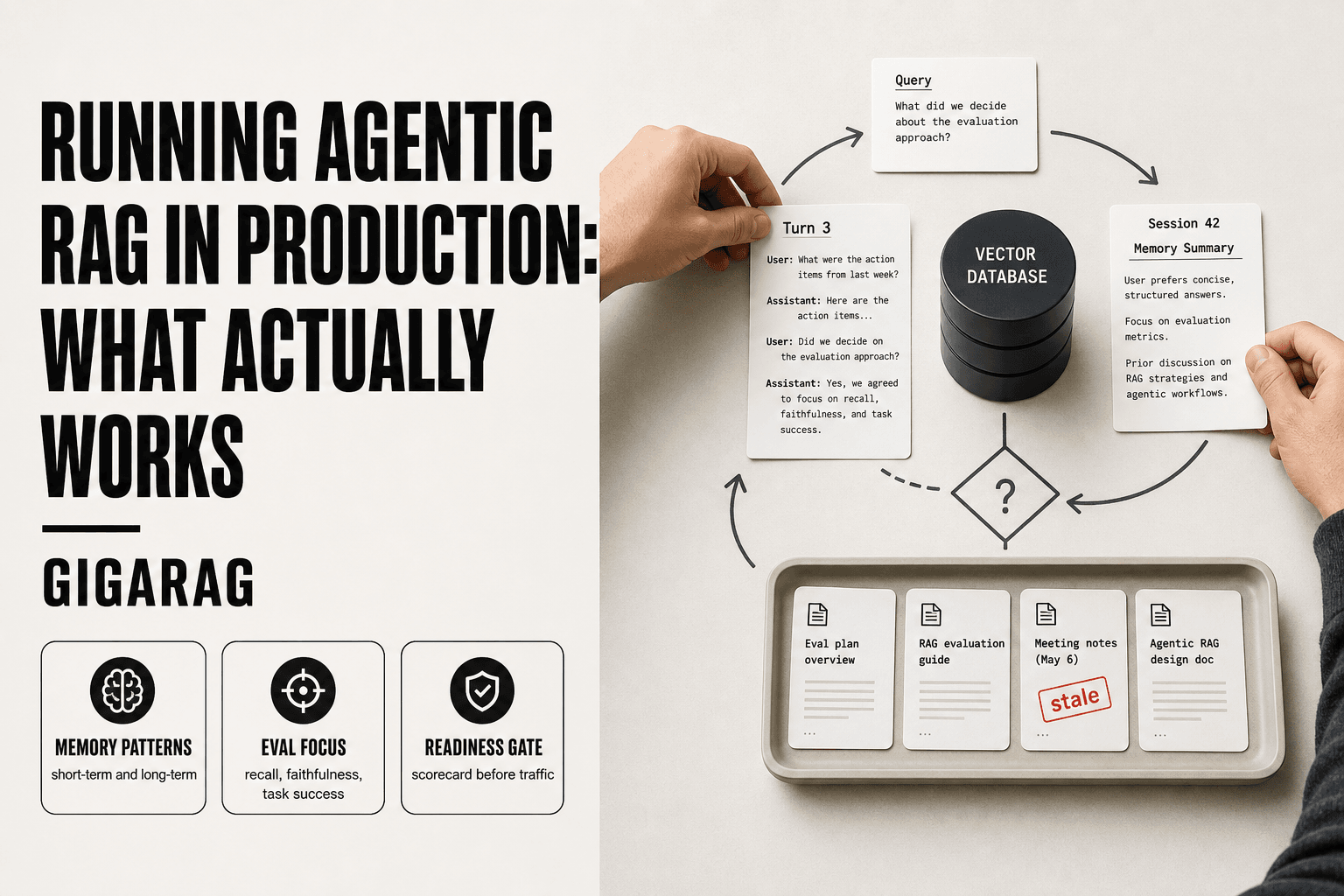
[!tip] For agent memory, keep working state and long-term memory in separate stores: working state should be short-lived and task-scoped, while long-term memory (facts, prior resolutions, user preferences) should be written deliberately, not on every turn. Tools like GigaRAG are built for this split, but the discipline matters more than the tool.
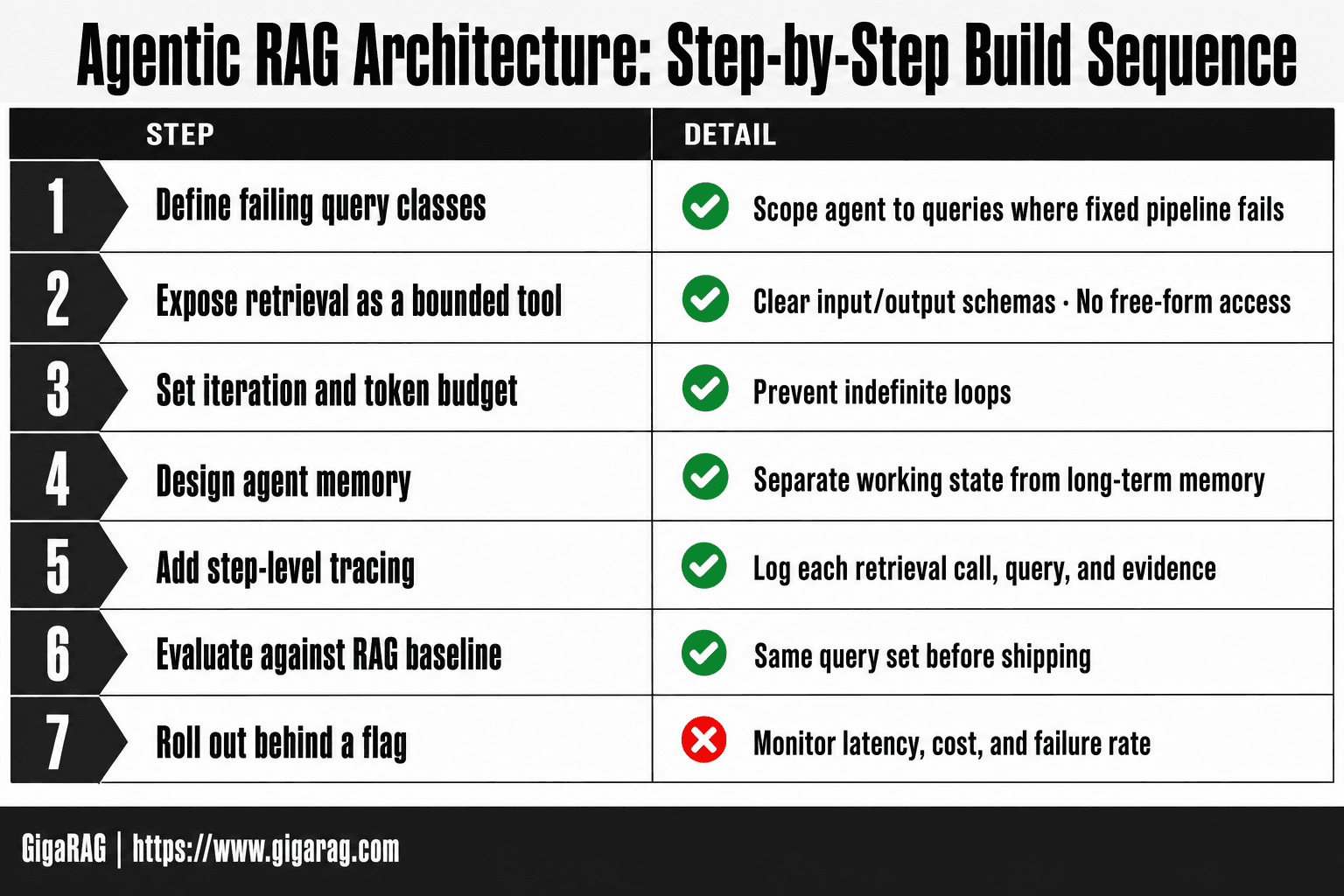
Agentic Rag Architecture: A Step-by-Step Guide
- Define the query classes where a fixed pipeline demonstrably fails, and scope the agent to those only.
- Expose retrieval as a bounded tool with clear input/output schemas rather than free-form access.
- Set an explicit iteration and token budget so the agent cannot loop indefinitely.
- Design agent memory: separate working state (current task) from long-term memory (retrieved facts, prior turns).
- Add step-level tracing that logs each retrieval call, its query, and the returned evidence.
- Evaluate against your traditional RAG baseline on the same query set before shipping.
- Roll out behind a flag and monitor latency, cost, and failure rate per query class.
Core Components of Agentic RAG Architecture
Four pieces make up the architecture. You can sketch them on a whiteboard in under a minute.
The agent reasoning loop
The loop is the agent's control flow: observe, decide, act, observe again. The agent receives a query, reasons about what it needs, calls a tool, inspects the result, and decides whether to continue or stop. Each pass through the loop costs one model call. That's the latency tax.
Tool interfaces and retrieval calls
Retrieval is just one tool among several. The agent treats the vector store, a SQL database, and an external API the same way: as callable functions with defined inputs and outputs. What makes retrieval special is that it's usually the first tool called, and its results shape every decision after.
Memory and state management
State is what the agent remembers between loop iterations: which queries it already ran, what came back, what it ruled out. Without state, the agent repeats itself. With state, it can say "that index returned nothing useful, try the other one." Memory is the harder problem, and it gets its own section.
Orchestration patterns: routing, query planning, ReAct, plan-and-execute
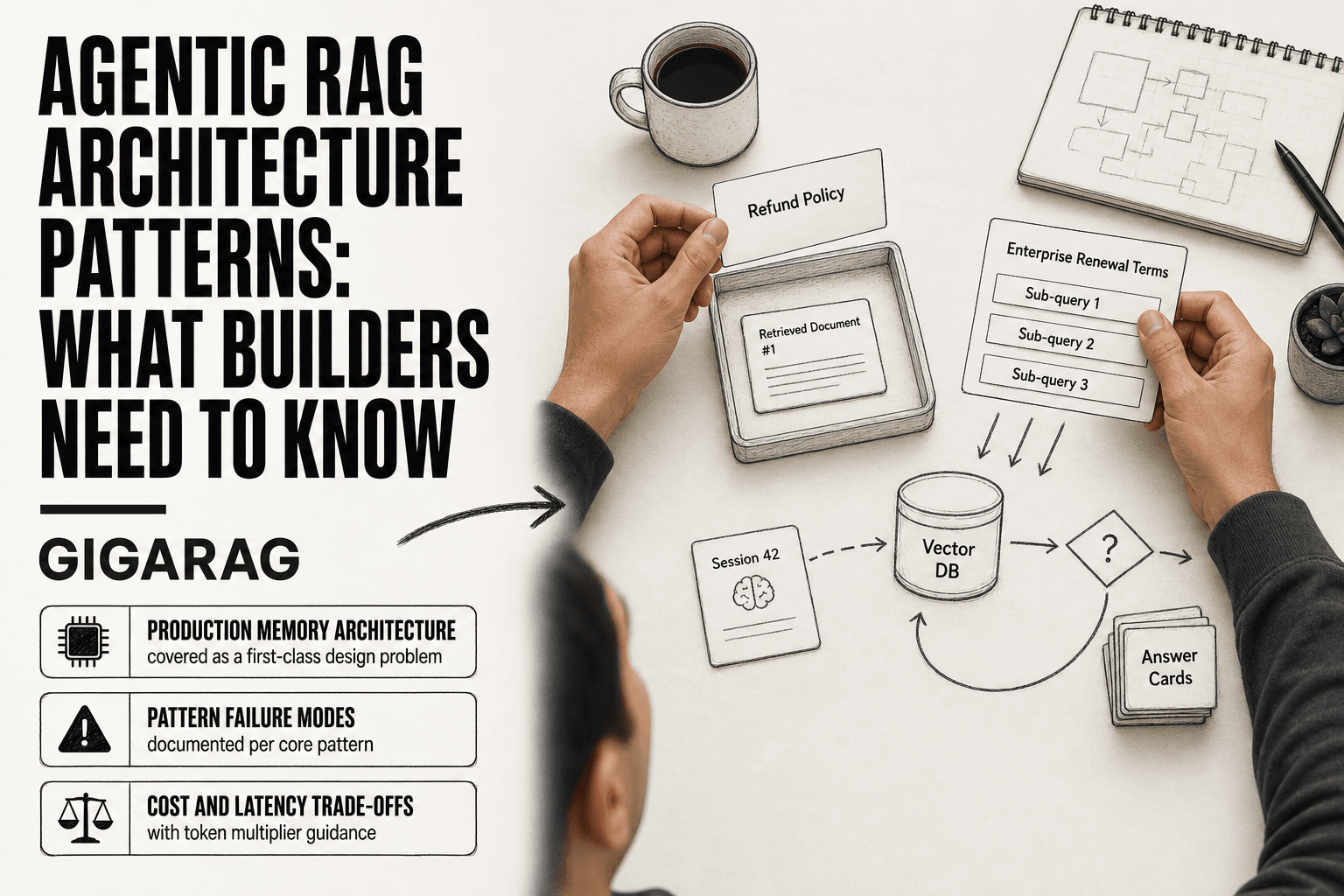
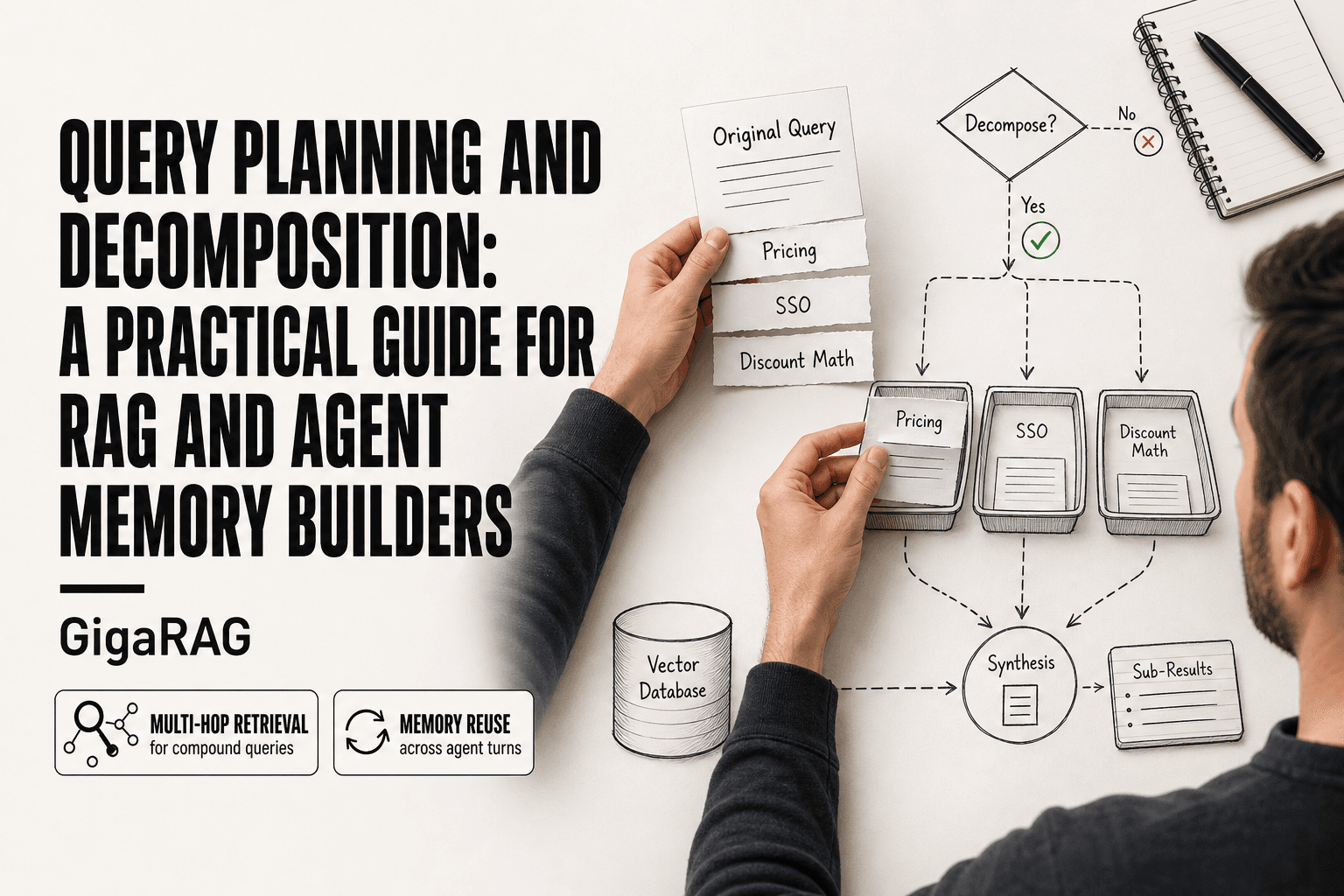
Four patterns cover most implementations. Routing sends the query to one specialist index based on topic. Query planning breaks a complex question into sub-queries before retrieving. ReAct interleaves reasoning and action step by step. Plan-and-execute separates the planning phase from the execution phase entirely.
The pattern you pick determines how many model calls you'll pay for. Routing is cheapest. Plan-and-execute is most flexible but slowest.
Agent Memory: The Missing Piece in Most Guides
Most agentic RAG guides stop at the reasoning loop. They show you routing, query planning, tool calls. Then they skip what happens between turns. That gap is where real systems break.
Short-term vs. long-term agent memory
Short-term memory is the working state of a single query. It holds what the agent has retrieved, what it ruled out, and what it still needs. It lives in the context window or a scratchpad and dies when the query ends.
Long-term memory persists across queries. It stores what the agent learned about the user, the knowledge base, or which retrieval strategies worked. Without it, every query starts cold.
How memory interacts with the retrieval pipeline
Memory changes what gets retrieved. A short-term memory of "the vector index returned nothing for 'refund policy'" tells the agent to try the SQL table next. A long-term memory of "this user asks about billing every Monday" can preload relevant chunks before the first retrieval call.
The interaction is bidirectional. Retrieval results update memory. Memory shapes the next retrieval. That loop is what makes agentic RAG different from a linear pipeline.
Practical patterns for state management
Three patterns cover most cases. A scratchpad object holds query state in memory and resets each turn. A checkpoint saves state to disk so a failed run can resume. A memory store persists across sessions, usually as a vector index or key-value table.
Start with a scratchpad. Add checkpoints when runs get expensive. Add long-term memory only when you have evidence that cross-query context improves answers. Most systems don't need it.
How Agentic RAG Works: A Step-by-Step Walkthrough
The cleanest way to see agentic RAG is to trace one query through the loop. Here's a concrete run.
A sample query, traced end-to-end
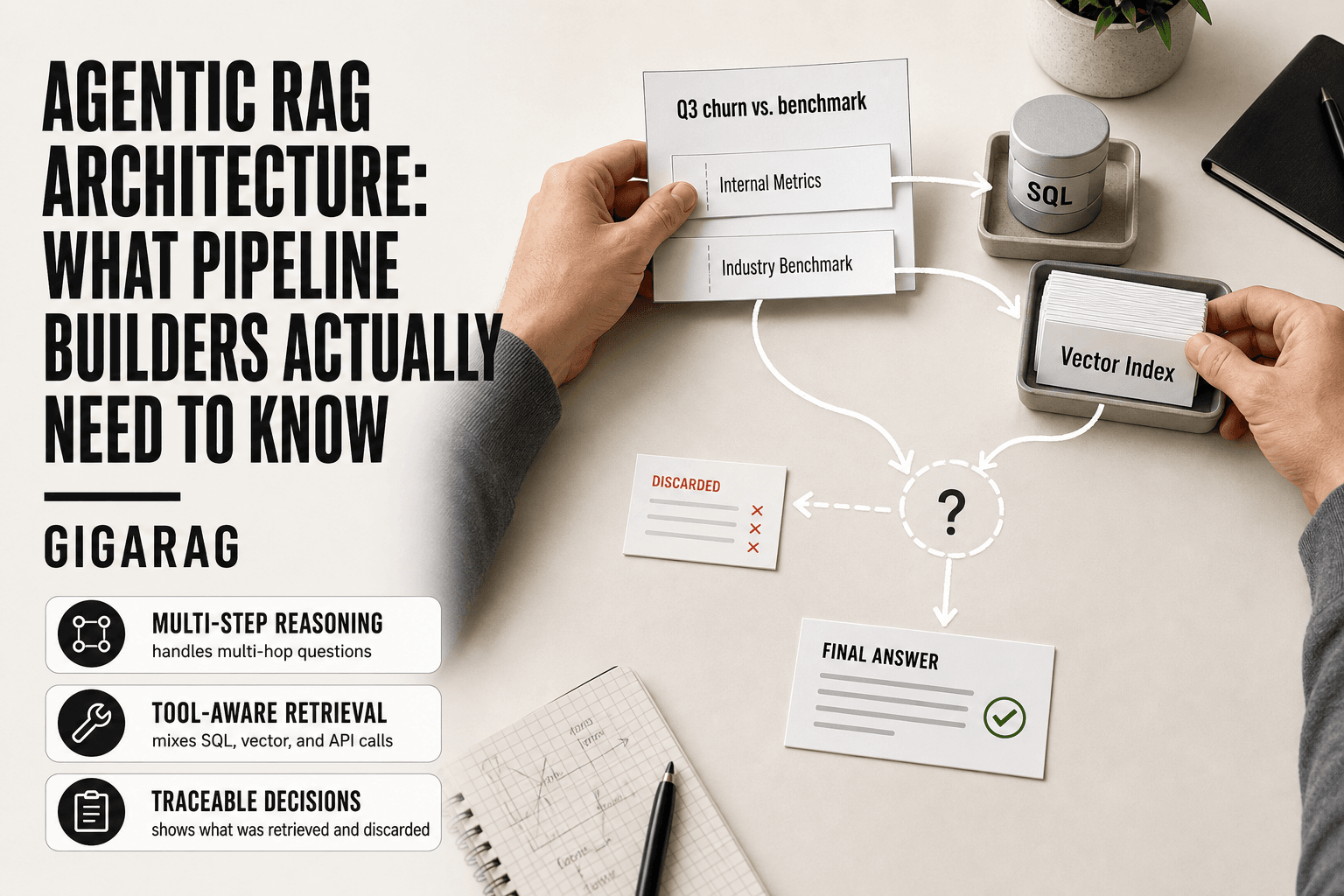
A user asks: "What was our Q3 churn rate, and how does it compare to the industry benchmark?"
The agent starts by parsing the question into two sub-questions. It calls the internal metrics database for Q3 churn. It gets a number: 4.2%. Then it queries the vector index for industry benchmarks. The top result is a PDF from a consulting firm, but the agent notices the date is 2022. It discards that chunk and re-queries with a date filter. The second retrieval returns a 2024 report with a 3.1% benchmark.
Where the agent decides to retrieve
The decision points are the architecture. The agent retrieves when the question has multiple parts, when the first result looks stale, or when a tool returns nothing useful. It doesn't retrieve when it already has the answer in short-term memory. That's the whole difference from a linear pipeline: retrieval is conditional, not automatic.
What the final answer looks like
The agent composes: "Q3 churn was 4.2%, up from 3.8% in Q2. The 2024 industry benchmark is 3.1%, so we're 1.1 points above. The 2022 report put the benchmark at 2.7%, but I excluded it as outdated."
The answer cites sources, shows the reasoning, and flags what it ruled out. That transparency is the payoff. It's also what makes the latency cost visible: three retrieval calls, one discard, one re-query.
Agentic RAG Use Cases That Actually Justify the Complexity
The honest answer: agentic RAG earns its latency cost only when the question can't be answered by a single retrieval. If one good chunk solves it, traditional RAG wins. Here's where it doesn't.
Multi-hop research and synthesis
Questions that require chaining facts across sources. "Which of our competitors raised funding this year, and how does their valuation compare to ours?" The agent retrieves funding announcements, then retrieves your internal valuation data, then compares. Traditional RAG can't hold the intermediate result while it fetches the next piece.
Tool-augmented retrieval
When the answer lives outside your vector index. The agent calls a SQL database for a metric, a weather API for context, a calculator for a ratio. Retrieval becomes one tool among several. This is the clearest win: no amount of chunking gets you a live API call.
Adaptive query refinement
When the first retrieval fails and the fix isn't obvious. The agent rephrases the query, tightens filters, or switches indexes based on what came back. Traditional RAG returns whatever the first query matched. Agentic RAG notices the top result is from 2022 and re-queries with a date constraint.
Keep in mind: all three use cases share one condition. The query has multiple steps, and the steps depend on each other. If yours doesn't, skip the agent.
Honest Limitations: What Agentic RAG Cannot Do
Agentic RAG is not a reasoning upgrade. It's a control-flow upgrade. The agent decides what to retrieve and when, but the underlying model still hallucinates, still misreads retrieved text, still fails on ambiguous queries. Adding agency doesn't fix retrieval quality. It adds decision points where things can go wrong.
Latency and cost realities
Every agent loop iteration is another LLM call. A three-step query costs three times the tokens of a single retrieval. If your latency budget is 500ms, agentic RAG won't fit. Plan for 2-10 seconds per query once the agent reasons, calls tools, and re-reasons.
Failure modes: loops, bad tool calls, context overflow
Agents get stuck. They re-query the same index with the same phrasing and get the same bad result. They call the wrong tool because the tool description was vague. They stuff every intermediate result into context until the window overflows and the final answer degrades. Each failure needs a guardrail: max iterations, tool validation, context trimming.
When agentic RAG is the wrong choice
Single-hop lookups. FAQ-style questions. Anything where one good chunk answers the query. If your retrieval already works, an agent adds latency and failure modes without improving answers. Start with traditional RAG. Add agency only when a real query fails and you can name the missing step.
A Decision Framework: Traditional RAG, Agentic RAG, or Fully Autonomous?
The honest answer is: it depends on your query patterns and your latency budget. Most pipelines don't need agency. Some do. Here's how to tell.
Three questions to ask before adding agency
Do your queries need more than one retrieval step? If one good chunk answers the question, traditional RAG wins. If the answer requires pulling from three sources and comparing them, you need an agent.
Can you name the missing step? Don't add agency because retrieval feels weak. Add it because a specific query failed and you can say exactly what the agent should do differently: "it needs to look up the account first, then retrieve the policy."
Can you afford 2-10 seconds per query? If not, stop. Agentic RAG multiplies latency with every loop iteration.
A simple decision tree
Start with traditional RAG. Run real queries. If answers are good, you're done.
If a query fails, ask: does it need a second retrieval step? No? Fix your chunks or embeddings. Yes? Add one agent step, not a full autonomous system.
Only go fully autonomous when queries vary so much that no fixed pipeline can handle them, and you have the latency budget and evaluation infrastructure to catch failures.
What to do if you're unsure
Build the simplest thing that works. Ship it. Log every failed query. When you see a pattern of failures that maps to a missing retrieval step, add that one step as an agent action. That's the whole framework.
Common Mistakes When Building Agentic RAG Architecture
Most failed agentic RAG projects die from the same three errors. Here's what they look like and how to avoid them.
Overcomplicating the agent loop
Builders add five agent steps where one would do. Every extra loop iteration adds latency and a new failure point. Start with a single retrieval step. Add more only when a specific query pattern demands it.
Ignoring memory and state
Agents that forget what they retrieved repeat work. Store conversation state and retrieved context explicitly. Without it, your agent loops or contradicts itself.
Skipping evaluation
You can't improve what you don't measure. Log every failed query. Track retrieval precision and answer quality before and after adding agency. If the numbers don't move, the complexity isn't paying for itself. That's the test for any agentic RAG architecture.
Frequently Asked Questions
What is agentic RAG architecture?
Agentic RAG architecture replaces the fixed retrieve-then-generate pipeline with an LLM agent that decides when to retrieve, what to query, and whether to retrieve again. The agent treats retrieval as one tool among several and iterates until it has enough evidence to answer. This adds flexibility for complex queries at the cost of latency and a larger failure surface.
What is an example of agentic RAG?
A support assistant that receives 'why was my invoice higher last month?' might first retrieve the invoice, then retrieve the pricing policy, then retrieve the usage log, and only then answer. A traditional pipeline would retrieve once and likely miss one of those hops. The agent's decision to retrieve again is what makes it agentic.
What is the difference between agentic RAG and agentic AI?
Agentic RAG is a specific pattern: an agent whose primary tool is retrieval over your knowledge base. Agentic AI is the broader category of systems that plan, use multiple tools, and act with autonomy. Agentic RAG is a subset — useful when grounding in your own data is the main requirement.
When should I not use agentic RAG?
Skip it when queries are simple single-lookup questions, when latency budgets are tight, or when your retrieval quality is already the bottleneck. In those cases a well-tuned traditional RAG pipeline is cheaper, faster, and easier to debug. Adding an agent to a broken retriever just makes the failure more expensive.
How do I manage agent memory in agentic RAG?
Separate working state from long-term memory. Working state holds the current task's intermediate results and should be discarded after the turn. Long-term memory holds durable facts, prior resolutions, and user preferences, and should be written selectively. Mixing the two is a common cause of context bloat and inconsistent answers.
Can I build agentic RAG with LangChain?
Yes — LangChain and similar frameworks provide agent executors, tool abstractions, and retrieval integrations that cover the common patterns. The framework choice matters less than how you bound the agent's tools, set iteration limits, and instrument tracing. Most production issues come from architecture decisions, not the library.
What are common agentic RAG use cases?
Multi-hop research questions, support workflows that span multiple systems, and queries that mix structured and unstructured data are the strongest fits. Simple FAQ bots, high-QPS low-latency endpoints, and single-document lookups are usually better served by traditional RAG.
About GigaRAG
GigaRAG is for agent memory and RAG pipeline builders. get this right. Whether you are working through agentic rag architecture or something adjacent, we publish what we have actually tested, including where it falls short.