Forward Deployed Engineer Interview Guide for 2026
A forward deployed engineer interview isn't a software engineering interview with more meetings. You're being judged on whether you can turn a customer's half-formed problem into a deployable, supportable result while explaining trade-offs in plain terms. Coding matters, but so do discovery, SQL, debugging, system design, rollout plans, and the judgment to say what you don't know.
No generic FDE interview guide can tell you an employer's current loop or guarantee an offer. It depends on the company, the customer work, and the ownership level in the role, so check current job descriptions and treat candidate reports as leads, not policy.
Quick answer
Prepare to show how you turn an unclear customer problem into a deployable, supportable technical outcome, not just how you code or communicate.
- Clarify the problem and constraints.
- Prioritize a useful first solution.
- Explain deployment, failure handling, and handoff.
What a forward deployed engineer interview guide for 2026 should cover
An FDE interview tests whether you can turn an unclear customer need into a working, supportable technical result. Expect technical problem-solving, discovery, delivery judgment, and clear communication, not a standard software engineering loop with extra meetings. The exact rounds depend on the company and role.
FDE interview process: likely rounds and what varies by company
A loop may include a recruiter screen, coding, debugging or SQL, system design, an assignment, a customer case, and behavioral interviews. Don't treat that as a fixed sequence. Check the current role description and ask your recruiter what format to expect.
Recruiter screen: motivation, role fit, location, customer-facing readiness, and career narrative
You need a clear reason for wanting customer-facing delivery work, not just any engineering job. Explain projects where you handled unclear goals, worked across teams, or owned an outcome after release. Keep it concrete.
Coding, debugging, and SQL rounds: correctness, investigation, communication, and practical judgment
Coding tests whether you can write correct, readable code. Debugging tests how you narrow a failure before changing things. SQL may test joins, aggregation, data quality, and whether you notice that a neat query can still answer the wrong business question.
System design and practical assignments: architecture, trade-offs, deployment thinking, and scope control
Start with users, constraints, and success measures. Then propose a small first release, name the interfaces and data flow, and explain monitoring, access control, rollback, and ownership. A large architecture without a delivery plan isn't enough.
Customer simulation and behavioral interviews: discovery, trust, ownership, conflict handling, and results
Ask questions before proposing a solution. Show how you would handle conflicting needs, surface risks, and set a next step the customer can act on. Strong answers connect a decision to an outcome while staying honest about what you didn't control.
What interviewers are not looking for: perfect requirements, jargon-only answers, or a generic sales pitch
You won't get perfect requirements. Don't pretend you have them. State assumptions, test the risky ones early, and don't sell technology before you can explain why it solves the customer's problem.
Technical skills for forward deployed engineer interviews
You don't need deep expertise in every platform named in a job post. You do need to show sound judgment: where your knowledge ends, how you would reduce risk, and when you would bring in a specialist.
Python and coding exercises: write readable production-minded code, tests, error handling, and complexity trade-offs
Write small, clear functions first. Explain input checks, useful error messages, tests for normal and bad inputs, and time or memory cost where it matters. Clever code that nobody can support isn't worth much.
Debugging exercise: explain a hypothesis-driven workflow for an unreliable API or failing data pipeline
Start with the symptom, scope, and recent changes. Form a hypothesis, inspect logs and metrics, reproduce the fault if you can, then change one thing at a time. Don't jump straight to a fix.
SQL and databases: joins, aggregation, indexing, data quality, schema choices, and safe migrations
Be ready to explain what a query means in business terms, not just write it. Check duplicate rows, nulls, join keys, and time boundaries before trusting a result. For schema changes, name a rollback plan and explain how old and new application versions coexist.
APIs, cloud, Docker, Kubernetes, and distributed systems: explain interfaces, deployment boundaries, reliability, observability, and failure modes
You don't need to present yourself as a Kubernetes operator if you aren't one. Explain an API contract, service ownership, deployment steps, health checks, logs, alerts, retries, timeouts, and what happens when a dependency fails. That shows production thinking.
LLMs, RAG, MCP, and AI agents: discuss evaluation, retrieval quality, prompt and tool failure, permissions, memory, latency, cost, and human review
An LLM answer isn't proof. Define a task-specific evaluation set, inspect retrieved sources, and test wrong or missing context, failed tools, unsafe permissions, and prompt injection. Keep human review for decisions where a bad answer can cause harm.
For a shared-memory example, you can discuss how GigaRAG connects agents through MCP or an API while access controls limit what each agent can use. The main catch is that memory does not replace evaluation, permission checks, or a safe fallback.
Sample technical prompts and strong-answer structure: clarify assumptions, state constraints, propose an approach, test it, and explain operational trade-offs
For any prompt, use the same order: clarify the user and outcome, state constraints, propose the smallest useful approach, describe tests, then cover rollout and monitoring. Here's why: you show technical depth and the discipline to avoid building the wrong thing.
Step-by-step: work through an ambiguous customer case
- Ask questions to clarify the customer's goal, users, constraints, and success criteria.
- Summarize the problem and identify what remains uncertain.
- Prioritize a small, useful first outcome and explain what you would defer.
- Sketch an architecture that addresses the stated constraints.
- Describe how you would deploy the solution and detect or handle failures.
- Explain how you would hand off the work and communicate its limits.
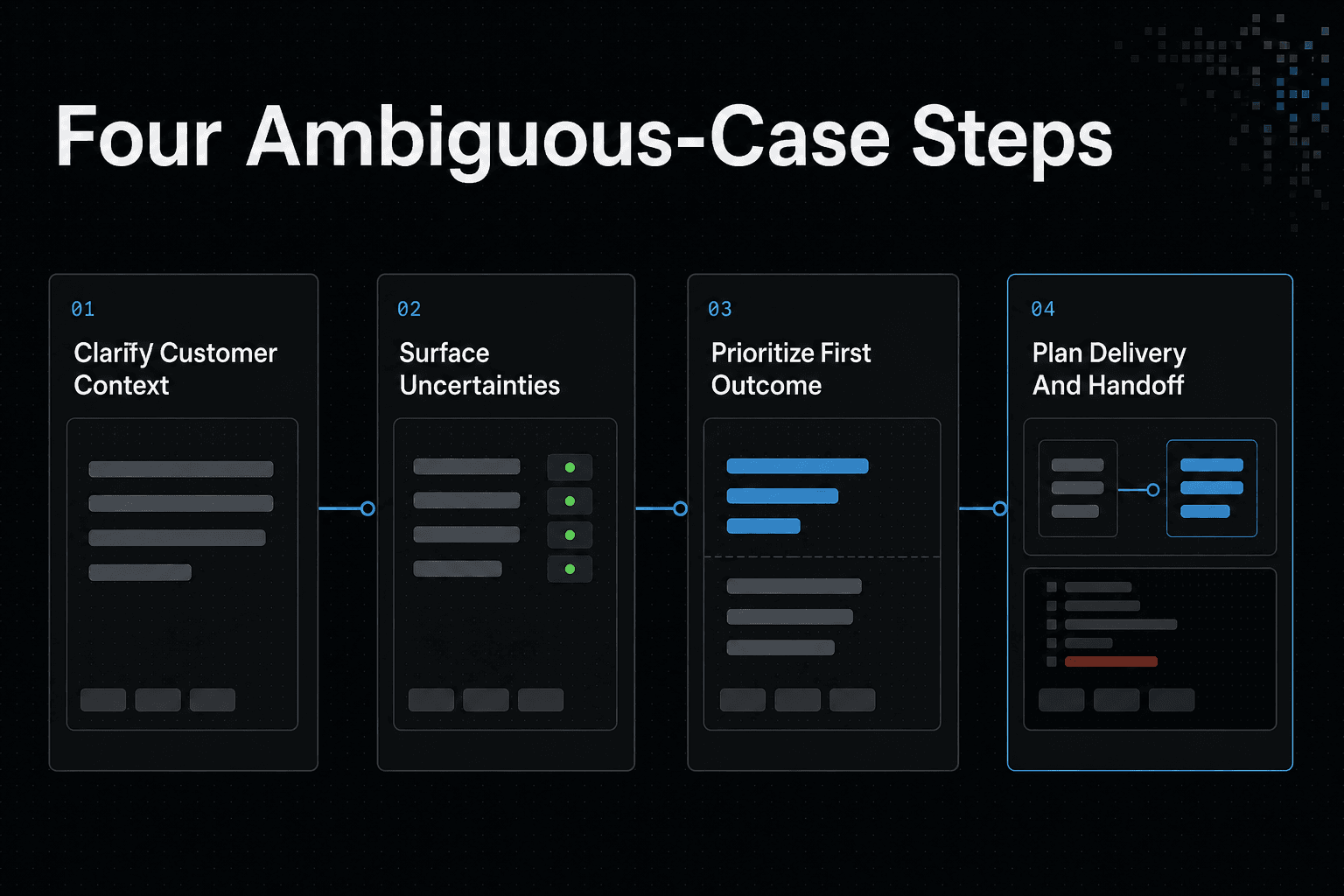
Solve an ambiguous customer case like an FDE
Don't start by designing the assistant. The customer hasn't defined a safe, useful problem, so a polished architecture would only hide the risk.
[!tip] Practice one customer scenario end to end: discovery, prioritization, architecture, deployment, failure handling, and handoff. Reuse it to show how your decisions change as you take on more responsibility.
Role-play scenario: a customer needs an AI assistant to answer internal operations questions but cannot define success, data access, or risk limits
Say: "I would treat this as discovery, not a build commitment." Ask for one real question the team struggles to answer, who asks it, and what happens when the answer is wrong.
Clarifying questions: users, workflows, data sources, permissions, success metrics, constraints, timeline, and decision-makers
Find the daily workflow before naming features. Check which systems hold the answers, who may see each source, what must never appear, how success will be judged, the delivery date, and who can make trade-offs.
Break the work into a thin-slice plan: discovery, data audit, prototype, evaluation, pilot, rollout, and handoff
Start with a data audit and a small evaluation set of real questions. Then prototype retrieval over one approved source, test it with a limited user group, fix failures, and only then plan a broader rollout and handoff.
Prioritize requirements: separate must-haves from nice-to-haves and explain what to defer
Must-haves might be source citations, permission checks, and a clear fallback when the system cannot answer. Defer broad agent actions, extra data sources, and custom interfaces until the first workflow proves useful.
Design the solution: API boundaries, data flow, retrieval or agent workflow, access controls, monitoring, fallback paths, and ownership
Keep the assistant behind a narrow API. It should retrieve only documents the signed-in user may access, return the source with its answer, log failures without exposing sensitive content, and route uncertain cases to the existing support path.
If the case calls for shared agent memory, GigaRAG's central Hive Mind can connect agents through MCP or the API. Explain the access controls, then explain what the system still cannot safely answer without approved source access.
Explain trade-offs and delivery risks: build versus buy, speed versus reliability, retrieval freshness, cost, privacy, rollout, incident response, and change management
The honest answer is: it depends on data sensitivity, source quality, and the cost of a wrong answer. Name stale documents, weak permissions, slow responses, and unclear ownership early, then assign an owner and response path for each risk.
Sample response framework: narrate decisions plainly, surface unknowns early, and commit to next steps without promising certainty
State the unknowns, propose the smallest safe test, and say what evidence would change the plan. Commit to a discovery session, data-access review, and prototype decision point, not an outcome you cannot guarantee.
FDE vs. software engineering vs. solutions engineering
Titles overlap across employers. Read the job description closely: the real split is who owns discovery, how far you carry implementation, and whether you stay accountable after launch.
Preparation lens: FDE, software engineering, and solutions engineering
| Preparation lens | Forward deployed engineering | SWE or solutions engineering |
|---|---|---|
| Problem framing | Connect customer needs to a technical outcome | SWE: frame a product or system problem; solutions: clarify a customer need |
| Technical work | Show how you would build, deploy, and support a solution | SWE: emphasize engineering design and implementation; solutions: explain the proposed technical approach |
| Customer context | Bring customer constraints into technical decisions | SWE: focus on engineering constraints; solutions: focus on customer-facing technical guidance |
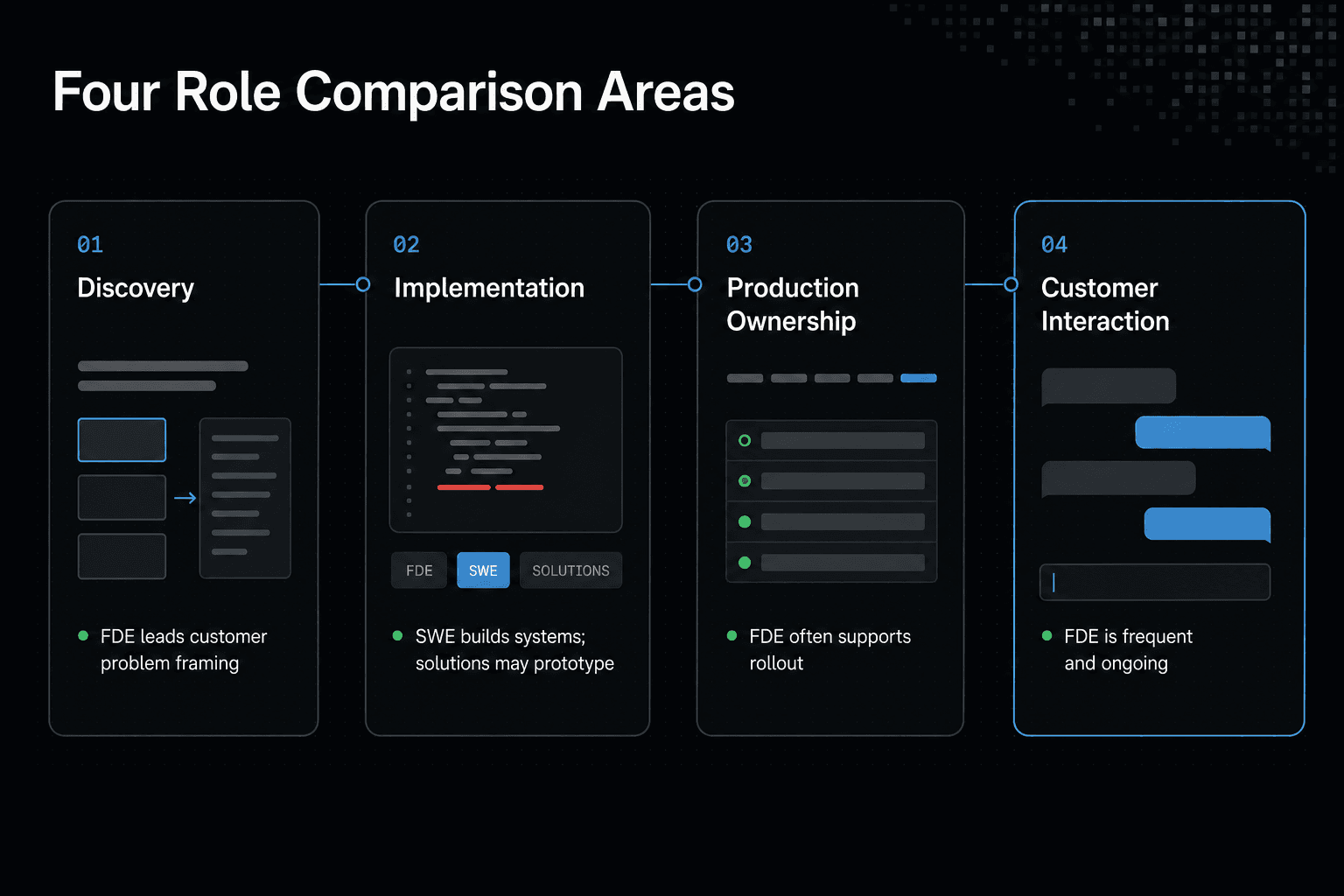
Comparison table: FDE, traditional software engineer, and solutions engineer across discovery, implementation, production ownership, and customer interaction
| Area | FDE | Software engineer | Solutions engineer |
|---|---|---|---|
| Discovery | Leads customer problem framing | Usually receives product requirements | Supports technical qualification |
| Implementation | Builds integrations and workflows | Builds product or platform systems | May configure, demo, or prototype |
| Production ownership | Often stays through rollout and support | Owns services within an engineering team | Usually hands delivery to another team |
| Customer interaction | Frequent, direct, and ongoing | Varies by team | Frequent, often before purchase |
The main catch is that these are patterns, not fixed rules. A role titled FDE may lean more toward platform work, implementation, or customer delivery.
Fresh graduates: show learning velocity, fundamentals, communication, and scoped project ownership rather than pretending to have executive-level delivery experience
Don't claim executive-level judgment you haven't earned. Show clear code, sound fundamentals, a project you owned within a real scope, and how you asked for help when a requirement was unclear.
Experienced engineers: show independent discovery, integration depth, measurable delivery outcomes, and operational judgment
Connect your technical choices to a delivered result. Explain how you clarified needs, integrated with existing systems, handled a failure, and measured whether the work helped users.
Senior candidates: show technical strategy, stakeholder alignment, risk management, team leverage, and accountable delivery
Senior answers need more than a strong design. Show how you set direction, align decision-makers, reduce delivery risk, and help others make good technical calls under pressure.
Common misconception: FDE is neither purely pre-sales nor simply an on-site SWE role
An FDE can code deeply and work closely with customers. The role is worth pursuing if you want both, but not if you only want to build isolated features or only want to sell a technical vision.
Prepare for Palantir, OpenAI, Anthropic, Databricks, and AI-focused FDE roles
Company names don't tell you the interview loop. Roles change, and candidate reports can age fast. Treat each application as its own research task.
[!note] Interview rounds and requirements vary by company and role. Verify current job requirements, and treat company-specific process accounts as candidate reports unless an official source confirms them.
Use current job descriptions to map required capabilities to your evidence bank: customer delivery, data systems, AI applications, security, and deployment
Start with the live posting. Pull out repeated verbs and nouns, then match each to a project story, technical example, or gap you need to close. Don't force a match you can't support.
Create a company research sheet: product context, customer type, implementation environment, technical constraints, and role wording
Keep one page per company. Note the product, likely users, data environment, security concerns, and exact role language. This gives your mock case a real operating context.
Evidence labeling rule: distinguish official job postings and company materials from dated candidate reports, recruiter statements, and speculation
Label every claim by source. Official materials show what the company says now. Candidate accounts may suggest topics, but they don't confirm a required round.
Tailor stories and mock cases without claiming a company uses a specific round unless a current, citable source confirms it
Tailor your examples to the role's stated work: customer discovery, data integration, AI delivery, or production support. You can't prepare for an unverified format, but you can prepare to explain sound judgment under pressure.
Build your FDE interview preparation roadmap
Build evidence before scripts. Your aim is to show how you turn a customer problem into a supportable result, not to recite a perfect answer.
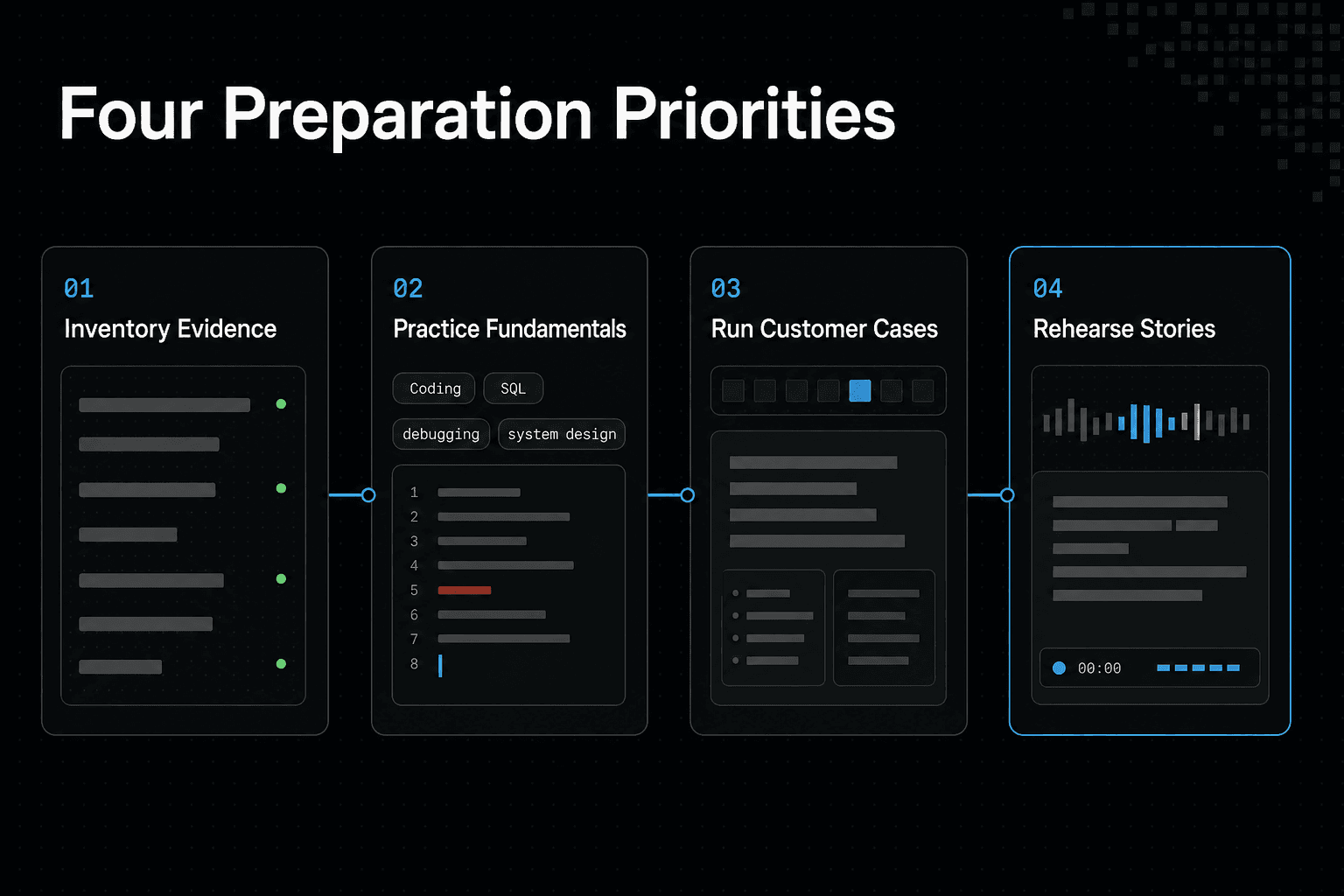
Two-week or four-week preparation roadmap: inventory evidence, practice technical fundamentals, run customer cases, and rehearse stories
In two weeks, map your project evidence, practice coding and SQL, then run one customer case each day. With four weeks, add debugging drills, system design, and recorded story practice.
Mock interview checklist: clarify requirements, write or outline a solution, name trade-offs, test assumptions, discuss rollout, and summarize next steps
Before you start, ask who uses it, what success means, and what limits apply. Outline the solution, test its weak points, explain rollout and ownership, then end with a clear next step.
Behavioral question bank: ownership, difficult stakeholder, failed launch, ambiguous project, conflict, learning, and customer impact
Prepare one honest story for each prompt. Include your decision, the result, and what you changed afterward.
Common mistakes: coding before clarifying, over-designing, hiding uncertainty, ignoring operations, treating AI output as reliable by default, and speaking only in abstractions
Don't code around an unknown problem. Name uncertainty, propose how to reduce it, and cover monitoring, fallback paths, and human review where AI output could cause harm.
Final readiness test: deliver a concise end-to-end answer that links customer value, engineering execution, measurable outcome, and production support
Give yourself ten minutes. If you can explain discovery, delivery, measurement, and support without drifting into jargon, you're ready to handle the real conversation.
Frequently asked questions
What does a forward deployed engineer do in an interview case study?
Show how you would clarify a customer problem, prioritize a useful outcome, and turn it into a deployable, supportable technical solution. Explain your assumptions and trade-offs as you go.
What technical skills should I prepare for an FDE interview?
Prepare to discuss coding, debugging, SQL, and system design, as well as deployment and failure handling. The interview format and emphasis vary by role.
How is an FDE interview different from a software engineering interview?
An FDE preparation plan should connect engineering decisions to customer needs and delivery, not stop at code or design. The specific difference depends on the role and interview loop.
How is a forward deployed engineer different from a solutions engineer?
For interview preparation, distinguish the emphasis: an FDE should explain how a customer need becomes a built, deployed, and supportable outcome. A solutions engineering discussion can center on the customer-facing technical approach, so verify the scope in each job description.
What should I do when an FDE interviewer gives me ambiguous customer requirements?
Ask focused questions about the goal, users, constraints, and success criteria. State what you still don't know, propose a prioritized first outcome, and explain the trade-offs.
How should I prepare for an FDE system design interview involving AI agents or RAG?
Start with the customer problem and constraints, then explain the design and how you would deploy, monitor, and handle failures. Don't assume an AI agent or RAG system is needed unless the scenario supports that choice.
What do interviewers assess in an FDE customer simulation?
Show that you can clarify the need, communicate trade-offs, and connect technical choices to a useful customer outcome. The exact assessment depends on the interview and role.
How can a new graduate prepare for a forward deployed engineer interview?
Practice explaining your reasoning through an end-to-end customer scenario, including problem clarification, a first solution, deployment, and handoff. Make your assumptions explicit and verify which skills the role requires.
About GigaRAG
GigaRAG is a shared memory platform for AI agents that helps developers and teams keep project knowledge available across sessions and tools. It can provide useful context when you need to discuss shared agent memory in an AI-focused FDE case.
You can connect agents to GigaRAG's central Hive Mind through MCP or the API. Access controls manage what each agent can use, which makes permissions a relevant design consideration when you discuss agent workflows.