Agentic RAG Architecture Patterns: What Builders Need to Know
Most agentic RAG architecture patterns guides read like they were written for someone building a weekend demo, not a production pipeline. If you're building agent memory systems that persist across sessions, or a RAG pipeline that has to survive real traffic, the standard five-pattern rundown leaves out the parts you actually need. Agentic RAG is retrieval augmented generation where the LLM plans, retrieves, evaluates its own output, and calls tools in a loop instead of doing one pass and stopping. The honest answer is that most of what's written about it skips memory architecture and multi-agent coordination entirely. GigaRAG is built for exactly the audience those guides ignore. This guide covers the core patterns with their failure modes, agent memory architecture as a first-class design problem, multi-agent coordination, cost and latency numbers, a decision framework for choosing patterns, and the cases where you shouldn't use agentic RAG architecture patterns at all.
| At a glance | Details |
|---|---|
| Core idea | Agents decide retrieval, grading, and rewriting at runtime |
| Main patterns | Router, ReAct loop, multi-agent, corrective, self-RAG |
| Memory types | Short-term context, episodic, semantic, procedural |
| Persistence layer | Vector store plus structured store for durable memory |
| Biggest cost driver | Extra LLM calls per query for routing and grading |
| When to avoid | Simple FAQ lookups and strict latency budgets |
In This Guide
- Agentic RAG vs Traditional RAG: What Actually Changes
- Single-Agent Agentic RAG vs Multi-Agent Agentic RAG
- Core Agentic RAG Architecture Patterns
- Agentic Rag Architecture Patterns: A Step-by-Step Guide
- Agent Memory Architecture: The Missing Pattern
- Multi-Agent Coordination Patterns
- Cost and Latency Trade-offs in Agentic RAG
- When NOT to Use Agentic RAG
- A Decision Framework for Choosing Agentic RAG Architecture Patterns
- Evaluation Pipeline for Agentic RAG
- Framework Selection: LangGraph vs LlamaIndex vs Custom
- Common Mistakes When Building Agentic RAG Architecture Patterns
Agentic RAG vs Traditional RAG: What Actually Changes
Traditional RAG is a straight line. You embed a query, pull the top-k chunks from a vector database, stuff them into a prompt, and generate an answer. One pass. No second thoughts.
That works until it doesn't.
What traditional RAG gets wrong
The single-pass design assumes the first retrieval is good enough. It rarely is. The query might be ambiguous, the chunks might be adjacent to the answer but not contain it, or the embedding model might miss the semantic connection entirely. Traditional RAG has no way to notice any of this. It retrieves once, generates once, and stops.
There's no feedback loop. If the retrieved context is irrelevant, the model still has to answer from it. If the answer is weak, nothing triggers a second attempt. And there's no tool use: the system can't query a database, call an API, or run a calculation to fill gaps in what the vector store returned.
The core loop: plan, retrieve, evaluate, act
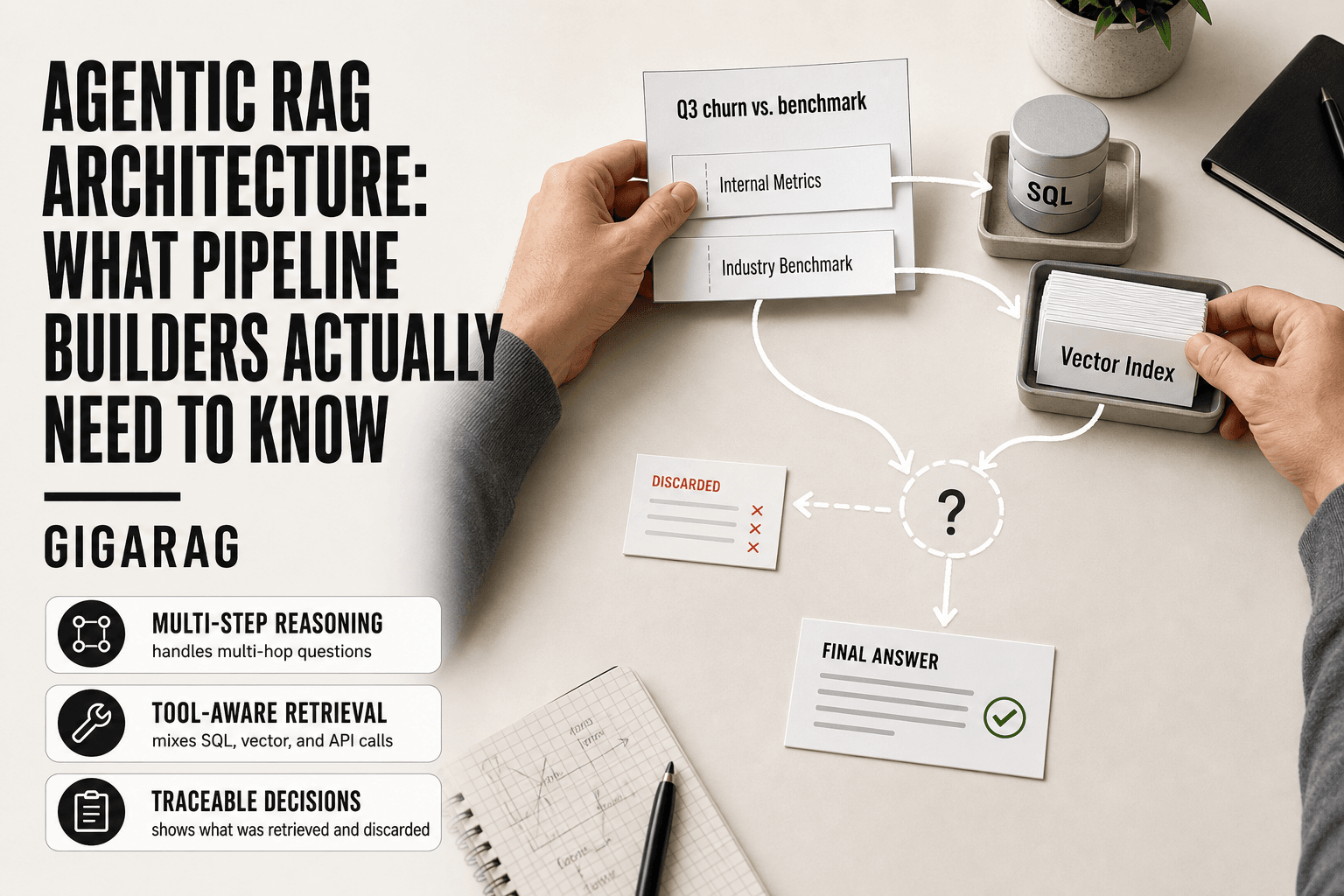
Agentic RAG replaces the straight line with a loop. The agent plans what it needs to know, retrieves, evaluates whether what it got is sufficient, and acts: rewrite the query, retrieve again, call a tool, or generate the final answer.
The evaluation step is the key difference. After retrieval, the agent checks the context against the question. Too thin? Retrieve more. Off-topic? Rewrite and retry. Missing a fact that requires computation? Call a tool instead of guessing.
This loop can run two or three times for a simple query, or a dozen times for a multi-hop question that requires stitching together facts from different sources.
Where agentic RAG adds real value
The value shows up in three places. Complex queries that need decomposition. Answers that need verification against multiple sources. Tasks that require tool use beyond retrieval: calculations, structured data lookups, or API calls.
The cost is latency and token spend. Every loop iteration burns tokens and adds seconds. For a simple lookup, that's waste. For a question that traditional RAG would answer wrong, it's the difference between a hallucination and a correct answer.
[!note] Agentic RAG adds LLM calls for routing, grading, and rewriting, so token cost and latency typically rise compared with a single retrieval pass. Treat those extra calls as a budget you must justify per use case.
Single-Agent Agentic RAG vs Multi-Agent Agentic RAG
| Factor | Single-Agent | Multi-Agent |
|---|---|---|
| Coordination | One loop handles retrieve, grade, generate | Orchestrator delegates to specialized agents |
| Latency and cost | Lower, fewer LLM calls per query | Higher, more calls and handoffs |
| Debugging | Simpler trace, one decision path | Harder, needs per-agent tracing |
| Best for | Focused domains, tight latency budgets | Broad domains, parallel sub-tasks |
| Failure mode | Loop gets stuck or over-retrieves | Agents disagree or duplicate work |
Core Agentic RAG Architecture Patterns
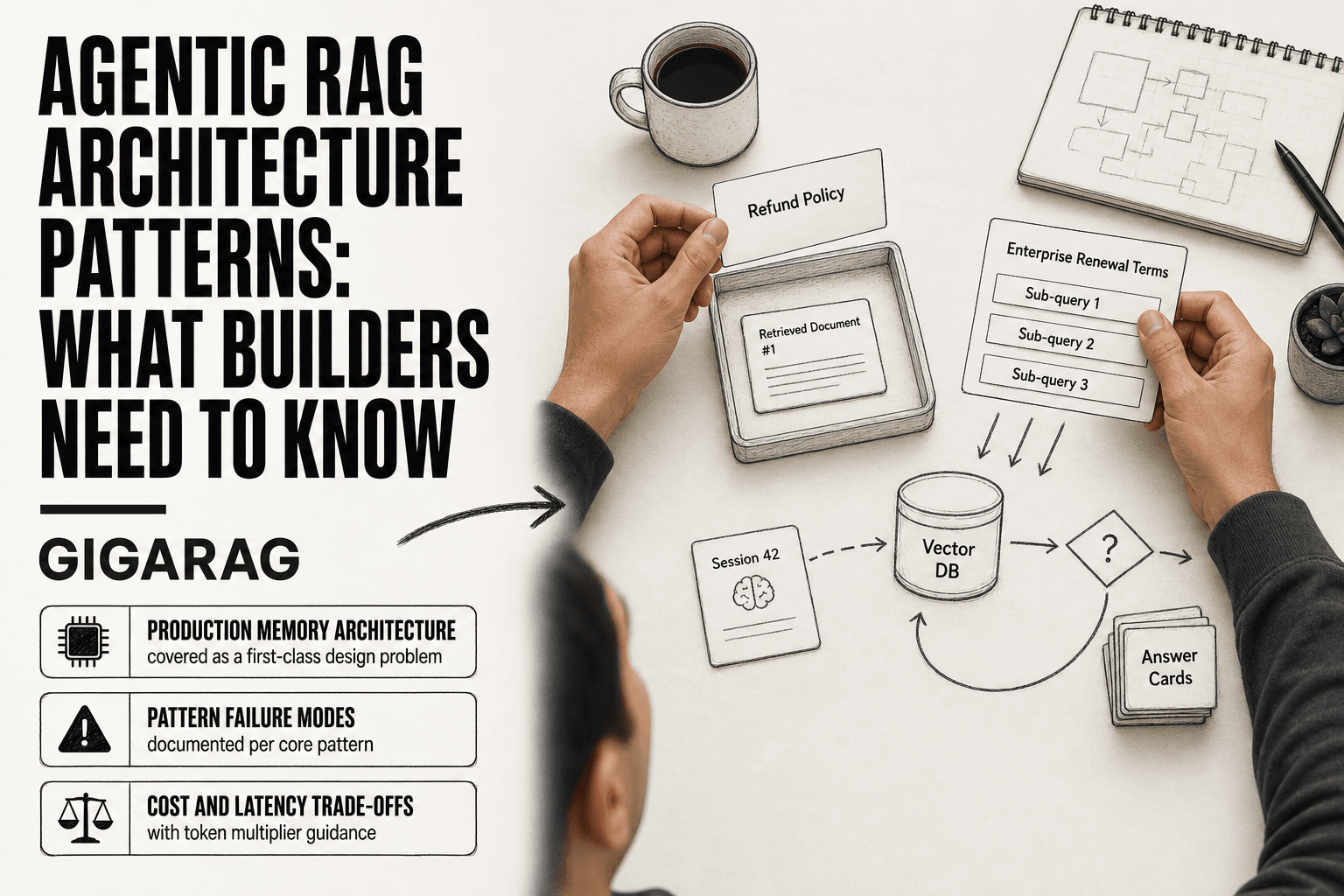
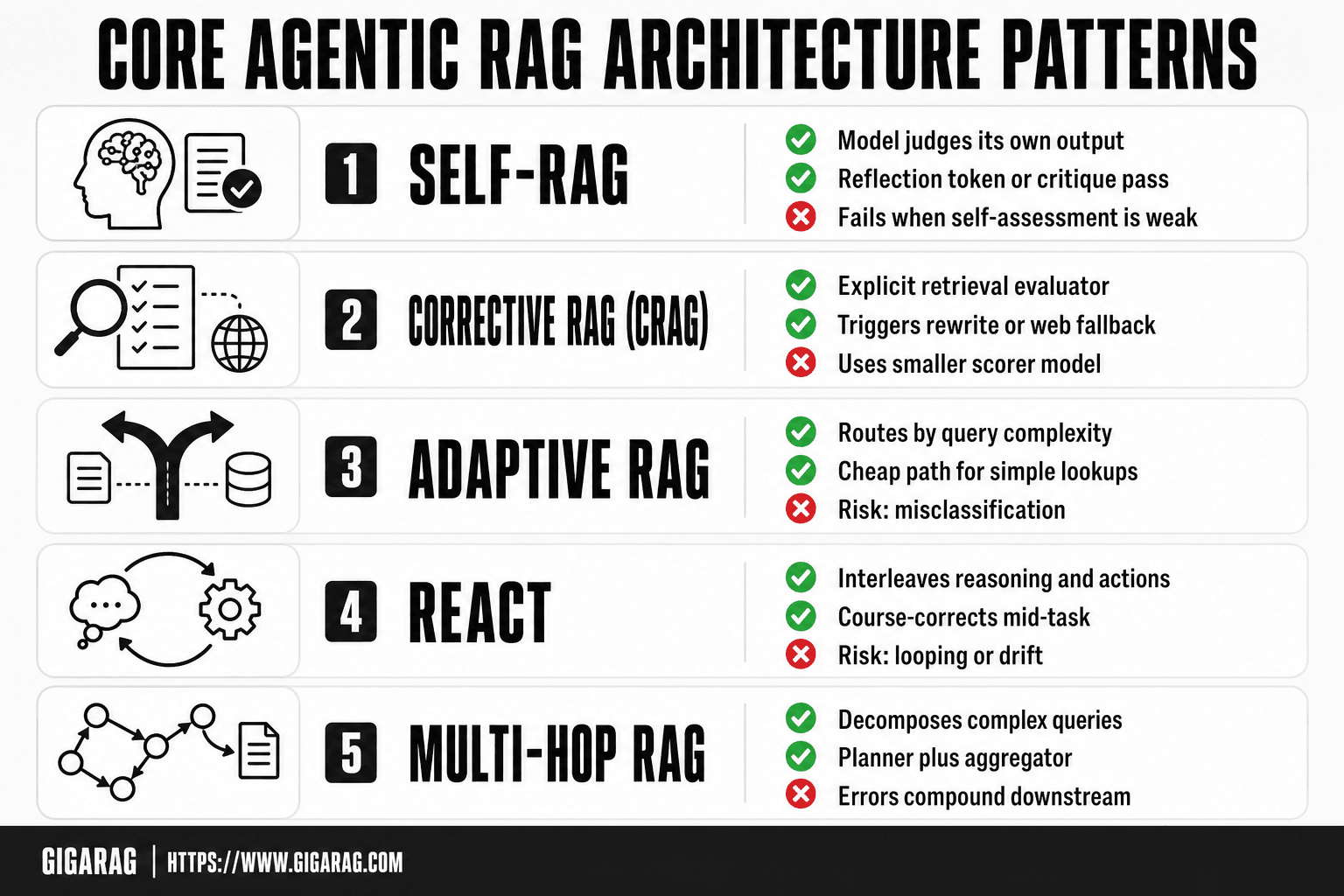
The five core agentic RAG patterns are Self-RAG, Corrective RAG (CRAG), Adaptive RAG, ReAct, and Multi-hop RAG. Each adds a different control mechanism to the retrieval loop: self-critique, retrieval evaluation, strategy selection, interleaved reasoning, or query decomposition. Choosing one depends on your query complexity, latency budget, and failure tolerance.
These patterns aren't mutually exclusive. Production systems often combine two or three. But each has a distinct mechanism, and understanding that mechanism is what lets you pick the right one instead of cargo-culting a name.
Self-RAG: self-reflection and critique
Self-RAG makes the model judge its own output. After generating a draft answer, the model evaluates whether the retrieved context actually supports each claim. If a claim isn't grounded, the model either regenerates with a critique prompt or triggers another retrieval round.
The mechanism is a reflection token or a separate critique pass. The model scores its own answer on faithfulness and relevance, then decides: accept, revise, or retrieve more.
It works when hallucinations are expensive and you can afford the extra generation passes. It fails when the model is bad at self-assessment, which happens more often than vendors admit. A weak model will confidently approve a wrong answer.
Corrective RAG (CRAG): retrieval evaluation and correction
CRAG adds an explicit retrieval evaluator before generation. The system scores retrieved documents for relevance to the query. If the score is high, it proceeds. If the score is low, it triggers a corrective action: query rewrite, web search fallback, or broader retrieval.
The evaluator is typically a smaller, cheaper model or a heuristic scorer. That's the key design choice: you don't burn a full LLM pass to check retrieval quality.
CRAG works when retrieval quality is inconsistent, which is most production systems. It fails when the evaluator itself is miscalibrated and rejects good context or accepts bad context.
Adaptive RAG: dynamic strategy selection
Adaptive RAG routes each query to a different strategy based on its complexity. A simple lookup goes straight to single-pass retrieval. A complex question gets decomposition, multi-hop retrieval, or tool use.
The router is a classifier that predicts query complexity before retrieval starts. That prediction determines how many resources the query gets.
This is the pattern that most directly addresses cost. You don't pay for agentic loops on queries that don't need them. The failure mode is misclassification: a complex query routed to the cheap path produces a wrong answer with no recovery.
ReAct: reasoning and acting interleaved
ReAct alternates reasoning steps with actions. The model thinks, then acts (retrieve, call a tool, query a database), then observes the result, then thinks again. The reasoning is explicit: the model writes out what it's trying to figure out before each action.
This interleaving is what lets the agent course-correct mid-task. If a retrieval returns nothing useful, the next reasoning step notices and changes the approach.
ReAct works for tasks where the path isn't knowable in advance. It fails when the reasoning steps drift, the model loops on the same action, or the explicit reasoning burns tokens without improving the outcome.
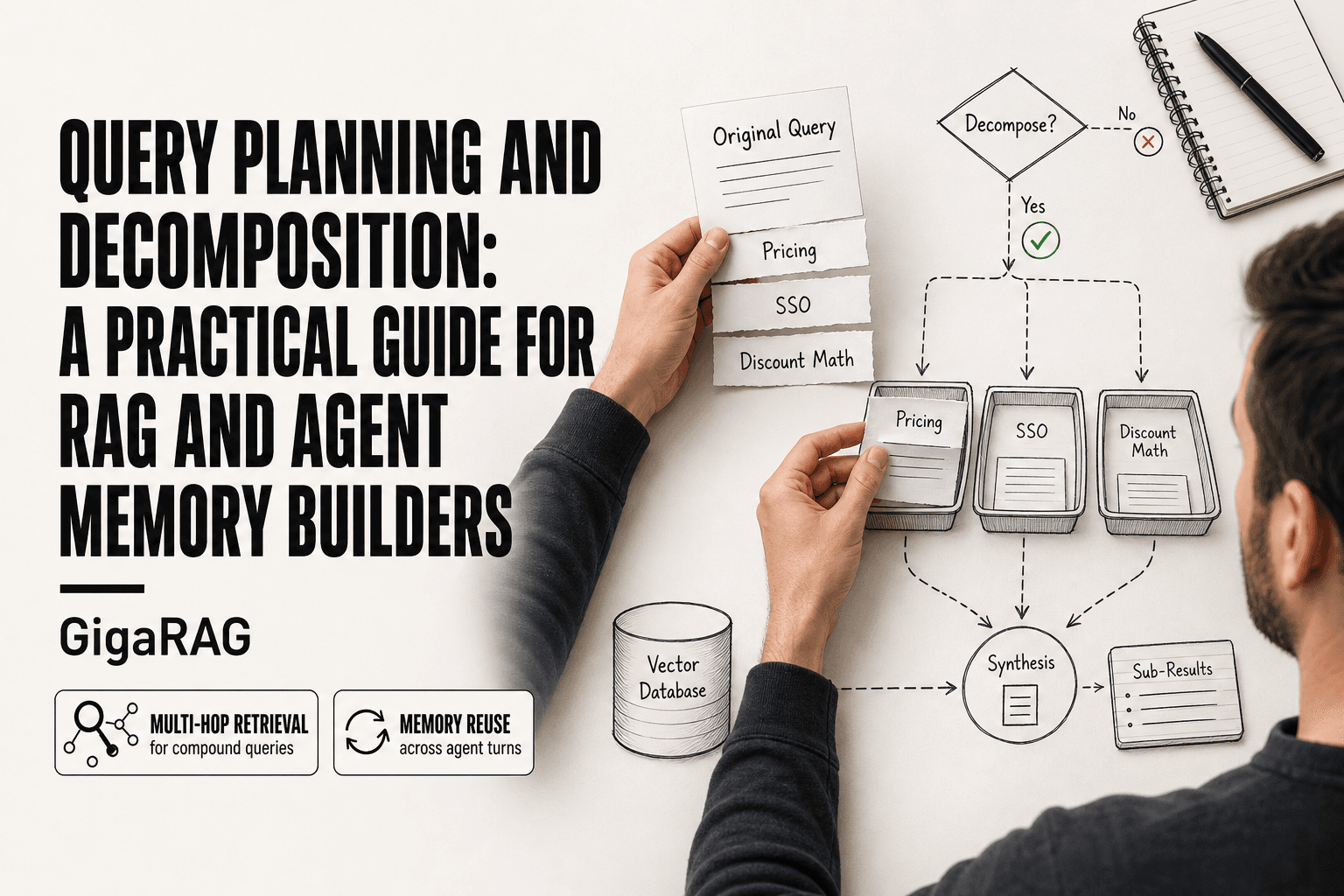
Multi-hop RAG: decomposing complex queries
Multi-hop RAG breaks a complex question into sub-questions, answers each one, then combines the results. The decomposition can happen upfront or iteratively, where each answer determines the next sub-question.
The mechanism is a planner that generates sub-queries, plus an aggregator that synthesizes the final answer from intermediate results.
It works for questions that require facts from multiple documents that no single chunk contains. It fails when the decomposition is wrong, because errors compound: a wrong answer to sub-question one poisons everything downstream.
[!tip] For agent memory builders, store episodic memory as summarized session records with timestamps and a stable user or agent ID, and keep raw transcripts in cold storage. This keeps the hot vector index small while still letting you reconstruct context across sessions.
Agentic Rag Architecture Patterns: A Step-by-Step Guide
- Define the task boundary and decide whether agentic control is actually needed
- Choose a base pattern: router, ReAct loop, corrective RAG, self-RAG, or multi-agent
- Design the memory schema: what is short-term, episodic, semantic, and procedural
- Pick a persistence layer that separates vector memory from structured session state
- Instrument retrieval, grading, and generation steps with traces and token accounting
- Set guardrails: max iterations, fallback to plain retrieval, and refusal conditions
- Evaluate on a held-out set of real queries before scaling traffic
Agent Memory Architecture: The Missing Pattern
Most agentic RAG guides stop at the five retrieval patterns and never touch memory. That's a problem, because memory is what separates a stateless retriever from an agent that can actually build on prior work. The top results skip this entirely.
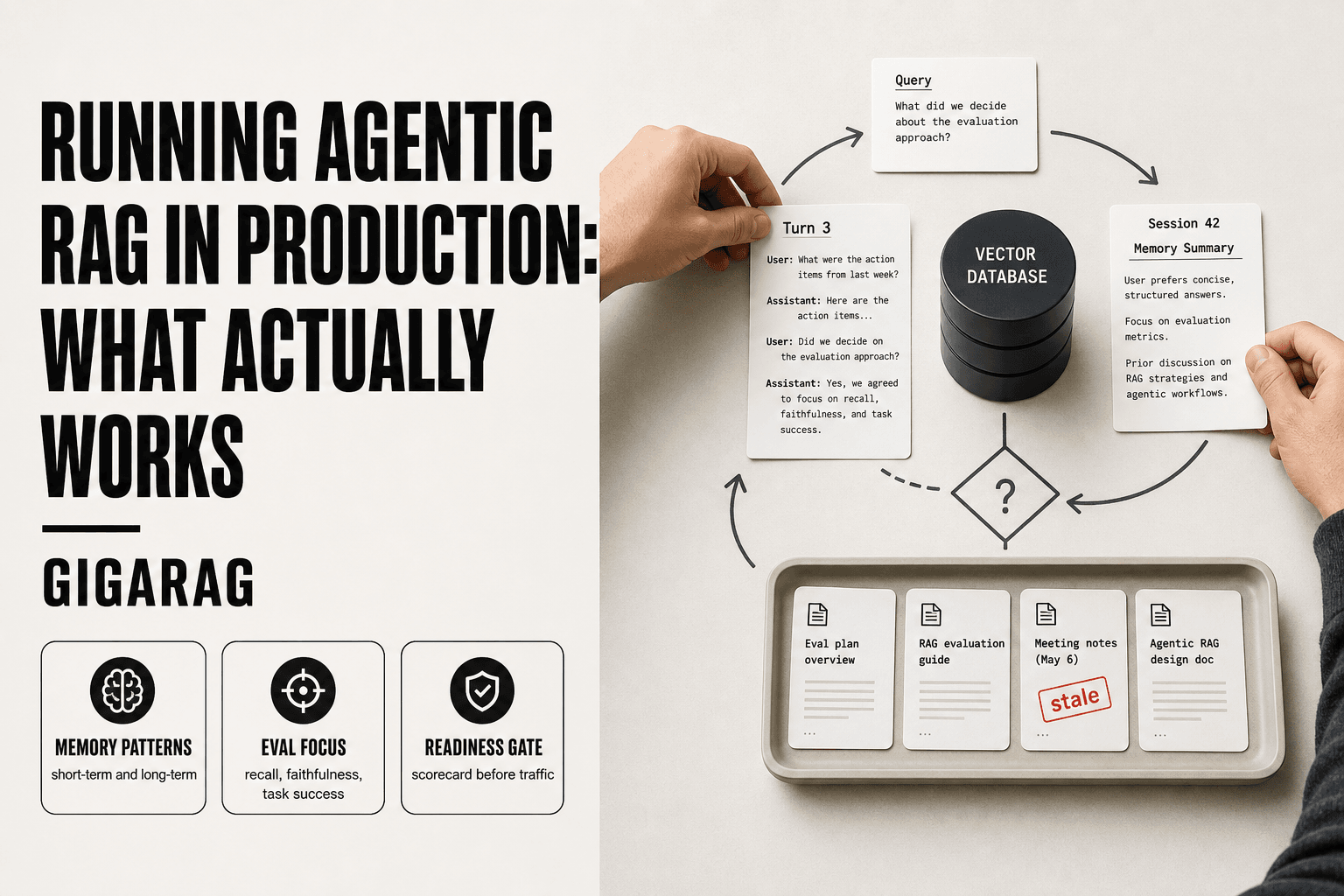
Working memory vs long-term memory in agents
Working memory is the context window plus any scratch space the agent uses during a single task. It holds the current query, intermediate retrieval results, reasoning traces, and tool outputs. It resets when the task ends.
Long-term memory is what persists after the session closes. It stores facts about the user, decisions the agent made, retrieval patterns that worked, and corrections from past failures. Without it, every session starts from zero.
The honest answer is that most agentic RAG systems have no long-term memory at all. They're stateless functions wrapped in a loop. That's fine for one-off queries. It's a dead end for anything that needs continuity.
Memory persistence across sessions
Persistence means writing memory to a store that survives process restarts. The store can be a vector database, a key-value store, or a graph database, depending on what you need to retrieve later.
What you persist matters more than where. Raw conversation transcripts are cheap to store but expensive to retrieve usefully. Structured memories, like extracted facts or learned preferences, cost more to write but pay off in retrieval quality.
The main catch is staleness. A memory written three months ago may no longer be true. You need a way to update or invalidate old memories, and most builders skip that until a wrong answer surfaces in production.
Memory retrieval as a RAG problem
Here's the shift that changes the design. Memory retrieval is itself a RAG problem. You embed memories, store them in a vector index, and retrieve the most relevant ones before answering the current query.
That means your memory system needs the same machinery as your document retrieval: chunking, embedding, reranking, and relevance scoring. The difference is that memories are smaller, more numerous, and change more often than documents.
You also need a write path. Document RAG is mostly read-only. Memory is read-write, and the write side is where most implementations fall apart. A bad write pollutes retrieval for every future session.
Memory architecture implications for pipeline design
If you're building a pipeline, memory changes the shape of it. You need a memory retrieval step before the main document retrieval, a memory update step after the task completes, and a conflict resolution step when retrieved memories contradict current documents.
That's three extra stages in a pipeline that most guides treat as a single retrieval call. The cost is real: more tokens, more latency, more failure modes. But the alternative is an agent that forgets everything you taught it.
Start with working memory only. Add long-term memory when you can name the specific facts you need to persist and the queries that will retrieve them. Don't build a memory system because a framework makes it easy. Build it because a use case demands it.
Multi-Agent Coordination Patterns
Multi-agent systems split the agentic RAG workload across multiple agents, each with its own role, tools, and context. The top results don't cover this at all. That's a gap, because coordination patterns change how retrieval and reasoning actually run in production.
Orchestrator-worker pattern
One orchestrator agent plans the task and delegates subtasks to worker agents. The orchestrator decides what to retrieve, which worker handles it, and how to merge results. Workers are specialized: one for document retrieval, one for code search, one for summarization.
This is the easiest multi-agent pattern to reason about. The orchestrator holds the plan, so you always know where a task is and who's responsible for the next step. The trade-off is a bottleneck. Every decision routes through the orchestrator, and a bad plan from the orchestrator wastes every worker's effort.
Peer-to-peer agent coordination
Agents talk directly to each other without a central coordinator. Each agent has its own retrieval scope and can request information from any other agent. This works when tasks are loosely coupled and no single agent needs global visibility.
The honest answer is that peer-to-peer is harder to debug. When an answer is wrong, you have to trace a message graph instead of a single plan. Use it when the orchestrator becomes the failure point, not because it sounds more flexible.
Shared memory across agents
Agents coordinate through a shared memory store instead of direct messages. One agent writes a retrieval result to memory; another agent reads it when it needs that context. This decouples agents in time, so they don't need to be running simultaneously.
Shared memory is the pattern that most closely matches the memory architecture from the previous section. The catch is consistency. Two agents can write conflicting facts to the same memory, and you need a resolution rule before that happens.
When multi-agent is over-engineering
Most agentic RAG systems don't need multiple agents. A single agent with a good memory architecture and a solid retrieval loop handles the majority of production workloads.
Multi-agent adds value when tasks are genuinely separable: different retrieval sources, different reasoning modes, or different latency requirements. It's over-engineering when you're splitting a single retrieval task into pieces just to have multiple agents. That adds coordination overhead without improving retrieval quality.
Start with one agent. Add a second when you can name the specific subtask it will own and the failure it will prevent.
Cost and Latency Trade-offs in Agentic RAG
Agentic RAG buys accuracy with tokens and time. Every reflection loop, re-query, and tool call adds another round trip through the model. The bill compounds fast.
Token multipliers: what iterative retrieval costs
A traditional RAG call uses one retrieval pass and one generation pass. Agentic RAG multiplies that. A Self-RAG pattern that critiques its own retrieval and regenerates can run 3 to 5 times the token count of a single-pass system. A ReAct loop that takes four reasoning steps before answering multiplies it further.
The multiplier isn't fixed. It scales with how many iterations the agent actually runs, and that depends on query difficulty. Simple lookups might finish in one pass. Multi-hop questions that require decomposing into sub-queries can hit 10x or more. You can't budget for agentic RAG with a flat per-query cost. You budget for a distribution, and the tail is where the money goes.
Latency budgets and user experience
Latency is the harder constraint. Users tolerate a 2-second response for a chatbot. They don't tolerate 15 seconds. Each agentic iteration adds model inference time plus retrieval time plus any tool execution time. A three-step ReAct loop can easily push past 10 seconds on a mid-sized model.
The honest answer is that agentic RAG doesn't fit every interface. If you're building a synchronous API where the caller waits for a response, you need a hard iteration cap. If you're building an async pipeline where the agent runs in the background, latency matters less and you can afford deeper reflection. The interface dictates the budget.
When the added cost is justified
It depends on what the wrong answer costs. If a bad retrieval means a wrong fact in a customer-facing answer, the extra tokens are cheap insurance. If a bad retrieval means a slightly less relevant document in an internal search, single-pass RAG is fine.
The test is simple: measure retrieval quality on your actual queries with and without the agentic loop. If the agentic version improves precision or recall by a margin that matters for your use case, the cost is justified. If it doesn't, you're paying for architecture you don't need.
When NOT to Use Agentic RAG
Agentic RAG is not a default. It's a tool you reach for when single-pass retrieval demonstrably fails. Most production RAG systems don't need it.
Scenarios where traditional RAG is sufficient
If your queries are single-hop lookups against a stable corpus, traditional RAG wins. A support bot answering "what's your refund policy" from a fixed knowledge base doesn't need reflection loops or tool calling. One retrieval pass, one generation pass, done.
The same holds when latency is the hard constraint. A synchronous API where callers wait for a response can't absorb three reasoning iterations. Traditional RAG returns in under a second. Agentic RAG doesn't.
Failure modes: loops, drift, cost spikes
Loops are the classic failure. The agent retrieves, critiques, retrieves again, and never converges. You set a max iteration cap of 3, and the agent burns all three without improving the answer. Worse, it can loop on the same query indefinitely if the critique signal is weak.
Drift happens when the agent's reasoning steps pull it away from the original question. A multi-hop query about "renewal terms for enterprise accounts" becomes a tangent about contract law because one intermediate retrieval surfaced the wrong document. The agent follows the trail.
Cost spikes are the silent killer. A query that usually takes 2 iterations suddenly takes 8 because the retrieval returned noisy results. Your per-query cost triples with no warning. You need hard caps and monitoring, not hope.
What agentic RAG cannot fix
Agentic RAG cannot fix bad retrieval. If your embeddings are poor or your chunks are badly sized, no amount of reflection will recover the right context. The agent can only work with what retrieval returns.
It also cannot fix bad source data. If your knowledge base is incomplete or outdated, the agent will confidently reason over wrong information. The loop improves the process, not the inputs.
And it cannot replace evaluation. You still need to measure retrieval precision, faithfulness, and task completion. Agentic patterns add complexity, which means more failure modes to monitor, not fewer.
A Decision Framework for Choosing Agentic RAG Architecture Patterns
You don't pick a pattern from a list. You pick it from constraints. Here's the framework I use when a team asks which agentic RAG architecture fits their pipeline.
Decision inputs: complexity, latency, cost, memory
Four inputs drive the choice. Query complexity is first: single-hop lookups don't need agents. Multi-hop reasoning with intermediate retrieval does. Latency budget is second: if callers wait synchronously, you can't afford reflection loops. Cost tolerance is third: every iteration multiplies tokens. Memory requirements are fourth: does the agent need to remember context across sessions, or is each query independent?
Answer those four before looking at patterns. Most teams skip this and start with a framework. That's backwards.
Pattern selection matrix
| Constraint | Recommended pattern |
|---|---|
| Single-hop, low latency, tight budget | Traditional RAG |
| Single-hop, needs quality check | Corrective RAG |
| Multi-hop, can afford 2-3 iterations | ReAct or Multi-hop RAG |
| Multi-hop, needs self-critique | Self-RAG |
| Variable query types, routing needed | Adaptive RAG |
| Cross-session memory required | Agent memory architecture |
The matrix is a starting point, not a verdict. If you're at 800ms latency budget and your query needs three hops, the answer isn't a pattern. It's a redesign.
Migration path from basic RAG
Start with traditional RAG. Measure retrieval precision and faithfulness. When precision drops below your threshold on specific query types, add corrective retrieval for those queries only. When multi-hop queries appear, add ReAct with a hard iteration cap of 3. Add memory only when users report losing context across sessions.
Don't migrate all at once. Each step adds cost and failure modes. You earn the next pattern by measuring the current one's limits.
Evaluation Pipeline for Agentic RAG
Evaluation is where most agentic RAG projects quietly die. You can't tune what you don't measure, and agentic systems break in ways traditional RAG metrics don't catch.
Retrieval and generation metrics
Start with the basics. Retrieval precision, recall, and MRR tell you whether the right chunks come back. Generation metrics like faithfulness and answer relevance tell you whether the model used those chunks correctly. RAGAS is the practical starting point: it computes faithfulness, answer relevancy, and context precision with a few lines of code. TruLens adds tracing so you can see which retrieval step went wrong.
The catch: these metrics assume a single retrieval pass. Agentic RAG makes multiple passes, so you need to evaluate each hop separately, not just the final answer.
LLM-as-judge for agentic systems
LLM-as-judge works, but it drifts. A judge model scoring faithfulness on 100 examples will agree with human raters maybe 80% of the time. That's fine for tracking regressions, not for certifying correctness.
For agentic systems, judge the trajectory, not just the output. Did the agent retrieve before answering? Did it correct a bad retrieval? Did it stop when it had enough context? Judge each step against the expected action, not the final answer alone.
Agent-specific metrics: task completion, loop detection
Two metrics matter more than anything else. Task completion rate: what fraction of queries end in a correct, grounded answer? Track this per query type, because multi-hop queries will drag it down.
Loop detection is the second. Count how many times an agent repeats the same retrieval or reasoning step without new information. A loop rate above 5% means your reflection or corrective logic is broken. Log every iteration with a step ID so you can spot loops in production traces, not just in eval sets.
Tool recommendations: RAGAS for metric computation, LangSmith or Langfuse for tracing and loop detection, and a human review set of 50 queries you score by hand every release. The human set is non-negotiable. Automated metrics miss drift.
Framework Selection: LangGraph vs LlamaIndex vs Custom
You've picked your patterns and built your eval pipeline. Now you need a framework to wire it together. The honest answer: it depends on how much control you need and how much plumbing you're willing to write yourself.
LangGraph: strengths and weaknesses
LangGraph is built for stateful, cyclical agent workflows. You define nodes and edges explicitly, so loops, retries, and conditional routing are first-class. That's exactly what agentic RAG needs. The main catch is the learning curve: graph-based thinking doesn't come free, and debugging a stuck node takes practice. Lock-in is real too. Your orchestration logic lives in LangGraph's abstractions, not yours.
LlamaIndex: strengths and weaknesses
LlamaIndex wins on retrieval ergonomics. Chunking, indexing, reranking, and query engines are one-liners. If your agentic RAG is mostly retrieval with light orchestration, it's the fastest path to production. The weakness shows when your agent logic gets complex. LlamaIndex's agent abstractions are thinner than LangGraph's, and you'll fight the framework when you need fine-grained control over loops and state.
When to go custom
Go custom when you need full control over memory persistence, multi-agent coordination, or latency budgets that neither framework respects. You'll write more code, but you'll own every abstraction. For most builders, that's over-engineering. Start with LangGraph for complex orchestration, LlamaIndex for retrieval-heavy work, and go custom only when you've hit a wall you can measure.
Common Mistakes When Building Agentic RAG Architecture Patterns
Most production failures aren't architectural. They're process failures that show up after launch.
Ignoring memory design until too late
You build the retrieval loop, wire up tool calling, ship it. Then users ask follow-up questions and the agent forgets everything from the previous turn. Retrofitting memory into a running system means reworking your state schema, your prompts, and your persistence layer. Design working memory and long-term memory before you write the first orchestration node. It's cheaper by an order of magnitude.
Over-engineering with multi-agent when single-agent suffices
Multi-agent coordination looks impressive in diagrams. In practice, it multiplies your failure surface: more prompts to drift, more state to sync, more loops to debug. If one agent with good tool calling and a solid memory design handles your use case, stop there. Add agents only when you can name the specific bottleneck they remove.
Skipping evaluation until production
You'll ship, users will report hallucinations, and you'll have no baseline to measure fixes against. Build your eval harness before launch, not after. Run it on every prompt change. Agentic RAG architecture patterns fail quietly: loops that terminate but return wrong answers, retrievals that miss context, memory that corrupts across sessions. Only evals catch these before users do.
Frequently Asked Questions
What is agentic RAG architecture?
Agentic RAG architecture is a retrieval-augmented generation design where an LLM agent decides when and how to retrieve, evaluates the results, and may rewrite queries or call tools before answering. It differs from classic RAG, where retrieval happens once in a fixed pipeline.
How does agentic RAG differ from standard RAG?
Standard RAG retrieves once and generates once. Agentic RAG adds a control loop: the agent can route to different sources, grade retrieved chunks, retry with a rewritten query, or escalate to another agent. That flexibility costs extra LLM calls and latency.
What are the main agentic RAG patterns?
Common patterns include router-based retrieval, the ReAct retrieve-and-reason loop, corrective RAG that grades and retries, self-RAG with self-critique, and multi-agent setups with an orchestrator. Each trades simplicity for control in different ways.
How do you persist agent memory across sessions?
Separate memory into short-term context, episodic session summaries, semantic facts, and procedural rules. Persist episodic and semantic memory in a durable store keyed by user or agent ID, and reload the relevant slice at session start rather than replaying full transcripts.
When should you not use agentic RAG?
Skip it when queries are simple lookups, when latency budgets are tight, or when a single retrieval pass already meets quality targets. Agentic control adds cost and failure modes that only pay off for ambiguous, multi-hop, or tool-using tasks.
What causes agentic RAG failures?
Common failures include retrieval loops that never converge, graders that reject good chunks, memory that grows unbounded, and multi-agent handoffs that duplicate or contradict work. Max-iteration caps, fallbacks, and per-agent tracing reduce these risks.
How do you evaluate an agentic RAG pipeline?
Evaluate retrieval quality, answer faithfulness, and task success separately, and track token cost and latency per query. Use a held-out set of real user queries and compare against a plain RAG baseline to confirm the agentic layer earns its overhead.
About GigaRAG
GigaRAG is for agent memory and RAG pipeline builders. get this right. Whether you are working through agentic rag architecture patterns or something adjacent, we publish what we have actually tested, including where it falls short.