When Agentic Retrieval Is a Waste of Money
Your team may need persistent project knowledge or shared agent memory. GigaRAG is a shared memory platform built to keep that knowledge available to AI agents across sessions and tools. That need does not mean every question needs an agent to plan, search again, inspect results, and call tools.
Agentic retrieval can't guarantee better answers, deterministic execution, bounded tool use, or low tail latency. The main catch is that each extra loop can add LLM calls, retrieval passes, reranking, tokens, and failure points, while a SQL query, metadata filter, keyword search, or single-pass RAG path may already fit the job. It depends on your query shapes and whether a simpler baseline fails on ambiguous or multi-hop work.
The good news is you don't have to choose one architecture for everything. Compare simpler retrieval paths, model cost and p95 latency per query, and route only baseline-failing queries to an agentic path.
Quick answer
Agentic retrieval is a poor fit when a predictable query can be answered by a simpler retrieval path. Treat it as an escalation option, and benchmark its added quality against its added cost and latency.
- Route predictable requests to deterministic retrieval.
- Escalate ambiguous, multi-hop, or baseline-failing requests only when testing shows a benefit.
What agentic retrieval is and what it adds to RAG
Agentic retrieval is a RAG workflow where an LLM can decide what to fetch, inspect results, and take another step before answering. Traditional RAG usually retrieves a fixed set of passages once, then generates. The extra loop can help with unclear or multi-part questions, but it cannot guarantee a better answer.
Traditional RAG: retrieve once, then generate
Traditional RAG is a single-shot pipeline: search the user's query, retrieve matching records, place them in the prompt, and ask the model to answer. It may use vector search, keyword search, metadata filters, or a mix.
The retrieval rule is set before the request, so the path is easier to bound and inspect. For a known record or document, that predictability is often enough.
Agentic retrieval: plan, retrieve, inspect, revise, and possibly use tools
Agentic retrieval adds a decision loop. A model may split a question into subquestions, choose a source, inspect evidence, reformulate a search, or call a tool such as SQL or an API.
Here's what happens behind the scenes: each decision can trigger another model call or retrieval pass. That is useful only when the added steps solve a real gap in the first result. For a simple lookup, it is often needless.
What it does not automatically provide: accurate answers, reliable memory, or deterministic behavior
Don't confuse autonomy with truth. An agent can retrieve irrelevant material, misread evidence, choose the wrong tool, or stop too early.
Agentic retrieval also does not create persistent memory by itself. Saving shared context across sessions requires a separate storage and retrieval design; GigaRAG addresses that need by making project knowledge available to agents across sessions and tools. An agentic route can still vary between runs unless you impose limits, so you need evaluation, access controls, and fallbacks.
Deterministic retrieval vs agentic retrieval
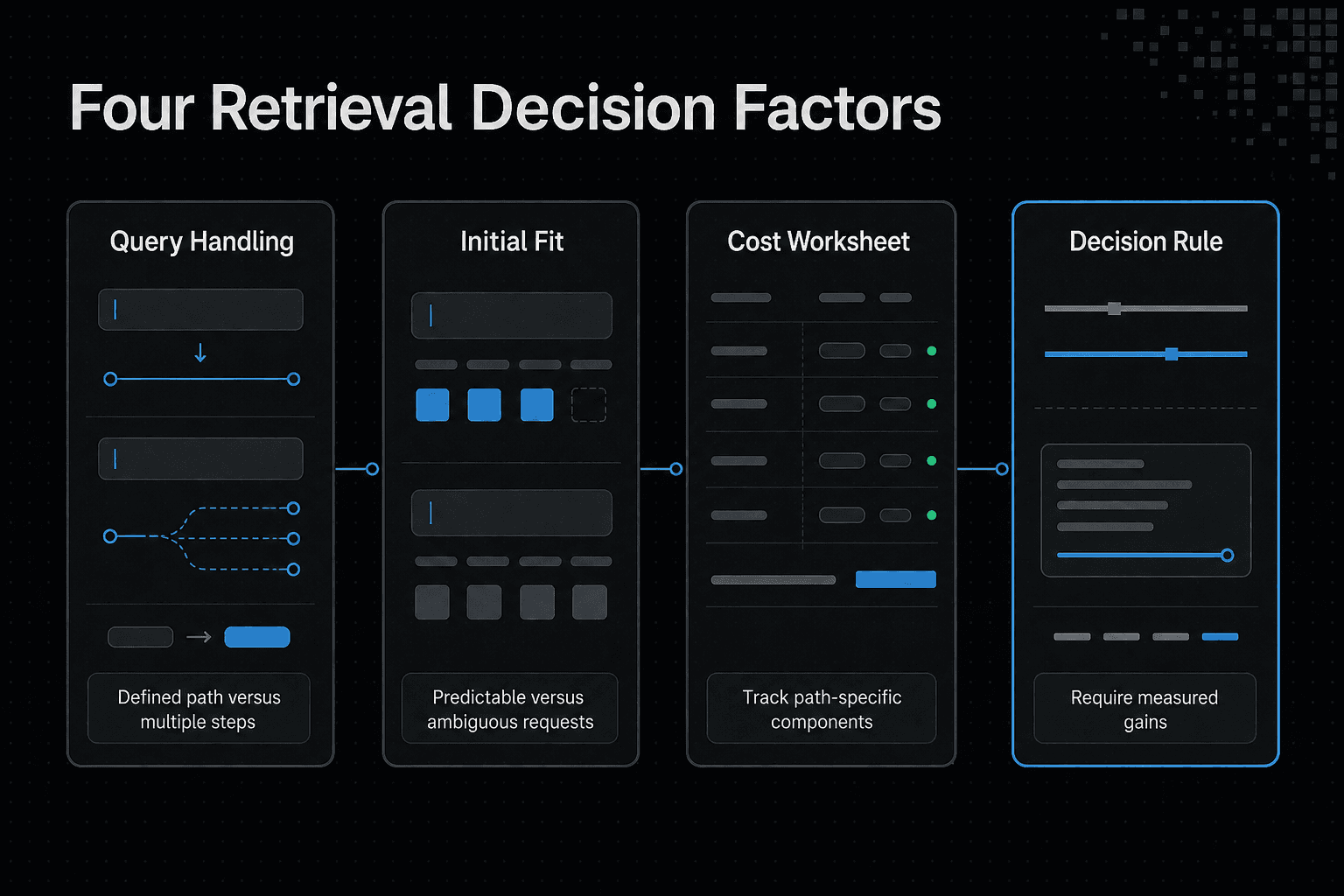
| Factor | Deterministic retrieval | Agentic retrieval |
|---|---|---|
| Query handling | Use a defined retrieval path | Let the system plan and take multiple retrieval steps |
| Good initial fit | Predictable requests | Ambiguous, multi-hop, or baseline-failing requests |
| Cost worksheet | Track the components used by the path | Separate planning, retrieval passes, reranking, tools, and operations |
| Decision rule | Keep it if it meets the quality target | Keep it only if measured gains justify added cost and latency |
How the agentic retrieval loop creates cost and latency
The cost isn't just the final answer. Every branch in the loop can add model tokens, search requests, network waits, and a new chance to take the wrong path.
Planning and query decomposition
Planning asks a model to interpret the request and decide what to do first. If it splits one question into several subquestions, you may now have several retrieval jobs before generation starts.
That can be justified for a real multi-hop task. For a request with one clear source, it is extra work with no built-in quality gain.
Repeated retrieval, reranking, and evidence checks
A loop may search, rerank results, judge whether the evidence is enough, then search again with a revised query. Each pass adds retrieval latency, and reranking or evidence grading can add another LLM call.
The main catch is compounding work. A weak first search can cause more searches, not a clean failure, so log retrieval rounds and why each round happened.
Tool execution, retries, and context growth
Tool calls add their own wait time. SQL queries, APIs, code search, and document stores can fail, return too much data, or need a retry. Each result added to the prompt also increases input tokens for the next model call.
Set hard limits. Cap tool calls, retrieval rounds, prompt size, and wall-clock time so an uncertain request can't turn into an open-ended workflow.
Why p95 latency matters more than a happy-path demo
A happy-path demo shows the fast request. Your users feel the slow tail, where a tool stalls, a retry fires, or the agent takes one more loop before it stops.
Track p50 and p95 latency by stage. If the agentic path helps only a small group of queries but makes the slowest requests unacceptable, route those queries differently.
Step-by-step: decide whether to escalate a query
- Collect representative queries and label the expected answers.
- Run each query through the simplest plausible baseline.
- Record answer quality, latency percentiles, and failure types.
- Route ambiguous, multi-hop, or baseline-failing queries to the agentic path.
- Measure planning, retrieval, reranking, tool, and operational costs separately.
- Compare both paths on the same query set and rubric.
- Keep agentic escalation only where its measured benefit justifies its added cost and latency.
When agentic retrieval is a waste of money
Agentic retrieval isn't a default upgrade. If the answer path is already bounded, planning, repeated search, and tool choice add moving parts without solving a real retrieval problem.
Simple lookups and known system-of-record fields
Use SQL or a direct API when you need a current account balance, order status, owner, or other field with a known source. You want a bounded query against the system that owns the fact, not a model deciding which tools to try.
Don't put an agent between a user and a deterministic lookup unless it has a clear job beyond wording the request. Otherwise, you pay for interpretation where a fixed query is more reliable.
Stable FAQs and small, well-curated knowledge bases
A stable FAQ rarely needs a search loop. If a small set of reviewed documents answers the same questions, keyword search, metadata filtering, or single-step vector RAG is usually enough.
The main catch is upkeep. Once answers become stale or spread across conflicting sources, a simple path can fail, but autonomy still isn't the only fix.
Predictable query templates and single-hop document retrieval
Known query shapes should use known routes. A request such as "find the deployment guide for service X" can go straight to code search or a filtered document index.
Single-hop means one source should answer the question. If your evaluation set shows that one retrieval pass finds that source, an agent loop is not worth it.
High-volume repetitive workloads where small per-query overhead compounds
Small overhead becomes real spend at volume. An extra planning call, reranker, or second retrieval pass on every repeated support question can raise runtime cost and tail latency without improving the answer.
Keep these requests on a cheap, bounded path. Reserve escalation for cases where that path returns weak evidence, misses a constraint, or cannot answer at all.
Choose the simplest retrieval baseline first
Start with the shape of the question, not the appeal of the architecture. Each added retrieval layer creates more work to run, monitor, and debug, so use the narrowest path that can return supported evidence.
[!tip] For a reproducible comparison, freeze the query set and quality rubric before testing, then apply both to SQL, metadata filters, lexical search, vector RAG, hybrid search, and agentic retrieval.
Use SQL or a deterministic API for structured facts and transactions
Use SQL or a deterministic API when the answer lives in a known field: a balance, ticket status, user role, or current inventory count. The system of record owns the fact, and a bounded query gives you a clear failure mode when that fact is missing.
Keep the query direct, and return a clear missing-data result when the required field is unavailable rather than sending the request through an open-ended retrieval loop.
Use metadata filters for known scope, tenant, repository, or date constraints
Metadata filters narrow the search space before retrieval starts. If you know the tenant, repository, document type, or date range, apply those constraints rather than asking a model to infer them from a broad result set.
This also helps prevent cross-scope results. A vector match from the wrong repository is still the wrong answer.
Use keyword search for exact terms and identifiers
Keyword search fits exact strings: error codes, function names, product SKUs, policy IDs, and file paths. These terms often lose precision when you turn them into embeddings, especially when one character changes the meaning.
Check the index first. Search can't find an identifier that was never indexed.
Use vector RAG for semantic document questions
Use vector RAG when users ask for meaning rather than exact wording, such as "What does the leave policy say about caring for a relative?" One retrieval pass can surface relevant passages even when the document uses different terms.
The main catch is evidence quality. Vector similarity suggests relevance, but it doesn't prove that the retrieved passage answers the question.
Use hybrid search when lexical precision and semantic recall both matter
Hybrid search combines keyword and semantic retrieval. It fits questions that contain both a hard constraint and a broader concept, such as a named service plus a request to explain its deployment rules.
It depends on your query mix: if identifiers and natural-language questions both appear often, hybrid retrieval can be worth the added index and ranking work.
A transparent cost and performance model per query
A worksheet won't tell you whether an answer is correct or a tool call was necessary. It will show where each path spends money and time, which is enough to reject an agent loop that adds work without a measured quality gain.
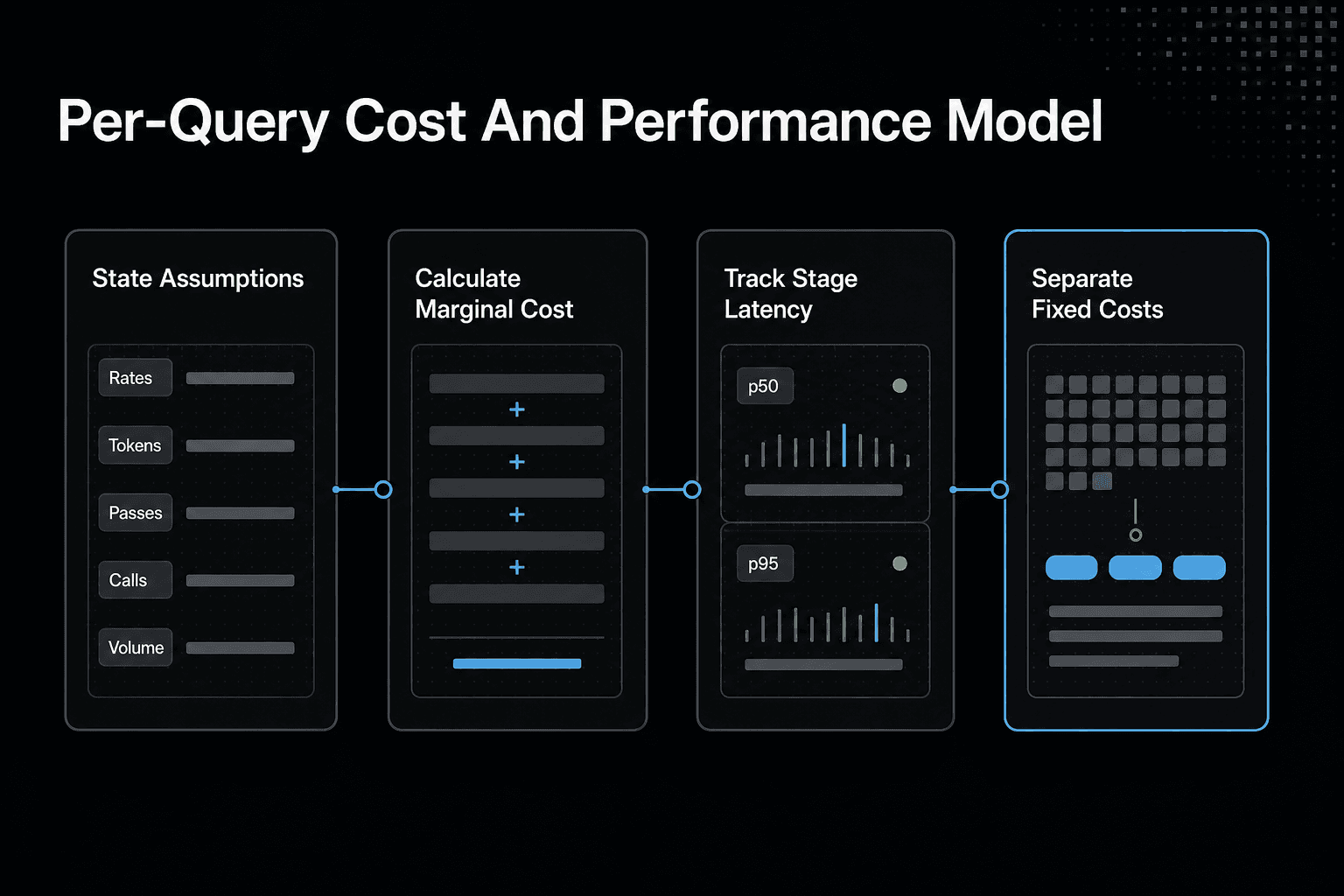
State assumptions: model rates, input/output tokens, retrieval passes, tool calls, and traffic volume
Write down replaceable inputs before comparing paths: input and output token rates, average tokens per model call, embedding cost, retrieval and reranking requests, tool-call charges, and monthly query volume. Keep retries and failed calls in the sheet. They are runtime work too.
Calculate marginal query cost for direct search, vector RAG, and an agentic path
For each path, add only work caused by one query. Direct search might be search request cost plus one generation call. Vector RAG adds query embedding, vector retrieval, and any reranker. An agentic path adds every planning call, retrieval round, tool call, retry, and final generation call.
Use this form:
marginal cost = model tokens + embeddings + retrieval + reranking + tools + retries
Don't use a universal multiplier. Your result depends on your model rates and how often the loop takes another turn.
Track latency as p50 and p95 across each stage
Log elapsed time for routing, retrieval, reranking, each model call, each tool, and final generation. Report p50, the typical result, and p95, the slow tail users notice when a tool stalls or an agent loops.
A fast median is not enough: p95 shows whether retries, slow tools, or extra retrieval rounds create delays that affect a meaningful share of requests.
Separate marginal runtime cost from fixed engineering and operations cost
Keep infrastructure, indexing, observability, evaluation, prompt maintenance, access control, and on-call work outside the per-query formula. Divide those fixed costs by expected query volume only when planning a total cost model.
Low-volume systems can make a cheap query path look expensive once upkeep is included.
Compare retrieval quality without moving the goalposts
A benchmark can't prove that an agentic path is always better. It can show whether it improves your workload enough to justify more calls, tools, and tail latency. Run every path against the same fixed questions, corpus snapshot, access rules, and answer format.
Build a representative query set by task, data source, and difficulty
Sample real request shapes: structured lookups, exact-term searches, semantic questions, known-scope document questions, ambiguous requests, and multi-hop tasks. Tag each query with its expected sources, constraints, and difficulty before you run it.
Keep held-out queries. Otherwise, tuning prompts or routing rules against the same small set can make a weak path look ready.
Score answer correctness, citation or evidence support, and task completion
Use a rubric that separates a correct answer from a well-written wrong one. Score factual correctness, whether cited evidence supports the claim, constraint handling, and whether the user could complete the task.
Define partial credit in advance. A response may find the right document but miss a date filter, which isn't the same failure as inventing an answer.
Log failures: wrong source, missed constraint, bad tool call, unnecessary loop, and timeout
Record the full path for each failure: route selected, retrieved items, tool calls, model turns, elapsed time, and final output. Label the failure type rather than filing every bad result as "retrieval failed."
This matters when an agent finds good evidence but ignores it, or keeps searching after it already has enough support.
Set rollout thresholds for quality gain, failure rate, p95 latency, and cost per successful task
Set the pass line before reviewing results. Require a material quality gain over the baseline, no unacceptable rise in failures, an acceptable p95 latency, and a lower or justified cost per successful task.
If the agentic path misses that line, don't roll it out for those queries.
Real-world retrieval scenarios: escalate or keep it simple?
An agentic path cannot turn missing data or vague ownership into a supported answer, and it will not make live systems safe to query without access rules. If agents need project knowledge to persist across sessions and tools, GigaRAG can address that shared-memory need separately from retrieval planning. Start with the narrowest path that can answer the request, then escalate only when that path cannot gather the needed evidence.
Repository question with a known file or symbol: direct code search or metadata-filtered retrieval
If you know the repository, path, or symbol, use code search or a metadata filter scoped to that repository and branch. An agent that plans several searches adds work without improving a bounded lookup.
Use direct code search for an exact identifier. Use metadata-filtered retrieval when scope is known but wording isn't, such as finding a function's callers within one service.
Internal policy question across related documents: hybrid or vector RAG
Policy questions often span an employee handbook, exceptions, and dated updates. Hybrid search keeps exact policy terms while vector retrieval catches paraphrases, then constrain results by audience, jurisdiction, and effective date.
Escalation isn't the default. Use an agent only if the request must reconcile conflicting sources or follow a chain of linked rules.
Debugging an incident across logs, tickets, and documentation: possible agentic escalation
Incident work can require joining timestamps, deployment records, tickets, and runbooks that use different terms. It depends on whether you need to form and check several leads, rather than run one known query.
Cap tool calls. Give the agent read-only access, and don't use it to replace a known log query or dashboard filter.
Live external research with uncertain sources: agentic retrieval may be justified if freshness and verification matter
Freshness changes the job. Agentic retrieval may be justified when sources change frequently and the workflow must search within defined source rules, compare dates, and verify that the evidence is current enough for the task.
An agent can search, compare dates, and collect citations, but it cannot establish that a source is true. Define source rules and a stop budget before allowing repeated searches.
Persistent agent memory is not the same as agentic retrieval
Persistent memory can't make stale project facts correct, settle conflicting records, or safely grant an agent broader access. It stores or retrieves context across sessions. Agentic retrieval is a separate choice to plan, call tools repeatedly, and decide what to do next.
[!note] Persistent knowledge and autonomous multi-step retrieval address different needs. Shared context alone does not establish a need for agentic retrieval.
Cross-session context, shared project knowledge, and provenance
A coding agent may need repository rules, past decisions, service ownership, and approved runbooks after a session ends. Multiple agents may also need the same project record. That is a memory and knowledge-management problem, not proof that every request needs an autonomous search loop.
Keep provenance with each memory item: where it came from, when it was recorded, and which version or repository it applies to. Without that, old notes can look as trustworthy as current source code, leaving you with confident but unsupported changes.
Why memory retrieval can still use deterministic or single-step paths
Memory lookup can be bounded. Retrieve the current project's architecture note by project ID, fetch the latest decision record by date, or run one metadata-filtered search over approved documents.
That path won't resolve an open-ended investigation. But for known context, it is often worth it because you can control scope, inspect what was retrieved, and avoid paying for planning that adds no useful work.
MCP-connected tools: choose bounded access patterns before autonomous exploration
MCP-connected tools can expose files, tickets, databases, and internal services to an agent. With GigaRAG, developers can connect agents to a central Hive Mind through MCP or the API, while access controls determine what each agent can use. The main concern remains access breadth: a tool connection does not establish which calls are safe, necessary, or within a task's scope.
Start with read-only tools and narrow inputs such as a repository, environment, ticket ID, or time range. Make sure you log calls and return sources. You can widen access later if a measured workload needs it.
Questions to ask before adding planning and repeated tool use
Ask four things: Is the needed context already named? Can one query retrieve it? Is there a clear system of record? What evidence shows that the single-step path fails?
If the answer is vague, instrument the baseline first. Add planning only when the request must choose among sources, follow links across systems, or revise its search after supported evidence comes back.
Use a hybrid router instead of making every query agentic
A router won't make weak data trustworthy or turn an open-ended task into a bounded one. It decides which path gets the query, then limits escalation when the simple path cannot return supported evidence.
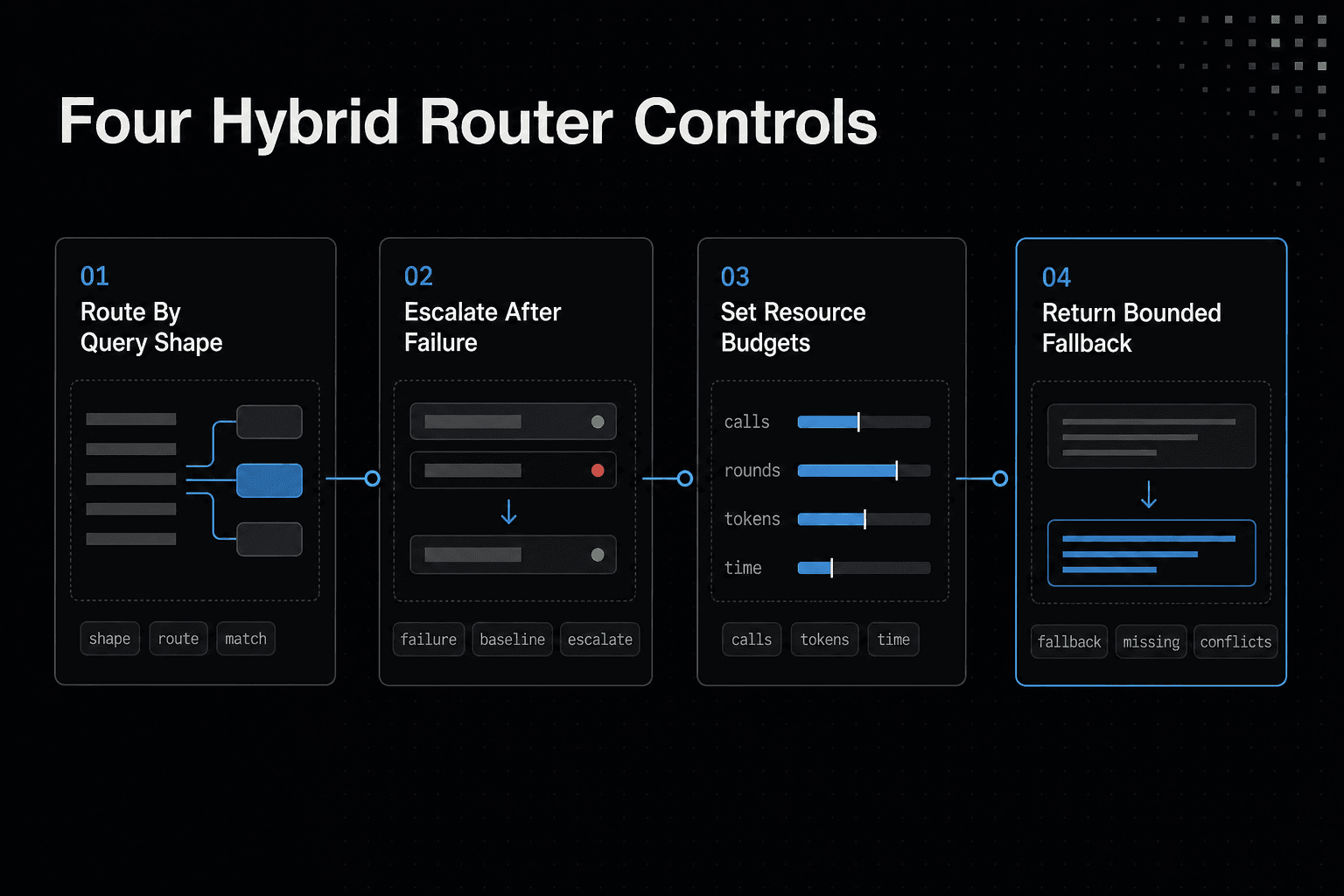
Route by query shape: structured, known-scope, semantic, ambiguous, or multi-hop
Send structured facts to SQL or a fixed API. Use metadata filters when the repository, tenant, date range, or document set is known. Use lexical, vector, or hybrid search for one-hop document questions.
Reserve an agentic path for ambiguity or multi-hop work. That means the system must choose among sources, connect evidence across them, or revise a failed search based on what it found.
Escalate after a measurable baseline failure, not merely because a query sounds complex
Complex wording isn't enough. Run the cheapest suitable path first, then escalate only when it returns no evidence, conflicting evidence, an incomplete answer, or a result that fails your evaluation rules.
Log the trigger. Otherwise, the router becomes a guesser that sends too much traffic into costly loops.
Set budgets for maximum tool calls, retrieval rounds, tokens, and wall-clock time
Give the agent a hard ceiling for each resource: tool calls, retrieval rounds, input and output tokens, and elapsed time. Stop when it reaches any ceiling, even if it wants one more search.
Keep the budget tied to task value. A short internal lookup should not consume the same allowance as an incident investigation spanning tickets, logs, and runbooks.
Return a bounded fallback when escalation cannot produce supported evidence
Don't let a stopped loop invent closure. Return the evidence found, name the missing source or unresolved conflict, and ask for a narrower scope when one exists.
That fallback is less satisfying than a confident answer. It is also easier for you to review and act on safely.
Make agentic retrieval earn its place
Agentic retrieval can't guarantee correct answers, bounded cost, or a useful result before its budget expires. Treat it as an escalation path, not your default: it earns its extra LLM calls and tool use only when it beats a simpler system on the queries that matter.
Start with the lowest-complexity system that fits the task
Begin with the narrowest path that can answer the request: SQL for structured facts, a fixed API for known records, or filtered search for a known document set. If one retrieval pass returns supported evidence, don't add planning, repeated searches, and tool calls around it.
It depends on the task's data shape and failure cost. An incident question spanning logs, tickets, and runbooks may justify escalation. A request for an account field usually doesn't.
Keep the evaluation set and cost logs after launch
Keep the representative query set, quality rubric, failure labels, per-query cost, and p50 and p95 latency logs you used before rollout.
Watch for drift. New documents, changed schemas, and altered tool behavior can turn a route that once worked into a costly loop, leaving you with higher spend and no clear quality gain.
Expand agentic routing only when measurable gains persist
Add query types to the agentic route in small groups. Compare its answer quality, supported evidence, completion rate, failure rate, latency, and cost per successful task against the simpler baseline.
Set a removal rule too. If the gain disappears, or the path mainly adds retries and unsupported answers, send that traffic back to the deterministic route.
Frequently asked questions
What is the difference between agentic retrieval and traditional RAG?
Traditional RAG can use a defined retrieval path to supply context for an answer. Agentic retrieval adds planning and the possibility of repeated retrieval or tool calls, so compare those added steps against the quality benefit they provide.
When should I use SQL instead of RAG?
Use SQL as a baseline when the request can be answered from structured data with a defined query. Benchmark it against other paths on the same queries before adding agentic retrieval.
Is vector RAG enough for a small internal knowledge base?
The knowledge base's size alone does not decide whether vector RAG is enough. Test it on representative queries with a stated quality rubric, and compare its results with simpler filters or other retrieval baselines.
Why can agentic retrieval have higher p95 latency than single-step retrieval?
An agentic path may include planning and multiple retrieval or tool steps. Measure p95 latency for the complete workflow on the same query set to see how those steps affect your system.
How do I calculate the cost per query for an agentic retrieval workflow?
Build an assumption-led worksheet that separately records LLM planning, retrieval passes, reranking, tool execution, and operational cost. State assumptions for each component and measure them on your workload rather than relying on a universal multiplier.
What metrics should an agentic retrieval benchmark include?
Use the same query set and quality rubric for every retrieval path. Record answer quality, latency percentiles, and failure types. Track cost components separately so the comparison reflects both performance and expense.
Which queries should be routed to an agentic retrieval system?
Start by routing predictable requests to deterministic paths. Consider escalation for ambiguous, multi-hop, or baseline-failing queries, then retain it only where benchmarking shows a worthwhile benefit.
Does persistent agent memory require multi-step agentic retrieval?
No. Persistent knowledge and autonomous multi-step retrieval solve different problems. A need for shared context does not by itself establish a need for an agent to plan and search repeatedly for each query.
About GigaRAG
GigaRAG provides a shared memory layer for AI agents, helping developers and teams keep project knowledge available as work moves across sessions and tools.
Agents can connect to GigaRAG's central Hive Mind through MCP or the API, with access controls that define the knowledge each agent can use.


