When a Bigger Context Window Beats Retrieval
Ever-larger LLM context windows make it tempting to treat retrieval augmented generation as old plumbing. That is a mistake. A bigger window can hold more input, but it cannot guarantee attention, recall, sound reasoning, persistent knowledge between agent sessions, permission checks, or low token cost.
The honest answer is that it depends on the work: does your model need to reason across a bounded set of files or documents, or find a few relevant facts in a large collection that changes often? Those are different jobs. Context is active input, RAG selects material at query time, and persistent memory keeps useful state for later work.
Quick answer
A bigger context window can beat retrieval when the task needs reasoning across a bounded body of material that you can provide directly. Choose by comparing token use, latency, retrieval overhead, update frequency, and access controls, not by assuming one architecture always wins.
- Use direct context for bounded, broad-reasoning tasks.
- Use retrieval when selecting relevant material from a larger or changing corpus matters.
- Consider a hybrid when a task needs both selective retrieval and broad-context synthesis.
Context windows, retrieval, and agent memory are different layers
A larger context window lets a model work from more material in one request, but it doesn't replace retrieval or memory. They solve different problems.
[!note] A context window, a retrieval system, and persistent agent memory are different layers. A larger window alone does not establish persistence, permissions, recall, or reasoning quality.
What an LLM context window holds during one request
During one request, the context window holds instructions, user input, attached excerpts, and output budget. It's working space, not storage you can count on later.
What vector RAG retrieves and injects at query time
Vector RAG searches indexed chunks, then injects selected results into that working space. It can narrow a large corpus, but it can miss relevant chunks or return weak ones.
Why persistent agent memory is not the same as a larger prompt
Persistent agent memory keeps facts, decisions, or summaries outside the current prompt for later sessions. It still needs storage, update rules, and a way to find the right record.
GigaRAG is built for this separate layer: it keeps project knowledge available across agent sessions and tools through a central Hive Mind.
What happens when the context window limit is reached
When input and expected output exceed the limit, the system can't send it all in one request. It depends on implementation: content may be cut, summarized, split across calls, or rejected, each risking lost context.
Direct context vs vector RAG vs hybrid
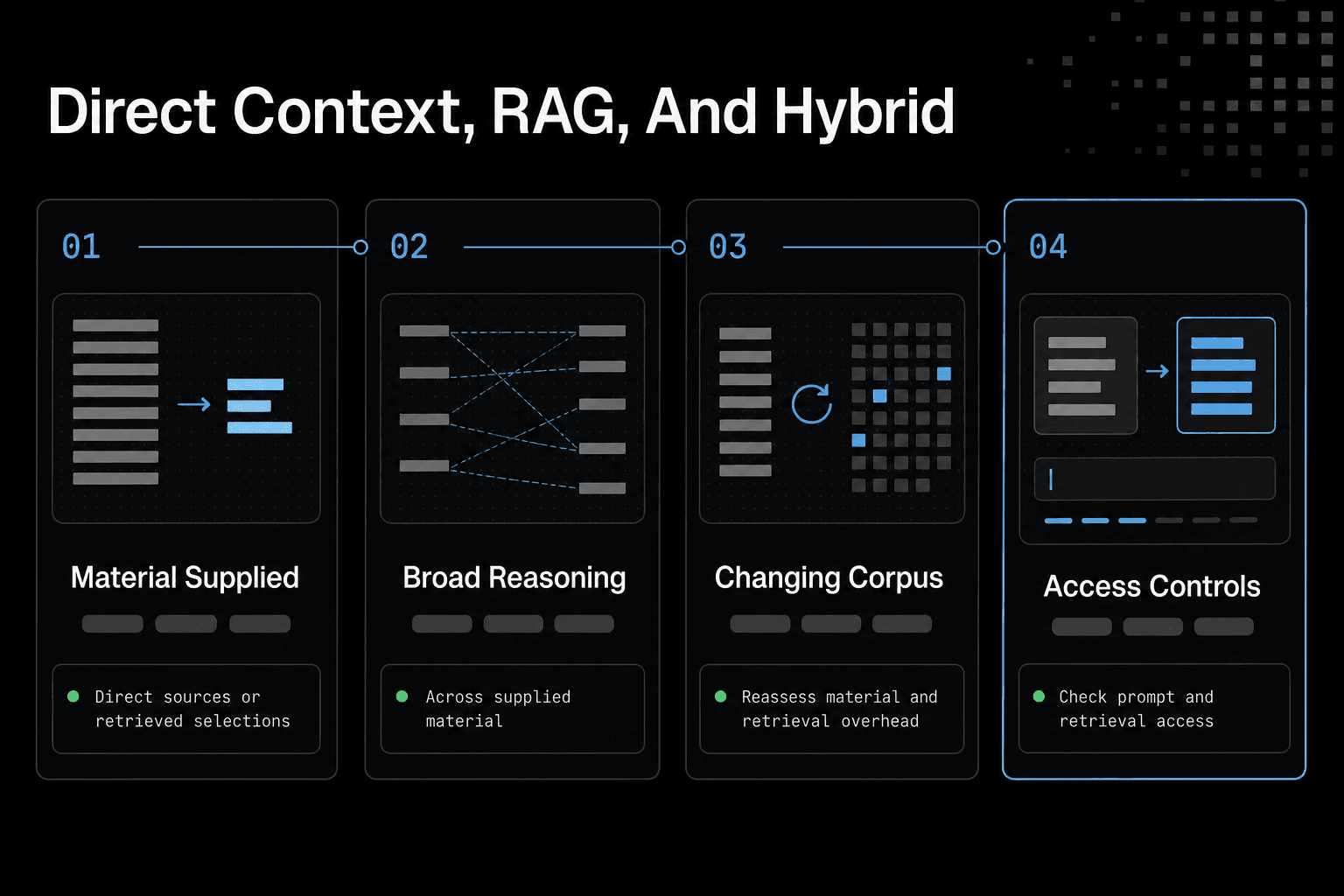
| Factor | Direct context | Vector RAG or hybrid |
|---|---|---|
| Material supplied | Provide the task's bounded source material directly. | Retrieve selected material; a hybrid can combine retrieved sources with broader context. |
| Broad reasoning | Consider it when the task calls for reasoning across the supplied material. | Check whether retrieval could omit material needed for cross-document reasoning. |
| Changing corpus | Reassess and supply current material for each task. | Compare retrieval overhead with how often the corpus changes. |
| Access controls | Check what material enters the prompt. | Check retrieval and prompt access controls for the intended users and task. |
| Operating tradeoffs | Measure token use and latency for the task. | Measure token use, latency, and retrieval overhead for the same task. |
How long-context prompting, vector RAG, and hybrid systems work
Direct long-context prompting: assemble, send, reason
Your application gathers the relevant files or documents, puts them in one prompt, and sends that prompt to the model. The model can then compare material across the full supplied set.
This is simple. The main catch is that every included token travels with the request, even when only part of it matters.
Vector RAG: chunk, embed, retrieve, rerank, inject
RAG splits source material into chunks and stores a numeric embedding for each chunk. At query time, semantic search finds likely matches, a reranker may reorder them, and the system injects the selected text into the prompt.
That adds moving parts. A useful passage can be missed before the model sees it.
Hybrid design: retrieve evidence, then preserve broad working context
A hybrid system retrieves fresh evidence from a large corpus, then keeps task plans, key files, and prior findings in active context. This suits work that needs both targeted lookup and cross-file reasoning.
It isn't a free upgrade. You still need rules for what stays, what gets replaced, and what must be retrieved again.
Where token consumption, retrieval overhead, and latency enter the request path
Direct context spends most of its overhead on prompt assembly and input tokens. Vector RAG adds indexing, embedding, search, reranking, and context injection before generation starts.
A 1M-token window means the model can accept up to one million tokens within its context limit. It doesn't mean that one million tokens will help every task. Check the whole path: retrieval time, prompt size, output budget, and the quality of the evidence the model received.
Step-by-step: choose an architecture for the task
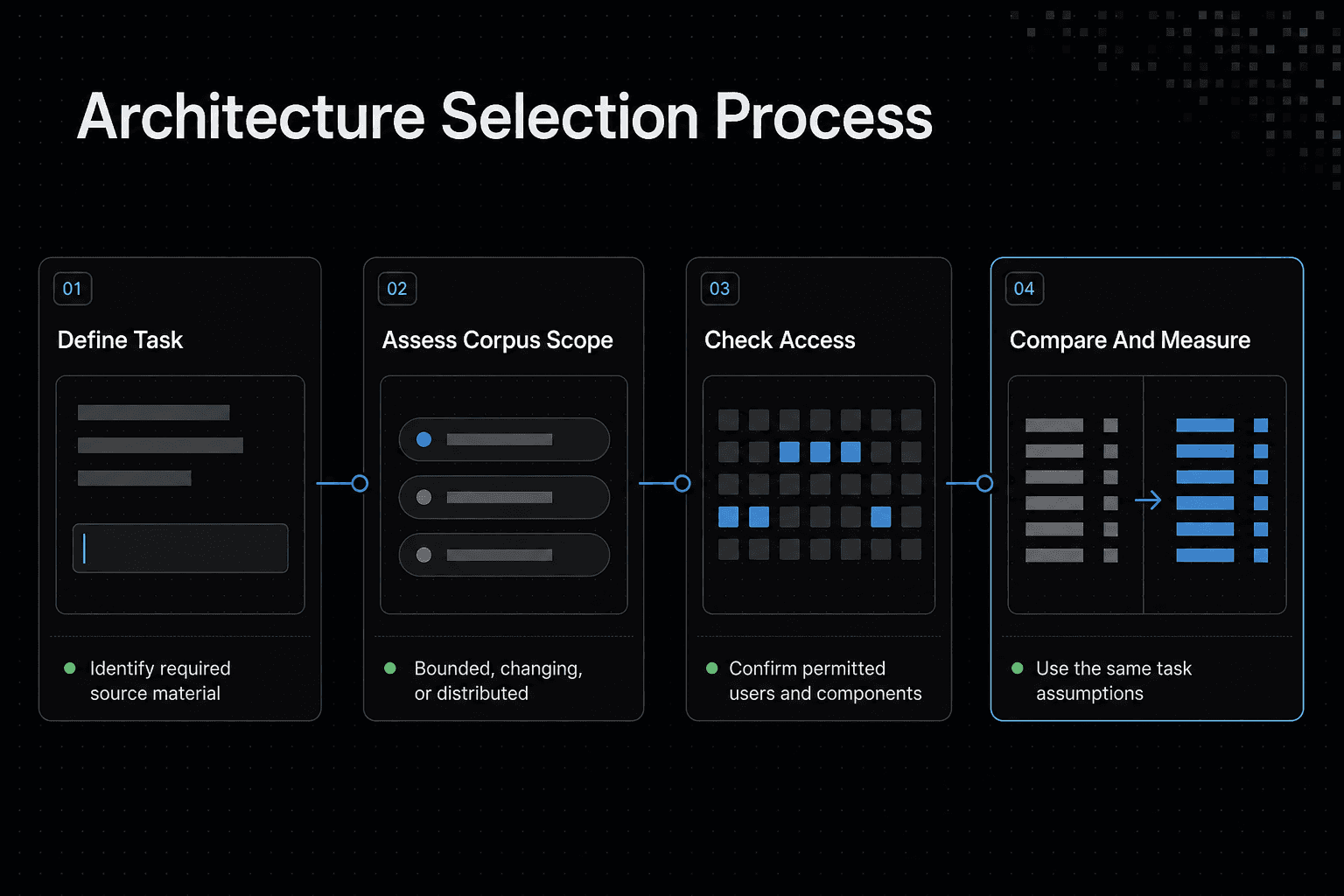
- Define the task, corpus, and what a successful answer must use.
- Record whether the relevant material is bounded, changing, or spread across documents.
- Check which users and components may access the material.
- Compare a direct-context approach with retrieval and, where useful, a hybrid.
- Measure token use, latency, and retrieval overhead under the same task assumptions.
- Check outputs for missed material, weak reasoning, and permission failures.
- Choose the simplest design that meets the task's needs, then reassess when the corpus or workflow changes.
When a bigger context window beats retrieval
[!tip] For a coding workflow, compare architectures on the same repository task. Record which files were available to the model, what retrieval added, and whether the answer used the needed material.
Whole-codebase analysis, debugging, and repository-wide refactoring
Use direct context when the task is to understand how parts connect, not to find one file. A bug may start in a route, pass through a service, depend on a shared type, and surface in a test. Retrieval can return good fragments while hiding the chain between them.
Repository-wide refactoring has the same problem. If you need to rename an abstraction, change its callers, and preserve behavior across modules, broad context gives the model more of the dependency story.
Long-document review where evidence is distributed across the document
A long policy, contract, or design document may place definitions, exceptions, and scope limits far apart. Retrieval works poorly when none of those passages is useful alone.
Keep the full document in context when your question asks how its parts interact. "Does the exception in appendix B change the rule in section 3?" is a relationship question.
Cross-document synthesis and contradiction checking
Direct context also fits a bounded set of documents that must be compared as a group. You can ask the model to trace conflicting dates, terms, assumptions, or requirements across the set.
The main catch is focus. More text doesn't guarantee the model will notice every conflict.
Small-to-medium, relatively stable collections with broad task scope
It depends on whether the collection fits your prompt budget and whether tasks routinely span most of it. If both are true, retrieval may add failure points without narrowing the work in a useful way.
Technical examples: trace a behavior across files; compare policy changes across documents
Ask for the path from an API handler through configuration, business logic, and tests. Or supply policy versions and ask which obligations changed, where they conflict, and what evidence supports each finding.
Why a larger context window does not automatically improve results
Fitting a corpus into one prompt only removes the hard cutoff. It doesn't make every passage equally visible, current, relevant, or usable for the task you gave the model.
Attention dilution and missed evidence in crowded prompts
A crowded prompt can bury the one clause that changes the answer. The model may focus on repeated language, nearby text, or a plausible pattern instead of the evidence you need it to weigh.
More context can mean less focus.
Input-token cost, queueing, and end-to-end latency
Every file, document, and duplicate passage becomes input the system must process. That can raise request cost and slow the full path from prompt assembly to response, especially when many users or agents send large requests at once.
Measure the whole request, not just generation time.
Context management: stale, duplicate, contradictory, or irrelevant material
Context needs curation. Old policies, duplicate code, conflicting drafts, and irrelevant search results can steer an answer in different directions unless you label versions, remove duplicates, and state which source wins.
A larger window can hold the mess. It can't resolve it for you.
Model limits: context capacity is not persistent memory, guaranteed recall, or permission enforcement
A context window exists for one request. It doesn't preserve knowledge across sessions, prove the model recalled every detail, or decide who may see a document. Keep memory, source selection, and access control as separate parts of your architecture.
Choose direct context, vector RAG, or a hybrid architecture
Choose based on the work, not the largest available window. Direct context suits bounded material that must be read together. RAG suits selective lookup across a corpus that is too large, too changeable, or too costly to send every time.
Decision criteria: corpus size, task breadth, update frequency, query repetition, permissions, and budget
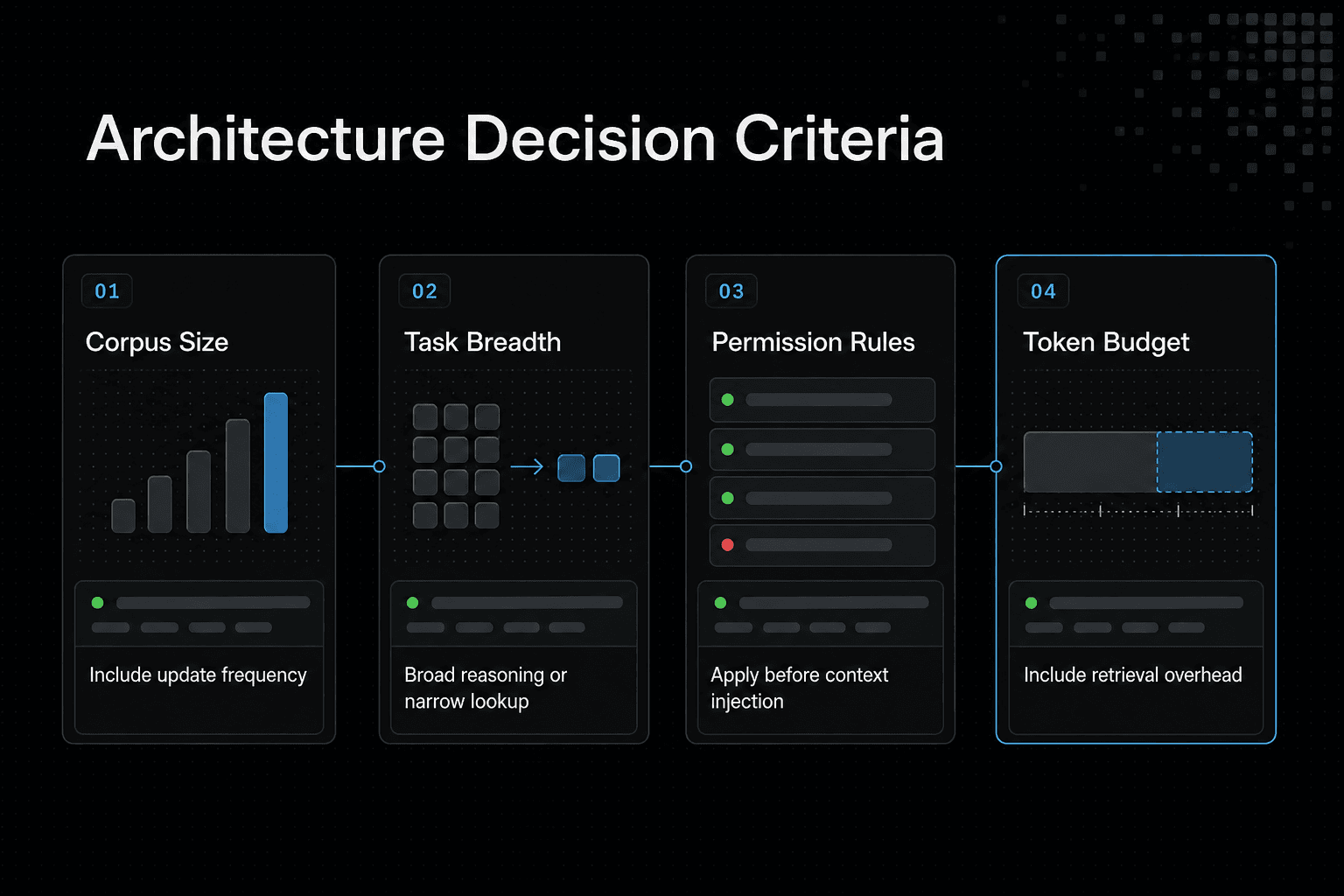
Write down six facts: corpus size, how often it changes, whether tasks need broad reasoning, repeated queries, permission rules, and your token budget. A small stable repository with cross-file tasks points toward direct context. A large knowledge base with narrow questions points toward retrieval.
When RAG is stronger: massive or fast-changing corpora, strict access controls, repeated lookup tasks, and cost-sensitive workloads
RAG is often worth the added machinery when most requests need a few current passages rather than the whole corpus. Apply permissions before context injection, and retrieve only material the user may see.
Cost and performance worksheet: record input tokens, output tokens, retrieval and reranking time, end-to-end latency, and task completion
Run the same representative tasks through each design. Record input and output tokens, retrieval and reranking time, full request latency, and whether the task was completed correctly.
Evaluation criteria: retrieval recall, evidence coverage, grounded-answer quality, code or task success rate, and failure analysis
Check whether retrieval found needed evidence, whether the answer used enough of it, and whether the final task succeeded. Read failures closely. A correct answer with missing evidence may still be unsafe for your workflow.
Persistent work across sessions and tools: treat shared agent knowledge as a separate layer; do not expect a single context window to provide it
Keep durable facts, decisions, and tool state outside the prompt. A context window can carry them for one request, not manage shared knowledge over time.
GigaRAG can connect agents to its central Hive Mind through MCP or the API. Its access controls manage what each agent can use.
The practical rule: match the architecture to the work
A large context window won't provide durable memory, enforce permissions, or ensure the model notices every relevant detail. Retrieval won't simplify work when the job is to reason across a bounded body of material and its relationships.
Start with representative tasks, not a preferred technology
Start with tasks your team actually needs to finish. For repository-wide debugging, a full policy comparison, or a tightly bounded review, direct context is often the cleaner fit. For repeated, narrow lookup across changing material, retrieval is usually the better fit. Use a hybrid when the task needs selected current evidence and broad working context.
Measure results before committing to infrastructure
Measure before you build around either choice. Run the same task set, then compare task success, evidence coverage, input and output tokens, retrieval time, and end-to-end latency. Keep the failures, not just average scores. If one design adds machinery without improving the work your users need done, it isn't worth it.
Frequently Asked Questions
What is the benefit of having a larger context window?
It can let you provide more task material directly, which may suit work that requires reasoning across a bounded body of content. Assess that benefit alongside token use, latency, and answer quality.
When does a bigger context window beat retrieval?
Consider direct context when the task needs broad reasoning across a bounded set of material and supplying that material directly is practical. Compare it with retrieval on the same task rather than assuming it will perform better.
What is the difference between a context window and agent memory?
A context window is not the same layer as persistent agent memory. Treat memory as a separate design question, including what persists between tasks and what access controls apply.
How big is a 1M-token context window in practical terms?
A token count alone does not specify how much of a particular corpus will fit. It depends on the material being supplied. Estimate with the actual content and task prompt rather than assuming a fixed document count.
What happens when an LLM reaches its context window limit?
The task must be adapted to fit the available context, for example by changing what material is supplied or using retrieval. A larger window alone does not resolve attention, recall, or reasoning limits.
When is vector RAG better than long-context prompting?
Consider vector RAG when selecting material from a larger or changing corpus is central to the task. Evaluate retrieval overhead, access controls, latency, and whether selection preserves the material needed to answer.
Does a larger context window guarantee better recall or reasoning?
No. A larger window does not guarantee attention, recall, or reasoning quality. Assess those outcomes on the task and material you intend to use.
How should teams compare the cost and latency of RAG versus long-context prompting?
Compare both approaches on the same task and assumptions, tracking token use and latency. Include retrieval overhead for RAG. The preferable design depends on those results and the task's update and access requirements.
About GigaRAG
GigaRAG is a shared memory platform for AI agents that helps developers and teams keep project knowledge available across sessions and tools. This makes it relevant when your architecture needs persistent project knowledge outside a single context window.
Connect agents to a central Hive Mind through MCP or the API. GigaRAG also includes access controls to manage what each agent can use.


