What Changes at 100K Documents in a RAG System?
What changes at 100k documents in a RAG system isn't a news story or a hard capacity limit for RAG pipeline builders and agent-memory engineers. It's the point where a corpus can turn into far more chunks, embeddings, metadata records, and index updates than your prototype had to manage.
Plain vector similarity search may still be enough. It depends on document length and chunking, query mix, metadata filters, tenant boundaries, and how often content changes or must disappear. At this size, the main catch is operational correctness: duplicate sources, stale indexes, missed deletes, and uneven tenants can damage answers even when search stays fast.
Quick answer
100,000 documents isn't a universal capacity limit for a RAG system. It's a useful point to check how chunking, updates, filtering, and retrieval behave on your own workload.
- Measure chunks and indexed records, not just source documents.
- Check retrieval quality on representative queries.
- Track update and deletion behavior before choosing more complex architecture.
What Changes at 100K Documents in RAG?
[!tip] For an agent-memory or RAG build, keep a small evaluation set of real queries and expected sources so you can compare retrieval changes against the same examples.
Documents, chunks, embeddings, and metadata are different units of scale
A source document isn't usually one searchable item. Your pipeline splits it into chunks, turns each chunk into an embedding (a numeric representation of its meaning), and stores metadata alongside it.
That multiplication is the first change. One hundred thousand short records may produce a manageable number of vectors, while the same number of long manuals, tickets, or transcripts can produce far more. Metadata matters too: tenant IDs, dates, source names, access rules, and document versions all affect what retrieval must search and filter.
Why 100,000 documents is not a universal threshold
100,000 documents isn't a capacity limit. It depends on document length, chunking rules, embedding model, query volume, update rate, and whether one shared corpus serves many tenants.
A plain vector search may still be adequate. If your documents are clean, your chunks are well sized, and retrieval tests show relevant results within your latency needs, adding more layers isn't worth it. However, problems hidden in a small corpus become easier to see when many near-duplicate or loosely related chunks compete for the same query.
The first inventory to create before changing architecture
Start with counts, not assumptions: source documents, chunks, vectors, metadata fields, tenants, duplicate sources, daily updates, and deletes. Then record ingestion time and how long changed or deleted content remains searchable.
Keep a small set of real queries with known good source passages. Without that baseline, you can't tell if a new index, filter, or reranker fixed retrieval or merely changed it.
How should you handle document growth?
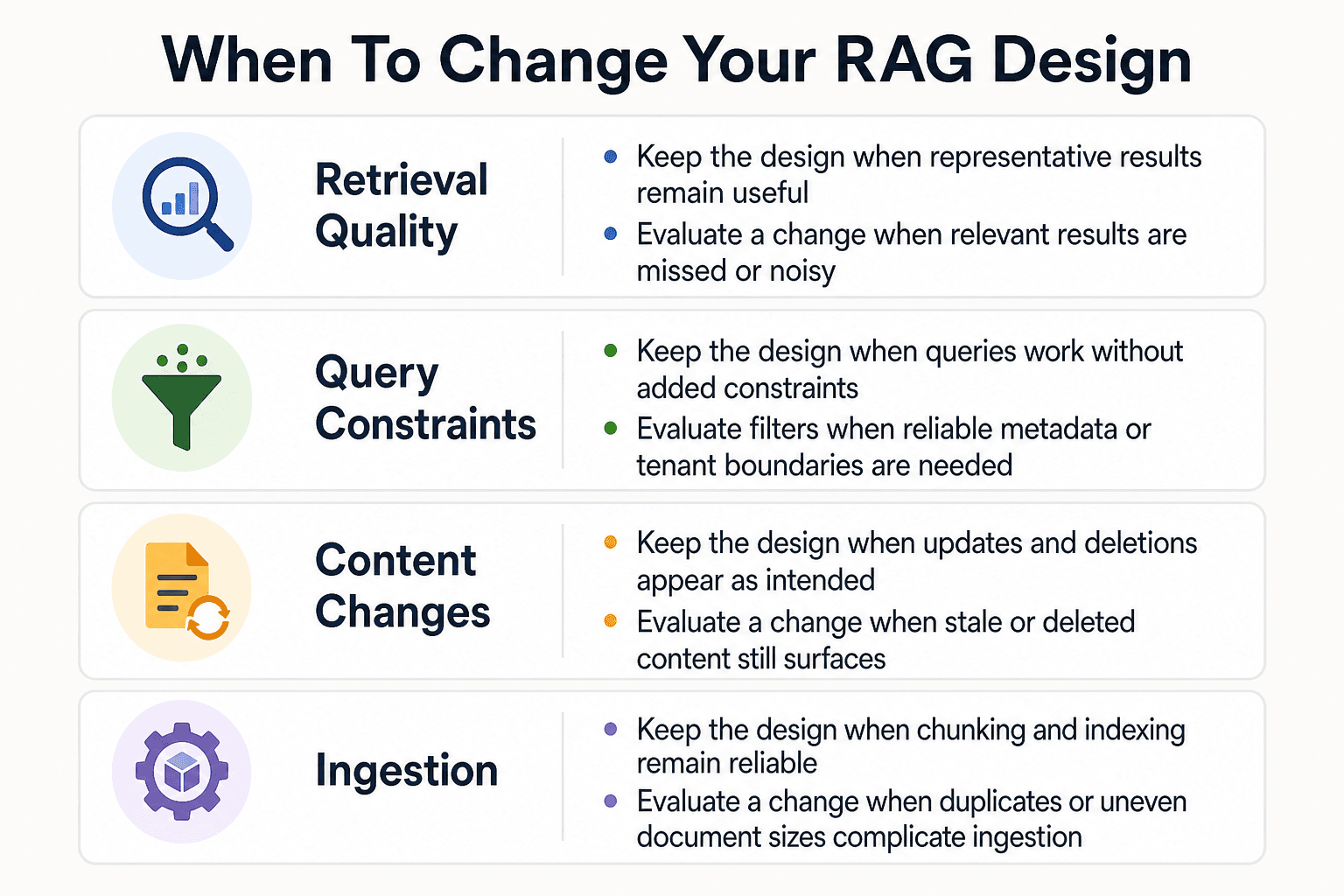
| Factor | Keep the current design | Evaluate a change |
|---|---|---|
| Retrieval quality | Results remain useful on representative queries | Relevant results are missed or noisy |
| Query constraints | Queries work without additional constraints | Users need reliable metadata or tenant filters |
| Content changes | Updates and deletions are reflected as intended | Stale or deleted content continues to surface |
| Ingestion | The current pipeline handles chunking and indexing reliably | Duplicates or uneven document sizes complicate ingestion |
How ingestion, storage, and index updates change
A larger index can't make an unreliable ingest process correct. If a job skips a file, repeats a chunk, or leaves deleted text searchable, fast retrieval only returns the wrong state of your corpus.
From one-off uploads to observable ingestion jobs
Treat each batch as a job with a source ID, version, status, timestamps, chunk count, and error record. Make retries idempotent: running the same input twice should update existing records, not create a second set of vectors.
Consistency matters. Use the same chunking rules and metadata schema across sources, or retrieval results will reflect pipeline differences rather than document relevance.
Duplicate content and uneven document distributions
Deduplicate before embedding where you can. Repeated manuals, copied help pages, and overlapping exports waste storage and can crowd out useful passages in search results.
Check distribution too. One huge source or tenant can produce most of your chunks. A global index may still work, but you need to know which sources dominate before you blame the embedding model.
Stale indexes, deletes, and embedding drift
Updates need a clear path from source change to old-chunk removal, new embedding creation, and index refresh. A delete isn't complete when the source file disappears. It's complete when its chunks, vectors, and searchable metadata no longer return.
Keep embedding versions with each record. When you change models or chunking rules, old and new vectors may behave differently, so plan a controlled reindex rather than mixing them without a way to compare results.
Storage and cost drivers to measure instead of guess
Track chunk count, vector size, metadata storage, embedding work, index build time, update backlog, and delete lag. Also separate full rebuilds from daily changes.
Those numbers show where the cost is.
What changes at 100k documents: A step-by-step guide
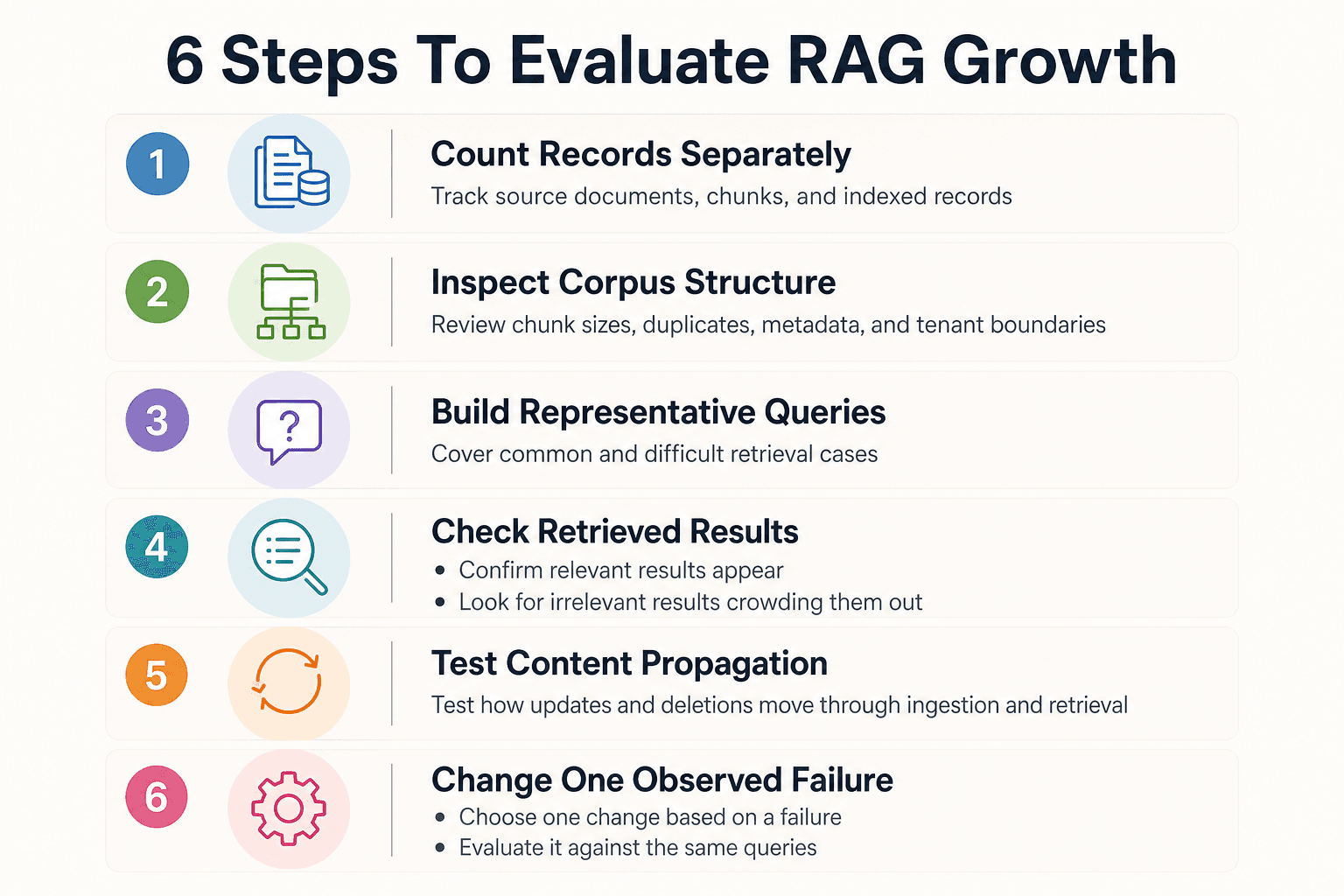
- Count source documents, chunks, and indexed records separately.
- Inspect chunk sizes, duplicate content, metadata, and tenant boundaries.
- Build representative queries that cover common and difficult retrieval cases.
- Check whether relevant results appear and whether irrelevant results crowd them out.
- Test how updates and deletions propagate through ingestion and retrieval.
- Choose one change based on an observed failure, then evaluate it against the same queries.
Retrieval at 100K documents: When vector search is not enough
At 100K documents, vector search can still be enough, but you should stop assuming it is. Add filters, hybrid retrieval, reranking, or a different index layout only when evaluation shows missed relevant passages, noisy top results, unacceptable tail latency, or incorrect tenant and date boundaries.
What gets harder: candidate quality, latency, and filtering
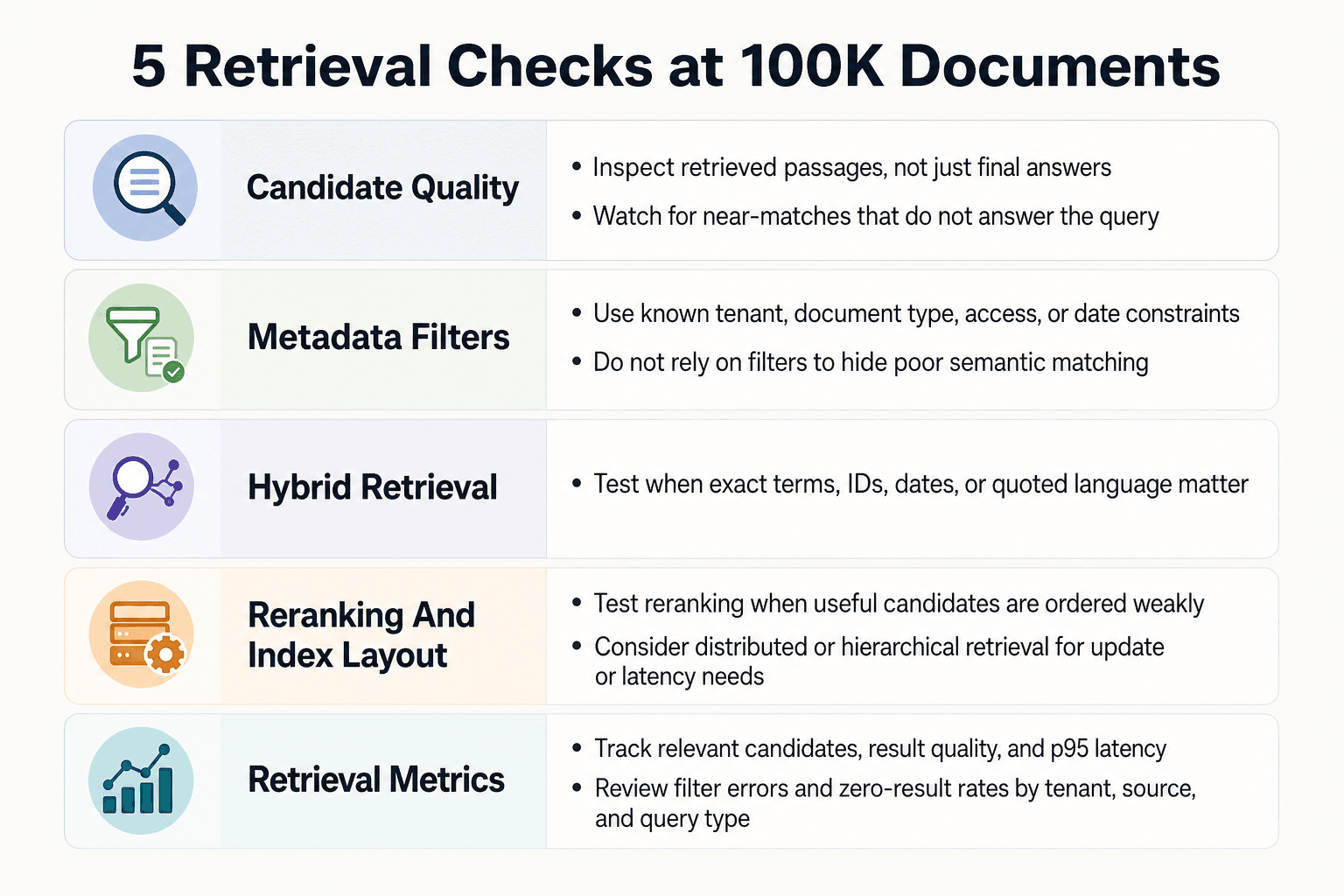
More chunks create more near-matches. Approximate search may return passages that sound related but don't hold the answer, while broad candidate requests can add work before generation. Keep a query set with known relevant chunks, and inspect the retrieved list, not just the final answer.
When metadata filtering helps and when it hides bad retrieval
Filters narrow a permitted set. They don't improve semantic matching. When tenant, document type, access rule, or date is known at query time, filter on it. If filters only make bad results disappear, inspect chunking and queries, because relevant material may never enter the candidate set.
When to test hybrid search and reranking
Test hybrid retrieval when exact terms matter: product names, error codes, IDs, dates, or quoted policy language can be poorly served by semantic similarity alone. Test reranking when initial retrieval finds useful candidates but puts weak ones first.
Don't add both by default.
When distributed indexing or hierarchical retrieval becomes useful
Distributed indexing becomes useful when one index can't meet your update or latency needs. Hierarchical retrieval can help when your corpus has natural partitions, such as tenants, repositories, or document families, and you can route a query before searching passages.
Metrics: recall-oriented evaluation, relevance quality, p95 latency, filter behavior, and zero-result rates
Track whether relevant chunks appear in retrieved candidates, then judge the quality and order of the top results. Measure p95 latency, filter errors, and zero-result rates separately by tenant, source, and query type, so a healthy average doesn't hide a failing part of your corpus.
Failure modes and architecture choices at larger corpus scale
At this point, retrieval errors become product errors. A vector database can search vectors, but it can't decide which content is current, permitted, or worth trusting.
[!note] A count of 100,000 source documents does not specify how many chunks or indexed records the system contains. That depends on the corpus and its processing choices.
Scenario: a broad corpus creates plausible but noisy answers
Before, a query finds one obvious guide. After, it retrieves several near-duplicate passages from different teams, and the model blends them into a plausible answer with no clear source of truth.
Deduplicate during ingestion, retain source and version metadata, and evaluate retrieval against queries that expose conflicting guidance. More candidates aren't always better.
Scenario: one tenant or source dominates retrieval results
A large tenant or heavily indexed repository can fill the candidate list simply because it has more similar chunks. This is a data distribution problem, not proof that its content is more relevant.
Apply tenant boundaries before retrieval when isolation is required. If sources need fair representation, inspect results by source rather than assuming global similarity will balance them.
Scenario: deleted or changed content remains retrievable
A document is removed from the source system, but its chunks stay in the index. Users can then receive revoked policy text or an old product instruction.
Make deletes and updates first-class ingestion events. Keep a stable document ID on every chunk so you can find, replace, and verify affected vectors.
Scenario: a new embedding model changes retrieval behavior
A new embedding model may improve some queries while moving previously useful chunks farther away. Mixed embedding versions in one index make scores hard to interpret.
Version embeddings and re-evaluate before switching. In practice, re-embed into a separate index, compare results, then cut over when the new retrieval behavior is acceptable.
What not to expect from a vector database alone
It won't handle source ownership, access rules, duplicate policy, freshness checks, or evaluation design for you. Those choices belong in your ingestion and retrieval architecture.
A practical next-step plan for 100K-document RAG
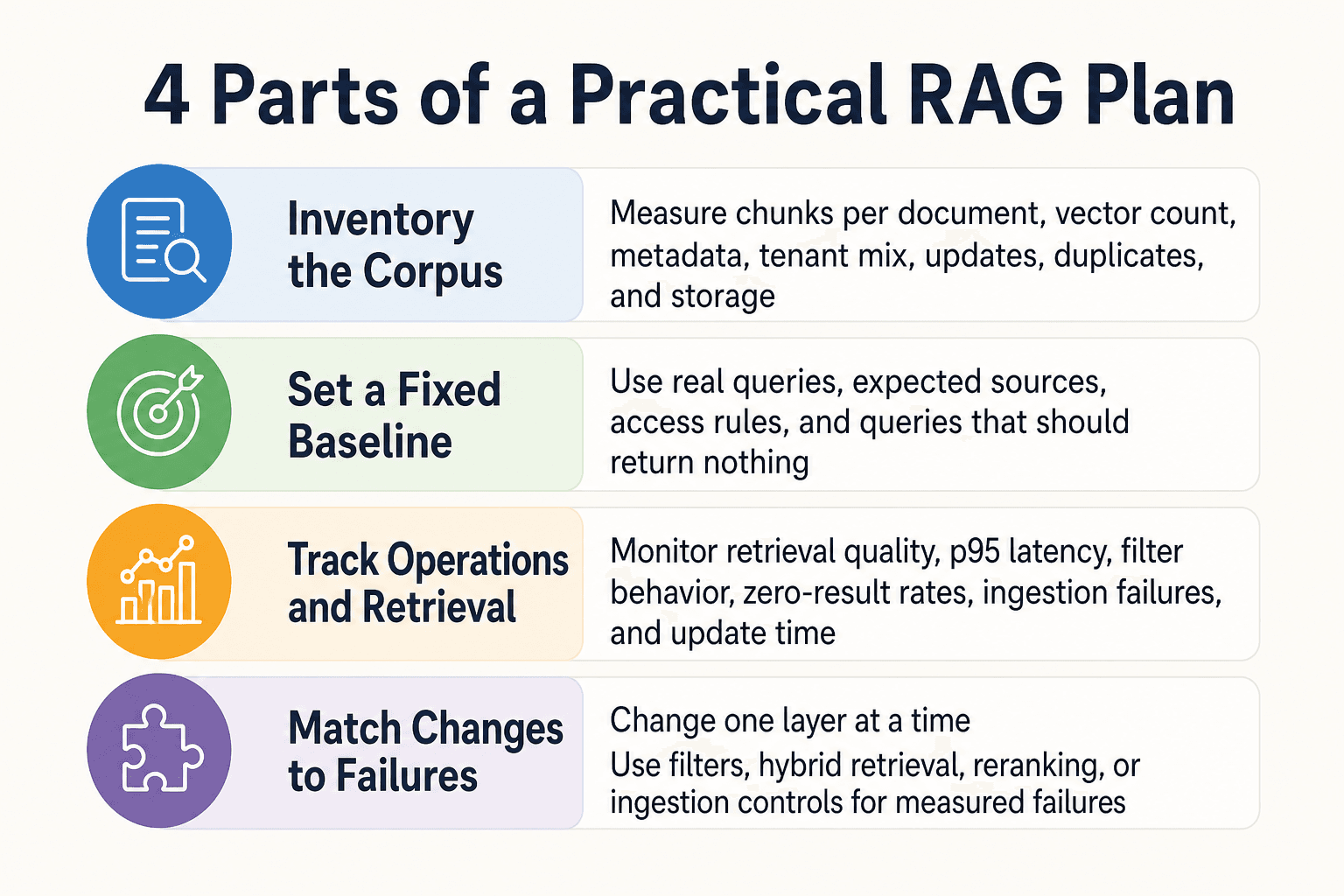
Measure first, then change one retrieval layer at a time
Start with a corpus inventory: chunks per document, vector count, metadata fields, tenant mix, update rate, duplicate rate, and current storage use. Then build a fixed evaluation set of real queries, expected sources, access rules, and queries that should return nothing.
Keep the baseline. Track retrieval quality, p95 latency, filter behavior, zero-result rates, ingestion failures, and time from a source change to an updated index.
Change one layer at a time: chunking, filters, hybrid retrieval, or reranking. If you change all four, you won't know what fixed the problem or what raised cost.
Choose complexity based on failure mode rather than document count alone
Plain vector search can remain adequate when evaluation shows relevant, permitted, current chunks arrive reliably. Don't add distributed indexes or hierarchical retrieval because the corpus crossed a round number.
Add components when a measured failure calls for them. Use filters for access boundaries, hybrid retrieval for exact terms, reranking for weak candidate order, and stronger ingestion controls for stale content. That's what changes at 100k documents: operations and proof matter more than a larger index.
Frequently asked questions
Is 100,000 documents a lot for a RAG system?
There is no universal document-count threshold that determines capacity. Assess the chunks created, the workload, and whether retrieval and operations meet your requirements.
How many vectors can 100,000 documents create?
The document count alone does not determine the vector count. Chunking and indexing choices affect how many records are created, so measure that output in your own ingestion pipeline.
When should a RAG system use hybrid search instead of vector search alone?
Evaluate hybrid search when your test queries show that vector search alone misses relevant results, especially for your corpus's query patterns. Compare both approaches on the same representative queries before changing the design.
Do metadata filters make RAG retrieval more accurate?
Filters can help apply explicit constraints, such as tenant or document attributes, when those constraints are correctly represented in metadata. Test filtered retrieval to confirm it returns the intended sources without excluding relevant ones.
How do you keep a RAG index current after documents change or are deleted?
Define how the ingestion pipeline handles changed and deleted sources, then test that behavior end to end. Verify that updated content can be retrieved and removed content no longer appears.
What causes noisy retrieval results in a large RAG corpus?
Noise can come from duplicate content, uneven chunks, or weak query-to-source matches. Inspect retrieved examples and identify the failure mode before selecting a remedy.
About GigaRAG
GigaRAG helps you share agent memory like you share Google Docs. It connects your AI agents to a central Hive Mind, with access controls for what each agent can use. Developers, vibe coders, and teams can keep project knowledge available across sessions and tools, so agents can pick up where work left off without rebuilding context or managing a full RAG stack.


