Chunking Explained Without the Jargon
Chunking explained without the jargon is what you came for, but here's the frustration every RAG and agent memory builder hits first: the guides all say "just chunk your documents," then immediately start talking about embeddings, tokens, and vector spaces as if you already live there. You don't. And you shouldn't need to.
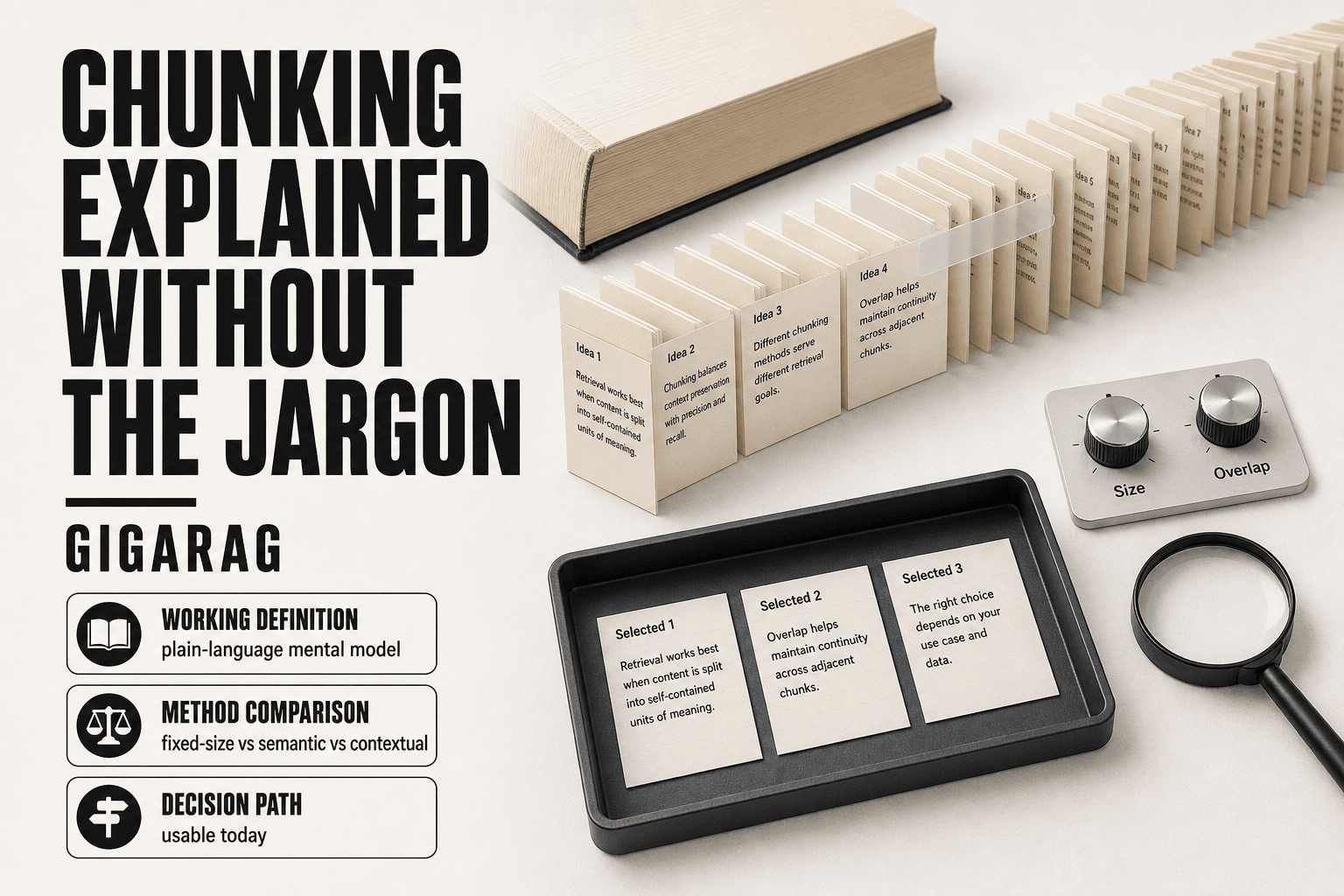
So start with the plain version. Chunking is cutting a long document into smaller pieces, like slicing a book into index cards, so a system can find and use just the relevant cards instead of the whole book every time. That's it. No magic.
Most guides stop there or bury you in vendor pitch. This one doesn't. I'll walk through the methods that actually matter, be honest about what chunking can't do, and answer the questions you're too far in to ask. Tools like GigaRAG can handle the tuning for you, but you still need the mental model first. Here's what you'll get: a working definition, a comparison of chunking methods, the two knobs you actually control, and a decision path you can use today.
| At a glance | Details |
|---|---|
| What it is | Splitting documents into smaller pieces for retrieval |
| Why it matters | Retrieval quality depends on chunk size and boundaries |
| Common methods | Fixed-size, recursive, semantic, document-aware |
| Typical chunk size | Often a few hundred tokens; tune per use case |
| Key trade-off | Small chunks improve precision, lose context |
| Agent memory angle | Chunking shapes what an agent can recall |
In This Guide
- What Is Chunking, Really?
- Fixed-Size Chunking vs Semantic Chunking: Which Should You Use?
- Why Chunking Matters for RAG and Agent Memory
- Chunking Explained Without The Jargon: A Step-by-Step Guide
- Chunking Methods You'll Actually Encounter
- Chunk Size and Overlap: The Two Knobs You Actually Control
- Choosing a Chunking Strategy Without Losing Your Mind
- What Chunking Cannot Do (And What You Shouldn't Expect)
- Chunking for Agent Memory: What's Different
- Common Mistakes When Chunking for RAG
- Putting It Together: A Simple Chunking Workflow
- Final Thoughts on Chunking Without the Jargon
What Is Chunking, Really?
Chunking is cutting a long document into smaller, self-contained pieces so a retrieval system can find the right piece when a question comes in. It's a preprocessing step, not a thinking step. You do it once, before any queries arrive.
The index card analogy
Take a 400-page book. You want to answer questions about it without rereading the whole thing every time. So you cut it into index cards. Each card holds one idea, one scene, one recipe, one definition. You file the cards in a cabinet.
When someone asks "what's the recipe for sourdough starter?", you don't open the book. You pull the card that holds that recipe. That's chunking. The book is your document. The cards are your chunks. The cabinet is your retrieval system.
The catch: where you cut matters. Cut mid-recipe and you'll pull a card that's missing the second half. Cut too coarsely and each card holds five unrelated ideas, so you can't find any of them precisely. Cut too finely and you'll need fifty cards to answer one question.
Chunking vs. tokenization in plain terms
Tokenization is a different step that happens either before or after chunking, depending on your pipeline. A token is roughly a word or a piece of a word. Tokenization splits text into those pieces so a model can process it.
Chunking splits text into meaningful units. Tokenization splits text into model-readable units. You can chunk a paragraph into sentences, then tokenize each sentence into tokens. Or you can tokenize the whole document, then chunk the token stream. The order depends on your tools.
Here's the practical difference: you choose chunk boundaries based on meaning. You don't choose token boundaries at all. The tokenizer does that for you, mechanically.
Why "chunk" and not "section" or "paragraph"?
Because chunking doesn't respect document structure by default. A section is whatever the author decided. A paragraph is whatever the author decided. A chunk is whatever you decided.
That's the point. You're not preserving the author's organization. You're building a retrieval unit that fits your embedding model, your context window, and your query patterns. Sometimes that lines up with paragraphs. Often it doesn't.
Calling it a "chunk" signals that you're making a deliberate cut, not inheriting one.
[!note] Chunking does not make a model smarter or add knowledge; it only changes how existing text is packaged for retrieval. It can also lose context that spans chunk boundaries and adds preprocessing overhead you must maintain.
Fixed-Size Chunking vs Semantic Chunking: Which Should You Use?
| Factor | Fixed-Size Chunking | Semantic Chunking |
|---|---|---|
| How it splits | By a set token or character count | By meaning shifts between sentences |
| Setup effort | Low: pick a size and overlap | Higher: needs a model or heuristic |
| Retrieval precision | Can cut mid-idea, hurting precision | Usually keeps ideas intact |
| Speed and cost | Fast and cheap | Slower, may add compute cost |
| Best for | Quick prototypes, uniform text | Dense docs where meaning matters |
Why Chunking Matters for RAG and Agent Memory
Chunking exists because retrieval systems fail on whole documents. Not slowly. Completely. Feed a 50-page PDF to an embedding model and you get a vector that represents everything and nothing. Ask a specific question and the match is mush.
The context window problem
Every LLM has a hard limit on how much text it can hold at once. That limit is the context window. A 400-page book doesn't fit. A 10-page contract might not fit either, once you add your prompt, your instructions, and the model's response.
Chunking solves this by letting you retrieve only the pieces that matter. You don't load the whole book. You load three index cards. The model sees relevant text, not a wall of it.
Why smaller pieces retrieve better
Embedding models convert text into vectors. A vector for a focused chunk points at one idea. A vector for a whole document points at the average of every idea in it. The average of fifty ideas matches no query well.
Smaller chunks also mean tighter matches. When a user asks about a specific error message, a chunk containing that error message and its fix will rank higher than a chunk containing the error message, three unrelated paragraphs, and a changelog. Retrieval precision depends on chunk quality. Garbage chunks, garbage retrieval.
What changes when you're building agent memory
Agent memory isn't one-shot retrieval. An agent reads, writes, and revisits chunks across a session. That changes the math.
Chunks need to be stable over time. If you re-chunk your documents every session, the agent can't reliably point back to "that thing I read earlier." The chunk it read is gone, replaced by a slightly different cut. Stability matters more than optimality.
Agents also retrieve repeatedly, not once. A chunk that's slightly too large costs you on every retrieval, not just the first one. The overhead compounds.
[!tip] For agent memory, chunk by event or turn rather than by token count, so each memory unit stays self-contained and retrievable without needing its neighbors.
Chunking Explained Without The Jargon: A Step-by-Step Guide
- List what your system must retrieve: facts, procedures, or conversational memory.
- Inspect your source documents for natural boundaries like headings, paragraphs, or turns.
- Start with a simple fixed-size split and a small overlap as a baseline.
- Test retrieval on real questions and note where answers get cut off or mixed.
- Try a semantic or document-aware split if precision is still poor.
- Tune chunk size and overlap against your own evaluation set, not generic advice.
- Document the choice and revisit it when your data or queries change.
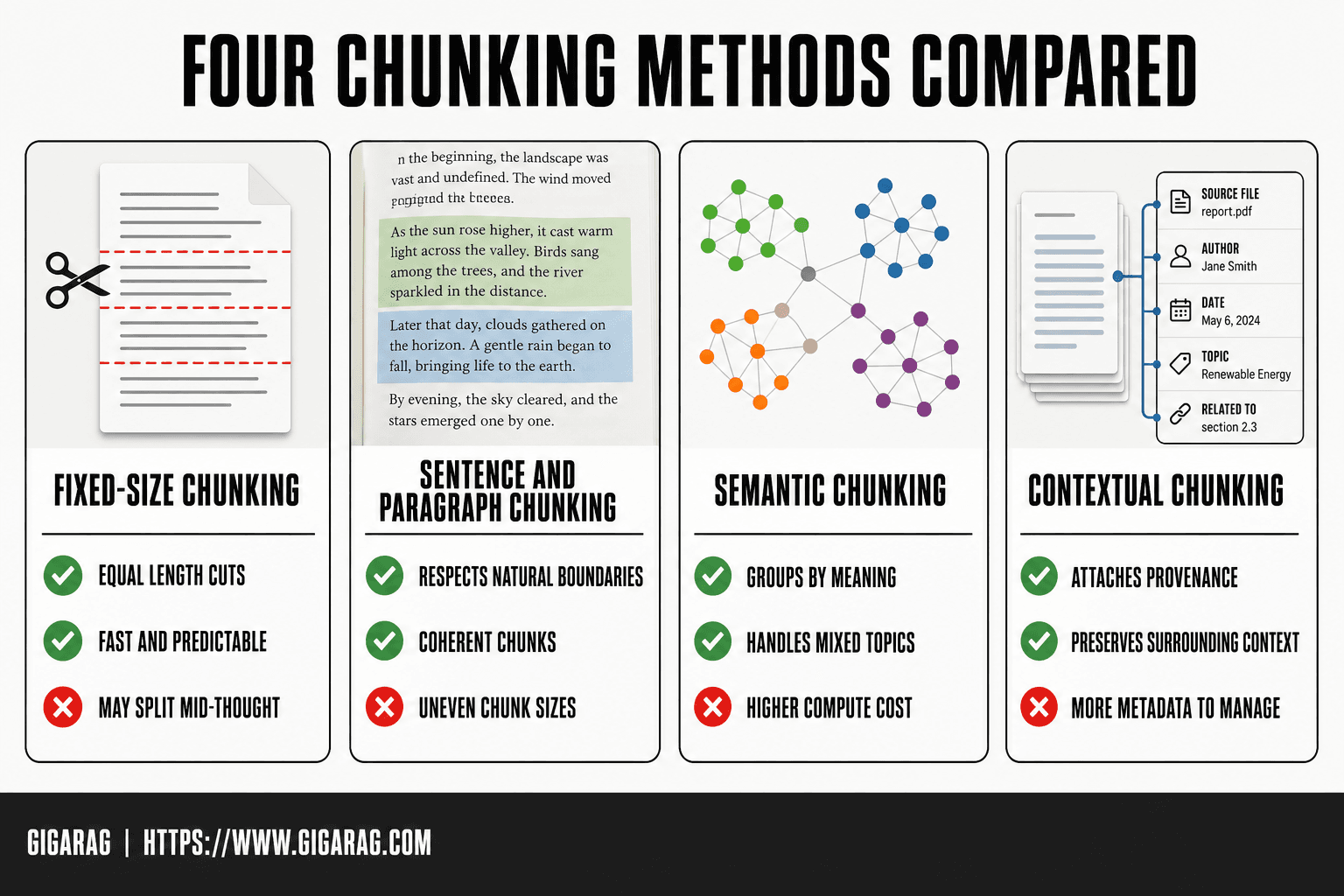
Chunking Methods You'll Actually Encounter
Four methods cover most of what you'll see in the wild. Each has a different idea about where one chunk ends and the next begins. None is universally right.
Fixed-size chunking: the pizza slicer
Fixed-size chunking cuts text into pieces of equal length, usually measured in characters or tokens. You set the size, the slicer cuts. It doesn't care where sentences start or end. A chunk might stop mid-word.
Think of it as slicing a pizza into equal slices regardless of where the toppings fall. One slice gets all the pepperoni. Another gets mostly crust. The slices are even, but the distribution isn't.
It's useful when you need speed and predictability. If your documents are uniform, like logs or product listings, fixed-size works fine. If your documents are prose with real structure, it creates problems: chunks that start mid-sentence and end mid-thought. You can add overlap to soften this, but overlap is a bandage, not a fix.
Sentence and paragraph chunking: respecting natural boundaries
This method cuts at sentence or paragraph boundaries. The chunker reads until it hits a period or a paragraph break, then starts a new chunk. Chunks vary in size, but they stay coherent.
The analogy here is cutting a book along chapter and section lines rather than measuring pages. You respect the author's structure instead of imposing your own.
It's useful for anything written in natural language: documentation, articles, contracts, emails. The chunks read like complete thoughts, which helps both embedding quality and the human reviewing retrieval results. The trade-off is uneven chunk sizes. A long paragraph becomes a long chunk. A page of short dialogue becomes many tiny ones.
Semantic chunking: grouping by meaning
Semantic chunking groups sentences based on what they mean, not where they fall. The chunker compares each sentence to the ones around it. When the meaning shifts enough, it starts a new chunk.
Imagine sorting index cards by topic rather than by the order they came out of the book. Two sentences from different paragraphs might end up in the same chunk because they're about the same thing.
It's useful when your documents mix topics freely: meeting notes, forum threads, research papers. The main catch is cost. Semantic chunking requires an embedding model to judge meaning, which means more compute and more latency. It's also less predictable. You can't set a chunk size and know what you'll get.
Contextual chunking: keeping related context together
Contextual chunking goes one step further. It doesn't just group by meaning. It attaches context to each chunk: where it came from, what section it belongs to, what document it's part of. The chunk carries its provenance with it.
Think of a filing cabinet where every card has a header saying which drawer it came from and which folder sits next to it. The card is small, but it knows its place.
It's useful when retrieval needs to reconstruct surrounding context. A chunk that says "the second option is cheaper" is useless without knowing what the options are. Contextual chunking preserves that link. The cost is more preprocessing and more metadata to manage. You're building a richer index, and that takes time.
Chunk Size and Overlap: The Two Knobs You Actually Control
Chunk size is how much text goes into one chunk. Overlap is how much of the previous chunk repeats at the start of the next. Those are the only two knobs most chunkers give you. Everything else is method choice.
What chunk size actually changes
Smaller chunks retrieve more precisely. A 100-token chunk answering a specific question gives the LLM less noise. But it also gives less context. A chunk that says "the second option is cheaper" is useless alone.
Larger chunks carry more context but dilute the signal. The embedding represents an average of everything in the chunk. A 1,000-token chunk about five topics embeds as a blur of all five. When a query matches one topic, the other four drag the similarity score down.
The honest answer: chunk size is a trade between precision and context. You can't have both at the same setting.
What overlap actually changes
Overlap exists because fixed-size and sentence chunkers cut mid-thought. If a chunk ends at "the second option is" and the next starts at "cheaper," neither chunk is useful alone. Overlap repeats the tail of one chunk at the head of the next, so the boundary thought survives somewhere.
More overlap means fewer broken thoughts. It also means more redundancy. Your index stores the same text twice, sometimes three times. Retrieval may return near-duplicate chunks, which wastes context window and confuses the LLM.
Overlap of 10-15% of chunk size is a reasonable starting point. Zero overlap works when your chunks respect natural boundaries.
Starting points for RAG vs. agent memory
For RAG, start with 200-500 tokens per chunk and 10-15% overlap. Test retrieval quality before adjusting. Most embedding models handle this range well.
For agent memory, go smaller: 100-300 tokens. Agents retrieve repeatedly and need precise, stable chunks. Overlap matters less if you chunk at sentence boundaries. What matters more is chunk stability over time, which the next section covers.
Choosing a Chunking Strategy Without Losing Your Mind
You don't need to test every method. You need to answer three questions about your data, three about your queries, and then follow a path. That's it.
Questions to ask about your documents
Start with what your documents actually look like. Not what you wish they looked like.
Are they structured or freeform? HTML pages, Markdown files, and docs with headings give you natural boundaries. Use them. Sentence or paragraph chunking respects those boundaries for free. If your documents are transcripts or scraped text with no structure, fixed-size chunking with overlap is your fallback.
How long are they? A 500-word support article chunks differently than a 200-page manual. Short documents may need no chunking at all. Long documents need a method that keeps sections intact.
Do they mix topics? A single page covering pricing, setup, and troubleshooting will produce muddy embeddings if you chunk it blindly. Semantic chunking helps here, but it costs more compute. If your documents are mostly single-topic, skip it.
Questions to ask about your queries
Your chunks only matter in relation to what people ask.
Are queries specific or broad? "How do I reset my password" wants a small, precise chunk. "Explain the billing system" wants a larger chunk with surrounding context. If your users ask both, you need a method that handles both, or you accept a trade-off.
Do queries need cross-chunk context? If answering a question requires pulling facts from three different sections of a document, small chunks will fail. You'll need larger chunks or a retrieval step that pulls multiple chunks and stitches them.
What's your latency budget? Semantic chunking adds preprocessing time. If you're indexing millions of documents nightly, that cost matters. Fixed-size chunking is fast. Sentence chunking is nearly as fast. Semantic chunking is slower and costs more per document.
A simple decision path
Here's the path I'd follow.
If your documents have clear structure, use sentence or paragraph chunking. It's cheap, it respects boundaries, and it works for most RAG use cases.
If your documents are unstructured, use fixed-size chunking with 10-15% overlap. Start at 300 tokens. Test.
If your queries need meaning-based grouping and you can afford the compute, add semantic chunking. Don't start there. Start simple, measure retrieval quality, then add complexity only if the simple approach fails.
If you're building agent memory, go smaller and prioritize stability. Sentence-level chunks, 100-300 tokens, chunked at natural boundaries. Agents retrieve repeatedly, so consistency matters more than raw precision.
The main catch: no method survives contact with real queries. Pick a starting point, run ten real queries, and look at what comes back. If the wrong chunks keep showing up, change one knob at a time. Don't change method, size, and overlap all at once. You won't know which one fixed it.
What Chunking Cannot Do (And What You Shouldn't Expect)
Chunking is a preprocessing step. It cuts text into pieces so retrieval has something to grab. That's the whole job. It doesn't understand your documents, and it doesn't make your retrieval smarter on its own.
Chunking doesn't make your data smarter
If your source text is vague, contradictory, or badly written, chunking preserves that. A chunk is just a slice of the original. Cutting a confusing paragraph into three pieces gives you three confusing pieces.
The embedding model does the understanding, not the chunker. Chunking only decides where the boundaries fall. If the underlying text doesn't contain the answer, no chunking strategy will conjure it. You can't fix bad data by slicing it differently.
Context loss at chunk boundaries
Every chunk boundary is a place where meaning can break. A sentence that says "This approach works well" is useless if the chunk before it named the approach. The reader's LLM sees only the chunk you retrieved, not the chunk before it.
Overlap helps, but it's a patch, not a fix. Overlap repeats a few tokens across boundaries. It doesn't reconstruct the full argument. If your answer depends on facts spread across three chunks, retrieval has to pull all three and stitch them. Chunking alone won't do that.
Chunks that are too small lose context. Chunks that are too large bury the relevant sentence in noise. Both fail in different ways.
The overhead cost
Chunking takes time and compute before any query ever runs. You're preprocessing every document, generating embeddings for every chunk, and storing all of it. For a small knowledge base, that's trivial. For millions of documents re-indexed nightly, it's a real line item.
Semantic chunking costs the most. It runs an extra model pass over your text to find meaning-based boundaries. Fixed-size chunking costs the least. The trade-off is real: better boundaries, higher preprocessing bill.
The honest answer is that chunking is a necessary cost, not a feature. It exists because context windows and embedding models have limits. It doesn't add intelligence, it doesn't preserve cross-chunk context automatically, and it isn't free. Expect it to do one thing: make your text retrievable in pieces. Anything beyond that is the rest of your pipeline's job.
Chunking for Agent Memory: What's Different
Agent memory isn't a one-shot lookup. A RAG pipeline retrieves chunks, answers a question, and forgets. An agent keeps state across turns, revisits earlier chunks, and updates what it knows. That changes what you need from chunking.
Why agent memory isn't just RAG with extra steps
In RAG, each query is independent. You retrieve the best chunks, generate an answer, done. The chunks don't need to persist beyond that exchange.
Agent memory is different. The agent accumulates context over a session or across sessions. It may retrieve the same chunk ten times. It may need to update a fact it learned earlier. It may need to reason across chunks retrieved at different points in a conversation.
That means chunk boundaries matter more. If a chunk shifts between retrievals, the agent's memory becomes inconsistent. If a chunk is too large, the agent wastes context window on irrelevant text every time it revisits. If it's too small, the agent loses the surrounding context that made the chunk useful in the first place.
Chunk stability and update patterns
The main catch: agent memory needs stable chunks. In one-shot RAG, you can re-chunk your documents whenever you want. The retrieval is stateless. In agent memory, re-chunking changes what the agent retrieves next turn. That can break reasoning chains.
So you need a chunking strategy that survives updates. If a document changes, you want to update only the affected chunks, not re-chunk everything. Fixed-size chunking makes this hard: inserting one sentence shifts every boundary after it. Structure-aware chunking (by section, by paragraph) keeps boundaries stable when content changes locally.
You also need to think about what happens when the agent writes to its own memory. If the agent stores notes, summaries, or decisions, those need chunking too. And they change more often than source documents.
What to prioritize when chunks live long-term
Three things matter more for agent memory than for RAG:
Stability over optimality. A slightly worse chunk boundary that stays put beats a perfect boundary that shifts every re-index.
Update granularity. Can you update one chunk without touching its neighbors? If not, every small change becomes a full re-chunk.
Retrieval repeatability. The agent will retrieve the same chunk many times. It should get the same content back every time, unless the underlying source actually changed.
The honest answer is that agent memory chunking is a maintenance problem, not just a retrieval problem. You're not just cutting text. You're deciding how your agent's long-term memory gets stored, updated, and revisited.
Common Mistakes When Chunking for RAG
Most chunking problems aren't exotic. They're the same five mistakes repeated across projects, usually because the builder copied a default setting and never looked back.
Treating every document the same
A support ticket, a legal contract, and a product manual need different chunking. The ticket is short and self-contained. The contract has clauses that only make sense together. The manual has a strict hierarchy of sections and subsections.
If you run all three through the same fixed-size splitter, you get chunks that cut contracts mid-clause and manuals mid-step. The retrieval still works sometimes, which is the trap. It works just often enough that you don't notice the failures.
The fix: group your documents by type before chunking. Apply the method that matches the structure. It's more setup work, but it's setup you do once.
Ignoring natural boundaries
Fixed-size chunking doesn't care where a paragraph ends or a sentence stops. It cuts at the token count, full stop. That means a chunk can start with the tail of one idea and end with the head of another.
Embedding models handle this worse than you'd expect. A chunk that mixes two unrelated topics gets an embedding that represents neither well. When a query matches one of those topics, the chunk ranks lower than it should.
The fix is simple: use sentence or paragraph boundaries when you split. Most chunking libraries have a recursive splitter that tries to cut at natural breakpoints first. Use it. If you must use fixed-size, add overlap so at least some context survives the cut.
Skipping retrieval testing
This is the most common mistake, and the most expensive. Builders pick a chunk size, ship the pipeline, and never check whether retrieval actually returns the right chunks for real queries.
You can't know if your chunking works by looking at the chunks. You have to run queries and inspect what comes back. When a query returns the wrong chunk, look at why. Is the chunk too large? Too small? Did the split cut the answer in half?
The fix: build a small test set of queries with known-good answers. Run them after every chunking change. It's twenty minutes of work that catches problems a code review never will.
Chunking mistakes compound quietly. The pipeline doesn't crash. It just returns slightly wrong results, and your users blame the model when the chunking was the problem all along.
Putting It Together: A Simple Chunking Workflow
You don't need to solve chunking in one sitting. You need a starting point, a way to test it, and a loop that tightens things up. Here's the workflow I use.
Step 1: Look at your documents
Open ten of them. Not a sample of one. Ten gives you enough variety to see the patterns.
Ask three questions. How long are they on average? Do they have structure you can see, like headings or sections? Do ideas span multiple paragraphs, or does each paragraph stand alone?
The answers tell you which method to try first. Short, self-contained documents work fine with fixed-size chunking. Long documents with clear headings want sentence or paragraph splitting. Documents where meaning crosses paragraph boundaries need semantic chunking or at least generous overlap.
Don't skip this step. It's fifteen minutes, and it prevents the most common mistake from the last section: treating everything the same.
Step 2: Pick a starting method
Start simple. Fixed-size or sentence-based splitting is the default, not because it's best, but because it's predictable. You can reason about what it's doing.
Set an initial chunk size based on what you found in step 1. For RAG on general text, 256 to 512 tokens is a sane starting range. For agent memory, lean smaller, around 128 to 256, since you'll be retrieving more frequently and want tighter matches.
Set overlap at 10 to 15 percent of chunk size. That's enough to keep context from dying at the boundary without bloating your index.
Step 3: Test and adjust
Build a test set of ten to twenty queries with answers you know are in your documents. Run them through retrieval. Look at what comes back.
When a query misses, inspect the chunk. Too large? The answer is buried. Too small? The context got split. Wrong boundary? The split cut the answer in half.
Adjust one knob at a time. Change chunk size, rerun the tests, compare. Then change overlap, rerun, compare. One variable per iteration, or you won't know what fixed it.
This loop is manual and a little tedious. That's the honest trade-off for control. If you'd rather skip the tuning, GigaRAG handles chunk size and method selection automatically based on your document structure. But if you're doing it by hand, this three-step loop gets you to a working setup in an afternoon.
Final Thoughts on Chunking Without the Jargon
Here's what I want you to take away.
Chunking is cutting text into pieces your system can handle. That's it. The index card analogy holds: you're slicing a book into cards so you can find the right card later. Everything else, fixed-size, semantic, contextual, overlap, is just a different way of deciding where the cuts go.
The honest answer is that chunking is a trade-off, not a solved problem. Smaller chunks retrieve more precisely but lose context. Larger chunks keep context but bury the answer. Overlap helps at the boundaries but adds storage and processing cost. There's no setting that works for every document, every query, and every use case. You pick based on your data and your retrieval needs, then you test.
Chunking also won't make your data smarter. It doesn't understand your documents. It doesn't add meaning. It just splits text. If your source material is messy or ambiguous, chunking won't fix that. It will faithfully split the mess into smaller messes.
The good news is you don't need to overthink it. Start with sentence-based splitting at 256 to 512 tokens for RAG, 128 to 256 for agent memory, overlap at 10 to 15 percent. Run ten to twenty test queries. Adjust one knob at a time. That loop gets you to a working setup faster than reading another vendor whitepaper.
If you'd rather not tune knobs at all, GigaRAG automates chunk size and method selection based on your document structure. You focus on your product. The plumbing handles itself.
Chunking explained without the jargon comes down to this: cut your text into usable pieces, test whether retrieval works, and adjust. It's a practical trade-off, not a mystery.
Frequently Asked Questions
Can you explain chunking in a simple way?
Chunking is cutting a long document into smaller pieces so a computer can find and use the right part later. Think of tearing a book into index cards, each holding one idea. When a question comes in, the system grabs the most relevant cards instead of the whole book.
Can you give me an example of chunking techniques?
Common techniques include fixed-size splitting by token count, recursive splitting that respects paragraphs and sentences, semantic splitting that detects meaning shifts, and document-aware splitting that follows headings or sections. Each trades simplicity for how well it preserves meaning.
Is chunking a mnemonic?
In psychology, chunking is a memory technique where you group items to remember more, like turning a phone number into groups of digits. In RAG and agent memory, the word means splitting text for retrieval. Same idea of grouping, different purpose.
Can you give me an example of chunking words?
If a paragraph says 'The cat sat on the mat. It was sunny.', a chunker might split it into 'The cat sat on the mat.' and 'It was sunny.' Each chunk is a self-contained unit. Poor splits, like cutting mid-sentence, can confuse retrieval.
What chunk size should I use for RAG?
There is no universal number; many teams start around a few hundred tokens with a small overlap and then tune. The right size depends on your documents, your questions, and how your retriever works. Always test on your own data.
Does chunking work the same for agent memory?
Not exactly. Agent memory often benefits from chunking by event, turn, or task rather than by token count, because each memory needs to stand alone when recalled. RAG chunking usually focuses on document sections and retrieval precision.
What can chunking not do?
Chunking cannot add knowledge, fix bad source text, or guarantee that related ideas stay together. It also cannot replace good retrieval or evaluation. It is a packaging step, not a solution to every RAG problem.
About GigaRAG
GigaRAG helps GigaRAG is for agent memory and RAG pipeline builders. get this right. Whether you are working through chunking explained without the jargon or something adjacent, we publish what we have actually tested, including where it falls short.