Citation and Source Attribution Patterns for RAG Agents
An agent can return a polished answer with five links and still leave an important audit question: does each factual statement have cited evidence that supports it, and was that evidence part of the retrieved set for the run?
Build a traceable evidence trail: record atomic claims, passage IDs, source locations, retrieval events, and any memory references. Then evaluate citation correctness, causal faithfulness, coverage, and retrieval alignment as separate dimensions.
Quick answer
A useful RAG citation connects a specific claim to evidence that supports it, not merely a link to the answer. Track whether the citation is correct, whether the cited evidence influenced generation, and whether factual claims are covered.
- Break answers into factual claims.
- Link each claim to its supporting passage and retrieved source.
- Evaluate correctness, faithfulness, coverage, and retrieval alignment separately.
What citation and source attribution patterns mean
Use citation labels for reader-facing support and retain a separate internal record for evaluation. That record can connect each material claim with the passage cited for it and the retrieval set used for the answer.
[!note] Check support and causal use separately. Compare each claim with its cited passage for correctness, then use controlled or counterfactual tests when you need to assess whether that evidence influenced generation.
Citation vs. attribution vs. provenance
For this workflow, use citation for the reader-facing reference attached to a claim, attribution for the named source associated with that reference, and provenance for the internal trace that connects the claim, passage, and retrieval record.
These labels serve different jobs in an evidence trail. The Trustworthy Retrieval-Aligned Citation Evaluation (TRACE) framework evaluates outputs at the level of atomic factual statements, with separate measures for correctness, causal faithfulness, coverage, and retrieval alignment.
Why claim-level evidence matters in agent workflows
For answers based on retrieved material, record which passages were retrieved for the answer. Citation evaluation can then compare cited evidence with the retrieval set for that run.
Bind each atomic factual claim to passage IDs and its retrieval-run record. Treat memory references as pointers to prior work, then return to the linked passage when the agent needs evidence for a later answer.
What citations cannot prove
Citation correctness and causal faithfulness answer different questions. A citation may support a completed answer without establishing that the cited evidence influenced its generation.
Assessing faithfulness therefore requires more than comparing the final claim with a supporting passage: it requires testing whether changes to the evidence affect the related output.
Document-level links vs. claim-level evidence
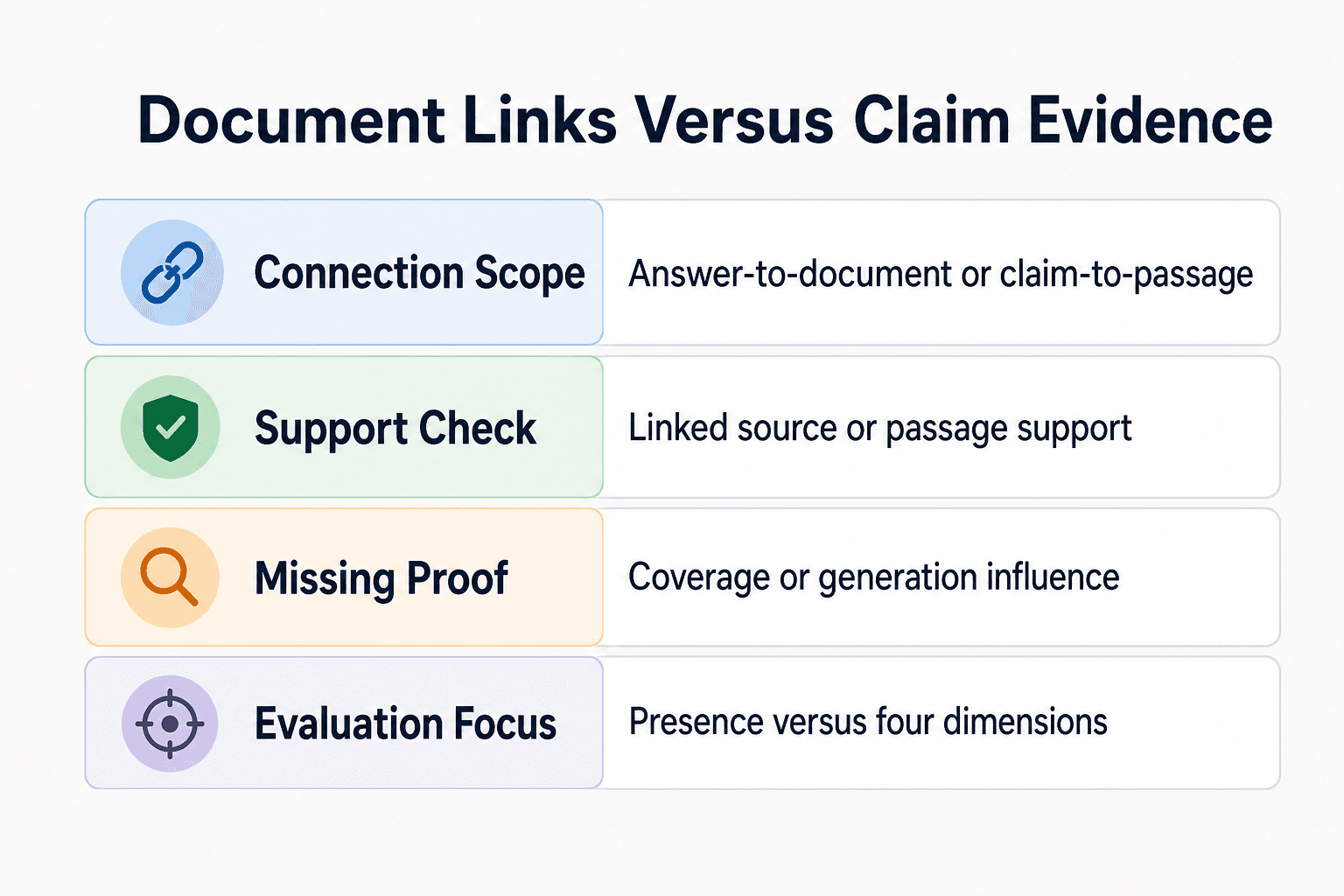
| Factor | Document-level link | Claim-level evidence |
|---|---|---|
| What it connects | Answer to a document | Individual claim to a supporting passage |
| What it helps check | Whether a source is linked | Whether the cited passage supports the claim |
| What it does not establish | That every factual claim has a citation | That the cited evidence influenced generation |
| Evaluation focus | Presence of a citation | Correctness, faithfulness, coverage, and retrieval alignment |
How claim-level evidence and provenance work in RAG
A traceable answer starts before generation. When retrieval returns a passage, keep its source, location, version, and retrieval context, then attach that evidence to the specific claim it supports.
[!tip] For a traceable agent workflow, store the passage reference with the retrieval event and the claim it supports. This gives evaluators the fields needed for claim-level citation checks.
Use stable IDs for documents, passages, retrieval runs, and claims
Give each document a stable ID and each chunk a passage ID. Store a locator too, such as a page, heading, line range, or character offsets, so a reader can find the exact text after the document is rendered differently.
Create a retrieval-run ID for every query and a claim ID for every atomic factual statement in the answer. TRACE-style evaluation decomposes generated outputs into atomic factual statements and parses their citation markers and source links.
Store the evidence record alongside the generated answer
For each claim, save the cited passage IDs, retrieval-run ID, model and prompt version, timestamp, and document version. Keep the visible citation linked to this record, not just to a document URL.
That gives you an audit path. You can ask which passage the system retrieved, what the model saw, and which generated claim used it.
Keep source evidence separate from summaries and agent memory
Design memory records to hold a short note and references to prior claims or evidence records. Keep the source passage separately available for claim-level evaluation.
The important distinction is between a summary and the evidence it references. A memory note can help locate prior work, while the linked passage remains the item to inspect when the agent reuses a claim.
If your agents share project knowledge through GigaRAG, keep source pointers with the memory record so a later claim can be checked against the linked passage.
Design for document updates, deleted sources, and stale citations
Version documents and passages rather than overwriting them. When a source changes, mark dependent claims and memory records as needing review. If it disappears, preserve the old record where policy allows, but show that the live source can't be checked.
Don't silently keep a citation that no longer resolves.
Step-by-step: Build a claim-to-evidence trace
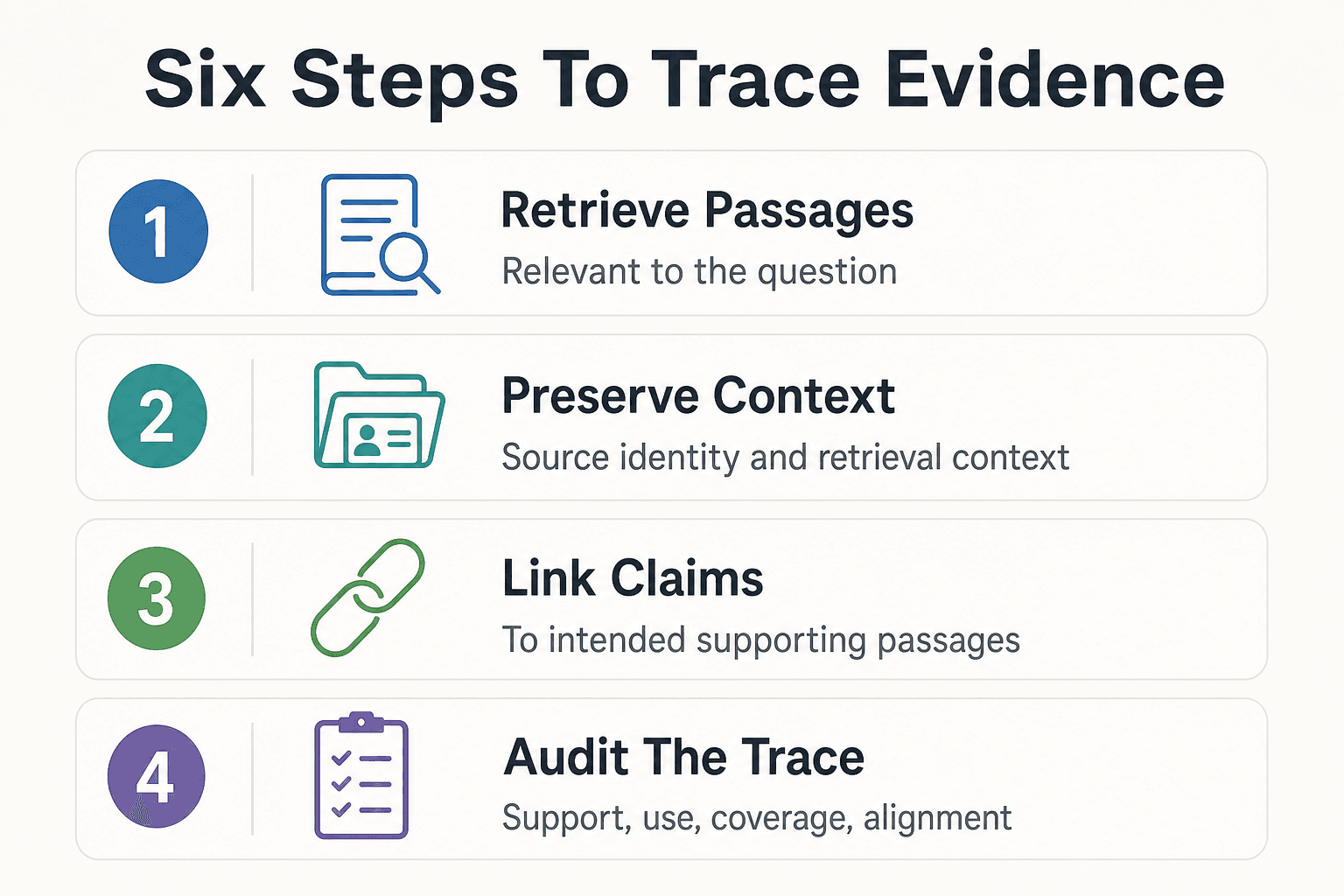
- Retrieve passages relevant to the user's question.
- Preserve each passage's source identity and retrieval context.
- Generate factual claims with links to the passages intended to support them.
- Record which retrieved passages were supplied during generation.
- Persist the claim, passage reference, and retrieval event in the agent's trace.
- Audit each citation for support, use, coverage, and presence in the retrieved set.
End-to-end example: From a generated claim to its source passage
Scenario: an agent answers a repository or project-knowledge question
A developer asks, "Where is the API retry limit set?" The agent retrieves config.md, finds a passage under "Request handling," and answers by citing that passage as the location of the setting.
Treat this as one atomic factual claim. For statement-level evaluation, attach the claim to the retrieved passage used as its cited evidence.
Example evidence record: claim ID, passage ID, locator, retrieval run, and timestamp
Here's a compact record shape:
{
  "claim_id": "clm_104",
  "text": "The API retry limit is three attempts.",
  "passage_id": "psg_config_22",
  "document_id": "docs_config",
  "document_version": "a81f",
  "locator": "config.md#request-handling, lines 42-46",
  "retrieval_run_id": "ret_778",
  "recorded_at": "2025-03-08T10:15:00Z"
}
The record associates the claim with a retrieval-run ID and passage ID. Its locator provides a practical place to inspect the text offered as support.
Example memory record: what to retain and what must be re-verified
A compact memory record can store the question, claim ID, passage ID, document version, and a brief note such as "retry limit found in configuration docs."
Don't retain the setting's value as verified truth on its own. In a later session, use the IDs to fetch the passage again before repeating the claim.
GigaRAG can keep project knowledge available across sessions and tools. However, the memory record should still point back to the versioned passage for verification.
What changes when the source file or document is updated
If config.md changes, create a new document and passage version. Mark clm_104 and any memory record that points to psg_config_22 as needing review.
Keep the earlier record distinct from the new version so an evaluator can compare the evidence records associated with each answer.
How to evaluate citation and source attribution patterns
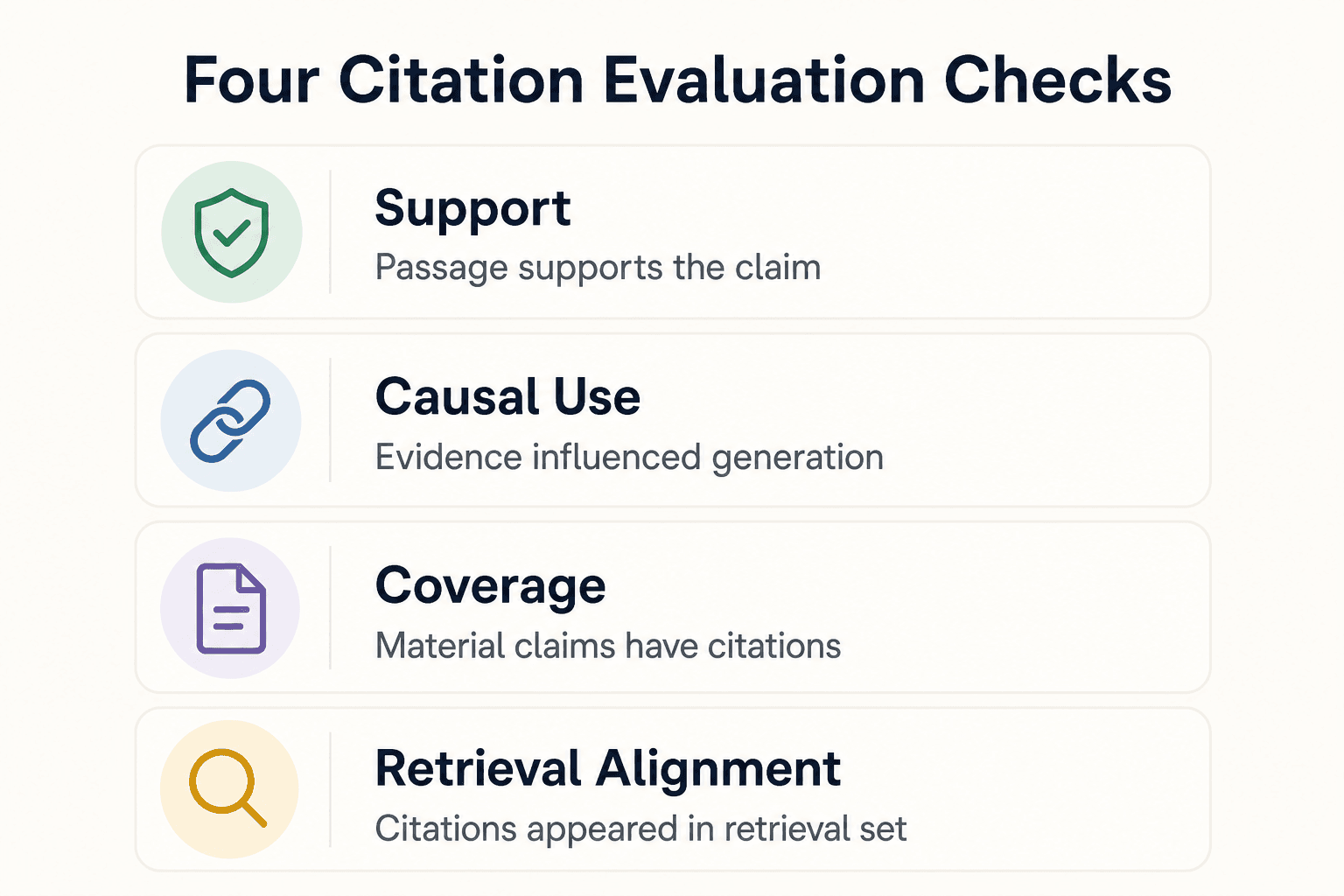
Evaluate citation quality with four separate checks: support, causal use, coverage, and retrieval alignment. TRACE-style evaluation reports these as distinct dimensions rather than a single citation score.
Correctness: does this passage support this claim?
Split sampled answers into atomic factual claims, then compare each claim with its cited passage. Mark it supported, unsupported, or partly supported. This checks citation correctness at the statement level.
This is the support check. It does not assess causal faithfulness.
Faithfulness: was the cited evidence actually used?
Faithfulness asks whether the cited passage influenced generation, not merely whether it could support the finished words. Test this with controlled runs: remove or replace a passage, then check whether the related claim changes.
If the answer stays the same after a cited passage is removed, that result alone does not establish when the citation was attached. Compare outcomes across controlled runs as part of a causal-faithfulness assessment; a citation can support the finished answer while still failing that assessment.
Coverage and retrieval alignment
Coverage is the share of material factual claims with at least one citation. Retrieval alignment is the share of citations that appeared in the retrieval set for that run. Track both.
Report low coverage as missing citation presence, not as proof that uncited claims lack support. When retrieval alignment is low, compare the cited sources with the retrieval record to identify citations that were absent from the evaluated run's retrieval set.
A lean evaluation loop for production agent workflows
Start with a reviewed regression set of real questions, expected claims, and known supporting passages. For each release, log retrieval IDs, claim-to-passage assertions, citations, and abstentions, then rerun the set.
Sample live answers too. In Sanjay Jha’s RAG Evaluation & Metrics post, the evaluation areas are retrieval quality, generation quality, grounding and trust, end-to-end performance, and continuous production evaluation. Its end-to-end view also includes latency, cost per query, and reliability.
Common mistakes and practical design choices
Mistake: adding citations after generation
Don't write the answer first and attach plausible links afterward. A citation can support the final wording yet still be unfaithful if the passage did not influence generation.
Bind claims to retrieved passage IDs before the model returns them. If no passage supports a material claim, omit it, qualify it, or say the evidence is missing.
Mistake: treating agent memory as a verified source
Treat agent memory as a pointer to prior work, not as the cited passage for a factual claim.
Store a memory record with the prior claim, passage ID, source version, and retrieval-run ID. When the agent relies on that record later, retrieve the linked source and evaluate the new claim against the passage.
Choose the smallest trace model that fits the risk
Choose the trace detail to match the decision at stake. A short, low-risk answer may need only a source reference, while workflows that require statement-level citation evaluation should retain claim, passage, and retrieval-run records.
Start small: stable document and passage IDs, locators, and a retrieval-run ID. Add atomic claim records and source-version checks when you need to explain exactly why the agent said something, or when a stale citation could cost your team.
If you connect agents to GigaRAG through MCP or the API, use its access controls to manage what each agent can use.
Frequently asked questions
What is the difference between citation, attribution, and provenance in a RAG system?
In a practical evidence trail, a citation is the reader-facing reference attached to a claim, attribution names the associated source, and provenance is the internal record that connects the claim, passage, and retrieval information.
Why should a RAG response be evaluated at the claim level?
TRACE-style evaluation decomposes generated outputs into atomic factual statements and evaluates their citations separately. Recording a passage reference for each claim supports that statement-level check.
What is claim-level evidence?
Claim-level evidence is the passage reference recorded for a particular factual statement in an answer. It supports statement-level checks of whether the cited evidence supports that claim.
How do citation correctness and citation faithfulness differ?
Correctness asks whether the cited evidence supports the statement. Faithfulness also asks whether that evidence actually contributed to generating the statement.
What does citation coverage measure in RAG evaluation?
Coverage measures the proportion of factual statements with at least one citation. It does not, by itself, show that those citations support the statements.
Should agent memory be treated as a source of truth?
No. A persisted memory record can help trace prior work, but the record alone does not establish that its content is true. Keep links to the underlying evidence so claims can be checked against their sources.
What metadata should a RAG system store for a source passage?
Store identifiers for the passage and source, a locator for the passage text, and the retrieval-run and claim records that connect the evidence to an answer. These fields support checks of citation support and retrieval alignment.
How is retrieval alignment measured in RAG evaluation?
Retrieval alignment measures the share of citations that appeared in the retrieval set for the evaluated run. Track it separately from citation correctness, faithfulness, and coverage.
About GigaRAG
GigaRAG is a shared memory platform for AI agents that helps developers and teams keep project knowledge available across sessions and tools.
You can connect agents to a central Hive Mind through MCP or the API. Access controls manage what each agent can use.


