How to Cut Your Embedding Bill Without Losing Recall
High-dimensional embeddings can add storage and similarity-computation costs in retrieval systems. Compression changes the representation, so assess the resulting retrieval quality on the workload you intend to run.
Separate changes that reduce the number of embeddings from changes that compress existing vectors. Then compare one candidate configuration with a fixed baseline, using relevance labels and the cost measures that matter to your system.
Quick answer
Compression can reduce vector storage and similarity-computation costs. The cited research found that the best compression strategy varied by task, so evaluate a candidate configuration on representative queries before deployment.
- Compare retrieval quality and operating costs before and after the change.
- Change one variable at a time and set a rollback threshold.
What an embedding bill actually pays for
Start by identifying the charges and resource measures that make up your embedding bill. High-dimensional vectors increase storage and similarity-computation costs; other costs should be measured in your own system before you change dimensions or precision.
Ingestion cost versus recurring storage and query cost
Track initial embedding work separately from the costs you continue to observe after deployment. This makes it easier to see which part of the system a proposed change is intended to affect.
Why chunk count can matter as much as vector dimensionality
Review chunking alongside vector size. Decide whether duplicate or low-value records belong in the candidate corpus, and preserve enough context for the retrieval tasks in your evaluation set.
Costs that should be calculated from your own provider invoices and system telemetry
Use provider invoices, system telemetry, and a defined candidate configuration to calculate the trade-off for your environment.
Dimensionality reduction vs quantization
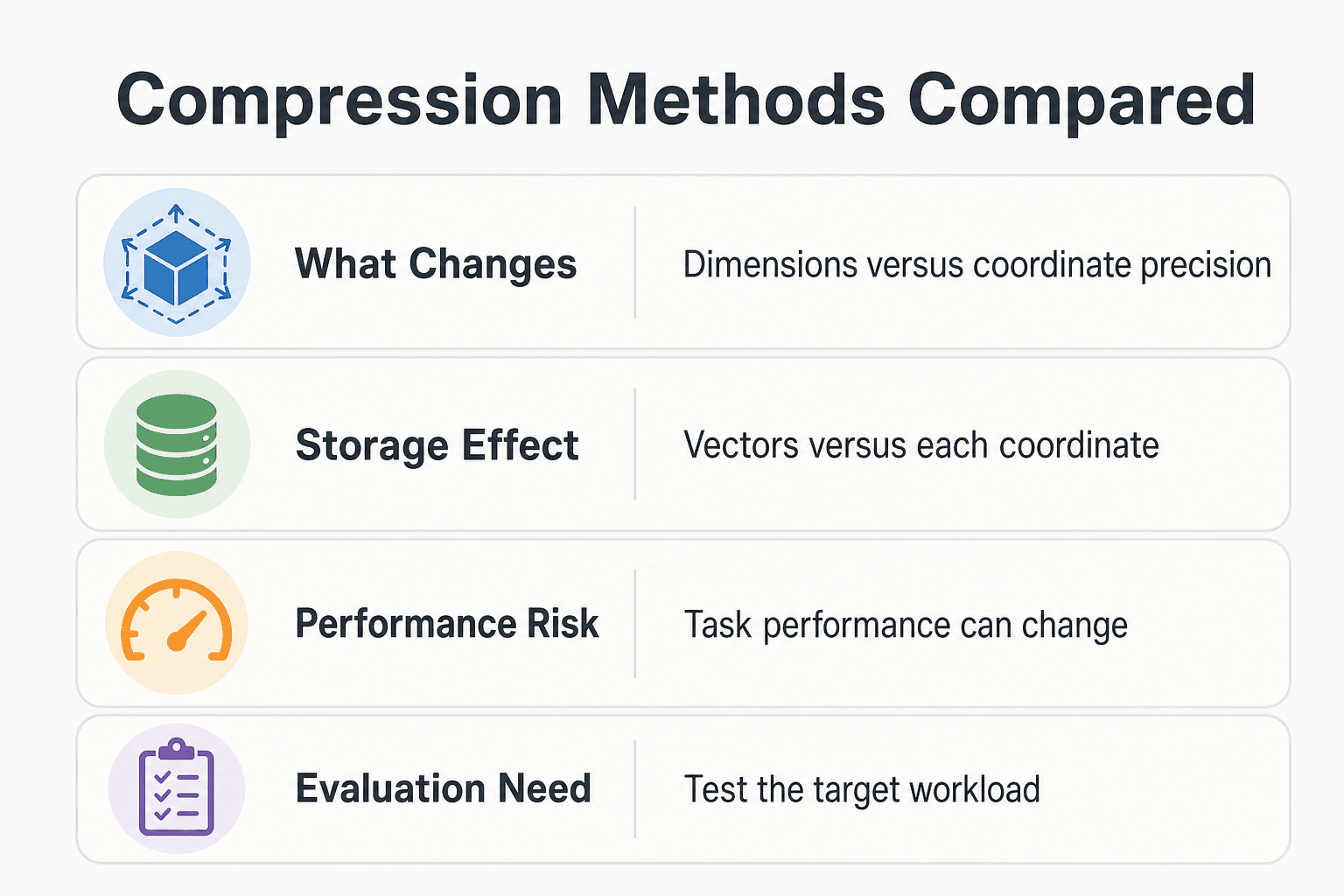
| Factor | Dimensionality reduction | Quantization |
|---|---|---|
| What changes | The number of retained vector dimensions | The precision used to represent each coordinate |
| Potential cost effect | Can reduce vector storage | Can reduce the storage used per coordinate |
| Key risk | Removing dimensions can reduce task performance | Lower numerical precision can affect performance |
| Evaluation need | Test retrieval on the target workload | Test retrieval on the target workload |
How to cut your embedding bill without losing recall
Decide whether duplicate or unnecessary records belong in the corpus before changing vector representations. Test caching and compression as separate changes so each comparison has a clear baseline and candidate.
Reduce unnecessary chunks and duplicate content before compressing vectors
Look for repeated boilerplate, stale copies, and records that divide one useful passage into several near-duplicate entries. Evaluate any chunking revision with queries that require surrounding context as well as queries that target a specific passage.
Cache stable inputs only when the text and embedding configuration match
Use an explicit cache key for the text and embedding configuration you intend to reuse. When content or configuration changes, create a candidate embedding and validate the resulting retrieval behavior rather than treating the old cache entry as interchangeable.
Treat smaller models, fewer dimensions, and lower precision as experiments rather than guaranteed savings
Dimensions control how many values a vector keeps. Quantization controls how many bits store each value. Test smaller models, reduced dimensions, and lower precision as separate candidate configurations against the same baseline.
Define the cost objective for the candidate configuration
Specify which costs the candidate is intended to affect, such as vector storage, similarity computation, or processing work. Compare those measured results with the baseline alongside the retrieval-quality threshold you set.
Step-by-step: validate an embedding cost change
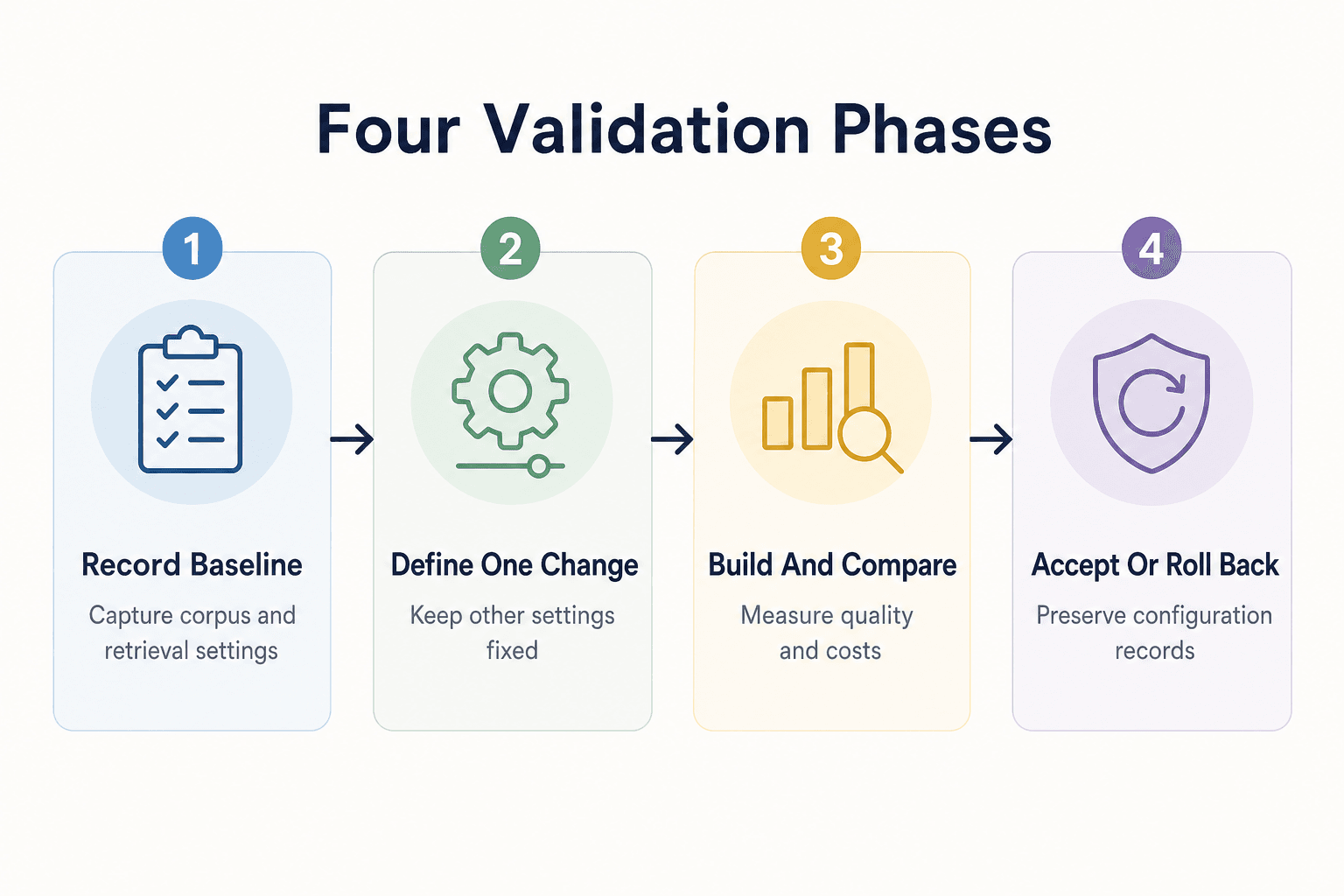
- Record the current embedding, chunking, preprocessing, vector configuration, and retrieval settings as your baseline.
- Define the candidate corpus and identify any content, chunking, or configuration changes that the migration will include.
- Choose one change to test, such as reducing dimensions or applying quantization, and keep other settings fixed.
- Build the candidate collection separately from the baseline so that both configurations remain available during validation.
- Compare Recall@k, ranking metrics, and the cost measures you selected for the evaluation.
- Accept the change only if it meets your quality threshold and cost objective. Otherwise, roll back.
- Preserve the content and configuration record for the candidate collection so the evaluated migration can be reproduced or reversed.
Measure retrieval quality before changing the index
Use a labeled set of relevant chunks or documents and the same retrieval settings before and after a cost change. Report Recall@k, a ranking metric, and the cost measures selected for the comparison.
[!tip] For code and project knowledge, include queries about exact identifiers, error messages, and concepts. GigaRAG helps developers and teams keep project knowledge available to AI agents across sessions and tools, so include requests that reflect that project knowledge.
1. Freeze a baseline: corpus version, chunking, model, index settings, filters, and top-k
Record the corpus version, chunk rules, embedding model, index settings, metadata filters, and top-k. Holding these settings fixed gives the baseline and candidate runs the same retrieval conditions.
2. Build a representative evaluation set for coding, project-memory, and agent tasks
Label queries that reflect real work: code symbol lookups, project decisions, error messages, and tasks that require several sources. For a GigaRAG deployment, include the project-knowledge requests agents make through the shared memory platform, rather than limiting the set to clean questions with obvious answers.
3. Compare Recall@k with ranking metrics such as nDCG or MRR
Use Recall@k to compare the baseline and candidate on the same labeled evaluation set. Add a ranking metric such as nDCG or MRR when the order of retrieved results matters, and evaluate the metrics against the acceptance criteria you set before testing.
4. Record latency, index size, embedding volume, and operational work beside quality
Log embedding volume, index size, query latency, and migration work with each result. Compare these operational measures with the quality results when selecting a configuration.
5. Define acceptance and rollback criteria before rollout
Set the lowest acceptable Recall@k and ranking score before testing. Retain the baseline configuration until the candidate meets those criteria and the measured cost objective.
Compression and dimension changes: useful, but not universally safe
Compression changes how vectors are stored and represented. Treat each compression setting as a configuration to evaluate against the retrieval-quality and cost criteria you defined.
[!note] A study of four embedding models across four MTEB task families found that the optimal compression strategy depended on the task. Treat its results as evidence from those evaluated settings, not as a preset for every retrieval system.
Dimensions and precision reduce different parts of the representation
Dimension reduction retains fewer coordinates. Quantization retains the coordinate count while representing each coordinate with fewer bits. The compression study notes that high-dimensional low-bit and low-dimensional high-bit representations can preserve different information under the same bit budget.
Why 128 dimensions is not a universal safe limit
No single dimension count is established here as a general threshold. Test 128 dimensions against the same representative queries, relevance judgments, and retrieval settings as the baseline.
When truncation, projection, or model-supported reduced dimensions may be tested
Where a model supports reduced-dimensional outputs, test the available settings against the same baseline. PCA and random projection are dimensionality-reduction approaches that should receive the same retrieval evaluation before adoption.
What compression research shows and what it does not prove for a production corpus
The cited research found that combining dimensionality reduction and quantization could provide stronger compression than either method alone in its evaluated settings. Its four-model, four-task-family experiment does not establish the result for an arbitrary production corpus or query set.
Example: test one compression setting against the same queries and retrieval configuration
Start with one candidate setting. Re-embed a copy of the corpus, keep top-k and filters fixed, then compare Recall@k and ranking scores against the baseline. Reject it if it misses your pre-set limit, even if the index is much smaller.
Why semantic similarity is not enough to reuse embeddings
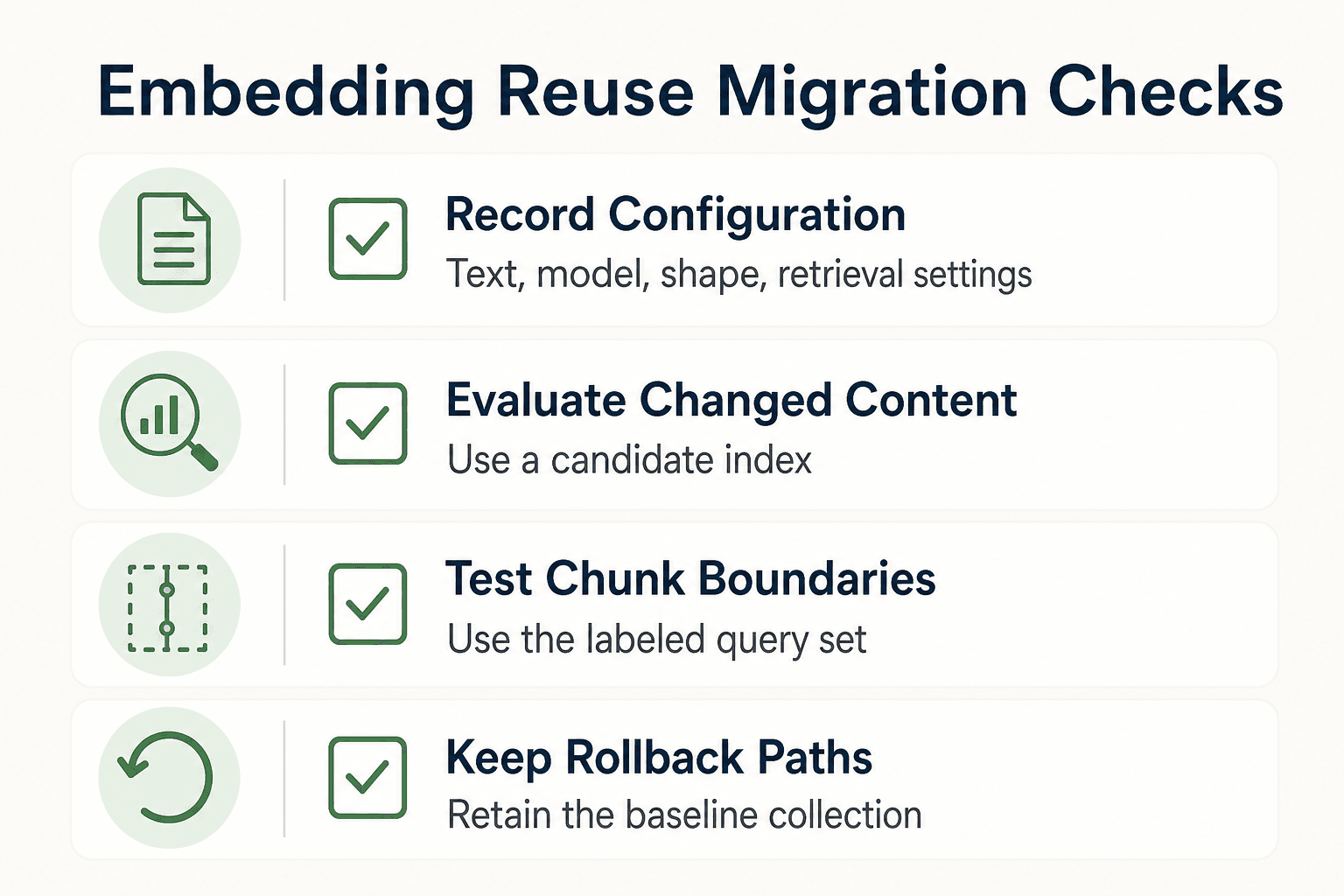
Treat embedding reuse as a migration decision, not as a judgment based only on similar wording. Record the text and embedding configuration associated with each vector, then evaluate a candidate index when either the content or configuration changes.
Similar wording is not a migration-validation result
When content is revised, compare retrieval results for the revised collection with the baseline instead of using semantic similarity as the acceptance test.
Include chunk-boundary changes in migration evaluation
Include representative chunk-boundary changes in the candidate collection and test them with the same labeled queries used for the baseline.
Reuse criteria should be explicit and testable
Document the text, preprocessing, embedding model, output shape, and retrieval configuration associated with a reusable vector. Use that record to define the migration candidate, then validate the candidate collection with the evaluation workflow in this article.
Migration safety: preserve metadata, test on a copy, validate dimensions, and keep rollback paths
Preserve source IDs, chunk IDs, document versions, filters, and provenance before migrating. Test a separate collection and retain the baseline until evaluation passes. If agents connect to GigaRAG’s central Hive Mind through MCP or the API, include access-control scenarios in that validation so the collection reflects what each agent can use.
When to re-embed instead of trying to reuse vectors
When text, chunking, normalization, model version, dimensions, or vector configuration changes, build a candidate collection and evaluate it before replacing the baseline. Keep a rollback path while the migration is being assessed.
Optimize only after you can prove the trade-off
Do not select a candidate solely because the index is smaller or a processing step finishes sooner. Select it when it meets the quality criteria and the cost objective defined for the evaluation.
A retrieval-quality change and a cost change should be evaluated separately. Hybrid sparse-dense retrieval is one possible retrieval approach; assess its quality and operational characteristics in the same measurement framework as any other candidate.
A practical go/no-go checklist
Keep a change only when the evaluation record supports all of the following:
- It meets the Recall@k and ranking thresholds you set before testing.
- It meets the measured cost objective selected for the test.
- Its latency, migration work, and operational requirements are acceptable for the deployment.
- It was compared with the baseline under the same corpus, queries, filters, and top-k settings.
- The team has documented the result and a path to restore the prior configuration if needed. For GigaRAG deployments, include the access controls that govern what each agent may use.
If the result does not meet the criteria, retain the baseline.
Frequently asked questions
How should I use Recall@k in a RAG retrieval evaluation?
Use Recall@k to compare the baseline and candidate configurations on the same labeled query set. Pair it with a ranking metric when result order matters, and decide before testing what result meets your acceptance criteria.
How do I evaluate a reduced-dimension embedding configuration?
Run the reduced-dimension candidate against the same representative queries, relevance judgments, and retrieval settings as the baseline. Compare Recall@k, ranking metrics, and the cost measures you selected, then keep or reject the candidate according to predefined criteria.
Is 128 dimensions enough for embeddings?
The supplied compression research does not establish 128 dimensions as a general threshold. It found that the optimal compression strategy depended on the task across the models and task families evaluated, so test 128 dimensions on your own retrieval workload.
Does quantization always preserve embedding recall?
No. Quantization represents each coordinate with fewer bits while retaining the dimensionality, and its effect should be measured on the retrieval task you intend to run.
Can I reuse an embedding when I change a document chunk?
Treat the revised chunk as part of a migration candidate. Generate the candidate collection, run the labeled retrieval evaluation, and retain the baseline until the migration meets your acceptance criteria.
Why is semantic similarity not enough to validate embedding reuse?
Semantic similarity is not a replacement for migration evaluation. Validate the candidate collection with representative queries, relevance judgments, and the retrieval settings used in deployment.
What should I measure besides recall when reducing embedding costs?
Measure a ranking metric and the cost measures that matter to your system, such as vector storage, similarity computation, processing work, or query latency. Compare the same measures for the baseline and candidate configurations.
Should I change the embedding model, dimensions, and chunking strategy at the same time?
Prefer separate candidate tests when possible. Holding other settings fixed makes each baseline-to-candidate comparison easier to interpret; validate any combined migration as its own configuration.
About GigaRAG
GigaRAG is a shared memory platform for AI agents that helps developers and teams keep project knowledge available across sessions and tools. That makes retrieval evaluation especially relevant when teams are changing the representations behind shared project knowledge.
Teams can connect agents to a central Hive Mind through MCP or the API, while access controls manage what each agent can use. Include those access boundaries when defining representative agent tasks and validating a retrieval migration.


