How to Write an FDE LinkedIn Headline for FDE Roles
A generic LinkedIn headline such as "Software Engineer | Problem Solver" leaves an FDE recruiter guessing what you build, whether you work with customers, and where you have delivered it. An FDE LinkedIn headline needs to show technical depth and delivery context in one quick scan because Forward Deployed Engineer roles sit between implementation work and real field problems.
The main catch is that a headline can frame real evidence, but it can't create an FDE title, customer ownership, or results you can't support elsewhere on your profile. For current FDEs, career changers, and software engineers, the useful signals differ. APIs, Python, cloud infrastructure, LLMs, or systems integration matter only when paired with truthful proof of collaboration, prototyping, or delivery.
Quick answer
An FDE LinkedIn headline should connect the technical work you can demonstrate with the customer-facing delivery you can support with evidence.
- Name relevant skills or implementation work.
- Add collaboration, ownership, or prototyping only when your profile supports it.
- Use a target-role phrase without implying you have held the FDE title if you have not.
What a Forward Deployed Engineer does and what recruiters scan for
An FDE role sits between building software and making it work in a real delivery setting. Your headline can't prove that you can do either. It can show a recruiter where to look for evidence: technical work, customer collaboration, implementation, and ownership.
The technical-and-customer delivery balance
FDE work isn't just coding, and it isn't just customer support. You may need to understand a problem with stakeholders, build or adapt a prototype, connect systems, and stay involved until people can use the work.
That mix matters. A headline such as "Software Engineer | APIs and integrations | Customer implementation" gives a clearer starting point than "Engineer seeking new opportunities" because it names what you build and the setting where you use it.
Don't claim customer ownership if you only worked on an internal tool. Use the closest true wording instead, such as "partnered with client-facing teams" or "built implementation prototypes."
What a headline can signal versus what the rest of the profile must prove
Your headline can signal role direction, a technical focus, and delivery context in one line. It can't carry the full case.
Projects and experience should back up each meaningful term with details: what you built, who you worked with, what systems you integrated, and what part you owned. Keep the claim narrow when the evidence is narrow, so recruiters can trust what they find in the rest of your profile.
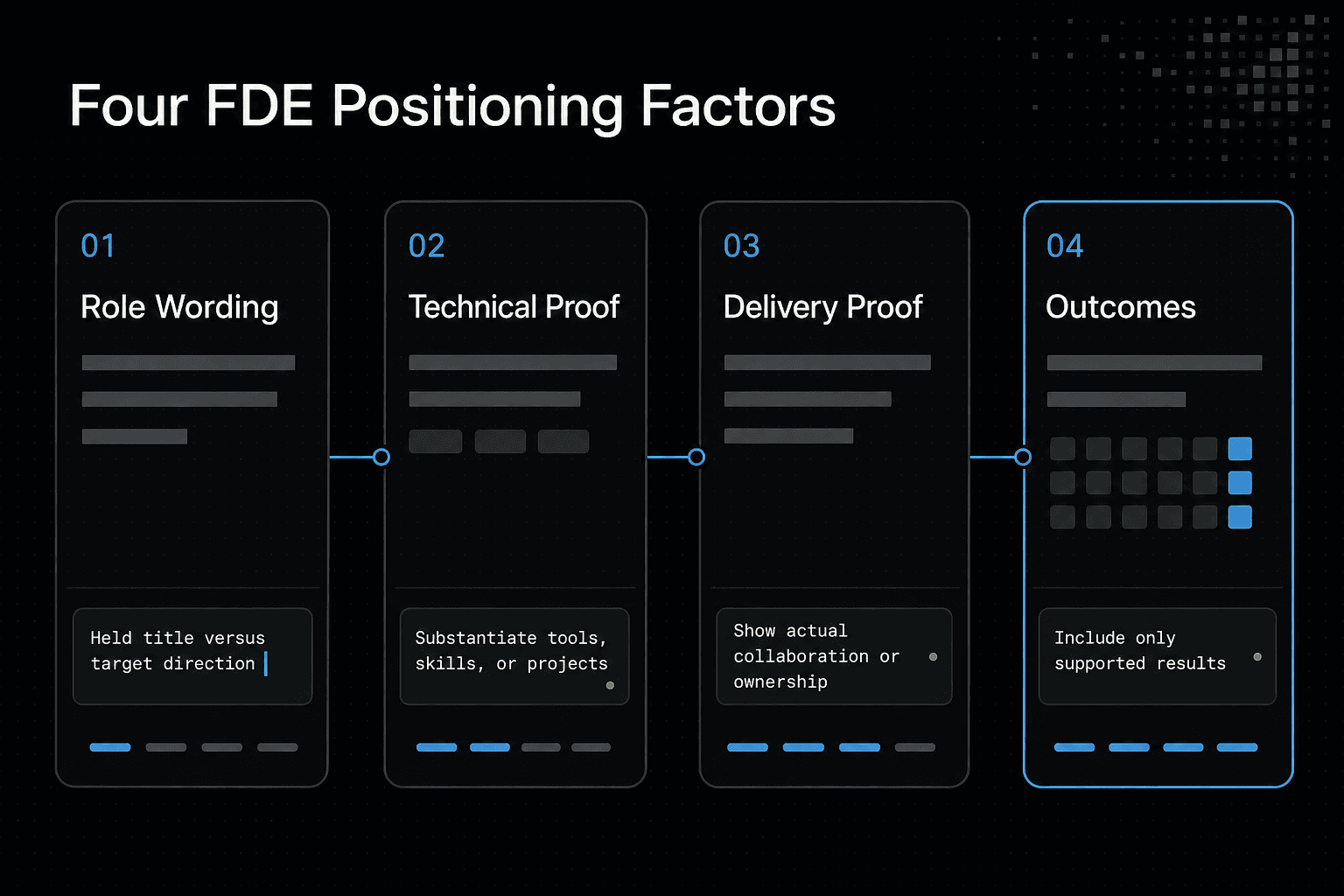
FDE headline positioning by experience
| Factor | Current FDE | Aspiring FDE |
|---|---|---|
| Role wording | Use FDE if it is your current or past role | Describe your target or adjacent experience without claiming the title |
| Technical proof | Highlight tools and implementation you can substantiate | Name skills or projects you can demonstrate |
| Delivery proof | Show supported customer or deployment ownership | Use collaboration or project delivery evidence you actually have |
| Outcomes | Include only outcomes supported elsewhere on your profile | Avoid implying customer results you did not achieve |
What makes an FDE LinkedIn headline effective
A useful FDE LinkedIn headline answers three things fast: the role you do or want, the technical work you can support, and the delivery setting where you have used those skills. It doesn't need to tell your whole career story. It needs to make the right evidence easy to find.
[!note] Aiming for an FDE role is not the same as having held the FDE title. Make that distinction clear in your headline.
Lead with the role you have or the role you are targeting
Start with your current role when it is relevant, then add your direction if you are moving toward FDE work. "Software Engineer | Targeting Forward Deployed Engineer roles" is clear and honest. "Forward Deployed Engineer" isn't a target label if you have never held that job.
Keep it plain. A recruiter should not have to decode a creative title before they can tell where you fit.
Use evidence-led specificity instead of vague ambition
Words like "passionate," "results-driven," and "problem solver" take up space without showing what you have done. Replace them with a skill, system, or work type you can support elsewhere on your profile.
For example, "Python Engineer | API integrations and rapid prototypes" gives a recruiter useful leads to follow. Only name Python, APIs, prototypes, or outcomes that your projects and experience can back up.
Balance technical terms with a delivery signal
Technical keywords matter, but a tool list alone reads like a search filter. Add a short signal about how you apply the work: customer implementation, technical discovery, stakeholder collaboration, or solution delivery.
The main catch is accuracy. "LLM applications | customer delivery" works only if you have built those applications and worked in that delivery context. If your work was internal, use narrower headline wording that recruiters can trust.
Step-by-step: Draft a credible FDE headline
- Choose FDE role wording that accurately reflects your experience or career goal.
- Select technical skills or implementation work you can substantiate on your profile.
- Identify evidence of customer collaboration, delivery, prototyping, or ownership.
- Pair the technical evidence with the delivery evidence in a concise headline.
- Check that each title, technology, responsibility, and outcome is supported elsewhere on your profile.
Choose technical skills that support your FDE story
Pick a small set of terms that describe work you have actually done, not every tool you have encountered. A focused set gives the recruiter a clear reason to open your profile.
[!tip] For a transition headline, connect a concrete project or implementation skill to the collaboration or delivery work you can point to elsewhere on your profile.
Technical terms worth using only when you can substantiate them
Use Python, APIs, systems integration, cloud infrastructure, AI/ML, LLMs, RAG, MCP, or AI agents only when your experience, projects, or portfolio can explain the claim. "RAG prototypes" means you built or materially contributed to a retrieval-based application. "MCP integration" means you worked with that protocol in a real implementation, not that you read about it.
Keep the terms tied to your target roles. An engineer who built API integrations doesn't need to add cloud, LLMs, and agents unless those were part of the work.
How to turn integrations, prototypes, and implementation work into concise proof
Name the work type, then the technical focus. "Software Engineer | API integrations and customer implementation" is clearer than "Full-Stack Developer | AI, Cloud, Innovation."
For internal work, use wording such as "rapid prototypes" or "internal tools." For work with users or clients, "technical discovery," "implementation," or "stakeholder collaboration" may fit if you can show that context elsewhere on your profile.
Short beats broad.
What not to imply about AI, LLM, cloud, or customer deployment experience
Don't imply that you designed an AI agent if you only used an AI tool, or that you led a deployment if you contributed code to one part of it. The same rule applies to cloud ownership, production systems, and customer delivery.
The honest answer is that a narrower claim can help more. "Built LLM prototypes" is worth using when true, even if "AI solutions architect" sounds more impressive.
Use an FDE headline formula you can adapt
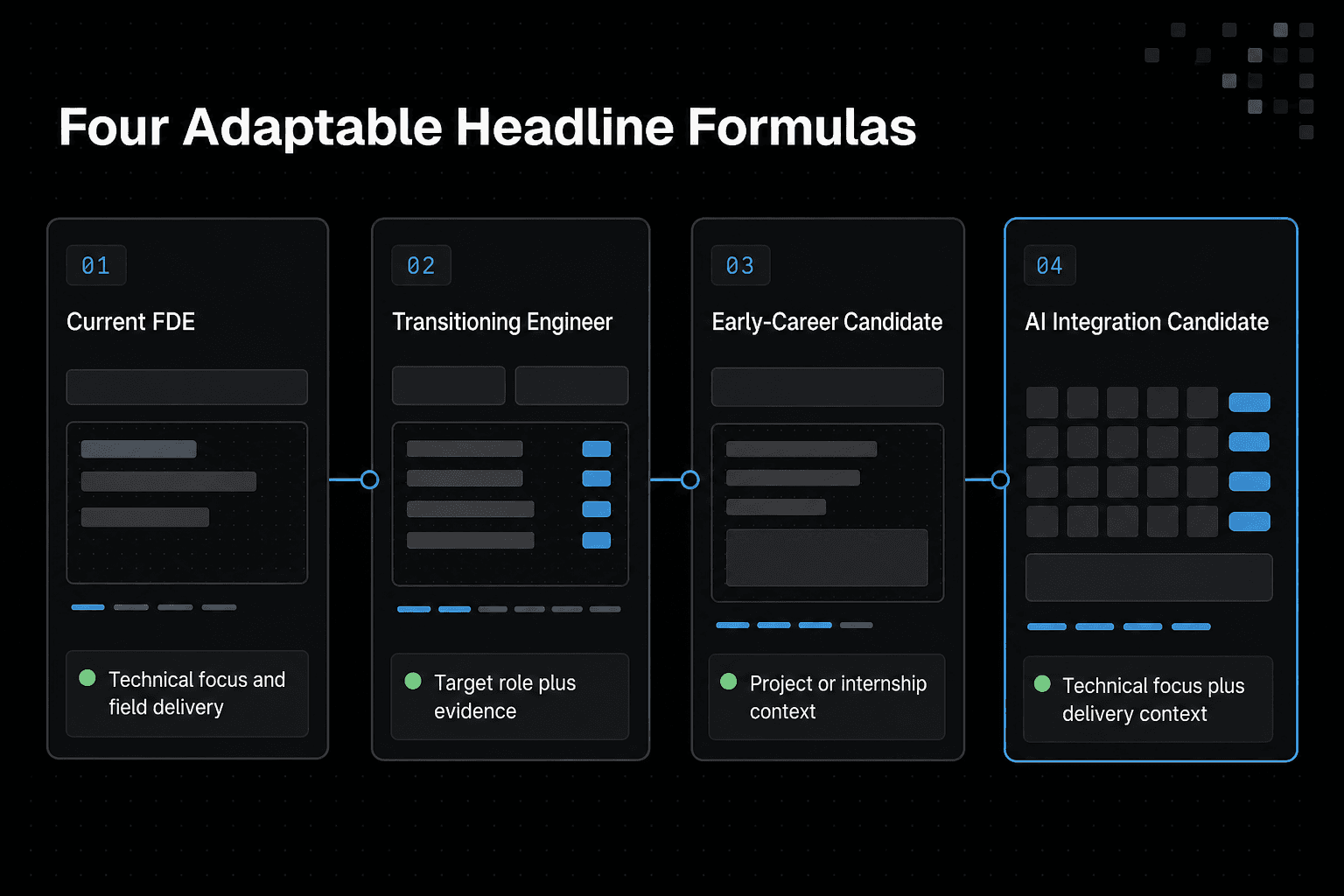
Build your headline from four parts: your current or target role, one technical focus, the delivery context, and a working style or outcome you can prove. Keep only the parts that make your fit clearer. A headline can't give you FDE experience, customer ownership, or results you haven't earned.
Formula for current FDEs
Use: Forward Deployed Engineer | [technical focus] | [customer or field delivery] | [working style or supported outcome].
Choose "customer implementation" only if it reflects your work. Don't add an outcome unless the rest of your profile can show it.
Formula for engineers moving into FDE work
Software Engineer targeting Forward Deployed Engineer roles | [technical focus] | [implementation or collaboration evidence] keeps the direction honest.
Use "targeting" when FDE isn't your current job. It depends on your evidence: name integrations, prototypes, or stakeholder work that you can explain.
Formula for early-career candidates
Early-career engineer | [technical focus] | [project, internship, or implementation context] is enough.
Skip senior-sounding labels. A project-based claim is more useful when it points to work you can walk through in an interview.
Formula for AI, RAG, and integration-focused candidates
[Current or target role] | [LLMs, RAG, APIs, or integrations] | [prototype or delivery context] works when those terms are true.
Keep it narrow. "RAG prototype builder | API integrations | technical discovery" says more than a long AI tool list, provided each phrase has proof.
FDE headline examples: Before-and-after rewrites by experience level
Experienced Forward Deployed Engineer
Before: Engineer | Problem Solver | Building Great Products
After: Forward Deployed Engineer | Python and API integrations | Customer implementation and technical discovery
The first headline hides the work that makes you relevant. The rewrite names your role, technical proof, and delivery context without claiming a result you can't show elsewhere.
Software engineer transitioning to FDE
Before: Software Engineer | Looking for New Opportunities
After: Software Engineer targeting Forward Deployed Engineer roles | Cloud integrations | Customer-facing prototypes
Don't call yourself an FDE if that isn't your job. "Targeting" makes your direction clear, while prototypes and integrations give recruiters a reason to take that direction seriously.
AI/ML, RAG, or integration builder
Before: AI Engineer | LLMs | RAG | Agents | Python | APIs | Cloud
After: AI engineer | RAG prototypes and API integrations | Technical discovery for customer use cases
If relevant to work you can document, a narrower alternative might be: AI engineer | GigaRAG MCP integration | Agent knowledge workflows. Use the GigaRAG example only if you actually connected agents through MCP or the API and can explain your contribution.
Tool lists aren't a story. This version keeps the AI terms but adds implementation and collaboration work that can matter in an FDE search.
New graduate or intern
Before: Computer Science Graduate | Seeking FDE Role
After: Early-career software engineer targeting FDE roles | Python and APIs | Internship and project delivery
Start smaller. You don't need to imply customer ownership or production deployment if your evidence comes from coursework, an internship, or a personal project.
Career switcher with adjacent implementation experience
Before: Technical Consultant | Ready for a Career Change
After: Technical consultant targeting FDE roles | Systems implementation | Stakeholder workshops and solution delivery
"Career change" doesn't tell a recruiter what transfers. Name the implementation work you did and the people you worked with, then make sure your experience section can back up each phrase.
Position yourself for an FDE role without claiming experience you do not have
A headline can show where you're heading. It can't turn adjacent work into an FDE title, customer ownership, or production deployment you never had.
Use target-role language without presenting it as current employment
If you're an engineer moving toward FDE work, use "targeting Forward Deployed Engineer roles" or "interested in customer-facing implementation." That signals a clear direction while keeping your current title intact.
Fresh graduates and interns can use "early-career engineer targeting FDE roles" when their projects, coursework, or placements support the technical terms that follow. Career changers should keep their established title, then add the relevant lane: "Technical consultant targeting FDE roles."
Be plain about the gap. Recruiters can assess potential, but they can't assess a title you invented.
Translate adjacent work into relevant delivery evidence
Look for work that overlaps with FDE delivery: integrating systems, scoping a solution, building a prototype, running stakeholder workshops, troubleshooting an implementation, or turning user needs into technical requirements. Name what you actually did.
A backend engineer might lead with APIs, cloud systems, and cross-team delivery. An intern might name a Python project and the product team they supported. A consultant can mention implementation and stakeholder discovery, but not "customer deployment" unless they owned that work.
Keep the scope visible. "Built an internal RAG prototype" is useful evidence. "Deployed enterprise AI solutions" isn't a fair substitute.
Claims that require proof before they belong in a headline
Before you use "Forward Deployed Engineer," "customer-facing," "AI/ML," "LLM," "RAG," "cloud," or "systems integration," check that your experience, projects, or portfolio can explain it. The same rule applies to outcome claims such as revenue gained, time saved, or systems shipped.
Don't borrow prestige from a tool or team. If you assisted on a customer project, say you supported it. If you built a prototype for coursework, call it coursework.
The honest answer is simple: choose the most specific wording you can prove elsewhere on your profile.
Build a recruiter-friendly FDE keyword strategy
Your headline needs enough terms to show your lane, not every term you know. Pick keywords that describe the FDE work you want and can support in your experience, projects, or portfolio.
Role and delivery keywords
Start with one role signal: "Forward Deployed Engineer," "software engineer targeting FDE roles," or "technical consultant targeting customer-facing implementation." Then add one delivery signal, such as customer collaboration, technical discovery, solution delivery, rapid prototyping, or systems integration.
Keep it tight. "Python engineer | APIs | customer implementation" tells a clearer story than a headline that stacks five job titles.
Technical specialization keywords
Choose technical terms that match your real work: Python, APIs, cloud infrastructure, LLMs, RAG, MCP, AI agents, or systems integration. These terms work when they narrow your story.
Don't claim the whole stack. If you built API integrations, say that. If you only explored an LLM in coursework, don't present yourself as an AI deployment lead.
How to prioritize keywords for a specific FDE job search
It depends on the roles you want, the work you can prove, and the terms that recur in the job descriptions you are pursuing. Start with the target role, add the strongest technical match, then use a delivery term that shows how you work.
For example: "Engineer targeting FDE roles | Python and API integrations | Rapid prototyping with customer teams." Change the technical phrase when your search shifts from integration work to AI or cloud implementation.
Why keyword stuffing weakens credibility
A headline like "FDE | Python | Java | AWS | Azure | GCP | LLMs | RAG | ML | APIs | Kubernetes" reads like an inventory. It doesn't show what you build, who you work with, or why those tools belong together.
The main catch is trust. Use fewer terms, connect them to a delivery context, and leave the full tool list for your skills and project sections.
Common FDE headline mistakes and how to fix them
A weak headline can hide relevant work. A bloated one can make you sound less credible, even when your background fits customer-facing implementation.
Generic engineering titles with no FDE direction
"Software Engineer" is accurate, but it gives an FDE recruiter little to work with. Add the direction and proof you have: "Software Engineer targeting FDE roles | API integrations and rapid prototyping."
Don't add "Forward Deployed Engineer" as though it is your current job if it isn't. Use "targeting FDE roles" or name the adjacent work you actually did.
A long list of tools with no delivery context
Tools alone don't explain your value. "Python | AWS | LLMs | RAG | APIs | Docker" could describe many roles, and it says nothing about implementation or collaboration.
Pick a technical focus, then connect it to work. For example: "Python and API integration engineer | Building prototypes for customer workflows." Keep the rest in your skills section.
Unverified claims of FDE, AI, customer, or outcome expertise
Don't claim customer ownership if you only joined internal meetings. Don't claim AI deployment experience because you completed a course or built a small demo.
The honest answer is simple: each headline claim should have evidence elsewhere on your profile. That might be a project, a work bullet, a portfolio link, or a clear description of what you built and your role in it.
Trying to fit every career goal into one headline
"FDE | Product Manager | Data Scientist | Founder | AI Engineer" makes your search hard to read. It also suggests you haven't chosen the work you want next.
Choose one main direction for this search. If you want FDE roles, lead with technical implementation and customer delivery, then update the headline when your target changes.
Check, test, and improve your headline before you publish
Your headline doesn't need to be clever. It needs to hold up when a recruiter opens the rest of your profile.
The final credibility checklist
Before you publish, check each part against work you can show:
- Is your current title accurate, or does "targeting FDE roles" make the direction clear?
- Can you point to a job bullet, project, or portfolio item for each technical term?
- Does your delivery claim match your actual customer, stakeholder, or implementation work?
- Have you removed outcomes you can't prove?
- Can someone read it in one quick scan?
If one phrase fails this check, cut it or make it narrower. "Built API integrations" is safer than "drove enterprise transformation" when the latter has no clear evidence behind it.
Match the headline to the experience and project sections
A headline makes a promise. Your experience and project sections must show the work behind it.
If you say you build RAG prototypes, describe one prototype, the data or retrieval work involved, and your part in building it. If you mention customer workflows, explain who you worked with and what you delivered. Keep the wording consistent, but don't copy the headline into every section.
When to update the headline
Update it when your evidence changes or your target role narrows. A new implementation project, customer-facing responsibility, or deeper technical focus can earn a more specific phrase.
Don't change it every week. Change it when you can support a better claim, so your profile stays useful to the FDE roles you want.
Make your next FDE search signal clearer
A recruiter should not have to guess what you build, how you work with others, or why you fit an FDE role. Your headline can't prove those things alone, but it can point them to evidence that does.
The honest answer is simple: choose the most specific wording that remains fully true. If "Software Engineer | API Integrations | Partnering with implementation teams" matches your record, it is stronger than a grand FDE claim you can't support.
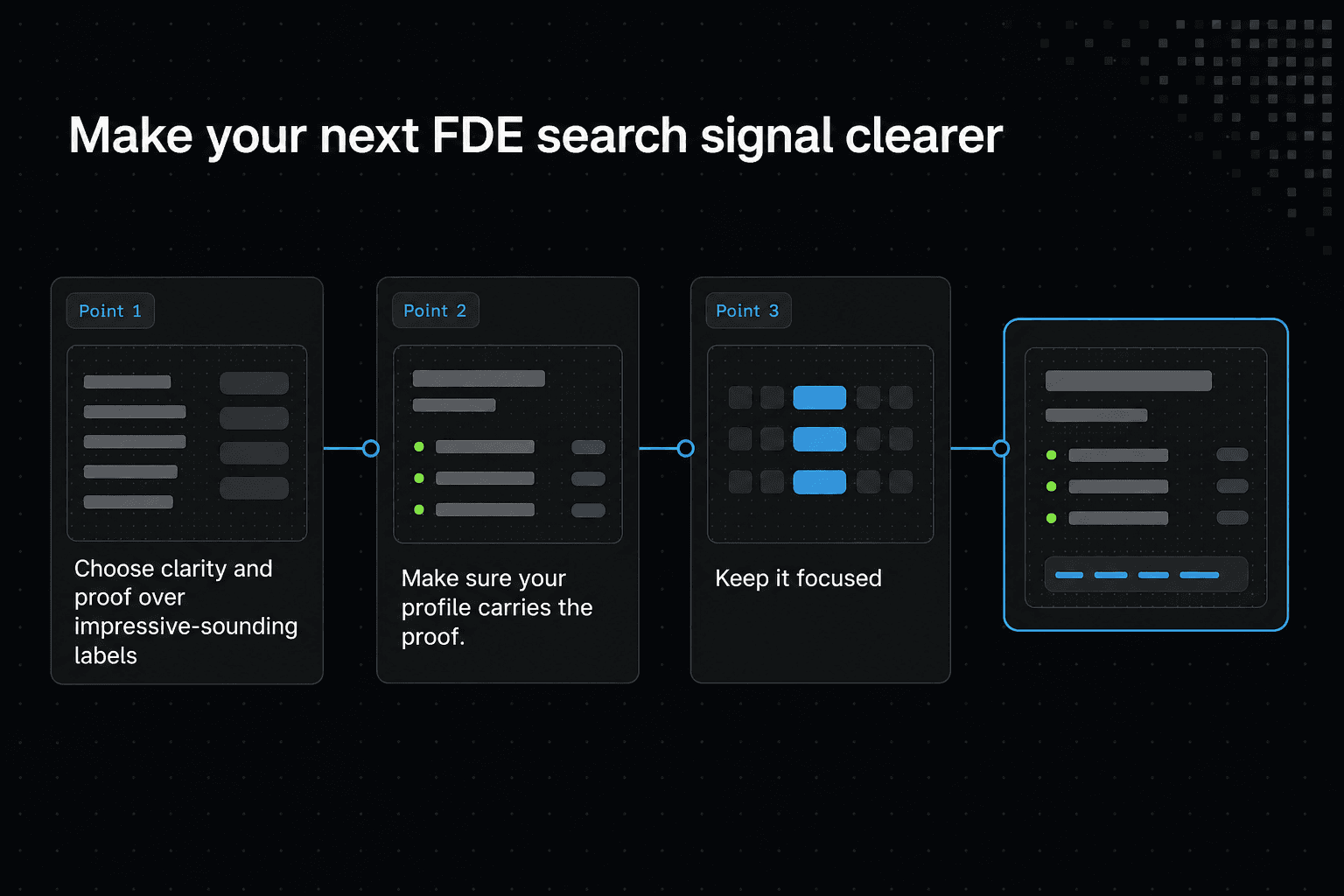
Choose clarity and proof over impressive-sounding labels
Don't borrow a title because it sounds like the job you want. Use "Forward Deployed Engineer" when it is your role, or make your direction plain with wording such as "Software Engineer targeting FDE roles."
Make sure your profile carries the proof. A technical term needs a project, job bullet, or portfolio example behind it. A customer-delivery phrase needs stakeholder work, implementation ownership, discovery, or support you can describe.
Keep it focused. One role signal, a small set of technical strengths, and one delivery context are enough.
Frequently asked questions
What should an FDE LinkedIn headline include?
Pair relevant technical implementation skills with delivery evidence such as customer collaboration, prototyping, or ownership. Include only claims you can support elsewhere on your profile.
Can I use Forward Deployed Engineer in my headline if I have never held the title?
You can signal that you are targeting FDE roles, but don't present Forward Deployed Engineer as a title you have held. Make your actual role and experience clear.
How can a software engineer position themselves for an FDE role on LinkedIn?
Connect demonstrable engineering work, such as building or integrating software, with supported evidence of collaboration, implementation, or delivery. Avoid implying customer ownership if you have not had it.
Which technical skills should I include in an FDE headline?
Choose skills relevant to work you can demonstrate, such as APIs, AI/ML, LLMs, cloud, integrations, or coding workflows. Don't list technologies you can't substantiate.
Should I mention Python, APIs, AI/ML, LLMs, cloud, or systems integration in an FDE headline?
Mention the terms that reflect your actual experience and support the FDE story you want to tell. A focused set of relevant skills is better than unsupported keyword stuffing.
How do I show customer-facing experience in an FDE LinkedIn headline?
Use specific, truthful evidence of customer collaboration or delivery if you have it. If you do not, emphasize relevant project collaboration or implementation work instead of claiming customer ownership.
What are common mistakes in an FDE LinkedIn headline?
Common credibility risks include using a title you have not held, listing unsupported technologies, and claiming customer ownership or outcomes you can't substantiate.
How often should I update my LinkedIn headline while targeting FDE roles?
Update it when your target or evidence changes, such as when you complete a relevant project or gain delivery experience. Keep each claim aligned with the rest of your profile.
About GigaRAG
GigaRAG is a shared memory platform for AI agents that helps developers and teams keep project knowledge available across sessions and tools.
You can connect agents to a central Hive Mind through MCP or the API. Access controls manage what each agent can use.