
FDE Portfolio Mistakes: How to Prove You Can Ship in the Real World
FDE portfolio mistakes can sink an otherwise sharp demo for software, AI, and RAG engineers chasing Forward Deployed Engineer roles. A slick happy path says little about whether you can handle a customer's workflow, bad data, access limits, or a failed integration. Worse, a portfolio cannot prove customer adoption, universal AI safety, or production readiness without supporting evidence.
A viewer can watch your demo in two minutes. A reviewer needs to inspect how you chose the problem, what broke, who owns recovery, and why you accepted one trade-off over another. The useful FDE portfolio makes customer understanding, operational maturity, evaluation, and trade-off judgment easy to inspect, not merely easy to watch.
TL;DR
A slick demo shows a narrow happy path. It does not, by itself, show how you would understand a customer workflow, handle deployment constraints, or learn from failure. Turn one or two projects into reviewable case studies that make those decisions visible.
FDE Portfolio Mistakes Start With Misunderstanding the Job
A portfolio can document your reasoning and evidence, but it cannot establish adoption, universal AI safety, or production readiness on its own. It can show how you think through those limits. That's the standard reviewers need.
[!note] A portfolio can document your reasoning and the evidence you collected, but it cannot prove customer adoption, universal AI safety, or production readiness without supporting evidence.
What an FDE does: discovery, delivery, debugging, and feedback to product
A Forward Deployed Engineer works where customer problems meet a product's real limits. You need to uncover the workflow, ship within messy systems and constraints, debug what breaks, then turn recurring field pain into useful product feedback.
They own end‑to‑end outcomes on the most complex AI platform deals – aligning sales promises, technical reality, and customer value across PoC → pilot → production. Your portfolio should connect a technical choice to the person using it, the work it changes, and the constraint that shaped the decision.
Why a demo is evidence of a capability, not evidence of deployment readiness
A polished demo proves a narrow thing: your system can work on the path you prepared. It doesn't show how it handles bad inputs, access rules, system failures, changing data, or a user who doesn't follow the script.
That's not enough. Show the deployment assumptions, known failure cases, and what happens when a dependency is unavailable.
The boundary between customer-specific work and reusable product learning
Customer-specific work is often necessary. The main catch is leaving it as a one-off fix.
Field work should produce a pattern: a reusable component, a documented constraint, or a product change that helps the next customer. In the worst cases, companies use FDEs to create the illusion of PMF by dressing up a consulting business to look like a product company.
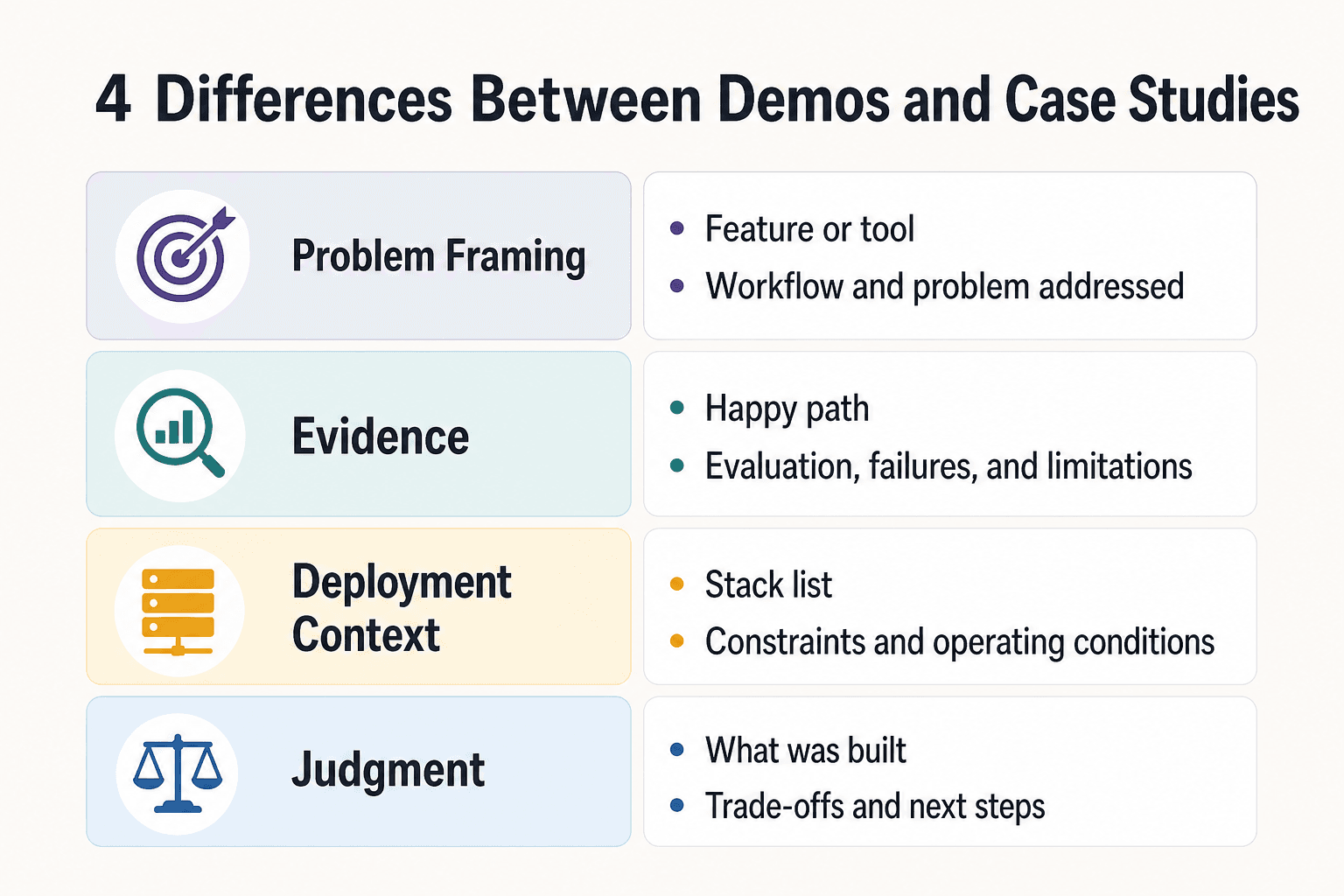
Demo description vs. reviewable deployment case study
| Factor | Demo description | Reviewable case study |
|---|---|---|
| Problem framing | Names a feature or tool | Explains the workflow and problem being addressed |
| Evidence | Shows the happy path | Describes evaluation, observed failures, and limitations |
| Deployment context | Lists a stack | Explains relevant constraints and how the system was run |
| Judgment | Highlights what was built | Makes trade-offs and next steps visible |
What Hiring Managers Expect From an FDE Portfolio
Hiring managers should be able to inspect the customer problem, choices made under uncertainty, evidence that it can be delivered, and limits on its value. An FDE portfolio isn't a promise of adoption or production readiness. It's a reviewable record of judgment.
[!tip] If you lack FDE experience, label simulated customer constraints as assumptions. Distinguish them clearly from observations or results you actually collected.
How an FDE portfolio differs from a traditional software engineering portfolio
A software engineering portfolio can center on code quality, system design, and feature delivery. Those matter here too. An FDE project also needs to show who has the problem, what their workflow looks like, and why the chosen scope fits their constraints.
Show the decision path, not just the build.
How it differs from an AI/ML portfolio focused on models or benchmarks
A model score or benchmark can show technical skill, but it doesn't show that the feature fits a real task. Reviewers need the task definition, input-quality limits, evaluation cases, and the point where a person must check the output.
Don't treat a good demo result as business value. State what value you could measure, what you could not measure, and why.
Projects that demonstrate the right skills without previous FDE employment
You don't need an FDE title. Start with a bounded workflow, such as routing support requests or finding policy answers from approved documents, then document the unclear requirements you had to resolve.
Include a stakeholder map, even if the stakeholders are assumed roles in a clearly labelled practice project. Explain which request you declined, deferred, or simplified. That shows scope control.
What reviewers can reasonably infer, and what they cannot, from public portfolio work
A reviewer can infer how you frame problems, make trade-offs, write for others, and prepare for failure. They can't infer that customers will adopt the system, that your data reflects every setting, or that a public prototype is safe for all production use.
Keep those boundaries visible.
FDE Portfolio Mistakes: A Step-by-Step Guide
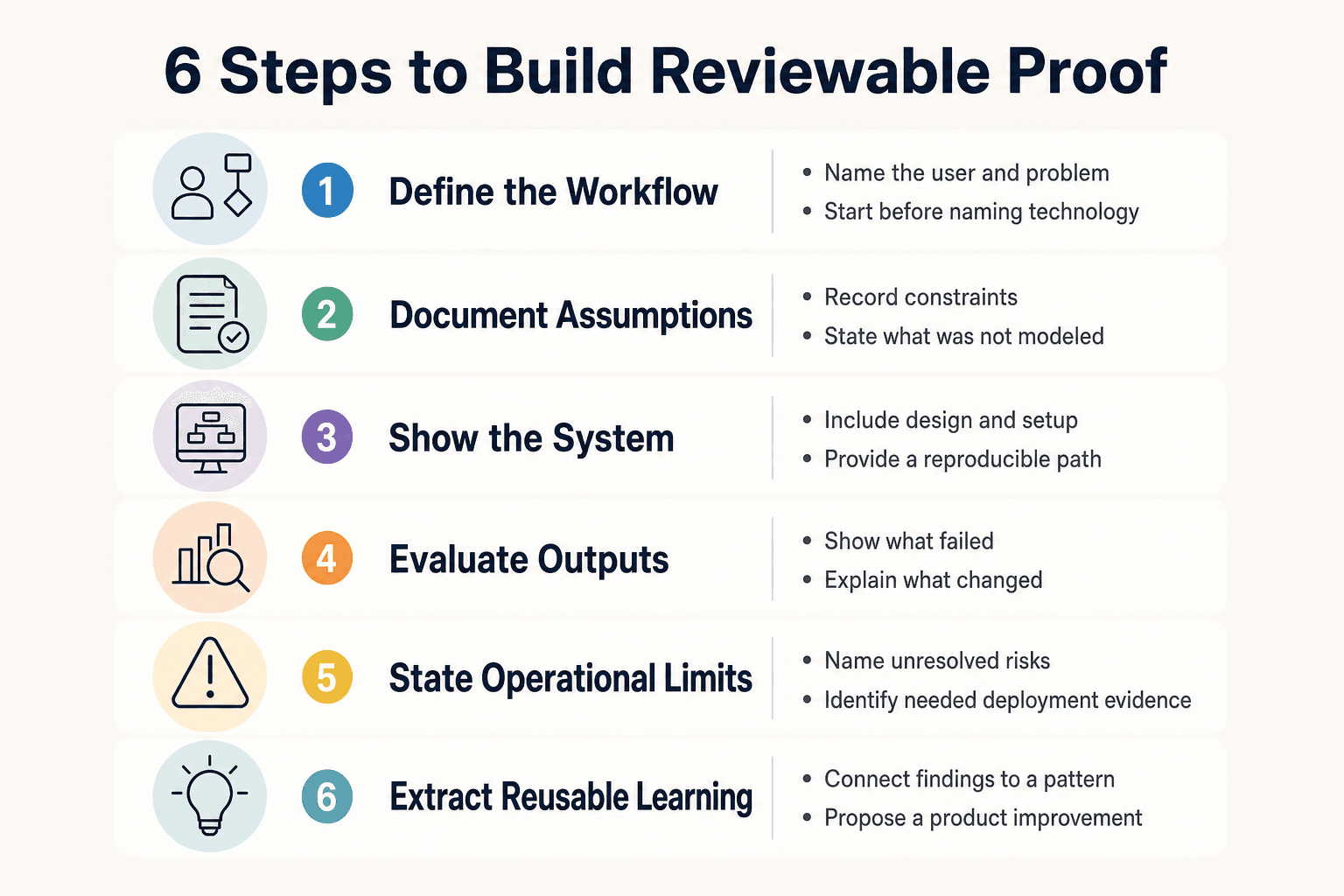
- Choose one project and describe the user, workflow, and problem before naming the technology.
- Document the assumptions you made and the constraints your project did or did not model.
- Show the system design, setup instructions, and a reproducible path through the project.
- Explain how you evaluated outputs, including what failed and what you changed.
- State operational limits, unresolved risks, and what further evidence deployment would require.
- Connect the project's findings to a possible reusable pattern or product improvement.
The Customer-Workflow Blind Spot: Building the Wrong Solution Well
A clean build can still solve the wrong problem. If your portfolio begins with the feature, reviewers can't see how you found the real work, whose needs conflicted, or why this version deserved to exist.
Before and after: from "built a support agent" to a workflow-specific problem statement
"Built a support agent that answers policy questions" describes a capability, not a customer problem.
Try: "Support staff searched three policy sources while handling time-sensitive refund requests. The assistant retrieves approved policy text, cites the source, and hands uncertain cases back to an agent." Now a reviewer can inspect the user, moment of need, source boundary, and failure path.
Keep the limit visible: you haven't proved that support staff will adopt it without observing use.
Evidence of customer discovery without confidential customer access
You don't need private customer interviews to show discovery. Use public job descriptions, help-center articles, product documentation, forum posts, or a clearly labelled practice scenario. Then separate facts from assumptions.
Make an assumption log. State what you inferred about volume, permissions, handoffs, and success criteria, then show how each assumption changed the scope. That gives reviewers something more useful than an invented customer quote.
Documenting ambiguity, competing stakeholder needs, and decision owners
Map the people around the workflow: the person doing the task, the manager accountable for outcomes, the security owner, and the team that maintains the source data. Their requests won't always fit together.
For example, speed may favor automatic replies while compliance requires review for certain cases. Name who decides, what evidence they need, and which risk wins when goals conflict. A feature request often loses the workaround and local constraint behind it, as Bartek Pucek argues. Your portfolio should preserve both.
Turning field findings into reusable product patterns instead of bespoke fixes
Don't present every request as a feature. Group findings into patterns: repeated source-permission problems may call for a reusable access layer, while one team's naming convention may stay local.
The honest answer is that it depends on whether the problem recurs across workflows and customers. Record the decision, rejected bespoke fix, and product change you would propose. That shows you can turn field detail into a learning loop rather than add another one-off configuration for the next customer.
When a Great Demo Fails in Production
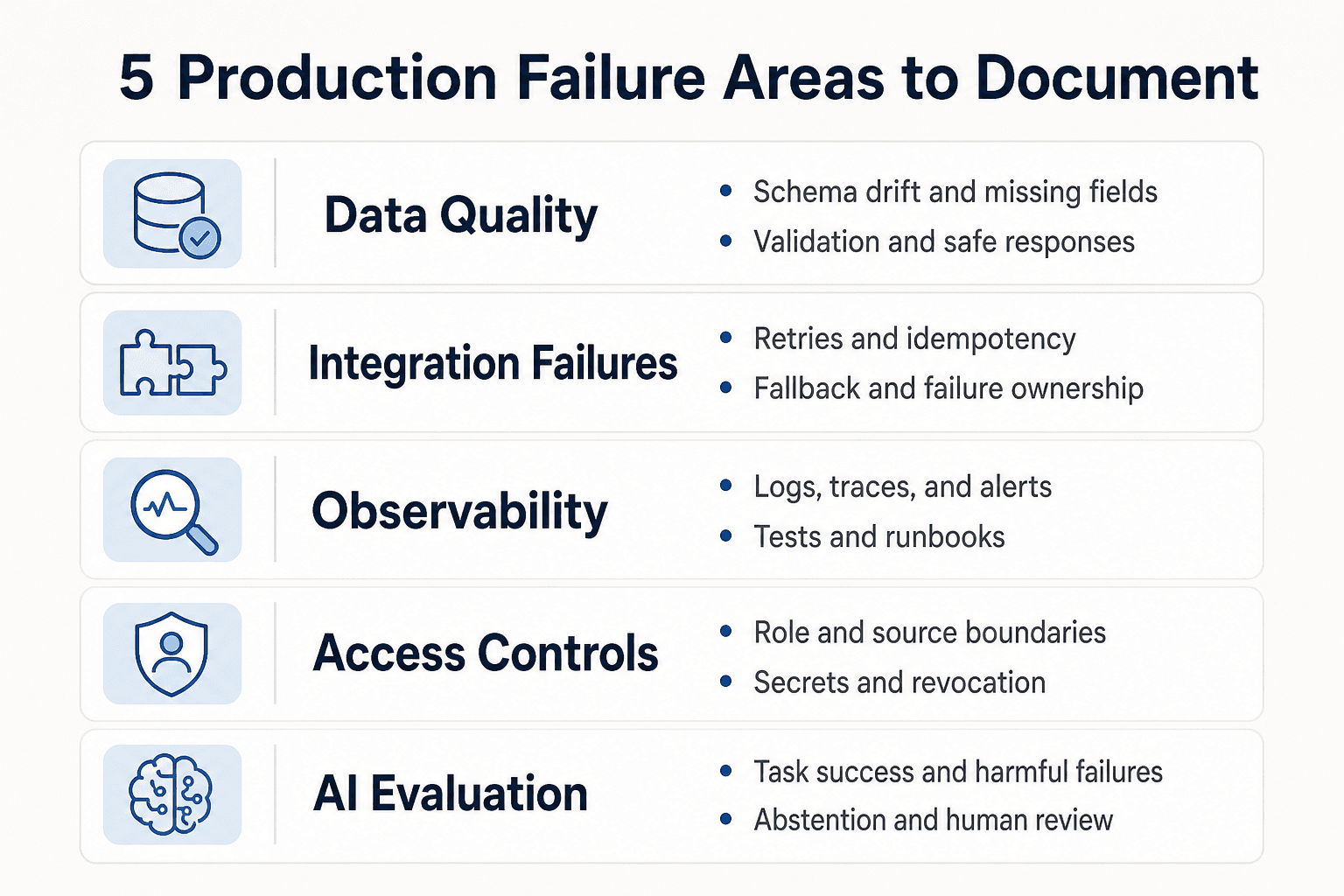
A portfolio can't prove your prototype is production-ready, that every integration will behave, or that an AI feature is safe in every context. It can show that you anticipated the conditions that break the happy path and made those risks inspectable.
Messy data, schema drift, missing fields, and legacy-system constraints
Don't show only clean sample records. Include a data contract, validation rules, and examples of missing, stale, duplicated, or renamed fields.
State what happens when an upstream system changes a column or cannot supply an ID your workflow needs. Poor data quality remains the single largest technical barrier to successful AI deployment., but the useful portfolio evidence is your response: reject the record, quarantine it, or use a safe default.
Brittle integrations: retries, idempotency, fallbacks, and failure ownership
An API call will fail. Show your timeout, retry policy, and idempotency key, which stops a retried request from creating the same action twice.
Name the fallback: queue the work, hand it to a person, or stop the workflow. Make sure you assign an owner for failed jobs and explain how they know a job needs attention.
Testing and observability: what logs, alerts, traces, and runbooks show
Screenshots don't show operability. Add unit and integration tests for expected failures, then include a redacted log example, trace flow, alert condition, and short runbook.
Here's what happens behind the scenes: logs record events, traces follow one request across services, and alerts call attention to a threshold. A reviewer can then see how you would debug a slow or broken customer workflow.
Security and access controls: what to document without exposing secrets
Never publish keys, tokens, customer records, or internal endpoints. Document the boundary instead: which role can read which source, where secrets live, what data reaches the model, and how access is revoked.
Keep the limit visible. A diagram and policy description show design intent, not that a real security review approved the system.
AI feature evaluation: task success, harmful failure cases, and human review boundaries
AI outputs may sound certain, but certainty doesn't equal accuracy or fairness. Define task success with a labelled test set or review rubric, then include failures that matter: unsupported answers, wrong citations, unsafe actions, or sensitive-data exposure.
The good news is you don't need to claim universal safety. Show when the system abstains, when it routes to human review, and who has authority to approve the final action.
Build Reviewable Proof: GitHub, README, Demo, Architecture, and Deployment
A polished page can hide weak engineering. Give reviewers artifacts they can inspect, run, and challenge while stating what remains unproven without a real customer environment.
A README that explains the user, workflow, constraints, and success criteria
Start with the user and the job they need done. Explain the workflow, inputs, output, constraints, and condition that counts as success.
Keep it decision-focused. Name the trade-off you made, why you made it, and what the project won't handle.
Architecture diagrams that show data flow, trust boundaries, and failure paths
Draw the path from source data to user action. Mark external services, stored data, role boundaries, and places where a request can fail.
Happy-path boxes aren't enough. Show what happens when a dependency times out, input fails validation, or a user lacks permission.
GitHub evidence: commits, issues, tests, configuration, and reproducibility
Your repository should let someone understand how the work changed over time. Keep meaningful commits, issues for known gaps, tests for core behavior, and sample configuration with secrets removed.
Add setup steps another developer can follow. If they need paid services, special access, or local infrastructure, say so before they spend time trying to run it.
Demo evidence: show a failure path and recovery, not only the happy path
Record a short demo of the normal workflow, then break something on purpose. Use a bad input, unavailable dependency, or denied permission and show the system's response.
Don't fake certainty. A recovery path shows engineering judgment, but it can't prove that every incident is covered.
Deployment evidence: environment assumptions, cost considerations, rollback, and a runbook
State where the system runs and what it assumes about network access, identity, data volume, and third-party services. Include cost drivers if your design calls external models or APIs.
Then add a rollback step and a short runbook for a failed release. This turns a demo into something a reviewer can reason about.
Red Flags That Reveal a Polished Presentation Without Engineering Depth
The evidence must survive inspection. If a reviewer can't trace a claim to code, a decision, or a test, polish becomes a red flag.
Red flags: screenshots without code, vague metrics, and unexplained architecture
Screenshots, vague metrics, and arrow-only diagrams don't explain a system. Link each claim to code, a test, or a decision note, and state what each metric measures.
Red flags: no failure cases, no access model, and no evaluation plan for AI behavior
Missing failure cases are worse than a plain interface. For an AI feature, show denied access, bad source material, or an unsupported answer, then name the access rule and evaluation boundary.
How to document a failed experiment without making the portfolio look weaker
Don't bury the miss. State the hypothesis, the test, the result, and the decision that followed. A failed retrieval approach can strengthen the case when you explain why it failed and what you changed.
How to explain trade-offs among speed, reliability, scope, cost, privacy, and maintainability
Trade-offs are the work. Say you limited data for privacy, accepted a slower human check for reliability, or cut scope for a deadline. Then name the cost and what would make you revisit the choice.
Before and after: replacing 'used RAG' with an evidence-based implementation narrative
Before: "Used RAG to answer support questions." After: "Indexed approved articles, required citations in replies, logged unanswered questions, and routed low-confidence cases to review." The second version gives a reviewer implementation choices to inspect, not a label to trust.
A Self-Assessment Checklist and Prioritized Improvement Plan
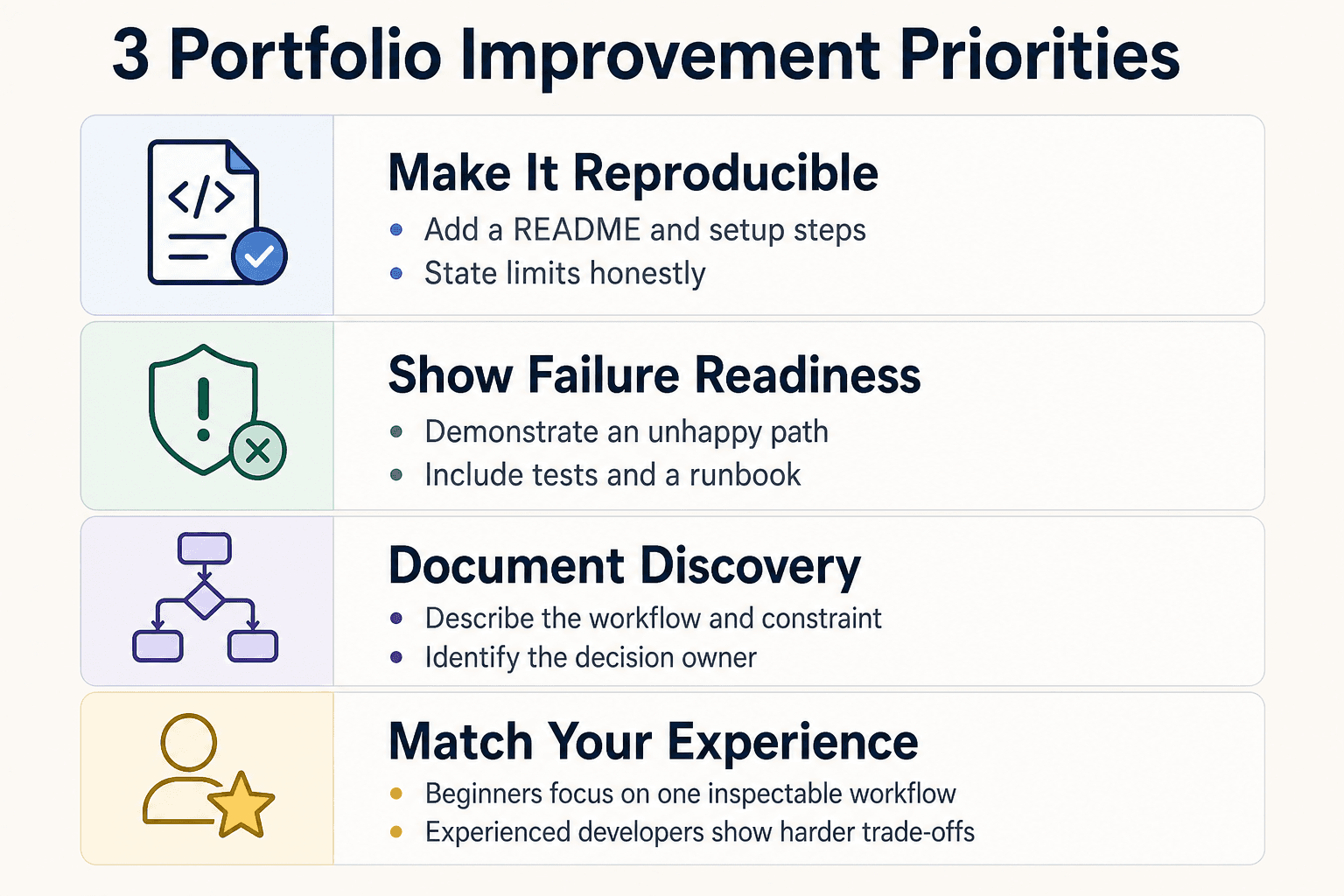
Don't start another project yet. Audit the strongest one against evidence a reviewer can inspect, then fix the biggest gaps in order.
Portfolio checklist: customer, workflow, evidence, reliability, security, evaluation, and outcomes
Check that your project answers these questions: Who uses it? What work does it change? What evidence supports the design? How does it fail, recover, protect access, and assess AI output? Name an outcome you hoped to improve, but don't present an unmeasured result as fact.
Priority 1: make one project reproducible and honest about its limits
Start with a clean README, setup steps, sample configuration, and a way for another person to run the core workflow. Then add a limits section: a portfolio can't prove a customer will adopt the system, and a prototype isn't production-ready just because it deploys.
Keep it runnable.
Priority 2: add production-readiness evidence and a failure-path demo
Show one unhappy path. For example, demonstrate a missing field, failed API call, denied user request, or poor retrieval result, then show the fallback, log entry, and operator action.
Add tests where they matter most, plus a short runbook for diagnosis and recovery. You don't need a full operations platform, but you do need to show that somebody owns failure.
Priority 3: add discovery, stakeholder, and business-value documentation
Write a short problem brief before expanding features. Include the user's current workaround, a constraint, a decision owner, and a question you would need to ask before deployment.
If you have no customer access, use a clearly labelled hypothetical workflow or public process. Don't pretend it is field research. State what feedback would change your design, because that shows you can learn rather than defend a first draft.
Beginner versus experienced developer improvement paths
If you're a beginner, focus on one narrow workflow and make it inspectable: code, README, architecture sketch, tests, limits, and a failure demo. Depth beats three unfinished apps.
If you're experienced, the main catch is higher expectations. Document a harder integration, competing requirements, access boundaries, cost or maintenance trade-offs, and an iteration you changed after new evidence.
Make Your Portfolio Useful Before You Make It Impressive
A portfolio can't prove that a customer will adopt your system, that an AI feature is safe in every context, or that your prototype will survive production load. It can show how you reasoned about those unknowns, what you built to reduce risk, and where more evidence is needed.
A clean demo may get attention, but a reviewer needs enough detail to inspect your judgment under real constraints.
The final standard: clear evidence, explicit limits, and a learning loop
Make each project answer three things: what problem you chose, why you chose this approach, and what would make you change it. Show the code and artifacts behind the answer, not just the finished screen.
Name limits plainly. If your evaluation uses synthetic data, say so. If access control is a design rather than a deployed feature, say that too. Honest boundaries make your claims easier to trust.
Then leave a learning loop: feedback you would collect, a failure you would monitor, and the next decision that feedback would shape. The best fix for FDE portfolio mistakes is not a bigger claim. It's evidence a reviewer can check.
Frequently Asked Questions
What should an FDE portfolio include?
Include a small number of projects with clear problem framing, workflow context, implementation details, evaluation, and limitations. Make the evidence reviewable with a README, architecture notes, and a way to inspect or run the project.
How is an FDE portfolio different from a software engineering portfolio?
An FDE portfolio should make customer context and deployment judgment visible alongside engineering work. Show how you framed a workflow, handled constraints, evaluated the solution, and identified what should happen next.
What projects are best for a Forward Deployed Engineer portfolio?
Choose projects that let you explain a real or carefully scoped workflow, relevant constraints, and how you evaluated the result. A modest project with visible trade-offs can make your judgment easier to review than a polished demo with little context.
Can I build an FDE portfolio without FDE experience?
Yes. You can present a project as a case study and make clear which customer conditions are simulated assumptions rather than firsthand deployment experience. Do not imply that a prototype was adopted or production-ready unless you have supporting evidence.
How do I show customer discovery in a portfolio project?
Describe the user, their workflow, the problem you chose to address, and the assumptions behind your framing. If you did not speak with customers or observe a live workflow, say so and explain how you would validate those assumptions.
How do I prove an AI or RAG project is production-ready?
A portfolio alone cannot establish production readiness. Document the evaluation you performed, deployment conditions you tested, known limitations, and remaining risks. Avoid claiming readiness beyond that evidence.
Should I include failed experiments in an FDE portfolio?
Include failures when they clarify what you learned and how that changed your approach. Explain the relevant evidence and trade-off rather than presenting a failure as proof of a broader result.
About GigaRAG
Learn more about GigaRAG at https://www.gigarag.com.


