FDE resume bullet points that prove technical delivery and customer impact
FDE resume bullet points have to answer one question for aspiring and current Forward Deployed Engineers: can you take an unclear customer problem through real technical delivery? A list such as "Built RAG pipeline with Python and APIs" can't show that. It leaves out the user need, your role, whether it reached production, and what evidence supports the work.
A stronger bullet might say you "Prototyped a retrieval workflow for support-document search, using evaluation cases from stakeholder questions to compare results before a pilot." It still can't prove revenue, broad adoption, or production reliability, and you shouldn't invent those claims. Strong bullets don't need inflated numbers, but they need bounded ownership, a reason for the technical choice, and proof you can stand behind.
Quick answer
An FDE resume bullet should connect a customer or user problem to your technical action, your role in delivery, and the evidence you can honestly share.
- Name the problem and context.
- State what you personally built, changed, or investigated.
- Describe the delivery stage and support the outcome with verifiable evidence.
What recruiters look for in FDE resume bullet points
Recruiters scan FDE resume bullet points for proof that you can take a customer or operational problem through delivery: clarify the need, make a technical choice, ship or support the work, and show the evidence available. A list of tools can't prove that. Honest scope matters as much as impact.
The difference between an FDE resume and a technology inventory
"Built with Python, Kubernetes, and LLMs" says what you touched. It doesn't show why the work existed, who needed it, or whether it reached a usable stage. An FDE bullet connects the stack to a problem and delivery constraint.
The five signals recruiters need to infer quickly
They need to see context, your bounded ownership, the technical decision, the delivery stage, and a defensible result. Keep it concrete. Don't claim a customer outcome you couldn't control or turn a prototype into a production deployment.
A simple bullet anatomy: context + action + mechanism + evidence
Start with the problem, then name what you did and how. End with evidence: a deployed integration, stakeholder validation, a test result, or an incident resolved. If you don't have a metric, use the proof you do have.
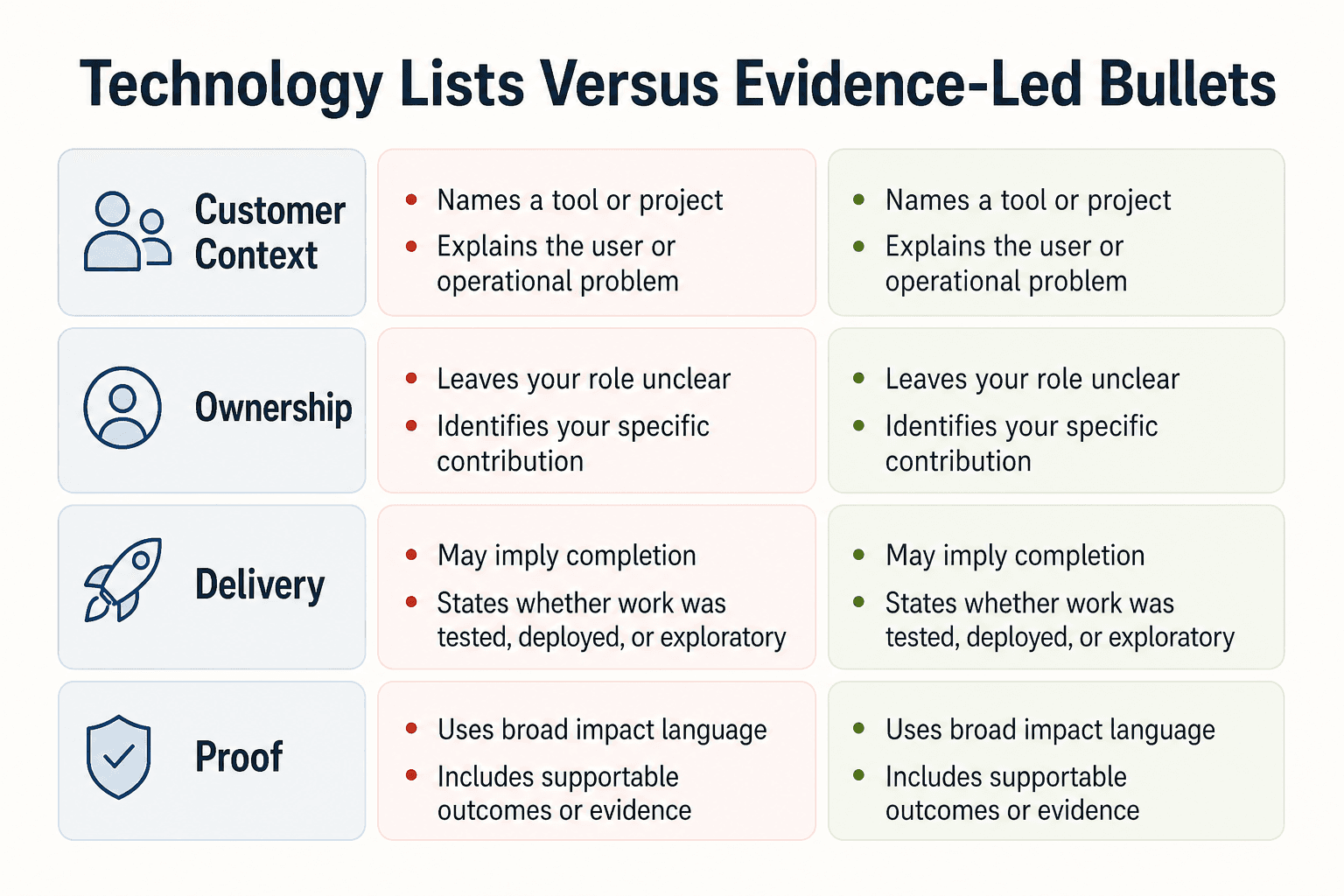
Technology list vs. evidence-led FDE bullet
| Factor | Technology list | Evidence-led bullet |
|---|---|---|
| Customer context | Names a tool or project | Explains the user or operational problem |
| Ownership | Leaves your role unclear | Identifies your specific contribution |
| Delivery | May imply completion | States whether work was tested, deployed, or exploratory |
| Proof | Uses broad impact language | Includes only supportable outcomes or evidence |
Use an evidence-first framework for technical delivery
A resume bullet can't prove revenue, adoption, latency, or model quality unless you can trace that result to your work and defend the number. Don't fill that gap with a guess. Use the delivery evidence you actually have.
[!tip] For AI or RAG projects, explain the problem the component addressed, such as retrieval, integration, or troubleshooting, rather than listing model and framework names alone.
The C-A-M-E framework: customer context, action, mechanism, evidence
Draft each bullet with C-A-M-E: customer context, your action, the mechanism you chose, and evidence of what happened. "Mapped support-team requirements, built an API integration to sync case data, and released it for stakeholder review" is specific without claiming business impact you can't verify.
How to distinguish individual ownership, team contribution, and collaboration
Scope your verbs carefully. Use "built," "debugged," or "wrote" for work you owned. Use "contributed to," "partnered on," or "supported" when a team made the decision or shipped the system.
Small wording change, big difference.
When a metric is credible, and when not to use one
Use a metric when you know its source, time frame, and connection to your work. If a team dashboard showed a result after launch, but you did not own measurement or the full release, don't present it as your individual outcome.
It depends on attribution. Name the shared result only when you can state your role plainly.
Evidence alternatives: release stage, test coverage, stakeholder validation, decision records, and operational artifacts
Evidence isn't limited to outcome metrics. A completed proof of concept, merged test suite, approved architecture decision, deployment runbook, stakeholder sign-off, or resolved incident can all support a claim.
Here's what happens behind the scenes: these artifacts show that the work moved beyond an idea, even when customer data is private or outcomes take months to measure.
A concise editing checklist for one-line and two-line bullets
Before you start applying, check each bullet:
- Can you name the user, workflow, or operational problem?
- Does the verb match your actual ownership?
- Does the technical choice explain why it was used?
- Is the metric traceable, or should you use another form of proof?
- Could you explain the claim in an interview?
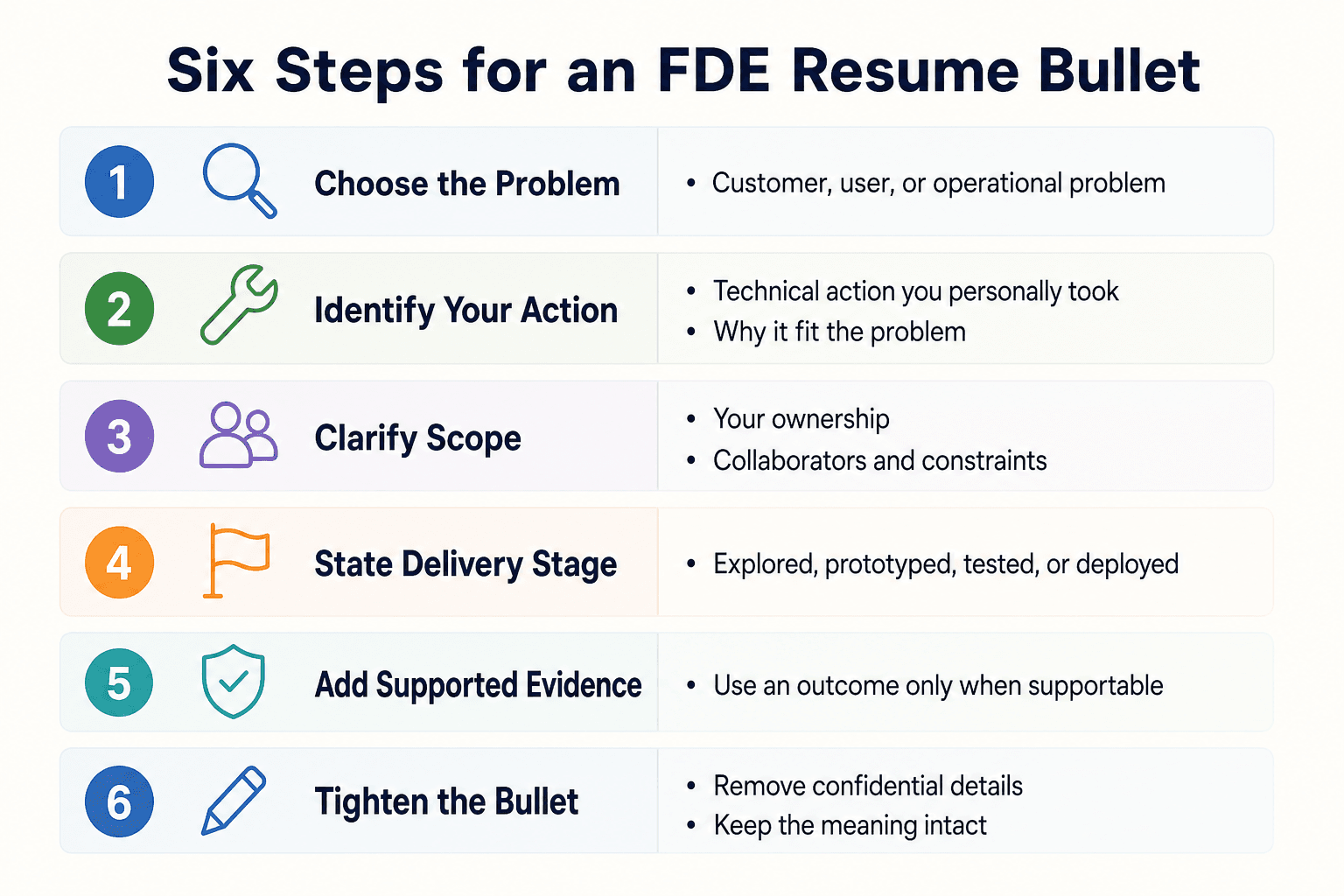
FDE resume bullet points: a step-by-step guide
- Choose a customer, user, or operational problem you worked on.
- Identify the technical action you personally took and why it fit the problem.
- Clarify your ownership, collaborators, and constraints.
- State whether the work was explored, prototyped, tested, or deployed.
- Add an outcome only when you can support it with evidence.
- Remove confidential details and tighten the bullet without changing its meaning.
Before-and-after FDE bullet examples by career background
The weak versions below name a task. The stronger versions name the problem, your bounded role, and proof that the work reached a real delivery stage. Don't borrow an outcome you can't explain in an interview.
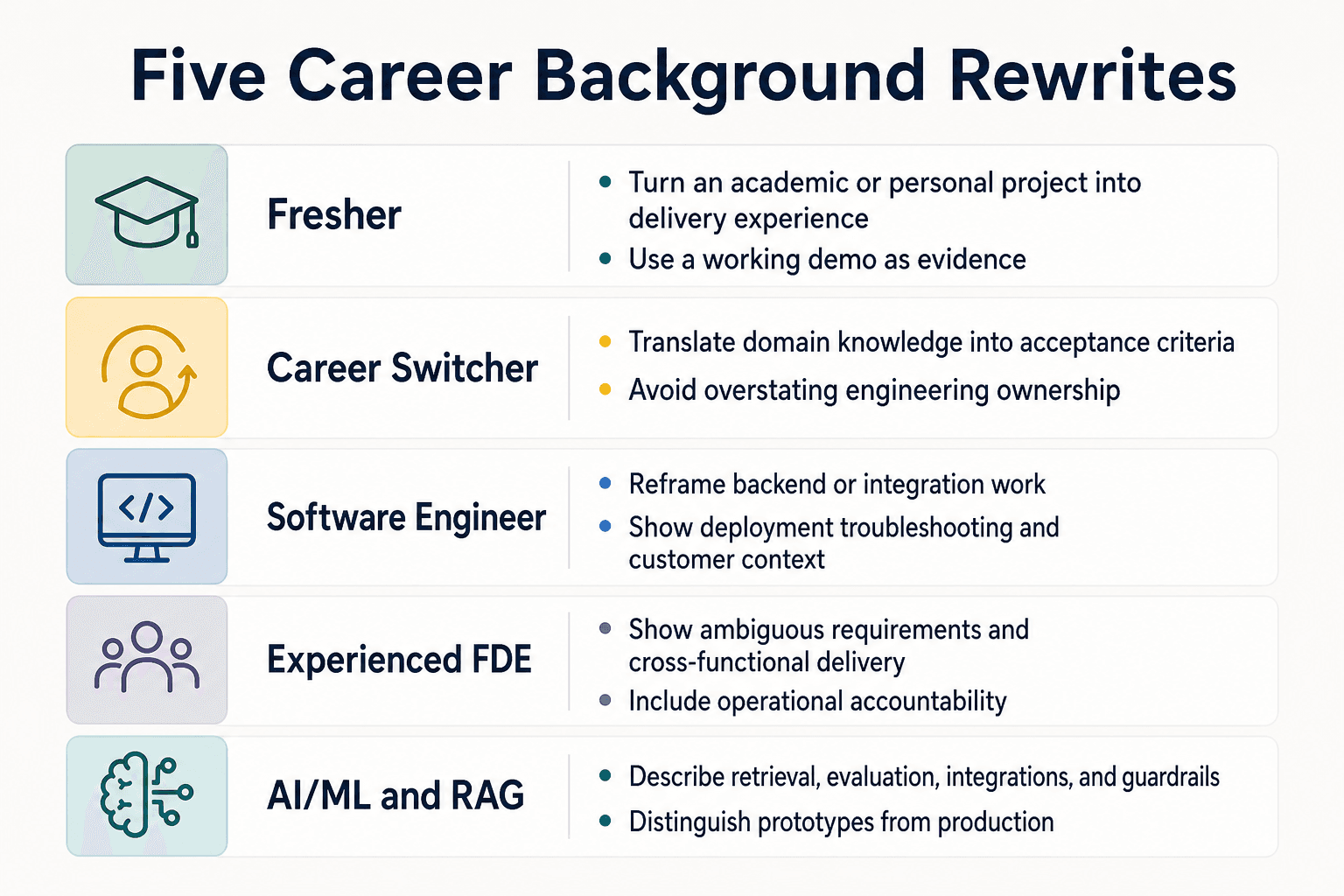
Fresher example: convert an academic or personal project into evidence-based delivery experience
Before: Built a chatbot using Python and an LLM.
After: Built a document-search prototype for student policy questions, added source retrieval to ground responses, and shared a working demo with project reviewers.
Career switcher example: translate domain knowledge and customer problem-solving without overstating engineering ownership
Before: Helped clients solve technical issues.
After: Gathered workflow issues from operations users, translated them into acceptance criteria, and partnered with engineers to validate an integration prototype.
Don't say you built it if you did not.
Software engineer example: reframe backend, platform, or integration work for an FDE role
Before: Developed REST APIs and fixed bugs.
After: Built and debugged an API integration that moved order data between systems, documented failure cases, and supported deployment troubleshooting with the customer team.
Experienced FDE example: show ambiguous requirements, cross-functional delivery, and operational accountability
Before: Led client implementations.
After: Turned unclear stakeholder needs into a phased implementation plan, coordinated engineering and customer teams, and maintained the runbook used during production support.
AI/ML and RAG examples: describe retrieval, evaluation, agent memory, integrations, and guardrails in business context
Before: Created a RAG agent with memory.
After: Prototyped a retrieval-augmented assistant for support-document questions, evaluated answer quality against a defined test set, and added citation and access controls before stakeholder review.
If memory stored prior user context, say that. If it was only a demo, don't call it a production deployment.
What each rewrite changes: specificity, ownership, evidence, and customer relevance
The better bullets explain why the technology existed: to answer questions, connect systems, reduce a workflow gap, or support a release. They replace vague success claims with proof you can show, such as a demo, test set, runbook, review, or resolved incident.
Avoid FDE resume mistakes that make strong work sound weak
A credible bullet shows where your role stopped as clearly as where it began. That matters when a customer result came from a joint effort, a later release, or a decision you advised but did not own.
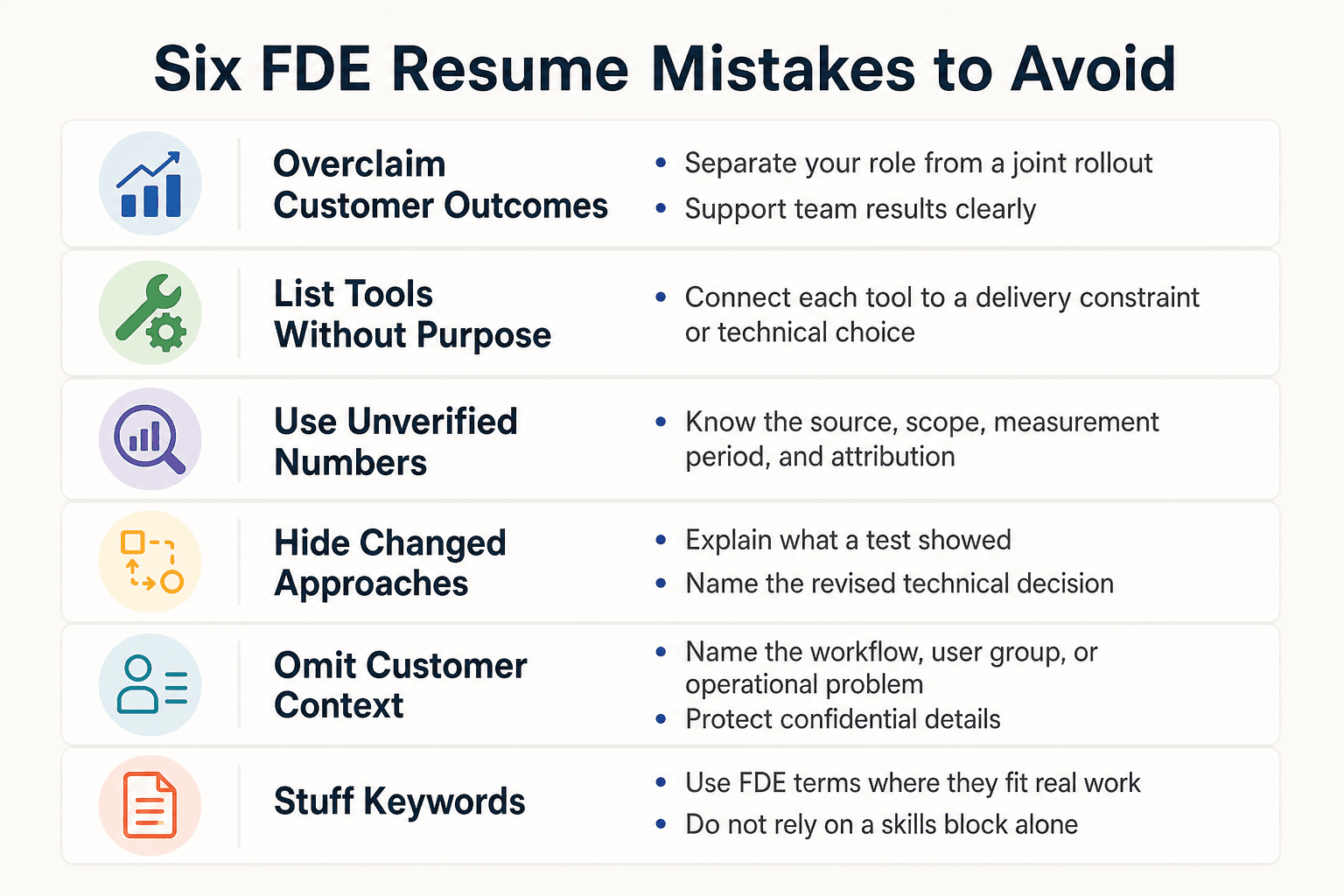
Do not claim ownership of a customer outcome you did not control
Don't write "increased customer adoption" if you only built one part of the rollout. Write "built the onboarding integration used in the customer rollout" and name the outcome only as a team result, if you can support it.
Do not list Python, Kubernetes, LLMs, or APIs without explaining their use
A stack list proves very little. Tie each tool to a technical choice: "used Kubernetes to package the service for the customer's deployment environment" is stronger because it explains the delivery constraint.
Do not use unverified revenue, accuracy, latency, or adoption numbers
A number isn't evidence just because it looks precise. Use a metric only when you know its source, scope, measurement period, and your connection to it. Otherwise, name the artifact or decision you can verify.
How to mention a failed experiment or changed approach honestly
You don't need to hide a rejected approach when it led to a sound technical decision. Say what the test showed and what changed: "evaluated a retrieval approach against a defined question set, documented weak results, and revised the chunking strategy before review."
How to add customer and business context to a project bullet
Name the workflow, user group, or operational problem without exposing confidential details. "Reduced manual order checks" is useful context; "helped a customer" is not.
ATS guidance: use FDE keywords naturally without keyword stuffing
Use terms from the role where they fit your real work: customer discovery, requirements, API integration, prototype, deployment, incident troubleshooting, or RAG evaluation. Don't paste them into a skills block and hope they carry the application.
Frequently asked questions
What should an FDE resume bullet point include?
Connect the customer or user problem to your technical action and your specific role. Clarify the delivery stage, then include an outcome only when you can support it.
How do I write FDE resume bullet points with no work experience?
Use coursework, personal projects, or volunteer work when it shows relevant problem-solving or delivery. Be clear about the setting, your contribution, and whether the work was a prototype, test, or deployed project.
How can a software engineer tailor a resume for a Forward Deployed Engineer role?
Reframe relevant engineering work around the user problem, technical decisions, integration or deployment work, and your direct contribution. Do not imply customer ownership or outcomes you did not have.
Should every FDE resume bullet include a metric?
- Use a metric only when it is accurate, relevant, and verifiable. A specific explanation of the problem, your action, and the delivery status is better than an unsupported number.
How do I describe a RAG or AI project on an FDE resume?
Explain what problem the system was meant to address, what you built or integrated, and what you personally owned. Distinguish a prototype or experiment from a deployed system, and avoid claiming results you cannot verify.
How should I list customer-facing work without revealing confidential client information?
Describe the customer context without identifying the client or exposing protected details. Focus on the type of problem, your role, and shareable evidence. Follow any confidentiality obligations that apply to you.
Turn your existing experience into a stronger FDE resume
[!note] A team result is not automatically an individual result: make your contribution distinct from work owned by others. Do not present an experiment or failed prototype as a successful deployment.
Build an experience inventory from projects, incidents, prototypes, and stakeholder work
Start with work you can document: projects, incidents, prototypes, handoffs, and stakeholder conversations. For each, note the problem, your role, the constraint, what you changed, and the proof you can show.
Match evidence to the FDE job description
Read the job description for delivery signals, not just tools. If it calls for customer discovery, integrations, deployment, or troubleshooting, select an example where you did that work and name the relevant artifact, decision, or release stage.
Use a final credibility review before submitting
Check every verb. Could you explain what you personally built, tested, decided, or supported if asked in an interview?
Remove claims you can't defend.
What a resume bullet cannot prove on its own
A bullet can show a credible starting point, but it can't prove your technical depth, judgment under pressure, or ability to work with a customer. Keep notes, demos, design records, and clear stories behind your FDE resume bullet points, because interviews will test the detail.
About GigaRAG
GigaRAG helps you share agent memory like you share Google Docs. It connects your AI agents to a central Hive Mind, with access controls for what each agent can use. Developers, vibe coders, and teams can keep project knowledge available across sessions and tools, so agents can pick up where work left off without rebuilding context or managing a full RAG stack.