FDE Resume Examples for Freshers, Engineers, and Career Switchers
FDE resume examples can help aspiring Forward Deployed Engineers, including RAG and agent-memory builders, turn technical work into a credible application. But they can't turn a generic software engineering resume into proof that you've owned customer outcomes. An FDE role needs a clear link between a technical decision, an operating constraint, and evidence that someone used the result.
The main catch is honesty: don't copy production metrics, client ownership, or stakeholder claims you can't verify. Instead, frame the work you did, the limits you handled, and the outcome you can support. These examples are adaptable models, not achievements to copy verbatim.
Process overview
An FDE resume should connect technical work to a real operating constraint and a user or customer need, not just list tools or change your job title. Start with verified engineering, project, and stakeholder-facing evidence. Then choose examples that match your experience level, rewrite bullets around the work and its outcome, and check that every keyword describes your actual experience.
What makes an FDE resume different from a software engineer resume
An FDE resume can't prove client ownership, production adoption, or business impact if you don't have evidence. Don't borrow those claims from a job description. Start with what you can verify: the system, the people who used it, the constraint, your part in delivery, and the result you observed.
A software engineer resume can focus on features and stack. An FDE resume must show how you handled an unclear problem through deployment and iteration. Here's why: the role sits between technical work and the conditions around it, including user needs, existing systems, rollout risks, and feedback after release.
The four signals hiring teams need to see
Show four things in each strong entry:
- Discovery: How you learned what users or stakeholders needed.
- Constraint handling: The messy data, legacy system, security rule, time limit, or unclear requirement that shaped the work.
- Deployment ownership: Your role in integration, release, monitoring, debugging, or handoff.
- Operational result: A verified outcome, such as a completed rollout, fewer manual steps, or feedback that changed the next version.
The result doesn't always need a percentage. It does need a real basis.
What an FDE resume should not imply without evidence
Don't write that you "led client delivery" when you supported an internal team. Don't call a demo a production deployment, or say users adopted a tool when you only built it.
FDE language can make ordinary work sound bigger than it was. Keep the scope plain, especially when confidentiality prevents you from naming the organization or sharing exact results.
When a software engineering achievement is FDE-relevant
It depends on whether the work reached beyond feature delivery. A backend project becomes FDE-relevant when you can connect a technical choice to a user workflow, a deployment constraint, or an observed outcome.
For example, "Built an API service in Python" is generic. "Built an API service that mapped inconsistent source fields for an internal operations workflow, then fixed errors found during rollout" shows integration, iteration, and operating context.
FDE resume vs. software engineer resume: what changes?
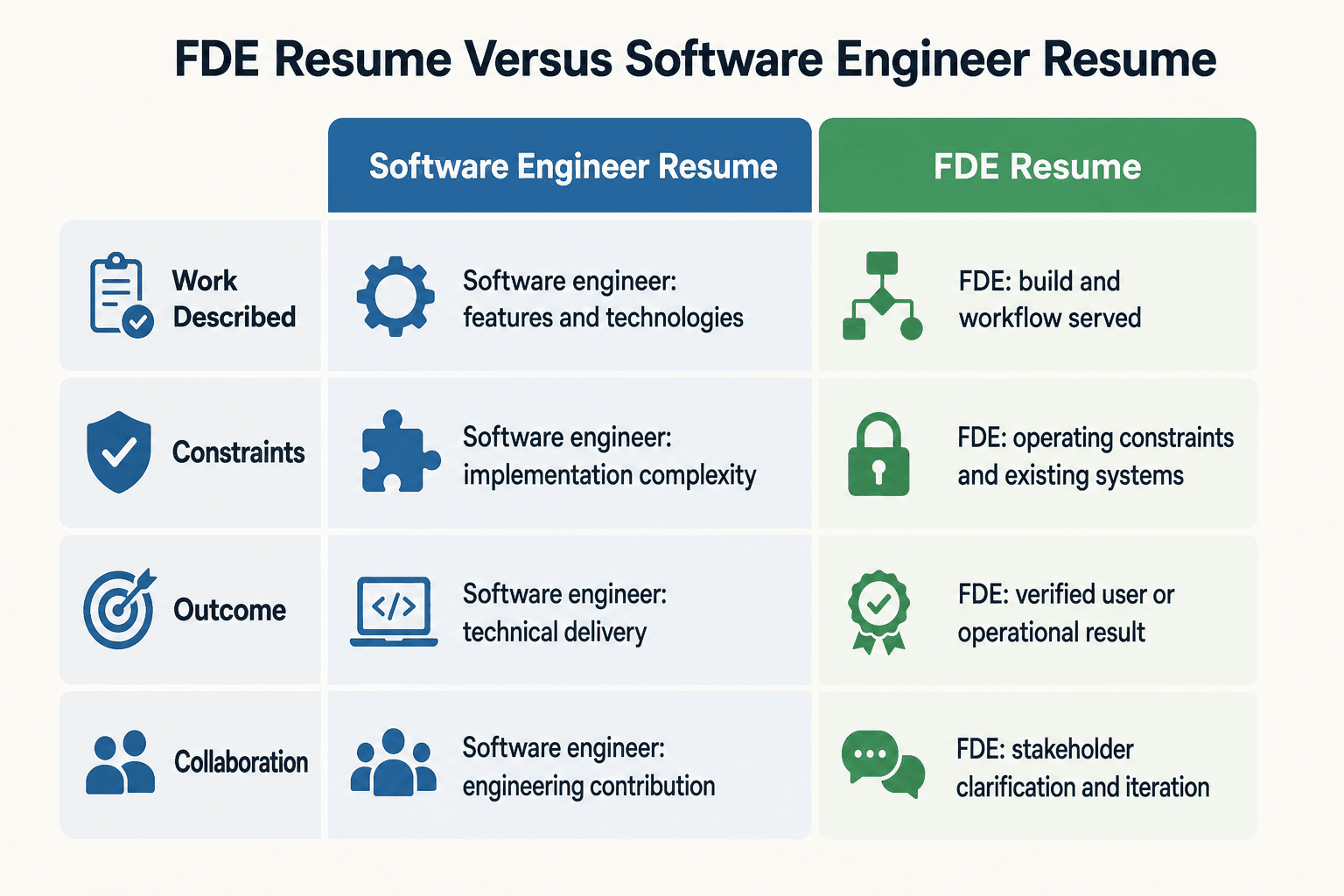
| Factor | Software engineer framing | FDE framing |
|---|---|---|
| Work described | What you built and the technologies used | What you built and who or what workflow it served |
| Constraints | Technical complexity or implementation details | Operating constraints, such as legacy systems or incompatible authentication |
| Outcome | Technical delivery or system behavior | A verified user, customer, or operational outcome |
| Collaboration | Engineering-team contribution | How you worked with stakeholders to clarify needs and iterate |
Set up the resume structure before you write
A clean layout makes real evidence easier to find. It can't rescue vague bullets, unsupported results, or a claim that makes a class project sound like client delivery.
Recommended section order for an FDE application
Use this order:
- Contact details and links
- Summary, if it adds useful context
- Technical skills
- Experience
- Projects
- Education and relevant certifications
Put experience before projects when you have relevant roles. If you are changing careers or early in your career, a strong project can carry more weight, so place it where a reviewer will see it.
Within each role, lead with work closest to deployment, integration, debugging, or user needs. Don't order bullets only by date.
How to use a summary without writing a generic objective
Keep the summary to two or three lines. Name your technical focus, the kind of problem or environment you have worked in, and one verified delivery signal.
Skip statements like "seeking a challenging FDE role." They tell the reader nothing. Keep a summary only when it gives context the rest of your resume cannot show quickly.
Skills grouping and readable layout choices
Group skills by use: languages, data and pipelines, cloud and infrastructure, APIs and integrations, and delivery tools. This is easier to scan than a long mixed list.
Only list tools you can discuss. Include certifications when they fit the job, especially for a named cloud platform or regulated environment.
When one page versus two pages is reasonable
One page is the usual choice. The FDE Resume guide suggests two pages only when you have eight or more years of relevant experience.
It depends on whether the second page adds proof of FDE-relevant work. If it holds old tools, repeated bullets, or unrelated duties, cut it.
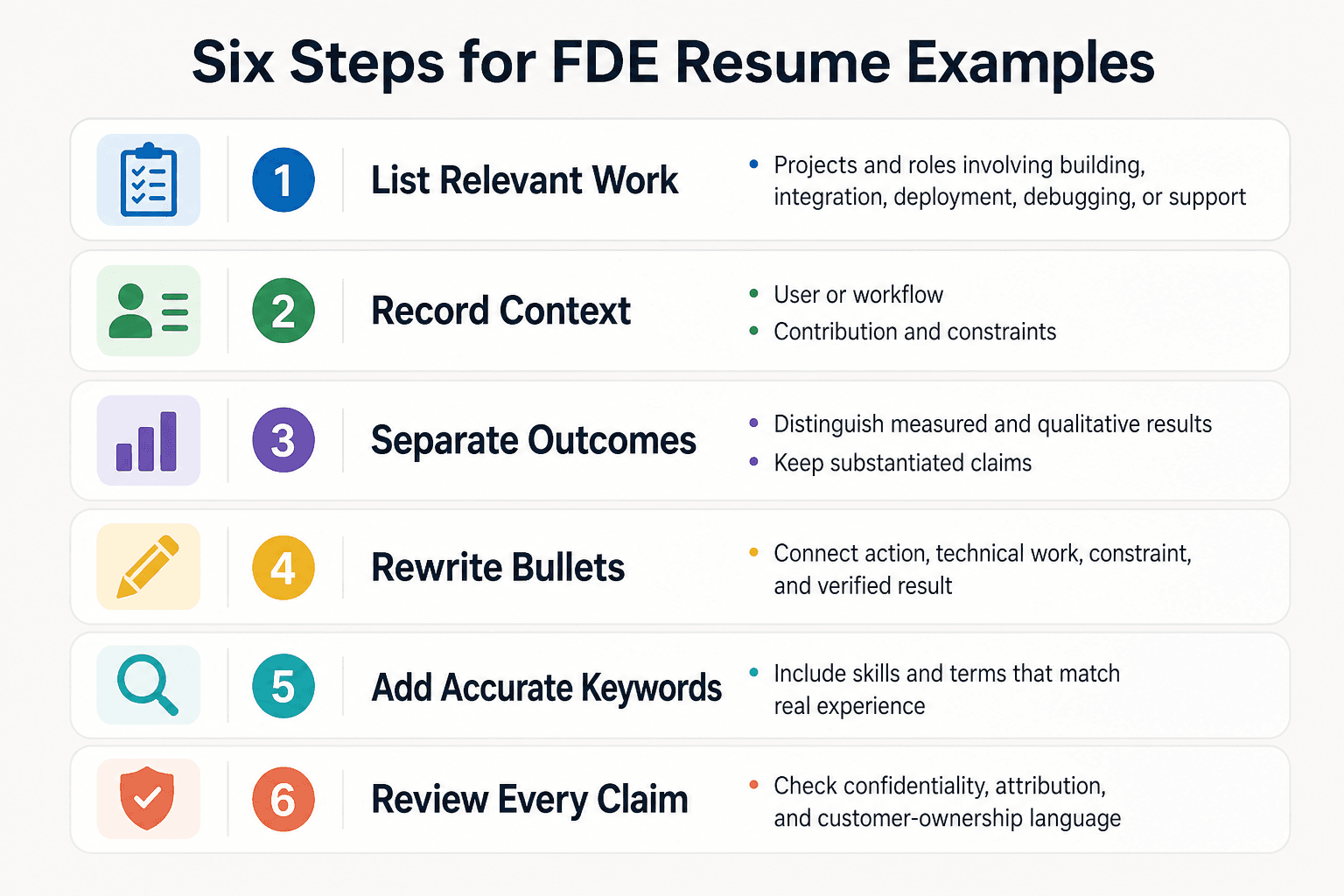
FDE resume examples: a step-by-step guide
- List projects and roles where you built, integrated, deployed, debugged, or supported software.
- Record the real user or workflow, your contribution, and the constraints you encountered.
- Separate measured outcomes from qualitative results, and keep only claims you can substantiate.
- Rewrite each bullet to connect your action, technical work, constraint, and verified result.
- Add role-relevant skills and keywords only where they accurately describe your experience.
- Review every bullet for confidentiality, attribution, and any claim of customer ownership you cannot support.
Step 1: Build an evidence inventory for customer-facing work
Before you write a bullet, collect the proof behind it. A resume is not the place to reconstruct a project from memory or turn a small contribution into ownership of the whole outcome.
Make a working document for each relevant project, role, or internal tool. Include notes, tickets, pull requests, release records, demos, architecture diagrams, and feedback you can safely use. Start with what you can defend.
Capture the user problem, system constraint, and your role
Write down who had the problem: an external customer, an internal operations team, a support group, or product users. Then name the problem in plain terms, such as slow document lookup or repeated data-entry errors.
Add the constraint that shaped the work. It might be an older API, incomplete data, permission rules, a short delivery window, or a system you could not change. Finally, state your role: what you investigated, decided, built, or fixed. Don't claim stakeholder discovery if you only received requirements from someone else.
List evidence for prototypes, integrations, releases, and fixes
For each item, record the delivery path:
- Prototype: What workflow or assumption it tested.
- Integration: Which systems, APIs, or data sources you connected.
- Release: What environment you deployed to and what you owned.
- Fix: The symptom, root cause if known, and change you made.
- Feedback: Who reviewed the work and what changed afterward.
Specific records matter. "Built a prototype" is thin. "Built a demo that let an operations team search approved documents" gives a reviewer a real workflow to assess.
Use scope or qualitative evidence when exact metrics are unavailable
Exact metrics are useful only when you can verify them. If you cannot share a percentage, use bounded scope instead: the team involved, the workflow affected, the release stage, or the systems connected.
You can also use careful qualitative evidence, such as "used in a pilot," "reviewed during weekly stakeholder sessions," or "released to an internal team." These phrases must be true. "Improved efficiency" says little without a measure or a clear description of what became easier.
Protect confidential information without making vague claims
You do not need to name a client, expose source code, or reveal private volumes. Replace identifying details with an accurate category, such as "regional logistics company" or "internal claims operations team," and describe the technical work at a safe level.
Confidentiality does not justify claiming production adoption, revenue impact, or ownership you cannot substantiate. If a result is restricted, describe the decision, delivery, and verified scope so your resume still gives the reader something concrete to trust.
Step 2: Adapt FDE resume examples to your experience level
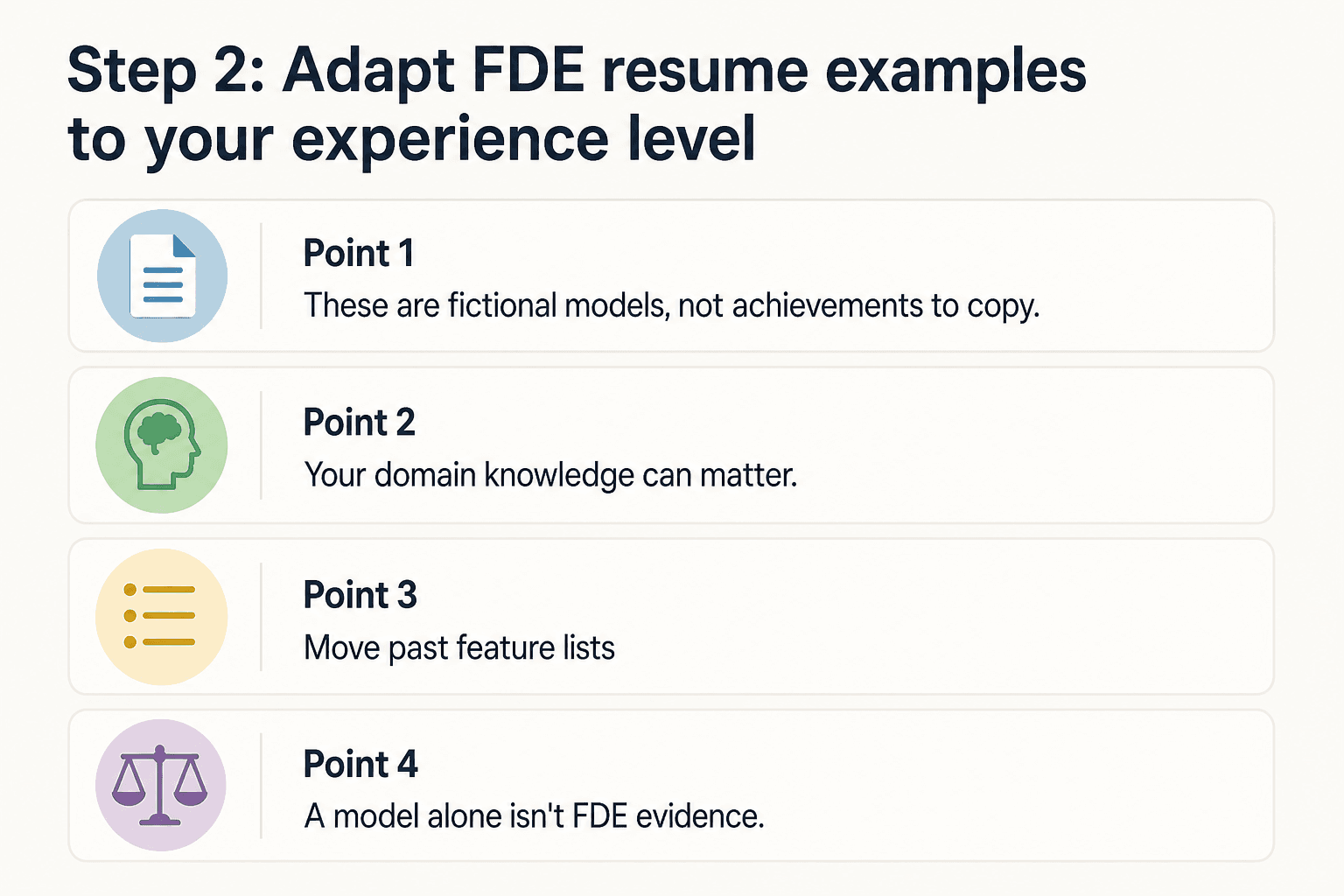
These are fictional models, not achievements to copy. Use the shape of each example, then replace every detail with evidence from your own inventory. Your level changes the proof you lead with, but it doesn't change the honesty rule.
FDE resume example for a fresher: coursework, capstones, and user-tested projects
Lead with a capstone, internship, or student tool that solved a real user's problem. A summary might say: "Computer science graduate with Python, SQL, and API project experience, focused on turning user feedback into working prototypes."
List skills you used: Python, SQL, REST APIs, Git, Docker, and cloud tools if applicable. For a project entry, write: "Built a document-search prototype for a student services workflow; gathered feedback from staff during demos and revised the interface." Don't claim client delivery, production deployment, or adoption beyond what you can prove.
FDE resume example for a career switcher: domain knowledge and technical delivery
Your domain knowledge can matter. A former analyst, consultant, or operations specialist can show that they understand a workflow before they code for it.
Try a summary such as: "Operations professional transitioning to engineering, with experience mapping reporting workflows and building Python tools for internal users." An entry might read: "Automated a recurring reconciliation task with Python and SQL after documenting handoffs with the finance team." Don't call internal colleagues customers or imply you owned a deployment you supported.
FDE resume example for a software engineer: from features to deployment outcomes
Move past feature lists. Show the constraint, the system boundary, and what happened after release.
A summary could say: "Software engineer with experience shipping API integrations and debugging production services across cross-functional teams." Rewrite "built an integration service" as "Built an API service that connected the product to an external system, resolving authentication failures during rollout." Don't invent user counts, revenue, or direct stakeholder discovery.
FDE resume example for an AI/ML engineer: model work, evaluation, and workflow integration
A model alone isn't FDE evidence. Emphasize how you evaluated it, connected it to a workflow, and handled failure cases.
Use a summary like: "AI/ML engineer with experience evaluating models and integrating data-driven features into usable applications." A project entry might say: "Developed a retrieval prototype, compared response quality against a labeled test set, and added source links for reviewer checks." Don't claim production reliability or customer adoption from an offline experiment.
FDE resume example for an experienced Forward Deployed Engineer: scope, leadership, and repeatable delivery
Show both direct delivery and the systems that made later delivery easier. Your summary can name the environments, integrations, and teams you supported without exposing restricted details.
An experience entry might read: "Led discovery and delivery for an internal operations workflow, coordinated integration work across engineering and operations, and documented the release process for future teams." Don't inflate team leadership into ownership of all commercial or customer outcomes.
Step 3: Turn technical work into strong FDE resume bullets
Strong FDE bullets connect a verified action to its context, constraint, delivery, and outcome. Name what you did and why the work was hard, then state only results you can support. If no metric exists, describe an observable change, such as a completed rollout, a resolved failure, or feedback used.
The action, context, constraint, delivery, and outcome formula
Use this shape: action + system or workflow + constraint + delivery step + verified outcome. It keeps a bullet grounded in work you can explain in an interview.
Start with a working verb: built, mapped, integrated, deployed, debugged, or documented. Then add only the context that makes the decision matter.
Before and after: ambiguous stakeholder requirement
Before: "Worked with stakeholders on requirements."
After: "Mapped an operations team's reporting workflow, clarified conflicting requirements, and documented a phased build plan for engineering review."
Don't claim reduced disputes or faster delivery unless records support it.
Before and after: rapid prototype and feedback loop
Before: "Built a Python prototype."
After: "Built a Python prototype for a document-search workflow, ran demos with internal users, and revised the interface based on their feedback."
The prototype is not production just because people saw it.
Before and after: API or legacy-system integration
Before: "Integrated third-party APIs."
After: "Connected an application to an external API, investigated authentication failures, and added error handling for unsuccessful requests."
Name the legacy constraint if you know it. Don't call an integration reliable without evidence from its use.
Before and after: production deployment and debugging
Before: "Deployed and maintained a service."
After: "Supported deployment of a service through the team's release process, investigated a production error, and documented the fix for future incidents."
Use "supported" when you were not the release owner.
How to write impact when you do not have a percentage or revenue figure
A number isn't required. Write the result you can verify: "enabled a team to test the workflow," "produced a reusable integration guide," or "resolved an authentication issue blocking a rollout."
Keep the scope clear. "Used by the finance team" is stronger and more truthful than "improved business efficiency" when you don't have measured impact.
Step 4: Show the FDE workflow behind RAG and integration projects
A RAG project isn't FDE evidence just because it uses an LLM, embeddings, or a vector store. The useful evidence is the path from a user's blocked workflow to a testable system, including data limits, integration work, release conditions, and feedback that changed the build.
[!tip] For a RAG or agent-memory project, name the real integration or operating constraint you handled and the user workflow it supported. Describe an outcome only if you can verify it.
Treat every scenario below as an adaptable model, not an achievement to copy.
From customer workflow to a testable RAG prototype
Start with the workflow, not the model. A strong project entry can say you mapped how a support team searched policy documents, defined which questions the prototype should answer, and built a retrieval flow for those documents.
If internal users tried a demo, write that they tested a prototype and gave feedback. Don't say you owned customer discovery, improved support outcomes, or shipped an adopted tool unless you can prove those claims.
A model bullet: "Mapped a document-search workflow with internal users, built a RAG prototype over approved policy files, and revised answer display after feedback on missing source context."
How to describe API integrations and data-handling constraints
RAG work often breaks at the edges: source permissions, inconsistent file formats, missing metadata, expired tokens, or an API that returns incomplete records. These constraints show you worked with a real system rather than a clean sample dataset.
Name what you handled without exposing protected details. You might write that you connected approved document sources through an API, filtered content by existing access rules, and logged failed ingestion jobs for review. Don't imply that your project enforced enterprise permissions unless you built or verified that control.
A model bullet: "Integrated an approved document API into an ingestion workflow, handled malformed files and failed requests, and documented data-quality limits for project reviewers."
How to frame deployment, evaluation, observability, and debugging
A working demo is not enough. Show how you checked retrieval quality, deployed within the environment available to you, and investigated failures after release or testing.
Be precise about your role. If you compared returned passages against a small set of expected answers, call it a retrieval evaluation set, not proof of broad accuracy. If you added logs for failed requests, slow responses, or empty results, describe monitoring you implemented, not round-the-clock operational ownership.
A model bullet: "Deployed a RAG prototype in the team environment, reviewed retrieval results against defined test questions, and added request logging to investigate empty responses during user trials."
What a project cannot prove about client ownership or production adoption
The honest answer is that it depends on your records and role scope. A capstone, internal demo, or personal build cannot prove you managed a client account, owned a production release, met an SLA, or drove company-wide adoption.
Don't borrow those signals. State "internal users," "project reviewers," or "pilot feedback" when that is the real scope, and be ready to explain who made deployment and access decisions.
Step 5: Add FDE resume keywords without keyword stuffing
Keywords won't turn a generic engineering resume into FDE evidence. They only help an application tracking system and recruiter find work you actually did, so add a term where the surrounding bullet proves it.
A skills list packed with "deployment," "integration," and "client-facing" looks forced if your experience never explains the system, constraint, or user involved.
Role and delivery keywords
Use role language in your summary and experience entries when it is true: Forward Deployed Engineer, solution deployment, client-facing engineering, production deployment, systems integration, rapid prototyping, and user feedback.
Don't claim the FDE title just to match a posting. If you were a software engineer who deployed an internal tool, name the real title and describe the relevant delivery work. The FDE Resume guide recommends natural coverage across real experience, not a forced checklist.
Technical keywords for integration and deployment work
Put technical terms in grouped skills, then repeat them only where a project shows how you used them. Useful terms may include API integration, data pipeline, cloud infrastructure, Python, SQL, CI/CD, REST, authentication, data migration, monitoring, debugging, and fault tolerance.
Be exact. "AWS" belongs on the page if you used AWS, not because the job description names it. The same rule applies to Kubernetes, Docker, Airflow, RAG, and any platform-specific tool.
Customer-facing and problem-solving keywords
FDE work often calls for language that connects technical choices to people and constraints: stakeholder discovery, customer requirements, workflow mapping, ambiguous requirements, legacy systems, adoption, technical discovery, and phased rollout.
Use "customer" only when you worked with customers. Otherwise, "internal users," "project reviewers," or "partner teams" is more honest and still shows that you gathered feedback and adjusted the build.
A simple ATS review pass before submitting
Start with the job description. Mark the role terms, technical stack, deployment conditions, and customer-facing duties that match your verified evidence.
Then check four places:
- Summary: Include two or three high-value terms tied to your real scope.
- Skills: Group languages, cloud, data, and integration tools so terms are easy to scan.
- Experience: Use keywords inside specific bullets about a build, constraint, and result.
- Projects: Add missing but truthful terms through work you shipped, tested, or documented.
Read the resume aloud once. If a term sounds bolted on, cut it or replace it with a plain description of what you did.
Step 6: Position projects when you have no formal FDE title
You don't need an FDE title to show FDE-relevant work. You do need to separate what your project proves, such as integration or user feedback, from what it cannot prove, such as customer ownership or a production outcome.
[!note] A project or adjacent engineering role can show FDE-relevant skills without proving that you held an official FDE title. Keep the role title and your contribution accurate.
A recruiter can see the difference. Don't make them guess.
Transferable evidence from internal engineering work
Internal tools can be strong evidence when you name the users, their workflow, the constraint, and your delivery role. A dashboard for operations staff, a data pipeline for finance, or an API service used by another team can show discovery, integration, debugging, and adoption work.
Call internal users "internal users." If you only built a feature and handed it off, say that. You can claim implementation, testing, documentation, or support where true, but not end-to-end deployment ownership unless you owned the release and its follow-up.
How to frame consulting, support, and implementation experience
Consulting, technical support, and implementation roles often supply useful evidence because they involve unclear needs and real system constraints. Describe the engagement, the technical work, the people you worked with, and the verified result.
For example: "Configured data imports for a client implementation, investigated authentication failures with the client IT team, and documented the resolution process." This shows delivery work without claiming you designed the whole solution or owned the account.
How to present a portfolio project without calling it client delivery
A capstone, open-source contribution, or technical demo can show how you think through an FDE workflow. It cannot prove customer adoption, production use, or that you managed a live deployment.
State the setting plainly: "Built a prototype," "tested with classmates," or "published a demo." Include the problem, data source, system design, constraints you handled, and how you evaluated the result.
A project-entry template for the resume
Use this structure:
- Project name | Stack
- Problem: Who the build was for, or the workflow it modeled.
- Delivery: What you integrated, deployed, tested, or documented.
- Constraint: The messy data, permissions, latency, or system limit you handled.
- Evidence: A verified test result, user feedback, or link to code and documentation.
Fix common FDE resume mistakes before you apply
A clean layout won't rescue a vague resume. It can only make real evidence easier to find, so fix the claims and context before you adjust fonts or file names.
Mistakes that make a candidate look like a generic engineer
"Built a Python service" says very little. Add the workflow, the people who used it, the constraint, and what you delivered: an internal operations tool, inconsistent source data, a prototype, or a released service.
Explain acronyms on first use unless they are universal to the job description. Don't paste a flat skills block with every technology you have touched. Group skills by type so relevant depth is easier to scan.
Claims to remove, qualify, or substantiate
Remove outcomes you can't support. Don't claim revenue gained, hours saved, production adoption, or ownership of a client relationship unless you can explain the evidence behind it.
The honest answer is that not every good project has a metric. Use a bounded statement instead: "Built a prototype tested with three internal users," or "Documented recurring authentication failures for the implementation team." That is more useful than an unsupported percentage.
Watch for missing context. "Worked with stakeholders" is weak unless you say what you clarified, decided, delivered, or changed.
Formatting and file checks for a clean submission
Keep the page easy to parse: clear section headings, standard bullet points, readable text, and consistent dates. Avoid tables, graphics, text boxes, and dense columns when you can, since application tracking systems may parse them poorly.
Use the file format requested in the application. If none is named, a PDF preserves your layout, but check that its text is selectable and links work before you upload it.
Final FDE relevance checklist
Before you submit, check each role and project entry:
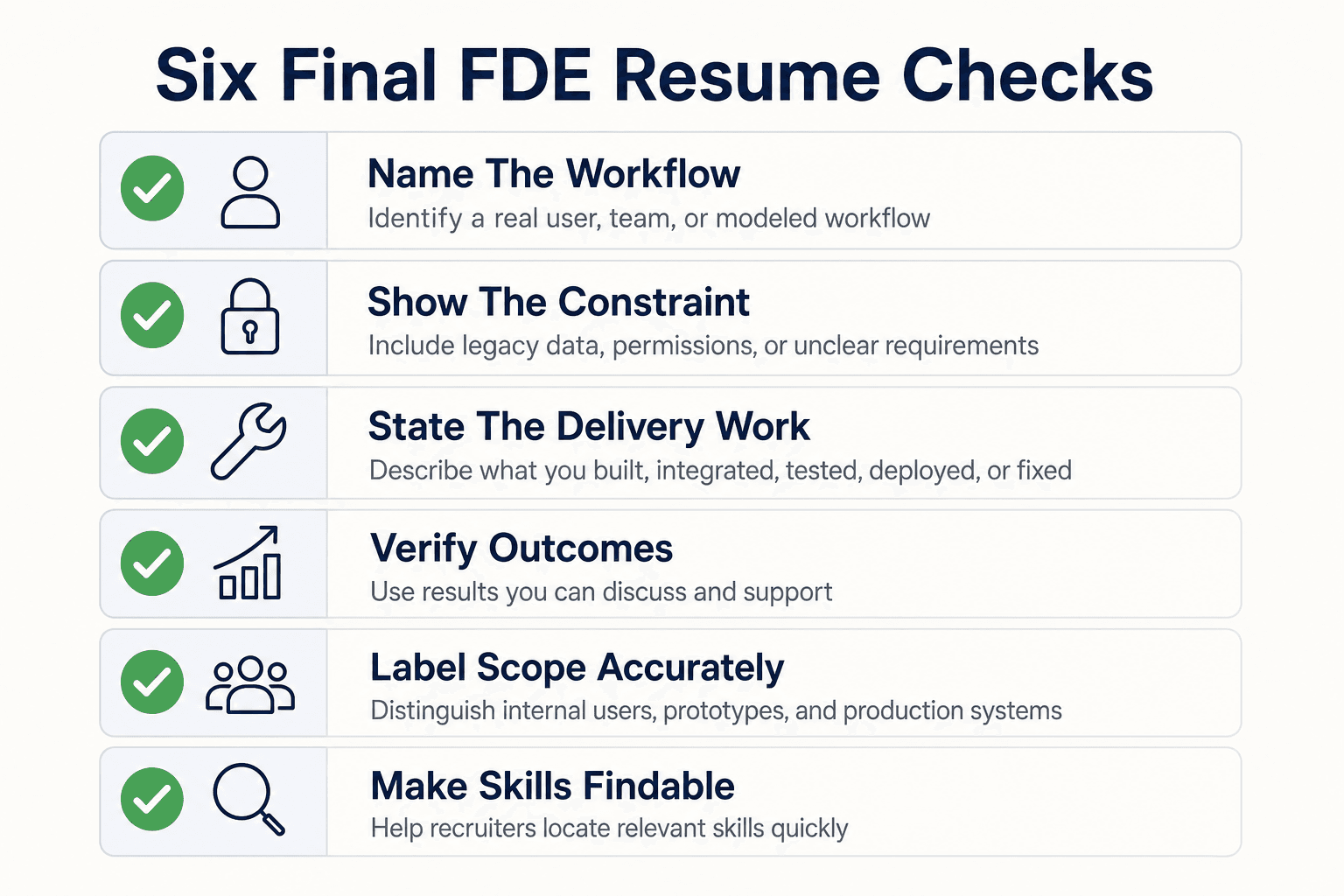
- Does it name a real user, team, or modeled workflow?
- Does it show a constraint, such as legacy data, permissions, or unclear requirements?
- Does it state what you built, integrated, tested, deployed, or fixed?
- Does every outcome have evidence you can discuss?
- Are internal users, prototypes, and production systems labeled accurately?
- Can a recruiter find your relevant skills in seconds?
If a bullet could fit any software engineer resume, rewrite it until your delivery context is clear.
Use these FDE resume examples as evidence, not a script
Once each bullet can stand up to a follow-up question, resist the urge to make it sound like someone else's career. A copied template may contain the right keywords, but it won't help when a recruiter asks what you actually decided, built, or learned.
Tailor the evidence to each FDE job description
Start with the job description. Mark the repeated needs: discovery, API integration, production support, data work, stakeholder communication, or rapid prototyping. Then choose the two or three entries from your evidence bank that match those needs.
Don't rewrite history to match a title. If you built an internal tool, call it an internal tool. If you supported a pilot rather than a production release, say so. A resume tailored with false scope creates a hard interview problem.
Keep a master evidence bank for future applications
Keep a private document with project notes, draft bullets, links, dates, constraints, tools, user feedback, and any metrics you can verify. Add details while you still remember them. Small facts, such as a deployment blocker or a decision changed after feedback, often make the strongest interview stories.
For each new application, pull from that bank rather than starting from a blank page. Your best FDE resume examples are grounded in work you can explain clearly and adapted to the role without turning a template into a claim.
Frequently asked questions
What should an FDE resume include?
Show relevant technical skills, deployment or integration work, and evidence of solving a real user or workflow problem. Organize bullets around what you built, the constraints, and outcomes you can substantiate.
How is a Forward Deployed Engineer resume different from a software engineer resume?
An FDE resume should make the connection between technical work, its operating context, and the people or workflows it serves clear. A generic list of tools and features may not show that connection.
Can I apply for an FDE role without an official FDE title?
Yes. Relevant engineering roles and projects can provide evidence of integration, deployment, stakeholder communication, or iterative problem-solving. Keep your actual job title and scope truthful.
What are the best FDE resume keywords for ATS?
Use terms that match both the role and your real experience, such as API integration, data pipelines, production deployment, systems integration, Python, or SQL. Include them naturally in skills and bullets rather than adding unsupported keywords.
How do I write FDE resume bullets when I do not have exact metrics?
Describe the work, the verified constraint, and the result in specific qualitative terms. Do not invent numbers or imply a measured production impact you cannot confirm.
What projects should a fresher include in an FDE resume?
Choose projects that show relevant technical work and explain the intended user or workflow, implementation choices, and real constraints. Clearly label personal or academic work and do not present it as client or production deployment.
Where can I find FDE resume examples in PDF format?
The supplied TechieCV reference offers an interactive FDE resume template with a PDF download option. Treat its sample content as a format example, not evidence for claims about your own experience.
About GigaRAG
GigaRAG helps you share agent memory like you share Google Docs. It connects your AI agents to a central Hive Mind, with access controls for what each agent can use. Developers, vibe coders, and teams can keep project knowledge available across sessions and tools, so agents can pick up where work left off without rebuilding context or managing a full RAG stack.