
FDE Resume Keywords: How to Prove the Skills Hiring Teams Want
An FDE resume isn't a longer software-engineering skills list. Forward Deployed Engineering means shipping and fixing technical solutions in messy customer environments, so hiring teams need proof that you can build, deploy, diagnose, and explain the work.
Keywords can't make up for weak technical fundamentals, unsupported claims, or no evidence that you've handled customer-facing delivery. Titles and stacks vary, so don't copy every cloud, AI, or integration term into one Forward Deployed Engineer resume. A keyword matters only when you can point to a project, deployment, troubleshooting case, or stakeholder outcome behind it.
Quick answer
An FDE resume should connect technical work to solving customer problems and delivering solutions in real operating environments. Match keywords to the target job description, and include each only when you can support it with evidence.
- Separate recurring capabilities from tools named for a specific role.
- Map each relevant keyword to a project, responsibility, or result.
What FDE resume keywords signal to hiring teams
FDE resume keywords can't prove you can ship reliable work, handle a hard customer conversation, or diagnose a live problem. They make relevant evidence easier to find. Your resume must connect technical choices to a customer's working need.
The FDE resume difference: technical delivery plus customer ownership
An FDE works close to the customer and the code. Show both sides: you changed a system, deployed it in a real environment, worked through constraints, and owned the result after launch.
Core capabilities versus named technologies
Languages, cloud platforms, APIs, Kubernetes, LLMs, or RAG may matter, but none is universal. Put capabilities first: implementation, deployment, troubleshooting, technical discovery, system design, and stakeholder communication.
Add a named tool when the role asks for it and you can show how you used it.
What keywords cannot prove on their own
Keywords label relevant experience; they do not show its depth, scope, or result. Use the surrounding bullet or project description to establish what you owned, the constraint you handled, and what happened after delivery.
Don't claim tools you used once or stuff the posting into your skills list. Each selected term needs proof in a bullet, project, or summary.
How FDE and solutions resumes differ
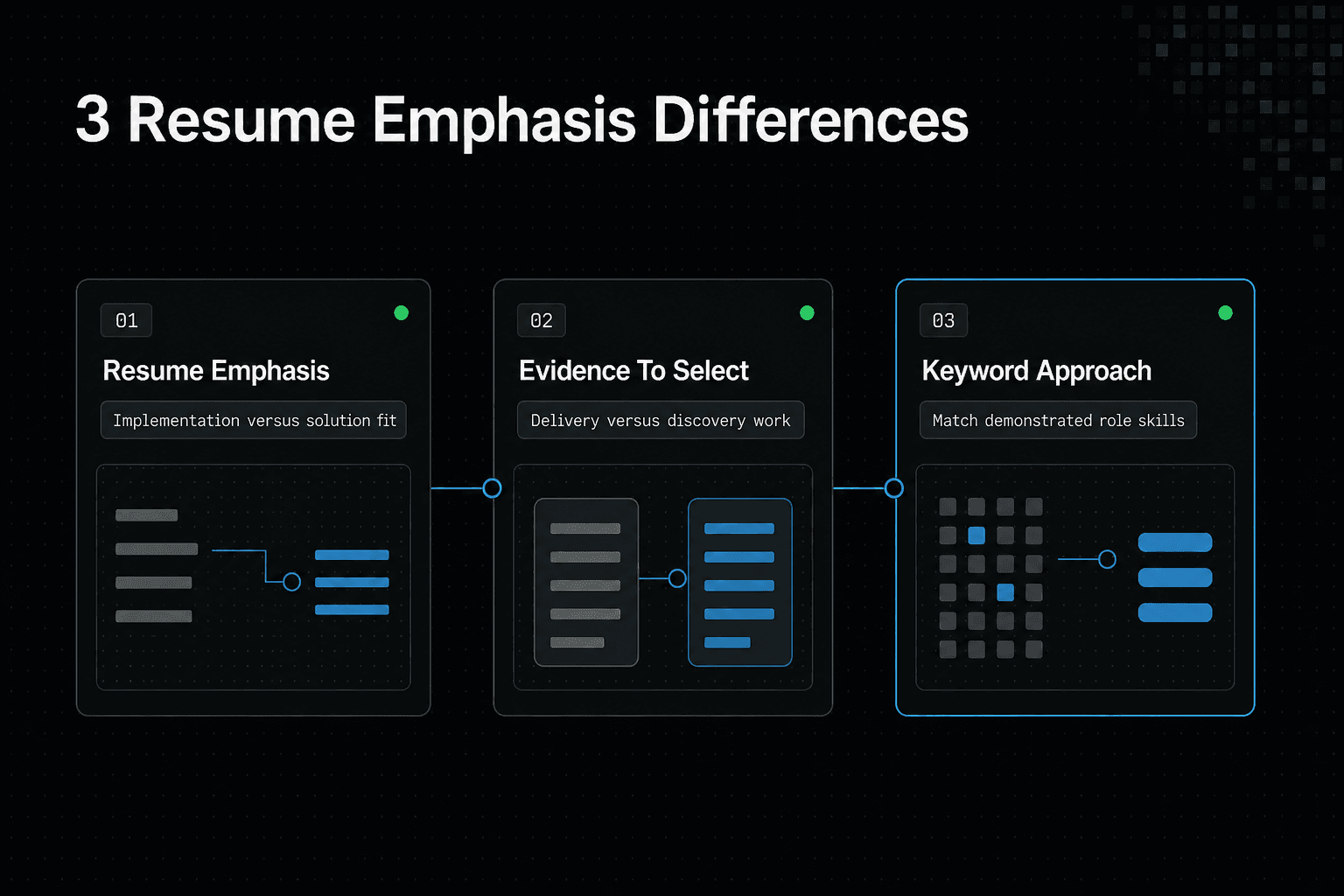
| Factor | Forward Deployed Engineer | Solutions Engineer |
|---|---|---|
| Resume emphasis | Technical implementation tied to customer problems | Technical discovery, solution fit, and implementation planning |
| Evidence to select | Projects showing hands-on technical execution and delivery | Work showing discovery, technical validation, or implementation planning |
| Keyword approach | Use job-description terms that match your demonstrated skills | Use job-description terms that match your demonstrated discovery, validation, or solution-planning work |
FDE resume keywords: categorized checklist
Use FDE resume keywords only when you can point to work that proves them. Put recurring delivery skills first, add stack terms that match the role, and leave out tools you can't explain, reproduce, or connect to a result in an interview.
Programming languages, software engineering, and frameworks
Core: Python, Java, JavaScript, TypeScript, SQL, data structures, testing, debugging, Git, and code review, if they reflect your work. Add React, Node.js, or another framework only if the posting needs it or your project uses it.
Databases, APIs, integrations, and system design
Core: REST API, API integration, authentication, data modeling, system design, and production debugging. Role-specific: GraphQL, event-driven systems, PostgreSQL, Snowflake, or Salesforce.
Name the system and integration you owned, not a long vendor list.
Cloud platforms, infrastructure, DevOps, and deployment
Core: cloud infrastructure, CI/CD, monitoring, logging, deployment, incident response, containers, and Kubernetes. Role-specific: AWS, Azure, GCP, Terraform, Docker, or a particular CI tool.
A cloud badge alone is weak proof.
AI/ML, LLMs, RAG, AI agents, and MCP
Only use these terms if you built, evaluated, deployed, or supported the work: machine learning, LLMs, prompt engineering, RAG, embeddings, vector databases, AI agents, and Model Context Protocol (MCP). If you used GigaRAG, describe the actual work—for example, making project knowledge available to agents across sessions and tools—and keep model names role-specific.
Technical discovery, solution architecture, stakeholder management, and troubleshooting
Core: technical discovery, requirements gathering, solution architecture, stakeholder management, customer workshops, implementation planning, escalation handling, root-cause analysis, and troubleshooting. Show the constraint you found and how the delivered system changed.
How to label a keyword: core, role-specific, or do-not-claim
Mark each term before you write. Core means it fits most FDE work and appears in your evidence. Role-specific means the target posting asks for it and you have proof.
Do-not-claim means you saw it in a job ad, studied it lightly, or can't discuss your contribution.
Step-by-step: map FDE keywords to resume evidence
- Copy the target job description into a working document.
- Mark recurring capabilities separately from role-specific tools and technologies.
- For each relevant term, identify a project or responsibility that shows it.
- Rewrite the evidence to show the problem, your technical contribution, and the outcome you can substantiate.
- Place supported terms in the most relevant skills or experience entry.
- Remove keywords you can't connect to genuine experience.
[!note] A keyword is not evidence of a skill by itself. Connect each claimed capability to work you can describe accurately.
Separate core FDE skills from role-specific stack keywords
A named tool isn't a core FDE skill just because it appears in one posting. Start with the work you can do across stacks, then add technologies only when the target role asks for them and your experience backs them up.
[!tip] Keep a keyword-to-evidence worksheet for each application, so you can tailor the resume without adding technologies or experience you can't support.
Likely recurring capabilities: implementation, deployment, debugging, and customer problem solving
Implementation, deployment, debugging, and customer problem solving are useful starting categories because they describe work, not a vendor. Show them through a shipped integration, a production issue you traced, or a customer constraint that changed the design.
Make each tool name earn its place by identifying the system, your responsibility, and a delivery or operational result.
Common role-specific clusters: enterprise integration, data platforms, AI systems, or regulated environments
Group stack terms by the problem the employer needs solved. An enterprise role may stress identity, APIs, CRM, or ERP integration. A data platform role may call for SQL, warehouses, pipelines, and governance, while an AI role may name RAG, evaluation, vector search, agents, or MCP. For work with GigaRAG, name the relevant implementation detail, such as connecting agents to its central Hive Mind through MCP or an API, rather than listing the platform without context.
Regulated environments can add audit, access-control, privacy, or compliance language. Don't borrow these terms from adjacent roles. If you didn't work under those constraints, they don't belong on your resume.
A job-description evidence table: term, recurrence, proof, and resume location
Use a small table across your target postings. It keeps keyword choices tied to evidence.
| Term | Recurrence | Your proof | Resume location |
|---|---|---|---|
| API integration | 3 target postings | Built partner API workflow | Experience bullet |
| Kubernetes | 1 target posting | Deployed a project service | Skills and project |
| RAG | 2 target postings | No deployed work | Leave out |
"Recurrence" means how often the term appears in your own sample, not across the whole market. Keep the posting text nearby when you tailor each version.
Research limitation: don't state market-wide keyword frequency without current job-posting data
Don't write that a tool is "most requested" or universally required unless you have current job-posting data that supports that claim. The honest answer is that demand varies by employer, customer base, and product stack, so your target postings are the evidence that matters for your application.
Match FDE keywords to a job description and ATS
Tailoring isn't copying a posting into your resume. Pull out the language that matches work you can prove, then place each term where a recruiter can see the context behind it.
Step 1: extract responsibilities, technical terms, and customer-language terms
Copy the posting into a working note. Mark action words such as "deploy," "debug," "integrate," and "design," then mark named tools, platforms, and customer terms such as discovery, stakeholder, implementation, or escalation.
Keep the groups separate. A tool tells you part of the stack, while a responsibility tells you what the employer expects you to do with it.
Step 2: rank must-have, preferred, and contextual terms
Treat repeated requirements and "required" qualifications as must-haves. Put "preferred," "nice to have," and unfamiliar tools in a second group. Contextual terms describe the setting, such as enterprise customers, regulated data, or production systems.
Don't force a match. If a must-have term has no honest proof, a keyword won't fix that gap.
Step 3: map every selected keyword to a summary, skills line, bullet, or project
Give each selected term one home. Put your role target and strongest relevant proof in the summary, searchable technologies in skills, and delivery evidence in experience bullets or projects.
For example, "API integration" belongs in a bullet that says what you integrated, why the customer needed it, and what changed after release. A bare skills list can't carry that weight.
Step 4: run an ATS-safe formatting and consistency check
Use standard headings, plain text, and simple bullets. Avoid text boxes, graphics, columns, and decorative skill ratings when a plain layout will do.
Check that your headline, skills, dates, and bullets tell the same story. If you list Kubernetes or RAG, make sure a project or experience bullet shows where you used it.
Where to put FDE skills on your resume
A keyword needs a job. Put it where it adds evidence, not in every section. Repeating "Python," "RAG," or "stakeholder management" without context makes your resume longer, not stronger.
Resume summary: role target, domain context, and strongest proof
Use two or three lines to name the role you want, the kind of systems or customers you know, and one strong proof point. Keep it tight.
Example: "Software engineer with experience building API integrations and deploying cloud services for internal users. Seeking an FDE role focused on customer implementation and production troubleshooting."
Technical skills: grouped, searchable, and limited to defensible proficiency
Group skills by type: languages, cloud and DevOps, data and APIs, then AI systems if relevant. List tools you could discuss clearly in an interview.
Don't rate yourself with bars. "Kubernetes" belongs here only if a bullet or project can show what you did with it.
Experience bullets: action, technical method, customer context, and measurable outcome
This is where FDE claims earn their place. Start with what you built or fixed, name the method, show who needed it, then state the result you can support.
"Built a REST API integration for a customer onboarding workflow, worked with operations to resolve data-mapping issues, and reduced manual handoffs from [X] steps to [Y]."
Projects: show deployment thinking when paid FDE experience is limited
Projects can show useful proof when your job history doesn't include customer delivery. Include the user problem, architecture, deployment approach, and how you handled failure cases. For example, a GigaRAG project could explain how agents accessed shared project knowledge across sessions and tools, which connection method you used, and how access controls limited what each agent could use.
A tutorial clone isn't enough. Show why the system would work outside a notebook.
Sample FDE resume section layout
Use a plain order:
- Summary: role target and strongest delivery proof
- Technical skills: grouped tools and languages
- Experience: customer-aware implementation bullets
- Projects: deployed systems, integrations, or AI workflows
- Education or certifications: only when they support the role
Rewrite engineering experience into FDE achievement bullets
A skills list can't show how you work when a deployment breaks or a customer need changes. Your bullets need that proof. Keep the outcome honest, and use brackets until you can replace them with records you can defend.
Weak versus strong: API and integration delivery
Weak: "Built API integrations using Python."
Stronger: "Built a Python REST API integration for [customer or team] onboarding, resolved data-mapping issues with operations, and reduced manual handoffs from [X] steps to [Y]."
The stronger version shows the system, the user context, and the work around the code. Don't add "customer" if the users were internal.
Weak versus strong: cloud deployment and production troubleshooting
Weak: "Deployed services to AWS and fixed bugs."
Stronger: "Deployed [service] to AWS with CI/CD checks, investigated [type of production failure], and documented a recovery path that reduced repeat support requests by [X] over [period]."
Name the failure only if you can explain it. "Improved reliability" means little without the incident, safeguard, or measured change behind it.
Weak versus strong: AI/ML, RAG, and agent workflow projects
Weak: "Built a RAG chatbot."
Stronger: "Built a RAG workflow for [user task], added retrieval checks for [failure mode], and used feedback from [users or test cases] to revise prompts and source handling."
RAG isn't an achievement by itself. Show the workflow it supported and the limits you found.
Metrics to use when revenue data is unavailable
Use measures you actually tracked: deployment time, manual steps removed, tickets resolved, test cases covered, onboarding time, defect recurrence, response time, or number of supported users. Counts work too.
The main catch is that a metric without context can mislead. State the baseline, time period, and scope when you have them.
What not to invent: customer impact, uptime, scale, and proficiency
Don't claim revenue impact you weren't given, "99.9% uptime" without monitoring data, or "scaled to millions" because a platform could do so. Don't call yourself an expert in Kubernetes, LLMs, or stakeholder management when your evidence is one course or demo.
Before applying, make sure you can explain each claim: what you did, the evidence behind the result, and the limits of your responsibility.
FDE resume priorities by seniority and background
The evidence bar rises with scope. A new graduate can prove careful project work and clear communication, while a senior candidate needs to show sound decisions when customers, systems, and teams pull in different directions.
Entry-level and fresh graduates: projects, internships, debugging, and communication evidence
Lead with projects, internships, labs, or support work where you built, fixed, tested, or explained something. Keep claims narrow. A course project can show deployment thinking, but it can't stand in for years of customer ownership.
Mid-level software engineers: ownership, integrations, deployment, and cross-functional delivery
Show what you owned beyond code: an integration, release path, production issue, or handoff with product and operations. Name the system boundary and the people involved.
This helps hiring teams see that you can deliver in a messy environment, not just complete assigned tickets.
AI/ML engineers: production ML, evaluation, RAG, agent reliability, and user workflows
Don't lead with model names alone. Show the user task, evaluation method, retrieval or agent failure mode, and change you made after feedback.
If your RAG or agent work stayed a demo, use precise wording rather than implying production use.
Senior FDE candidates: technical strategy, architecture decisions, escalation ownership, and stakeholder influence
Focus on decisions with consequences: tradeoffs you set, architecture paths you rejected, escalations you led, and alignment you built across technical and business stakeholders. "Led strategy" isn't enough.
Explain the decision and what it changed for delivery.
Career switchers: transferable customer, implementation, and technical problem-solving proof
Translate relevant work from implementation, support, consulting, operations, or customer success into evidence of diagnosis and follow-through. Start with the technical work you can defend.
Customer-facing experience helps, but it won't replace the ability to build, integrate, or troubleshoot systems.
FDE vs. Forward Deployed Software Engineer and solutions roles
Titles overlap. The honest answer is that the right label depends on what you actually owned: customer delivery, hands-on implementation, pre-sales support, or broad system design.
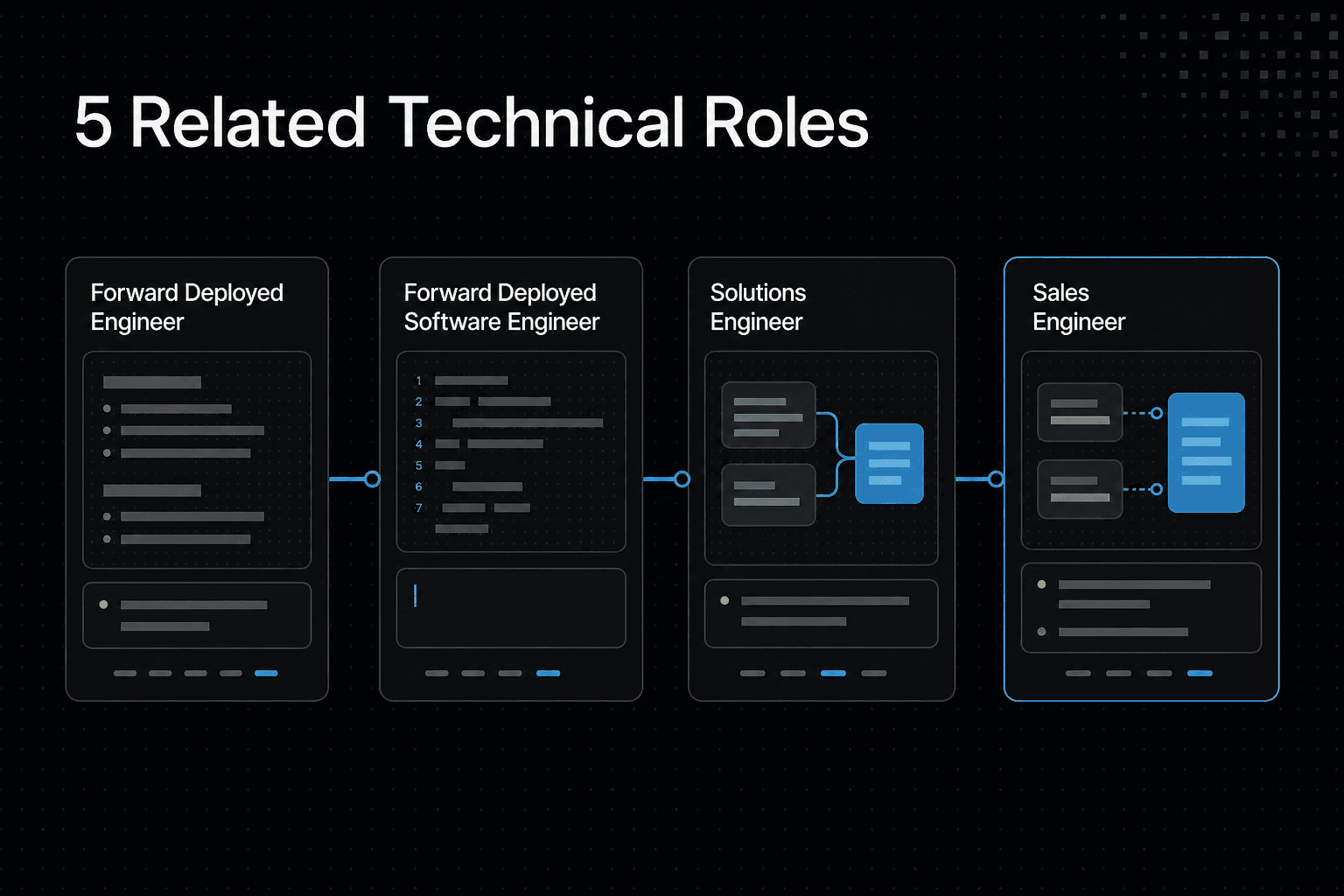
Comparison table: FDE, Forward Deployed Software Engineer, Solutions Engineer, Sales Engineer, and Solutions Architect
| Role | Main focus | Resume proof |
|---|---|---|
| FDE | Customer delivery and production problem solving | Built, deployed, debugged, and adapted solutions |
| Forward Deployed Software Engineer | FDE work with deeper software ownership | Shipped code, integrations, and production changes |
| Solutions Engineer | Technical discovery and solution fit | Ran discovery, demos, and technical validation |
| Sales Engineer | Pre-sales technical support | Supported deals, proposals, and product evaluation |
| Solutions Architect | System design across wider constraints | Defined architecture, tradeoffs, and implementation plans |
How to choose the closest title for your resume headline
Start with the work that took most of your time. If you wrote and maintained customer-facing code, "Forward Deployed Software Engineer" may fit. If discovery and demos came first, use a solutions title instead.
Avoiding title inflation when responsibilities only partially overlap
Don't call yourself an architect because you joined design meetings. Don't claim sales engineering because you spoke with customers.
Use the title your evidence can carry, then show adjacent skills in your bullets.
Common FDE resume mistakes to fix before applying
Before applying, check every term against the posting and your record. Clean formatting can't rescue claims you can't explain in an interview.
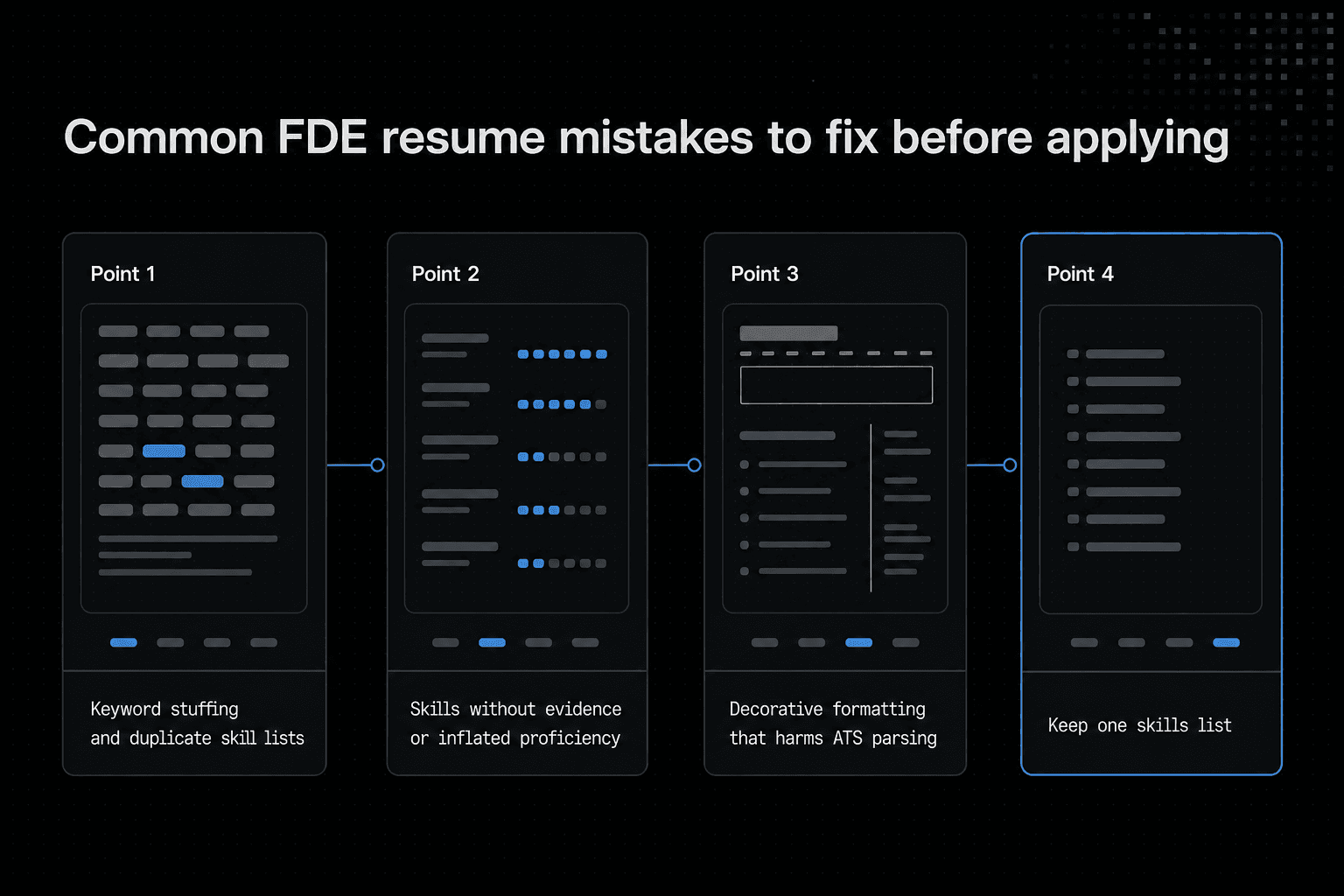
Keyword stuffing and duplicate skill lists
Keep one skills list. Repeating terms wastes space and can look like padding, not relevant experience.
Skills without evidence or inflated proficiency
List a skill only when a bullet or project can show how you used it. Drop tools you only sampled.
Decorative formatting that harms ATS parsing
Use plain headings, standard fonts, and simple bullets. Tables, text boxes, columns, and graphics can disrupt parsing.
Using one generic resume for materially different FDE postings
Tailor terms to the role's stack and customer work. One generic version blurs what you can actually deliver.
Frequently asked questions
What are the most important FDE resume keywords?
Prioritize terms that appear in the target job description and that you can support with concrete experience. Show the related work in a project or experience bullet rather than relying on a skills list alone.
Which FDE keywords are core skills versus role-specific technologies?
Treat capabilities repeated across the target description as potential priorities, and tools or platforms named for that role as role-specific. Include either only when your experience supports the claim.
How do I tailor an FDE resume to a job description?
Extract the relevant terms, group capabilities separately from technologies, and map each term to evidence from your work. Revise bullets to explain the problem, your contribution, and the outcome you can substantiate.
Should I list RAG, LLMs, AI agents, or MCP on an FDE resume?
List a term when it is relevant to the target role and you have experience you can explain. Don't add a technology simply because it appears in a search query or seems likely to attract attention.
How is a Forward Deployed Engineer different from a Solutions Engineer?
An FDE resume should emphasize hands-on implementation, deployment, debugging, and adapting solutions in customer environments. A Solutions Engineer resume more often emphasizes technical discovery, demos, and validating solution fit. Titles can overlap, so use the target description and the work you actually performed when choosing how to position your experience.
What should an entry-level FDE candidate put on a resume without customer deployment experience?
Use projects or other technical work you can accurately describe, and make your individual contribution clear. Don't present project work as a customer deployment if it wasn't one.
How can I quantify FDE resume bullets if I don't have revenue metrics?
Use a concrete outcome you can verify, even if it isn't a revenue figure. If you can't substantiate a numeric result, describe the deliverable and your contribution without inventing a metric.
Can ATS keywords make up for limited FDE experience?
Keywords can make relevant experience easier to identify, but they don't show that experience on their own. Pair each important term with accurate evidence, and don't claim skills you can't support.
About GigaRAG
GigaRAG is a shared memory platform for AI agents. It helps developers and teams keep project knowledge available across sessions and tools.
You can connect agents to a central Hive Mind through MCP or the API. Access controls manage what each agent can use.