How to Fix Missing Citations in RAG Answers
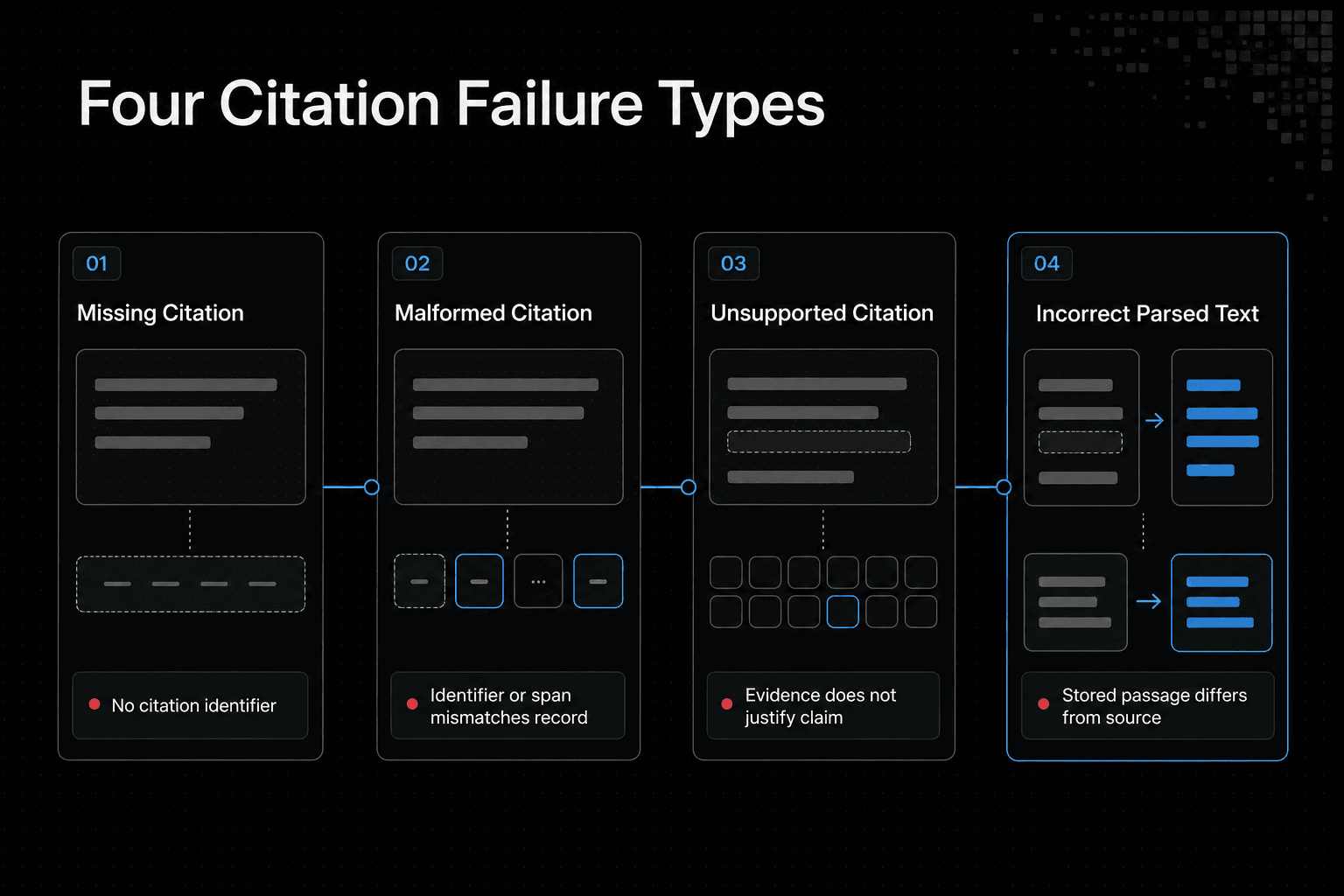
A RAG answer can look well sourced and still fail in four different ways: it has no citation, cites a chunk that does not exist, points to the wrong passage, or links to text that cannot prove the claim. A page number alone is not evidence. If the parser scrambled a table, the retrieval step lost document metadata, or the model stretched a quote beyond what it says, a neat citation badge won't make the answer grounded.
The main catch is that no automated check can prove a source is authoritative, fresh, parsed faithfully, or complete for the question. You can, however, catch most operational failures with an evidence trail that follows each claim from parsed text through retrieval, validation, and rendering. This guide covers how to inspect that trail, require structured claims, verify IDs and evidence spans, run entailment checks, and show an honest unsupported state in your UI.
Quick diagnosis
A missing citation, a malformed citation, an unsupported claim, and an incorrectly parsed evidence passage are different failure modes. Trace the claim from retrieved evidence through validation and rendering before changing retrieval settings.
- Check whether retrieval returned evidence for the claim.
- Check whether the model output includes a citation identifier.
- Check whether that identifier matches a retrieved source and evidence span.
- Check whether the quoted evidence actually supports the claim.
- Check whether the interface renders the validated citation.
Define the Citation Failure Before You Try to Fix It
Citation failures can start upstream. Name the layer first. Don't treat each one as a prompt issue.
Missing citation vs. invalid citation vs. unsupported claim
Missing has no evidence. Invalid mismatches its record. Unsupported has evidence that doesn't justify the claim.
Why a correct page or source ID is not proof of entailment
A page proves location, not entailment.
What automated validation cannot prove: authority, freshness, parser fidelity, and complete coverage
Automation checks IDs and text. It cannot prove authority, freshness, parser fidelity, or complete coverage.
Missing, Malformed, or Unsupported: Which Citation Failure Is It?
| Failure | What to inspect | Next action |
|---|---|---|
| Missing citation | Whether a claim has any citation identifier | Flag the claim for evidence review or an unsupported state |
| Malformed citation | Whether the identifier and evidence span match the retrieved record | Reject or repair the reference using recorded provenance |
| Unsupported citation | Whether the cited evidence entails the claim | Do not present the claim as supported |
| Incorrect parsed text | Whether the stored passage matches the source content | Correct the parsed evidence before assessing support |
Set Up the Evidence Trail Across Parse, Retrieve, Generate, and Render
A valid ID still won't explain where the evidence went. You need records from each handoff before you can debug the break.
Log parser output, source text, page or locator, chunk boundaries, relevance score, and document version
Keep the extracted text beside its locator, chunk boundaries, score, and version. Raw parser output matters.
Record the retrieved candidate set separately from the citations selected by the model
Log every retrieved candidate, then log the smaller set the model cited. These are not the same record.
Use stable source_id and chunk_id values rather than UI-only indexes
Use stable source_id and chunk_id values. A list position can change after reranking or a new document upload.
Check parsing failures first: flattened tables, broken reading order, missing headers, and bad chunk boundaries
Check parsing first: flattened tables, broken reading order, missing headers, and bad chunk boundaries can corrupt evidence before retrieval starts.
Step-by-Step: Trace a Citation Failure
- Capture the user query, retrieval event, and retrieved chunk records.
- Inspect the model output as structured claims with citation identifiers and evidence spans.
- Validate each identifier and span against the retrieved records.
- Assess whether each cited passage supports its associated claim.
- Mark unsupported claims explicitly instead of attaching an unverified source.
- Check that the interface displays only the validated citation state.
- Record the failure category and evaluation result for the incident.
Use a Structured Claim Schema for RAG Citations
A claim schema makes each factual statement, its cited chunk, and its verification state machine-checkable. It won't prove the source is true or current, but it can stop missing IDs, stale versions, empty quotes, and unsupported claims from reaching your UI as valid evidence.
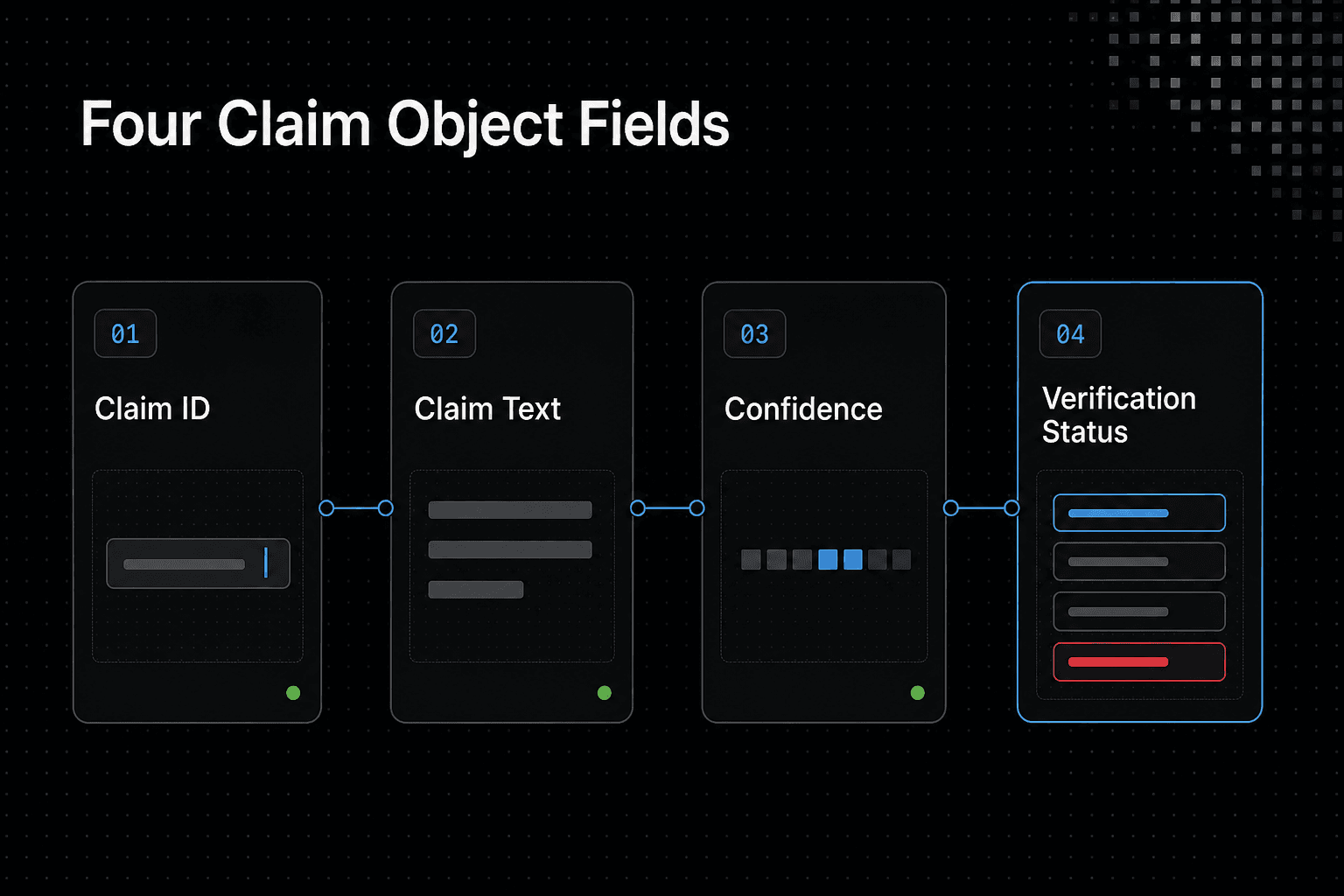
The claim object: claim_id, claim_text, confidence, and verification_status
Give every factual claim a stable ID. Confidence may be null, but status cannot be.
The citation object: source_id, chunk_id, document_version, locator, quote, retrieval_score, and evidence_span
Keep the exact quoted span. A page number alone isn't enough.
Required fields, nullability rules, enums, and schema constraints
{"$schema":"https://json-schema.org/draft/2020-12/schema","type":"object","required":["claims"],"additionalProperties":false,"properties":{"claims":{"type":"array","items":{"type":"object","additionalProperties":false,"required":["claim_id","claim_text","confidence","verification_status","citations"],"properties":{"claim_id":{"type":"string","minLength":1},"claim_text":{"type":"string","minLength":1},"confidence":{"type":["number","null"],"minimum":0,"maximum":1},"verification_status":{"enum":["supported","unsupported","insufficient_evidence","validation_error"]},"citations":{"type":"array","items":{"type":"object","additionalProperties":false,"required":["source_id","chunk_id","document_version","locator","quote","retrieval_score","evidence_span"],"properties":{"source_id":{"type":"string","minLength":1},"chunk_id":{"type":"string","minLength":1},"document_version":{"type":"string","minLength":1},"locator":{"type":"string","minLength":1},"quote":{"type":"string","minLength":1},"retrieval_score":{"type":"number"},"evidence_span":{"type":"object","required":["start","end"],"properties":{"start":{"type":"integer","minimum":0},"end":{"type":"integer","minimum":1}}}}}}}}}}
Separate supported, unsupported, insufficient_evidence, and validation_error states
Use unsupported when cited text fails to prove the claim. Use insufficient_evidence when retrieval has no adequate evidence.
Prompt contract: require JSON that conforms to the schema, but do not assume schema compliance proves truth
Require this JSON from the model. Then validate IDs, quotes, and claim support separately.
Implement Deterministic Citation Validation in Python
Schema validation checks shape, not truth. Run it before entailment so fabricated IDs and stale metadata never reach semantic scoring.
[!tip] When debugging, log the retrieval event and the exact evidence span alongside each claim; this makes it easier to distinguish a retrieval problem from a generation, validation, or rendering problem.
Runnable setup: typed models, JSON Schema validation, and a small in-memory chunk registry
from dataclasses import dataclass
from jsonschema import validate, ValidationError

@dataclass(frozen=True)
class Chunk:
    version: str
    locator: str
    text: str

chunks = {
    ("guide", "c1"): Chunk("v2", "p. 3", "Retention is 30 days.")
}
schema = {"type": "object", "required": ["citations"]}

def check(answer):
    try:
        validate(answer, schema)
    except ValidationError as e:
        return {"status": "validation_error", "errors": [e.message]}

    errors, seen = [], set()
    for c in answer["citations"]:
        key = (c.get("source_id"), c.get("chunk_id"))
        chunk = chunks.get(key)
        if not chunk:
            errors.append("unknown_chunk")
        elif c.get("document_version") != chunk.version:
            errors.append("stale_version")
        elif c.get("locator") != chunk.locator:
            errors.append("wrong_locator")
        elif not c.get("quote") or c["quote"] not in chunk.text:
            errors.append("invalid_quote")
        elif key in seen:
            errors.append("duplicate_citation")
        seen.add(key)
    return {"status": "validation_error" if errors else "ready", "errors": errors}
Validate that each cited source_id and chunk_id exists in the retrieved set
Use only the retrieved registry. Unknown keys are rejected.
Validate document_version, locator, and quote-to-chunk matching
Compare each field with the stored chunk, including the exact quote.
Reject fabricated IDs, stale chunk references, empty evidence spans, and duplicate citations
Add span start and end checks before accepting ready.
Return machine-readable validation errors instead of silently dropping citations
Keep the errors with the claim. Your UI can then show validation_error, not a false citation.
Verify Claim Support With Entailment and an Unsupported-Claim Fallback
Deterministic checks can't prove meaning. A real chunk ID and exact quote can still sit beside a claim the quote does not support.
[!note] A citation identifier that resolves to a real source does not, by itself, show that the source supports the claim.
Why valid citation IDs can still fail to support the answer
A citation may mention retention while the answer claims a policy applies to every customer. The ID is valid. The claim isn't grounded.
Entailment-based verification inputs, threshold selection, and score logging
Score the claim against its cited text, then set a threshold from reviewed examples. Log the score, model version, and decision.
Check the cited evidence span, not merely the full document
Use the quoted span or a small surrounding window. Full documents can hide a mismatch.
Unsupported-claim handling: remove, qualify, ask for clarification, or state insufficient evidence
Remove claims that aren't needed. Otherwise qualify them, ask for missing context, or return insufficient_evidence.
Do not turn low entailment into a fabricated replacement citation
Don't search for a nicer-looking source after a failed check. Keep the failure record, or you'll replace one unsupported claim with another.
Debug a Missing-Citation Incident End to End
Incident input: a user question, retrieved chunks, and an answer with one missing citation and one unsupported claim
User asks about 30-day retention. Chunks cover both. Answer omits citation, claims exports.
Trace the failure through parser output, retrieval logs, generation JSON, deterministic checks, and entailment results
Parser is sound. JSON loses retention metadata. Export ID passes, but entailment fails.
Show corrected structured output and the resulting user-facing answer behavior
Restore metadata. Mark exports unsupported.
Add a regression test from the incident so the same failure is caught later
Test this case.
Sample metrics: citation coverage, valid-citation rate, entailment pass rate, unsupported-claim rate, and citation latency
Track coverage, validity, entailment, latency.
Render Citations Safely in a Streaming RAG UI
Don't stream citation badges with token text. A token stream is provisional, while a citation must survive ID, quote, and support checks. Show the answer as still verifying until that record arrives.
Stream provisional answer text separately from verified citation events
Emit a separate verification event.
Attach citations at claim boundaries rather than after the entire response
Bind each event to its claim.
Show verification-pending and insufficient-evidence states honestly
Don't imply proof early.
Keep source title, locator, quote, and document version inspectable in the UI
Make each field inspectable.
Avoid rendering a citation badge until its claim-to-evidence relationship has passed the applicable checks
Render only after validation.
Preserve Citation Provenance Across GigaRAG Multi-Agent Handoffs
Shared knowledge can move evidence between agents, but it can't prove that evidence supports a claim. Keep citation validation in your application, and treat every memo as input for review rather than release-ready proof.
Publication gate
Before publishing product-specific instructions, verify GigaRAG terminology, MCP behavior, shared-memo support, access controls, and commands against current official documentation. Don't present the requested setup sequence, npm install -g gigarag, gigarag login, gigarag connect, restart VS Code, then "List my GigaRAG buckets," as confirmed until that check is complete.
Provenance handoff contract
Put these fields in every shared memo: source_id, chunk_id, document_version, locator, quote, retrieval timestamp, producing_agent, and verification_status. A research agent writes the memo, a coding agent uses it, and a reviewer rechecks each claim-to-source link before release.
Access and validation
Restrict who can read, write, revise, and delete evidence records. Preserve audit fields instead of overwriting provenance, so you can trace a bad citation back to the agent and retrieval event that produced it.
Troubleshoot the Most Common Causes of Missing RAG Citations
Trace the break from the rendered answer back to the retrieved chunk. Don't start by changing the prompt, because a citation can vanish in generation, serialization, validation, or the UI.
No citations at all: generation contract, output parser, and UI event handling
Inspect the model JSON, parser errors, and citation events separately. If citations exist in JSON but not on screen, the UI is the failed layer.
Citations disappear after retrieval: metadata propagation and chunk serialization
Check that source_id, chunk_id, and document version survive chunk storage and handoff. Missing fields can't be restored safely later.
Citations point to the wrong passage: chunking, reranking, and stale document versions
Compare the cited chunk with the retrieved candidate set. Rechunking or a changed document can leave old IDs pointing at the wrong text.
Citations exist but fail support checks: overbroad claims, weak retrieval, and low entailment
Narrow the claim or retrieve better evidence. A valid locator is not proof.
Correct locator but wrong evidence: document parsing, tables, reading order, and extracted-text inspection
Inspect extracted text beside the original file. Flattened tables and broken reading order can preserve a page number while corrupting the evidence you show.
Roll Out Citation Validation Without Blocking Useful Answers
Start with checks that don't add model latency. Add semantic review only where deterministic validation passes but support is still unclear.
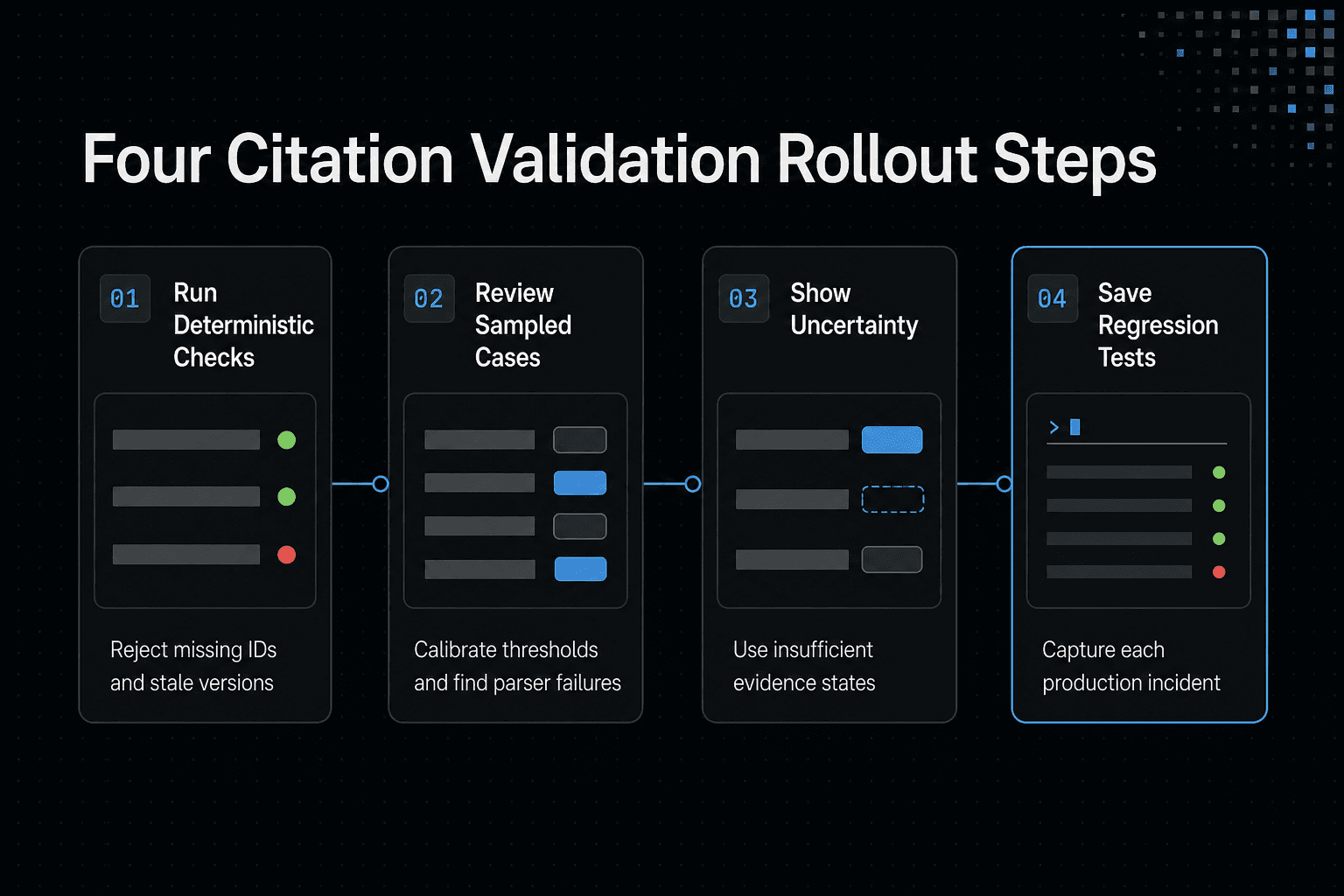
Start with deterministic provenance checks before adding an entailment model
Reject missing IDs, stale versions, and unmatched quotes first. They're cheap failures to catch.
Use sampled human review to calibrate thresholds and find parser failures
Review borderline cases and wrong passes. This exposes bad extraction that scores alone can hide.
Choose explicit uncertainty over polished but unsupported claims
Show "insufficient evidence" when the record fails. Don't replace it with a plausible source.
Treat every production citation incident as a regression-test candidate
Save the input, retrieved chunks, output, and expected state. Your next release shouldn't recreate the same break.
Frequently Asked Questions
Why does my RAG answer have no citations even when retrieval returns documents?
Retrieval results and answer citations are separate parts of the pipeline. Check whether the model output includes citation identifiers, whether validation accepts them, and whether the interface renders them.
What is the difference between a valid citation and a citation that supports a claim?
A valid citation resolves to a recorded source or evidence span. A supporting citation also provides evidence for the specific claim it accompanies; check these separately.
Which provenance fields should every RAG citation include?
Preserve at least the source ID, chunk ID, document version, retrieval event, and evidence-span metadata so a claim can be traced back to the retrieved passage.
Can JSON Schema validation prove that an RAG answer is grounded?
No. A schema can check whether structured fields are present and correctly shaped, but grounding requires checking whether the cited evidence supports the claim.
How should a RAG system respond when it cannot find evidence for a claim?
Return an explicit unsupported-claim state rather than inventing or attaching a source. Keep that state distinguishable from a claim with a validated citation.
Why can a citation point to the correct page but still be wrong?
The cited passage may not support the claim, or the text parsed from the page may be incorrect. Inspect both the source passage and its parsed representation.
How do entailment checks improve RAG citation validation?
They add a check of whether the evidence supports the claim, beyond verifying that a citation identifier exists. Treat the result as a validation signal, not as a substitute for preserving the evidence trail.
How should citations appear in a streaming AI interface?
Keep citation state explicit while output is still being assembled. Render citations as validated only after checking their identifiers and evidence; do not present an unverified reference as supported.
What metadata should agents preserve when handing evidence to another agent?
Preserve the source ID, chunk ID, document version, retrieval event, and evidence-span metadata with the claim. This keeps the evidence traceable across the handoff.
About GigaRAG
GigaRAG is a shared memory platform for AI agents that helps developers and teams keep project knowledge available across sessions and tools. Connect your agents to a central Hive Mind through MCP or the API, with access controls to manage what each agent can use.


