How to Fix Stale Answers in a RAG Application
How to Fix Stale Answers in a RAG Application starts with a distinction you can't skip: an answer can be wrong without being stale. When a user asks about a policy changed this morning and gets last week's once-correct rule, the response may sound plausible, but it does not show that retrieval used current evidence.
The honest answer is that replacing the model is usually not the first fix. The old answer may come from the source, ingestion run, index, retrieval result, cache, or mutable session memory, and each needs a different repair. No freshness control can recover a change your system cannot access or verify. Trace the answer from its cited chunk to the source version, ingestion run, index version, retrieval time, cache status, and memory state before you re-embed anything.
Quick diagnosis
A stale answer conflicts with evidence it should reflect. An incorrect answer may be wrong for other reasons, and a plausible response does not show which evidence or memory the system used.
- Record the answer, query, and retrieval timestamp.
- Check the source version and ingestion run.
- Verify the index version and retrieved passages.
- Inspect cache status and agent or session memory separately.
- Change only the layer the trace identifies.
How to Fix Stale Answers in a RAG Application: define the failure
A stale answer is not just an answer you don't like. It conflicts with the current authoritative source, even if it was correct when the system first indexed the content.
RAG can fail at the data, retrieval, generation, and pipeline layers. Therefore, a convincing answer is not proof that your application used current evidence, and changing the model won't fix a source or cache that still serves old material.
What counts as stale: the answer conflicts with the current source of truth
Start with the source of truth: the record, policy, product page, or database field your system is meant to reflect. If that source now gives one plan price and the answer gives a retired price, the answer is stale.
Old text may remain in a vector index, response cache, or agent memory. It may also sit in a current index because the update never reached it. The key fact is conflict with verified current content, not the answer's age alone.
What stale does not mean: unsupported generation, wrong retrieval, and missing coverage
A hallucination is different. The model states something the retrieved evidence does not support, even if every source is current. That is a generation failure.
Wrong retrieval is different too. The current source may be indexed, but the system retrieves an unrelated chunk because ranking, chunking, or query routing went wrong. Missing coverage means the source was never available to retrieve.
These failures can look alike. Your trace has to separate them before you fix anything.
Set a freshness expectation by content type and change frequency
It depends on how often content changes and what a wrong answer costs. A legal policy, inventory record, and internal handbook should not share one update schedule.
Define when each source should appear in answers after a verified change, and what happens when that window is missed. Include deletions, not just edits. If your system cannot access or verify an upstream change, it cannot promise a current answer.
Knowledge-base freshness vs. agent-memory freshness
| Factor | Knowledge-base content | Agent or session memory |
|---|---|---|
| What to inspect | Source version and ingestion run | Stored facts and memory state |
| Trace evidence | Index version and retrieved passages | Memory entries used for the answer |
| Potential scope | May affect answers that retrieve the content | May affect answers that use that session or agent state |
| First response | Verify source and ingestion before rebuilding | Inspect or update relevant memory separately |
Set up the evidence you need before debugging
Don't start by reindexing. If you can't tie one bad answer to the exact evidence path that produced it, every fix is a guess and may hide the real failure.
[!tip] Keep the source version, ingestion run, index version, retrieved passages, cache status, and memory state together in each debugging trace so you can compare the answer path before rebuilding the index.
Build a trace record before the next incident. It should follow an answer from the current source through ingestion and retrieval to the context the model received.
Create a known-change test case with an old and current source version
Pick one source with a clear change, such as a replaced policy rule or a product record with an updated limit. Keep both the retired and current text, along with when each should take effect.
Then write a query that should expose the change. Run it before and after each repair. A vague question won't help, because you need to know which source claim the system was meant to return.
Capture source ID, version or modified time, chunk ID, ingestion run, and index version
Give each source a stable ID that survives a title change or moved URL. Store a source version when one exists, or a modified time when it does not. Don't treat either field as proof that the content is correct.
For every chunk, retain its chunk ID, source ID, source version, ingestion run ID, and index version. Keep the text, or a retrievable copy, too. Without that link, you may find an old chunk but have no way to tell how it entered the index.
Log query time, retrieved chunk IDs, cache status, memory state, prompt context, and answer citations
Log the exact query, query time, retrieved chunk IDs, and scores where your system exposes them. Record cache status, including the cache key or entry version, so you can separate a reused answer from fresh retrieval.
Also capture relevant session or agent memory, the final prompt context, and any citations shown to the user. Keep sensitive data out of logs or redact it before storage. The trace must show what the model could use, not what you expected it to use.
Choose a canonical source of truth when duplicate documents disagree
Duplicate documents drift. A help page, PDF, and database record can all describe the same rule, then disagree.
Choose which source wins for each fact type, and record that rule in your ingestion setup. If no source is clearly authoritative, don't let retrieval silently blend the conflict. Flag it for review, because a newer timestamp alone may not settle which document controls the answer.
How to fix stale answers in a RAG application: a step-by-step guide
- Capture the query, answer, retrieval timestamp, and request identifiers.
- Check the authoritative source and note its current version or content.
- Trace the ingestion run and confirm which source version it processed.
- Inspect the index version and passages returned for the request.
- Check whether a cache served the answer or retrieved context.
- Inspect agent or session memory for conflicting or outdated information.
- Apply the smallest targeted correction and retest the same query.
Step 1: Trace the stale answer back to its evidence
Trace the exact answer through its retrieved chunks, source version, ingestion run, index version, cache status, and memory state. If the evidence path is current, the answer may be a ranking or generation failure, not a freshness failure. Don't change embeddings or prompts until you know which layer served the bad claim.
Start with the exact user query, timestamp, response, and cited or retrieved chunks
Take the query exactly as the user sent it. Record the response, request timestamp, answer citations, retrieved chunk IDs, retrieval scores, and the final context passed to the model.
Then ask: did this response come from a fresh run or reused output? A cache hit can return an old answer without calling retrieval. If the system did retrieve, preserve the retrieval timestamp, source IDs, chunk text, ingestion run ID, and index version for every result.
Compare the retrieved chunk text with the current authoritative source
Open the retrieved chunk, not just its metadata. Compare its words with the current canonical source and the older version from your known-change test.
Three outcomes matter. The chunk may contain retired text, contain current text but fail to answer the query, or match the current source while the final answer conflicts with it. Each points to a different repair.
A plausible citation proves very little.
Classify the result: old chunk, current chunk but wrong ranking, cached answer, stale memory, or unsupported answer
Use the trace to classify the failure:
- Old chunk: Retrieval returned a retired source version. Check ingestion, retirement, and index propagation.
- Current chunk but wrong ranking: The right evidence exists, but weaker or conflicting material outranked it. Check retrieval and reranking.
- Cached answer: The response predates the source update. Check the answer cache, semantic cache, cache key, and TTL.
- Stale memory: Session or agent memory supplied an older claim. Check whether retrieved authoritative evidence should override it.
- Unsupported answer: No retrieved chunk supports the claim. This is a generation failure, even if the answer sounds familiar.
The four-layer framing in RAG Accuracy Problems separates data, retrieval, generation, and pipeline failures. Your trace should do the same, because an answer can be wrong at more than one layer.
Do not change embeddings or prompts until the trace identifies a failing layer
Re-embedding everything may be worth it when the index contains obsolete vectors or a chunking change needs a rebuild. It won't clear an answer cache, remove stale memory, or correct a source record that was already wrong.
Start with the smallest repair that matches the evidence. Retire one old chunk if it caused the answer. Invalidate the affected cache if cached output caused it. Change ranking only when current evidence was retrieved but lost to the wrong result.
Step 2: Repair stale source content and version metadata
Once the trace shows an old chunk, don't rebuild the whole index first. Repair the record that told the pipeline what the source was, which version was valid, and whether it still existed.
[!note] Content hashes can help identify changes to the content they cover, but a matching hash alone does not show that a source was accessible, correctly ingested, or reflected in the index.
A vector index can faithfully retrieve obsolete text. The main catch is that retrieval can't infer retirement from embeddings alone.
Treat source version, effective date, and last-verified time as separate fields
Store a stable source ID, source version, effective date, and last-verified time on each document and chunk. These fields answer different questions: which document this is, which revision it represents, when its rule takes effect, and when your system last confirmed the source was available and current.
Don't use a page's modified timestamp as a substitute for all three. A publisher may change formatting without changing a policy, publish a future rule before it takes effect, or make a meaningful change without a reliable timestamp.
Keep the canonical source reference too. When duplicate documents disagree, your pipeline needs a defined source of truth rather than treating both as equally valid evidence.
Use content hashes to detect text changes, not as proof that all meaningful changes were captured
A content hash gives you a compact fingerprint of fetched text. When the hash changes, fetch and process the new content. When it does not, you can usually skip a needless re-embedding run.
That is useful, but limited. A matching hash doesn't prove the source is still right, that a permissions-based page showed all content, or that a dynamic page returned the state a user sees.
Here's why: the hash describes only the captured input. It cannot detect an upstream change your crawler could not access or a source change outside the stored text.
Handle renamed, moved, split, merged, and deleted documents explicitly
URLs are not stable document identities. A renamed or moved page should retain its source ID and record its new location, while a replacement page should link to the document it supersedes.
Splits and merges need their own mapping. If one policy becomes three pages, retire the old chunks and link the old version to each successor. If several pages become one, preserve the lineage so you can audit where retired claims came from.
Deletion needs an explicit event. If a fetch returns not found, access denied, or an empty result, don't silently treat that as a safe update. Mark the result, investigate when needed, and retire old content only when your source rules support that decision.
Prevent old and new versions from remaining equally eligible for retrieval
During an update, old and new chunks can coexist briefly. That's normal. Leaving both eligible after the new version is verified is not.
Add lifecycle status to every chunk: active, superseded, retired, or pending verification. Filter retired and superseded chunks before ranking instead of hoping a newer timestamp makes the current version win.
For time-bound material, filter by effective date too. A newly published version may apply in the future, so the answer should not treat it as current evidence before then.
Step 3: Make ingestion and index updates safe to retry
A source record can be correct while an interrupted ingestion run leaves retrieval in a mixed state. Retrying must not create a second copy of the same chunk, revive retired content, or mark an incomplete update as ready to serve.
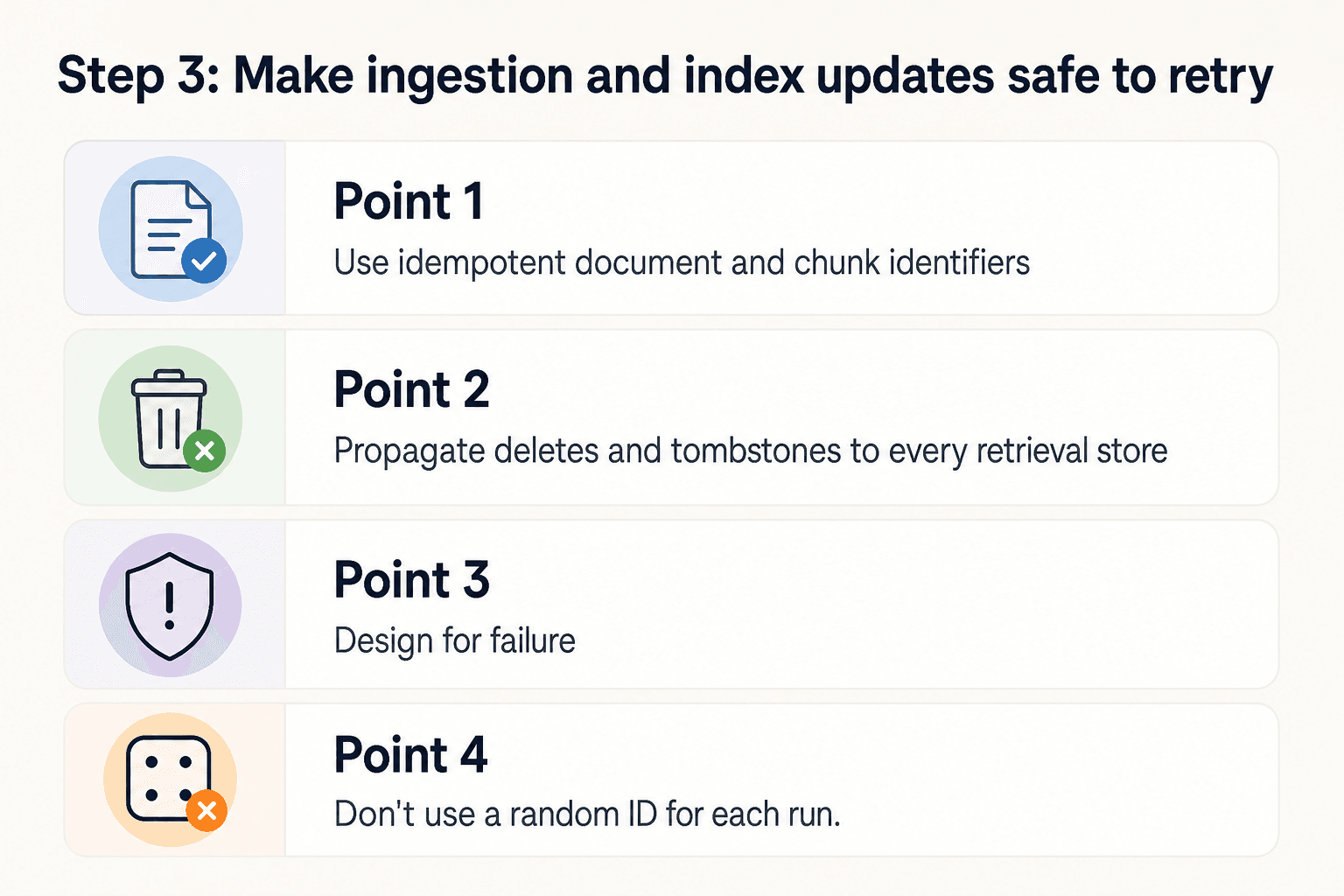
Design for failure. Fetches time out, embedding jobs fail, and workers can run the same message twice.
Use idempotent document and chunk identifiers
Give each document a stable ID that survives a new version, URL move, or retry. Then give each chunk an ID derived from the document ID, version, chunk position, and the chunking rules that produced it.
The exact format matters less than its behavior: processing the same input twice should write to the same record, not create another eligible result. If you change chunk boundaries or parsing rules, include a pipeline or chunking version so the system can separate a deliberate replacement from a duplicate.
Don't use a random ID for each run. You won't be able to safely upsert, compare, or retire records later.
Process updates as an ordered lifecycle: detect, fetch, parse, chunk, embed, upsert, verify, retire
Treat ingestion as a lifecycle with recorded states: detect, fetch, parse, chunk, embed, upsert, verify, and retire. Store the run ID and document version at each stage so a failed job can resume or retry without guessing which output is safe.
Upsert new chunks before retiring the old active version. Then verify that new records exist, carry the expected source and version metadata, and are eligible for retrieval. Only after that check should old chunks become superseded or retired.
Order matters. Retiring first can leave you with no usable evidence if the new embedding or index write fails.
If only some chunks reach the index, don't mark the document version active. Keep it pending, remove or isolate incomplete records, and retry from a known stage.
Propagate deletes and tombstones to every retrieval store
A deletion is not complete when one vector record disappears. The same content may sit in a keyword index, metadata store, chunk table, cache, or separate index used by another retrieval path.
Write a tombstone, a record that says a document version must no longer be served, using the stable document ID and version. Apply it to every store that can return the content, and filter retired status even while physical deletion runs.
Keep in mind that a tombstone cannot prove a source was truly deleted. It records the decision your pipeline made from the source signal it received.
Verify post-ingestion retrieval with the changed source before declaring the update complete
Don't call an update done because the job reports success. Run a known query or source-linked check against the changed document and inspect the retrieved chunk IDs, text, version, and lifecycle status.
Check the negative case too: a query that previously found the retired claim should no longer return it as eligible evidence. If both versions still appear, the write may have worked while a filter, secondary index, or cache still exposes the old record.
Mark the update complete only when retrieval points to the changed source your answer system is meant to use.
Step 4: Fix retrieval, cache, and agent memory freshness
If the index holds the current document, don't assume the answer path is current. A cache can replay an old response, a reranker can bury the new chunk, and an agent can treat an earlier session detail as authoritative.
Trace each layer. Change one thing at a time, then run the same known-change query.
Check whether query-result, semantic, and answer caches can return pre-update output
Inspect every cache between the query and final response. A query-result cache may reuse an old list of chunk IDs, a semantic cache may treat a new question as close enough to an earlier one, and an answer cache may return completed text without retrieval or generation running.
Record the cache key, creation time, expiry, hit or miss status, and source or index version used when the entry was written. If the stale answer comes from a cache hit, changing embeddings, prompts, or reranking won't fix that request.
Include corpus or index version in cache invalidation strategy where appropriate
Invalidate cached output when underlying evidence changes, but don't clear every cache for every update unless your freshness needs require it. It depends on what the cache represents: an answer about one document can use a document or corpus version, while a cached retrieval result may need the index version and filter state.
A TTL, or time-to-live expiry, limits how long an entry can survive. It does not guarantee freshness between expiry points. Include a version in the cache key or reject entries built against an older version for current-sensitive queries.
Test retrieval before and after reranking to locate ranking-related staleness
Run the known-change query against the first-stage retriever and save ranked chunk IDs, scores, text, and versions. Then run the same candidate set through the reranker and compare the order.
The main catch is that the current chunk can be present but too low to reach the model. If it disappears before reranking, inspect retrieval filters, query rewriting, embeddings, or hybrid-search settings. If it drops after reranking, inspect the reranker's input and ranking rules instead.
Separate session or agent memory recency from external knowledge-base recency
Session memory records what happened in a conversation. Your knowledge base supplies external evidence. They aren't interchangeable.
Keep memory with its own timestamp, scope, and source, especially when it contains user preferences, prior tool results, or temporary facts. A current index cannot correct stale memory if the agent never retrieves, or if the prompt gives old memory more weight than retrieved material.
Define when memory should be superseded by retrieved authoritative evidence
Write an explicit precedence rule before a conflict reaches production. For factual claims that belong to an authoritative source, retrieved current evidence should replace incompatible session memory. Memory can still preserve the user's question, task state, and stated preferences.
Don't silently blend the two. If retrieved evidence conflicts with a user-provided fact that you cannot verify, say so and show which source the answer relies on.
Step 5: Constrain generation when retrieved context conflicts
A current index does not guarantee a current answer. Generation can still fail when the prompt contains conflicting documents, gives older text more weight, or leaves the model room to fill gaps beyond the retrieved evidence.
Don't solve this by making the model sound more certain. Set rules for what evidence it may use, how it handles disagreement, and when it must decline to answer.
Pass source version and recency metadata into the answer context when it is meaningful
Give the model more than chunk text when version matters. Include a source name or ID, effective date, version, status, and last-verified time beside each chunk, then state which fields decide precedence.
Keep the instruction narrow. For example, use the document with the latest effective date when two sources cover the same policy, unless a source is marked retired or superseded. A modified timestamp alone may not settle the conflict, so don't present it as proof that one claim is current.
Prefer an explicit conflict response over silently blending contradictory documents
Two documents can look relevant while making incompatible claims. If the model merges them into one smooth answer, you get a statement that no source supports.
Require it to name the conflict, cite the competing evidence, and either follow a defined authority rule or ask for review. This can feel less helpful than a direct answer. It is safer when the system cannot establish which version governs the user's case.
Require answer citations or abstention when evidence is missing or inconsistent
Make each factual claim traceable to a retrieved chunk. If the answer cannot point to support, it should say that the available context does not establish the answer instead of filling the gap from model knowledge.
The good news is that this makes debugging simpler. An unsupported claim is a generation failure, while a cited old claim sends you back to the source, index, retrieval, cache, or memory trace. Citation alone is not enough, though: check that it supports the exact claim and comes from an eligible source.
Test positional effects when current evidence appears alongside older context
Generation can fail after retrieval succeeds, particularly with positional bias and conflicting context. Test the same evidence in different prompt orders: current source first, current source last, and old material removed.
Watch for an answer that changes when the order changes despite the same source set. If it does, reduce duplicate context, exclude retired versions before generation, and place governing evidence where your prompt gives it clear priority.
Step 6: Add freshness checks, SLOs, and regression tests
A repaired incident is not proof that the pipeline will stay fresh. Without routine checks, a missed update, retired record, or stale cache can return quietly until a user finds it.
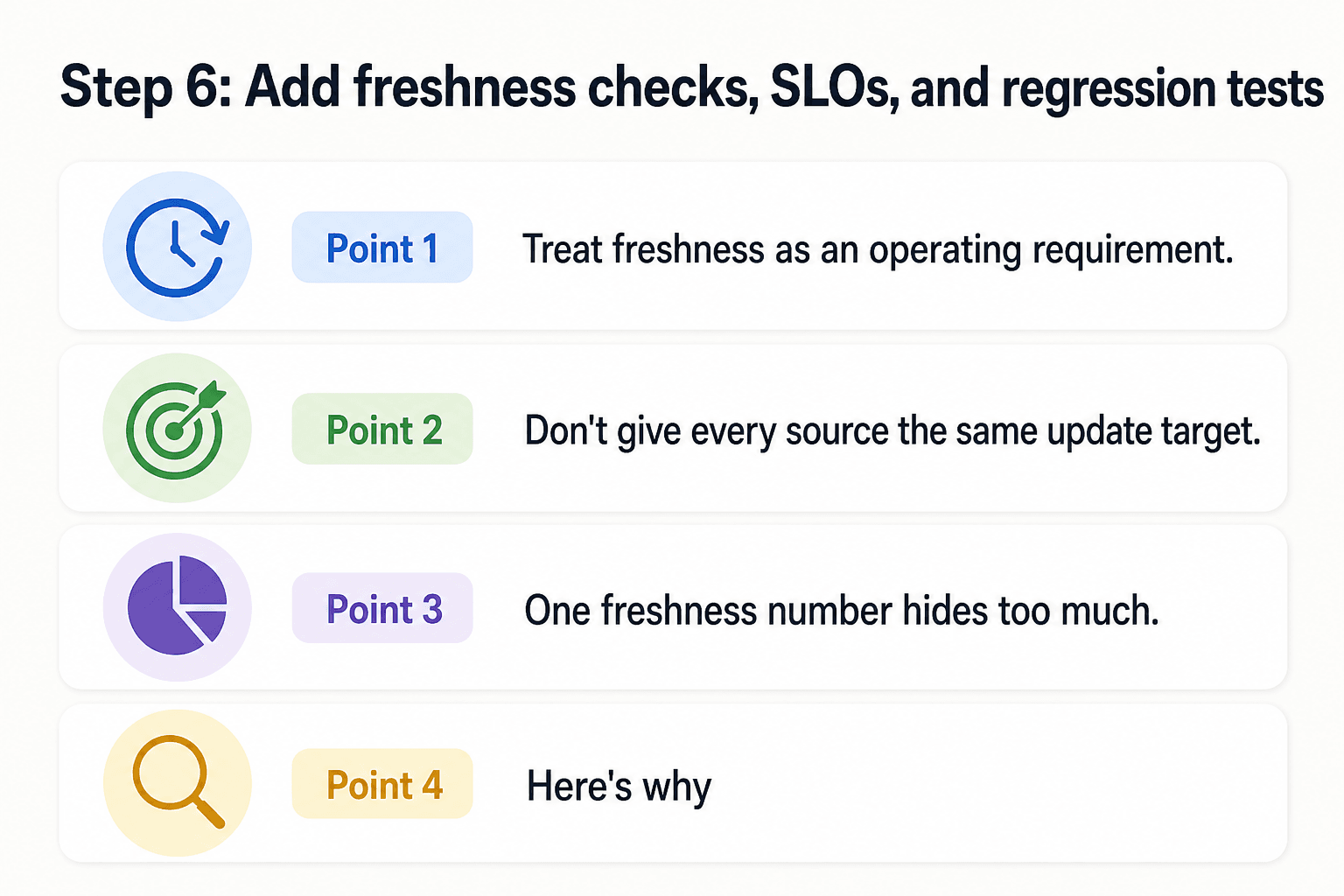
Treat freshness as an operating requirement. They emerge from failures at four distinct RAG pipeline stages – data, retrieval, generation, and evaluation – and are most severe when the underlying knowledge base is ungoverned or stale., which matters because silent pipeline failures will not show up in a one-time retrieval test.
Define freshness SLOs by source class instead of one universal update target
Don't give every source the same update target. A policy with an effective date, a live inventory record, and a rarely changed handbook create different risks when they lag behind the source of truth.
Set an SLO, a target for service behavior, for each class. Define the event that starts the clock, such as source publication or a detected change, and the point that stops it, such as verified retrieval from the active index. Name who owns an exception when the source cannot be fetched.
Measure source-to-index latency, deletion propagation latency, and cache invalidation latency
One freshness number hides too much. Split the path into separate measurements: source change to ingestion, ingestion to searchable index, deletion notice to retired chunks becoming ineligible, and index change to cache invalidation.
Here's why. Fast ingestion does not help if an answer cache still serves an old response, and a current index does not help if deleted content remains retrievable. Record the source and index version at each checkpoint so you can find the slow or failed handoff.
Maintain a changed-document test set with expected current answers and citations
Keep a small set of documents with known old and current versions. For each case, store the query, current expected answer, supporting citation, and any old chunk or answer that must no longer appear.
Run the set after source, parser, embedding, index, cache, or prompt changes. Include deletes and superseded policies, not only simple text edits. An answer can sound right while citing a retired source, so pass criteria should check chunk eligibility and citation version as well as answer text.
Alert on failed ingestion, unexplained version gaps, and retrieval of retired content
Alert on conditions that require action, not every delayed document. Failed ingestion, a source version with no matching indexed version after its SLO window, and retrieval of a retired chunk are clear signals worth routing to an owner.
The main catch is that alerts cannot prove an upstream source changed if your system cannot access or observe it. They can show only what the pipeline saw, processed, and served, which is why source coverage and last-verified time belong in the same operational view.
Troubleshoot common freshness fixes that still fail
No control can guarantee a current answer when the system cannot see, fetch, or verify the current source. A successful reindex proves only that your pipeline processed what it received, not that it received the whole truth.
When a fix appears correct but stale output remains, return to the trace. Check the source record, active index version, retrieval result, cache status, and memory state before widening the repair.
Why re-embedding everything may not fix an unchanged cache or a bad source record
Re-embedding changes vector representations. It does not clear an answer cache, replace a cached retrieval result, correct a source record that still holds old text, or retire duplicate chunks that remain eligible for search.
This can be expensive noise. Start by asking whether the stale answer came from the new index at all, then check whether the source item was updated before you spend compute on the full corpus.
Why timestamps can be ambiguous, missing, or unrelated to semantic changes
A "last modified" field may reflect a page rebuild, file move, or metadata edit rather than a policy change. It may also be missing, copied from an older record, or use a time zone that makes ordering unclear.
Keep separate fields for source modification, effective date, ingestion time, and last verification. They answer different questions, and treating one timestamp as proof of currency can make a current document look stale or an obsolete one look safe.
What content hashes miss when pages render differently, depend on permissions, or hide dynamic data
A content hash compares the bytes or normalized text your collector captured. If a page shows different content by user permission, location, script execution, or session state, the hash can remain unchanged while another reader sees a meaningful update.
The same problem applies to data loaded after the initial page fetch. Check the fetch path, credentials, rendering method, and extracted text used for ingestion, because hashing an incomplete view proves only that incomplete view did not change.
Why decay scoring is a prioritization signal, not evidence that a document is false
Decay scoring can rank older or less recently verified documents for review. It cannot establish that their claims are wrong, because some records remain valid for years while newer pages may be drafts, corrections, or unrelated updates.
Use decay to decide what to inspect first. Don't use it alone to suppress content, overwrite a source version, or tell the model that an older document is untrustworthy.
What cannot be guaranteed: inaccessible upstream changes, unobserved deletes, and unknown source truth
If an upstream system changes without an observable event, blocks your fetcher, deletes a record without a tombstone, or exposes conflicting copies, your RAG application cannot reliably infer the intended state. The honest answer is uncertainty.
It depends on what your source exposes: stable IDs, version history, delete events, access rights, and an authoritative owner. Where those are absent, record last-verified time, flag the coverage gap, and let the answer abstain when current evidence cannot be confirmed.
Build a RAG freshness loop, not a one-time fix
A freshness loop cannot prove a source is current when no current version is available to retrieve. It can show where your system last had evidence and contain failure.
Start with one known-change case. Trace the answer through source version, ingestion run, index version, retrieved chunks, cache status, and memory state. Classify the fault before changing anything, then repair only the layer that served old material.
Run the same case again. Confirm that retrieval returns the current source, retired content cannot win, and the answer cites or reflects the change. Monitor update and deletion paths after release, because a working repair can drift as sources, caches, and agent memory change.
For How to Fix Stale Answers in a RAG Application, make this loop routine.
Frequently asked questions
What does RAG stand for?
RAG stands for retrieval-augmented generation. It is a system approach in which retrieved information supports a generated answer.
What causes stale answers in a RAG application?
Possible causes include outdated source content, an ingestion run or index that does not reflect the current source, retrieval behavior, cached answers, or stale agent memory. Trace the answer path before deciding which layer is responsible.
How can I tell whether a stale answer came from the index or a cache?
Inspect the request trace for the index version and retrieved passages, then check whether the response or context came from a cache. If those details were not recorded, add them before drawing a conclusion.
How often should a RAG application reindex documents?
There is no single schedule established by the supplied evidence. Choose an update approach that fits how often the sources change, and verify that each update reaches the index before treating it as current.
Can content hashes detect every source change?
A hash can help detect a change in the content that was hashed. It does not prove that the system could access the source, processed the right version, or updated the index.
How should a RAG system handle deleted documents?
Track deletion as a source-state change and verify that the corresponding content is no longer available to retrieval. A refresh or matching hash does not show that deletion propagated.
What is the difference between stale agent memory and stale knowledge-base content?
Knowledge-base content comes from sources and indexes used for retrieval. Agent or session memory is separate stored context. Inspect each independently because either can contribute outdated information.
About GigaRAG
Learn more about GigaRAG at https://www.gigarag.com.


