how to write a forward deployed engineer resume
How to write a forward deployed engineer resume starts with one shift: "customer-facing" isn't enough when your bullets read like internal ticket delivery. FDE hiring teams need to see how you took an unclear customer need, made technical choices under real constraints, deployed or integrated the work, and stayed accountable when it broke.
A resume can't manufacture customer discovery, production ownership, security work, or metrics you didn't have. Don't turn a demo into a deployment or a supporting task into an outcome you owned. Strong engineering experience can still be relevant, but you need to label its scope clearly and connect it to observable results.
Use an evidence-first method to map each job requirement to work you can prove. It covers tailoring, bullet rewrites, project descriptions, ATS-safe structure, and a final audit checklist.
Process overview
An FDE resume should show how you turned a customer's real-world problem into a working technical outcome, not just that you wrote code.
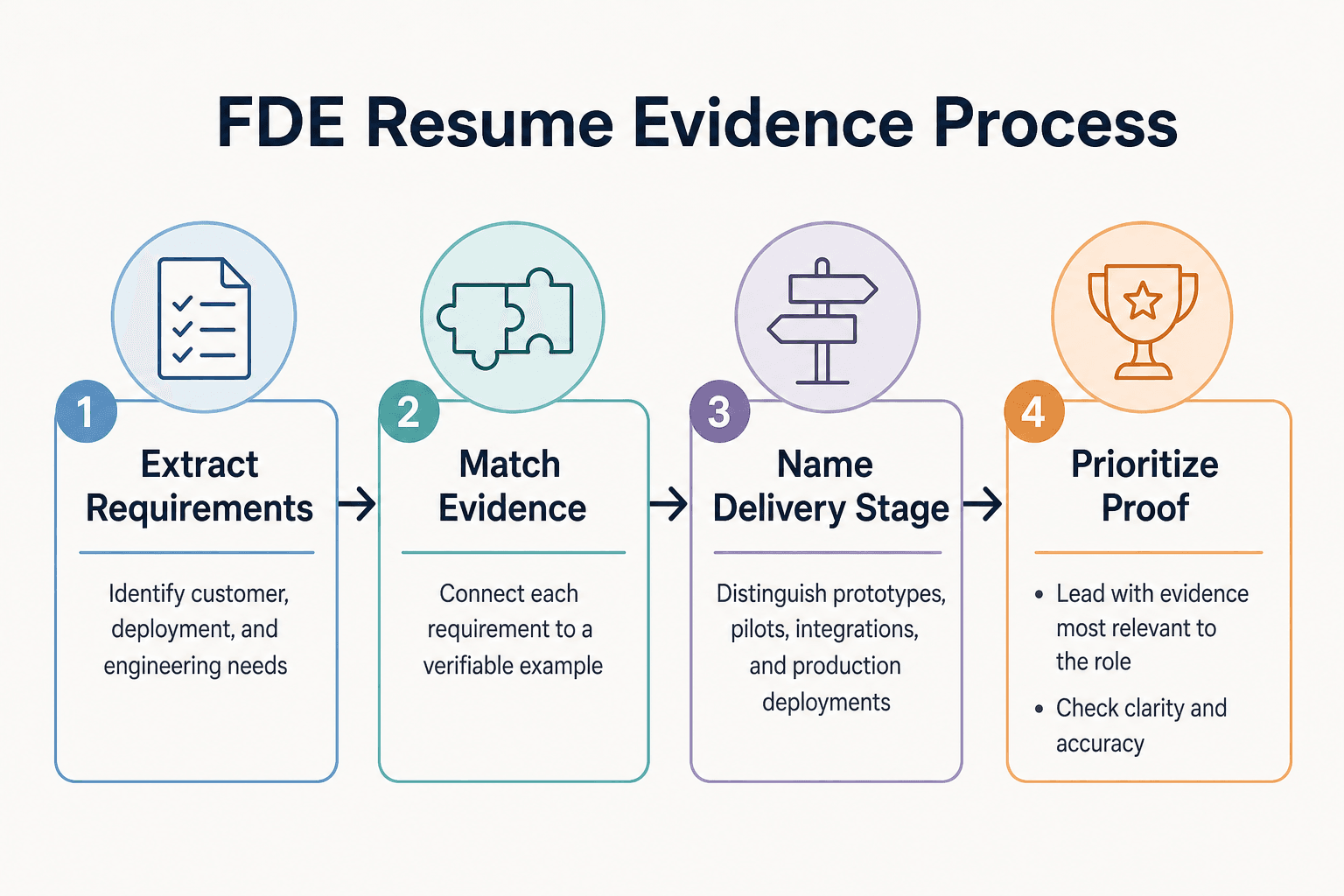
- Extract the role's customer, deployment, and engineering requirements.
- Match each requirement to a specific, verifiable example.
- Describe your work precisely, distinguishing prototypes, pilots, integrations, and production deployments.
- Prioritize the evidence most relevant to the role and check the resume for clarity and accuracy.
What a forward deployed engineer resume must prove
A forward deployed engineer resume must show that you can turn a customer's unclear problem into a working solution, then stay accountable when real constraints and failures appear. It can't create production, customer, security, or business-impact experience you didn't have. Your job is to make the evidence you do have easy to find.
[!note] The supplied reference describes an FDE as an engineer who owns customer outcomes and works through real-world deployment. It does not prescribe a specific resume format or provide resume outcome benchmarks.
The FDE outcome-ownership lens
An FDE resume isn't a software engineering resume with "customer-facing" added to the summary. The role centers on owning customer outcomes: understanding what the customer needs, making the software work in that environment, and dealing with the consequences after launch.
That doesn't mean you need to claim sole ownership of every result. Your bullets should connect your part of the work to a real delivery path: the user problem, the constraint, the technical decision, and what happened after the change shipped.
Ownership has limits. If you built one component under a lead engineer's direction, use accurate scope, such as "built," "implemented," or "supported," rather than "led" or "owned."
The four proof areas: customer context, engineering execution, deployment, and results
Start with customer context. Show who needed something, what workflow failed or slowed down, and which constraint shaped the work. A constraint could be an existing API, messy source data, access controls, a deadline, or a required system.
Then show engineering execution. Name the system you built or changed, the integration boundary, and the decision you made. "Built a Python service" is thin. "Built a Python service that mapped customer records from a partner API into the internal data model" tells a reviewer what you did.
Deployment is separate proof. A local demo, a pilot, and a production system aren't the same thing. State where the work ran, who used it, and what release or handoff work you handled.
Results come last. Use measured outcomes when you have records and can explain the scope. If you don't have a metric, describe an observable result instead: a workflow became usable, a defect was fixed, or a team adopted the tool.
Claims to avoid when the work was only a demo, prototype, or supporting contribution
Don't call a prototype a production deployment. Don't imply customer adoption when you only presented a demo, and don't claim reliability, security, or business impact because those were goals rather than verified outcomes.
The honest answer is that limited experience can still be useful. Label it accurately: "prototyped," "evaluated," "contributed to," "supported a pilot," or "implemented under guidance." A reviewer can judge honest scope. Inflated scope makes every other claim harder to trust.
Forward deployed engineer vs software engineer resume
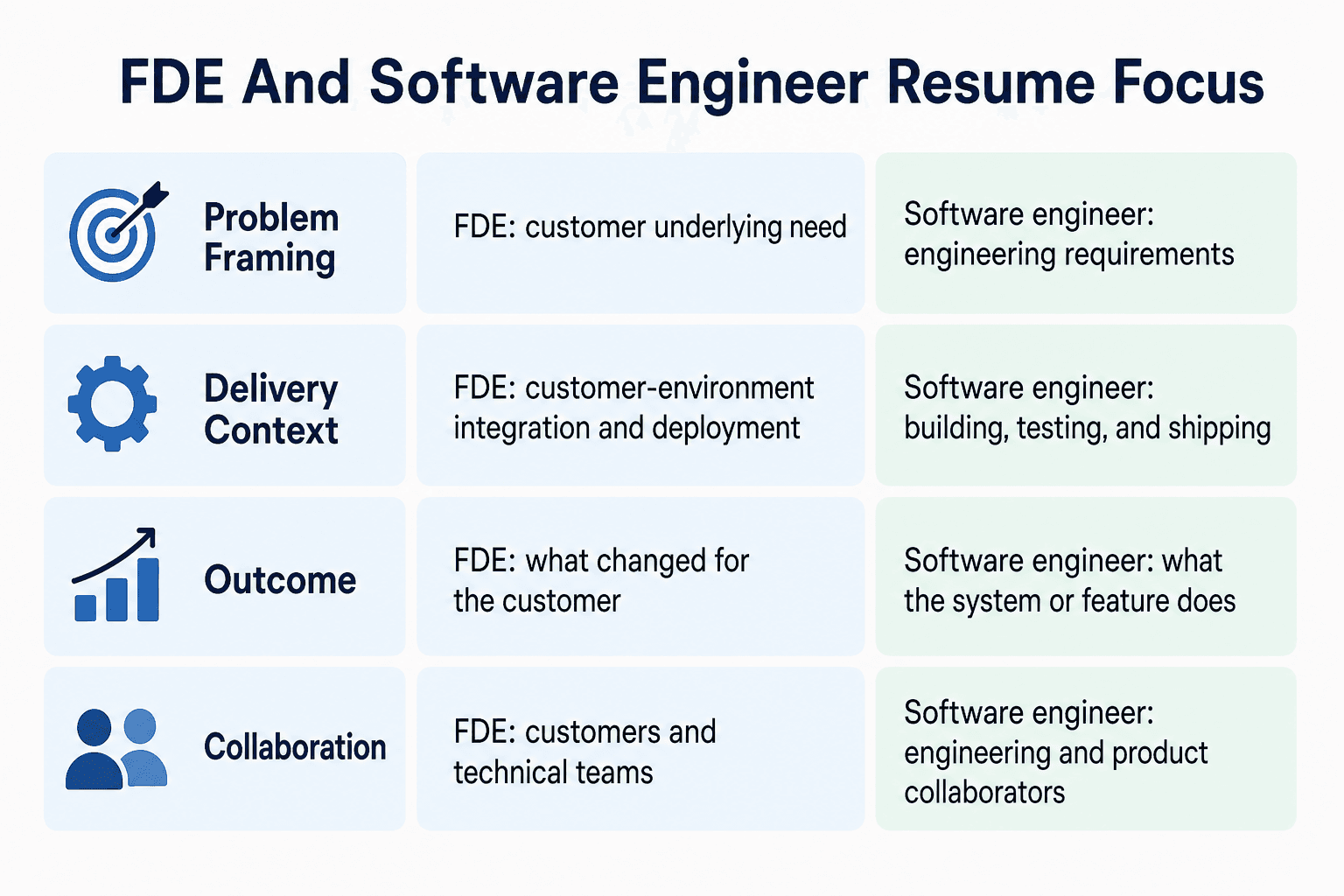
| Factor | FDE emphasis | Software engineer emphasis |
|---|---|---|
| Problem framing | How you understood a customer's underlying need | How you translated requirements into engineering work |
| Delivery context | Integration and deployment in a customer environment | Building, testing, and shipping software |
| Outcome | What changed for the customer after your work | What the system or feature does |
| Collaboration | Working directly with customers and technical teams | Working with engineering and product collaborators |
Start with the FDE job description and build an evidence inventory
Before you edit a bullet, pull the job description apart. You can't tailor an FDE resume by adding every tool and responsibility it names, especially if your work history can't back those terms up.
[!tip] For each target role, keep a small evidence map beside your draft: copy a job requirement, then link it to a specific work example or project before adding it to the resume.
Make a short inventory instead: each requirement, the strongest example you have, your exact role, the technical work involved, and the outcome you can verify. Missing evidence is useful. It tells you what not to claim and what kind of project or experience you may need to build next.
Separate must-have responsibilities from preferred tools
Read for verbs first. "Lead technical discovery," "integrate with customer systems," "debug production issues," and "deploy solutions" describe work you may need to prove. Mark these as must-haves when they appear repeatedly or near the start of the description.
Then list tools and domain terms separately: Python, APIs, cloud platforms, RAG pipelines, security reviews, or a specific database. A tool isn't proof that you can work through unclear requirements with a customer. Prioritize the responsibility, then show the tool inside the example where you used it.
Create a requirement-to-evidence table
Use a simple table with four columns:
| Job requirement | Your evidence | Scope and truth check | Resume location |
|---|---|---|---|
| API integration | Connected a partner API to an internal service | Built the mapping layer, not the full platform | Experience bullet |
| Customer discovery | Joined calls and turned requests into tickets | Supported discovery, did not lead it | Experience bullet |
| Reliability | Investigated failed jobs and added alerts | Internal system, outcome observed by team | Experience bullet |
Keep the scope check blunt. If you can't name what you did, who used it, or what happened afterward, the example may be too thin for a lead bullet.
Choose one proof story per major requirement
Don't use one project to prove everything. Choose your clearest story for each major requirement, even when the evidence comes from different roles, internships, coursework, or independent projects.
A good proof story has a beginning and an end: a user need or system problem, a constraint, your technical action, and a result you can state honestly. Keep the story narrow. A reviewer should be able to scan a bullet and understand why your work fits the role.
When to omit a keyword because you cannot support it
Omit a keyword when you couldn't explain it in an interview with a concrete example. Listing "production deployment" after hosting a personal demo, or "security review" after following a tutorial, creates a claim your resume can't carry.
It depends on what counts as support: a small contribution can justify a term if you state the contribution and setting accurately. "Supported a pilot integration" is useful. "Owned enterprise deployment" isn't, unless that is what you did.
How to write a forward deployed engineer resume: a step-by-step guide
- Read the target job description and highlight its customer-facing and technical responsibilities.
- List relevant work, projects, and customer interactions you can substantiate.
- For each responsibility, record your role, the technical work, the delivery stage, and the observable outcome.
- Choose examples that show how you handled unclear needs, implementation constraints, or debugging.
- Write concise bullets that separate your contribution from the team's and accurately name the deployment stage.
- Reorder and refine the evidence for the role, then check every claim for accuracy and readability.
Choose a recruiter-scannable FDE resume structure
Once you know which proof stories matter, put them where a recruiter can find them fast. A resume can't make thin evidence look strong, and an unusual layout can hide good work from both an applicant tracking system and a rushed reader.
Use this order: header, optional summary, skills, experience, selected projects, education, then optional open-source or portfolio links. Put your strongest, most relevant evidence near the top.
Header and links that are easy to verify
Start with your name, city or region, email, phone number, and one or two useful links. A LinkedIn profile, GitHub account, portfolio, or technical writing site can help when it shows work you discuss in the resume.
Keep links short and labeled plainly: "GitHub" or "Portfolio." Don't rely on icons alone. A reader should know where each link goes without hovering over it.
Summary: when it helps and when to skip it
A summary helps when you are changing fields, have several years of related work, or need to frame an unusual path. Keep it to two or three lines and state only what the rest of the resume proves.
You might name your engineering focus, customer-facing scope, and deployment experience. Skip it if it only says you are "results-driven" or "passionate." Those lines take space without giving the reader evidence.
Skills section: prioritize capabilities over tool dumping
Group skills by the work they support: languages and data, APIs and integrations, cloud and deployment, or AI systems and evaluation. Put the skills most relevant to the target role first.
Don't list every tool you have touched. A long tool dump makes it harder to see what you can use, and it creates interview risk when a recruiter asks for an example you can't give.
Experience, projects, education, and open-source placement
Put experience before projects when your work history carries the clearest FDE evidence. Each role should show customer context, technical choices, delivery work, or support after launch where those claims are true.
Put selected projects directly after experience if they fill a real gap, such as API integration, RAG evaluation, or a deployed internal tool. Label their state accurately: prototype, pilot, internal tool, or production system. Education usually belongs after projects unless you are a recent graduate with limited work history.
Open-source work can sit under projects or in a small separate section. Include it only when you can point to a meaningful contribution, issue, pull request, or maintained artifact.
ATS-safe formatting and readability checks
Use standard section headings, normal bullet points, and a single-column layout. Avoid text in images, decorative graphics, and dense sidebars, since they can make content harder to extract or scan.
Use readable job titles, dates, and company names. Keep each bullet focused on one proof story. If you can't understand what you did in a quick skim, a recruiter probably can't either.
Translate FDE responsibilities into relevant skills and keywords
Your skills section can't prove work you never did. It can make the proof in your experience and projects easier to find, which matters for an FDE role centered on customer outcomes and making software work in real environments.
Start with evidence. Then choose terms.
Technical skills that signal delivery capability
List technical skills that map to work you can describe in a bullet, project, or public artifact. For many FDE roles, that may include APIs, system integration, SQL, Python or another language, cloud services, CI/CD, containerization, deployment, debugging, observability, reliability, and security reviews.
Don't add Kubernetes because it appears in the job post if you only watched a team use it. Instead, name the part you handled: "Docker, GitHub Actions, REST APIs, PostgreSQL" is stronger when your project bullets show how you used each one.
For AI-focused roles, include RAG pipelines, model integration, prompt design, LLM evaluation, or monitoring only when you can explain the system, its limits, and how you assessed output quality. A model demo is not an evaluation program.
Customer and product skills that signal discovery capability
FDE work calls for more than implementation. The supplied guide describes the role as owning the customer's outcome, rather than only the relationship or sale, so your resume should surface evidence of technical discovery, requirements gathering, stakeholder communication, workflow mapping, and iteration from user feedback.
Use language that fits your role. "Ran technical discovery with operations users" is credible if you led those conversations. If you received requirements from a product manager, write "translated product requirements into an integration plan." Both can be useful, but they show different scope.
Avoid soft-skill piles such as "communication, leadership, teamwork." Name the work instead, so a reader can see what you did with other people and what changed for the project.
Operational skills that signal ownership after launch
Deployment isn't the finish line. If you supported a live system, include operational work you can back up: incident triage, root-cause analysis, logging, alerting, runbooks, access controls, reliability fixes, security reviews, or post-launch iteration.
Be exact about the setting. "Debugged production API failures" means something different from "debugged errors during a pilot," and neither should stand in for the other.
Keep in mind that security claims need the same care. You can state that you implemented role-based access, handled secrets, or took part in a review. Don't claim that you made a system compliant or secure unless that was your verified responsibility.
How to use exact job-description language truthfully
Reuse exact terms when they match your evidence. If a posting asks for "API integrations," use that phrase near a bullet describing the systems, endpoints, or data flow you integrated. This helps an ATS match the term and helps a recruiter find the proof.
It depends on what the employer means by the term. "Deployment" might mean releasing a cloud service, installing software in a customer environment, or supporting an on-site rollout. Read the surrounding responsibilities, then choose the closest truthful wording.
Don't repeat a keyword across every bullet. Put it once in skills and once beside the evidence that supports it, so your resume reads like a record of delivered work rather than a copied job description.
Write experience bullets that connect engineering to customer outcomes
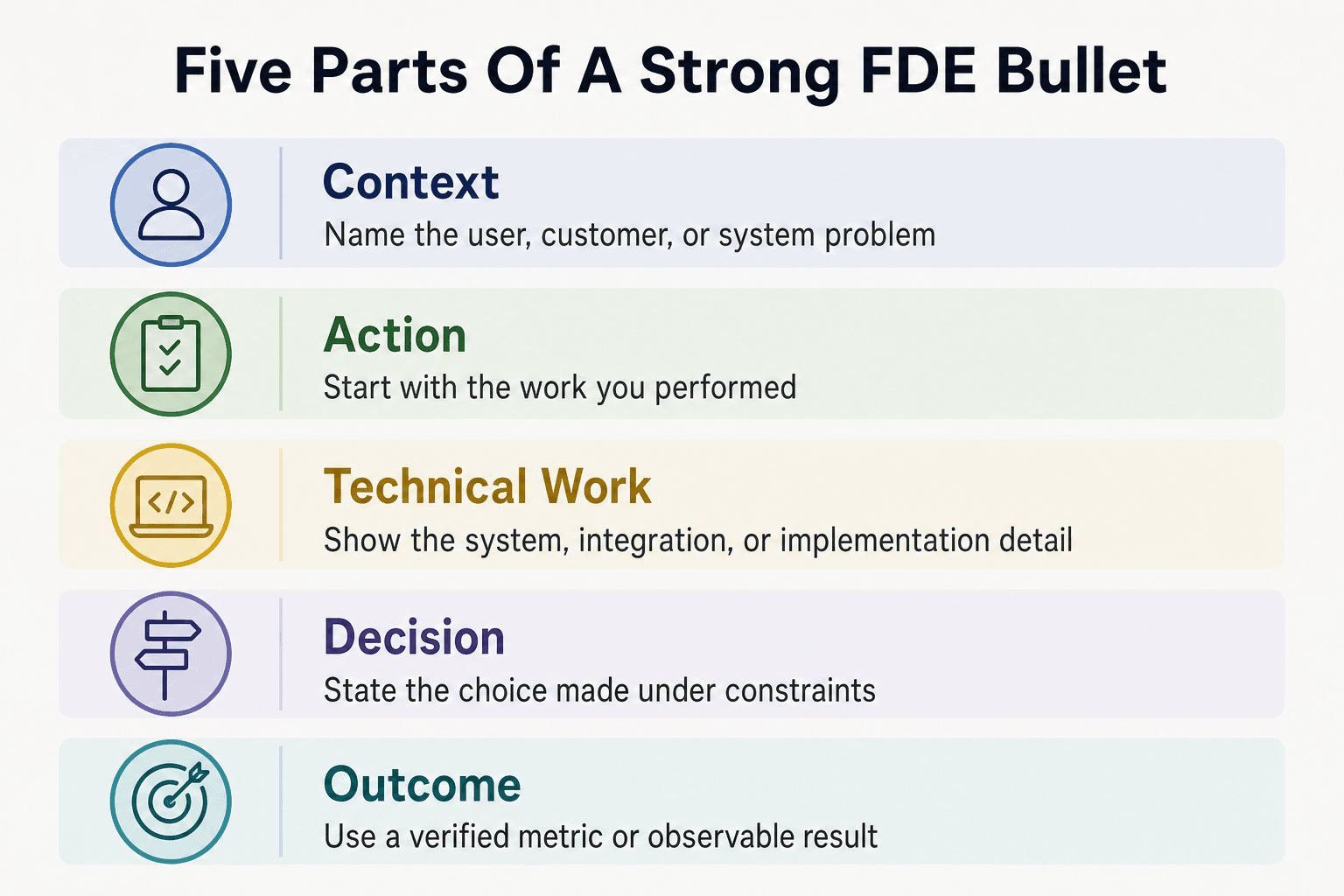
A strong FDE bullet shows more than code shipped. It connects a real user or customer need to your technical work, the choice you made under constraints, and the outcome you can support. Don't claim customer ownership, production impact, or a metric you can't verify.
A practical context-action-technical-decision-outcome formula
Use this shape: context, action, technical work, decision, outcome. You don't need every part in every bullet, but the reader should see why the work mattered and what you owned.
Keep it tight. Start with a working verb, name the system or user problem, then add the technical detail that proves the claim. "Built a service" is thin. "Mapped support-team workflows, built a Python service to sync ticket data with a CRM, and added retry handling for failed API calls" shows both the problem and the engineering.
Before-and-after: customer discovery and ambiguity
Before: "Worked with customers to gather requirements."
After: "Ran technical discovery with operations users, turned unclear reporting requests into a data-flow plan, and documented open decisions for the engineering team."
The second version doesn't pretend the work produced revenue or a finished launch. It shows how you reduced ambiguity, which is often the useful part of discovery work.
For a prototype, be equally clear: "Built a prototype from stakeholder interviews to test whether document search could answer common support questions." Don't write "delivered an AI solution" if the work stopped at a demo.
Before-and-after: integrations and deployment
Before: "Integrated APIs and deployed the application."
After: "Integrated REST endpoints between the internal order system and a partner platform, added field validation and error logging, and supported the team's release to a staging environment."
Scope matters. If you owned a live release, say so: "Deployed the service to production with the platform team and wrote a rollback runbook." If you only prepared it for handoff, don't borrow ownership from the release team.
Before-and-after: incidents, reliability, and security
Before: "Fixed production bugs and improved security."
After: "Investigated production API failures using logs and request traces, fixed a timeout in the integration path, and added an alert for repeated failures."
For security, name the control and your part: "Implemented role-based access checks for internal admin endpoints and supplied evidence for a security review." Don't claim compliance, a full security audit, or a secure system unless you can prove that responsibility.
Truthful metrics, bounded metrics, and no-metric alternatives
Metrics help when you know their source and boundary. Write "reduced manual reconciliation time for the operations team" only if the team measured it, and state the scope when useful: "for one pilot workflow" or "during the launch period."
Don't guess. A bounded outcome can still be strong: "Enabled support staff to search approved product documents in a pilot," or "Resolved the incident and documented the fix in a runbook."
For AI work, show evaluation rather than invented accuracy: "Created a labeled test set, reviewed incorrect answers with domain users, and revised retrieval rules." That tells a recruiter you treated output quality as engineering work, even when no defensible headline metric exists.
Select and describe FDE projects that show real delivery
Projects can fill a real evidence gap, especially when your work history doesn't show customer-facing delivery. They can't manufacture it. A polished demo is not proof of production deployment, customer adoption, security review, or ongoing operational ownership.
Choose work that shows how you handle an unclear need, a messy system boundary, or a practical constraint. The FDE model centers on making software work in a customer's real environment, not just building a feature in isolation.
What makes an independent project relevant to FDE work
Start with a user and a job they need done. "Built a chatbot" is weak because it doesn't say who used it, what information it needed, or what could go wrong.
A stronger project names the context, constraint, and decision: "Built a document-search prototype for support teams using a set of approved policy documents; added source links and a fallback response when retrieval returned weak matches." You don't need a real client to show sound delivery habits. You do need a believable use case and clear limits.
How to label a prototype, pilot, internal tool, and production system accurately
Use the label that matches the work. A prototype tests an idea. A pilot is limited use with a defined group or workflow. An internal tool serves your own team or organization. A production system is live software used for its intended purpose and supported after release.
Keep the boundary plain. If classmates used an app during a course project, call it a class project or limited pilot, not a customer deployment. If you deployed it publicly but had no active users, say it was publicly deployed, not production-proven.
Project evidence for RAG, APIs, existing systems, and evaluations
For RAG work, explain the corpus, retrieval approach, evaluation method, and failure handling. Don't imply an LLM's answers were reliable because the interface looked finished.
For integration work, name both sides of the boundary and what you handled: authentication, data mapping, validation, retries, logs, or rate limits. A project that connects to a real API or works around a legacy data format can show more FDE-relevant judgment than a standalone app.
Show how you checked results. You might describe a labeled question set, manual review against source documents, error categories, or feedback from intended users. Avoid a headline accuracy claim unless you can explain how you measured it.
Open-source contributions and public technical artifacts
A merged open-source contribution can be useful when it shows a real issue, your proposed fix, and review with maintainers. Link the pull request, issue, documentation, or design note when the resume format allows it.
Public artifacts also make your claims easy to verify: a README with setup limits, an architecture diagram, a short demo, or a runbook. Don't publish customer data, private code, or credentials to create proof.
Projects to leave off the resume
Leave off tutorial clones, unfinished repos, and projects you can't explain beyond the tools used. A long list of thin projects makes it harder to find your strongest evidence.
Also cut work that duplicates your experience section without adding a new capability. Keep the project that lets you show discovery, integration, evaluation, deployment state, or operational thinking the rest of your resume can't prove.
Tailor an FDE resume without misrepresenting experience
Tailoring changes what you foreground, not what happened. You can't turn internal engineering work into client delivery, a prototype into a production system, or a team result into your own outcome by changing the wording.
Start from the evidence inventory you built for the role. Then choose examples that best match its operating environment, technical boundaries, and kind of customer contact.
Prioritize the role's operating environment
An enterprise implementation role needs evidence of working around existing systems: APIs, identity controls, data mapping, rollout constraints, and stakeholder handoffs. Put those examples first, even if a more technically complex project sits elsewhere on your resume.
For an AI deployment role, lead with the parts you can support: retrieval setup, evaluation, prompt or model failure handling, monitoring, or user feedback. Don't claim AI reliability work if you only built an interface around a model.
Regulated roles call for care. If you worked within access rules, reviewed data handling requirements, or documented controls, say so. If you did not own a security review or compliance sign-off, don't imply that you did.
Field-heavy roles need proof that you can work through ambiguity with other people. Emphasize discovery meetings, debugging alongside users, training, incident follow-up, or translating a request into a technical plan.
Reorder evidence instead of rewriting history
Keep the underlying bullet true, then change its position and emphasis. A platform integration job may need your API work near the top. A customer implementation job may need the same bullet to begin with the user problem or rollout constraint.
For example, "Built a Python service that synced account records" can become "Mapped account fields with an operations team, then built a Python service to sync records between two systems." Use the second version only if you took part in that mapping.
Recruiters scan for fit fast. Put your strongest relevant proof before less relevant work.
Use company-specific terminology with proof nearby
Use terms from the job description when they accurately name work you did. If the role asks for "technical discovery," you might write "ran technical discovery sessions to clarify data inputs, workflow rules, and integration constraints." The proof sits in the same bullet.
Be precise with tool names too. Name a cloud platform, database, API protocol, or ticketing system when you used it and it matters to the role. Don't paste every term from the listing into Skills and hope the rest of the resume carries it.
The main catch is simple: a keyword without an example can make the document look thinner, not stronger.
Red flags: keyword stuffing, title inflation, and borrowed outcomes
Keyword stuffing makes your skills section hard to trust. Cut tools you used only once, can't discuss, or cannot connect to a project, job, or course.
Don't change your title to "Forward Deployed Engineer" if that was not your title. You can use a clarifying label such as "Software Engineer, customer implementation focus" only when your bullets prove that focus and the formal title remains visible.
Keep team outcomes separate from your own contribution. Write "contributed to a rollout that reduced manual steps" when that is what happened, not "reduced manual steps" if you cannot show your part. The same rule applies to customer names, adoption claims, uptime, revenue, and deployment scope.
Show FDE readiness when you are a fresher or career switcher
You don't need a formal FDE title to apply. You do need to show evidence that transfers, while being plain about what you have not yet owned: client delivery, production systems, security review, or long-term support.
Adjacent work can prove useful parts of the job. It can't fill every gap. Make the connection clear so a recruiter doesn't have to infer it.
Map adjacent roles to FDE evidence
Software engineering can show debugging, APIs, system design, deployment work, and work within technical constraints. AI/ML work can show data handling, model or RAG evaluation, failure analysis, and prototype building. Solutions, support, and implementation roles can show discovery, user communication, configuration, issue triage, and handoffs.
University projects count too, with limits. A team capstone may show that you gathered requirements, made tradeoffs, integrated a service, and presented a working result. It does not prove you supported a customer deployment after launch.
Start with the work, not the title. Under each role or project, write the FDE responsibility it supports and the specific action you took.
Build customer-context experience before applying
Customer context means more than saying you are a good communicator. You need an example of learning how someone works, clarifying a need, or changing a technical decision because of a user constraint.
Look for chances to do that now: support a team that uses your software, join implementation meetings, help document an internal workflow, volunteer for bug triage, or build a tool for a student group or local organization. Keep notes on the request, the constraints, your decision, and what happened after delivery.
Small scope is fine. Invented scope is not.
Create credible portfolio and open-source proof
A portfolio project should show a delivery path, not just a polished screen. State the user problem, the system boundary, the data or API integration, the deployment state, and how you checked that it worked.
For example, an FDE-relevant RAG project might include document ingestion, retrieval, a small evaluation set, known failure cases, and setup notes for another person. Label it a prototype if it has not served real users in production.
Open-source contributions can help when they are concrete. A merged bug fix, integration example, test improvement, or useful documentation change gives reviewers something they can inspect.
How to state limited production or client exposure honestly
Use direct labels: "course project," "independent prototype," "internal tool," "staging deployment," or "supported implementation." These terms set the right boundary without underselling the work.
If you have not worked with external clients, say what you did work with: internal users, classmates, support tickets, partner teams, or a project sponsor. If you did not own production operations, describe the testing, deployment, or debugging you performed.
The honest answer is that limited exposure may rule you out for senior FDE roles. For entry-level roles, clear evidence of technical delivery, learning from users, and accurate scope gives you a credible case.
Explain how an FDE resume differs from SWE, AI/ML, and solutions engineering resumes
The same work can read very differently depending on what you foreground. An FDE resume needs engineering depth, but it also needs to show how you turned a user's unclear need into a deployed and supported result.
Don't erase your specialty. Reframe the evidence around the path from discovery to delivery.
FDE versus traditional software engineering
A software engineering resume often leads with systems built, code shipped, performance gains, and technical ownership within a product team. Those are useful signals, but they can leave out who needed the work, what constraint shaped it, and what happened after release.
For FDE roles, keep the backend, API, infrastructure, and system design detail. Add the operating context: "Clarified reporting needs with operations users, designed an API integration around existing permissions, and supported rollout to the internal team." That shows technical judgment tied to a real user's workflow.
The main catch is overcorrecting. A resume that says only "partnered with stakeholders" can make you look like a coordinator rather than an engineer.
FDE versus AI/ML engineering
An AI/ML resume commonly emphasizes models, data pipelines, experiments, benchmarks, and evaluation metrics. That can be strong evidence for an AI-focused FDE role, especially when you built retrieval, evaluation, or monitoring components.
What it may not show is deployment in a customer's environment. State the integration boundary, the failure cases you checked, the user feedback that changed the design, and whether the work was a prototype, pilot, or production system.
A high model score alone isn't enough. If you cannot show real-user adoption or production operation, don't imply it.
FDE versus solutions or sales engineering
Solutions and sales engineering resumes often show discovery calls, demos, proof of concepts, technical presentations, and support for account teams. That proves customer contact and commercial awareness, which many software engineering resumes lack.
An FDE resume must also prove hands-on build and delivery work. Name the code, configuration, integration, debugging, deployment, or technical decision you owned. "Led a demo" is not the same as "built and deployed the integration used in the demo."
It depends on the role: some FDE jobs are closer to implementation, while others expect deeper product and platform engineering.
Mistakes that hide customer ownership or engineering depth
Avoid split narratives. A dense technical section with no user context makes you look internal-only, while a resume full of meetings and stakeholder language can hide your ability to build.
Check each major bullet for both sides of the work: the problem or constraint, and the engineering action you took. Remove vague ownership claims when you only supported another engineer, and label demos, prototypes, and pilots accurately.
Make sure your strongest evidence appears early enough that a recruiter can see both parts of your fit.
Run a final FDE resume audit and prioritized improvement plan
A final pass won't create experience you don't have. It can make your real evidence easier to find, safer to parse, and harder to misread.
Two-minute recruiter scan
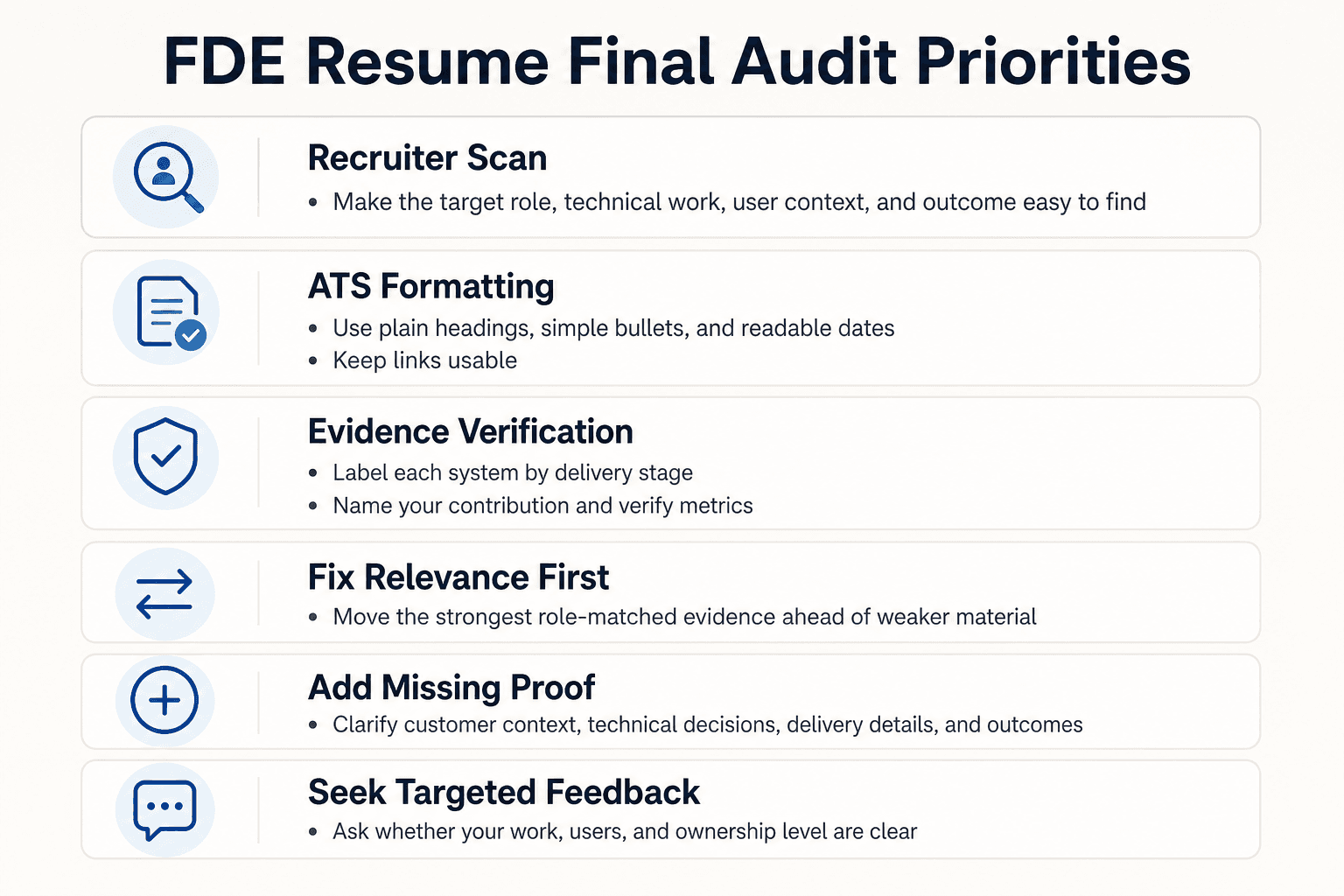
Read the resume from top to bottom in two minutes. Can you quickly see the role you want, the technical work you do, the customer or user context, and at least one credible delivery outcome?
If not, fix the order before rewriting individual bullets. Put your strongest relevant experience, project, or summary line near the top, and cut details that only matter after an interview.
ATS and formatting check
Use plain section headings, standard job titles, simple bullets, and readable dates. Avoid text in images, complex columns, graphics, tiny type, and unusual headings that may not parse cleanly in an applicant tracking system.
Keep links usable. A portfolio, GitHub profile, or project demo can help, but only if it opens and shows work you can explain.
Evidence and metric verification
Check every claim against what you did. Mark each system as a prototype, pilot, internal tool, or production deployment, and name your contribution when you worked with others.
Verify every metric too. If you don't know the exact impact, use an observable outcome instead: reduced a manual step, supported a rollout, resolved a recurring failure, or incorporated feedback from named user groups. Don't turn an estimate into a fact.
Priority order for fixing weak sections
Start with relevance. Match the target FDE job description to your most convincing evidence, then move those bullets and projects ahead of weaker but more impressive-sounding work.
Next, fix missing proof: customer context, technical decision, integration or deployment detail, and outcome. Then improve readability by shortening dense bullets and removing repeated tools. Leave formatting changes until last. A polished layout can't rescue vague claims.
When to seek feedback and when to stop editing
Ask for feedback when a reader can't tell what you built, who it served, or what level of ownership you had. Give them a target job description and ask what evidence feels unsupported or missing, not whether the resume "looks good."
Stop editing when each major requirement has truthful proof nearby, the document scans cleanly, and every bullet earns its space. How to write a forward deployed engineer resume comes down to that discipline: show relevant work clearly, preserve its real scope, and don't add claims you can't defend.
Frequently asked questions
What should a Forward Deployed Engineer resume include?
Show engineering work alongside evidence of understanding customer needs and delivering in real-world environments. Include specific examples of your role, technical contribution, deployment stage, and customer-relevant outcome. The supplied reference characterizes FDE work as owning customer outcomes, not simply customer relationships.
Is there a Forward Deployed Engineer resume template I can use?
The supplied reference does not provide a resume template. A practical starting structure is a concise summary, relevant skills, experience, and selected projects. Adapt the order to foreground the evidence that best matches the job description.
What projects should I include on an FDE resume?
Choose projects that let you explain a real user or customer problem, your technical contribution, and what happened when the solution was put to use. Label the work accurately as a prototype, pilot, integration, or production system rather than implying a more mature deployment than you achieved.
How do I tailor a Forward Deployed Engineer resume for an AI-focused role?
Match your verified AI experience to the role's stated requirements, and describe what you personally built, integrated, evaluated, or adjusted. The supplied reference notes that AI deployments can involve fine-tuning, prompt engineering, evaluation, and ongoing adjustment. Include these only when they reflect your work.
How can a software engineer transition to a Forward Deployed Engineer role?
Reframe relevant experience around customer problems, implementation constraints, and outcomes, using examples you can support. The supplied reference emphasizes that FDE work involves deploying software and working directly with customers, so highlight any genuine experience that shows those parts of the role.
Can a fresher apply for Forward Deployed Engineer jobs without formal FDE experience?
A lack of an FDE title does not prevent you from showing relevant evidence. Freshers can use projects, internships, or other verifiable work to explain how they understood a user need and built or deployed a solution. Be clear about the project's scope and your contribution.
Should I include Forward Deployed Engineer salary expectations on my resume?
The supplied reference does not provide salary guidance or establish that salary expectations belong on a resume. Focus the document on relevant evidence for the role, and provide compensation expectations only if the application specifically requests them.
About GigaRAG
GigaRAG helps you share agent memory like you share Google Docs. It connects your AI agents to a central Hive Mind, with access controls for what each agent can use. Developers, vibe coders, and teams can keep project knowledge available across sessions and tools, so agents can pick up where work left off without rebuilding context or managing a full RAG stack.