
Hierarchical Retrieval Patterns for Agent Memory and RAG
Hierarchical retrieval patterns can still give RAG pipeline builders and AI engineers a bad answer when a retriever finds the right policy clause but misses its definition, scope, or preceding event. The model gets a relevant sentence but lacks the context to tell whether it applies to this user, task, or time period. Hierarchy won't repair weak source material, find facts that aren't indexed, stop unsupported generation, or replace evaluation. It only changes how you select context.
Document hierarchy and agent-memory hierarchy solve different problems. A heading tree can connect a child passage to its parent section, while an agent may need to retrieve one event within the right user, session, or episode boundary. The main catch is added indexing work and latency, so a flat index is sometimes the better choice.
Quick answer
Hierarchical retrieval organizes content or memory into levels so your system can retrieve a relevant detail with the context needed to interpret it. Choose a pattern based on your source structure and query needs. Hierarchy adds complexity and can't supply information missing from the sources.
- Use parent-child retrieval when a precise passage needs its surrounding section.
- Preserve table headers with rows and document headings with their content.
- Test retrieval quality and latency against a flat baseline.
What are hierarchical retrieval patterns?
Hierarchical retrieval finds a small, relevant passage, then brings back the document unit around it so your model can read that passage in context. It can't supply missing facts, repair a vague source, or make a generated answer grounded. Its job is context selection, not truth checking.
[!note] Hierarchical retrieval can preserve context around a relevant passage, but it does not make weak source material complete or ensure that generated answers are supported.
The hierarchy: parent, child, and sibling units
A child is a precise retrieval unit, such as a paragraph, table row, or clause. Its parent is the enclosing section, while siblings are nearby children under that parent. These links preserve the heading, definitions, or scope needed to act on a narrow match.
How hierarchy differs from simply using larger chunks
Larger chunks put more context in every retrieval unit. However, they can bury the useful passage and weaken the match. A hierarchy keeps units separate, then expands only when a candidate needs parent or sibling context.
What a hierarchy-aware retriever returns
A hierarchy-aware retriever returns the matched child, selected parent context, and metadata that preserves their relationship and order. It may include siblings for a referenced definition or sequence. Don't treat expansion as proof that every related unit belongs in the prompt.
Which retrieval pattern fits the structure?
| Factor | Document hierarchy | Agent-memory hierarchy |
|---|---|---|
| Organizes | Sections, subsections, or other document units | Memory items grouped by scope or relationship |
| Useful when | A relevant passage needs document context | An agent must retrieve information from the right memory scope |
| Retrieval focus | A child passage plus relevant parent context | Choosing a memory level or boundary that fits the query |
| Main trade-off | Needs structure-aware preprocessing and parent-child links | Needs deliberate memory organization and retrieval rules |
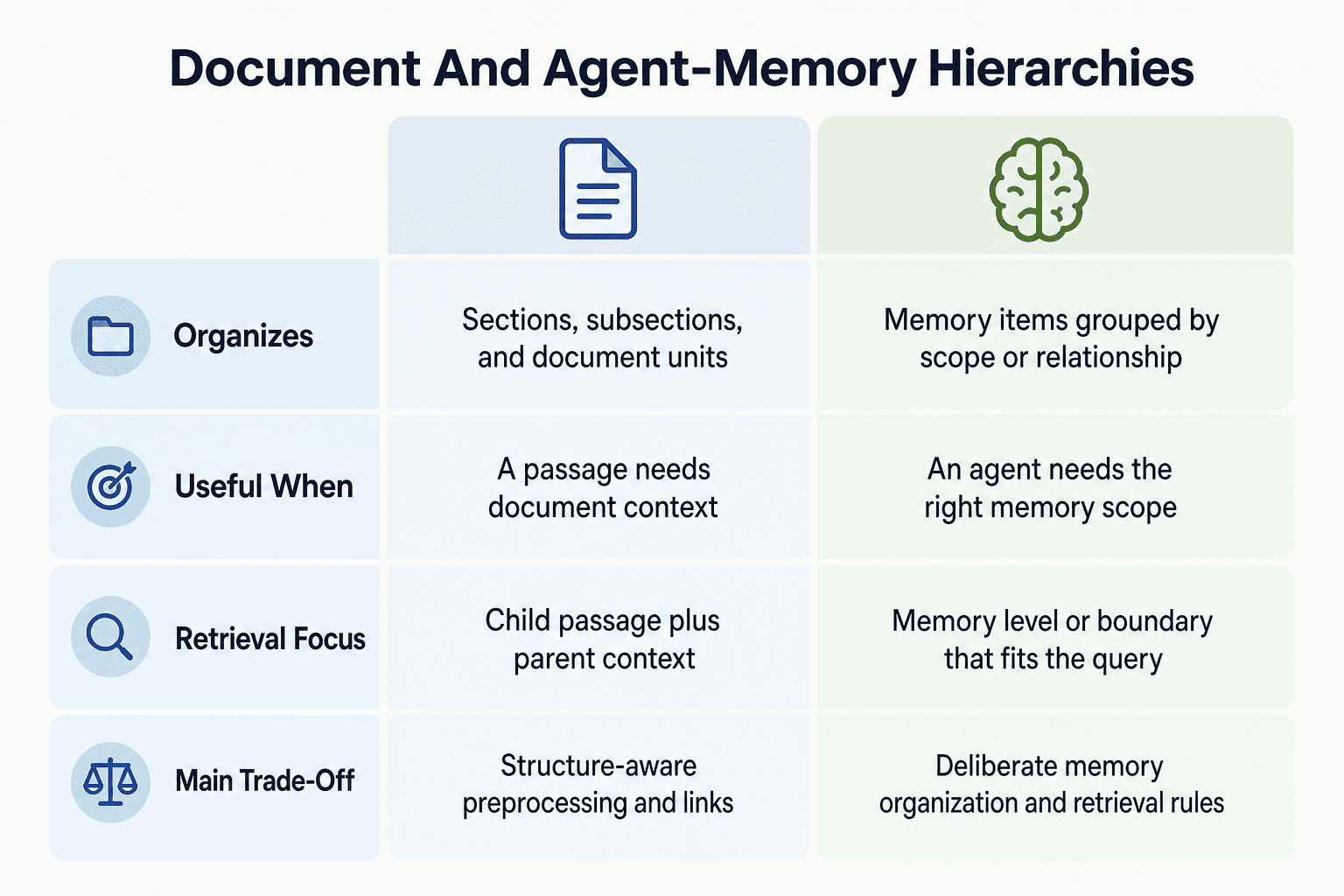
Four retrieval hierarchies RAG builders should not confuse
These patterns solve different problems. A document can have a hierarchy without your retriever using it, and a retriever can expand context without doing multi-step search.
Document hierarchy and hierarchy-aware chunking
Document hierarchy is the structure already present in a source: chapters, headings, paragraphs, rows, functions, and files. Hierarchy-aware chunking preserves those boundaries and links instead of splitting text at a fixed token count.
This is an ingestion choice. It doesn't decide which related units reach the model.
Parent-child retrieval
When a child chunk scores high on relevance, you surface the parent as well to provide context. A policy clause might return with its full section, including the heading and definitions that set its scope.
The main catch is context size. Returning every parent can add irrelevant text, so expansion rules need limits.
Recursive retrieval
Recursive retrieval repeats retrieval after an initial result exposes a reference, gap, or related question. A contract clause that points to another section may trigger a second lookup.
This suits questions that need connected evidence. It also adds latency and can wander unless you set depth and stopping rules.
Multi-level retrieval for broad-to-narrow search
Multi-level retrieval searches coarse units first, then searches within the selected area at a finer level. You might route a question to one product manual, then retrieve the exact subsection and paragraph.
This is a search strategy, not merely a parent link. Use it when the corpus is large enough that searching every child at once isn't worth the cost.
How hierarchical retrieval patterns work in a RAG pipeline
A hierarchy-aware pipeline can't make weak source material reliable or prove that a generated answer follows from retrieved text. It can keep a precise match connected to the structure that gives it meaning.
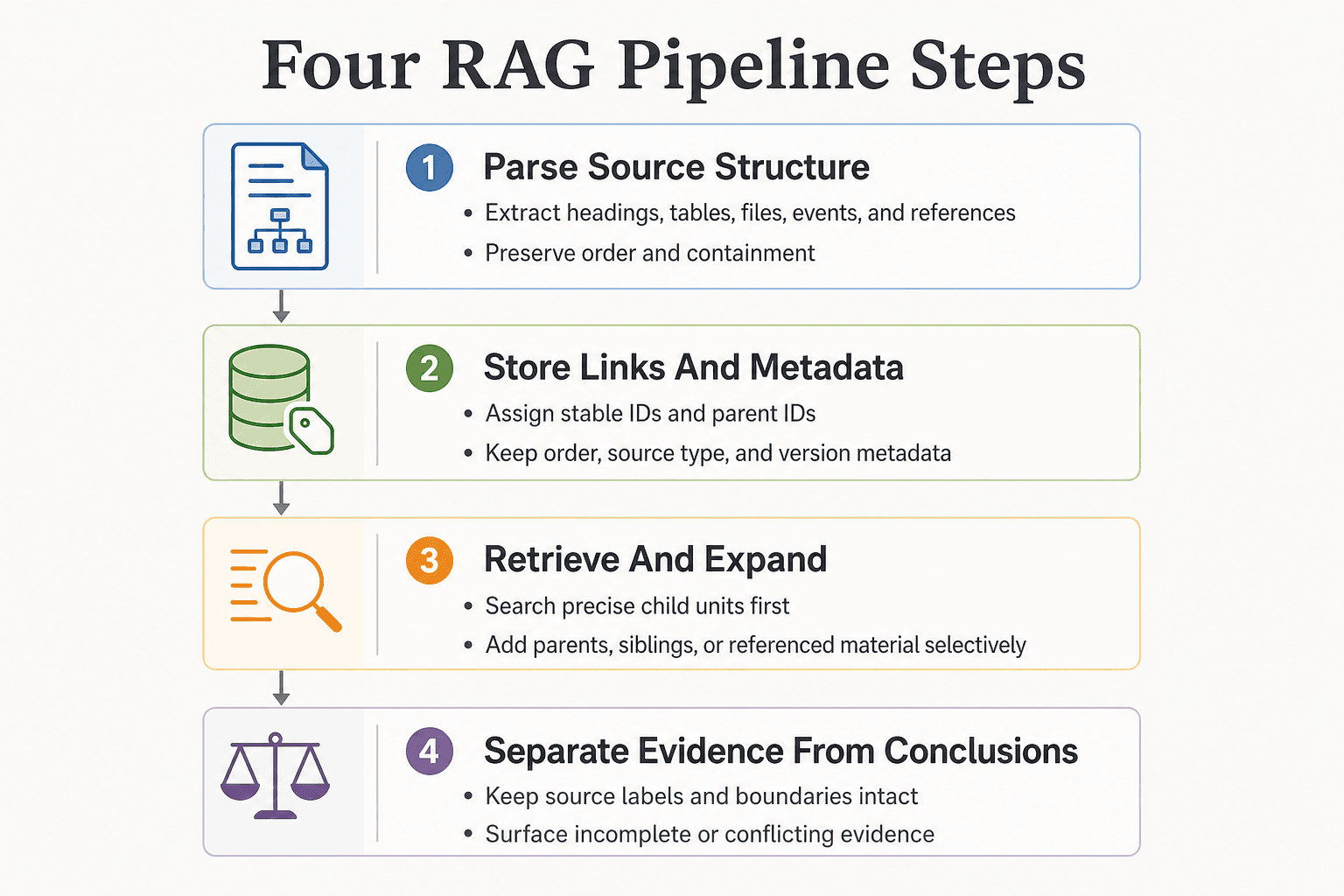
Parse source structure before chunking
Start with the source, not a token limit. Extract headings, paragraphs, tables, files, functions, events, and explicit references, then preserve their order and containment.
A contract clause may need its section heading and linked definition to be interpretable. The naive approach, fixed-size chunks of 500 tokens regardless of content, produces retrieval results that feel random to users because the boundaries cut across semantic units. Structure-aware parsing gives you boundaries worth retrieving.
Store hierarchy links and retrieval metadata
Give every unit a stable ID, a parent ID, an order within its parent, and source metadata such as document type and version. Keep links to siblings or referenced units when the source provides them.
The main catch is upkeep. When a source changes, update affected children and links or retrieval can assemble context from incompatible versions.
Retrieve children, expand to parents, then assemble context
Search small child units first because they provide a precise match. After ranking candidates, expand selected children to their parent section, relevant siblings, or directly referenced material, subject to a context budget.
Don't expand everything. A large parent can dilute the relevant passage with unrelated text, the same problem oversized chunks create. Use metadata filters before search where scope is known, then rerank the candidate set if relevance needs a second check.
Keep retrieval evidence separate from generated conclusions
Pass selected evidence to the model with its source labels and boundaries intact. The model can then answer from a clause, its scope, and its definitions instead of inferring missing context.
Here's what happens behind the scenes: retrieval chooses evidence, context assembly decides what surrounds it, and generation turns that material into an answer. If the evidence is incomplete or conflicting, your system should surface that limit rather than treat ancestor expansion as proof.
Examples: choosing the retrieval level for different sources
A single chunking rule isn't worth it when sources carry meaning in different structures. Retrieve the smallest unit that can match the query, then add only the parent, headers, definitions, or prior events needed to interpret it.
[!tip] For structured documentation, keep headings with their content and table headers with their rows. These are concrete structure-aware chunking practices described in the supplied production-RAG reference.
Technical documentation: retrieve a section and its relevant subsection
Search a subsection for a precise question, then include its section heading and nearby scope notes. A heading can tell you which product area, version, or constraint governs the passage.
Don't attach the whole document. Broad context can bury the instruction your model needs to follow.
Code repositories: retrieve a symbol with its enclosing module context
Use a function, method, or class as the retrieval unit when someone asks how code behaves. Keep its file path, imports, signature, and enclosing module available for expansion.
The source guidance notes that Code repositories benefit from function-level or class-level chunking that keeps the full implementation together. However, a symbol may depend on callers or shared types elsewhere, so module context still won't answer every behavior question.
Tables and policies: preserve headers, scope, and referenced definitions
Retrieve a table row with its column headers. A bare value is rarely useful if you can't tell what period, role, threshold, or exception the column represents.
For a policy clause, include the governing section and any definition it directly references. This matters when a rule's wording is precise but its scope sits elsewhere.
Event histories: retrieve an event with its thread or episode
Match the event closest to the question first. Then expand to the surrounding episode: what happened before it, what action followed, and which task or session it belongs to.
Keep the boundary tight. Pulling an entire history into context can mix unrelated episodes and give your agent the wrong basis for action.
Hierarchical retrieval for agent memory: scope before search
Agent memory isn't one corpus. Durable knowledge, current session state, past episodes, and task-local working context have different owners, lifetimes, and rules for use. If you search them as one index, a relevant old event can outweigh the instruction or state that should govern the current task.
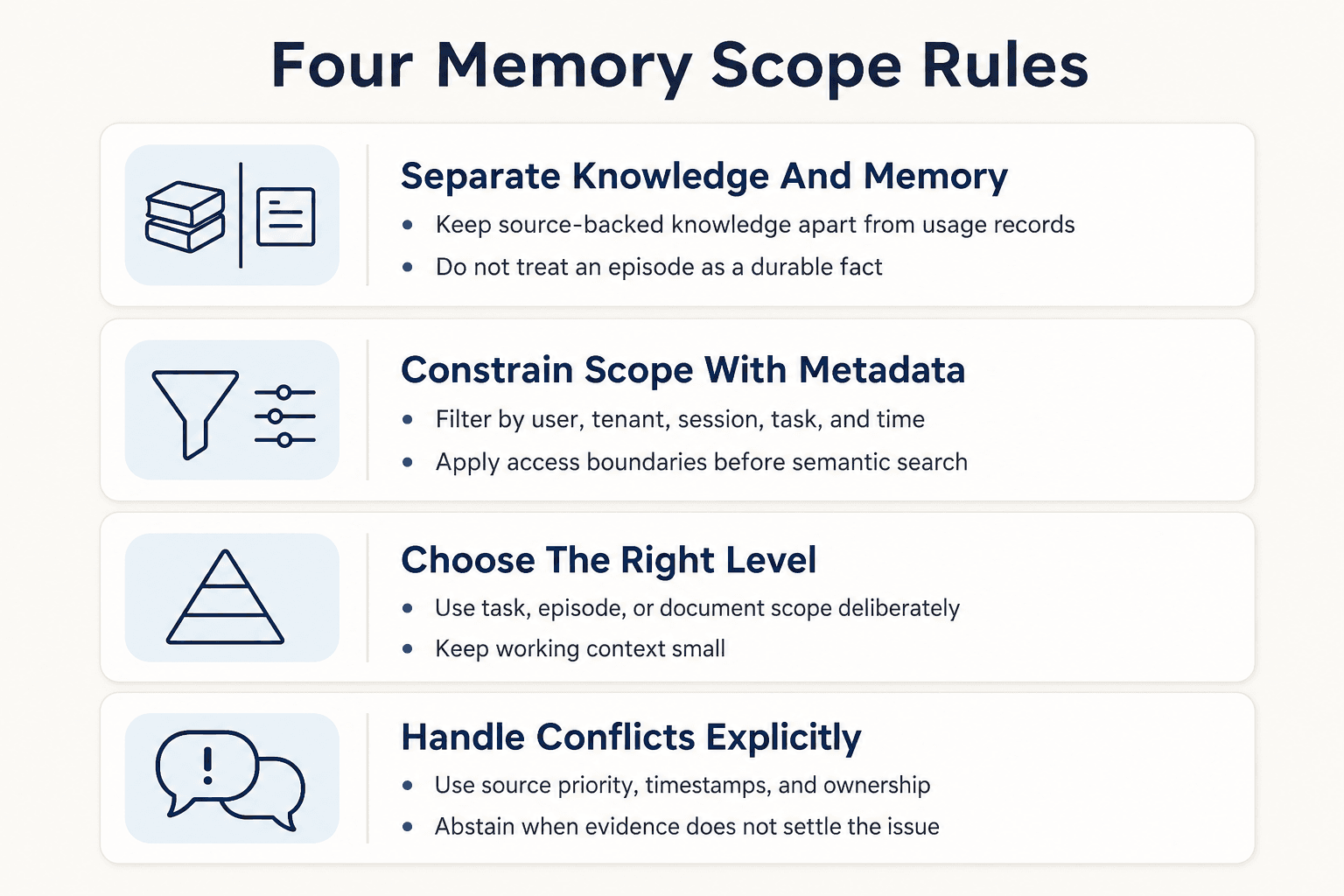
Separate knowledge retrieval from memory retrieval
Keep source-backed knowledge apart from records of what happened during use. Documentation can answer what a policy says, an episode can answer what a user asked for last week, and working context holds what the agent is doing now.
Don't treat an episode as a durable fact. It may be incomplete, superseded, or tied to one user's circumstances.
Use metadata to constrain user, tenant, session, and time scope
Apply scope filters before semantic search: user or tenant ID, session ID, task ID, access boundary, and time range. These fields decide which records the agent may consider before similarity decides which ones look relevant.
This is a safety boundary, not just a ranking hint. A well-matched memory from another tenant is still not usable context.
Choose episode, task, and document levels deliberately
Retrieve at the level that matches the question. An unfinished action may need the current task and its recent steps. A question about a prior decision may need the full episode, including the evidence and outcome. A question about a rule should route to the source document instead.
Keep working context small. It should support the current action, not become a second archive.
Do not expect hierarchy to resolve memory conflicts automatically
Hierarchy can show the parent episode, task, or document around a retrieved record. It can't decide which conflicting record is true, current, authorized, or worth following.
The honest answer is that conflict handling needs explicit rules: source priority, timestamps, ownership, and a way to abstain when the evidence doesn't settle the issue.
Query planning and routing across retrieval levels
A query planner should not send every request through the deepest path. It depends on the question's scope, the evidence it needs, and the latency budget you can afford. Fast, shallow retrieval suits direct lookups, while broader or multi-part questions may need expansion, decomposition, or a different search method.
Classify the query by scope and evidence need
Start by asking what would count as enough evidence. A request for a named setting may need one child passage. A question about an exception needs the parent policy section. A question with several claims may need separate sub-queries before you assemble context.
Keep it simple.
Start with a narrow candidate set
Retrieve small, precise units first, then rerank them if precision matters. This limits irrelevant context and gives the generator evidence it can point to, rather than a full document that merely contains the answer somewhere.
This ensures coverage of both exact matches (important for numbers, names, code) and semantic matches (conceptual questions).
Escalate only when evidence is incomplete
Broaden to a parent when the child lacks a definition, condition, or referenced rule. Decompose a question when one retrieval cannot support all its parts. Route reasoning-heavy requests through a slower path only when the shallow result fails an evidence check.
More retrieval isn't always better.
Set stopping rules to avoid unbounded recursive retrieval
Set a maximum depth, candidate count, retry count, and latency budget before you ship. Stop when added parent context does not supply missing evidence, or when sources conflict without a clear rule for resolution.
A corrective loop can retry retrieval when context is weak, but it still needs a point where the system abstains rather than searches forever.
How to select a hierarchical retrieval pattern
Choose the simplest pattern that preserves the context your questions actually need. Hierarchy adds links to store, logic to maintain, and sometimes more retrieval steps. It won't repair vague source material or make unsupported answers safe.
Your choice depends on five things:
- Source structure.
- Query scope.
- How often content changes.
- The precision you need.
- The latency budget you can afford.
Use parent-child retrieval for well-structured, reference-heavy documents
Use this pattern when documents have reliable sections, subsections, tables, or cross-references. Index small child units for precise matching, then fetch the parent section when a strong child hit needs its definition, scope, or exception.
This fits policy manuals, technical docs, contracts, and table-heavy reports. Keep parent links current when a source changes, or you can return a child from one version with context from another.
Use recursive retrieval for multi-hop or progressively scoped questions
Use recursive retrieval when the first result tells you where to look next rather than answering the question alone. A query about the effect of a vendor contract on procurement policy may require separate documents and a controlled expansion path.
The main catch is cost. Each retry, sub-query, or follow-up lookup adds latency, so set depth and candidate limits before you ship.
Use multi-level retrieval when corpus scale requires broad-to-narrow routing
Use multi-level retrieval when searching every child chunk would be too broad or too slow. Start at a coarse level, such as a product area, repository, tenant, or document collection, then search smaller units inside the selected branch.
This is a routing problem. Fast retrieval can establish recall, while a slower reranker can improve precision for the narrowed set, as Advanced RAG Patterns, Pipelines, and System Design describes. Your top level must be meaningful, or it adds a failure point before search.
Stay flat when hierarchy has no meaningful source structure
Stay flat for short, independent records with no useful parent context, such as isolated FAQs or simple catalog entries. Don't manufacture a tree from arbitrary chunk boundaries.
Flat retrieval is often worth it when updates are frequent and direct lookup matters more than surrounding context. Test it against a hierarchy baseline using the same queries, embedding model, and evaluation set, so you can see whether the extra retrieval work earns its place.
Implementation blueprint: build, test, and operate the hierarchy
Start with a small, representative source set. A hierarchy that looks sensible on one clean document can fail when tables, revisions, and cross-references enter the pipeline.
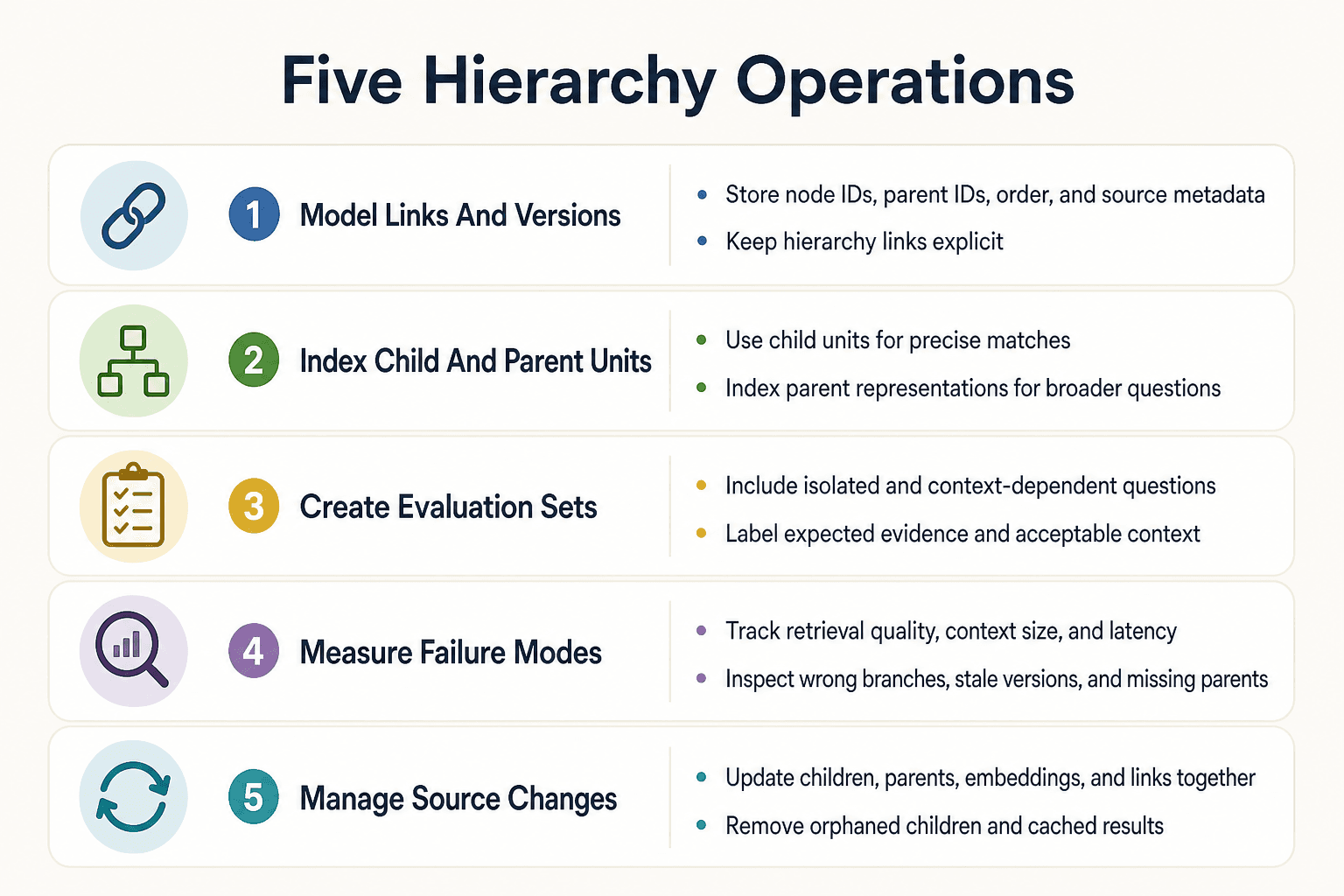
Model IDs, parent links, ordering, and source-version metadata
Give every node a stable ID, a parent ID, and an order within its parent. Store source ID, source version, content type, access scope, and timestamps alongside the text. Without version metadata, an updated parent can be paired with an old child.
Keep links explicit. Don't rebuild the tree from text at query time.
Index child and parent representations intentionally
Index child units when you need precise matches. Index parent units when users ask broad questions or when the parent has useful headings, definitions, and scope that a child cannot carry alone.
Use separate fields or indexes if the two levels serve different searches. Hybrid retrieval can combine keyword matching for exact names, numbers, and code with vector search for meaning, then rerank the narrowed candidate set.
Create evaluation sets for isolated and context-dependent questions
Write questions with known supporting evidence before tuning the pipeline. Include isolated questions that one passage should answer and context-dependent questions that need a child with its parent, linked definition, or preceding event.
Label the expected retrieval unit and acceptable context. Otherwise, a fluent answer can hide a retrieval miss.
Measure retrieval quality, context size, latency, and failure modes
Track whether the right child appears, whether required context arrives, and how much irrelevant text enters the prompt. Also measure retrieval, expansion, reranking, and generation latency separately.
Inspect failures by type: wrong branch, missing parent, stale version, access-scope leak, or context too large to use. Change one variable at a time, such as chunk boundaries or the embedding model, so results remain interpretable.
Plan for source updates, deletes, and hierarchy changes
Treat ingestion as a versioned pipeline, not a one-time load. When a source changes, update affected children, parent representations, embeddings, and links together where possible.
Deletes matter too. Remove orphaned children and cached results, then test that old versions cannot return. A hierarchy is only useful while its structure matches the source your users can access.
What hierarchical retrieval cannot fix
Hierarchy can't create evidence that your sources never contained, repair broken ownership rules, or make a model obey retrieved text. It selects context. That can reduce a known failure mode, but it doesn't turn an incomplete knowledge base into a reliable answer system.
Poor source documents and ambiguous ownership
A parent link preserves structure that exists. It can't tell you which of two conflicting policy versions is authoritative or fill in a definition that was never written.
Clean up source ownership, versioning, and access rules first. Otherwise, retrieval may return a well-formed tree of bad or unauthorized material.
Unsupported answers and generation-time hallucinations
Retrieved context is evidence, not a guarantee. A model can still add claims not supported by that context, misread a qualifier, or join two passages into a conclusion neither one states.
Require answers to stay within retrieved evidence where the task calls for it. Generation checks and answer validation can flag weak support, but they can also add another model step with its own error rate.
Sparse or rapidly changing corpora
Hierarchy is not worth much when documents have little meaningful structure or each item stands alone. A flat index may be simpler for short, independent records.
Fast-changing sources bring a different risk: child embeddings, parent text, and links can fall out of sync. Until all affected nodes update, expansion can supply stale context alongside a current match.
Added indexing, maintenance, and latency costs
The main catch is operational cost. Tree-structured chunking needs parsing, metadata, parent and child links, and update handling. Retrieval may also expand candidates, rerank them, or make extra search calls.
Each step consumes part of your latency budget. Multi-stage pipelines can improve precision, but fast, shallow retrieval may be the better choice when a request needs an answer quickly and broad context adds little.
Why offline and production evaluation still matter
Offline sets show whether the system retrieves the needed child and required context. They won't cover every real query, source update, access boundary, or prompt behavior.
Run a flat baseline beside the hierarchy. Track unsupported answers, stale results, context size, and latency in production, then keep the extra structure only where it earns its cost.
Choose hierarchy only when context has structure
Don't add a tree because RAG pipelines are meant to be advanced. Add one when your sources have stable parent-child relationships and important queries need both a precise match and the material that gives it meaning. If records stand alone, change often, or must return under a tight latency budget, flat retrieval is often the better starting point.
Start with one case where flat retrieval finds the right child but not enough context to answer safely. Build the smallest hierarchy that preserves that missing scope, then compare it with the flat baseline on the same questions and source updates. For hierarchical retrieval patterns, keep the added structure only when it improves retrieval evidence, answer support, context size, or latency enough to justify the work.
Frequently Asked Questions
What is hierarchical retrieval in RAG?
It organizes retrievable content into related levels rather than treating every passage as isolated. A system can use a relevant child passage with its parent context. The supplied production-RAG reference describes this pattern for structured documents.
What is the difference between hierarchy-aware chunking and parent-child retrieval?
Hierarchy-aware chunking creates units that respect document structure, such as sections or table rows with headers. When a child chunk scores high on relevance, you surface the parent as well to provide context. The supplied reference describes both practices.
When should I use recursive retrieval in a RAG pipeline?
Consider it when a query needs information gathered across multiple steps rather than a single passage. The supplied production-RAG reference contrasts simple single-hop questions with multi-step queries, but does not prescribe a universal threshold for recursive retrieval.
How does hierarchical retrieval work for agent memory?
It requires organizing memory into meaningful scopes and retrieving from the level suited to the query. The supplied references discuss agent-oriented retrieval generally but do not specify a validated memory hierarchy, so design and evaluate its boundaries for your application.
Can hierarchical retrieval replace hybrid search or reranking?
Not inherently. Hierarchy concerns how content and context are organized, while the supplied references describe hybrid search and reranking as separate retrieval techniques. It depends on the query and corpus.
How should I evaluate a hierarchy RAG system?
Compare it with a flat-retrieval baseline on representative queries. Check whether retrieved evidence includes enough context and whether answers are supported by that evidence. Track latency as well, since the supplied references identify retrieval quality and speed as design trade-offs.
When is flat retrieval better than hierarchical retrieval?
Flat retrieval may be preferable when the corpus has little useful structure or individual passages answer queries adequately. Tree-structured chunking adds metadata complexity., so it should address an observed context problem rather than be added by default.
About GigaRAG
Learn more about GigaRAG at https://www.gigarag.com.


