Naive vs Advanced vs Modular RAG: What Pipeline Builders Need to Know
You're building an agent that needs memory, and you're staring at three RAG architectures: naive, advanced, and modular. Every search result gives you a definition, but none of them tell you which one survives your latency budget, your cost ceiling, or your willingness to maintain it six months from now. That's the actual decision.
Here's the short version. Naive RAG is retrieve-then-generate with no frills: embed, search, stuff the context window, answer. Advanced RAG layers on reranking, query transformation, and hybrid search to fix what naive gets wrong. Modular RAG treats the whole pipeline as swappable blocks, so you can compose the exact retriever, reranker, and memory module your agent needs instead of accepting a fixed flow.
The honest answer is that most teams start with naive, outgrow it, and then misapply advanced techniques when what they actually need is modularity. GigaRAG supports modular RAG for agent memory, but this guide isn't a pitch. It's a practical breakdown of what each paradigm can and cannot do, plus a decision matrix you can score against your own constraints.
| At a glance | Details |
|---|---|
| Core difference | Pipeline complexity and control |
| Naive RAG | Retrieve, then generate, no tuning |
| Advanced RAG | Adds pre/post-retrieval optimization |
| Modular RAG | Composable, swappable modules and routing |
| Best for agents | Modular or agentic RAG |
| Main trade-off | Latency and cost vs accuracy |
In This Guide
- What Is Naive RAG?
- Naive vs Advanced vs Modular RAG: How They Compare
- What Is Advanced RAG?
- Naive Vs Advanced Vs Modular Rag: A Step-by-Step Guide
- What Is Modular RAG?
- Naive vs Advanced vs Modular RAG: Key Differences at a Glance
- How Each RAG Paradigm Works (With Practical Examples)
- Benefits and Limitations of Each RAG Approach
- When to Use Naive, Advanced, or Modular RAG
- A Decision Matrix for Choosing Your RAG Architecture
- RAG for Agent Memory: What Changes?
- Common Mistakes When Building Naive vs Advanced vs Modular RAG
- Final Thoughts on Choosing Your RAG Architecture
What Is Naive RAG?
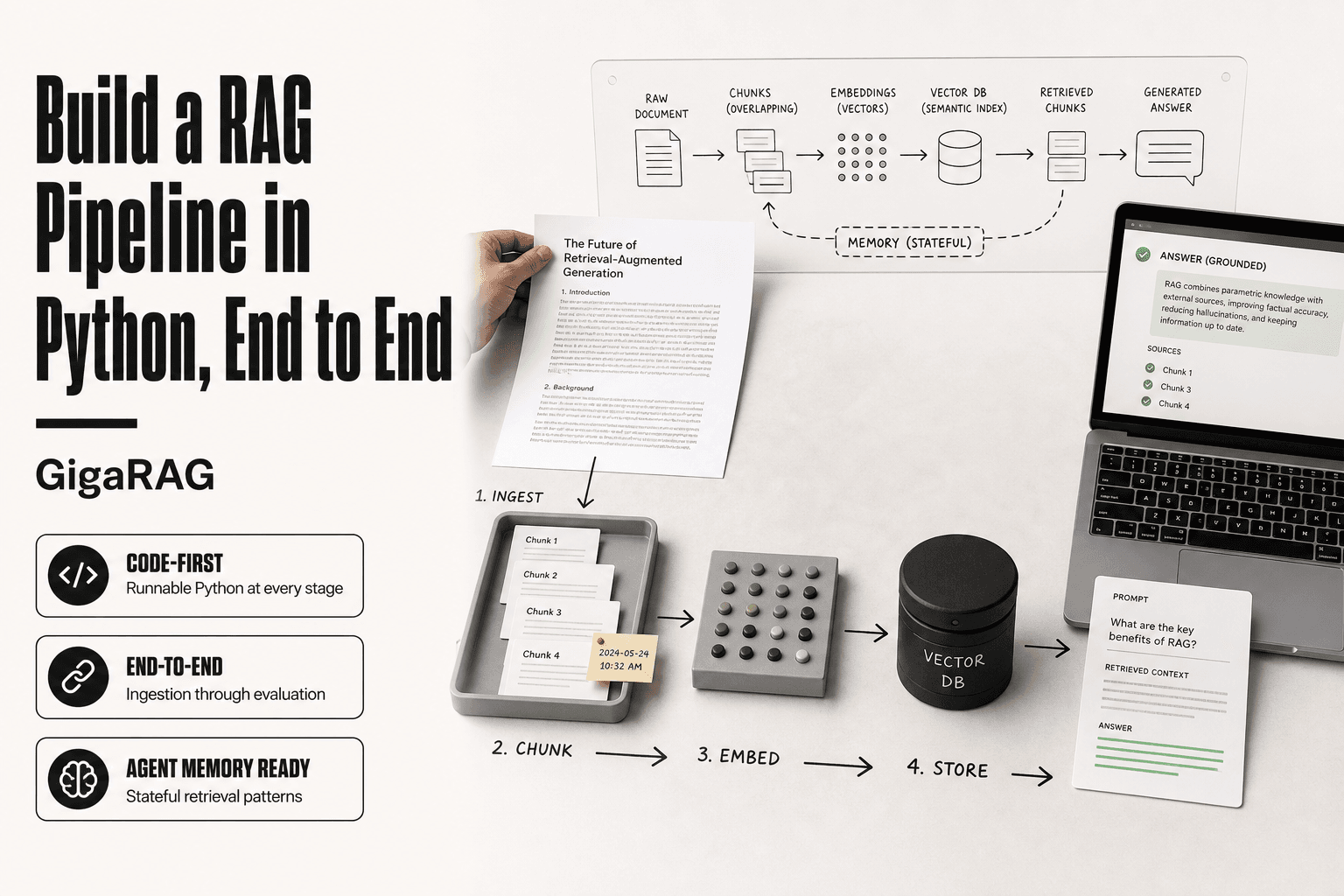
Naive RAG is the simplest retrieval-augmented generation pattern: chunk documents, embed them, retrieve the top-k chunks for a query, and stuff them into the LLM prompt. It's the baseline most tutorials start with, and it works until it doesn't.
The basic retrieve-then-generate flow
The pipeline has three stages. First, you split your documents into chunks and embed each chunk into a vector database. Second, when a query comes in, you embed it and run a similarity search to pull the top-k closest chunks. Third, you concatenate those chunks with the query into a single prompt and send it to the LLM.
Nothing gets reranked. Nothing gets rewritten. The query goes in raw, the chunks come out raw, and the model gets whatever the vector search happened to return. That's the whole thing.
Where naive RAG works well
Naive RAG is fine for small, static knowledge bases where the questions are straightforward and the answers live in one or two chunks. A support bot over 50 product docs, a prototype over a single PDF, an internal tool where latency matters more than recall. You can build one in an afternoon with a vector store and a single function call.
The main catch is that retrieval quality caps out fast. If the right chunk isn't in the top-k, the model never sees it, and no amount of prompt engineering fixes that.
[!note] These three paradigms are not mutually exclusive. Modular RAG typically contains advanced techniques, and advanced RAG is an optimized form of the naive retrieve-then-generate pattern.
Naive vs Advanced vs Modular RAG: How They Compare
| Factor | Naive RAG | Advanced RAG |
|---|---|---|
| Pipeline complexity | Single retrieve-then-generate pass | Adds pre- and post-retrieval steps |
| Retrieval quality | Basic vector similarity only | Hybrid search, reranking, query rewriting |
| Latency and cost | Lowest, fewest model calls | Higher due to extra steps |
| Maintainability | Simplest to build and debug | More moving parts to tune |
| Agent memory fit | Poor for multi-step memory | Better, but still rigid |
What Is Advanced RAG?
Advanced RAG is naive RAG with extra steps bolted on before and after retrieval. The goal is the same: get better chunks into the prompt. The difference is you stop trusting the raw query and the raw vector search to do that on their own.
Key techniques: reranking, query transformation, hybrid search
Reranking runs a second model over the retrieved chunks and reorders them by relevance to the query. Query transformation rewrites or expands the query before embedding it, so "how do I fix the login bug" becomes something the retriever can actually match against. Hybrid search combines vector similarity with keyword search, so exact terms like error codes or product names don't get lost in semantic drift.
How advanced RAG improves retrieval quality
The honest answer is that each technique fixes a specific failure mode. Reranking fixes the case where the right chunk is in the top 50 but not the top 5. Query transformation fixes the case where the user's wording doesn't match the document's wording. Hybrid search fixes the case where a rare exact term matters more than semantic similarity.
The cost is latency and complexity. Every extra step adds a model call or a second index, and you pay for that on every query.
[!tip] For agent memory specifically, keep the memory store separate from the retrieval pipeline so you can swap embedding models or add reranking without rewriting your agent logic.
Naive Vs Advanced Vs Modular Rag: A Step-by-Step Guide
- Define your accuracy, latency, and cost targets before comparing architectures.
- Start with a naive RAG baseline and measure retrieval and answer quality.
- Add advanced techniques (reranking, hybrid search) only where the baseline fails.
- Move to modular RAG when you need routing, multiple retrievers, or agent memory.
- Instrument each module with logging and evaluation so you can swap components safely.
- Re-evaluate regularly: what works at prototype scale may not hold in production.
What Is Modular RAG?
Modular RAG breaks the pipeline into independent, swappable parts. Instead of one fixed chain from query to answer, you compose the pieces you need and leave out the rest. A retriever here, a reranker there, a memory module bolted on when the task calls for it.
Modular RAG as composable building blocks
Think of it as a toolbox rather than an assembly line. Naive and advanced RAG are linear: query in, chunks out, answer generated. Modular RAG lets you route a query through different retrievers depending on its type, or swap a vector store for a graph store without touching the generator.
How modular RAG integrates advanced techniques
The techniques from advanced RAG don't disappear. They become optional modules. You can run reranking on some queries and skip it on others. You can add query transformation only when the initial retrieval returns weak results. That flexibility is the point, and it's also the cost: you now have an orchestration layer to build and debug.
Naive vs Advanced vs Modular RAG: Key Differences at a Glance
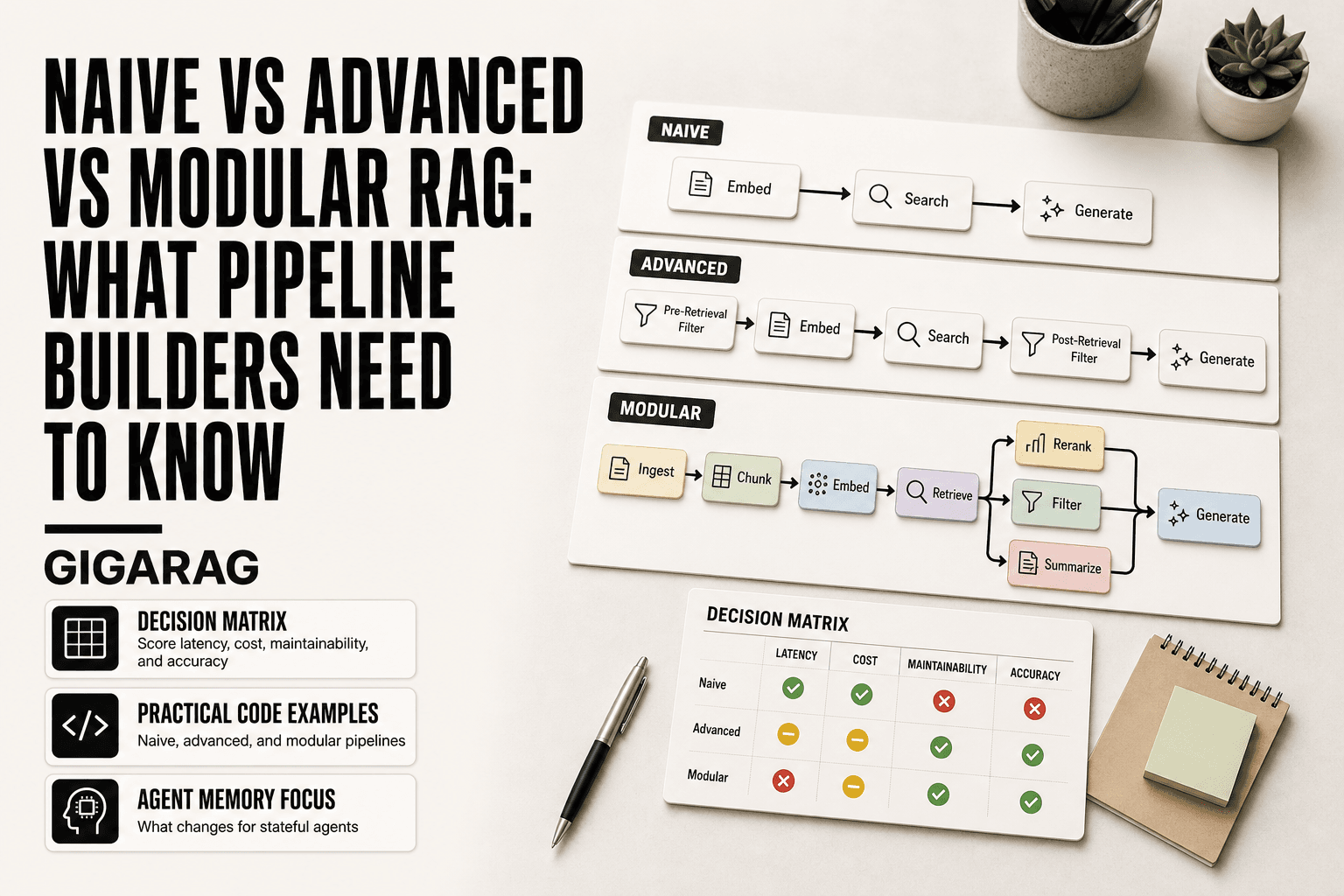
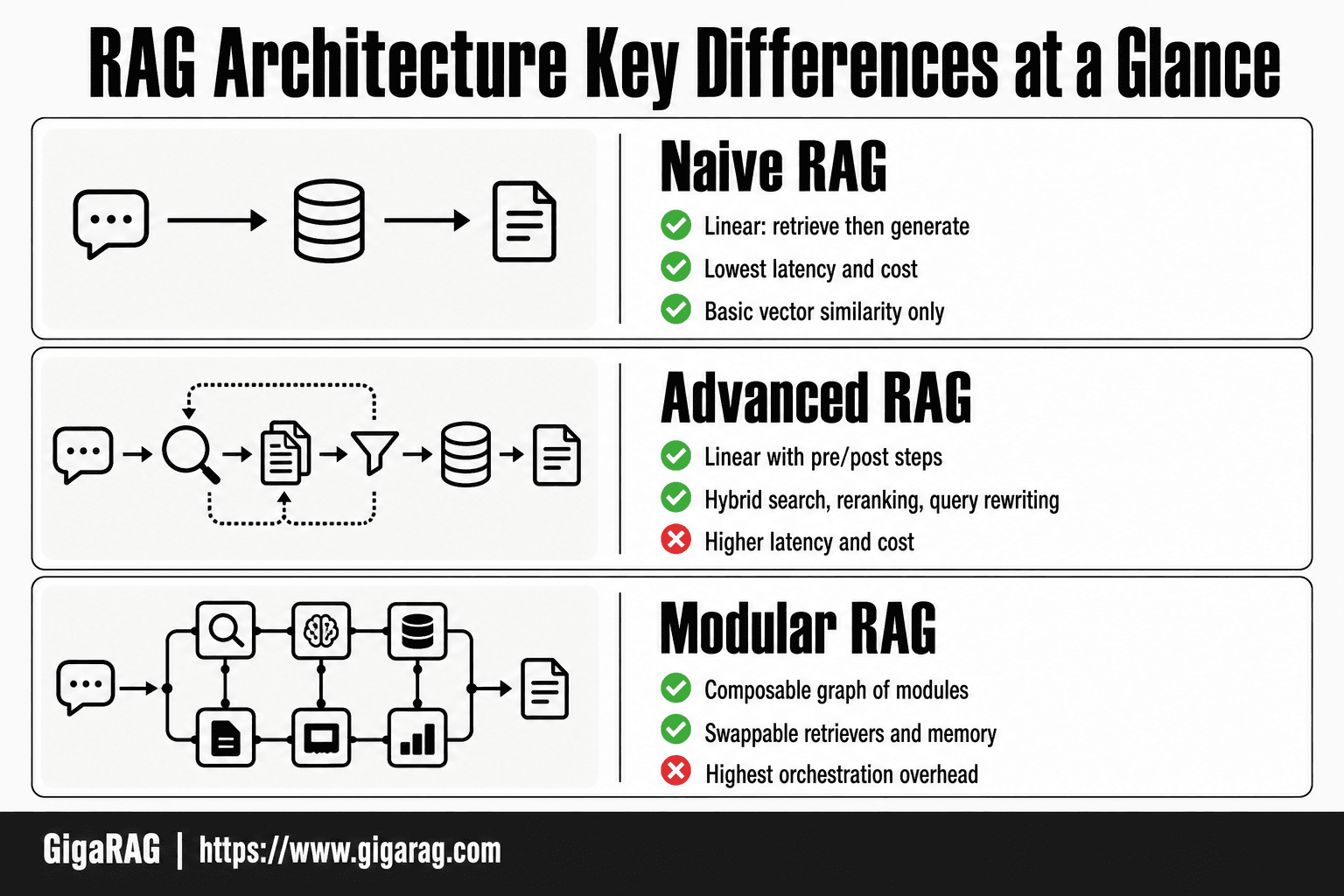
Here's the short version. Naive RAG is a straight line: retrieve, stuff context, generate. Advanced RAG adds preprocessing and postprocessing around that line. Modular RAG replaces the line with a graph of components you wire together yourself.
Comparison table: architecture, complexity, latency, cost
| Factor | Naive RAG | Advanced RAG | Modular RAG |
|---|---|---|---|
| Architecture | Linear: retrieve then generate | Linear with pre/post steps | Composable graph of modules |
| Complexity | Low | Medium | High |
| Latency | Lowest | Higher (reranking, query transforms) | Varies by module count |
| Cost | Lowest (one embedding + one LLM call) | Medium (extra model calls) | Highest (orchestration overhead) |
| Maintainability | Easiest | Moderate | Hardest without discipline |
| Best use case | Prototypes, small docs, tight budgets | Production Q&A needing accuracy | Agent memory, multi-source, evolving pipelines |
What the table tells you about trade-offs
The pattern is simple: more control costs more of everything else. Naive RAG wins on speed and simplicity. Advanced RAG buys accuracy with latency and compute. Modular RAG buys flexibility with engineering time.
The honest answer is that most teams should start with naive RAG, move to advanced RAG when retrieval quality actually hurts, and reach for modular RAG only when the pipeline itself needs to change shape per query or per agent.
How Each RAG Paradigm Works (With Practical Examples)
The table tells you what changes. Here's what that looks like in code.
Naive RAG pipeline example
You chunk a document, embed each chunk, store vectors, then retrieve the top-k matches for a query and stuff them into a prompt. That's it.
results = vector_db.search(query_embedding, top_k=3)
context = "\n".join([r.text for r in results])
answer = llm.generate(f"Context:\n{context}\n\nQuestion: {query}")
No reranking. No query rewriting. One embedding call, one LLM call. If the right chunk isn't in the top 3, the answer is wrong and nothing catches it.
Advanced RAG pipeline example
Same flow, but you add a reranker between retrieval and generation. You also rewrite the query before embedding it.
rewritten = llm.rewrite_query(query)
candidates = vector_db.search(embed(rewritten), top_k=20)
reranked = cross_encoder.rerank(query, candidates)[:5]
context = "\n".join([r.text for r in reranked])
answer = llm.generate(f"Context:\n{context}\n\nQuestion: {query}")
The top_k jumps from 3 to 20 because the reranker needs a wider net. That's the latency cost from the table made concrete.
Modular RAG pipeline example
You don't write one pipeline. You write components and an orchestrator that picks which ones run.
if query_needs_memory(query):
    context += memory_store.search(query)
if query_mentions_tool(query):
    context += tool_registry.call(query)
context = rerank(query, context)
answer = llm.generate(f"Context:\n{context}\n\nQuestion: {query}")
Each block is swappable. Swap the reranker, add a summarizer, route to a different retriever per query type. The catch: you own the orchestration logic, and it breaks in ways the linear pipelines don't.
Benefits and Limitations of Each RAG Approach
Every paradigm trades something. Here's the honest breakdown.
Naive RAG: benefits and limitations
The benefit is speed and simplicity. One embedding call, one LLM call, maybe 200ms end to end. You can build it in an afternoon and debug it with print statements.
The limitation is accuracy. No reranking means the top-k chunks are whatever cosine similarity says they are, even when that's wrong. No query rewriting means a vague question gets a vague retrieval. If your knowledge base is small and your queries are predictable, that's fine. If either is not, naive RAG will fail silently.
Advanced RAG: benefits and limitations
Advanced RAG fixes the accuracy problem. Reranking pushes the right chunk into the top 5 far more often. Query transformation handles synonyms, acronyms, and multi-hop questions that naive RAG misses entirely.
The cost is latency and complexity. You're adding a cross-encoder call and possibly an LLM call for rewriting before you even retrieve. That's 300-800ms extra per query, and now you have two models to tune instead of one. For a document Q&A bot, that's usually worth it. For a real-time agent, it might not be.
Modular RAG: benefits and limitations
Modular RAG gives you control. You can swap retrievers per query type, add memory when the task needs it, call tools when the query demands them. That flexibility is the whole point.
The limitation is that you own the orchestration. Every conditional branch is a place your pipeline can break. Debugging a modular system means tracing which components ran, in what order, and why. That's real engineering overhead, and it's not worth it for a simple use case. Don't reach for modular RAG because it sounds sophisticated. Reach for it when the linear pipelines can't express what you need.
When to Use Naive, Advanced, or Modular RAG
The honest answer is it depends on your latency budget, your accuracy requirements, and how much orchestration you're willing to own. Here's the breakdown.
Use naive RAG when...
Your knowledge base is small, under a few thousand chunks, and your queries are predictable. A support bot answering the same 20 questions about pricing and refunds doesn't need reranking. Naive RAG gives you 200ms responses and an afternoon of setup. If your users ask the same things every day, the extra machinery buys you nothing.
Use advanced RAG when...
Accuracy matters more than speed, and your queries vary. Multi-hop questions, synonyms, acronyms, or a knowledge base that spans domains all break naive retrieval. Reranking and query rewriting fix that. You'll pay 300-800ms extra per query, but for document Q&A where users wait a second anyway, that's a fair trade.
Use modular RAG when...
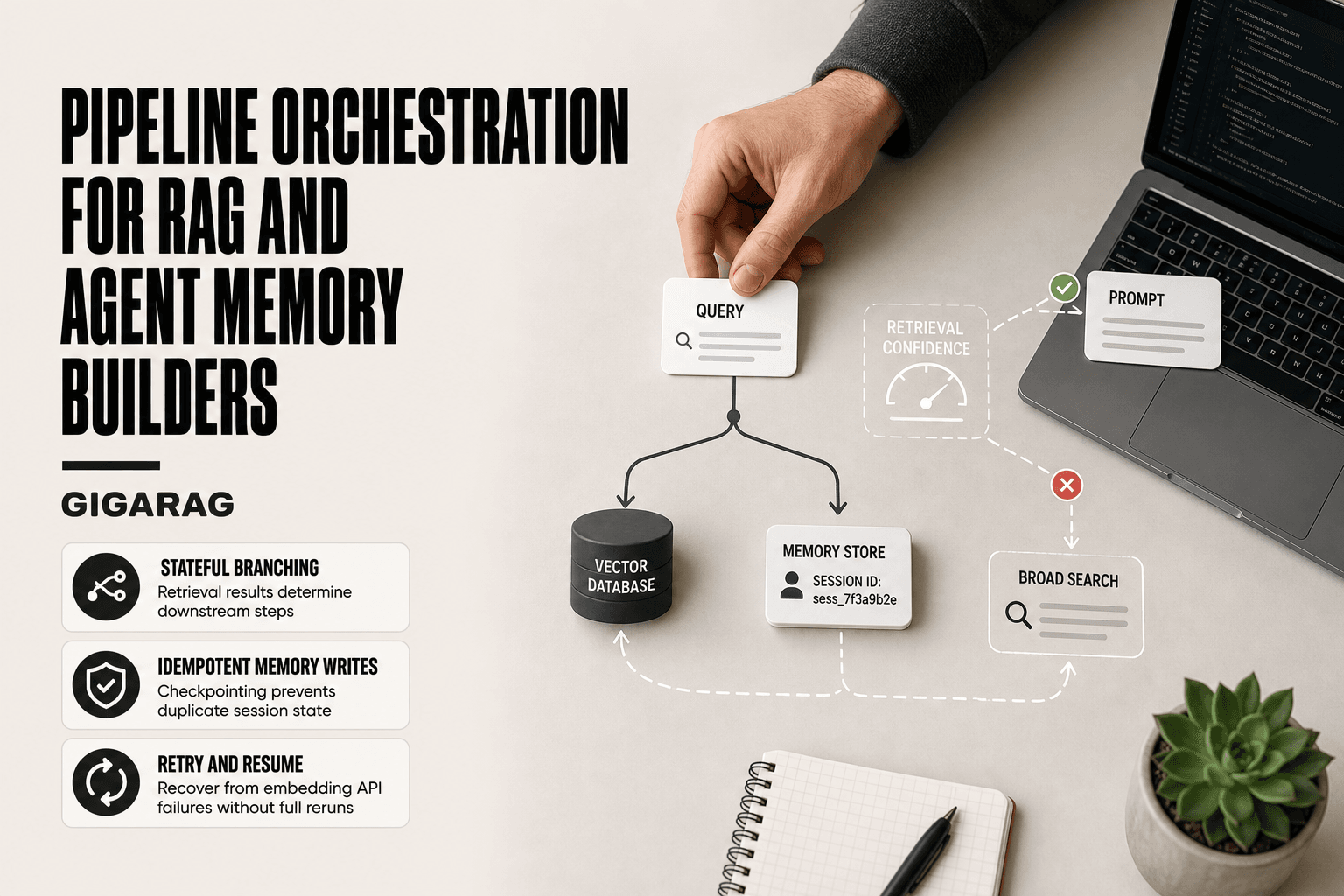
Your pipeline needs to do things a linear flow can't express. Agent memory is the clearest case: the agent must decide per turn whether to retrieve, call a tool, or write to memory. That conditional branching is modular RAG's whole design. You'll own the orchestration and the debugging, so don't reach for it unless the linear pipelines genuinely can't express what you need.
A Decision Matrix for Choosing Your RAG Architecture
Stop guessing. Score each paradigm against four factors that actually show up in production: latency, cost, maintainability, and accuracy. Rate each from 1 (poor) to 5 (excellent) for your specific use case, then total the scores.
Scoring factors: latency, cost, maintainability, accuracy
Naive RAG scores high on latency and cost, low on accuracy for anything beyond simple lookups. Advanced RAG flips that: better accuracy, higher latency and token cost from reranking and query rewriting. Modular RAG costs the most to maintain because you own the orchestration, but it's the only one that lets you tune each factor independently.
How to apply the matrix to your use case
Write down your hard constraints first. A 200ms latency budget rules out advanced RAG. A two-person team rules out modular RAG unless you already have orchestration tooling. Then score each paradigm against your actual queries, not hypothetical ones. If naive RAG scores above 15, don't overbuild. If modular RAG scores below 12, the complexity isn't paying for itself.
RAG for Agent Memory: What Changes?
Agent memory isn't document Q&A with extra steps. It's a different problem.
Why agent memory is different from document Q&A
Document Q&A is stateless. You embed a query, retrieve chunks, generate an answer, done. Agent memory is stateful. The agent carries conversation history, tool outputs, and prior decisions across turns. Retrieval has to account for what the agent already knows, not just what the user just asked.
Multi-turn context changes retrieval. A query like "what did we decide about the database?" only makes sense against stored memory. Tool calling adds another layer: the agent retrieves, then acts, then retrieves again based on what the tool returned. Naive RAG can't handle that loop. It assumes one shot.
Which paradigm fits agent memory best
Modular RAG fits best, and it's not close. You need a memory module that writes and reads separately from the retrieval pipeline. You need query transformation to rewrite agent state into searchable form. You need reranking when tool outputs flood the context.
Advanced RAG helps with retrieval quality but still assumes a linear flow. Agent memory is a loop, not a line.
The honest answer: if your agent only needs a static knowledge base, naive RAG works. If it needs to remember across turns, you're building modular RAG whether you call it that or not.
Common Mistakes When Building Naive vs Advanced vs Modular RAG
Most pipeline failures aren't architecture problems. They're implementation mistakes repeated across teams.
Mistakes with naive RAG
The biggest one: chunking without thinking. You split documents at 500 tokens, embed, and wonder why retrieval misses. Chunk size controls what the retriever can see. Too small, and context fragments. Too large, and the embedding dilutes.
Another: treating the vector store as a database. It isn't. Cosine similarity finds related text, not correct answers. If your knowledge base has near-duplicate content, naive RAG returns the wrong duplicate and the generator confidently repeats it.
Mistakes with advanced RAG
Reranking everything, always. Rerankers add latency and cost per query. If your initial retrieval already returns the right chunk in the top three, reranking buys you nothing. Use it when precision matters, not as a default.
Query transformation without a fallback. You rewrite the user's query, the rewrite loses a key term, and retrieval returns garbage. Keep the original query in the pipeline. If the transformed query scores worse, drop it.
Mistakes with modular RAG
Over-modularizing. You build twelve swappable components for a use case that needs three. Every module boundary adds serialization overhead and a failure point. Modularity is for parts that actually change.
The worst one: no evaluation harness. You swap retrievers, rerankers, and chunkers without measuring retrieval quality before and after. You can't improve what you don't score.
Final Thoughts on Choosing Your RAG Architecture
Start with naive RAG if you're prototyping. Move to advanced RAG when retrieval quality drops below what your use case tolerates. Reach for modular RAG when components need to change independently, which is most agent memory systems.
The honest answer: naive vs advanced vs modular RAG isn't a ranking. It's a fit problem. Latency, cost, and maintainability decide more than accuracy does.
If you're building agent memory, GigaRAG supports modular RAG without forcing you to assemble every piece yourself. You swap what changes, keep what works, and measure before you commit.
Frequently Asked Questions
What are the different types of RAG models?
The commonly cited types are naive RAG, advanced RAG, and modular RAG. Naive RAG does a single retrieve-then-generate pass, advanced RAG adds optimization before and after retrieval, and modular RAG composes swappable modules. Agentic RAG is often described as an extension where the model decides when and what to retrieve.
Which RAG architecture is best?
There is no universal best; it depends on your accuracy, latency, cost, and maintainability constraints. Naive RAG suits simple, low-stakes lookups, advanced RAG suits quality-sensitive Q&A, and modular RAG suits complex or agent-driven systems. Start simple and add complexity only when measurements justify it.
What is the advanced version of RAG?
Advanced RAG refers to pipelines that improve on naive retrieval using techniques like query rewriting, hybrid search, and reranking. These steps aim to raise retrieval precision and answer quality. They also add latency and operational complexity.
Which AI is best at RAG?
RAG quality depends more on retrieval, chunking, and evaluation than on any single model. A well-tuned pipeline with a modest model often outperforms a strong model with poor retrieval. Choose models based on your latency, cost, and context-window needs, then benchmark on your own data.
What is the difference between naive RAG and modular RAG?
Naive RAG is a fixed retrieve-then-generate pipeline with no tuning stages. Modular RAG breaks the pipeline into interchangeable modules such as routing, retrieval, reranking, and generation, so you can reconfigure or extend it. Modular RAG is more flexible but harder to build and maintain.
Is modular RAG always better than advanced RAG?
No. Modular RAG offers more flexibility but adds orchestration overhead and more failure points. If advanced RAG already meets your accuracy and latency targets, the extra complexity of a modular design may not be justified.
About GigaRAG
GigaRAG helps GigaRAG is for agent memory and RAG pipeline builders. get this right. Whether you are working through naive vs advanced vs modular rag or something adjacent, we publish what we have actually tested, including where it falls short.