How to Separate Persistent Memory from Conversation Context
How to Separate Persistent Memory from Conversation Context is a design problem AI engineers and product builders can't solve by buying a larger context window. The current prompt can hold recent turns, tool outputs, and working instructions, but it is not durable memory. As conversations grow and the context window becomes saturated, the oldest content is gradually pushed out of active memory.
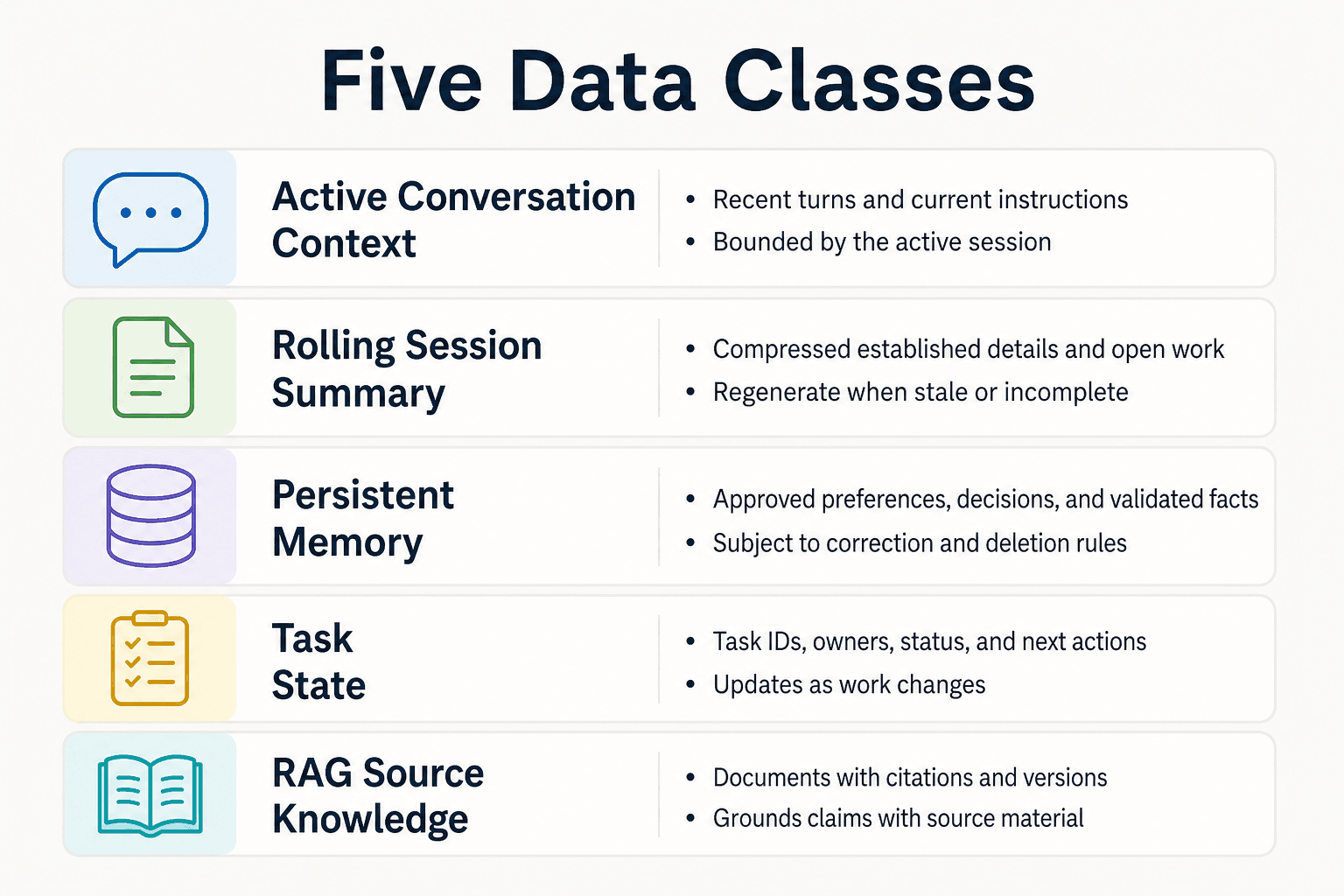
Persistent memory won't guarantee factual correctness, recall every user detail, or keep sensitive data safe on its own. It is selectively stored data that must be retrieved, scoped, updated, and deleted under rules you set. That boundary starts with five data classes: active context, a rolling summary, durable memory, task state, and source-grounded RAG knowledge.
The main catch is that these classes don't share the same trust or lifecycle. Apply write and retrieval gates, then add retention and deletion controls so your agent stays more predictable.
Process overview
A larger context window is not a memory architecture. Keep conversation history, durable facts, task progress, and source documents in separate classes, then retrieve only what the current request needs.
- Classify each datum by its purpose and lifespan.
- Keep recent turns in active context and compress older relevant turns into a rolling summary.
- Write stable, useful facts to persistent memory only under an explicit policy.
- Track changing work in task state, and keep reference documents in a source-grounded RAG corpus.
- Apply retrieval, retention, correction, and deletion rules to stored data.
How to Separate Persistent Memory from Conversation Context
An LLM with persistent memory still sees only the prompt assembled for its current inference. Conversation context holds the live working state for that prompt. Persistent memory is selected data stored outside the session and retrieved later when it fits the task, scope, and permissions.
[!note] Persistent memory can improve continuity, but it cannot guarantee factual correctness or permanent recall. Sensitive-data handling also requires governance, user controls, and retention and deletion policies.
Use the RAM analogy carefully: active context is working state, not literal RAM
The analogy is useful, but don't take it literally. Active context is the recent turns, instructions, tool output, and task details placed in the model's context window. As conversations grow and the context window becomes saturated, the oldest content is gradually pushed out of active memory.
What persistence means operationally: store, retrieve later, govern, update, and delete
The pattern: retrieve relevant context before sending the prompt, save notable outputs after. You also need rules for who can access a record, when it expires, how it changes, and how it is deleted.
This is selective recall.
What persistent memory cannot do: guarantee accuracy, preserve every detail, or replace source grounding
Stored memory can be stale, wrong, incomplete, or retrieved in the wrong situation. It can't guarantee recall of every past detail, and it shouldn't stand in for source-backed evidence when you need to answer factual questions.
Where should each datum live?
| Data class | Purpose | What belongs here | What does not belong here | Lifecycle |
|---|---|---|---|---|
| Active conversation context | Support the current exchange | Recent turns, current instructions, tool outputs, and task details | Unrelated history that does not help with the current task | Bounded by the active session or context-management process |
| Rolling session summary | Preserve compressed session state | Established details, open work, and current constraints | A source of record | Regenerate when stale, incomplete, or too broad |
| Persistent memory | Carry approved, useful information across sessions | Stable preferences, decisions, and validated facts intended for reuse | Every message, unverified claims, or sensitive data without governance | Subject to review, correction, retention, and deletion rules |
| Task state | Track changing work | Task IDs, owners, status, deadlines, and next actions | Conversational memory or user preferences | Update as work changes |
| RAG source knowledge | Ground claims with source material | Documents with citations, versions, and access controls | Unsupported remembered statements treated as evidence | Govern by source access, version, and retention rules |
Set up the five data classes before you store anything
Don't put every chat turn into one memory store. A transcript, a user preference, an open ticket, and a policy document have different lifetimes, trust levels, and retrieval rules. Give each one its own store or logical namespace so your agent can fetch the right thing without treating old conversation as fact.
[!tip] For agents that handle changing project work, store current status and pending actions as task state rather than durable user memory. Retrieve source documents separately when an answer needs evidence.
Active conversation context: recent turns, tool outputs, and current instructions
Keep the live prompt here: recent messages, current instructions, tool results, and details needed to finish the present task. This data is short-lived, and it can fall away when the session ends or the token budget runs tight.
Rolling session summary: compressed state that can be regenerated
Store a short account of what the session has established, what remains open, and any constraints that still matter. It isn't a source of record. Regenerate it from the transcript when it becomes stale, incomplete, or too broad.
Persistent memory: stable preferences, decisions, and validated facts
Use durable memory for information likely to matter again, such as confirmed preferences, lasting project decisions, and validated facts tied to a clear subject. Don't save a passing request or an unverified claim just because it appeared in chat.
Task state: workflow status, IDs, ownership, and deadlines
Keep workflow data separate: task IDs, owners, status, deadlines, and next actions. This is operational state, not conversational memory, so your system can update it without rewriting a summary or overwriting a user preference.
RAG source knowledge: documents with citations, versions, and access controls
Put documents and other source material in a RAG corpus with citations, versions, and access controls. Retrieved memory can guide the response, but source knowledge should ground claims that need evidence.
How to Separate Persistent Memory from Conversation Context: a step-by-step guide
- Define the purpose and permitted lifespan for each of the five data classes.
- Classify new information before storing it, and route task progress separately from durable facts.
- Reject automatic persistent writes for raw messages, uncertain claims, or information outside your approved policy.
- Before a response, retrieve only information relevant to the request and allowed for that user and task.
- Keep retrieved memories distinct from source documents and current conversation details.
- Provide a process to review, correct, expire, and delete stored information.
- Evaluate retrieval for relevance and stale or conflicting facts, then revise the policy when failures appear.
Step 1: Classify new information with a memory decision gate
Before anything crosses from a live session into another store, make it pass a write gate. A memory system can't decide whether a claim is true just because a user said it. Durable storage also raises privacy, security, and stale-data risks.
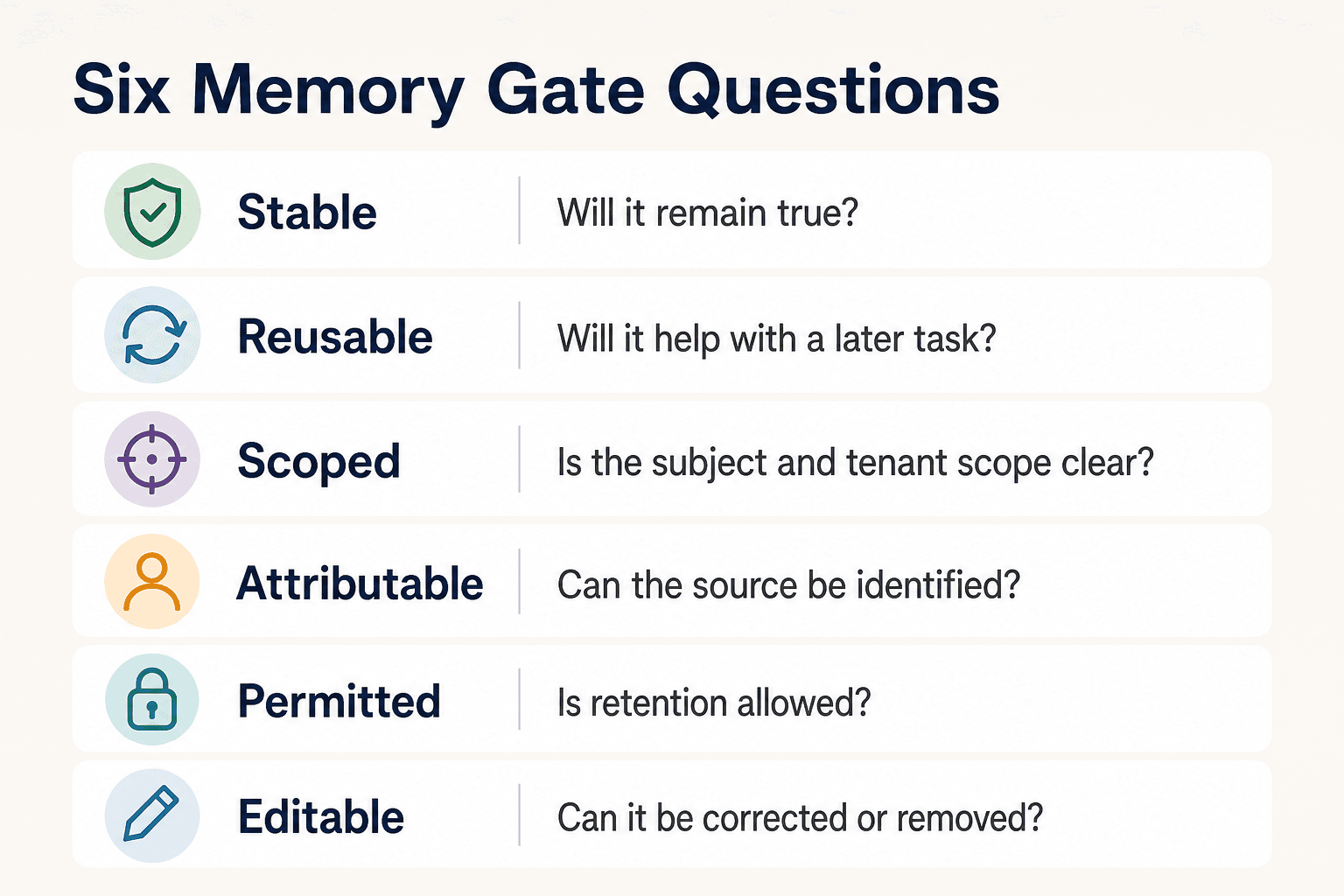
Ask six gate questions: stable, reusable, scoped, attributable, permitted, and editable
Ask: Will this stay true? Will it help in a later task? Is its subject and tenant scope clear? Can you name where it came from? Do you have permission to retain it? Can it be corrected or removed?
If any answer is no, don't write durable memory. Keep it in active context, add it to a rolling summary, or discard it when the session ends.
Write candidates: confirmed user preferences, durable project decisions, and verified entity facts
Write facts with a clear future use and owner: a confirmed language preference, an approved project decision, or a verified company address. Store the smallest useful statement, not a whole exchange.
Scope matters. A preference for one workspace must not become a preference for every user or tenant.
Do not write: transient requests, speculation, raw secrets, unsupported claims, and duplicate transcript details
Don't persist "remind me later" as a user preference, guesses made during troubleshooting, passwords, tokens, payment details, or claims with no trusted source. Don't save transcript fragments that merely repeat a summary or task record.
Consent is not implied by mention. Provide options to opt in or opt out of persistent memory features, allowing them to choose whether their session data is stored or not.
Attach metadata: subject, scope, source, confidence, timestamp, expiry, and consent state
Attach subject, scope, source, confidence, timestamp, expiry, and consent state to every accepted record. Include a memory ID and editable status so a correction can replace or retire it.
Without metadata, retrieval can't reliably distinguish a current user fact from an old, uncertain claim.
Step 2: Retrieve persistent memory separately from conversation context
At runtime, build the prompt in layers: current instructions, recent turns, task state, then a small set of durable memories that match the work at hand. Retrieve RAG evidence separately when the answer needs factual grounding. A stored memory can guide behavior, but it isn't proof.
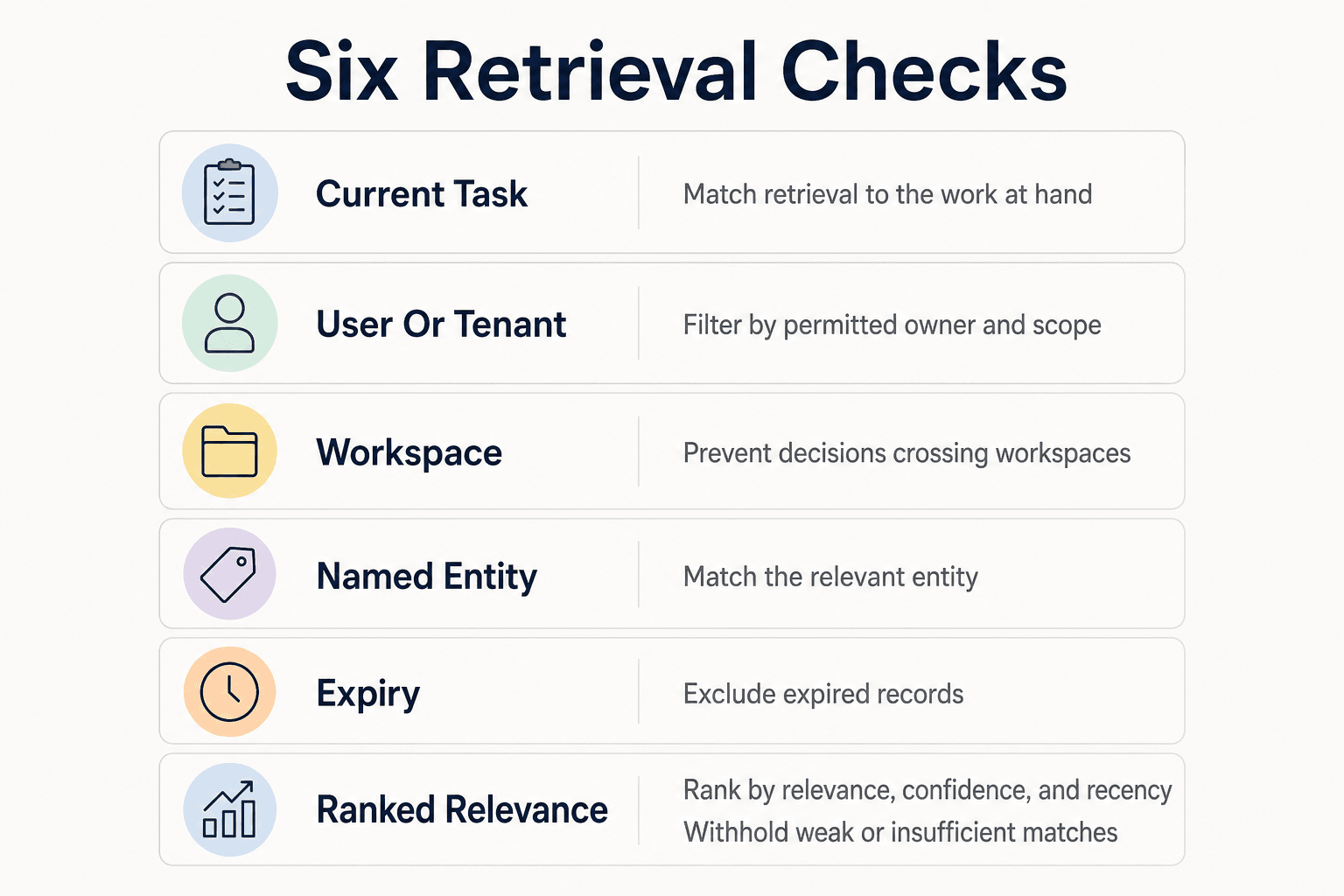
Retrieve by current task, entity, user, workspace, and recency, not similarity alone
Semantic similarity is only a first pass. Filter candidates by user, tenant, workspace, named entity, task type, and expiry before ranking them by relevance, confidence, and recency.
This prevents a project decision from one workspace entering another prompt just because the wording looks alike. Scope comes first.
Keep memory retrieval and RAG retrieval distinct because their trust models differ
Memory holds scoped facts, preferences, and prior decisions. RAG holds source documents that need attribution, version checks, and access controls.
The OpenAI Developer Community discussion describes retrieval agents injecting relevant context before a response. That pattern is useful, but don't let retrieved conversational memory stand in for a current source when the model makes a factual claim.
Use a ranked token budget and show the model provenance for injected memories
Set a token budget for memory, then admit the highest-ranked records until it is full. Include each record's subject, source, timestamp, confidence, and scope in the injected text.
Keep records short. A whole transcript is rarely worth the tokens.
Withhold retrieval when scope, confidence, permission, or relevance is insufficient
Don't retrieve a memory when its owner is unclear, its permission has changed, its confidence is low, or it does not materially help the current task. If the best match is weak, retrieve nothing.
The main catch is that abstention can feel less helpful in the moment. It is still better than feeding the model a stale preference, another user's data, or an unsupported claim.
Step 3: Add retention, deletion, and evaluation controls
Controls won't make a stored memory true or safe. They give you a way to limit how long it survives, trace why it was used, and remove it when it no longer belongs in the system.
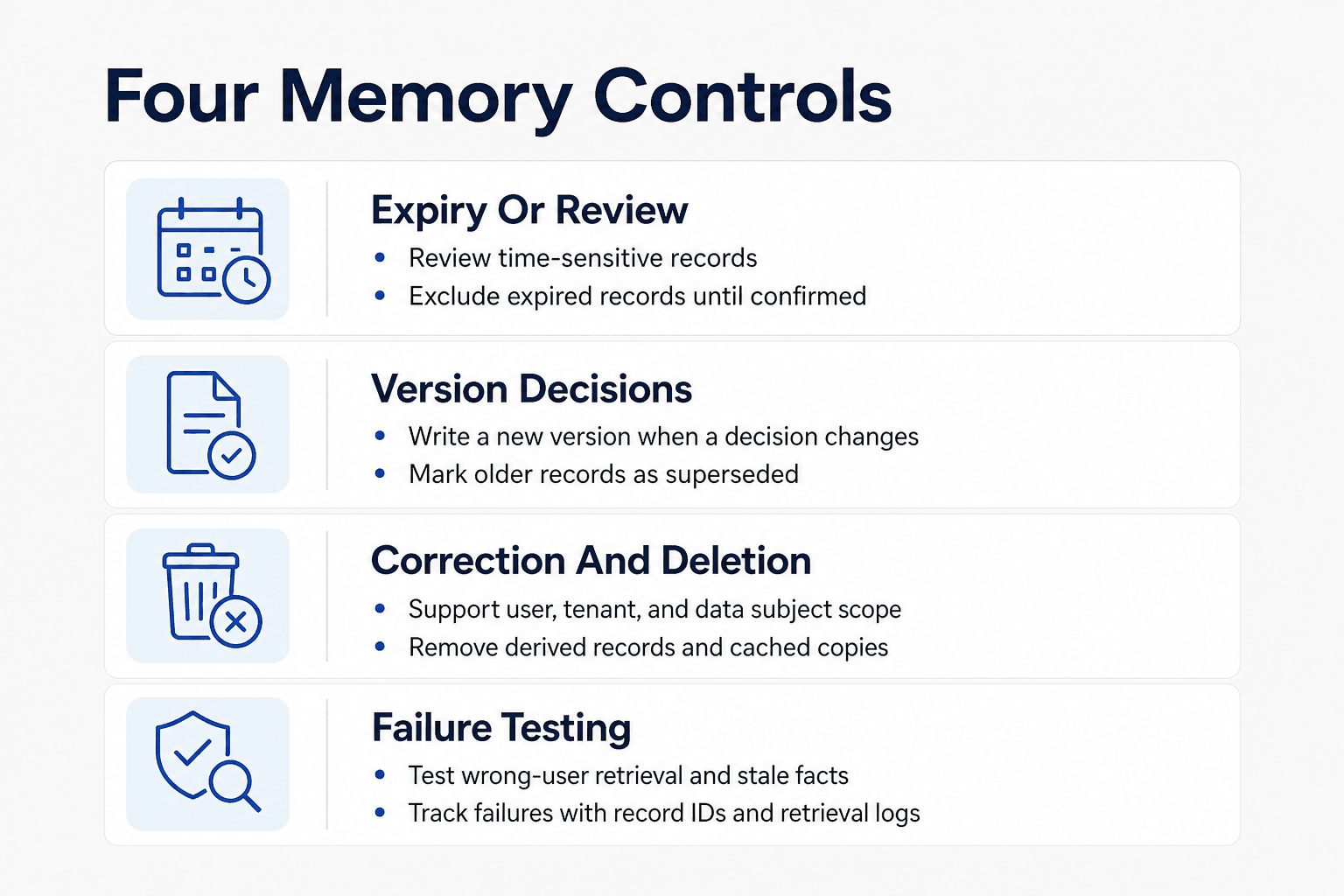
Expire or review memories whose truth changes over time
Give time-sensitive records an expiry or review date. Roles, deadlines, project status, and preferences can change, so exclude expired records from retrieval until a person or trusted process confirms them again.
Keep stable facts separate. A user's stated language preference may last longer than a current project owner.
Version decisions and mark superseded memories instead of silently overwriting them
Write a new version when a decision changes, then mark the old record as superseded. Keep the change time, source, editor, and reason, so you can audit why the agent followed one decision rather than another.
Don't delete history just to make the store look clean.
Support correction and deletion by user, tenant, and data subject scope
Let users correct or delete memories tied to them, and enforce the same boundary for tenants and other data subjects. The OpenAI Developer Community discussion flags privacy, stale data, and user control as persistent-memory risks.
Deletion must reach indexes, caches, summaries, and derived records. Removing one database row isn't enough if retrieval can still surface its contents.
Test failure cases: wrong-user retrieval, stale facts, thread bleed, and unsupported memory claims
Build evaluation cases that try to retrieve one user's memory for another user, reuse an expired fact, mix separate threads, or state an unverified memory as fact. Test deletion too.
MemoryLake's thread example shows how replies without their thread context can attach a value to the wrong item. Track these failures with record IDs and retrieval logs, so you can find the write or ranking rule that caused them.
Build for selective recall, not total recall
More storage won't fix weak rules. Start with a narrow memory class, explicit write gates, and retrieval logs you can inspect before you let an agent save more of what users say.
Start with one high-confidence memory class and measure retrieval quality
Begin with confirmed user preferences or versioned project decisions. Check what the agent retrieved, why it retrieved it, and whether it changed the answer in a useful way. If you can't trace a bad answer to a record and ranking decision, don't expand automation.
Document the boundary so product, security, and engineering teams apply it consistently
Write down what each class may store, who can access it, when it expires, and how it is removed. How to Separate Persistent Memory from Conversation Context is a shared operating rule, not just a prompt design choice.
Frequently asked questions
How do you handle memory or conversation context in your AI agent?
Separate recent turns, rolling summaries, durable facts, task state, and source documents into distinct data classes. Define explicit write, retrieval, retention, and deletion rules for each, then retrieve only context relevant to the current request.
What is an LLM with persistent memory?
It is an LLM system that can retain selected information outside the active conversation and retrieve it in later sessions. The stored information is an external memory layer. It does not ensure that every fact is correct or will always be recalled.
What is the difference between RAM and persistent memory?
In computing, RAM is working memory used during active processing, while persistent storage retains data beyond that active period. For an AI agent, active conversation context is analogous to working memory, while an external store can hold selected information across sessions. This is an analogy, not a guarantee about a particular product's implementation.
Should an AI agent save every conversation message as persistent memory?
- Raw transcripts can contain irrelevant, outdated, or sensitive details, and storing everything can make retrieval less predictable. Save only information allowed by policy and likely to be useful later. Keep conversation history or summaries separate when continuity requires them.
How is persistent memory different from a RAG knowledge base?
Persistent memory is typically used for selected information about a user, project, or prior interaction that may help in later sessions. A RAG corpus holds source material for retrieval and grounding. Keep the source available so the system can consult it rather than treating a remembered statement as verified evidence.
When should an agent avoid retrieving a stored memory?
Avoid retrieval when the memory is irrelevant to the request, outside the current user's or task's permitted scope, or known to be stale or superseded. If important memory conflicts with current information, do not silently treat it as authoritative.
How do you delete or correct stale persistent memory?
Provide a way to locate and review stored entries, then update or delete the affected records under a defined policy. Also check derived summaries or indexes that may contain the same information, and verify that the correction appears in later retrieval.
About GigaRAG
GigaRAG helps you share agent memory like you share Google Docs. It connects your AI agents to a central Hive Mind, with access controls for what each agent can use. Developers, vibe coders, and teams can keep project knowledge available across sessions and tools, so agents can pick up where work left off without rebuilding context or managing a full RAG stack.


