Query Routing Patterns for RAG and Agent Memory Builders
Query routing patterns direct an incoming request to an appropriate model, data source, index, or processing pipeline before an answer is produced. In RAG systems, routing can select retrieval paths, structured-query endpoints, live APIs, and answering models.
A router does not have to force an ambiguous request into one destination. Define eligible destinations and fallback behavior before deployment.
Quick answer
Query routing selects a destination for a request. Depending on the system, that destination may be a data source, index, processing pipeline, tool, or model.
[!tip] Log source, tool, retrieval, and model decisions as separate fields so route selection can be evaluated separately from downstream retrieval and generation.
- Keep source selection and model selection distinct when they answer different decisions.
- Apply authorization and availability controls before choosing among permitted destinations.
- Define clarification, fallback, or abstention behavior for uncertain requests.
- Evaluate route selection separately from retrieval and answer quality.
What are query routing patterns?
Query routing is a decision made before a system answers a request: it can select a source or tool and, in some pipelines, an answering model. The supplied sources describe rule-based, embedding-based, and LLM-based routing approaches.
[!note] Query routing is about destination fit. Tool gating is about whether a tool call is permitted.
The routing decision: destination, constraints, and fallback
A source-routing decision selects a destination, while model routing selects an answering model. Tool gating determines whether a call is allowed, while routing chooses among permitted destinations.
For each route, document:
- the intended source or workflow;
- eligibility constraints, such as permissions and availability;
- expected inputs and outputs; and
- a fallback action, such as clarification, a defined default, or abstention.
An LLM-routing example returns a route label and confidence value in JSON. A valid route format does not establish that the selected route is correct.
Why one default retrieval path can be insufficient
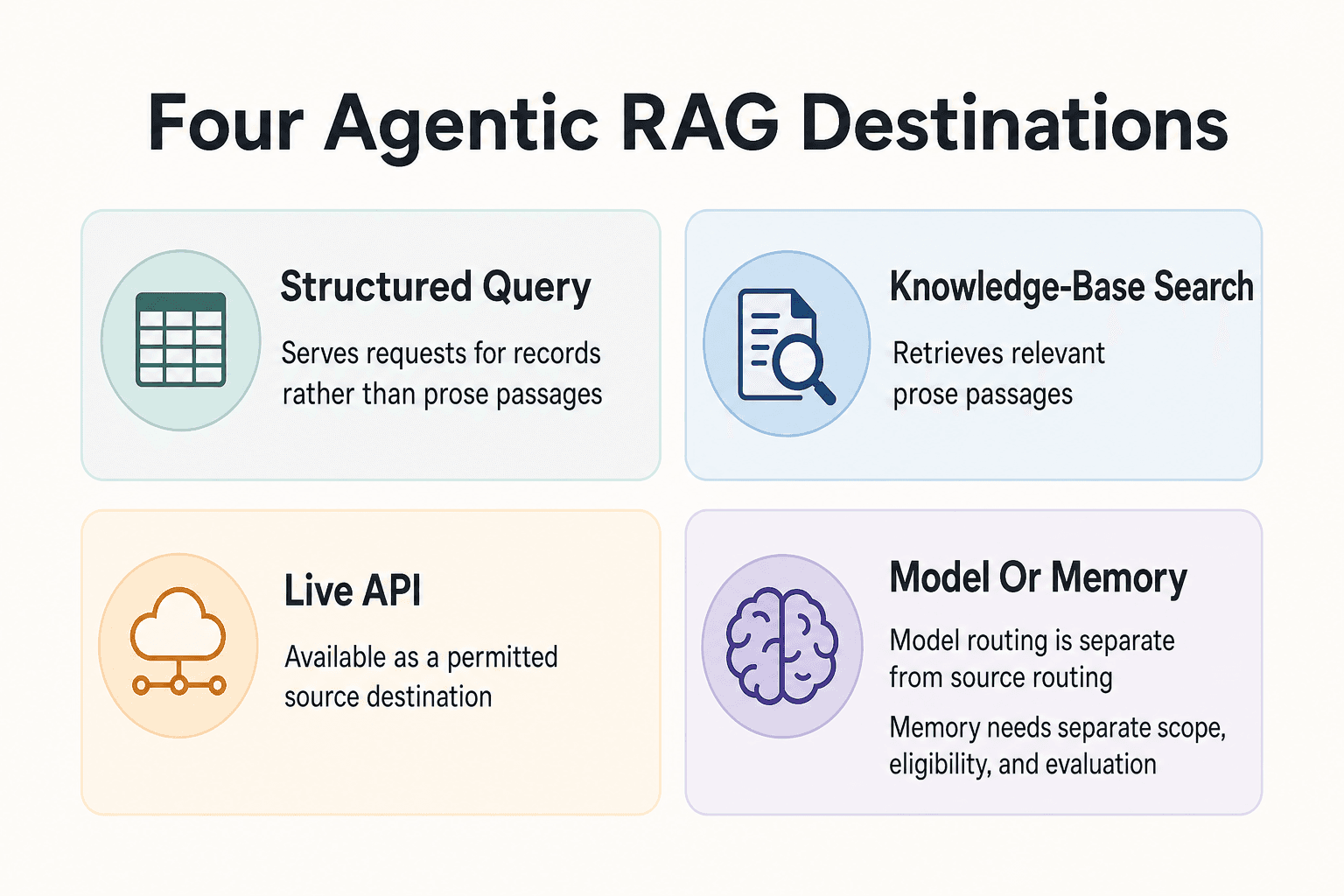
Different requests can call for different destination types. Structured product constraints can be served by a structured-query endpoint, while questions answered across prose documents can use knowledge-base search. The same definition includes routing to a live API.
Routing adds a decision point. Use it where destination boundaries are meaningful and where the decision can be evaluated.
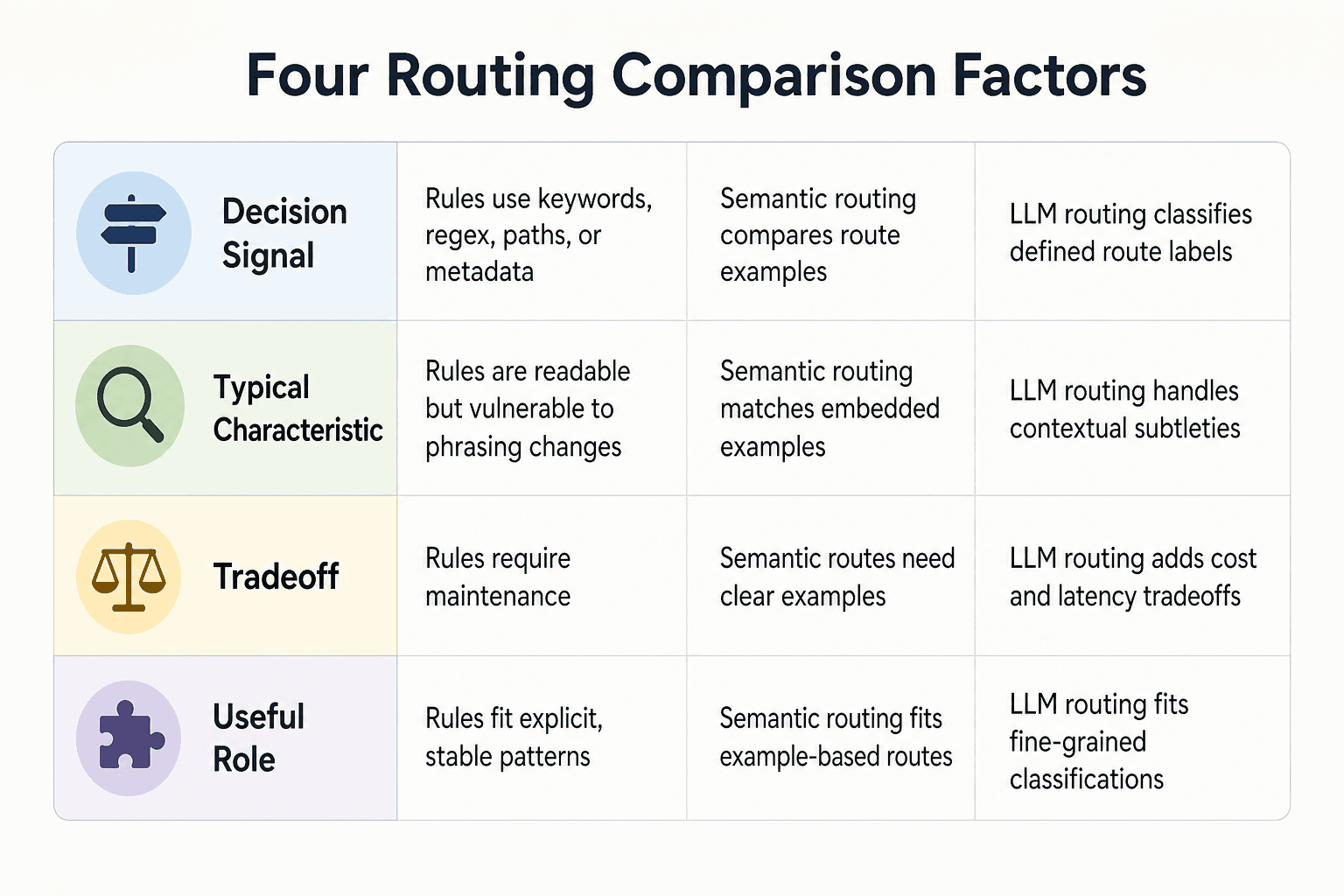
Rule-based vs. semantic vs. LLM routing
| Factor | Rule-based routing | Semantic routing | LLM routing |
|---|---|---|---|
| Decision signal | Keywords, regex, paths, or metadata | Similarity to route examples | Classification over defined route labels |
| Typical characteristic | Readable but vulnerable to changed phrasing | Matches incoming queries with embedded examples | Can classify complex patterns and contextual subtleties |
| Tradeoff | Requires rule maintenance | Route boundaries need clear examples | Adds a model decision with cost and latency tradeoffs |
| Useful role | Explicit, stable request patterns | Routes represented by example queries | Fine-grained task, complexity, or domain classifications |
What a router can route in an agentic RAG stack
Retrieval routing and source selection
Some requests may call for records rather than prose passages. A router can select a structured query, knowledge-base search, or live API from destinations permitted for the request.
If a system includes memory as a destination, define its scope, eligibility, and evaluation separately from retrieval and model routing.
Tool and data-source routing
Source routing selects a destination that fits the request. Tool gating is a separate control: it determines whether a call is allowed.
Model routing is a separate decision
Research on retrieval-augmented language models reports that different LLMs can vary in their ability to use retrieved content. A model-routing policy can account for the task and retrieved context rather than considering only the user prompt.
Query routing patterns: a step-by-step guide
- Inventory destinations and document a route contract for each one.
- Filter destinations using permission, ownership, and availability constraints.
- Create representative requests, including ambiguous requests and requests that should abstain.
- Record the selected route, confidence signal, and fallback outcome.
- Measure route selection separately from retrieval and answer quality.
- Review recurring errors and revise route boundaries, metadata, examples, or fallback behavior.
Rule-based and keyword routing
Rule-based routers use conditions such as keywords, regular expressions, paths, or metadata. A keyword-router example includes patterns for returns, shipping, API endpoints, authentication, prices, and stock.
Rules can be brittle when request phrasing changes. Treat rule maintenance as part of operating the router.
Use metadata before intent classification
Consider user access patterns, data-source characteristics, and query scope when organizing retrieval. A discussion of retrieval organization identifies those three considerations.
Keep access controls distinct from relevance selection.
Semantic and embedding-based routing
Semantic routing uses embeddings and similarity search against example queries associated with each route. The incoming query is embedded and compared with route examples to select a route.
Use representative route examples
Give every route a clear purpose and examples that reflect the language users use. Route names alone do not define the destination boundary.
Treat similarity as a signal, not proof
Define thresholds and a fallback action for close or uncertain matches rather than treating the nearest result as a correctness guarantee.
Possible uncertainty actions include:
- ask one focused clarifying question;
- use a limited, pre-approved set of destinations;
- use a defined general route; or
- abstain.
Logical and LLM-based routing
LLM-based routing uses a classifier model at the application entry point to make routing decisions. Use a closed route schema instead of allowing free-form route invention.
Use a fixed route schema
A schema can return a route label and confidence signal. A valid output format does not make the route correct.
Use LLM routing selectively
An LLM router makes a model decision before the selected retrieval, tool, or answer path proceeds. This approach introduces additional costs and latency. For stable, explicit intents, deterministic rules may be a simpler option.
Hybrid, hierarchical, and multi-route patterns
A router can select one or more destinations for a request. Define permitted route combinations, source limits, conflict handling, and cost limits before retrieving from multiple sources.
Naive hybrid concatenation of all sources can dilute precision and increase token count.
A practical query routing architecture for RAG pipelines
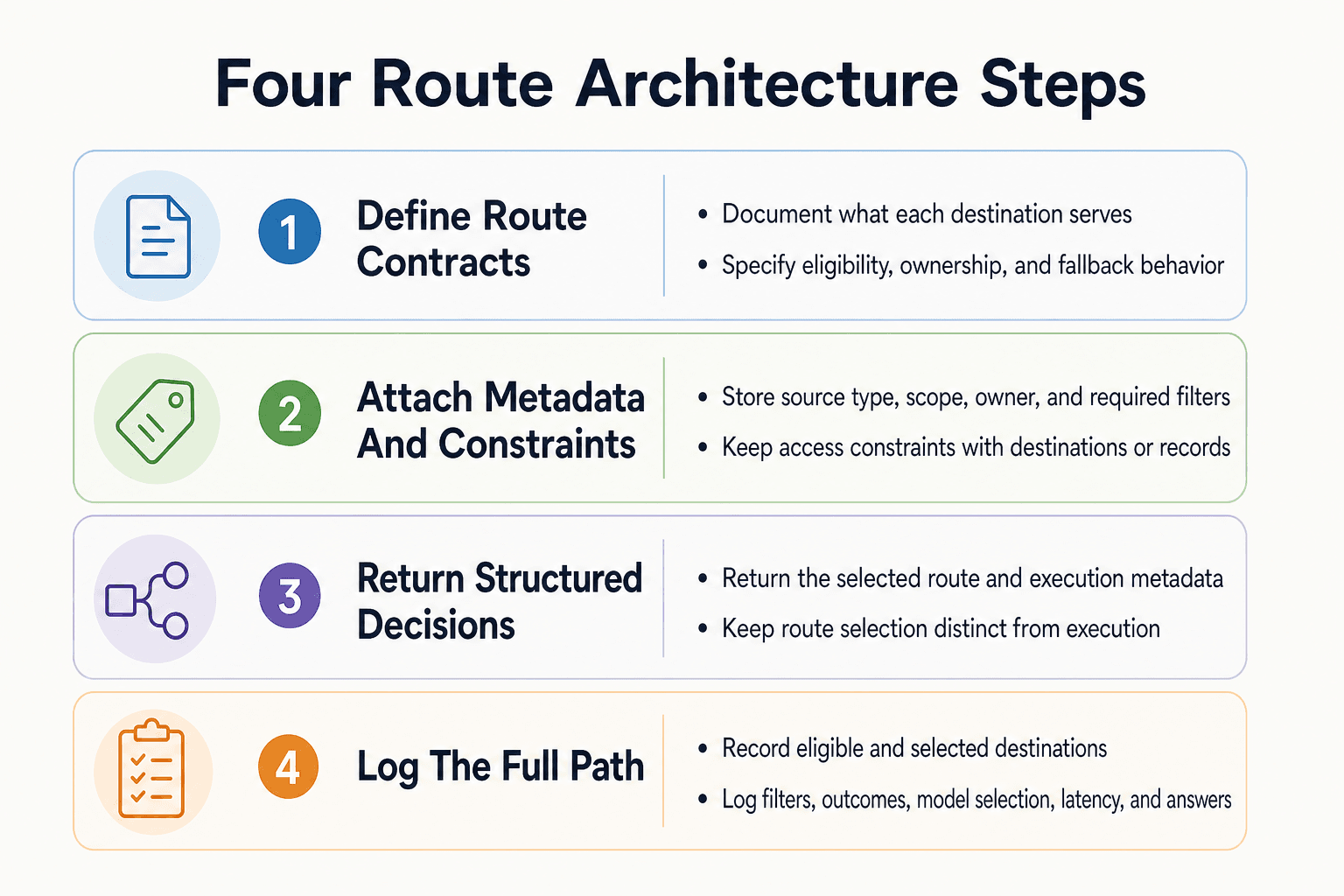
Step 1: Define route contracts
For every index, database, API, tool, and model, document what it serves, which requests are eligible, required inputs, expected outputs, ownership, and fallback behavior.
Step 2: Attach metadata and access constraints
Store source type, scope, owner, and required filters with the destination or its records. Filtering a large shared vector index can reduce recall, while commingled user data can raise security and compliance concerns.
Step 3: Return structured route decisions
Return the selected route and any route metadata required for execution. Keep route selection distinct from executing the route.
Step 4: Log the full request path
Log eligible destinations, selected routes, filters, retrieval or tool outcomes, model selection, latency, and answer outcomes. Handle protected information according to the system’s requirements.
Handling uncertain queries and silent misroutes
Misrouted queries can fail silently as downstream errors compound. A route that produces a valid structured response can still be incorrect.
Confidence bands and route eligibility
Treat confidence as a policy input, not as a guaranteed probability. Define what the system should do at different confidence levels and test that policy against representative requests.
Eligibility comes first: tool gating determines whether a call is allowed, while routing chooses among permitted destinations.
Clarify, fan out, default, or abstain
Ask for clarification when a required fact is missing. Use bounded fan-out only for explicitly permitted source combinations. Use a general route only when it has a defined scope. Abstain when no eligible route can answer under the system’s policy.
How to evaluate and improve a query router
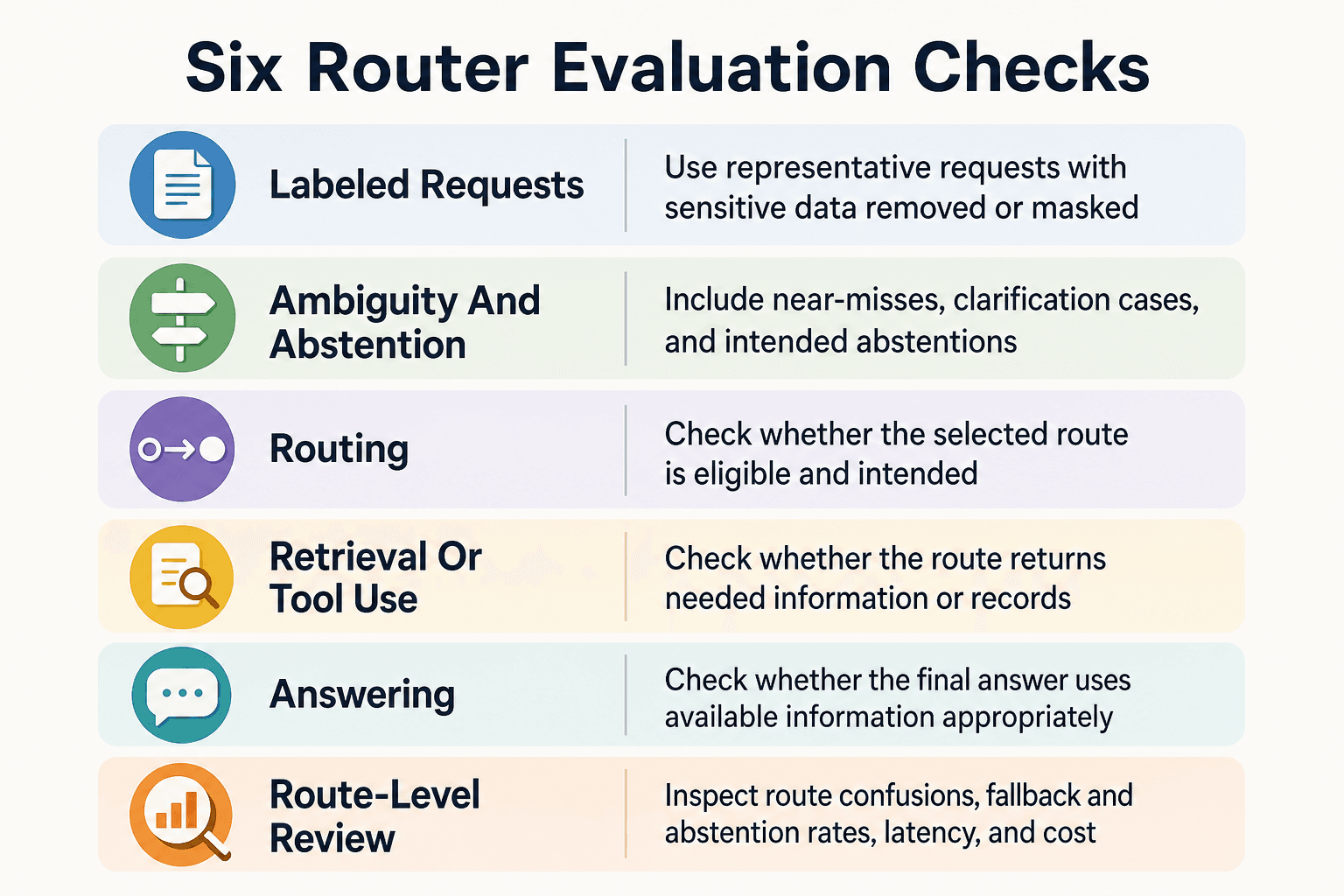
Build a labeled route dataset
Use representative requests after removing or masking sensitive data. Include straightforward cases, near-misses, ambiguity, clarification cases, and requests intended for abstention. If reviewers cannot consistently identify the intended route, revisit the route boundary before relying on classifier performance.
Measure separate stages
Evaluate:
- Routing: Did the system select an eligible intended route?
- Retrieval or tool use: Did that route return the needed information or record?
- Answering: Did the final answer use available information appropriately?
Track route-level metrics
Use a confusion matrix to inspect route confusions. Track route-level precision and recall, fallback and abstention rates, latency, and cost where those measures match the system’s goals.
Do not interpret a score such as 0.8 as an 80% reliability estimate without evaluation evidence supporting that interpretation.
When not to add a router
Do not add routing merely because a system has multiple components. A router adds a decision layer, and an incorrect routing decision can send a request to the wrong source or model.
Add more complex query routing patterns only when a simpler design does not meet measured needs for the system’s requests and destinations.
Frequently asked questions
What are query routing patterns in RAG?
They are approaches for directing a query to an appropriate source, index, model, or processing path before an answer is produced.
What is the difference between query routing and model routing?
Query routing can select a source, index, tool, or processing path. Model routing selects the model that handles the request.
When should I use semantic routing instead of an LLM router?
Semantic routing can suit routes represented by example queries. An LLM router can suit classifications involving complex patterns or contextual subtleties, but it introduces a model decision with cost and latency tradeoffs.
How does query routing work with agent memory?
Treat memory as a separately defined destination: specify its scope, eligibility rules, fallback behavior, and evaluation criteria before adding it to a routing policy.
Can a query router send one request to multiple data sources?
Yes. A router can select one or more destinations per request. Define permitted combinations and execution limits before using a multi-route design.
What should a router do when it is not confident?
Use the predefined uncertainty policy: clarify, select a limited approved route set, use a defined fallback, or abstain.
The value of query routing patterns depends on clear destination boundaries, permitted-route controls, and route-level evaluation.
About GigaRAG
GigaRAG helps developers and teams build better AI systems with reliable memory and knowledge retrieval. We share practical insights, real-world testing, and honest comparisons to help you understand what works, what doesn’t, and which tools are worth exploring.


