Do You Still Need RAG in 2026, or Is an LLM Enough?
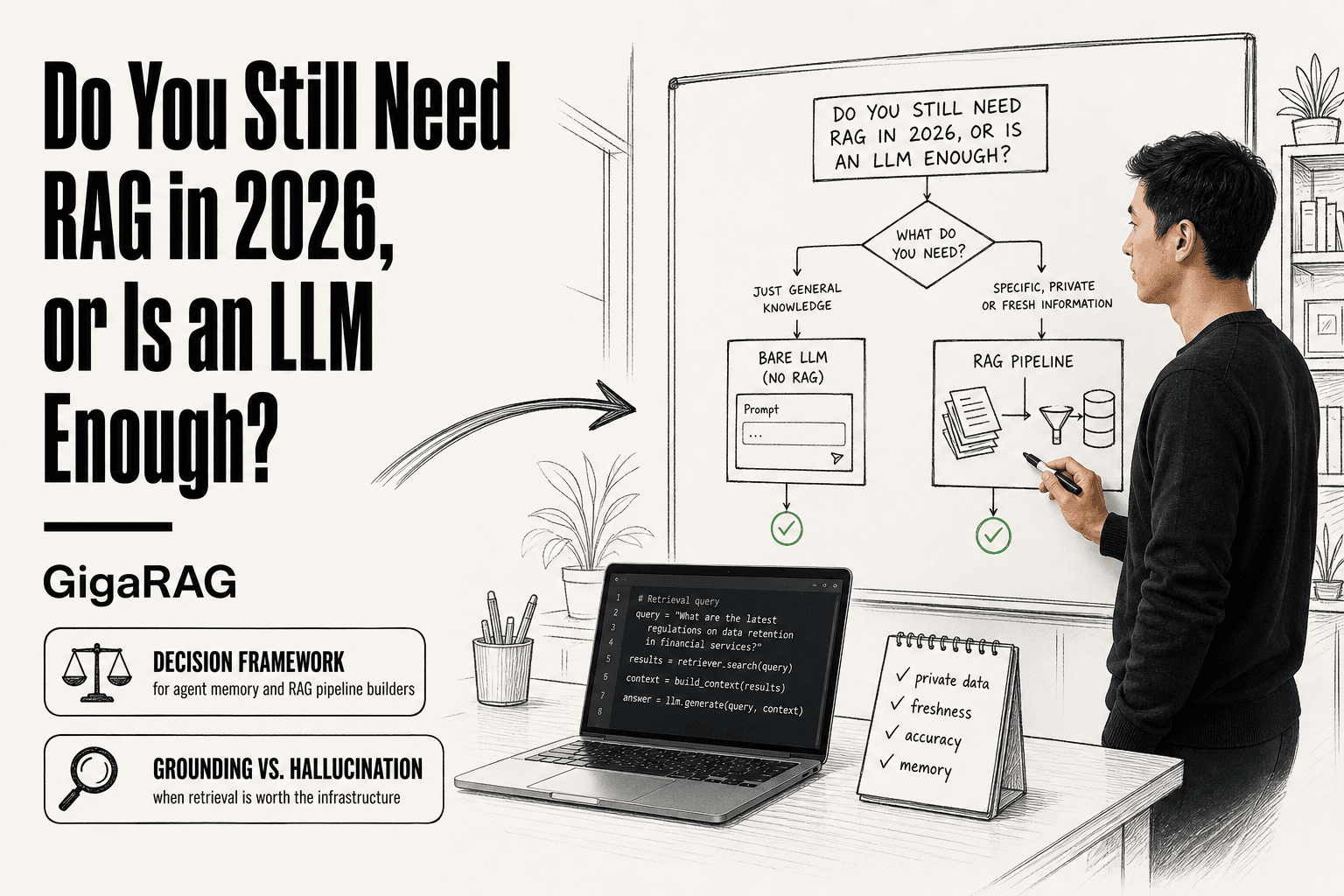
Do you still need RAG in 2026? If you build agent memory or RAG pipelines, you've heard the claim that retrieval augmented generation is dead, replaced by ever-larger context windows and smarter base models. The honest answer is it depends, and it depends on what your system must not get wrong. Most coverage gets the question backwards. It argues about technology when you're making an architectural decision every sprint, and the real question is narrower: does your agent need stateful access to private, changing knowledge, or does it just need to reason well? GigaRAG was built for exactly that audience, so this is written from the same place you work: inside the pipeline, watching retrieval latency and grounding quality trade against token cost. You won't get a verdict here. You'll get a decision framework that states plainly when a bare LLM is enough, what RAG cannot do, and the specific criteria that matter for agent memory and RAG pipeline builders.
| At a glance | Details |
|---|---|
| RAG's role in 2026 | Not dead, but context-dependent |
| LLM context windows | Large, but not infinite |
| Agent memory needs | RAG often essential |
| When LLM suffices | Static, small datasets |
| Key limitation of RAG | No real-time learning |
| Decision framework | Use criteria, not hype |
In This Guide
- The 'RAG Is Dead' Narrative Needs a Reality Check
- RAG vs. Bare LLM: Which Fits Your Use Case?
- What RAG Actually Solves in 2026
- Do You Still Need RAG In 2026: A Step-by-Step Guide
- How RAG Has Evolved from 2024 to 2026
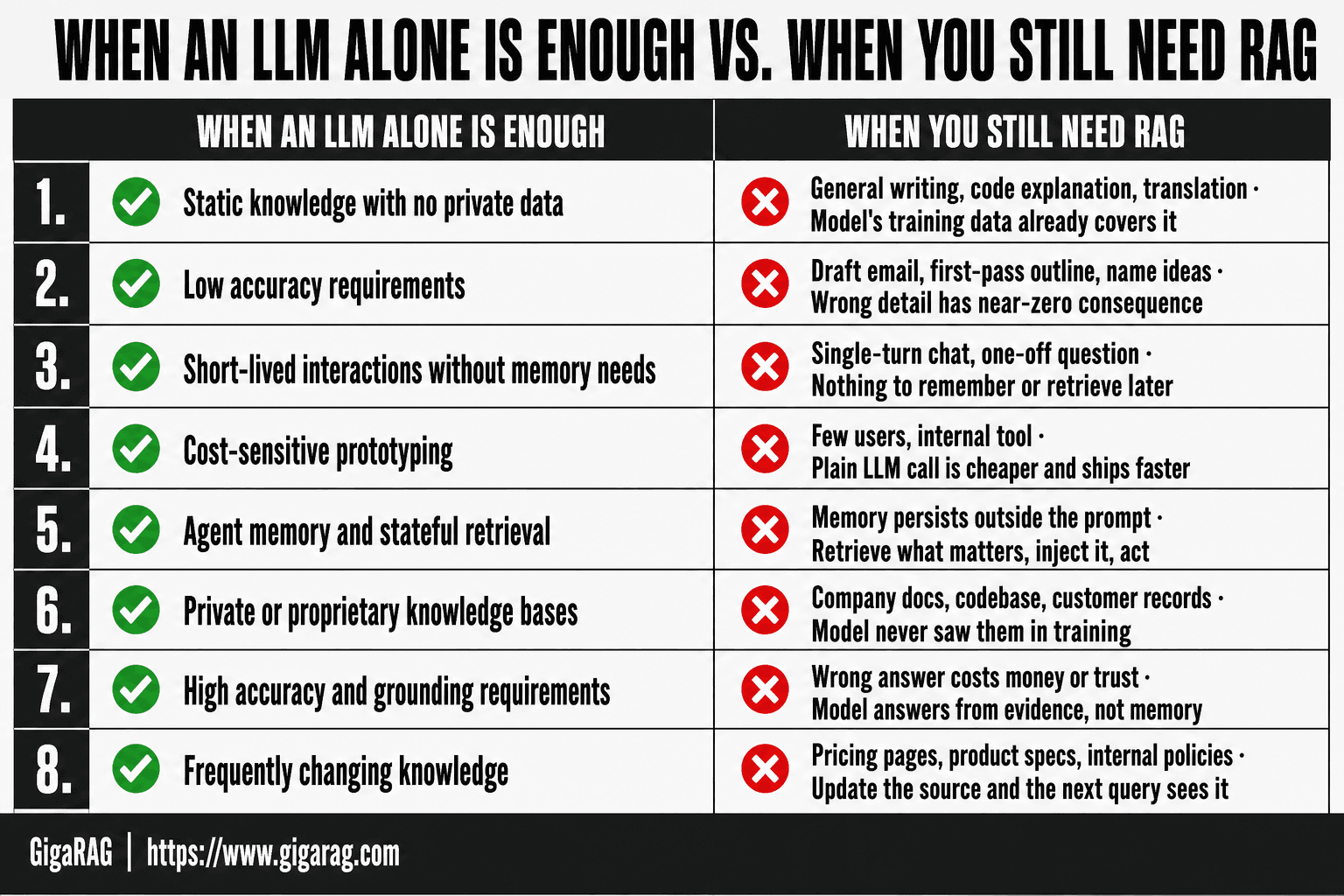
- When an LLM Alone Is Enough
- When You Still Need RAG in 2026
- RAG vs Fine-Tuning vs Long Context: A Practical Comparison
- What RAG Cannot Do in 2026
- A Practical Decision Framework for Agent Memory and RAG Pipeline Builders
- Key Takeaways
The 'RAG Is Dead' Narrative Needs a Reality Check
Some 2026 blog posts open by declaring RAG dead. The claim is loud. The evidence behind it is usually thin.
Where the 'RAG is dead' claim comes from
It comes from context windows. Models now hold hundreds of thousands of tokens, so the argument goes: why retrieve when you can just paste everything in? Add a few benchmark papers showing long-context models matching RAG on simple QA tasks, and you have a headline.
What the claim gets right
RAG is overkill for some jobs. If your knowledge fits in a prompt and rarely changes, retrieval adds latency and moving parts for no gain. That part of the critique holds.
What the claim misses for agent memory builders
The claim ignores state. Agents don't just answer questions; they accumulate memory across turns, sessions, and users. That memory grows. You can't paste a growing memory into every prompt forever. Token costs climb, latency climbs, and the model starts losing the signal in the noise. Retrieval exists precisely because memory doesn't fit in a window. Declaring RAG dead because context windows got bigger is like declaring indexes dead because RAM got cheaper. The problem didn't disappear; it just moved.
[!note] RAG does not enable real-time learning; it retrieves from a static index that must be updated separately. Even in 2026, RAG cannot automatically incorporate new information without pipeline maintenance.
RAG vs. Bare LLM: Which Fits Your Use Case?
| Factor | RAG | Bare LLM |
|---|---|---|
| Data freshness | Can fetch latest info | Limited to training cutoff |
| Context size | Scales beyond window | Constrained by window |
| Cost | Higher infra cost | Lower upfront cost |
| Latency | Adds retrieval time | Faster response |
| Agent memory | Persistent, queryable | Ephemeral, limited |
What RAG Actually Solves in 2026
RAG solves three problems that context windows alone cannot: grounding against hallucination, access to private data, and knowledge freshness without retraining.
Grounding against hallucination
A model with no retrieval can only answer from what it learned during training. When it doesn't know, it guesses. Sometimes the guess is plausible enough to ship. RAG changes the job: instead of generating from memory, the model generates from evidence you supplied. The answer is anchored to a document, a chunk, a source row. That anchor is what lets you say "the model said this because the source said this." Without it, you're auditing vibes.
Access to private and proprietary data
Your internal docs, customer tickets, codebase, and agent memory were never in the training set. No context window changes that. A model can't retrieve what it never saw. RAG is the bridge: you index your data, retrieve the relevant pieces at query time, and hand them to the model. The alternative is fine-tuning, which bakes private data into weights and creates a new problem every time that data changes.
Knowledge freshness without retraining
Training runs are expensive and slow. By the time a fine-tuned model ships, the knowledge it learned is already aging. RAG sidesteps that entirely. Update the index, and the next query sees the new data. No training run, no version bump, no waiting. For agent memory specifically, this matters more: memory changes constantly, and retrieval is the only mechanism that keeps up without a retraining loop.
[!tip] For agent memory builders, use RAG to store and retrieve conversation history or state, but combine it with a short-term buffer for recent context—this hybrid approach balances accuracy and latency.
Do You Still Need RAG In 2026: A Step-by-Step Guide
- List your data sources and their update frequency.
- Estimate the total size of data your system must access.
- Test your LLM's context window against your largest query scenario.
- Assess whether your queries require specific, up-to-date facts.
- Evaluate your latency and cost budget for retrieval infrastructure.
- Prototype a bare LLM solution and measure accuracy on your tasks.
- Compare results against a RAG prototype to make the final call.
How RAG Has Evolved from 2024 to 2026
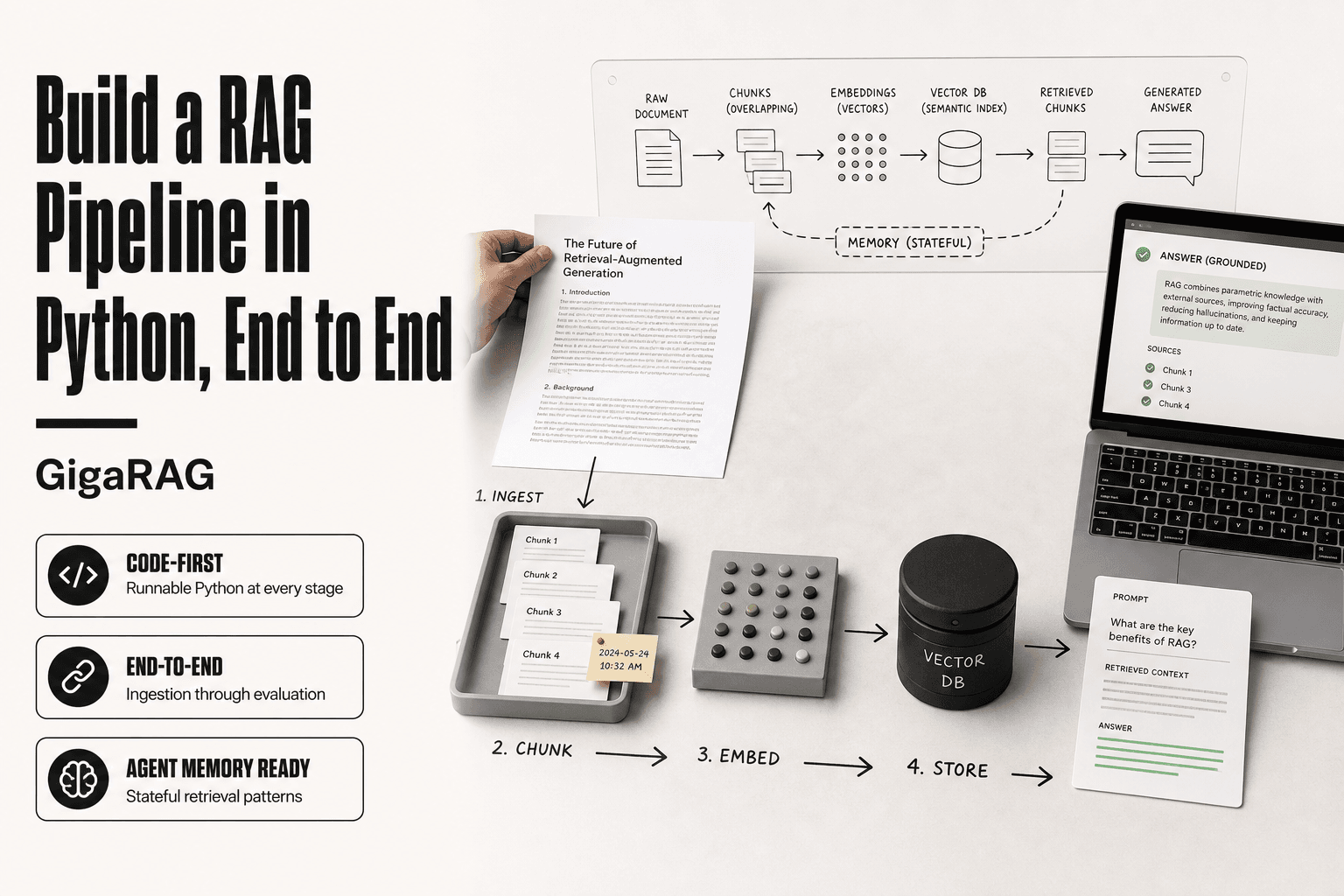
The RAG you read about in 2024 is not the RAG running in production now. The core loop, retrieve then generate, hasn't changed. Everything around it has.
From vanilla RAG to hybrid search and re-ranking
Early RAG meant one vector database and a cosine similarity search. It worked for demos. It missed for real queries where exact terms mattered: SKU numbers, error codes, legal citations. Hybrid search fixed that by combining dense vectors with sparse keyword matching like BM25. Re-ranking added a second pass, a cross-encoder scoring the top candidates before they hit the model. The result is fewer irrelevant chunks and better answers, at the cost of added latency and a second model in the pipeline.
Agentic RAG and memory-aware retrieval
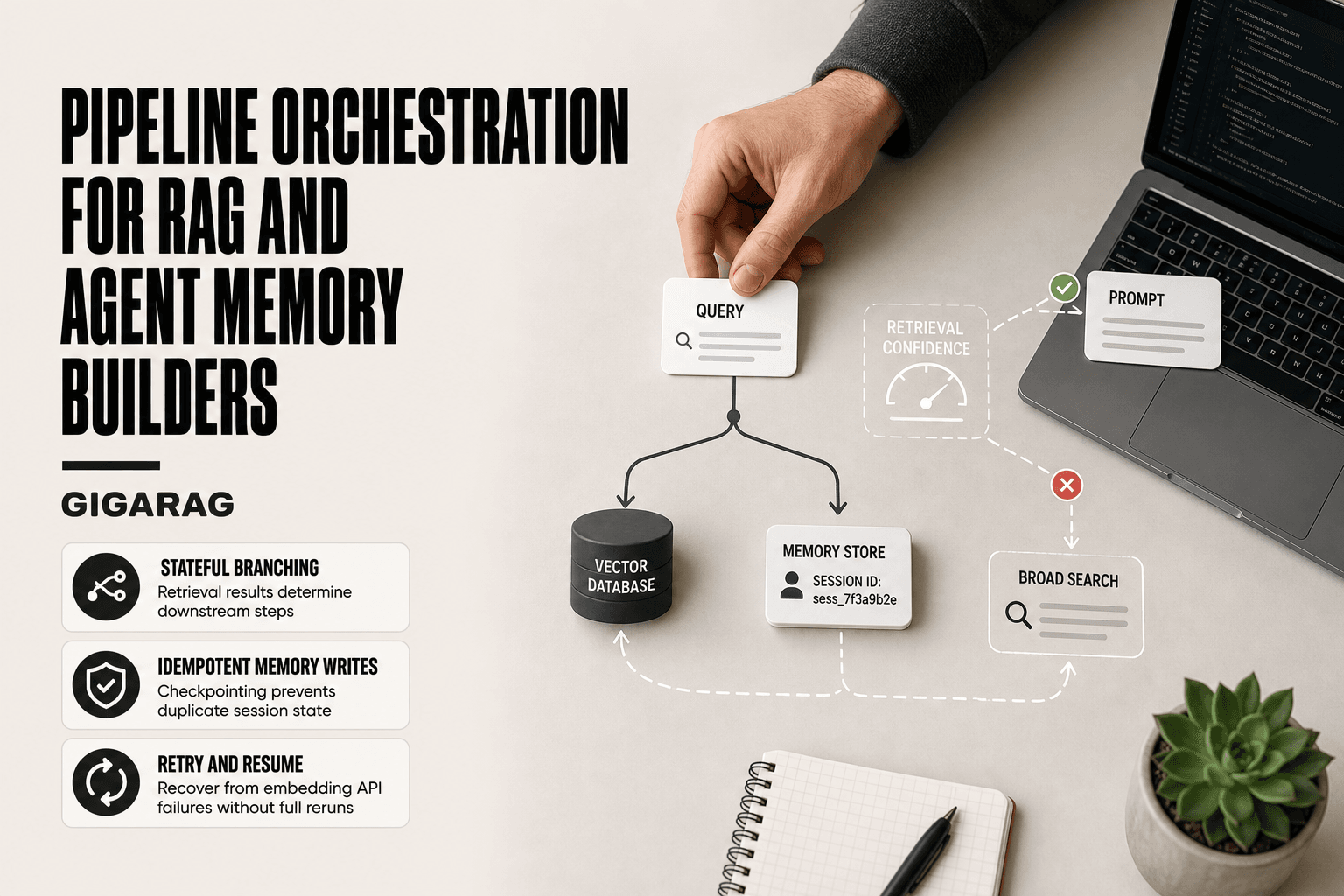
Retrieval used to be one shot: query in, chunks out, answer generated. Agentic RAG breaks that. The agent plans, retrieves, evaluates what it got, and retrieves again if the evidence is thin. Memory-aware retrieval goes further: the system tracks what the agent already knows from prior turns, so it doesn't re-fetch the same context or miss a fact it saw earlier. This is where agent memory and RAG converge.
The shift to invisible infrastructure
RAG is becoming plumbing. Vector databases, embedding models, and re-rankers are now managed services or library defaults, not projects. Builders spend less time on infrastructure and more on retrieval quality and memory design. The question isn't whether RAG works. It's whether your pipeline retrieves the right thing at the right time.
When an LLM Alone Is Enough
More often than most RAG pipeline builders want to admit. A bare LLM with a long context window handles a lot of work that used to require retrieval. The question isn't whether an LLM can do the job. It's whether your specific job has any of the four traits below.
Static knowledge with no private data
If your task draws on knowledge the model already has, RAG adds nothing. General writing, code explanation, summarization of text you paste in, brainstorming, translation. The model's training data covers it. Retrieval just adds latency and a failure point.
The test is simple: could a competent generalist answer this without looking anything up? If yes, skip RAG.
Low accuracy requirements
Not every output needs grounding. A draft email, a first-pass outline, a list of name ideas. These tolerate a wrong detail or a missed nuance. You'll review and fix them anyway.
RAG earns its cost when a wrong answer has a real consequence: a medical dose, a legal clause, a customer-facing support reply. When the cost of being wrong is near zero, the cost of retrieval is pure overhead.
Short-lived interactions without memory needs
A single-turn chat, a one-off question, a stateless API call. Nothing to remember, nothing to retrieve later. The conversation ends and the context dies with it.
RAG matters when state persists across turns or sessions. If your agent forgets everything after each response anyway, there's nothing to retrieve.
Cost-sensitive prototyping
RAG infrastructure isn't free. Vector databases, embedding models, re-rankers, chunking logic. Each piece adds cost and a thing that can break. For a prototype or an internal tool with a handful of users, a plain LLM call is cheaper and ships faster.
Start with the LLM. Add RAG when a real failure shows up, not before.
When You Still Need RAG in 2026
The flip side is just as clear. Four conditions make RAG worth the infrastructure, and they show up together more often than not.
Agent memory and stateful retrieval
Agents don't just answer questions. They act across turns, remember what you said three messages ago, and pull context from past sessions. A long context window holds a conversation. It doesn't hold a month of interactions, user preferences, and task history without blowing past token limits and cost.
RAG gives agents a memory that persists outside the prompt. Retrieve what matters, inject it, act. That's statefulness.
Private or proprietary knowledge bases
Your company's docs, your codebase, your customer records. The model never saw them in training. You can paste a few files into context, but a real knowledge base has thousands of documents. RAG is the only way to search them at query time.
High accuracy and grounding requirements
When a wrong answer costs money or trust, grounding matters. RAG pulls the actual source text into the prompt. The model answers from evidence, not memory. You can also show the user where the answer came from.
Frequently changing knowledge
Pricing pages, product specs, internal policies. These change weekly. Fine-tuning goes stale the day you ship it. RAG retrieves whatever is in the database right now. Update the source, and the next query sees it.
RAG vs Fine-Tuning vs Long Context: A Practical Comparison
Three ways to get knowledge into a model. Each solves a different problem, and picking wrong costs you either accuracy or money.
When fine-tuning is the better choice
Fine-tuning bakes knowledge into the weights. It's the right call when you need a consistent style, a fixed domain vocabulary, or a task the model does repeatedly. A support bot that always answers in your brand voice, a classifier for internal ticket routing. Fine-tuning doesn't retrieve anything. It changes how the model behaves.
The catch: fine-tuned knowledge goes stale. Update your product docs and the model still answers from last month's training run. Retraining costs time and compute.
When long context windows suffice
Long context works when your knowledge fits in the prompt. A single contract, a short spec, a few pages of documentation. Paste it in, ask your question, done. No vector database, no embedding pipeline, no retrieval latency.
The limit is practical. Context windows are big now, but stuffing 100,000 tokens into every call gets expensive fast. And the model pays less attention to information buried in the middle.
When RAG is the only viable option
RAG wins when knowledge is large, private, and changing. Thousands of documents. Proprietary data. Content that updates weekly. You can't fine-tune on every change, and you can't paste a knowledge base into context.
RAG retrieves the relevant chunks at query time and injects them. Fresh data, no retraining. That's the trade-off: more infrastructure, but knowledge that stays current without touching the model.
What RAG Cannot Do in 2026
RAG retrieves text. It does not think. If you expect it to fix a model's reasoning, you'll be disappointed.
RAG does not add reasoning
Retrieval feeds context to the model. The model still has to reason over that context. If the model can't follow a multi-step argument, RAG won't teach it. You get better inputs, not a better brain.
RAG still hallucinates
Grounding reduces hallucination. It doesn't eliminate it. The model can retrieve the right chunk and still misread it, or stitch facts together in a way the source never said. RAG makes errors less likely. It doesn't make them impossible.
Retrieval quality has a ceiling
Your pipeline is only as good as your chunks and embeddings. Bad chunking splits a fact across two pieces. Weak embeddings miss the relevant passage entirely. Re-ranking helps, but it can't recover what retrieval never found.
RAG narrows the gap between what the model knows and what your data says. It doesn't close it.
A Practical Decision Framework for Agent Memory and RAG Pipeline Builders
You don't need a headline. You need a checklist.
Assessing statefulness and memory persistence needs
Ask one question first: does the agent need to remember across sessions? If the answer is no, a stateless LLM call is enough. Don't build memory you won't use.
If the answer is yes, decide what "remember" means. Episodic memory (what happened in this conversation) can live in the context window. Semantic memory (what the agent knows about the user or domain) needs a store. RAG is that store.
The main catch: persistence isn't free. You're paying for storage, embeddings, and retrieval on every turn. If the agent only needs three facts about the user, put them in the system prompt.
Retrieval latency requirements for agents
Agents chain calls. Each retrieval adds latency. If your agent makes five tool calls and each one triggers a search, you've added five round trips.
It depends on your latency budget. Under 500ms per turn, you can afford a retrieval step. Under 100ms, you probably can't. Cache the common cases. Retrieve only when the context window can't hold the answer.
When to build vs buy your RAG pipeline
Build if you need control over chunking, embeddings, or re-ranking. Buy if you need to ship this quarter.
GigaRAG exists for the second case. It handles the pipeline so you can focus on the agent logic. But it won't fix a bad chunking strategy, and it won't make retrieval instant.
Start with the checklist. Then decide.
Key Takeaways
Do you still need RAG in 2026? It depends on four things: whether your data is private, whether it changes, whether accuracy matters, and whether your agent needs memory across sessions.
If you answered no to all four, a plain LLM is enough. Don't build infrastructure you won't use.
If you answered yes to any, RAG earns its complexity. The good news is the stack has matured. Hybrid search, re-ranking, and agentic retrieval are defaults now, not experiments.
Keep in mind what RAG won't do. It won't add reasoning. It won't eliminate hallucination. It won't fix a bad chunking strategy.
The decision isn't RAG versus LLM. It's whether your system needs grounding, freshness, and persistence. When it does, do you still need RAG in 2026? The answer is yes, and it's still the cheapest way to get all three.
Frequently Asked Questions
Is RAG becoming obsolete?
No, RAG is not obsolete, but its necessity depends on your use case. For tasks requiring up-to-date or domain-specific information, RAG remains valuable. However, for general queries with static data, a large-context LLM may suffice.
Do we need an LLM for RAG?
Yes, RAG typically uses an LLM to generate answers based on retrieved documents. The LLM synthesizes the retrieved information, so it is a core component. Alternatives exist, but LLMs are standard for their language understanding.
Which LLM is best for coding in 2026?
The best coding LLM depends on your specific needs, such as language support, context length, and cost. As of 2026, models like GPT-5, Claude 4, and CodeLlama variants are strong contenders, but you should evaluate them on your own codebase.
What replaced RAG?
Nothing has fully replaced RAG, but alternatives like long-context LLMs and memory-augmented agents reduce its necessity in some scenarios. Techniques like fine-tuning and prompt caching also complement or substitute for RAG in certain cases.
How does RAG improve agent memory?
RAG provides a persistent, queryable store for agent memories, such as past interactions or learned facts. This allows agents to access relevant information on demand, overcoming the limited context of LLMs and enabling more coherent long-term behavior.
What are the main costs of implementing RAG?
RAG adds infrastructure costs for vector databases, embedding models, and retrieval pipelines. It also introduces latency and engineering complexity. These costs must be weighed against the benefits of accurate, up-to-date responses.
Can a bare LLM handle real-time data without RAG?
No, a bare LLM cannot access real-time data unless it is connected to external tools or APIs. Without RAG or similar retrieval, the model is limited to its training data, which has a cutoff date. For live information, some retrieval mechanism is necessary.
About GigaRAG
GigaRAG is for agent memory and RAG pipeline builders. get this right. Whether you are working through Do You Still Need RAG in 2026, or Is an LLM Enough? or something adjacent, we publish what we have actually tested, including where it falls short.