RAG Anti-Patterns: Eight Things to Stop Doing
rag anti-patterns: eight things to stop doing starts with a simple boundary: RAG is suited to information searching, while users may also want to do something. As one discussion of RAG limitations notes, a RAG system may not recognize query type, conversation context, or a user’s stage in a journey.
Use this checklist to decide whether a request calls for retrieved information, state management, or an action-oriented workflow. It is a planning guide, not a universal technical evaluation standard.
Key takeaways
- RAG is described in the supplied source as useful for information searching.
- A user request may be informational or may ask the system to do something.
- Query type and state management are identified as RAG challenges in the supplied source.
- Treat information retrieval, conversation state, and action handling as separate design questions.
What counts as a RAG anti-pattern?
For this checklist, a RAG anti-pattern is a recurring implementation or operating choice that is poorly matched to the task. A general anti-pattern source describes anti-patterns as the opposite of design patterns and says they are “usually ineffective or obscure fixes.”
A practical definition for pipeline builders
The useful question is not whether every imperfect answer is an anti-pattern. Ask whether the same design decision repeatedly treats unlike requests as if they were identical—for example, treating an action request as an information request.
What this checklist does and does not cover
This checklist focuses on the boundary between information search, query type, state, and action workflows. It does not prescribe a particular retrieval architecture, chunking method, benchmark, logging design, or production-readiness score.
RAG answer vs workflow action: which fits the request?
| Factor | Information-oriented request | Action-oriented request |
|---|---|---|
| User goal | Obtain information | Ask the system to do something |
| Relevant question | What content can help answer? | What should happen next? |
| Design consideration | Retrieved information | Query type, state, and an appropriate action path |
Why RAG failures are often misdiagnosed
The supplied source describes a boundary that can be easy to miss: RAG responds from content it can access, while user inputs may differ in query type, context, subtext, and journey stage. A response that supplies information may therefore be a poor fit when the user is trying to complete a task.
The layers behind a seemingly simple answer
Before changing an answer, identify what the user is asking for. Is the user seeking information, attempting an action, continuing an earlier task, or expressing something that depends on context?
The source’s example involves a user who says they are moving house and need to update an address. It characterizes the problem as a system treating a request to do something as though it were a question requiring an answer.
What RAG cannot reasonably be expected to do
The supplied source does not present RAG as a complete answer to every user need. It identifies information searching as RAG’s strength and places “doing something” in the area of AI agents and automation.
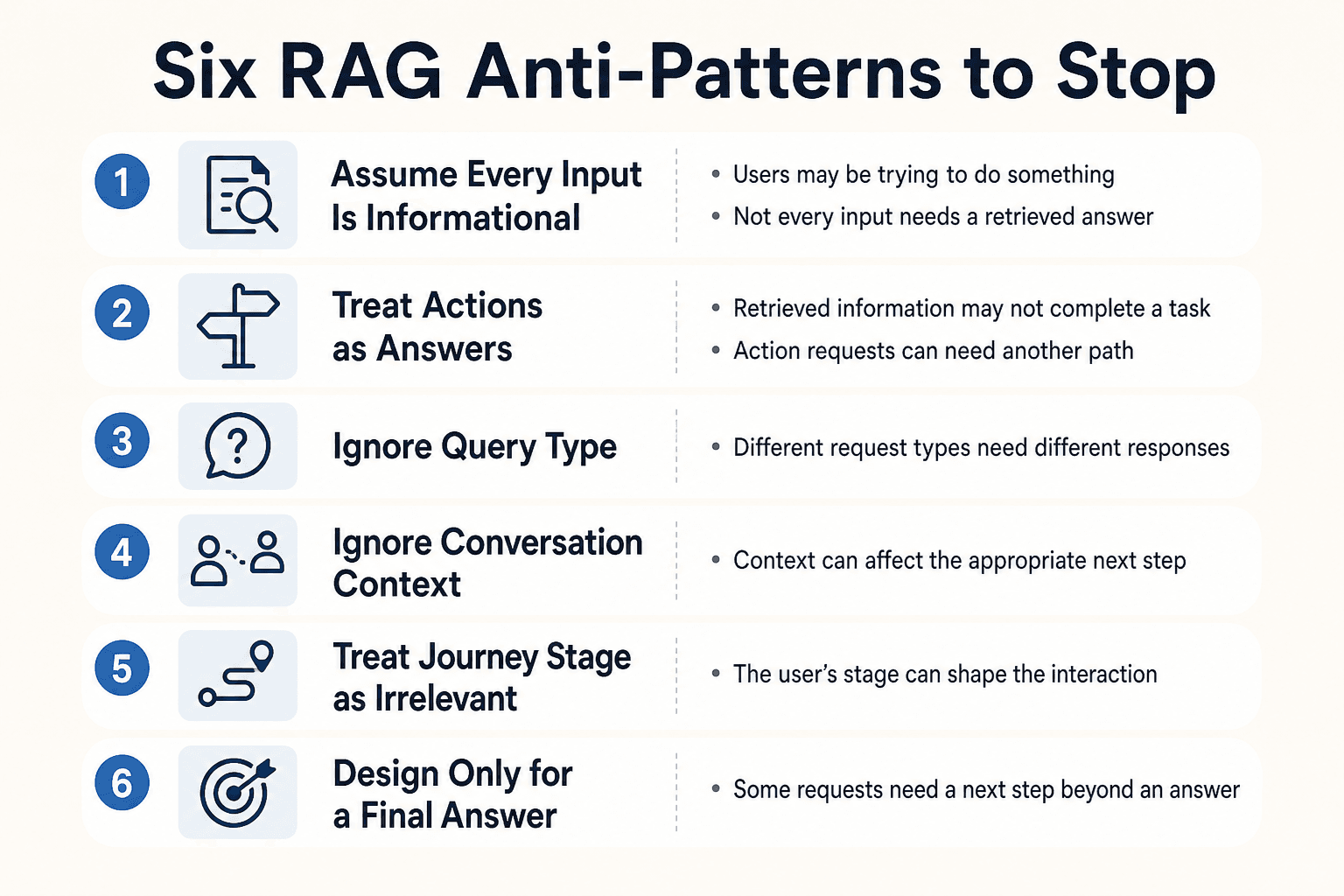
RAG anti-patterns: eight things to stop doing
- Stop assuming every user input is a request for information.
- Stop treating an action request as though a retrieved answer completes the task.
- Stop ignoring query type when deciding how to respond.
- Stop ignoring conversation context when it affects the next step.
- Stop treating journey stage as irrelevant to the interaction.
- Stop assuming information search alone covers every user need.
- Stop designing only for an answer that ends the conversation.
- Stop overlooking when an agent or automation may need to take over.
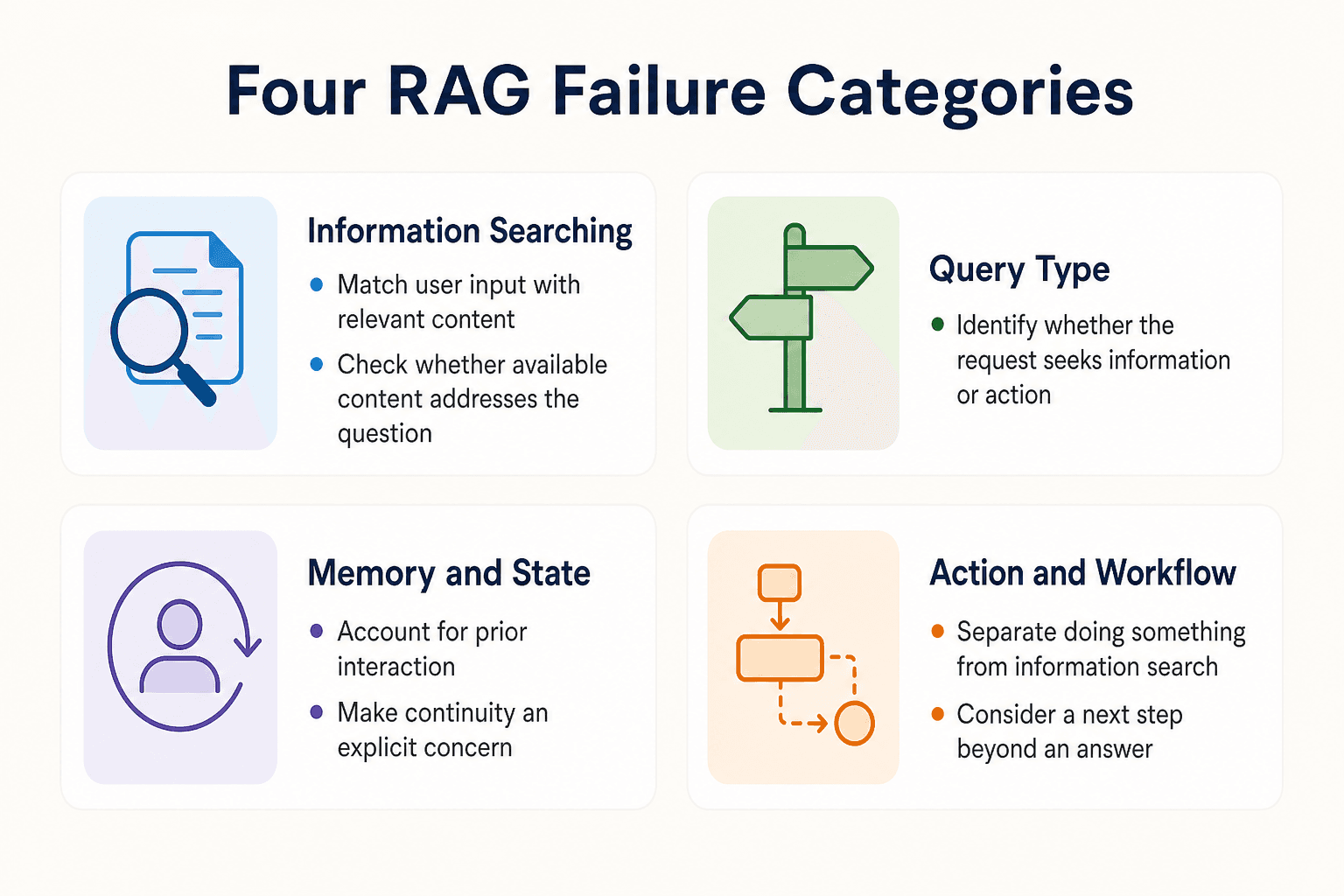
The failure taxonomy: retrieval, memory, state, and action
The supplied source specifically highlights information searching, query type, context, state management, and journey awareness. Use those categories to frame the problem before selecting a response approach.
Retrieval failures
For an information-oriented request, ask whether the available content addresses the user’s question. The supplied source describes RAG as a tool for information searching and semantic matching of user input with relevant content.
Memory and state failures
The supplied source identifies “the need to manage state” and “lack of journey awareness” among RAG limitations. When a response depends on prior interaction or the current stage of a task, make state and continuity explicit design concerns.
Action and workflow failures
The source distinguishes information search from doing something. It describes the latter as an area for AI agents and automation, rather than presenting a purely RAG-based answer as sufficient for every request.
Use this taxonomy before changing the stack
Begin with the intended outcome. If the user needs information, consider an information-search response. If the user is trying to complete a task, consider whether the experience needs a next step beyond an answer.
How to diagnose a RAG failure before you fix it
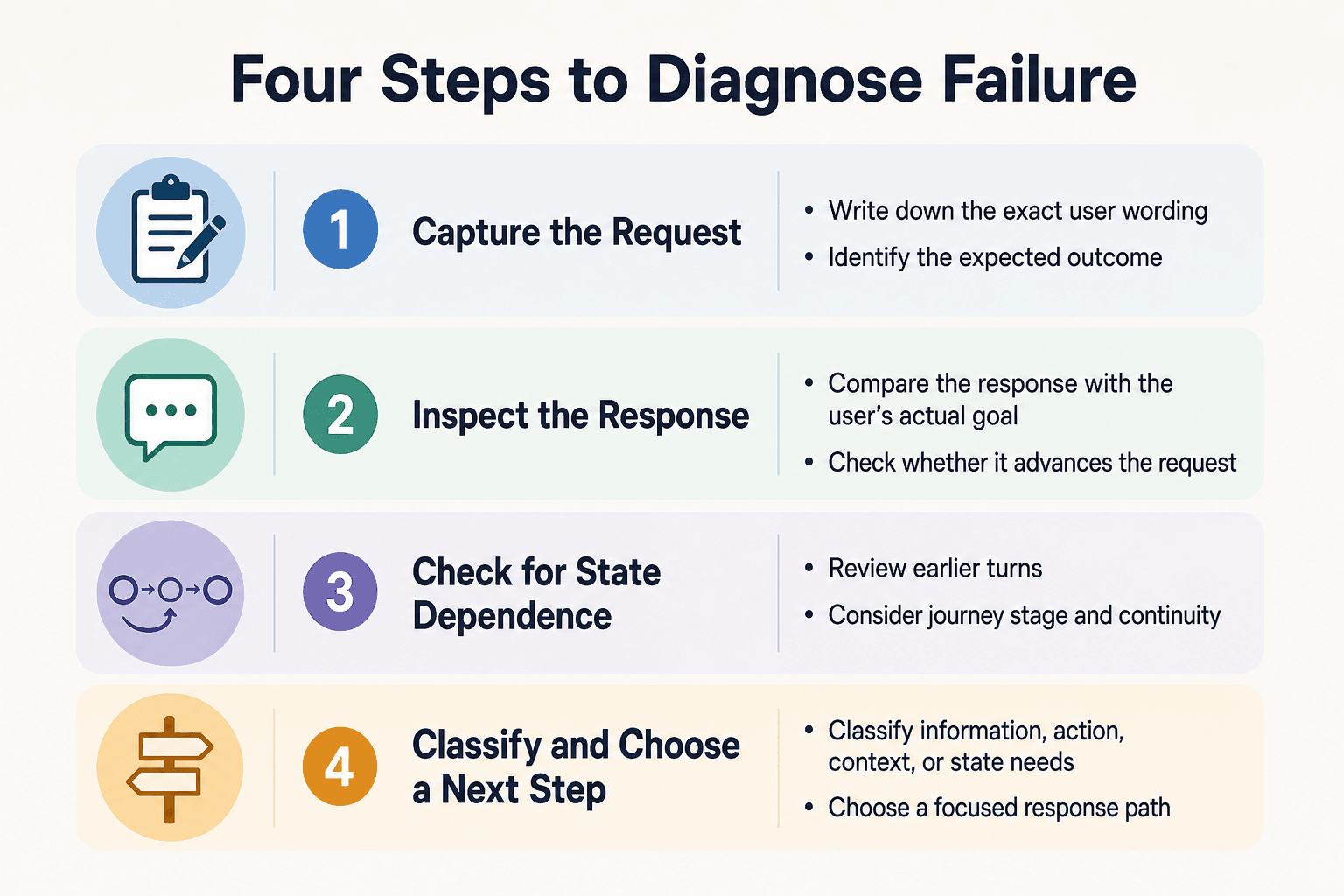
Use the request itself as the starting point. Identify the user’s wording, the expected outcome, the conversation context, and whether the system should answer, continue a task, or hand off to another capability.
Capture the query, context, and expected outcome
Write down the exact request and the outcome the user appears to seek. The supplied source emphasizes that RAG may not know the difference between query type, context, subtext, or journey stage.
Inspect the response in relation to the request
Ask whether the response addressed the user’s actual goal. A response can provide useful information while still failing to advance an action-oriented request.
Check whether the request depends on state
Where the next response depends on an earlier turn or the user’s position in a task, consider state management and journey awareness. Both are identified as limitations in the supplied source.
Classify the issue and choose one next step
Classify the request as information-oriented, action-oriented, or dependent on context or state. Then choose a focused next step appropriate to that classification.
1. Stop treating every input as an information request
The supplied source says that RAG systems can treat all user inputs as questions requiring answers. That approach can be mismatched when a user is trying to do something.
[!tip] Label a test request by its intended outcome before changing the answer. This can help distinguish an information request from a request to move a task forward.
Symptom: an answer ends the interaction too early
A user expresses an intended task, and the system responds only with information. The source calls this tendency the “full stop problem.”
Diagnostic: identify the user’s query type
Ask whether the user seeks information or is attempting to take action. The supplied source identifies inability to recognize query type as a RAG limitation.
Do instead: design for the intended next step
Where the request is action-oriented, consider a response design that supports an appropriate next step rather than only returning information.
2. Stop assuming RAG covers every user need
The supplied source states that users do not just have questions and do not always want to know something. It presents RAG as useful for information searching, not as a complete solution for all interaction needs.
[!note] The supplied source says that RAG systems are good for information searching, while users do not always want to know something; sometimes, they want to do something.
Symptom: information is returned when the user wants progress
The source’s address-update example illustrates a user who wants to do something while the chatbot responds as though the user merely wants to know how.
Diagnostic: compare the response with the user’s goal
Check whether the response helps the user obtain information or whether it merely describes a task the user wanted completed.
Do instead: define the handoff boundary
Decide where an information-search response should end and where an agent, automation, or other workflow should take over.
3. Stop ignoring query type
The supplied source lists inability to recognize query type as a limitation. It says that RAG may respond to every input based on the content it can access.
Symptom: different requests receive the same answer pattern
A system may respond with an answer regardless of whether the user asked a question or indicated an action they want to take.
Diagnostic: test informational and action-oriented wording
Include requests that ask for information and requests that express an intended action. Review whether the response fits the type of request.
Do instead: make query type part of the interaction design
Use query type as an explicit design consideration when deciding whether to answer, ask a follow-up question, or move to another interaction path.
4. Stop overlooking context and subtext
The supplied source says RAG may not know the difference between query type, context, and subtext. It also notes that user inputs are answered based on the content available to the system.
Symptom: a literal answer misses what the user means
A response may address the words in a message without addressing the user’s intended next step.
Diagnostic: review the preceding interaction
Where appropriate, consider whether earlier turns change the meaning or purpose of the current request.
Do instead: identify context-dependent interactions
Make a deliberate decision about how the system should handle requests whose meaning depends on conversation context.
5. Stop treating state as an afterthought
The supplied source includes “the need to manage state” and “lack of journey awareness” in its discussion of RAG limitations.
Symptom: the system lacks continuity across a task
When the user’s stage in a journey matters, an answer based only on available content may not address the full interaction need.
Diagnostic: ask whether journey stage matters
Consider whether the system needs to account for where the user is in a process before selecting a response.
Do instead: plan state management separately
Treat state management as a separate requirement when continuity or task progression is necessary.
6. Stop designing every response as a full stop
The supplied source describes the “full stop problem” as a tendency for RAG systems to end every response with a full stop, whether the user is asking a question or completing a task.
Symptom: the response does not invite an appropriate next turn
An answer may end the exchange even when the user is attempting to continue or complete a task.
Diagnostic: identify the next turn needed for success
Ask what must happen after the response for the user’s goal to be met.
Do instead: account for turn-taking
The source discusses turn-taking as part of conversation design. Consider whether the response should support the next turn rather than simply conclude.
7. Stop treating demonstration questions as the whole design problem
The supplied evidence does not prescribe a specific evaluation method or benchmark for RAG systems. It does, however, identify query type, context, state management, and journey awareness as relevant limitations.
Symptom: a system is assessed only on answer retrieval
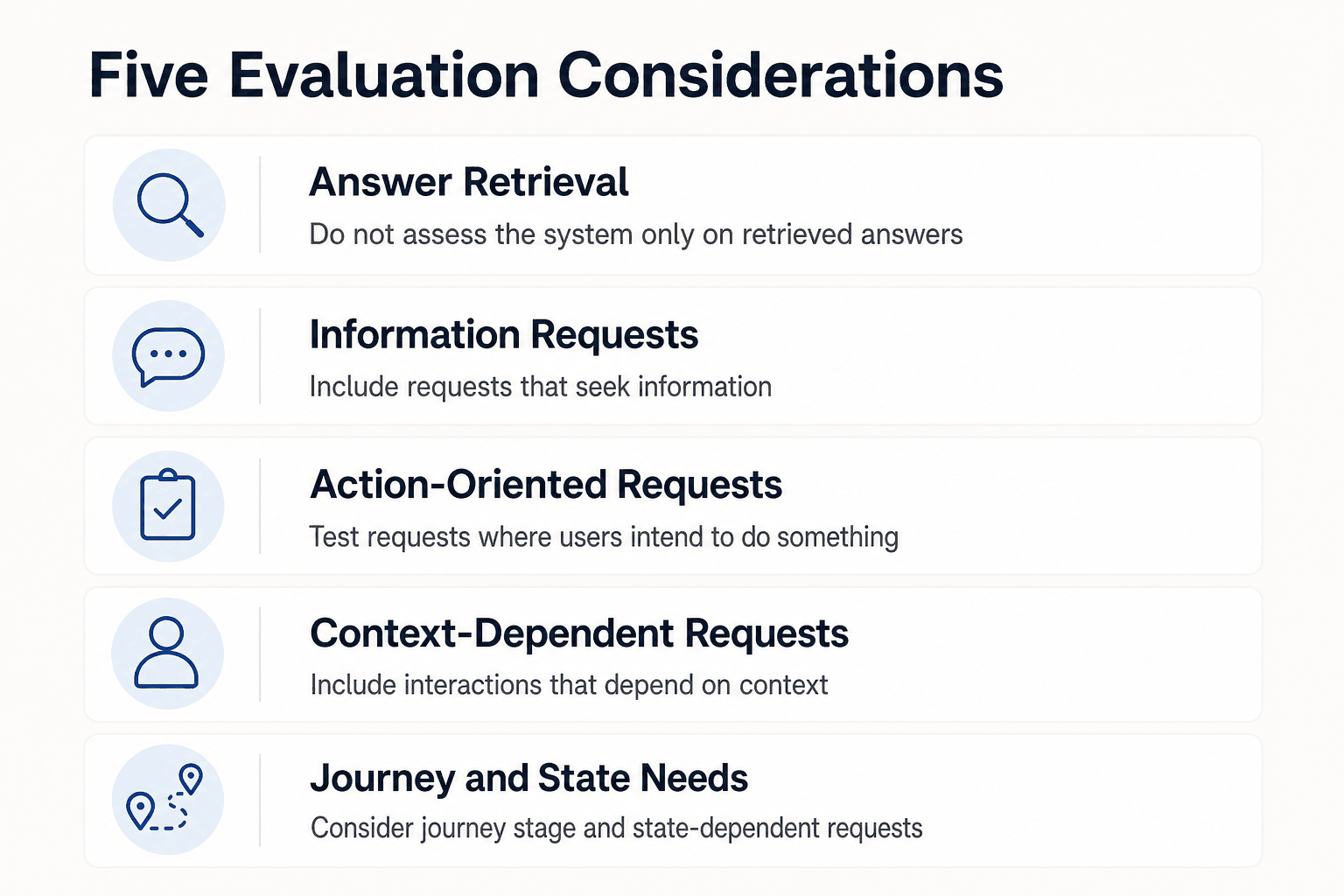
An assessment limited to information questions may not reveal how the interaction handles action-oriented or state-dependent requests.
Diagnostic: include more than one request type
Consider testing information requests alongside requests that depend on context, journey stage, or an intended action.
Do instead: align evaluation with the intended experience
Evaluate the types of interactions the system is intended to support. Avoid presenting the supplied source as support for a single required evaluation method.
8. Stop leaving the automation boundary undefined
The supplied source describes a grey area between RAG and AI agents or process automation. It says that RAG systems know things while AI agents do things.
Symptom: the system provides guidance when an action path is needed
The address-update example in the source shows the difference between explaining how to update an address and helping with the action the user intended.
Diagnostic: identify where RAG should end
For an action-oriented request, decide whether an information response is sufficient or whether another capability should take over.
Do instead: define the RAG-to-workflow handoff
Document the boundary between information searching and the process that handles the requested action.
Build the smallest reliable RAG loop first
Start with a narrow, clearly defined information-search use case. Then identify the requests that need more than information, including those that depend on query type, conversation context, state, or an action-oriented next step.
For rag anti-patterns: eight things to stop doing, the central lesson is not that RAG is ineffective. The supplied source describes RAG as good for information searching; the design challenge is recognizing when information searching is not the whole task.
Frequently asked questions
What is a RAG anti-pattern?
For this article, a RAG anti-pattern is a recurring design or operating choice that is poorly matched to the task. One example is treating every user input as a question when the user is trying to take action.
How do I know whether a request needs more than a RAG answer?
Consider whether the user is seeking information or trying to do something. The supplied source distinguishes information searching from actions and automation.
Can RAG recognize every query type and conversation context?
The supplied source identifies inability to recognize query type, context, and subtext as limitations discussed for RAG systems. It does not establish that every RAG implementation behaves identically.
What is the difference between RAG and agent memory?
The supplied source describes RAG as useful for information searching and separately identifies state management and journey awareness as challenges. This article therefore treats retrieval and state as separate design concerns.
When should an agent use a workflow instead of a RAG answer?
Consider a workflow or automation path when the user is trying to do something rather than merely obtain information. The supplied source uses an address update as an example of this distinction.
How should I evaluate a RAG pipeline before production?
The supplied evidence does not prescribe a specific evaluation method. As a planning step, include the kinds of requests the system is expected to support, such as information-oriented, action-oriented, or context-dependent requests.
What should I log to debug RAG failures?
The supplied evidence does not specify logging requirements. Define diagnostic practices according to your system’s needs and applicable requirements.
About GigaRAG
GigaRAG is for agent memory and RAG pipeline builders. get this right. Whether you are working through ragie alternatives or something adjacent, we publish what we have actually tested, including where it falls short.