RAG Architecture in LangChain vs LlamaIndex vs Custom: An Honest Comparison for Pipeline Builders
RAG architecture in LangChain vs LlamaIndex vs custom is a question most engineers answer by reading vendor blogs, then reading Reddit threads, then feeling worse than when they started. One framework claims to do everything. The other claims to do retrieval better. Neither mentions the option you're already considering: building it yourself. You're a pipeline builder who needs agent memory to work in production, not a feature matrix that looks good in a slide deck. Most comparisons skip custom RAG entirely or treat it as a failure mode. This one treats it as a first-class option. GigaRAG is built for exactly this audience, agent memory and RAG pipeline builders, and the perspective here comes from watching teams choose frameworks for the wrong reasons. The honest answer is that each approach has real limits, and pretending otherwise is how you end up rewriting your retrieval layer three months in. This guide covers what LangChain, LlamaIndex, and custom RAG each cannot do, how agent memory changes the architecture decision, and a decision framework at the end that maps your memory requirements, team size, and data complexity to the right choice.
| At a glance | Details |
|---|---|
| Core choice | Framework speed vs custom control |
| LangChain strength | Broad integrations and agent tooling |
| LlamaIndex strength | Indexing and retrieval abstractions |
| Custom strength | Full control over memory and data flow |
| Agent memory | Often bolted on, not built in |
| Best for | Teams matching tool to constraints |
In This Guide
- RAG Architecture in LangChain vs LlamaIndex vs Custom: At a Glance
- LangChain vs LlamaIndex vs Custom RAG: Which Fits Your Pipeline?
- What Is LangChain and How Does It Work for RAG?
- Rag Architecture In Langchain Vs Llamaindex Vs Custom: A Step-by-Step Guide
- What Is LlamaIndex and How Does It Work for RAG?
- What Custom RAG Architecture Actually Means
- Key Differences Between LangChain, LlamaIndex, and Custom RAG
- Agent Memory: The Architectural Concern Everyone Ignores
- RAG Database Types and How They Affect Architecture Choice
- RAG vs Context Windows: What You Should Not Expect
- When to Choose Each Framework: A Decision Framework
- Migrating Between Frameworks: What You Should Know
- Final Thoughts on RAG Architecture in LangChain vs LlamaIndex vs Custom
RAG Architecture in LangChain vs LlamaIndex vs Custom: At a Glance
There is no single best RAG architecture. LangChain wins on orchestration depth, LlamaIndex wins on retrieval precision, and custom wins on control when your memory or data requirements don't fit either framework.
Comparison table: LangChain vs LlamaIndex vs Custom
| Dimension | LangChain | LlamaIndex | Custom |
|---|---|---|---|
| Learning curve | Steep. Chains, agents, and memory modules each carry their own abstractions. | Moderate. Indexes and query engines map closely to RAG concepts. | Steepest. You own every component and every bug. |
| Flexibility | High within its abstractions. Hard to escape them. | High for retrieval. Lower for arbitrary orchestration. | Unbounded. You build exactly what you need. |
| Agent memory support | Built-in memory modules, but they're generic. | Limited. Memory is not a core abstraction. | Whatever you design. This is the main reason teams go custom. |
| Maintenance burden | Framework updates break things. You track their roadmap. | Same, but the surface area is smaller. | Entirely yours. No upstream surprises, no free fixes. |
| Time-to-first-result | Days to weeks. | Hours to days. | Weeks to months. |
How to read this table honestly
The table flattens real trade-offs into cells. That's the point of a table, but it hides something important: your specific memory requirements change every row.
LangChain's steep learning curve matters less if you need deep agent orchestration. LlamaIndex's limited memory support matters more if your agents need long-term recall. Custom's time-to-first-result looks bad until you realize that retrofitting agent memory into a framework can take longer than building it yourself.
The honest answer is that the table is a starting point, not a verdict. The sections that follow dig into what each approach actually does in production, including what each one cannot do.
[!note] LangChain and LlamaIndex are not mutually exclusive; many production systems use LlamaIndex for indexing and retrieval while using LangChain for orchestration and agent logic.
LangChain vs LlamaIndex vs Custom RAG: Which Fits Your Pipeline?
| Factor | LangChain | LlamaIndex |
|---|---|---|
| Primary focus | Broad orchestration and agent tooling | Data indexing and retrieval abstractions |
| Agent memory support | Via modules and external stores | Via memory modules and stores |
| Customization ceiling | High, but tied to framework patterns | High for retrieval, less for orchestration |
| Learning curve | Moderate to steep due to breadth | Moderate, focused on retrieval concepts |
| Best fit | Multi-tool agents and integrations | Document-heavy retrieval pipelines |
What Is LangChain and How Does It Work for RAG?
LangChain is an orchestration framework. It doesn't do retrieval itself. It wires together the pieces that do: document loaders, embedding models, vector stores, LLMs, and the logic that connects them. For RAG, LangChain treats retrieval as one step in a chain, not the center of the architecture.
LangChain's orchestration model: chains and agents
A chain is a fixed sequence of steps. Load documents, split them, embed them, store them, retrieve on query, pass context to the LLM. You define the order and LangChain runs it. That's the simplest RAG pattern and it works fine for basic question-answering over a knowledge base.
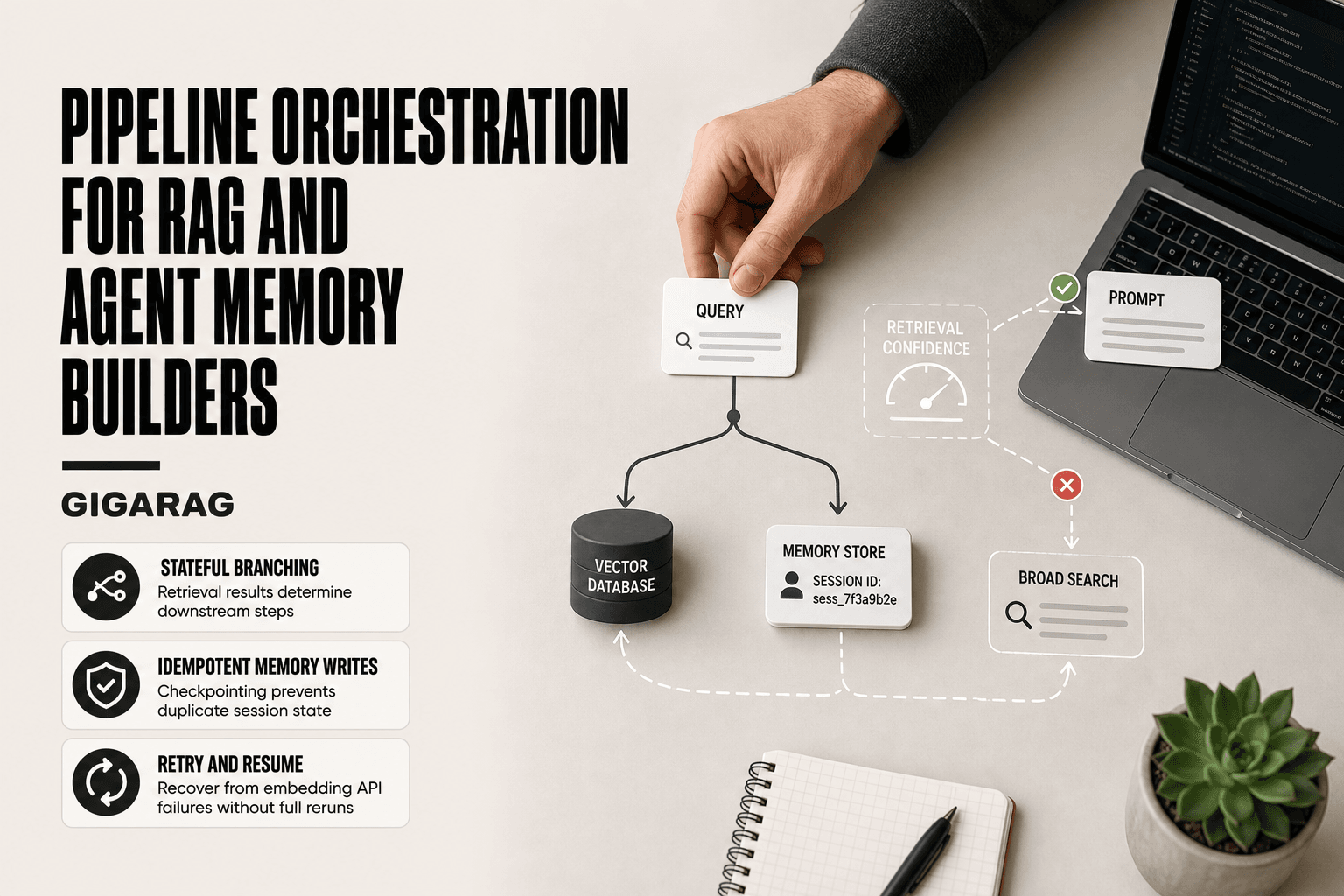
Agents are different. An agent decides what to do next based on the LLM's output. It might retrieve, then decide the results are weak and retrieve again with a different query. Or it might call a tool, inspect the result, and branch. For RAG, agents matter when retrieval quality depends on iteration rather than a single pass.
How LangChain handles retrieval and memory
Retrieval in LangChain sits behind a retriever interface. You can plug in vector search, hybrid search, or a custom retriever. The framework doesn't optimize retrieval itself. It hands your retriever a query and gets documents back.
Memory modules store conversation state. LangChain ships with buffer memory, summary memory, and vector-backed memory. Buffer memory keeps the raw transcript. Summary memory condenses it. Vector-backed memory stores past exchanges as embeddings and retrieves relevant ones. For agent memory, vector-backed is the only one that scales past a handful of turns.
What you cannot do with LangChain
LangChain won't make your retrieval better. If your chunking is bad or your embeddings are weak, LangChain will faithfully orchestrate a bad pipeline. It also won't give you fine-grained control over memory. The built-in memory modules are generic. Custom memory means subclassing and fighting the abstraction.
The main catch: LangChain's abstractions are deep. When they fit, you move fast. When they don't, you spend more time working around them than you would building the thing yourself.
[!tip] For agent memory specifically, design your memory interface first — what gets stored, retrieved, and forgotten — then pick the framework that fits that interface, rather than adapting your memory design to framework defaults.
Rag Architecture In Langchain Vs Llamaindex Vs Custom: A Step-by-Step Guide
- Map your agent memory requirements: short-term, long-term, or both.
- Assess your team's size and appetite for maintaining framework upgrades.
- Evaluate your data complexity: formats, volume, and update frequency.
- Prototype with LangChain and LlamaIndex on a small, representative dataset.
- Identify where each framework forces compromises for your memory design.
- Decide whether a custom layer is needed for memory or retrieval control.
- Plan for evaluation and observability from day one, regardless of choice.
What Is LlamaIndex and How Does It Work for RAG?
LlamaIndex is a data framework built around retrieval. Where LangChain treats retrieval as one step in a chain, LlamaIndex treats it as the core abstraction. Everything else exists to serve the index.
LlamaIndex's retrieval-first model: indexes and query engines
An index is a data structure that maps your documents into a searchable form. LlamaIndex ships with several: vector indexes, keyword indexes, tree indexes, graph indexes. Each answers a different kind of query.
A query engine sits on top of an index. You ask a question, the query engine retrieves relevant nodes, and passes them to an LLM with the question. The query engine handles the retrieval-to-generation handoff. You can customize retrieval depth, node count, and response synthesis without touching the index itself.
How LlamaIndex handles data ingestion and chunking
Ingestion starts with a document loader, then a node parser. The node parser is LlamaIndex's chunker. It splits documents into nodes, which are the atomic unit of retrieval. You control chunk size, overlap, and splitting strategy.
Nodes get embedded and stored in the index. LlamaIndex handles the embedding call, the vector store write, and the metadata attachment. You can swap embedding models and vector stores without changing your query code.
What you cannot do with LlamaIndex
LlamaIndex won't orchestrate complex multi-step workflows. It's not built for that. If your pipeline needs branching logic, tool calls, or agentic decision-making, you'll hit the edge of what the framework does well.
It also won't fix bad chunking. The node parser gives you control, but it doesn't know your data. If you split documents poorly, retrieval quality suffers regardless of which index type you pick.
What Custom RAG Architecture Actually Means
Custom RAG means you write the pipeline yourself. Direct calls to an LLM API. Your own vector store integration. Your own chunking and retrieval logic. No framework sitting between you and the model.
That sounds like more work. It is. But it's also the only way to get exactly the behavior you need when frameworks don't fit.
The spectrum: thin wrapper to fully bespoke
A thin wrapper is maybe 200 lines of code. You call an embedding API, store vectors in Postgres with pgvector, and write a retrieval function that returns the top-k chunks. You prompt the LLM with those chunks and the user's question. That's it. You've built RAG.
A fully bespoke pipeline is a different animal. Custom chunking that understands your document structure. Hybrid retrieval combining vector search with keyword search and reranking. Metadata filtering tied to your domain. Caching layers. Evaluation harnesses. Streaming responses. Agent memory that persists across sessions.
Most teams land somewhere in the middle. You start thin, then add pieces as you hit limits.
Core components you must build yourself
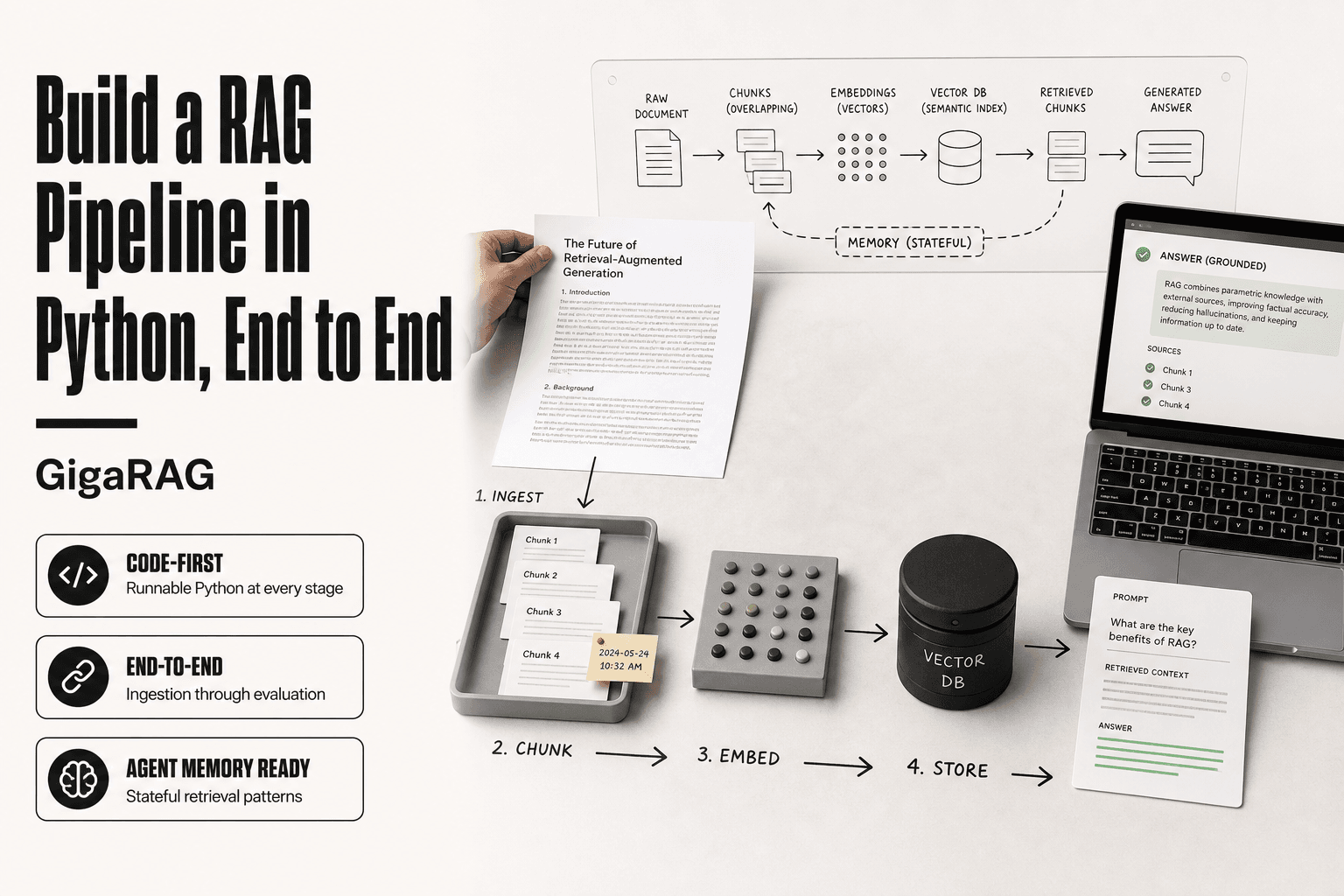
You need five things. An embedding step: take text, get vectors. A storage layer: put vectors somewhere you can query. A retrieval function: given a query, return relevant chunks. A prompt assembly step: stuff chunks and the question into a template. A generation call: send the prompt to an LLM and get a response back.
Each of those is a decision. Which embedding model? Which vector store? How many chunks to retrieve? What prompt format? Which LLM? Frameworks make some of these decisions for you. Custom means you make all of them.
What you cannot do with a custom build (without significant investment)
You won't get advanced retrieval features for free. Reranking, hybrid search, query transformations, recursive retrieval. These exist in LlamaIndex as configuration options. In a custom build, you implement them yourself.
You also won't get an ecosystem. No community plugins, no prebuilt connectors, no documentation for your exact setup. When something breaks, you're the support team.
The honest answer is that custom RAG is a trade. You trade framework convenience for control. If your memory requirements or data complexity are non-standard, that trade is worth it. If they're not, you're rebuilding what LlamaIndex already ships.
Key Differences Between LangChain, LlamaIndex, and Custom RAG
The frameworks look similar on a feature matrix. They are not similar in practice. LangChain optimizes for orchestration. LlamaIndex optimizes for retrieval. Custom optimizes for whatever you decide to build, which is both its strength and its risk.
Orchestration depth: LangChain wins, LlamaIndex trails, custom is unbounded
LangChain's core abstraction is the chain: a sequence of steps where output from one feeds the next. Agents extend that with tool use and branching logic. If your RAG pipeline needs to call external APIs, route between multiple retrievers, or coordinate multi-step reasoning, LangChain gives you that scaffolding out of the box.
LlamaIndex has query engines and workflows, but orchestration is not its center of gravity. You can build multi-step logic, but you'll fight the framework's retrieval-first assumptions to do it.
Custom is unbounded in both directions. You can build orchestration exactly as complex as you need, and no more. The catch is you build all of it. There's no chain abstraction, no agent runtime, no tool-calling loop unless you write one.
Retrieval precision: LlamaIndex wins, LangChain is adequate, custom is whatever you build
LlamaIndex treats retrieval as the product. Its indexing abstractions, node parsers, and query engines are designed around one question: how do we get the right chunks into the prompt? Features like recursive retrieval, hybrid search, and reranking are first-class configuration options.
LangChain's retrieval is serviceable. Its vector store integrations are broad, and its retrievers work. But retrieval is one component among many, not the thing the framework is built to perfect.
Custom retrieval precision depends entirely on your implementation. You can match LlamaIndex if you invest the time. Most teams don't. They get basic top-k vector search working and stop, which is fine for simple use cases and inadequate for complex ones.
Memory and context retention: where all three struggle
None of these approaches handles agent memory well out of the box. LangChain has memory modules, but they're designed for conversation history, not long-term knowledge retention. LlamaIndex has chat engines with memory, but the memory is shallow. Custom gives you full control, which means you also get full responsibility for building memory that works.
The honest answer is that agent memory is a distinct architectural problem, not a feature flag. We'll cover it in the next section.
Debugging and maintenance: the hidden cost nobody talks about
LangChain's abstraction layers make debugging harder. When a chain fails, the traceback points to framework internals, not your code. You spend time understanding what the framework did before you can fix what went wrong.
LlamaIndex is more transparent, but its indexing pipeline has its own complexity. Custom is the easiest to debug because every line is yours. It's also the most expensive to maintain because every line is yours.
The maintenance cost compounds. Framework upgrades break your code. Custom code breaks when APIs change. Neither is free.
Agent Memory: The Architectural Concern Everyone Ignores
Most RAG comparisons stop at retrieval quality. They miss the thing that actually determines whether your agent works in production: memory. An agent that retrieves perfectly but forgets the conversation after three turns is useless. An agent that remembers everything but can't distinguish what matters is worse.
Why agent memory is different from simple retrieval
Retrieval answers a question. Memory answers a question in context. When a user says "what about the pricing?" after a five-turn conversation about deployment options, retrieval alone doesn't know what "the pricing" refers to. Memory does.
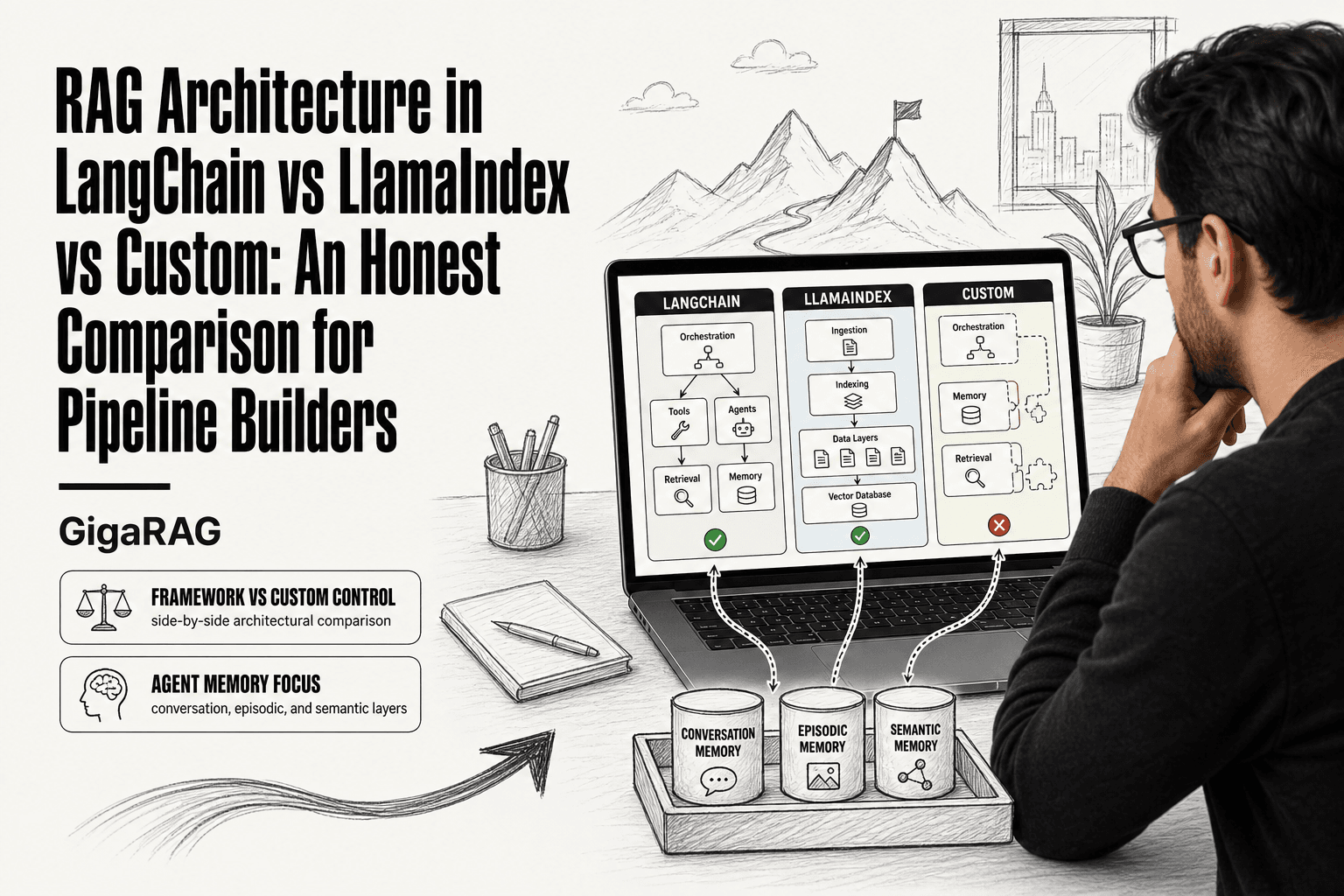
There are three distinct memory types you'll need to handle. Conversation history is the short-term buffer: what was said in this session. Episodic memory is what happened in past sessions: "last week you asked me to compare vector databases." Semantic memory is what the agent has learned about the user, the domain, or its own past decisions: "this user prefers self-hosted options."
Each type has different retention requirements, different retrieval patterns, and different failure modes. Treating them as one "memory" feature is the architectural mistake most teams make.
How LangChain, LlamaIndex, and custom handle memory
LangChain ships memory modules, but they're conversation buffers with extra steps. ConversationBufferMemory, ConversationSummaryMemory, ConversationBufferWindowMemory: these are all variations on "keep recent turns in the prompt." They work for chatbots. They don't work for agents that need to recall something from three sessions ago.
LlamaIndex's chat engines have memory, but it's shallow by design. The ChatMemoryBuffer keeps a rolling window of messages. That's it. If you need episodic or semantic memory, you're building it yourself on top of LlamaIndex's abstractions.
Custom gives you nothing and everything. You build the memory layer from scratch, which means you decide exactly what gets stored, how it's indexed, and when it's retrieved. That's the only approach that handles all three memory types well. It's also the only approach where you're fully responsible when memory fails.
Memory architecture patterns: buffer, summary, vector-backed
Three patterns dominate. The buffer pattern keeps raw conversation turns in the prompt until you hit the token limit, then drops the oldest. Simple, fast, and forgetful. The summary pattern compresses conversation history into a running summary, trading detail for retention. The vector-backed pattern stores memories as embeddings in a vector store, then retrieves relevant memories at query time.
In practice, production agents combine all three. Buffer for the current turn. Summary for the session. Vector-backed for long-term episodic and semantic memory. LangChain and LlamaIndex give you the first two. The third is where you're on your own, regardless of framework.
RAG Database Types and How They Affect Architecture Choice
Your database choice shapes your framework choice more than most people admit. LangChain and LlamaIndex both ship integrations for dozens of stores, but the integration depth varies wildly. A store with a thin wrapper means you're debugging the database driver yourself.
Vector databases vs hybrid search vs graph stores
Vector databases (Pinecone, Weaviate, Qdrant) store embeddings and run similarity search. They're fast for semantic retrieval but weak on exact keyword matches. Hybrid search engines (Elasticsearch, OpenSearch, Vespa) combine keyword and vector search in one query. Graph stores (Neo4j, Amazon Neptune) model relationships between entities, which helps when your queries span connected facts rather than isolated chunks.
Which database types each framework supports best
LlamaIndex treats the vector store as a first-class abstraction. Its index types map cleanly to Pinecone, Weaviate, and Chroma, and hybrid search works through its query engine layer. LangChain supports the same stores but treats them as one retriever among many, which means less optimization for any specific database. Custom gives you full control, but you write the integration yourself.
When your database choice forces a custom build
If you need graph traversal as part of retrieval, neither framework handles it well. LangChain has a Neo4j integration, but it's a thin wrapper around Cypher queries. LlamaIndex's graph support is experimental. When your retrieval logic depends on relationship patterns, not just similarity scores, you're building custom regardless of framework.
RAG vs Context Windows: What You Should Not Expect
RAG and context windows solve different problems. A context window holds whatever you stuff into it. RAG fetches relevant text at query time. The trade-off is simple: context windows are fast but bounded, RAG is flexible but depends on retrieval quality.
When context windows make RAG unnecessary
If your entire knowledge base fits in the context window, skip RAG. A 1M-token window holds roughly 700,000 words. That's a shelf of books. For a single document, a codebase snapshot, or a fixed prompt library, just load it all. No chunking, no embeddings, no retrieval pipeline to debug.
When RAG is still essential despite large context windows
RAG matters when data changes or grows. If your knowledge base updates daily, re-embedding beats re-prompting. If you have 10 million documents, no context window holds them. RAG also cuts token costs: fetching 5 relevant chunks costs far less than loading 500,000 tokens every call.
What RAG cannot fix: data quality, stale knowledge, poor chunking
RAG retrieves what you indexed. Garbage in, garbage out. If your source documents are wrong, retrieval returns wrong answers confidently. If your index is stale, RAG returns outdated facts. If your chunks split sentences mid-thought, retrieval precision collapses. None of this is a framework problem. It's a data problem, and no architecture fixes it.
When to Choose Each Framework: A Decision Framework
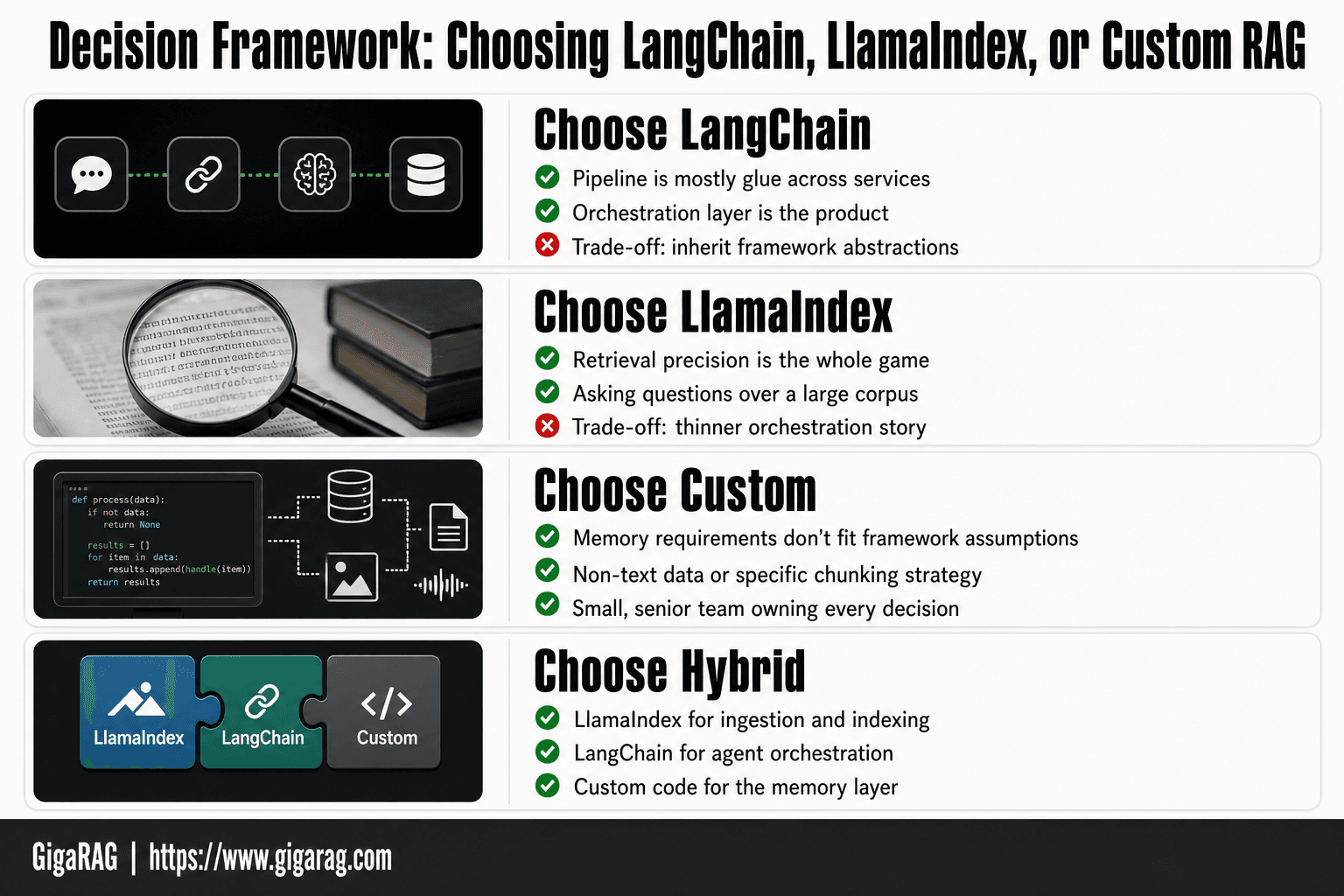
The honest answer is that no single architecture wins. It depends on three things: how much orchestration complexity you're willing to own, how precise your retrieval needs to be, and whether your memory requirements are standard or weird. Most teams pick wrong because they start with the framework and work backward. Start with your constraints instead.
Choose LangChain when...
LangChain earns its place when your pipeline is mostly glue. You're chaining five different services, switching between models mid-conversation, routing queries to different tools based on intent. The orchestration layer is the product, and retrieval is one component among many. If you're building an agent that calls APIs, queries a database, and occasionally pulls from a vector store, LangChain's chains and agents save you weeks of boilerplate.
The trade-off: you inherit LangChain's abstractions. When something breaks, you debug through layers you didn't write. For teams that value speed-to-first-result over full control, that's a fair deal.
Choose LlamaIndex when...
LlamaIndex wins when retrieval precision is the whole game. Your data is documents, lots of them, and the quality of what you pull back determines whether your answers are useful. LlamaIndex's query engines, node parsers, and built-in reranking give you retrieval tuning that would take months to build yourself.
If your use case is "ask questions over a corpus" without heavy agent routing, LlamaIndex is the shortest path. The catch: its orchestration story is thinner. Once you need complex multi-step agent behavior, you'll find yourself fighting the framework or bolting on LangChain anyway.
Choose custom when...
Custom is the right call when your memory requirements don't fit either framework's assumptions. You need a specific chunking strategy that neither library supports. Your data is non-text: images, audio, graph structures. You're building agent memory that persists across sessions in a way that's core to your product, not an add-on.
Custom also makes sense when your team is small and senior. Two engineers who know exactly what they're building will move faster with direct LLM API calls and a vector store client than by learning someone else's abstraction. The cost is real: you own every bug, every upgrade, every edge case. But you also own every decision.
The hybrid option: using multiple frameworks together
You don't have to pick one. A common pattern: LlamaIndex for ingestion and indexing, LangChain for agent orchestration, custom code for the memory layer that neither handles well. The risk is integration overhead. Each framework has its own abstractions, and translating between them adds friction.
In practice, hybrid works when the boundaries are clean. Ingestion in one place, orchestration in another, memory in a third. It falls apart when you start mixing them in the same code path. Then you're debugging two frameworks plus your own glue, and you've lost the benefit of either.
Migrating Between Frameworks: What You Should Know
Migration is rarely a rewrite. It's a salvage operation. You keep what's portable and accept that some of what you built will not survive the move.
What's portable: embeddings, vector stores, prompts
Embeddings are portable because they're just vectors. If you've already embedded a corpus, you don't re-embed it when you switch frameworks. Point the new framework at the same vector store and you're done. Prompts are portable too, mostly. A well-tested prompt is a string. Copy it over.
What's not portable: orchestration logic, memory state, custom integrations
Orchestration logic is the expensive part. LangChain chains, LlamaIndex query engines, custom agent loops: none of these translate. You rebuild them. Memory state is worse. Conversation buffers, summary caches, vector-backed memory stores all have framework-specific serialization. You'll either write a migration script or lose the history. Custom integrations die on the vine. That LangChain tool wrapper you wrote for your internal API? It's useless in LlamaIndex.
When migration is a mistake
Don't migrate because a framework released a new feature. Migrate when the current framework actively blocks what you need to build. If your pipeline works and your retrieval is good enough, the migration cost is pure waste. You'll spend weeks rebuilding orchestration logic to get a marginal improvement you could have achieved with a small custom module bolted onto what you already have.
Final Thoughts on RAG Architecture in LangChain vs LlamaIndex vs Custom
There is no single best RAG architecture. The right choice depends on what you're building, who's building it, and how much of the pipeline you're willing to own.
LangChain wins when orchestration complexity dominates. You're wiring together tools, agents, and multi-step workflows, and you want someone else to maintain the glue. LlamaIndex wins when retrieval precision is the whole game. You're indexing a corpus and you need the query engine to be the star. Custom wins when neither framework fits your memory requirements or your data doesn't look like what the frameworks assume.
The honest answer is that most teams overestimate how much framework they need. A thin custom wrapper around an LLM API and a vector store is often enough. You don't need LangChain to call a database.
That's the gap GigaRAG is built for: agent memory and RAG pipeline builders who need to move fast without locking their architecture into a framework they'll have to migrate out of later. The framework should serve the pipeline, not the other way around.
Frequently Asked Questions
Which RAG architecture is best?
There is no single best architecture; it depends on your memory requirements, team size, and data complexity. LangChain suits broad orchestration and integrations, LlamaIndex suits document-heavy retrieval, and custom RAG suits teams needing full control over memory and data flow. Start with a prototype and let constraints guide the choice.
Who are LlamaIndex's competitors?
LlamaIndex competes with frameworks like LangChain, Haystack, and custom retrieval pipelines. Each offers different trade-offs in indexing, orchestration, and memory support. The right choice depends on whether you prioritize retrieval abstractions, agent tooling, or full control.
What are the different types of RAG databases?
RAG systems typically use vector databases for semantic search, keyword or hybrid search engines for lexical matching, and relational or document stores for metadata and structured context. Some architectures combine multiple stores to balance recall, precision, and freshness.
What is the difference between RAG and context windows in large language models?
A context window is the fixed amount of text a model can process at once, while RAG retrieves relevant external information to include within that window. RAG extends effective knowledge beyond the context limit without retraining the model. The two work together: RAG fills the window with useful, up-to-date context.
Can I use LangChain and LlamaIndex together?
Yes, many teams use LlamaIndex for indexing and retrieval and LangChain for orchestration and agent logic. This hybrid approach lets you leverage each framework's strengths. It does add integration complexity, so evaluate whether the combined benefit justifies the overhead.
When should I build a custom RAG pipeline instead of using a framework?
Consider custom RAG when your agent memory requirements are non-standard, your data complexity exceeds framework abstractions, or you need fine-grained control over latency and cost. Custom builds also make sense if your team can maintain the pipeline and wants to avoid framework lock-in. Start with a framework prototype to validate assumptions before committing to custom.
How does agent memory change RAG architecture decisions?
Agent memory introduces state that persists across interactions, which affects how you store, retrieve, and expire information. Frameworks may offer memory modules, but their defaults might not match your access patterns or consistency needs. Treat memory as a first-class design concern and choose or build accordingly.
About GigaRAG
GigaRAG is for agent memory and RAG pipeline builders. get this right. Whether you are working through rag architecture in langchain vs llamaindex vs custom or something adjacent, we publish what we have actually tested, including where it falls short.