How Does RAG Architecture Work? An End-to-End Guide
RAG architecture guides have a habit of overselling. Most are vendor pitches in disguise, or surface-level explainers that fall apart the moment you try to wire one into a real agent memory system. If you're building pipelines, you've felt that gap. This guide walks the full end-to-end RAG architecture: the knowledge base, the embedding model, the vector store, the retriever, and the generator, with the actual workflow traced step by step. It also says plainly what RAG cannot do, which most guides skip. And it covers stateful patterns for agent memory, the part top results ignore entirely. GigaRAG shows up at the end as a tool built specifically for that problem, but everything before that is vendor-neutral.
| At a glance | Details |
|---|---|
| RAG stands for | Retrieval-Augmented Generation |
| Core components | Retriever, generator, knowledge base |
| Primary benefit | Grounds LLM outputs in external data |
| Key limitation | Cannot reason beyond retrieved context |
| Stateful RAG | Adds memory across interactions |
| Vendor-neutral | Works with any LLM and vector DB |
In This Guide
- What Is RAG Architecture?
- RAG vs Fine-Tuning vs Long Context: Which to Choose?
- Core Components of a RAG Architecture
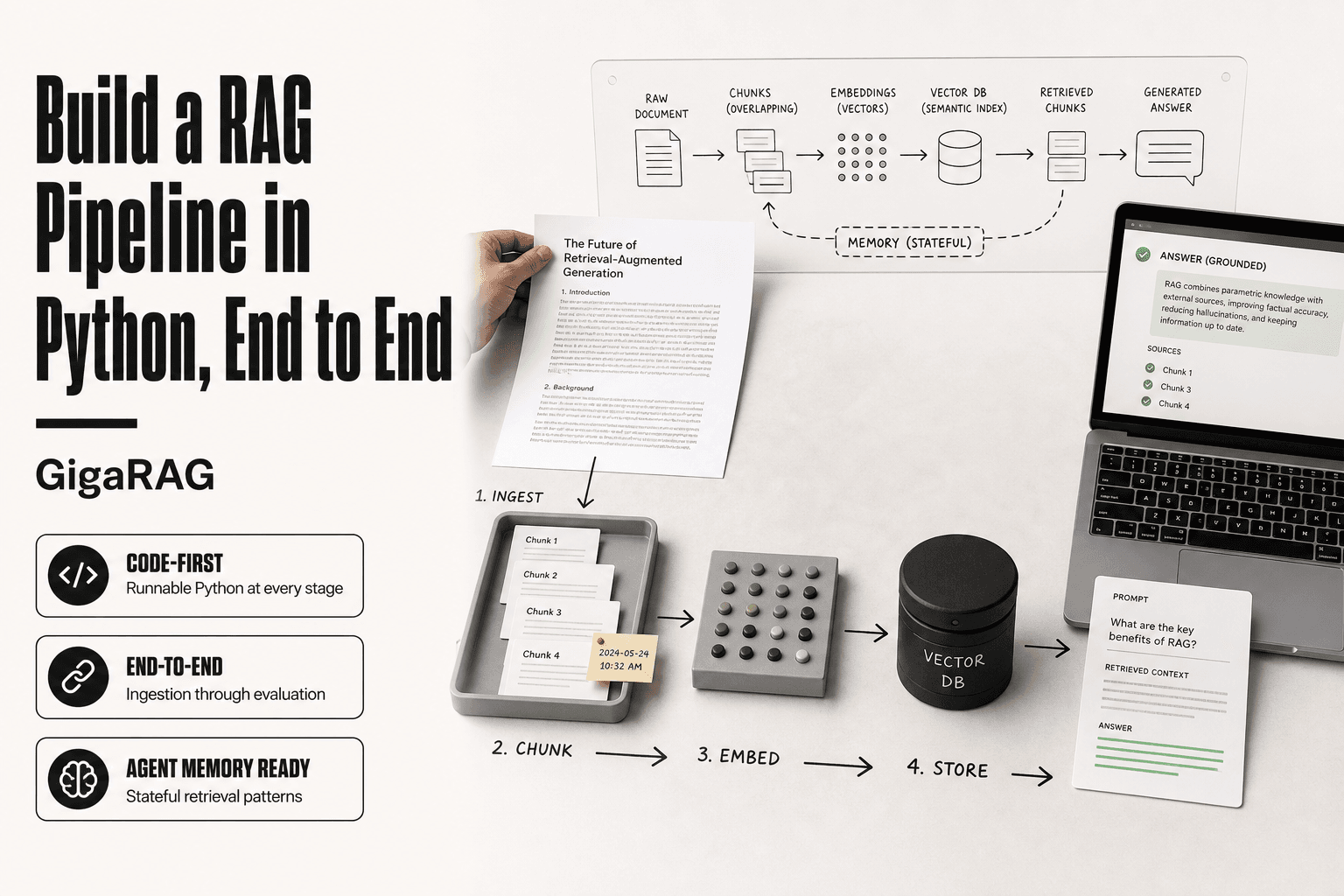
- RAG Architecture: A Step-by-Step Guide
- How Does RAG Architecture Work? Step by Step
- RAG for Agent Memory: Stateful Patterns
- What RAG Architecture Cannot Do
- RAG vs Fine-Tuning: Which Do You Need?
- Evaluating and Monitoring Your RAG Pipeline
- Common Mistakes When Building RAG Architecture
- Getting Started with RAG Architecture
What Is RAG Architecture?
RAG architecture is a system that retrieves relevant information from an external knowledge base and feeds it into an LLM's prompt before the model generates a response. The model sees your query plus the retrieved context, then answers from that material instead of relying on memory alone.
RAG vs plain LLM generation
A plain LLM answers from whatever it learned during training. That's a snapshot. It can't see documents you added last week, and it won't tell you when it doesn't know. It just produces plausible text.
RAG changes the order of operations. Before the LLM writes a word, a retriever searches your documents and pulls the passages most similar to the query. Those passages go into the prompt. The model now has source material in front of it.
Why retrieval matters for accuracy
The honest answer is that retrieval grounds the model. Without it, the LLM guesses. With it, the model can cite a specific passage you can check. That's the whole trade: you add a search step and a knowledge base, and in return you get answers tied to your data instead of the model's training distribution.
The main catch is that retrieval has to work. If the retriever pulls the wrong passage, the model confidently answers from bad context. You'll see that failure mode again.
[!note] RAG is not a single algorithm but a design pattern that combines retrieval and generation. Its effectiveness depends heavily on chunking strategy, embedding quality, and retrieval relevance.
RAG vs Fine-Tuning vs Long Context: Which to Choose?
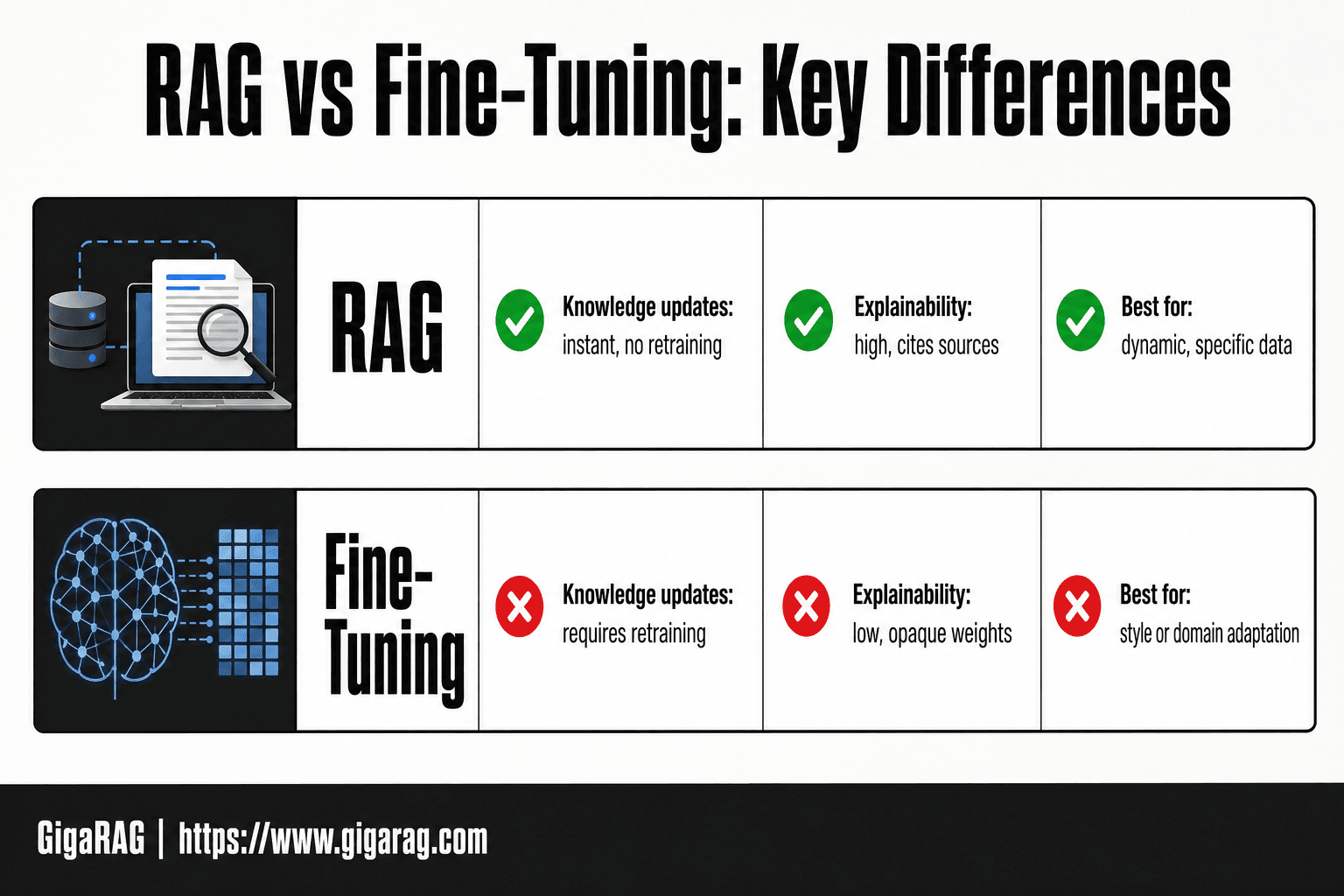
| Factor | RAG | Fine-Tuning |
|---|---|---|
| Knowledge updates | Instant, no retraining | Requires retraining |
| Data freshness | Always current | Static after training |
| Cost | Lower, per-query retrieval | High, training compute |
| Explainability | High, cites sources | Low, opaque weights |
| Best for | Dynamic, specific data | Style or domain adaptation |
Core Components of a RAG Architecture
Four pieces do the work: a knowledge base, an embedding model, a retriever, and a generator. Each one fails in its own way, and each failure shows up downstream as a wrong answer.
Knowledge base and data sources
The knowledge base is your source of truth. It can be PDFs, HTML pages, a wiki, a database dump, or an API feed. What matters is that the data is current and clean enough to search. Garbage in means the retriever pulls garbage out.
Before anything gets indexed, you need to decide what counts as a document. A page? A paragraph? A code file? That decision drives chunking later, and it's where most pipelines go wrong. Keep the raw source around. You'll want it for citations and debugging.
Embedding model and vector store
The embedding model converts text into a vector, a list of numbers that captures meaning. Similar text lands close together in vector space. That's the whole trick behind semantic search.
The vector store holds those vectors and runs similarity queries against them. When a query comes in, the store returns the nearest neighbours. It doesn't understand your data. It just measures distance. The embedding model does the understanding, and its quality caps what the retriever can find.
Retriever and hybrid search
The retriever takes a query, embeds it, and asks the vector store for the closest chunks. That's dense retrieval. It's good at meaning, weak at exact terms like product codes or error strings.
Hybrid search adds a keyword pass. You run both, merge the results, and score them together. It costs a bit more latency but catches the cases each method misses alone. Re-ranking then sorts the merged list so the best chunks sit at the top of the prompt.
Generator and LLM orchestration
The generator is the LLM that writes the final answer. It receives the query plus retrieved chunks, with instructions to answer only from that context.
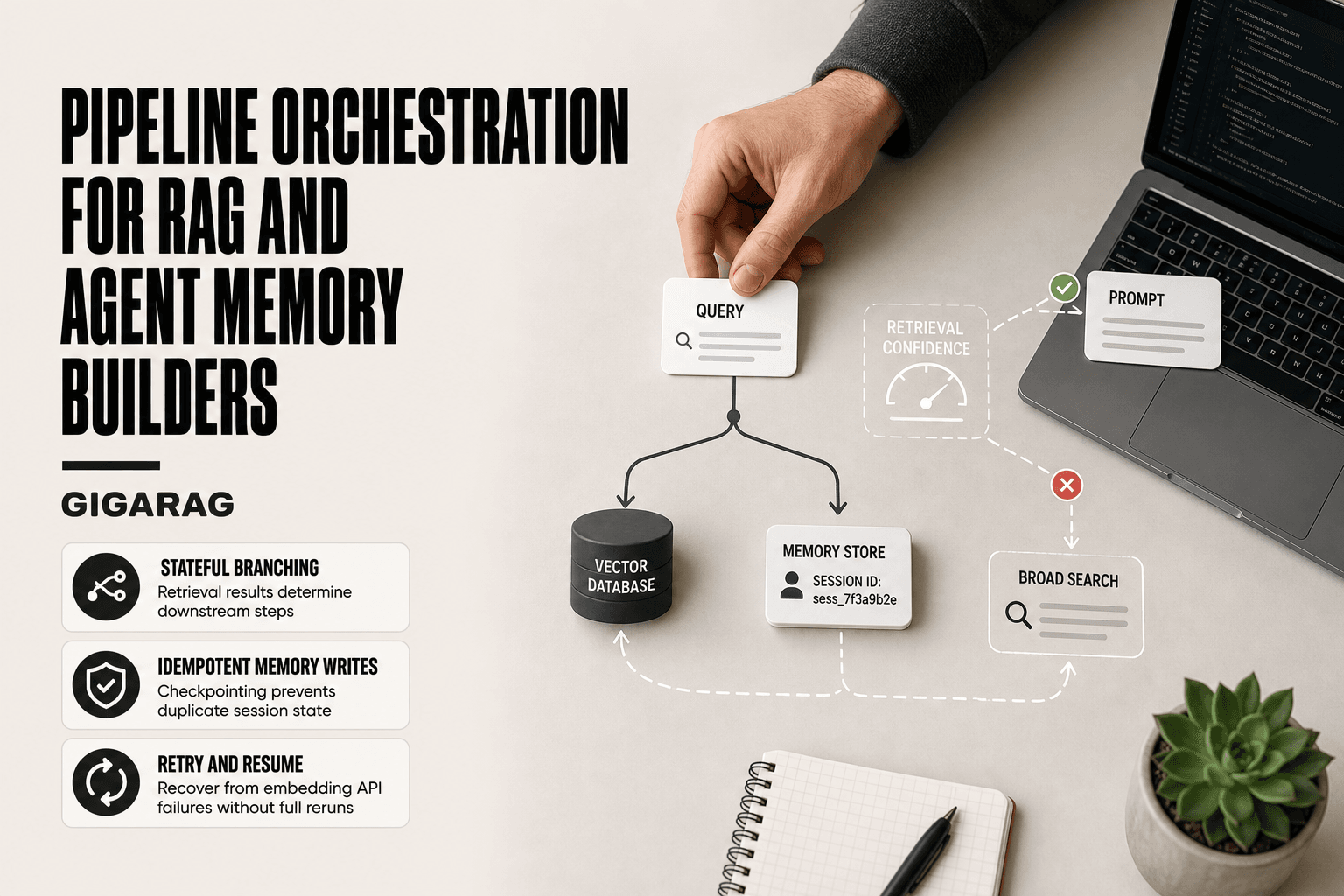
Orchestration is the glue: the code that runs retrieval, builds the prompt, calls the model, and handles the response. It also decides what happens when retrieval returns nothing. A good pipeline catches that case and says "I don't know" instead of letting the model improvise.
[!tip] For agent memory, implement a stateful RAG layer that stores conversation history and retrieved context in a short-term buffer, then summarize and persist key facts to a long-term store. This prevents context overflow and improves multi-turn coherence.
RAG Architecture: A Step-by-Step Guide
- Chunk your documents into manageable pieces (e.g., 500 words).
- Generate embeddings for each chunk using a model like text-embedding-3-small.
- Store embeddings in a vector database (e.g., Pinecone, Weaviate).
- At query time, embed the user's question.
- Retrieve top-k similar chunks using cosine similarity.
- Construct a prompt with the retrieved chunks and the original question.
- Send the prompt to an LLM to generate a grounded answer.
How Does RAG Architecture Work? Step by Step
The workflow runs in five stages. Each one feeds the next, and a mistake early on compounds through the rest of the pipeline.
Step 1: Ingestion and chunking
Ingestion pulls your source documents into the pipeline. That means reading PDFs, scraping pages, or querying a database and normalizing everything to plain text. The output is a set of documents ready for splitting.
Chunking breaks each document into smaller pieces. The chunk size matters more than most people expect. Too large, and the retriever returns a wall of text that buries the answer. Too small, and the chunk loses the context that makes it meaningful. A common starting point is 200 to 500 tokens per chunk with some overlap between neighbours, but the right size depends on your data. Code files chunk differently from legal contracts.
Step 2: Embedding and indexing
Each chunk goes through the embedding model and becomes a vector. The vector store indexes those vectors so similarity search runs fast. This is a batch job: you embed everything once, then re-embed only what changes.
The index is a snapshot. If your knowledge base updates daily, you need a re-indexing schedule. Stale indexes produce answers that cite old facts with full confidence.
Step 3: Retrieval and re-ranking
When a query arrives, the retriever embeds it and asks the vector store for the nearest chunks. You decide how many to pull. Ten is a reasonable default, but the number depends on your chunk size and context window budget.
Re-ranking then reorders those candidates. A cross-encoder or a smaller scoring model reads each chunk against the query and assigns a relevance score. The top three to five chunks survive. This step costs latency but sharply improves what lands in the prompt.
Step 4: Augmentation and prompt construction
Augmentation means stuffing the retrieved chunks into the prompt alongside the user's query. The prompt tells the model to answer only from the provided context and to say when it can't.
Prompt construction is where grounding happens or doesn't. You need clear instructions, the chunks in a stable order, and a fallback for empty retrieval. If the retriever returns nothing, the prompt should tell the model to admit it rather than guess.
Step 5: Generation and grounding
The LLM generates the answer from the augmented prompt. Grounding means the answer traces back to the chunks you supplied. Citations help: ask the model to reference which chunk each claim came from.
The honest catch is that grounding is only as good as retrieval. If the right chunk never made it into the prompt, the model can't cite it. The generator will still produce a fluent answer. It just won't be a correct one.
RAG for Agent Memory: Stateful Patterns
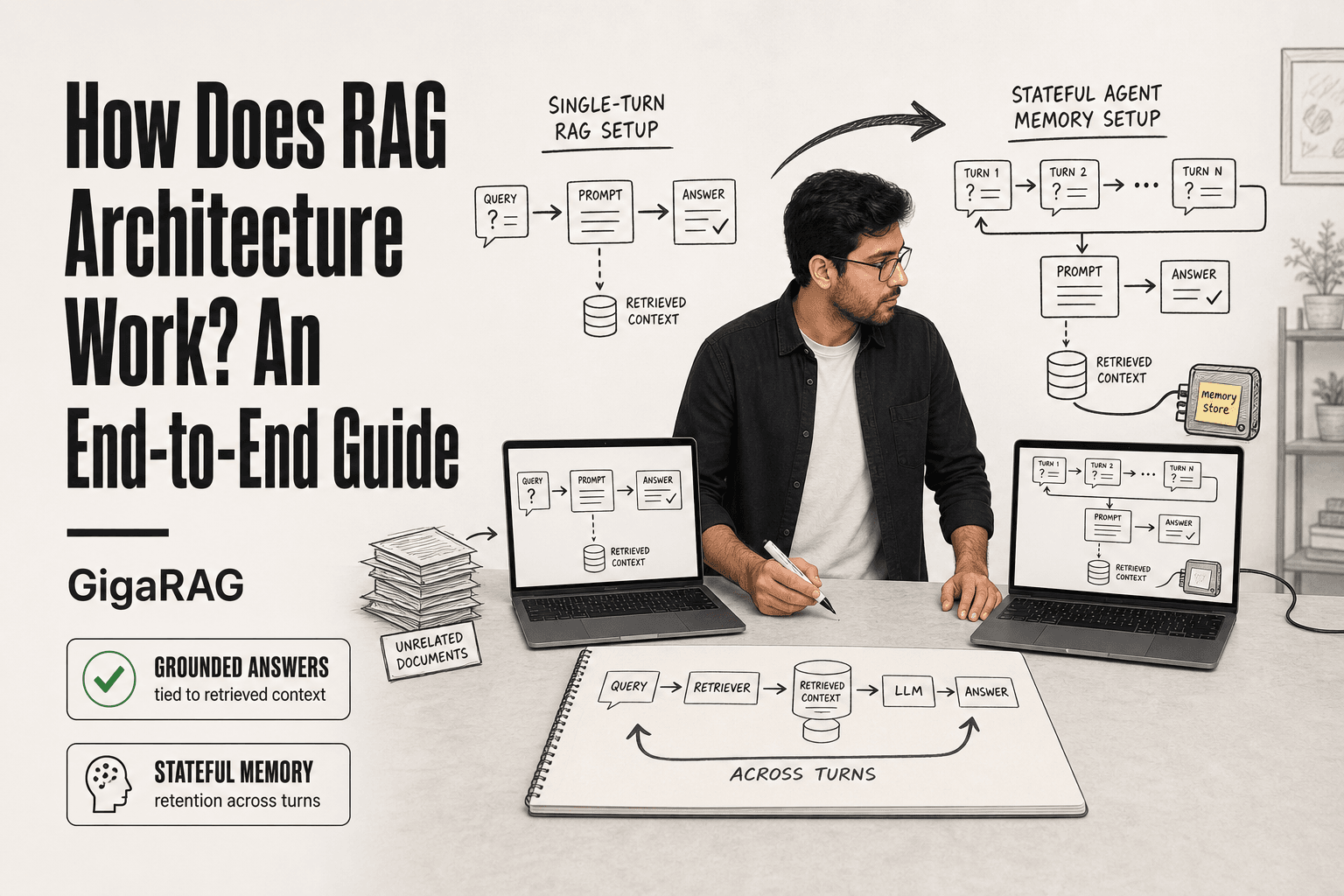
Most RAG guides stop at the single-turn case: one query in, one answer out. Agents don't work that way. An agent runs many turns against the same context, and what it retrieved three turns ago still matters. That's the gap between stateless and stateful RAG.
Stateless vs stateful RAG
Stateless RAG treats every query as a fresh start. The retriever runs, the generator answers, and the pipeline forgets everything. Fine for a search box. Wrong for an agent that needs to remember a user's constraints across a conversation.
Stateful RAG keeps a working memory. Each turn's retrieved chunks, generated answers, and user corrections get stored and made available to later turns. The retriever can then search both the external knowledge base and the conversation's own history.
Context persistence across turns
The simplest persistence pattern is appending prior turns to the prompt. That works until the context window fills. A better approach stores a compressed summary of each exchange and retrieves from that summary when relevant.
In practice, you'll hit a decision point around turn ten or fifteen. Do you summarize aggressively and lose detail, or keep full turns and burn tokens? The honest answer is it depends on how long your agent sessions run and how much the user's intent shifts mid-conversation.
Memory stores for agents
A dedicated memory store holds three things: facts the user stated, decisions the agent made, and retrieved chunks that proved useful. Each entry gets embedded and indexed just like your knowledge base.
The main catch is staleness. A user says "I prefer Python" on turn two, then asks for a JavaScript example on turn eight. Your memory store needs a way to update or deprecate old entries, or the agent will keep retrieving the wrong preference.
What RAG Architecture Cannot Do
RAG improves grounding. It does not guarantee it. The retriever can return the wrong chunks, the generator can ignore them, and the pipeline will still produce an answer that sounds confident. That's the failure mode you need to design around.
Retrieval misses and silent failures
A retrieval miss happens when the right chunk exists in your knowledge base but the embedding similarity search doesn't surface it. The query and the document use different words for the same concept, or the chunk boundary splits the answer across two pieces. The generator then answers from whatever it did retrieve, or from its own weights. You get a plausible answer with no grounding at all.
The worst part: nothing errors. The pipeline returns 200 OK and a wrong answer. You only catch it with evaluation or a user complaint.
Context window constraints
You can't retrieve everything. The context window has a hard token limit, and stuffing more chunks means cutting prompt instructions, conversation history, or generation budget. Long documents get truncated. Multi-hop questions that need evidence from five different sections often can't fit all five.
The honest answer is that RAG trades recall for relevance. You retrieve the top-k chunks and hope the answer is in there. Sometimes it isn't.
When RAG is the wrong tool
RAG won't teach the model new reasoning patterns. If your task needs a different style of thinking, not more facts, fine-tuning is the better lever. RAG also won't fix a bad knowledge base. Garbage chunks produce garbage answers, just with citations attached.
Don't reach for RAG when you need deterministic logic, real-time transactional data, or a system that must never hallucinate. A database query or a rules engine does those jobs better.
RAG vs Fine-Tuning: Which Do You Need?
Both change how a model behaves. They change different things. RAG changes what the model sees at inference time. Fine-tuning changes the model's weights before it ever sees a query.
When RAG wins
RAG wins when your knowledge changes often. Product docs, support tickets, internal wikis, news. You update the vector store and the next query sees the new data. No retraining.
RAG also wins on cost. Indexing a thousand documents costs a few dollars in embedding calls. Fine-tuning a 7B model costs hundreds in compute and hours of your time. If you need source citations, RAG gives them for free. Fine-tuning doesn't.
When fine-tuning wins
Fine-tuning wins when the task isn't about facts. You want a specific tone, a format, a reasoning style. You want the model to follow your schema without a five-paragraph prompt. You want it to stop saying "As an AI language model."
It also wins when your domain has vocabulary the base model mangles. Medical codes, legal citations, internal acronyms. RAG can retrieve the definitions, but the model still stumbles over the words themselves.
Hybrid approaches
You can do both. Fine-tune for style and format, then use RAG for the facts. The fine-tuned model follows your output schema. The retriever keeps it grounded in current data.
The catch: you now maintain two systems. Fine-tuning runs go stale. Vector stores drift. If you can't commit to both, pick the one that solves your bigger problem.
Evaluating and Monitoring Your RAG Pipeline
You can't improve what you don't measure. A RAG pipeline fails quietly: the retriever returns the wrong chunk, the generator hallucinates around it, and the answer looks confident but is wrong. Evaluation catches that before your users do.
Retrieval metrics
The retriever is the first thing to measure. Hit rate tells you whether the correct chunk appeared anywhere in the top-k results. Mean reciprocal rank (MRR) tells you how high it ranked. Recall@k tells you whether the relevant chunk made the cut at all.
Build a test set of 50 to 200 real queries with known-good chunks. Run them through the retriever. If hit rate is below 80%, fix retrieval before touching the generator. No amount of prompt engineering saves a retriever that can't find the right chunk.
Generation faithfulness
Faithfulness measures whether the answer is grounded in the retrieved context. You check this two ways: manually, by reading answers against their sources, or automatically, with an LLM judge that compares the answer to the retrieved chunks and flags unsupported claims.
The honest answer is you need both. LLM judges are fast but miss subtle fabrications. Manual review catches those but doesn't scale. Start with a judge on every query, then spot-check 10% by hand.
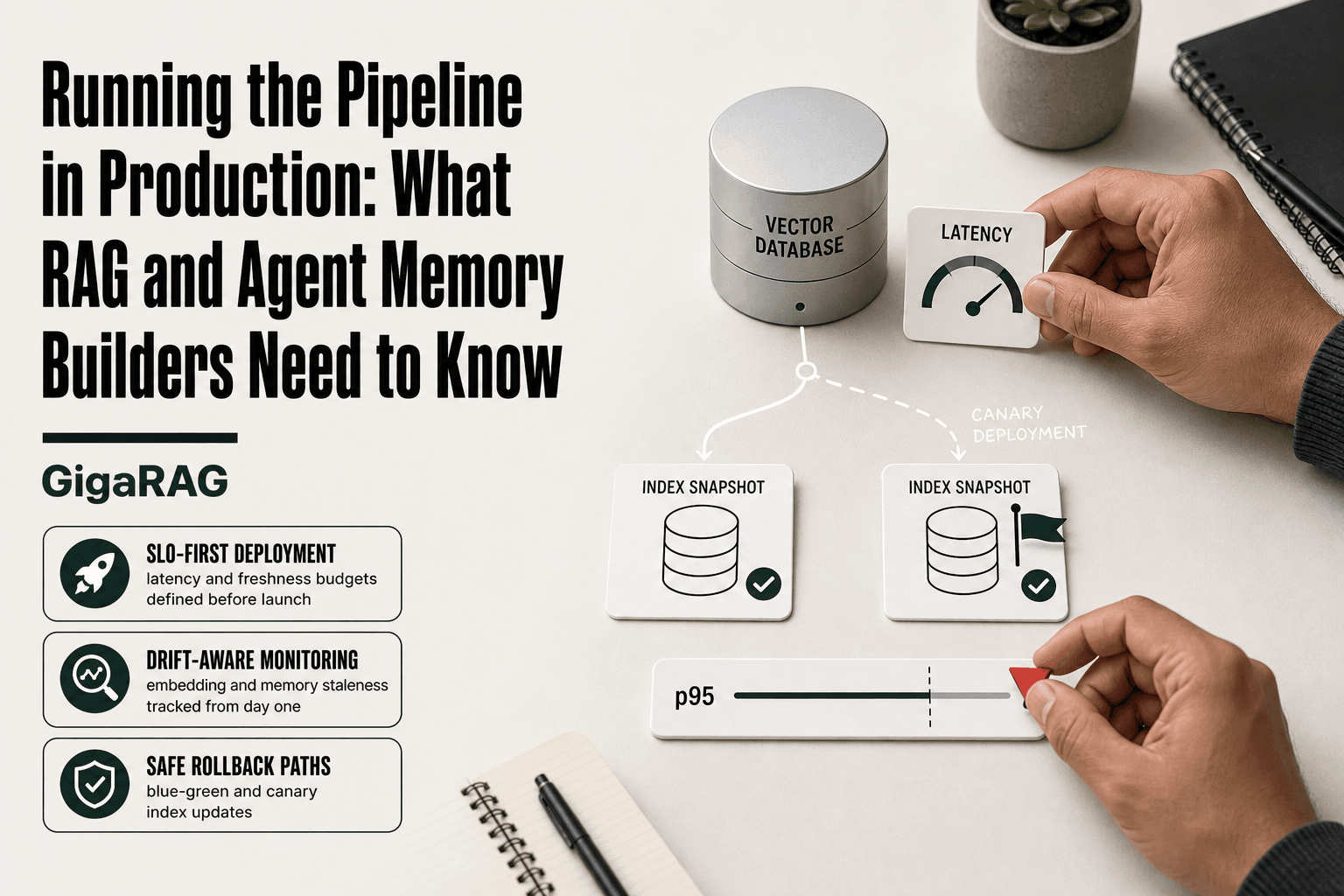
Monitoring in production
Latency is your first production metric. Retrieval adds 50 to 300 milliseconds. Generation adds more. Track p50 and p95 separately so you know which stage is slow.
Log every query, the retrieved chunks, and the final answer. When a user reports a bad answer, you can replay the exact retrieval. Watch for drift: embedding model changes, document updates, and query pattern shifts all degrade retrieval silently over time. Re-run your test set weekly.
Common Mistakes When Building RAG Architecture
Most RAG failures aren't architecture problems. They're implementation shortcuts that look fine in a demo and break in production.
Bad chunking strategies
Chunk size is the first thing people get wrong. Too small and you lose context: a 100-token chunk can't hold a full definition. Too large and you dilute the embedding: a 2,000-token chunk averages away the signal you're searching for.
Start with 300 to 500 tokens per chunk. Overlap by 10 to 15% so sentences don't get cut at boundaries. Then test against your actual queries. Chunking is empirical, not theoretical.
Ignoring retrieval latency
Retrieval adds 50 to 300 milliseconds per query. That's fine for a chatbot, but it compounds in agent loops where one turn triggers three retrievals.
Measure p95, not average. Averages hide the slow tail. If p95 exceeds 500 milliseconds, check your vector store's index type and whether you're re-embedding queries you've already seen. Cache frequent queries.
Skipping re-ranking
Retrieval gets you candidates. Re-ranking gets you the right one. A bi-encoder finds roughly relevant chunks fast. A cross-encoder scores each candidate against the query precisely, but costs more compute.
The fix is two-stage: retrieve 50 candidates with embeddings, re-rank the top 10 with a cross-encoder. That's the difference between an answer grounded in the right paragraph and one grounded in a paragraph that merely mentions the right words.
Getting Started with RAG Architecture
You don't need a full platform to start. You need four pieces: a vector store, an embedding model, a retriever, and an LLM. Everything else is optimization.
Choosing your stack
Start small. Use pgvector if you're already on Postgres, or Qdrant if you want a dedicated vector store. Pick an embedding model that matches your content: text-embedding-3-small works for most English text. Wire retrieval with a simple cosine similarity search before adding hybrid search or re-ranking.
Don't build the whole thing at once. Get one query returning grounded answers end-to-end, then measure where it breaks.
Where GigaRAG fits
If you're building agent memory, not just a single-shot RAG pipeline, GigaRAG is built for that: stateful retrieval, context persistence across turns, and memory stores that survive a session. It's not a general-purpose vector database. It's for pipelines where the agent needs to remember.
The honest answer: if you're doing one-off document Q&A, any stack works. If you're building agents that retrieve across turns, that's where RAG architecture gets hard, and where GigaRAG earns its place.
Frequently Asked Questions
Is ChatGPT a RAG model?
No, ChatGPT is not a RAG model by default. It is a generative LLM trained on a fixed dataset. However, OpenAI has integrated retrieval capabilities into some versions (like ChatGPT with browsing), which effectively uses RAG-like techniques to access external information.
What is RAG vs LLM?
An LLM is a language model that generates text based on its training data. RAG is an architecture that augments an LLM with a retrieval system, allowing it to pull in external knowledge at inference time. In short, RAG is a method to enhance LLM outputs with up-to-date or domain-specific information.
What is RAG vs MCP?
RAG (Retrieval-Augmented Generation) is a pattern for grounding LLM responses with retrieved data. MCP (Model Context Protocol) is a standard for connecting AI models to external tools and data sources. While RAG focuses on retrieval from a knowledge base, MCP is broader, enabling tool use and data access across various systems.
How to explain RAG in an interview?
Explain RAG as a two-stage process: first, retrieve relevant documents from a knowledge base based on the query; second, feed those documents to an LLM as context to generate an answer. Emphasize that RAG reduces hallucinations and allows dynamic knowledge updates without retraining.
What are the main components of RAG architecture?
The main components are: a document loader to ingest data, a chunking module to split text, an embedding model to vectorize chunks, a vector database for storage, a retriever to fetch relevant chunks, and a generator (LLM) to produce the final answer. Each component can be swapped independently.
What are common failure modes in RAG systems?
Common failures include retrieving irrelevant chunks due to poor embeddings, missing context because of bad chunking, and the LLM ignoring retrieved information. Also, stale data in the vector DB can lead to outdated answers. Mitigations include fine-tuning retrievers, hybrid search, and adding re-ranking.
How does stateful RAG differ from standard RAG?
Standard RAG treats each query independently. Stateful RAG maintains memory across interactions, storing conversation history and past retrieved contexts. This enables multi-turn coherence and personalized responses, which is crucial for agent memory systems.
About GigaRAG
GigaRAG helps GigaRAG is for agent memory and RAG pipeline builders. get this right. Whether you are working through How Does RAG Architecture Work? An End-to-End Guide or something adjacent, we publish what we have actually tested, including where it falls short.