RAG Architecture in LangChain vs LlamaIndex vs Custom: The Honest 2026 Guide for Agent Memory Builders
You've read the LangChain vs LlamaIndex comparisons. You've seen the benchmarks, the star counts, the "which should you choose" posts that end with "it depends" and then refuse to say what it depends on. For agent memory builders, the honest answer is missing: what each approach cannot do, and when you should skip both and build your own. This guide treats custom RAG architecture as a first-class option, not an afterthought. I compared all three against the requirements that actually break in production: persistence across sessions, latency budgets, multi-agent coordination. The good news is the decision gets clearer once you stop asking which framework is best and start asking which architecture your agent memory can live with. GigaRAG's documentation and our own pipeline work shaped the lens here, but the analysis stands on its own.
| At a glance | Details |
|---|---|
| Core difference | LangChain = chains, LlamaIndex = indexing, custom = full control |
| Best for agents | LangChain/LangGraph for orchestration, custom for memory |
| Best for retrieval | LlamaIndex for data-heavy, multi-source pipelines |
| Custom trade-off | Maximum control, higher engineering and maintenance cost |
| Hybrid approach | Framework for orchestration, custom for memory layer |
| Decision driver | Agent memory requirements and team capacity, not hype |
In This Guide
- What Is LangChain?
- LangChain vs LlamaIndex vs Custom RAG Architecture: Which Fits Agent Memory?
- What Is LlamaIndex?
- Rag Architecture In Langchain Vs Llamaindex Vs Custom: A Step-by-Step Guide
- What Custom RAG Architecture Actually Means
- RAG Architecture in LangChain vs LlamaIndex vs Custom: Key Differences
- Agent Memory Requirements Most Comparisons Ignore
- Honest Limitations: What Each Approach Cannot Do
- Hybrid Approaches: Framework Plus Custom Components
- RAG vs Context Windows: What You Should Not Expect
- A Decision Framework: How to Choose Your RAG Architecture
- LlamaIndex Alternatives Beyond LangChain
- Final Thoughts
What Is LangChain?
LangChain is an open-source Python and JavaScript framework for building applications on top of large language models. It doesn't train models. It gives you a standard way to connect an LLM to tools, documents, and memory so you can build pipelines without writing every integration from scratch.
The core idea is composability. You assemble components: a prompt template, a model, a retriever, a memory store, an output parser. Then you chain them into an execution path. That path can be deterministic (a chain) or dynamic (an agent that decides which tool to call next).
Core abstractions: chains, agents, and memory
Chains are fixed sequences. Input flows through each step in order, and you know exactly what happens at every stage. Agents are different. An agent gets a set of tools and decides at runtime which one to use, in what order, based on the model's reasoning. Memory is the persistence layer: it stores conversation history or retrieved context so the model can reference it across turns.
How LangChain handles retrieval and RAG
LangChain treats retrieval as one component in a larger pipeline. You bring your own vector database, your own embedding model, and your own chunking logic. LangChain wires them together: a retriever fetches relevant documents, a prompt template injects them into the context, and the model generates an answer grounded in that context. The framework doesn't optimize retrieval for you. It standardizes the plumbing.
LangChain's role in agent memory systems
For agent memory, LangChain gives you conversation buffers, entity stores, and vector-backed memory classes you can plug into an agent. The catch is that these are building blocks, not a complete memory architecture. You still decide what to persist, when to retrieve it, and how to bound the context window. LangChain makes the wiring easier. It doesn't make the design decisions for you.
[!note] LangChain and LlamaIndex are not mutually exclusive; many production systems use LlamaIndex for retrieval and LangChain (or LangGraph) for agent orchestration. Custom architecture is a valid third option when frameworks impose unwanted constraints on memory design.
LangChain vs LlamaIndex vs Custom RAG Architecture: Which Fits Agent Memory?
| Factor | LangChain | LlamaIndex |
|---|---|---|
| Primary strength | Agent orchestration and tool use | Data indexing and retrieval pipelines |
| Agent memory support | Via LangGraph and memory modules | Limited native memory; retrieval-focused |
| Customization ceiling | High, but constrained by abstractions | High for retrieval, less for agent loops |
| Learning curve | Moderate to steep (many abstractions) | Moderate (retrieval-centric concepts) |
| Best fit for agent memory | Orchestration + memory via LangGraph | Retrieval layer, not full memory system |
What Is LlamaIndex?
LlamaIndex is an open-source Python and TypeScript framework built specifically for connecting LLMs to your own data. Where LangChain starts from the model and works outward, LlamaIndex starts from the data and works inward. That difference shapes everything else.
The core problem LlamaIndex solves is indexing. You have documents, PDFs, databases, APIs. You want the model to answer questions grounded in that data. LlamaIndex gives you a structured way to load, chunk, embed, and index that data so retrieval is fast and relevant. It doesn't train or fine-tune models. It builds the retrieval layer.
Core abstractions: indexes, query engines, and data connectors
Data connectors load data from wherever it lives: files, Notion, Slack, SQL databases, APIs. Indexes organize that data for retrieval. The most common is the vector store index, but LlamaIndex also supports keyword, knowledge graph, and tree indexes. Query engines sit on top of an index and answer questions by retrieving relevant chunks and passing them to the LLM with a prompt.
How LlamaIndex handles retrieval and RAG
LlamaIndex treats retrieval as the product, not a feature. It gives you built-in chunking strategies, embedding integrations, and retrieval modes: semantic search, keyword search, hybrid. You can swap embedding models or vector stores without rewriting your pipeline. The framework also handles node postprocessors, which rerank or filter retrieved chunks before they reach the model. That's the part most RAG builders end up writing by hand.
Is LlamaIndex open source? (PAA answer)
Yes. LlamaIndex is open source under the MIT license. You can use it commercially, modify it, and self-host it without paying a license fee. The company behind it, LlamaIndex Inc., also sells a managed cloud platform, but the core framework is free and community-maintained.
[!tip] For agent memory builders: start with a framework to validate your use case, but design your memory layer as a separate service from day one. This makes it easier to swap frameworks or go custom later without rewriting your entire pipeline.
Rag Architecture In Langchain Vs Llamaindex Vs Custom: A Step-by-Step Guide
- Define your agent memory requirements: short-term (session), long-term (persistent), and retrieval needs.
- Evaluate LangChain if you need complex agent orchestration and tool use with memory via LangGraph.
- Evaluate LlamaIndex if your primary challenge is indexing and retrieving from diverse data sources.
- Assess custom architecture if you need full control over memory schemas, latency, or cost at scale.
- Prototype a hybrid: use a framework for orchestration and a custom layer for memory storage and retrieval.
- Benchmark against your specific agent memory workloads, not generic RAG benchmarks.
- Decide based on team capacity, maintenance burden, and long-term flexibility.
What Custom RAG Architecture Actually Means
Custom RAG means you own every layer. No framework between your code and the model. You write the retrieval, the embedding, the chunking, the memory. You decide what happens when a query fails.
That's the whole definition. Everything else is implementation detail.
The components you must build yourself
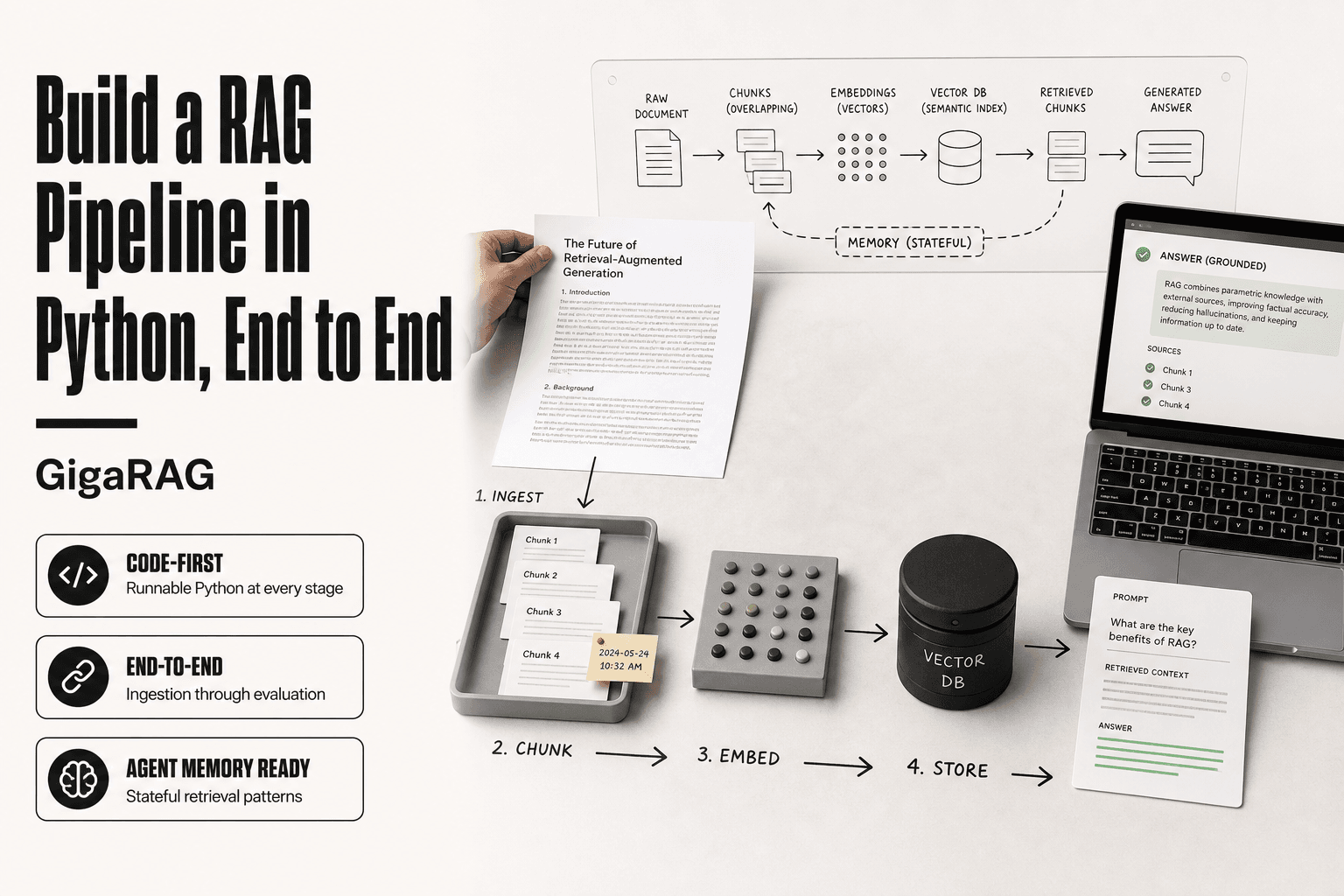
You own five pieces. The loader pulls documents from your sources. The chunker splits them into retrievable units. The embedder turns chunks into vectors. The retriever finds relevant chunks for a query. The memory layer stores what the agent has learned across sessions.
None of these are hard individually. A basic vector search is maybe 50 lines of Python. The difficulty is that you own all of them together, and they interact. Change your chunk size and your retrieval quality shifts. Swap embedding models and your memory store needs re-indexing.
What custom gives you that frameworks cannot
Control without abstraction tax. When a query returns garbage, you can trace every step: the chunk, the score, the prompt. No framework internals to debug through.
You also get latency control. Frameworks add overhead at each layer. Custom lets you skip the layers you don't need. For agent memory, where retrieval happens mid-conversation, that matters.
What custom costs you that frameworks hide
Maintenance is yours forever. Embedding models change. Vector databases deprecate APIs. Your chunking logic breaks on a new document format. Frameworks absorb some of that churn. Custom doesn't.
You also reinvent what frameworks already solved. Document loaders for 40 file types. Reranking strategies. Hybrid search. You'll build the 20% you need, then spend months discovering the other 80% exists.
RAG Architecture in LangChain vs LlamaIndex vs Custom: Key Differences
The best RAG architecture depends on your latency budget, team size, and how much control you need over retrieval and memory. LangChain wins on ecosystem breadth, LlamaIndex on data indexing, and custom on control and performance.
Execution model: chains vs agents vs your own code
LangChain runs on chains and agents. A chain is a fixed sequence of calls. An agent decides which tool to call next. Both wrap the LLM in abstractions you don't control.
LlamaIndex runs on query engines. You build an index, then query it. The engine handles retrieval and synthesis. Less flexibility than LangChain's agent model, but more predictable.
Custom runs on your code. You call the model directly. You decide the control flow. No framework decides anything for you.
Data handling and preprocessing
LlamaIndex is strongest here. It has loaders for hundreds of document types and built-in chunking strategies. LangChain has loaders too, but they're less central to the design. Custom means you write every loader and every chunking rule yourself.
Memory systems and context retention
LangChain has memory classes, but they're shallow. Most production teams replace them. LlamaIndex has chat memory, but it's tied to its query engine model. Custom gives you full control over what persists, where it lives, and how it's retrieved. For agent memory, that control is the point.
Abstraction level and control
LangChain is the most abstract. You trade control for speed of development. LlamaIndex is abstract around data, but less abstract around execution. Custom is zero abstraction. You see everything. You debug everything. You also maintain everything.
Production readiness and operational overhead
LangChain and LlamaIndex both ship with production features: logging, tracing, evaluation tools. Custom has none of that unless you build it. But frameworks also bring version churn. LangChain's API changes frequently. LlamaIndex's is more stable. Custom has no churn, but every production concern is yours.
The honest answer: frameworks get you to production faster. Custom keeps you there with less surprise.
Agent Memory Requirements Most Comparisons Ignore
Most RAG comparisons assume a single query, a single response, and no memory of what came before. Agent memory builders don't get that luxury. You need state that survives across sessions, context that follows a multi-step workflow, and retrieval fast enough that the agent doesn't stall mid-task. Here's what each architecture gives you.
Persistence and session continuity
LangChain's memory classes reset when the process restarts unless you wire them to a database yourself. LlamaIndex has similar limits: its chat memory lives in memory by default. Custom means you own the persistence layer from day one. You choose the store, the schema, and the eviction policy. That's more work, but it's the only option where session continuity is a design decision rather than an afterthought.
Context management across agent steps
An agent running ten steps needs to know what it did at step three without re-reading everything. Frameworks handle this with summarization or windowing, but the logic is generic. Custom lets you decide exactly what gets carried forward: tool outputs, intermediate reasoning, retrieved chunks, or none of it. That granularity matters when token budgets are tight and every step costs money.
Multi-agent coordination and shared memory
If two agents need to share state, frameworks offer little beyond message passing. LangChain's newer agent protocols help, but shared memory is still mostly your problem. Custom architectures can implement a shared memory store with read/write controls per agent. That's the pattern production multi-agent systems actually use.
Latency budgets for agent memory retrieval
An agent waiting on memory retrieval is an agent burning tokens and user patience. Frameworks add overhead: serialization, abstraction layers, framework-level logging. Custom retrieval can hit sub-50ms with a tuned vector store and direct calls. The tradeoff is you're responsible for every millisecond of that budget.
Honest Limitations: What Each Approach Cannot Do
Every framework comparison tells you what each tool does well. None tell you what you cannot do or should not expect. Here's the honest version.
LangChain: abstraction overhead and debugging pain
LangChain's abstraction layer is its biggest liability in production. When a chain fails, you're debugging through five layers of framework code before you reach your own. Stack traces point to langchain_core internals, not your retrieval logic. That's fine for prototypes. It's brutal at 2 a.m. during an incident.
You also cannot expect LangChain to stay stable. The API has shifted repeatedly across versions, and upgrading often means rewriting chains that worked yesterday. If you need deterministic, version-locked behavior, LangChain fights you.
LlamaIndex: rigidity beyond its data-centric sweet spot
LlamaIndex is excellent at indexing documents and querying them. Push it past that and it gets awkward. Custom agent memory patterns, unusual retrieval strategies, multi-agent shared state: these require fighting the framework's assumptions about how data flows.
You also cannot expect LlamaIndex to give you fine-grained control over latency. Its query engine pipeline adds overhead you can't easily strip out. For sub-50ms retrieval budgets, you'll end up bypassing the framework anyway.
Custom: maintenance burden and reinvention risk
Custom gives you control. It also gives you every bug, every security patch, every dependency update. You own the chunking logic, the embedding pipeline, the vector store integration, the memory layer. When the embedding model changes its API, you fix it. When the vector store has a CVE, you patch it.
You also risk reinventing what frameworks already solved. Retry logic, rate limiting, prompt templating: you'll rebuild these badly at least once before you get them right.
Common anti-patterns in all three approaches
The worst anti-pattern is treating any architecture as permanent. Teams pick LangChain, build everything on it, then discover the abstraction overhead is killing latency. Teams go custom, then burn six months rebuilding what a framework would have given them for free.
The second anti-pattern: ignoring evaluation. You cannot know if your RAG architecture works without measuring retrieval quality, latency, and memory accuracy. Frameworks don't do this for you. Custom doesn't either. You build the eval harness regardless of which path you choose.
Hybrid Approaches: Framework Plus Custom Components
Most production teams don't pick one path. They pick a boundary. Framework for the boring parts, custom for the parts that break.
When to use LangChain for orchestration only
LangChain earns its keep when you need chains, agents, and tool-calling wired together fast. Use it for the control flow: deciding which retriever to call, which prompt to build, which tool to invoke next. Don't use it for retrieval itself. Its retriever abstractions add latency and hide what's actually happening. Let LangChain orchestrate, then hand off to your own retrieval code.
When to use LlamaIndex for indexing only
LlamaIndex is genuinely good at ingestion. Document loaders, chunking strategies, embedding pipelines, index construction: that's the sweet spot. Use it to build and maintain your vector index. Then query it with your own code. The query engine layer is where LlamaIndex gets rigid, so skip it.
Where custom components earn their keep
Custom earns its keep in three places: memory, retrieval, and evaluation. Agent memory needs persistence semantics no framework gets right. Retrieval needs latency budgets frameworks can't meet. Evaluation needs ground truth no framework provides. Build those yourself.
A reference hybrid architecture pattern
Here's a pattern that works: LlamaIndex for ingestion and indexing, your own retriever for query-time retrieval, LangChain for agent orchestration, custom memory layer for session state, custom eval harness for measuring all of it. The framework handles plumbing. You own the parts that determine quality.
RAG vs Context Windows: What You Should Not Expect
RAG and context windows solve different problems. A context window is how many tokens the model can see at once. RAG is a retrieval step that pulls relevant text into that window before generation. They are not competitors. They are a pipeline.
What RAG solves that context windows cannot
Context windows have hard limits. Even a 1M-token window costs more per call and slows generation. RAG lets you keep a corpus of millions of documents and pull only the relevant chunks per query. That's the core difference: RAG scales retrieval, not attention.
The honest catch: RAG adds a retrieval step that can fail. If the retriever pulls the wrong chunks, the model generates confidently from bad context. A bigger context window doesn't have that failure mode. It just has cost and latency.
What context windows solve that RAG cannot
A long context window holds everything in one pass. No chunking decisions. No embedding drift. No retriever tuning. If your total relevant material fits in the window, RAG is overhead you don't need.
But "fits" is the operative word. Agent memory across sessions, multi-step workflows, shared state between agents: that rarely fits. And stuffing a huge window with everything makes the model worse at attending to what matters. RAG forces selection. That's a feature when selection is the job.
Implications for architecture choice
If your agent memory is small and session-scoped, a long context window may be enough. Don't build a RAG pipeline for 50KB of state.
If your memory spans sessions, agents, or a document corpus, RAG is the mechanism. The framework question (LangChain, LlamaIndex, custom) is secondary. First decide whether retrieval is even necessary. Many teams build RAG because it's the default, not because their use case needs it.
A Decision Framework: How to Choose Your RAG Architecture
The honest answer is: it depends on your persistence needs, latency budget, team size, and how much maintenance you can absorb. Here's a scorecard to make that concrete.
The RAG Architecture Decision Matrix
Score each requirement from 1 (low) to 5 (high):
| Requirement | What it measures |
|---|---|
| Persistence depth | Memory that must survive across sessions or agents |
| Latency budget | How fast retrieval must return (ms) |
| Team size | Engineers available to build and maintain |
| Maintenance capacity | Hours per week you can spend on upkeep |
| Customization depth | How far off the framework's happy path you need to go |
Scoring your agent memory requirements
Add your five scores. A total of 5 to 10 points to a framework. A total of 18 to 25 points to custom. The middle band, 11 to 17, points to a hybrid.
The individual scores matter more than the total. High persistence depth plus high customization depth is a custom signal even if everything else is low. High latency budget plus low team size is a framework signal even if persistence is high.
Reading your score: framework, custom, or hybrid
Framework (5 to 10): Your memory is session-scoped, your latency budget is generous, and you have one or two engineers. LangChain or LlamaIndex gets you running in days. The tradeoff is you inherit their abstraction choices.
Custom (18 to 25): Your memory spans sessions and agents, retrieval must return in under 100ms, and you have a team that can own the code. You're building the retrieval, embedding, and memory layers yourself. The tradeoff is everything breaks at 2 a.m. and it's your pager.
Hybrid (11 to 17): You use a framework for the parts that are commodity (document loaders, indexing) and build the parts that are your differentiator (memory layer, evaluation, retrieval ranking). This is where most production teams land.
When to revisit your choice
Revisit when one requirement changes materially. A new multi-agent feature that needs shared memory pushes you toward custom. A hiring freeze pushes you back toward framework. The scorecard is not a one-time decision. It's a checkpoint you run every quarter or every major architecture change.
LlamaIndex Alternatives Beyond LangChain
LangChain and custom builds aren't the only paths. A few other frameworks sit in the same space, each with a specific angle worth knowing before you commit.
LangGraph
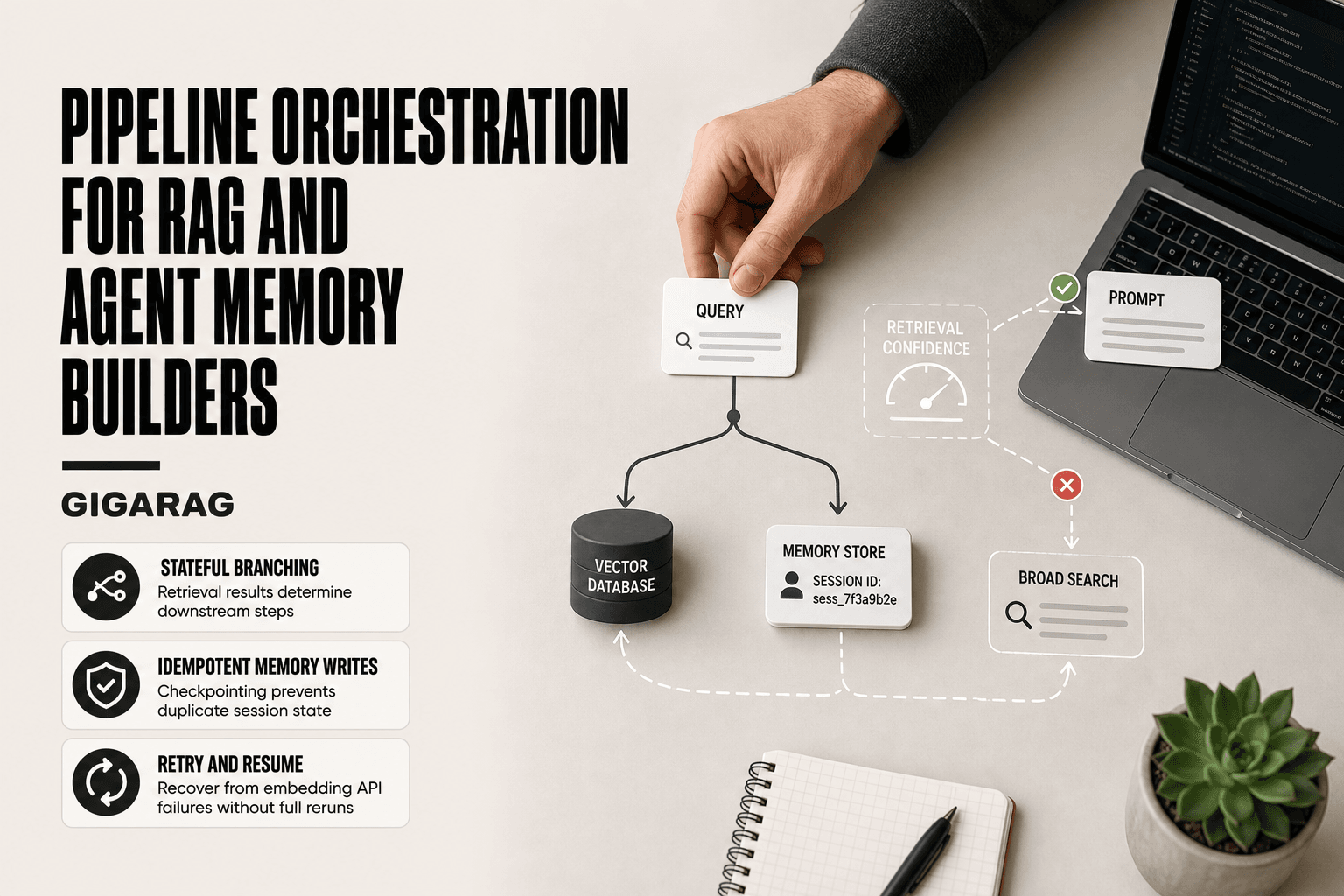
LangGraph is LangChain's answer to stateful, graph-based agent orchestration. It models your agent workflow as a directed graph of nodes and edges, which gives you explicit control over branching, retries, and state persistence. If you're building multi-step agents where the flow matters more than the retrieval, LangGraph is the more natural fit than raw LangChain. The catch is you're still inside the LangChain ecosystem, so the abstraction overhead doesn't disappear.
Haystack
Haystack, built by deepset, positions itself as a production-first framework for search and RAG pipelines. It's less opinionated about agent patterns and more focused on composable pipeline components: retrievers, readers, rankers, and generators you wire together. Teams that care about evaluation and deployment tooling often land here. The tradeoff is a smaller community than LangChain or LlamaIndex, which means fewer examples and slower answers when you hit a wall.
Other notable options
Semantic Kernel, from Microsoft, targets enterprise .NET and Python shops that want LLM orchestration inside their existing stack. DSPy shifts the focus from prompts to programming, letting you compile and optimize pipelines rather than hand-tune them. RAGFlow, an open source project, bundles document parsing and chunking with a visual pipeline builder. None of these replace the core decision. They just change the surface area you're building on.
Final Thoughts
The decision comes down to three questions: how deep does your agent memory need to persist, how tight is your latency budget, and how much maintenance can your team actually carry. LangChain gets you moving fast but hides complexity you'll pay for later. LlamaIndex shines when your data is the product and indexing quality matters more than agent flexibility. Custom gives you full control and zero abstraction tax, but you own every bug, every upgrade, and every edge case.
The honest answer is that most production teams land on a hybrid: a framework for the boring parts, custom code for the memory and retrieval layers that actually differentiate your agent. The limitations don't disappear with any choice. They just move.
If you're building agent memory systems or RAG pipelines and want a reference architecture that treats persistence and retrieval as first-class concerns, GigaRAG is worth a look. It's built for exactly the use cases this guide covers, and it doesn't pretend the tradeoffs away. When you're weighing rag architecture in langchain vs llamaindex vs custom, the right choice is the one your agent memory can actually live with.
Frequently Asked Questions
Which RAG architecture is best?
There is no single best architecture; it depends on your requirements. LangChain excels at agent orchestration, LlamaIndex at data indexing and retrieval, and custom architecture offers maximum control for specialized needs like agent memory. Many production systems use a hybrid approach.
Who are LlamaIndex's competitors?
LlamaIndex competes with LangChain, Haystack, and other RAG frameworks, as well as custom-built retrieval pipelines. The choice often comes down to whether you need a retrieval-focused framework or a broader agent orchestration tool.
What is the difference between RAG and context windows in large language models?
RAG retrieves relevant external information to augment the model's input, while context windows refer to the amount of text a model can process at once. RAG helps overcome context window limits by fetching only the most relevant data for each query.
Is LlamaIndex an open source framework?
Yes, LlamaIndex is an open source framework. It provides tools for data ingestion, indexing, and retrieval to build RAG applications, and it can be used alongside other frameworks like LangChain.
When should I choose a custom RAG architecture over a framework?
Choose custom when you need full control over memory schemas, latency, cost, or integration with existing systems, and when framework abstractions become limiting. Custom also makes sense if you have unique agent memory requirements that frameworks do not address well.
Can I use LangChain and LlamaIndex together?
Yes, many teams use LlamaIndex for retrieval and LangChain for agent orchestration. This hybrid approach leverages the strengths of both frameworks, though it adds integration complexity.
What are the limitations of using frameworks for agent memory?
Frameworks may impose abstractions that limit fine-grained control over memory storage, retrieval strategies, and latency. They can also add overhead and make it harder to optimize for specific agent memory workloads, which is why some teams eventually build custom memory layers.
About GigaRAG
GigaRAG is for agent memory and RAG pipeline builders. get this right. Whether you are working through rag architecture in langchain vs llamaindex vs custom or something adjacent, we publish what we have actually tested, including where it falls short.