Freshness Patterns for Fast-Changing Corpora for AI Agents
Your coding agent suggests an API endpoint that the team removed yesterday. Treat the answer as something to investigate with evidence rather than as proof that the current specification is wrong.
For fast-changing corpora, indexing needs ongoing verification as source records evolve. A repeatable process helps teams observe what changed and preserve evidence for later investigation.
Quick answer
Use an end-to-end verification workflow: identify the current source record, trace its indexed representation, and test the retrieval query used by the agent. Teams using a shared-memory platform such as GigaRAG can also keep the related project context available across sessions and tools.
- Trace a stale answer from source to retrieved chunk.
- Check that edits and deletions propagate.
- Test retrieval with a query that should match the replacement content.
Freshness patterns for fast-changing corpora: a verification workflow
Verify a changing corpus at four practical points: the source record, the indexed record, retrieval results for a representative query, and any saved agent context used for the task. This separates the evidence you can inspect at each stage.
[!note] A vector database stores embeddings, IDs, metadata, and often original content or a reference to it. Verify an update by inspecting the relevant indexed records and by testing retrieval with representative queries.
Source freshness: when the authoritative record changed
This clock matters first. An API specification may remove an endpoint, a team may reverse an architecture decision, or a documentation page may be corrected.
Use the published or otherwise authoritative source record as the comparison point for the rest of the workflow.
Index freshness: when the changed record was transformed and stored
Index review starts by identifying the records associated with a changed source document. In a vector database, stable record IDs support updates and deletion, while metadata supports filtering and governance.
Vector databases store embeddings with IDs and metadata. Keep the source references and record identifiers needed to investigate the indexed material.
Retrieval freshness: whether the current record wins for a real query
Inspect retrieval with the query patterns your application uses, including any metadata filters that determine which records are eligible for a result.
Test the removed endpoint name, its replacement, and relevant natural-language paraphrases. Record the returned content, IDs, and metadata so the test can be repeated after updates.
Memory freshness: what an agent session, summary, or task state still carries
Review any session context, summaries, saved plans, or task state that the agent receives for the task. Keep source references with durable project facts so a reviewer can compare them with the governing record.
Memory is working context, not proof. Keep a source reference with any durable fact so you can replace it when the authoritative record moves.
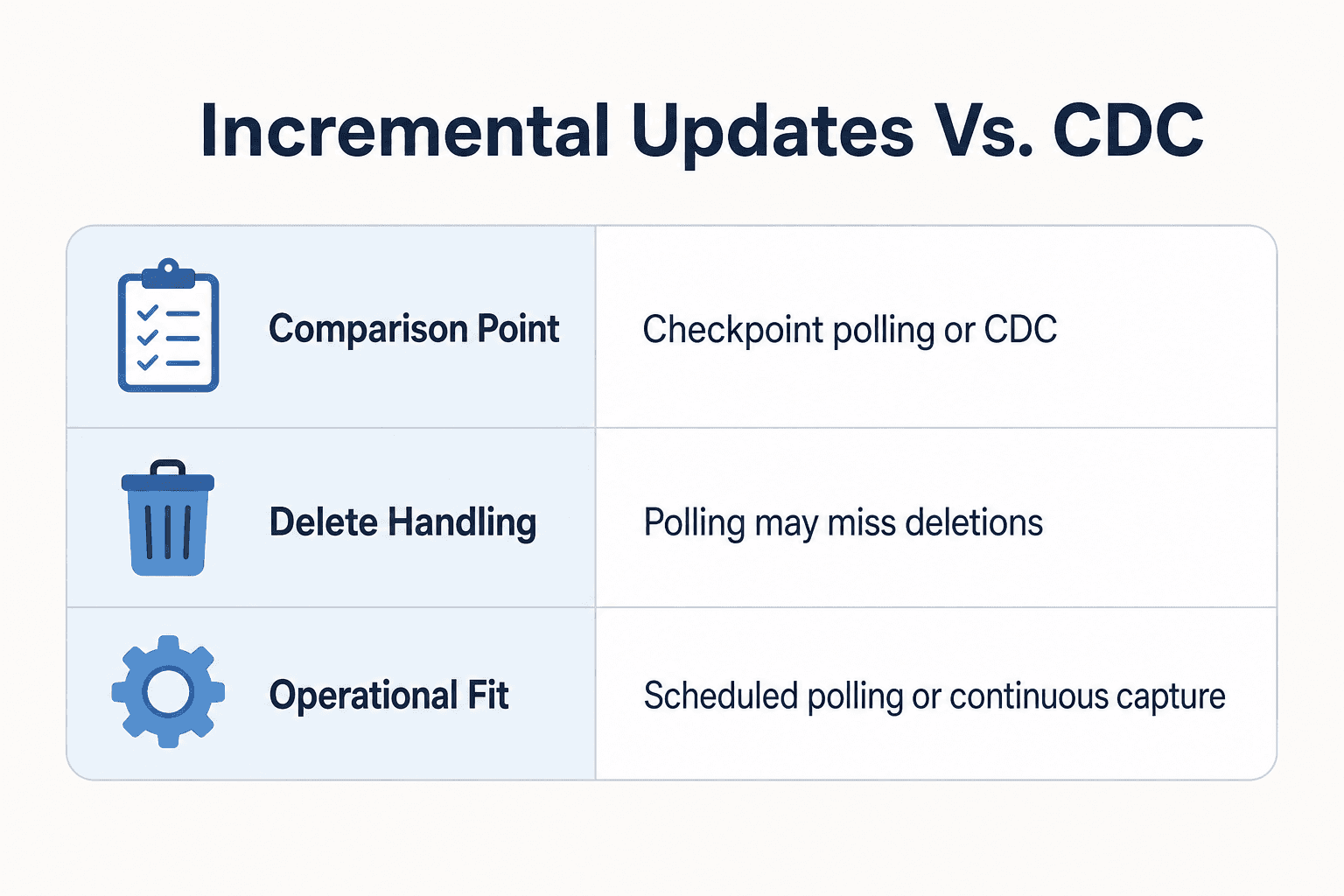
Incremental updates vs. CDC: Which fits?
| Factor | Option A | Option B |
|---|---|---|
| Comparison point | Timestamp or version polling | Change data capture (CDC) |
| Deletes | In one SaaS dataset examined by Weld, timestamp polling missed deletes | CDC is designed to capture inserts, updates, and deletes from source changes |
| Operational fit | Scheduled polling of records changed since a checkpoint | Continuous capture from database logs or change streams |
Choose incremental updates, CDC, or a full rebuild
Choose a change-detection pattern based on the source system, the changes that must reach downstream systems, and the delay your application can tolerate. CDC captures changes as they occur, while traditional batch processes run on a schedule.
Timestamp or version polling: simple, but don't assume it detects deletes
A polling pattern can query records whose updated_at value or version exceeds the last checkpoint. Define and test the source-specific behavior, including how the source represents removals.
Deletion handling needs explicit validation. Weld reports that timestamp polling missed deletes in one SaaS dataset, producing inconsistencies; do not assume a polling query covers removals without testing it for your source.
Application outbox events and change streams for event-driven ingestion
For database-backed sources, CDC can monitor transaction logs or change streams to capture inserts, updates, and deletes. Trigger-based approaches can use database triggers or application-level hooks when direct log access is unavailable.
A CDC implementation may use an initial snapshot as a downstream baseline, then capture later changes. The downstream application needs ordering and duplicate-event handling to maintain consistency.
Content hashes to skip unchanged documents and target changed chunks
If your pipeline uses a content hash, define what is normalized before calculating it and validate the resulting update behavior in your own pipeline.
If you store hashes for documents or chunks, retain the associated IDs and source references so you can compare indexed records with the current source during an investigation.
When an embedding-model change requires reprocessing
Vectors created by one embedding model generally should not be mixed with vectors from a different model or model version in the same search space. When the model changes, teams often re-embed and reindex their content.
Record the embedding-model version and the fields used to build the indexed text so you can identify how a record was produced.
Step-by-step: Trace and verify a stale result
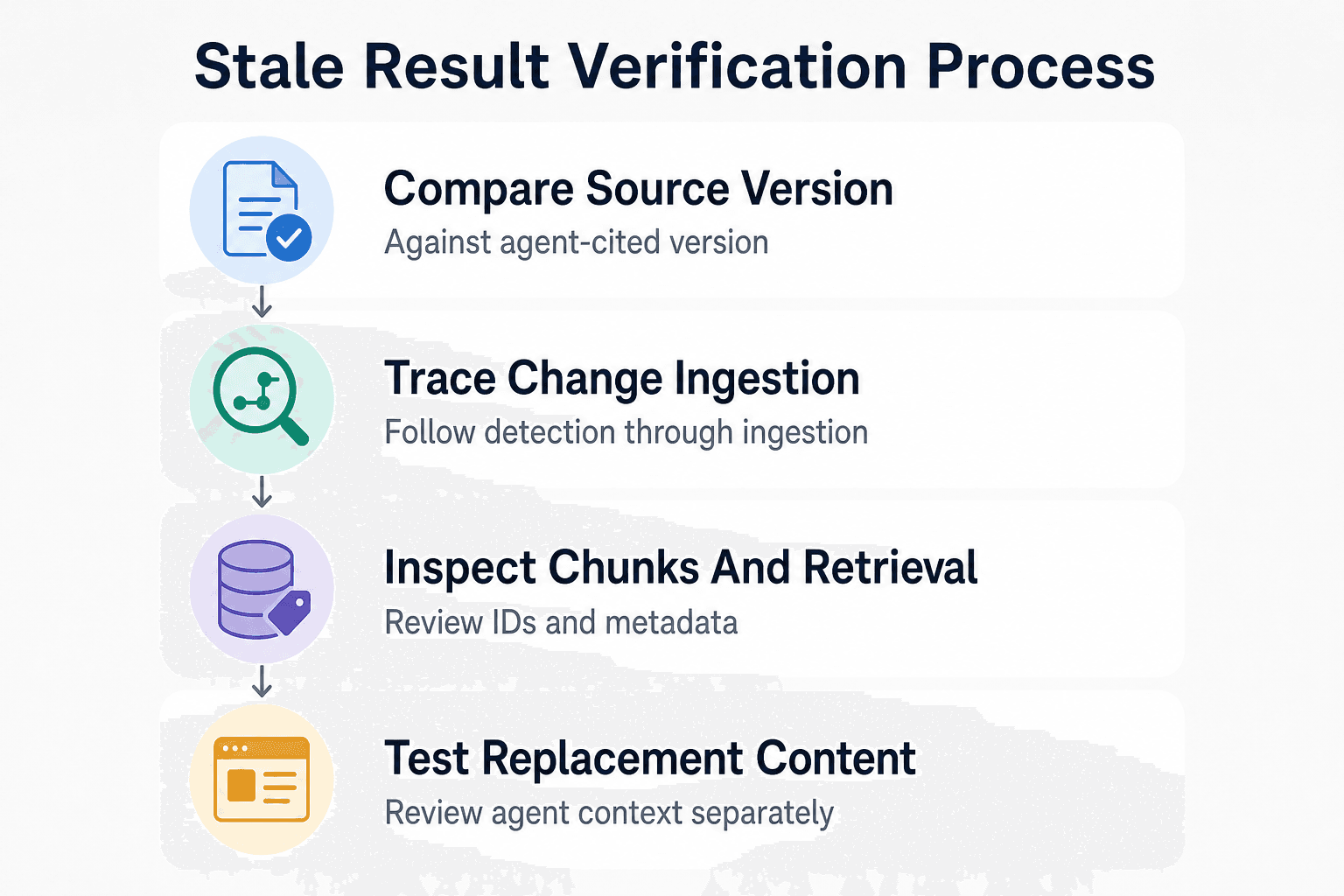
- Compare the source document with the version the agent cited.
- Trace the source change through detection and ingestion.
- Check whether the affected chunks were updated or removed.
- Inspect retrieved results and their IDs or metadata for version clues.
- Query for content unique to the replacement version.
- Review the context supplied to the agent separately when the retrieved material and the final answer do not match.
Handle edits, deletions, versions, and metadata correctly
For edits and removals, define how the pipeline identifies the related indexed records and how those records are updated or deleted. Then test the result with representative retrieval queries.
[!tip] For API-spec debugging, query using the replacement endpoint name and inspect the returned chunk's document ID and date metadata. This helps distinguish a stale indexed record from a current record that isn't ranking for the query.
Use stable document IDs, chunk IDs, parent-child links, and source locators
Give each source document a stable document_id that survives title edits, moves, and new versions. Give each chunk its own chunk_id, plus its parent document_id and a source locator such as a URL, page number, heading path, or byte range.
The Emergent vector database guide explains that each record needs a stable ID for updates and deletion, while metadata supports filtering and governance. Parent document IDs and source locators can make related chunks easier to inspect together.
Store version, content hash, indexed-at time, source-updated-at time, and access metadata
Store the source version and content hash with each document and chunk. Also keep source_updated_at, indexed_at, embedding-model version, and access metadata such as tenant or permission scope.
Keeping both source and indexing timestamps gives reviewers two distinct recorded values to compare during a trace.
Replace or retire prior chunks on edits instead of creating unbounded duplicates
Define a bounded update procedure for edits: identify the indexed chunks associated with the document, write the intended current records, and apply the chosen retirement or deletion action to prior records. Verify the procedure against the source and retrieval tests.
Avoid accumulating uncontrolled copies of the same source passage. Stable IDs, document relationships, and explicit retirement rules make indexed records easier to audit.
Use delete events or tombstones
Use an explicit delete event where possible. CDC can capture inserts, updates, and deletes from source changes, but downstream processing needs to preserve event order and handle duplicates.
When delete events are unavailable, a source inventory can be compared with indexed parent IDs as an implementation option. For timestamp polling, test deletion behavior against the specific source rather than inferring it from an absent poll result.
Diagnose and verify stale retrieval results
Diagnose a questionable answer by tracing its citation or retrieved material back to the indexed chunk and its metadata. Test raw retrieval separately from the agent interaction so each observation is recorded clearly.
Example: a removed API field still appears in coding-agent answers
Say an API specification removed legacy_mode, but a coding agent still recommends it. Begin by collecting the answer citation, retrieved records, filters, and supplied context; those artifacts establish what the agent had available for the response.
Start with the answer citation. If there isn't one, log the retrieved chunk IDs, scores, filters, and prompt context before changing the index.
Trace the result from answer citation to chunk ID, parent document, hash, version, and ingestion run
For each cited chunk, inspect its chunk_id, document_id, content hash, source version, and ingestion-run ID. Compare them with the current source record.
A current chunk beside an old one points to incomplete retirement or ranking trouble. An old hash and source version point upstream, before retrieval.
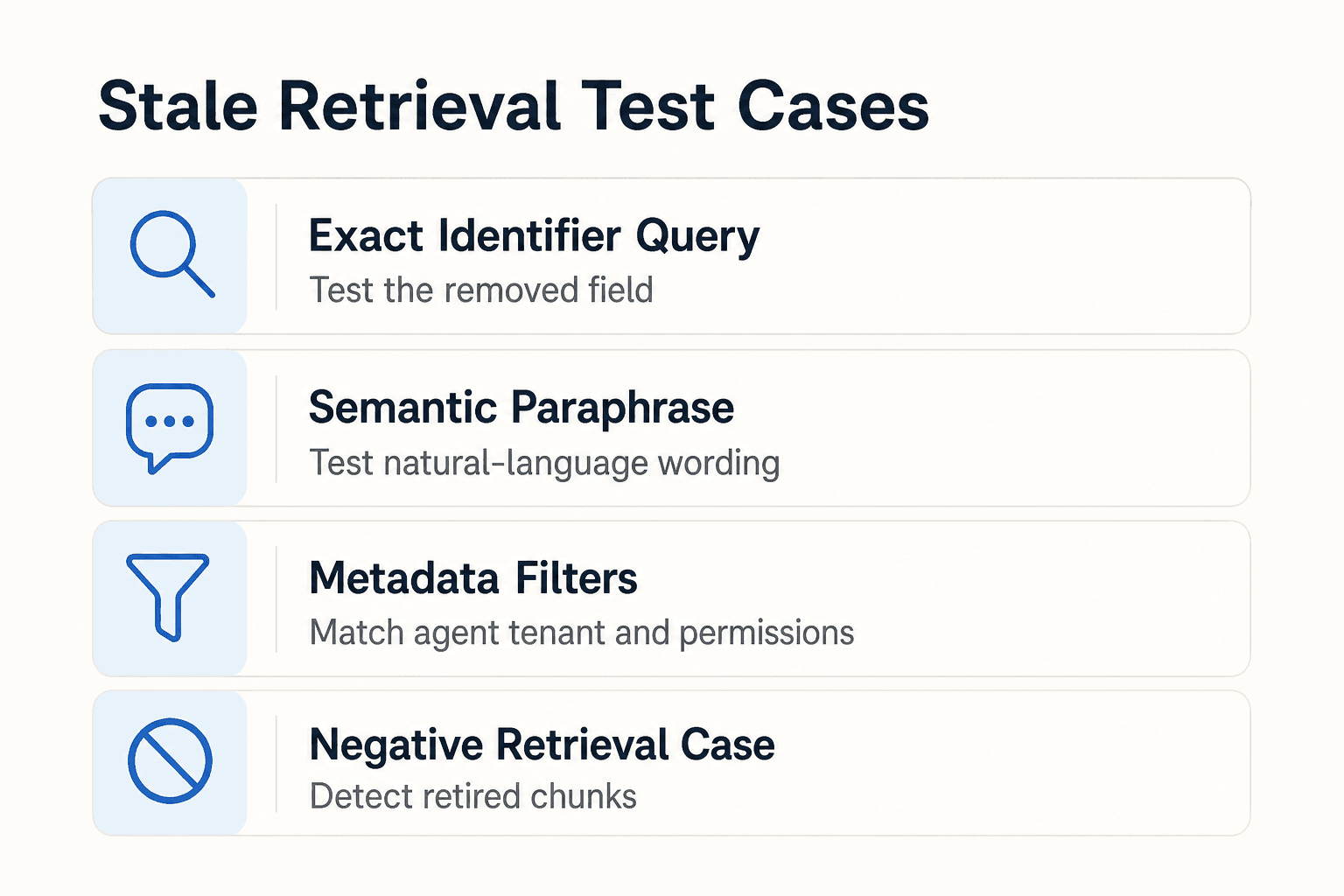
Test exact identifiers, semantic paraphrases, metadata filters, and negative retrieval cases
Query the removed field by its exact name, then ask a natural-language version such as "How do I enable legacy behavior?" Test with the same tenant, permission scope, and metadata filters your agent uses.
Vector search finds similar meaning rather than only exact words, while metadata filters can change which records are eligible. Check both paths.
Validate after the update: confirm the replacement retrieves and the obsolete chunk cannot
Run a fixed test set after every update: queries expected to retrieve the replacement and negative queries designed to detect a retired chunk. Test raw retrieval first, then test the agent with the intended session setup.
Keep the old chunk ID in the negative case. If it still appears, the fix isn't done.
Keep agent memory useful without treating it as source of truth
Treat session context, summaries, and task state as working material rather than the authoritative record for a project fact, API detail, or decision.
Separate authoritative source documents, retrievable knowledge, and session-specific working memory
Keep three layers distinct: the authoritative source, indexed knowledge built from that source, and session memory such as a task plan or recent tool output. They serve different jobs.
A design record can document a decision, and a retrieved chunk can point to that record. Keep session summaries identifiable as session context so reviewers can compare them with the underlying source.
Invalidate or refresh summaries when linked decisions, specifications, or tickets change
Link each summary or saved decision to source IDs and versions. When a ticket closes, a specification changes, or a decision is superseded, mark dependent memory stale and either rebuild it or remove it.
Use linked source IDs and versions where your workflow supports them, and review saved summaries when their related specifications, tickets, or decisions change.
Use MCP or API integrations to expose governed context
Expose retrieval through MCP or an API with source links, document IDs, versions, and permission-aware filters where available. GigaRAG connects agents to a central Hive Mind through MCP or the API, and its access controls manage what each agent can use.
Document the access-control behavior of the integration and test it with the agents and sources in scope.
Evaluate AI-agent memory systems against documented behavior
Evaluate documented capabilities alongside your configuration. For any memory tool, assess the shared-memory scope, available integrations, access controls, and the workflow used to maintain project knowledge across sessions and tools.
Do not assume a memory tool refreshes project knowledge automatically. Include the tool's documented update behavior in your evaluation and configuration review.
Frequently Asked Questions
What should I compare when investigating a stale-looking RAG answer?
Compare the current source document with the retrieved chunk or cited material, then inspect the chunk's IDs, metadata, and source reference. Run the same query directly against retrieval before drawing conclusions from the agent's final answer.
Why can an old API specification still appear after I update the source document?
A stale-looking result does not by itself establish why it appeared. Inspect the returned chunk, its IDs and metadata, the retrieval filters, and the query used by the agent, then compare those artifacts with the current source record.
What is the difference between timestamp polling and CDC?
Timestamp or version polling queries records changed since a checkpoint. CDC identifies source changes and propagates inserts, updates, and deletes downstream; it commonly reads a database transaction log or change stream. Choose based on the source capabilities and the change behavior you need to support.
How should a vector index handle deleted documents and chunks?
Use stable record IDs for updates and deletion, and define how your source communicates removals. CDC is designed to capture deletes from source changes. If you use polling, test deletion behavior with the specific source because Weld found missed deletes in one SaaS dataset.
What metadata should each RAG chunk store for freshness debugging?
Store the identifiers and references your workflow needs to trace a result: commonly chunk_id, document_id, a source locator, source version, content hash, source_updated_at, indexed_at, embedding-model version, and relevant access metadata. Vector-database metadata can support filtering and governance.
How can content hashes support an indexing workflow?
If your workflow uses hashes, define the normalization method, retain the associated source and record IDs, and test the update decisions your implementation makes when values match or differ.
How can I verify that a new document version is actually being retrieved?
Query for a term or detail unique to the new version, then inspect the returned content and metadata. Confirm that results point to the replacement record rather than an older chunk.
How should I investigate an AI agent answer that conflicts with retrieved material?
Log the retrieved passages, filters, prompt context, and any session summary or saved task state supplied to the agent. Compare these artifacts with the final answer and the authoritative source so the retrieval path and the agent context can be reviewed separately.
About GigaRAG
GigaRAG is a shared memory platform for AI agents that helps developers and teams keep project knowledge available across sessions and tools. Teams can use it alongside a documented source and retrieval workflow when they need shared project context.
Agents can connect to a central Hive Mind through MCP or the API. GigaRAG provides access controls to manage what each agent can use, supporting configurations with different agent access needs.


