RAG Survey Papers, Summarized: What Pipeline Builders Actually Need to Know
RAG survey papers, summarized for pipeline builders, have piled up fast enough to bury a retrieval index. You don't need another taxonomy. You need the 20% of survey insights that drive 80% of architecture decisions: which retrieval strategies actually hold up, where chunking consensus breaks down, and what no survey paper will tell you about production memory. This guide distills what the surveys agree on, where they contradict each other, and what they cannot give you: no implementation code, no benchmark shootouts, no deploy-ready recipes. GigaRAG's agent memory work sits downstream of these findings, so the summaries here double as a decision framework for anyone building retrieval pipelines today.
| At a glance | Details |
|---|---|
| What surveys cover | Taxonomies of retrieval, generation, and augmentation techniques |
| What they skip | Implementation code, benchmarks, production recipes |
| Key paradigm shift | From naive RAG to modular and agentic pipelines |
| Consensus finding | Retrieval quality and reranking drive performance |
| Builder takeaway | Use surveys for architecture, not for tuning |
| Agentic RAG trend | Surveys now cover agentic and multimodal RAG |
In This Guide
- What Is Retrieval-Augmented Generation (RAG)?
- Naive RAG vs Agentic RAG: What Surveys Say
- The Three RAG Paradigms: Naive, Advanced, and Modular
- Rag Survey Papers, Summarized: A Step-by-Step Guide
- Key Research Themes Across RAG Survey Papers
- What RAG Surveys Agree On: Consensus Findings for Builders
- Where RAG Surveys Disagree: Contested Findings and Open Questions
- What You Cannot Do with RAG Survey Papers
- From Survey to Pipeline: A Builder's Decision Framework
- Agentic RAG: What the Latest Surveys Reveal
- Common Mistakes When Building RAG Pipelines (According to Surveys)
- How to Read a RAG Survey Paper Efficiently
- Final Thoughts: Building Better RAG Pipelines with Survey Insights
What Is Retrieval-Augmented Generation (RAG)?
Retrieval-augmented generation (RAG) is a technique that lets a large language model pull facts from an external knowledge base before it answers, instead of relying only on what it memorized during training. The model retrieves relevant passages, stuffs them into the prompt as context, then generates a response grounded in that retrieved text.
The core RAG loop: retrieve, augment, generate
The loop runs in three steps. First, your query gets converted into a vector embedding and matched against a stored index of documents. Second, the top matches get inserted into the model's context window alongside your original question. Third, the model generates an answer using both. That's it. No fine-tuning, no weight updates.
Why RAG matters for agent memory
Agents need to remember things that happened after training. RAG gives them a way to look things up on demand. You store facts, conversation history, or tool outputs in a vector store, and the agent retrieves what's relevant when it needs it. The catch: retrieval quality sets the ceiling. If the wrong chunk comes back, the generation step can't fix it.
RAG vs fine-tuning: when to use each
Use RAG when your knowledge changes often or you need to cite sources. Use fine-tuning when you want to change how the model behaves, not what it knows. They're not rivals. Most production systems use both.
[!note] RAG surveys typically do not include implementation code or benchmark comparisons; they are best used for conceptual understanding and architecture planning, not for direct tuning.
Naive RAG vs Agentic RAG: What Surveys Say
| Factor | Naive RAG | Agentic RAG |
|---|---|---|
| Retrieval | Single-shot, static | Iterative, adaptive with agent control |
| Complexity | Low, easy to implement | High, requires orchestration |
| Use cases | Simple Q&A, basic search | Multi-step reasoning, tool use, memory |
| Survey coverage | Well-covered in early surveys | Emerging in recent surveys (e.g., Agentic RAG survey) |
| Production readiness | Mature, widely deployed | Experimental, evolving best practices |
The Three RAG Paradigms: Naive, Advanced, and Modular
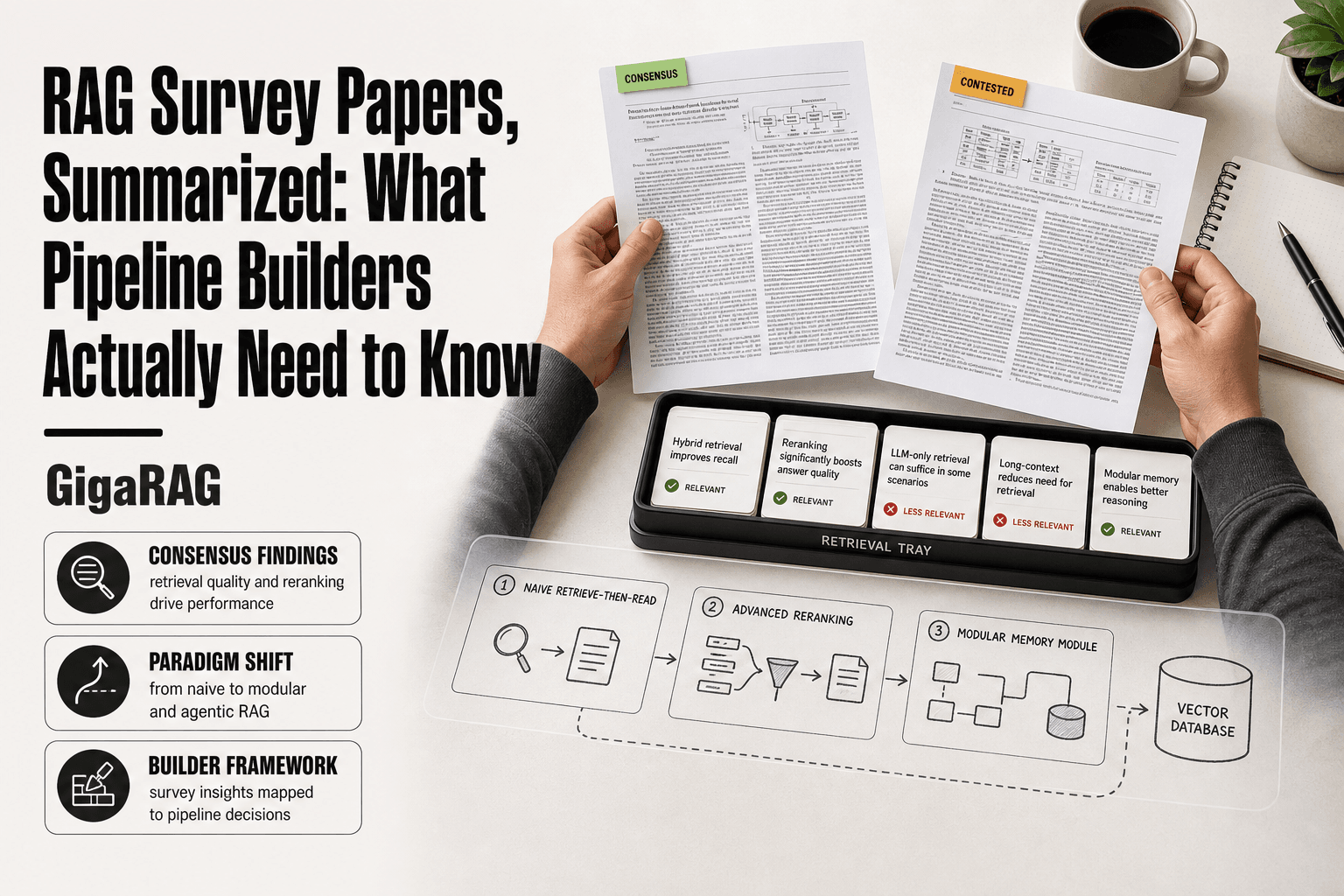
Every major survey lands on the same progression. RAG didn't arrive fully formed. It moved through three stages, and each stage tells you something about where the complexity lives in a pipeline. The names vary slightly between papers, but the architecture story is consistent.
Naive RAG: retrieve-then-read baseline
Naive RAG is the version most tutorials teach. You index documents, embed the query, retrieve the top-k chunks, and feed them to the model. That's the whole pipeline. It works for demos and small knowledge bases.
It breaks in predictable ways. Retrieved chunks often miss the context around them. The model gets irrelevant passages and either ignores them or, worse, uses them. There's no reranking, no query rewriting, no filtering. If your index is noisy, your answers are noisy. The surveys agree: naive RAG is a starting point, not a destination.
Advanced RAG: pre-retrieval and post-retrieval optimizations
Advanced RAG adds processing before and after retrieval. Before retrieval, you rewrite the query, expand it with synonyms, or route it to a specific index. After retrieval, you rerank the chunks so the most relevant ones sit closest to the model's attention.
The pre-retrieval step matters more than most builders expect. A poorly worded query retrieves poor chunks no matter how good your index is. Post-retrieval reranking fixes the ordering problem. Surveys consistently show that reranking with a cross-encoder improves precision more than swapping embedding models. The tradeoff is latency and cost. Each added step slows the pipeline.
Modular RAG: composable components for agent memory
Modular RAG treats the pipeline as a set of swappable parts. Retrieval, memory, routing, and generation become separate modules you can mix and match. This is where agent memory fits. An agent might route some queries to a vector store, others to a knowledge graph, and keep a separate memory module for conversation history.
The benefit is flexibility. You can add a reranker without touching your embedding model. You can swap retrieval strategies per query type. The cost is complexity. Every module you add is another thing to debug, monitor, and tune. Modular RAG is the paradigm that makes agent memory possible, but it's also the one most likely to turn into a maintenance burden if you build it without a clear reason.
[!tip] For agent memory builders: prioritize survey sections on memory and iterative retrieval, as these directly inform how you design state management and context windows in production agents.
Rag Survey Papers, Summarized: A Step-by-Step Guide
- Skim the taxonomy to understand the landscape and identify relevant paradigms.
- Focus on sections about retrieval, reranking, and memory—these drive performance.
- Note consensus findings and open challenges; they highlight what works and what doesn't.
- Map survey concepts to your pipeline: chunking, embedding, retrieval, generation.
- Identify gaps: surveys rarely provide code or benchmarks, so plan your own experiments.
- Check for updates: RAG is fast-moving; prefer surveys from the last 12 months.
Key Research Themes Across RAG Survey Papers
The paradigms give you a map of how RAG evolved. The research themes tell you where the field is still pushing. Survey papers cluster around four recurring problems, and each one maps to a pipeline decision you'll face.
Retrieval quality and hybrid search
Retrieval quality is the bottleneck every survey returns to. Dense embeddings miss exact matches like product codes or error strings. Sparse retrieval like BM25 catches those but misses semantic similarity. Hybrid search combines both, and surveys consistently show it outperforms either alone. The cost is two indexes and a fusion step. Most builders accept that tradeoff once they see the precision gain.
Generation faithfulness and hallucination reduction
The generator will hallucinate when the retrieved context is thin or contradictory. Surveys point to two fixes: better retrieval upstream and constrained decoding downstream. You can't fix a bad prompt with a better model if the chunks you fed it were wrong. Faithfulness metrics like groundedness and citation accuracy show up repeatedly as the way to measure this. The honest takeaway: hallucination reduction starts at retrieval, not generation.
Multimodal RAG: text, code, image, video, audio
RAG isn't text-only anymore. Surveys now cover retrieval across code, images, video, and audio. The challenge is that each modality needs its own embedding model and index. A text chunk and an image frame don't live in the same vector space without alignment work. Builders working with mixed content should expect to run separate retrieval pipelines and merge results, not one unified index.
Agentic RAG and tool use
The newest theme is agents that decide when to retrieve, what to retrieve, and whether to call a tool. This moves RAG from a fixed pipeline to a decision loop. The agent might rewrite a query, search a knowledge graph, or fetch from an API before generating. Surveys flag this as promising but immature. The failure modes are new: agents retrieve too much, too little, or loop without converging. Tool use adds capability and a new class of bugs.
What RAG Surveys Agree On: Consensus Findings for Builders
When multiple independent surveys reach the same conclusion, you can treat it as a working principle rather than a hypothesis. Four findings show up across the major RAG survey papers with enough consistency to guide architecture decisions.
Retrieval quality is the bottleneck, not generation
The generator can only be as good as the context it receives. Surveys repeatedly find that when RAG systems fail, the failure traces back to retrieval: the wrong chunks, missing chunks, or chunks that are relevant but buried too deep in the result list. Generation errors are downstream symptoms. The practical implication is that your optimization budget should go to retrieval first. A stronger embedding model or a better reranker moves the needle more than a bigger LLM.
Chunking strategy significantly impacts performance
How you split documents changes what your retriever can find. Chunks that are too large dilute relevance scores and waste context window space. Chunks that are too small lose the surrounding context that makes a passage meaningful. Surveys agree that chunking is one of the highest-leverage decisions in a RAG pipeline, but they stop short of prescribing a universal size. The consensus is that chunking matters enormously and that the right choice depends on your document type and query patterns.
Reranking improves precision more than embedding model swaps
A reranker that scores retrieved candidates against the query gives you more precision than upgrading your embedding model. Surveys consistently show that a two-stage pipeline, retrieve broadly then rerank narrowly, outperforms a single-stage dense retrieval setup. The mechanism is straightforward: the first stage optimizes for recall, the second for precision. You get the best of both without retraining anything.
Hybrid search beats dense-only or sparse-only
Dense retrieval handles semantic similarity. Sparse retrieval like BM25 handles exact matches, rare terms, and identifiers. Neither handles both well. Surveys that compare retrieval methods consistently find that hybrid search, combining dense and sparse scores, outperforms either approach alone. The cost is running two indexes and a fusion step. The benefit is that you stop missing the queries that fall through the cracks of a single retrieval method.
Where RAG Surveys Disagree: Contested Findings and Open Questions
The consensus findings are useful. The disagreements are where you need to think for yourself. Surveys don't all reach the same conclusions, and treating any single taxonomy as settled will lead you astray. Here are the areas where the papers conflict or simply don't have an answer yet.
Optimal chunk size: no consensus
One survey reports strong results with chunks around 256 tokens. Another finds 512 works better for technical documentation. A third argues that fixed-size chunking is the wrong frame entirely and that semantic chunking, splitting on meaning rather than token count, outperforms any fixed number. The honest answer is that chunk size depends on your document structure, your embedding model's context window, and what your queries actually look like. No survey gives you a number you can copy. You'll need to test on your own data.
When to use knowledge graphs vs vector stores
Some surveys position knowledge graphs as the clear upgrade for multi-hop reasoning and relationship-heavy queries. Others treat them as a niche tool that adds indexing complexity without consistent gains. The disagreement comes down to what the survey authors tested. Vector stores handle similarity search well. Knowledge graphs handle explicit relationships well. Most surveys don't run head-to-head comparisons on the same datasets, so the "winner" depends on which benchmark each paper chose. If your queries require traversing relationships, a graph helps. If they're mostly semantic lookup, a vector store is simpler and faster.
The role of query rewriting: essential or overrated?
Query rewriting transforms a user's raw question into a better retrieval query before searching. Some surveys list it as a core pre-retrieval optimization with measurable gains. Others barely mention it, or report that the gains disappear once reranking is added downstream. The conflict likely reflects different test setups: rewriting helps most when queries are short, ambiguous, or conversational. If your users type long, specific queries, rewriting adds latency without much benefit. If they type three-word searches, it's worth testing.
What You Cannot Do with RAG Survey Papers
Surveys map the territory. They don't build the road. If you're looking for code you can run, benchmarks you can compare, or deployment recipes you can copy, you'll be disappointed. Here's what survey papers won't give you.
No implementation code or tutorials
A survey describes what works, not how to build it. You'll find diagrams of retrieval pipelines and taxonomies of chunking strategies, but no working code. No pip install instructions. No example notebooks. The papers assume you already know how to implement what they describe. If you need a tutorial, look for a blog post or a library's documentation instead.
No head-to-head benchmark comparisons
Surveys cite benchmark results from many papers, but those numbers come from different datasets, different embedding models, and different evaluation setups. You can't compare a recall score from one paper against a faithfulness score from another. The surveys rarely run their own experiments. So you get a list of findings, not a leaderboard.
No production deployment guidance
Nothing in a survey tells you how to handle rate limits, cold starts, index rebuilds, or monitoring. Those are the problems that eat pipeline builders alive. Surveys stay at the architecture level. Production is your problem.
Surveys lag behind the latest research by 6-12 months
A survey published in mid-2025 covers papers from 2024 and earlier. By the time you read it, the field has moved. New embedding models, new reranking techniques, new agentic patterns. Treat surveys as a snapshot, not a live feed.
From Survey to Pipeline: A Builder's Decision Framework
You've read what surveys can't do. Now here's what they can. The consensus findings map directly onto pipeline choices. Start with retrieval, then chunking, then reranking, then memory.
Choosing your retrieval strategy based on survey consensus
The surveys agree on one thing: hybrid search beats dense-only or sparse-only. Dense retrieval handles semantic similarity. Sparse retrieval (BM25) handles exact terms, product codes, and rare identifiers. Combine them and you cover both failure modes.
In practice, start with hybrid. Most vector databases support it natively. If you're building on a budget, dense-only works for conversational queries over prose. But the moment your corpus includes technical terms or IDs, add sparse. The retrieval quality gap shows up fast.
Chunking decisions: what surveys suggest
Chunk size matters more than most builders expect. Too small and you lose context. Too large and you dilute the signal. Surveys point to a working range of 200 to 500 tokens for most text, with smaller chunks for code and larger for narrative documents.
The honest answer is it depends on your documents. Legal contracts need sentence-level chunks. Documentation pages need section-level chunks. Test on your own data. Don't copy a number from a paper and assume it transfers.
When to add reranking to your pipeline
Reranking improves precision more than swapping embedding models. That's a consensus finding. A cross-encoder reranker takes the top 20 or 50 retrieved chunks and reorders them by relevance. The cost is latency and a second model call.
Add reranking when your retrieval returns too many irrelevant chunks, or when your generation quality drops on long documents. Skip it if your corpus is small and your retrieval is already precise. Reranking is a fix for a specific problem, not a default.
Memory architecture for agents: lessons from modular RAG
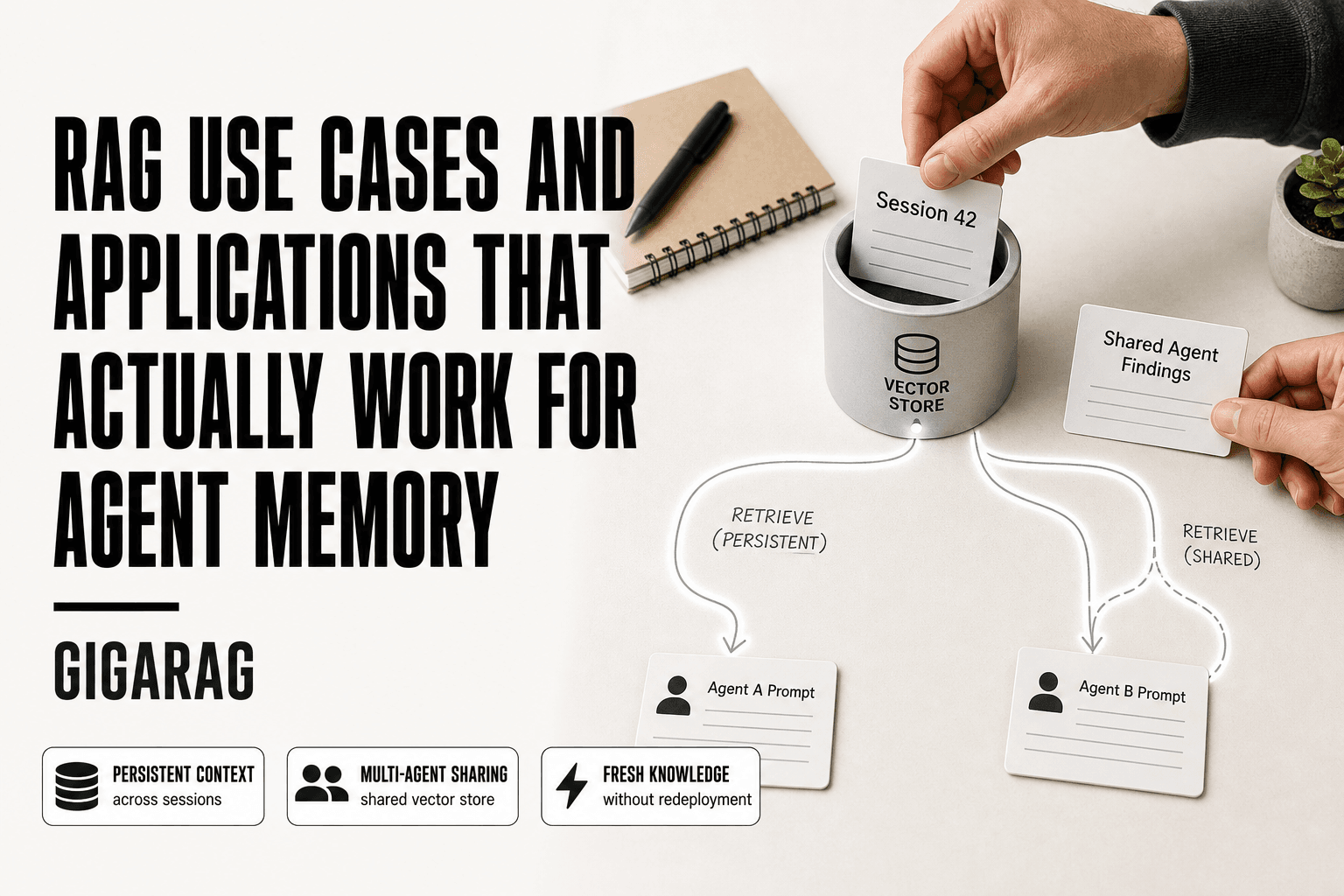
Modular RAG treats memory as a component you can swap. That's the lesson for agent builders. Don't bake memory into your retrieval loop. Keep it separate: a short-term buffer for the current session, a long-term store for persistent facts, and a retrieval layer that queries both.
The surveys don't give you a production memory architecture. They give you the pattern: separate concerns, compose components, test each piece independently. That's the framework. The implementation is yours.
Agentic RAG: What the Latest Surveys Reveal
The decision framework above treats RAG as a pipeline you configure. Agentic RAG treats it as a loop an agent controls. The difference matters for memory builders.
What makes RAG "agentic"?
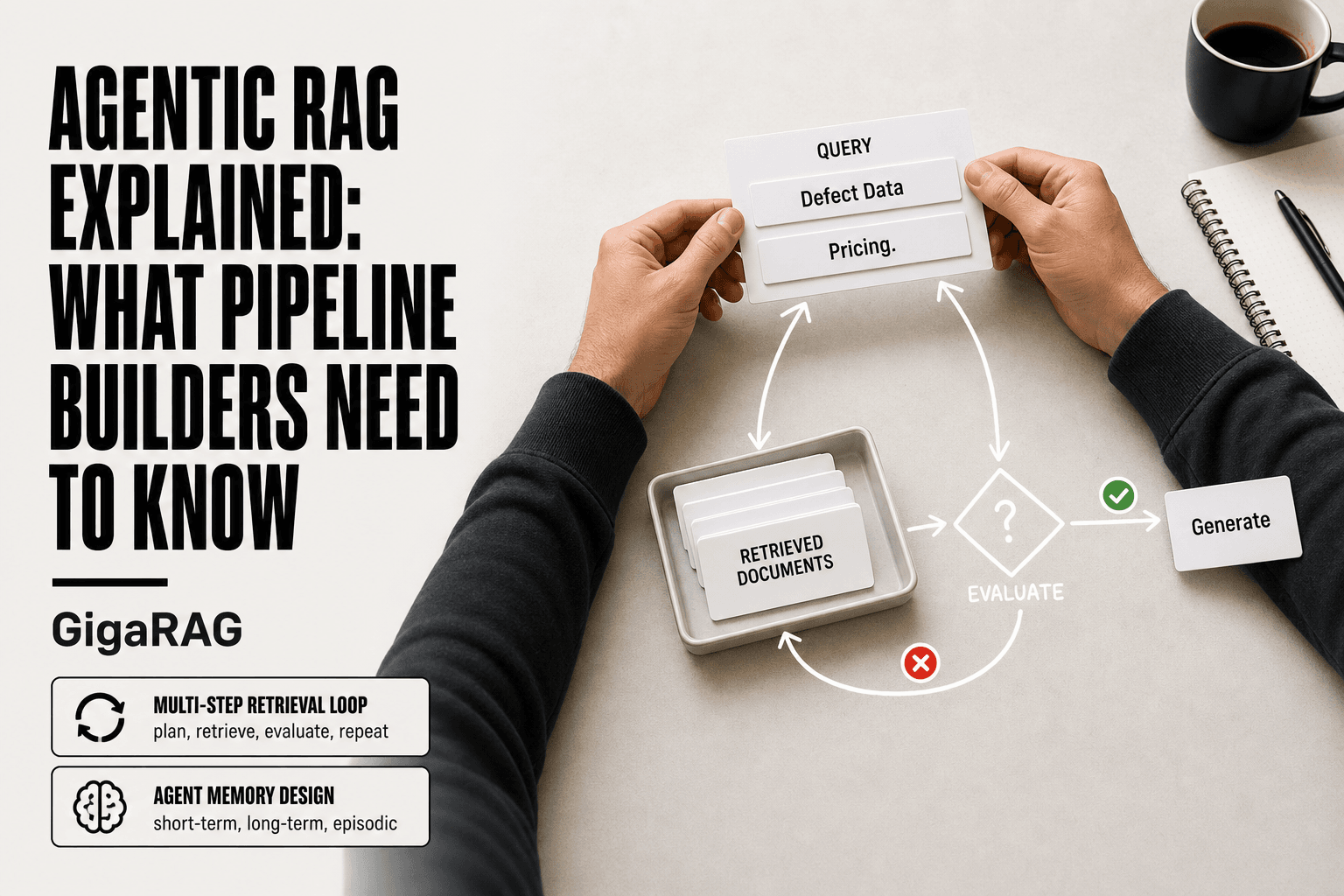
Standard RAG runs once: retrieve, augment, generate, done. Agentic RAG runs in a cycle. The agent decides whether to retrieve at all, what to retrieve, whether the result is good enough, and whether to retrieve again with a different query. It's the difference between a lookup and a search strategy.
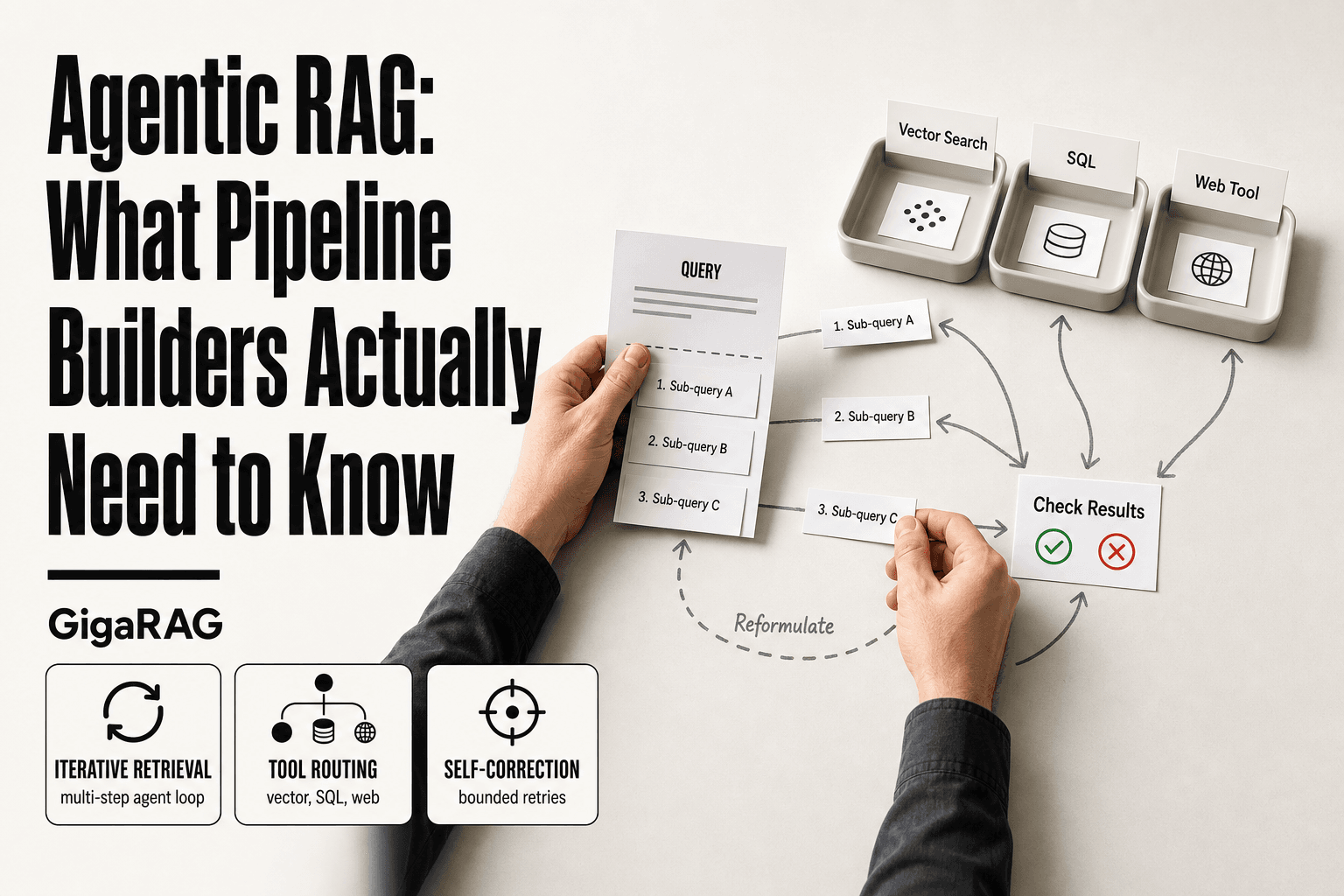
Surveys on agentic RAG describe this as giving the language model control over the retrieval process. The model becomes the planner, not just the generator. It can rewrite a query, issue multiple sub-queries, or abandon retrieval entirely when it already knows the answer. That control loop is what makes it agentic.
Memory modules in agentic RAG
The surveys converge on a three-part memory structure. Working memory holds the current task state. Episodic memory stores past interactions and their outcomes. Semantic memory holds extracted facts and knowledge. Each serves a different retrieval need.
Here's what happens behind the scenes. When an agent hits a question it can't answer from working memory, it checks episodic memory for similar past tasks. If that fails, it queries semantic memory, which is typically a vector store or knowledge graph. The retrieval order matters: recent context first, then learned facts.
The main catch is that surveys describe these modules conceptually. None of them ship a reference implementation. You get the architecture, not the code.
Tool use and multi-step retrieval
Agentic RAG surveys emphasize tool use as a core capability. The agent doesn't just query a vector database. It can call a calculator, search the web, query a SQL database, or invoke an API. Retrieval becomes one tool among many.
Multi-step retrieval follows. The agent retrieves, evaluates, and decides whether to retrieve again. A first pass might return broad context. A second pass, with a refined query, narrows it. Surveys report this iterative loop improves answer quality on complex questions, though the compute cost rises with each step.
Open challenges in agentic RAG
The honest answer is that agentic RAG is early. Surveys flag three unresolved problems. First, evaluation: standard RAG benchmarks don't measure agent behavior well. Second, reliability: agents sometimes loop, retrieve redundantly, or stop too early. Third, cost: multi-step retrieval multiplies token usage and latency.
For memory builders, the takeaway is clear. Agentic RAG is the direction the field is moving, but the surveys describe a research agenda more than a production recipe. Build the memory modules now. Wire in the agent control loop when your evaluation harness can measure whether it actually helps.
Common Mistakes When Building RAG Pipelines (According to Surveys)
Surveys don't hand you a checklist of mistakes. They bury them in limitation sections and benchmark discussions. Here's what falls out when you read between the lines.
Over-chunking documents
The instinct is to chunk small: 128 tokens, 256 tokens, tight little pieces. Surveys consistently show this backfires. Tiny chunks lose the surrounding context that makes retrieval meaningful. A sentence about "the policy" means nothing without the paragraph that names the policy.
The fix is to test. Start with 512 tokens and move up or down based on retrieval quality, not vibes. Some surveys report chunk sizes between 256 and 1024 tokens working best depending on the document type. Legal text wants larger chunks. Code wants function-level boundaries. There's no universal number.
Ignoring retrieval quality metrics
Builders measure the final answer. That's the wrong place to look. If retrieval returns garbage, generation can't fix it, no matter how good the model is. Surveys flag this as the single most common failure mode: pipelines tuned for generation quality while retrieval quietly underperforms.
Measure recall@k and precision@k before you touch the generator. If recall is low, your chunks or embeddings are wrong. If precision is low, you need reranking or better filtering. The answer quality will follow.
Skipping reranking
Dense retrieval gets you candidates. It doesn't rank them well. Surveys agree that a reranking step, whether a cross-encoder or a smaller model, consistently improves precision more than swapping embedding models. Yet most builders skip it because it adds latency and a second model to manage.
The honest answer is that reranking is worth the cost for any pipeline where precision matters. If you're retrieving five chunks and feeding them all to the generator, a bad ranking wastes context window and confuses the model. Rerank first.
Treating RAG as static instead of iterative
You build a pipeline, it works, you ship it. Then the documents change, the queries drift, and retrieval quality decays. Surveys describe RAG as a system that needs continuous evaluation and tuning, not a one-time build.
The main catch is that most teams don't have an evaluation harness. They can't tell when retrieval gets worse. Build the harness first. Log queries, log retrieved chunks, spot-check relevance weekly. Without that loop, you're flying blind.
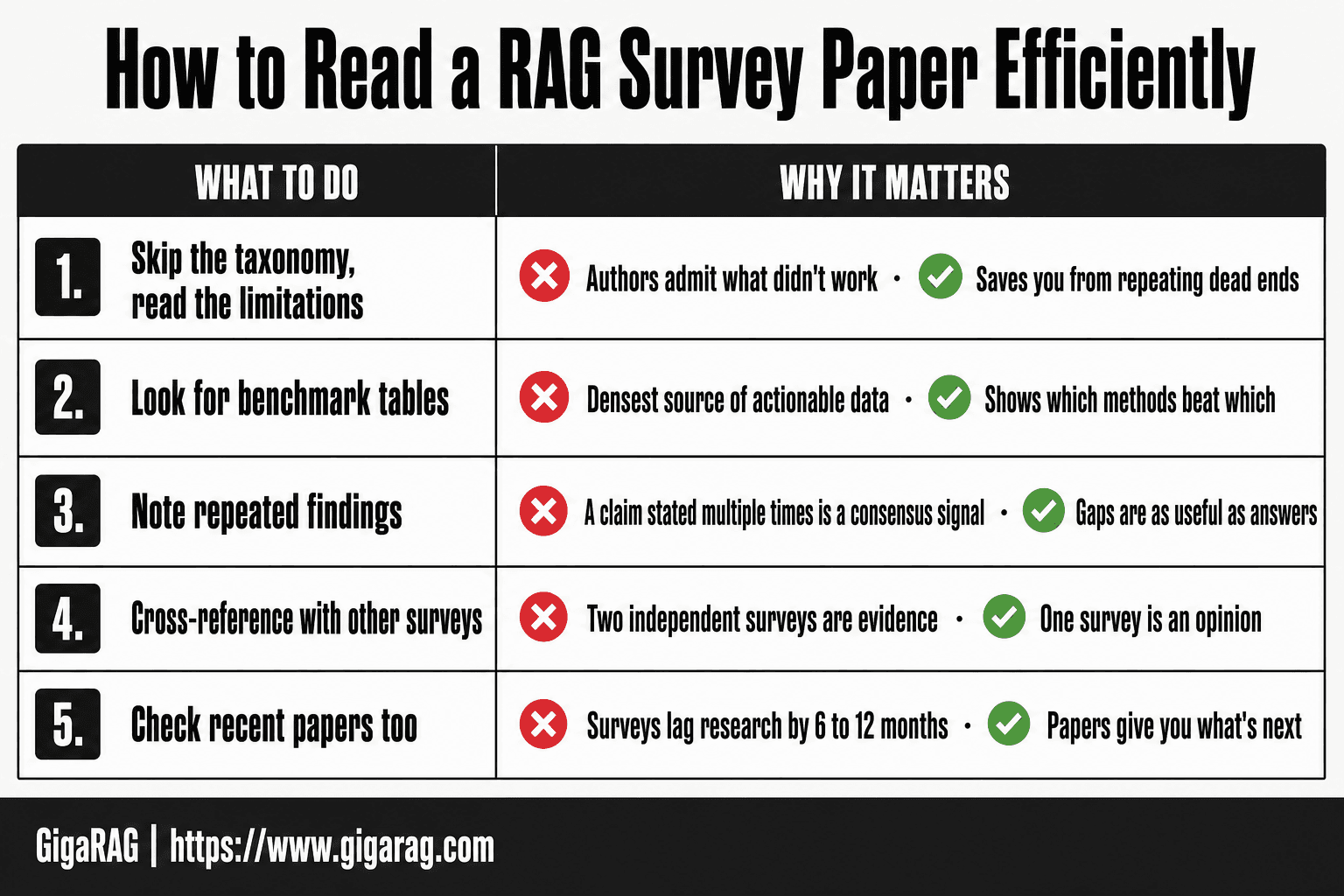
How to Read a RAG Survey Paper Efficiently
Most RAG surveys are 30 to 60 pages. You don't need all of them. You need the 20% that changes what you build. Here's a repeatable method that gets you there in under 30 minutes.
Skip the taxonomy, read the limitations
Every survey opens with a taxonomy: naive, advanced, modular, and a dozen subcategories. You can skip most of it. The taxonomy tells you how the authors organized their thinking, not what you should do.
The limitations section is where the real signal lives. Authors admit what didn't work, what they couldn't test, and where the evidence is thin. That's the part that saves you from repeating dead ends. Read the limitations before the methodology. It's faster and more honest.
Look for benchmark tables and consensus findings
Benchmark tables are the densest source of actionable data in any survey. They show which methods beat which, on which datasets, by how much. Don't read the prose around them. Read the numbers.
Then look for findings the authors state more than once. If a survey says reranking improves precision in three separate sections, that's a consensus signal. If it says chunk size matters but never gives a number, that's a gap. Note both.
Cross-reference with other surveys
One survey is an opinion. Two surveys that independently reach the same conclusion are evidence. When you find a claim that matters for your pipeline, check it against a second survey before you act on it.
The main catch is that surveys lag the research by 6 to 12 months. If you're building on the edge, cross-reference with recent papers too, not just other surveys. The surveys give you the stable consensus. The papers give you what's next.
Final Thoughts: Building Better RAG Pipelines with Survey Insights
The surveys agree on the big things: retrieval quality is the bottleneck, reranking pays for itself, and hybrid search beats either approach alone. The disagreements, mostly around chunk size and knowledge graphs, matter less than you'd think. Start with the consensus. Test the contested parts yourself.
What surveys can't give you is a running pipeline. They won't tell you how your documents chunk, how your embeddings drift, or whether your agent's memory actually retrieves the right context at the right time. That's the gap between reading about RAG and shipping it.
GigaRAG is built to close that gap. It operationalizes the survey insights covered here: hybrid retrieval, reranking, and memory modules for agents, wired together so you don't hand-roll each component. If you're building agent memory or a production RAG pipeline, the rag survey papers, summarized above, give you the map. GigaRAG gives you the road.
Frequently Asked Questions
What are the key findings from recent RAG survey papers?
Recent surveys highlight a shift from naive RAG to modular and agentic architectures. They consistently find that retrieval quality, reranking, and query transformation significantly impact performance. Surveys also note open challenges in evaluation and multi-step reasoning.
How do RAG surveys differ from practical guides?
Surveys focus on taxonomies, research trends, and theoretical frameworks, while practical guides provide implementation details, code, and tuning advice. Surveys help you understand the landscape; guides help you build.
Can RAG surveys help with production deployment?
Indirectly. They inform architecture decisions by explaining trade-offs between paradigms (e.g., naive vs. agentic RAG). However, they lack production-specific details like latency, cost, and scaling, so you'll need additional resources.
What is agentic RAG according to surveys?
Agentic RAG integrates autonomous agents into the RAG pipeline, enabling iterative retrieval, tool use, and dynamic decision-making. Surveys describe it as an evolution beyond static retrieval, suited for complex tasks requiring multi-step reasoning.
Are there RAG surveys focused on agent memory?
Some recent surveys cover memory mechanisms in RAG, particularly in the context of agentic systems. They discuss short-term and long-term memory, but dedicated surveys on agent memory are still emerging.
How often are RAG surveys updated?
RAG surveys are typically updated annually or when significant advancements occur. Given the rapid pace of RAG research, check for new surveys every 6–12 months to stay current.
About GigaRAG
GigaRAG is for agent memory and RAG pipeline builders. get this right. Whether you are working through rag survey papers, summarized or something adjacent, we publish what we have actually tested, including where it falls short.