RAG vs LLM vs Fine-Tuning vs Long Context: What Actually Works for Agent Memory
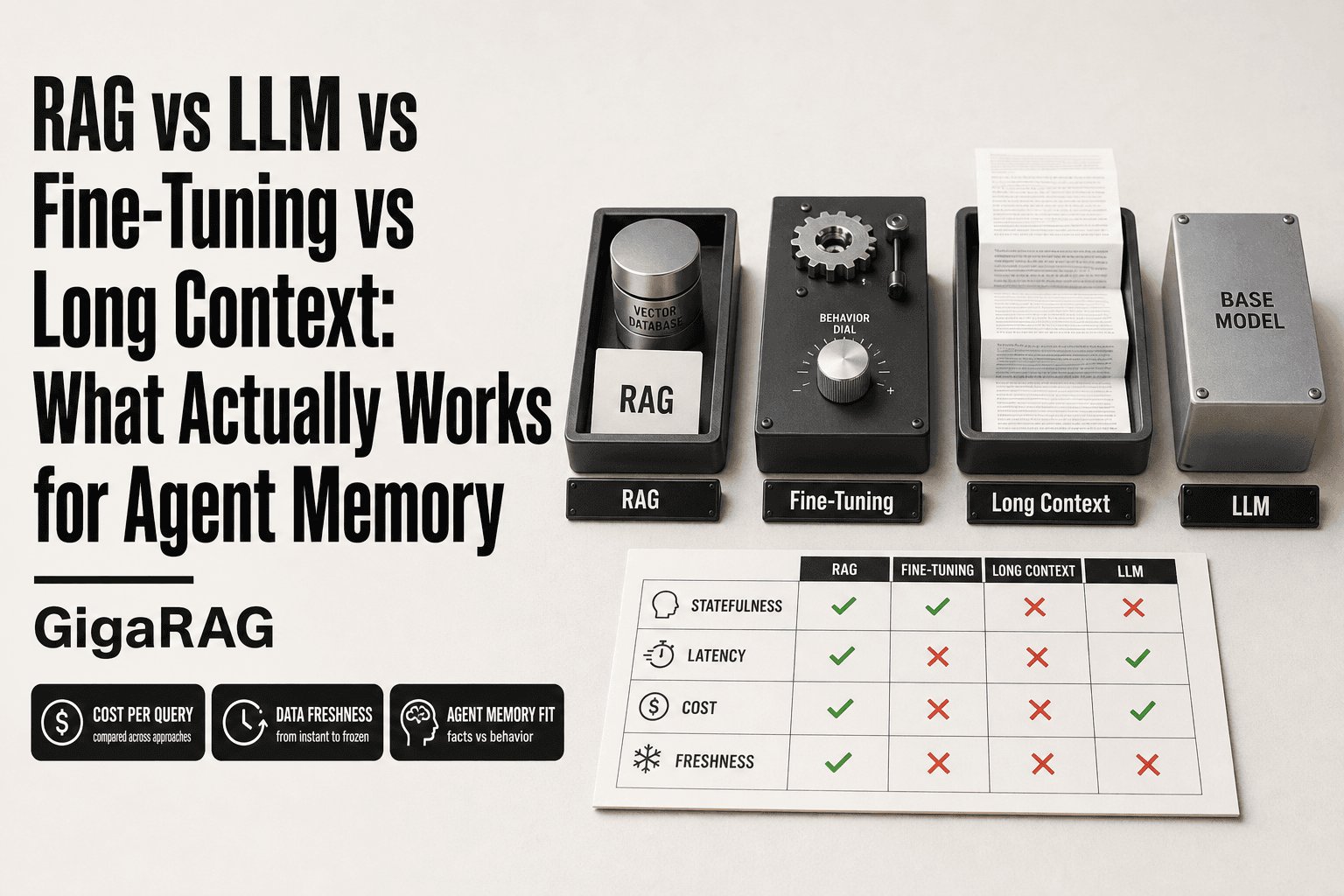
rag vs llm vs fine-tuning vs long context is the search you run when you've built enough agent memory systems to know every option sounds plausible and none feels clearly right. You've watched long context costs climb with every turn of the conversation. You've hit retrieval quality walls in RAG. You've wondered if fine-tuning would fix the behavior, only to realize it won't touch the knowledge. Most articles recycle the same definitions and stop there. They don't tell you what each approach breaks on. This guide does. It's written for agent memory and RAG pipeline builders who need to decide under real constraints: statefulness, latency budgets, cost per query at scale, and data freshness. GigaRAG is built for exactly that problem, but the honest answer is that no single approach wins. It depends on what your agent needs to remember and how fast it needs to recall it.
| At a glance | Details |
|---|---|
| RAG Best For | Dynamic, factual, up-to-date knowledge |
| Fine-Tuning Best For | Style, format, domain tone |
| Long Context Best For | Small, static, high-stakes context |
| Agent Memory Fit | RAG for facts, fine-tuning for behavior |
| Cost Driver | Retrieval vs training vs tokens |
| Latency Trade-off | RAG adds retrieval; long context adds tokens |
In This Guide
- What Is RAG? A Practical Definition for Pipeline Builders
- RAG vs Fine-Tuning vs Long Context: Which Fits Agent Memory?
- What Is Fine-Tuning? When You Should Actually Consider It
- Rag Vs Llm Vs Fine-tuning Vs Long Context: A Step-by-Step Guide
- What Is Long Context? The 1M-Token Window Reality Check
- RAG vs Fine-Tuning vs Long Context: Cost and Performance Compared
- What Each Approach Cannot Do: Honest Limitations
- Choosing the Right Approach for Agent Memory
- RAG Pipeline Architecture for Agent Memory: What Builders Get Wrong
- Common Mistakes When Choosing RAG vs LLM vs Fine-Tuning vs Long Context
What Is RAG? A Practical Definition for Pipeline Builders
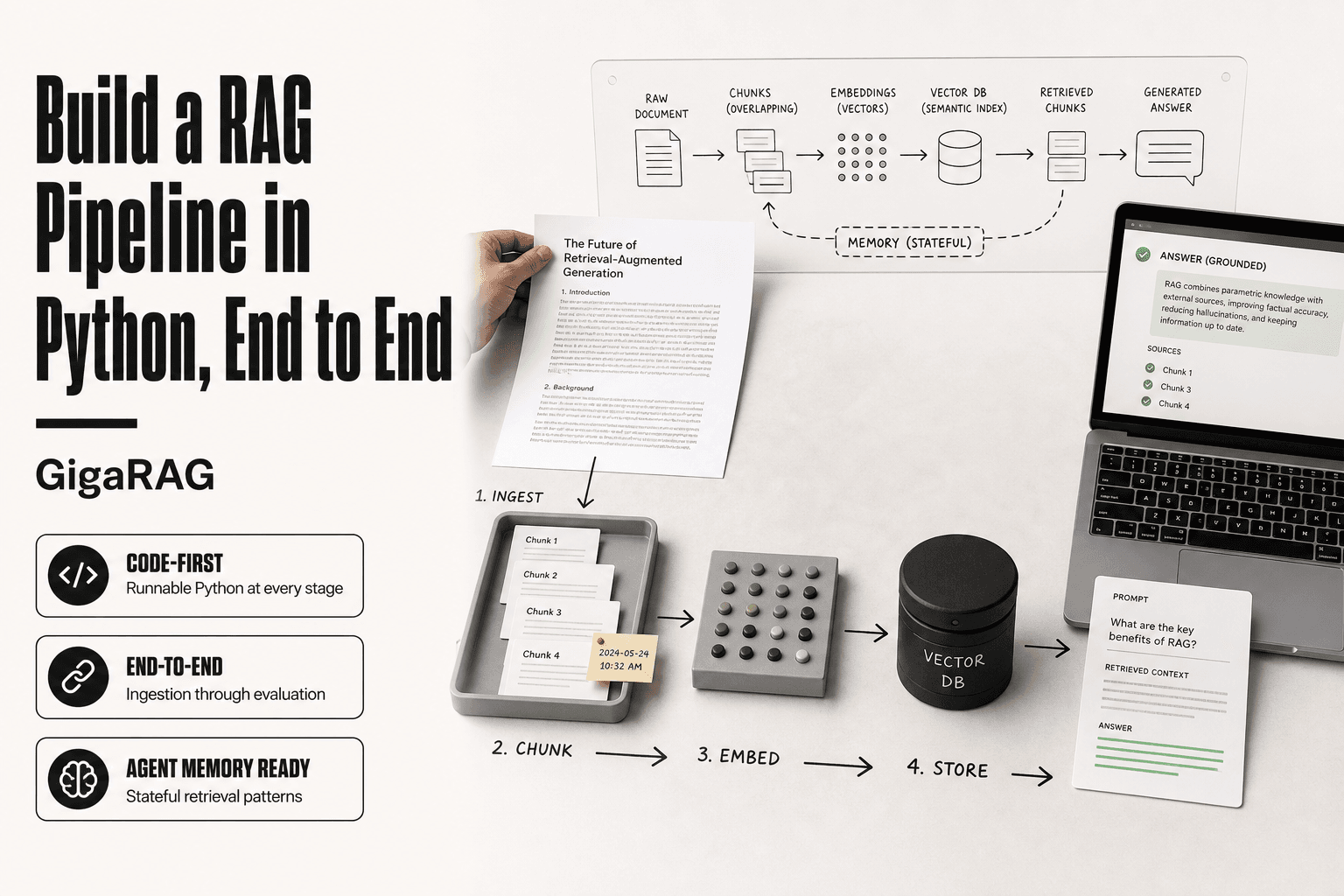
RAG (retrieval-augmented generation) is an architecture that gives an LLM access to external data at query time, instead of baking that data into model weights. The model retrieves relevant chunks from a knowledge base, stuffs them into the prompt, and generates an answer grounded in what it just read.
The retrieval-augmentation-generation loop
The loop runs three steps every query. Retrieval converts your question into an embedding, then searches a vector database for the nearest chunks. Augmentation inserts those chunks into the prompt alongside the question. Generation runs the LLM on that combined input.
Here's what happens behind the scenes: the embedding model and the LLM are usually different models. The embedding model handles search. The LLM handles reasoning and writing. That split matters because you can swap either one independently.
The main catch is that retrieval quality sets your ceiling. If the right chunk isn't in the top-k results, the LLM never sees it, and no amount of prompt engineering recovers the answer.
Where RAG fits in an agent memory stack
RAG is the read path for agent memory. When an agent needs to recall a past conversation, a fact from a knowledge base, or a document, it runs retrieval against a vector store. The retrieved context becomes working memory for that turn.
What RAG doesn't do is maintain state between turns. The agent's conversation history still lives in the prompt or a separate memory layer. RAG handles the long-term, searchable knowledge. The short-term context window handles the current task.
[!note] Fine-tuning does not reliably teach new factual knowledge; it adjusts model behavior, style, and format. For facts, use retrieval or long context.
RAG vs Fine-Tuning vs Long Context: Which Fits Agent Memory?
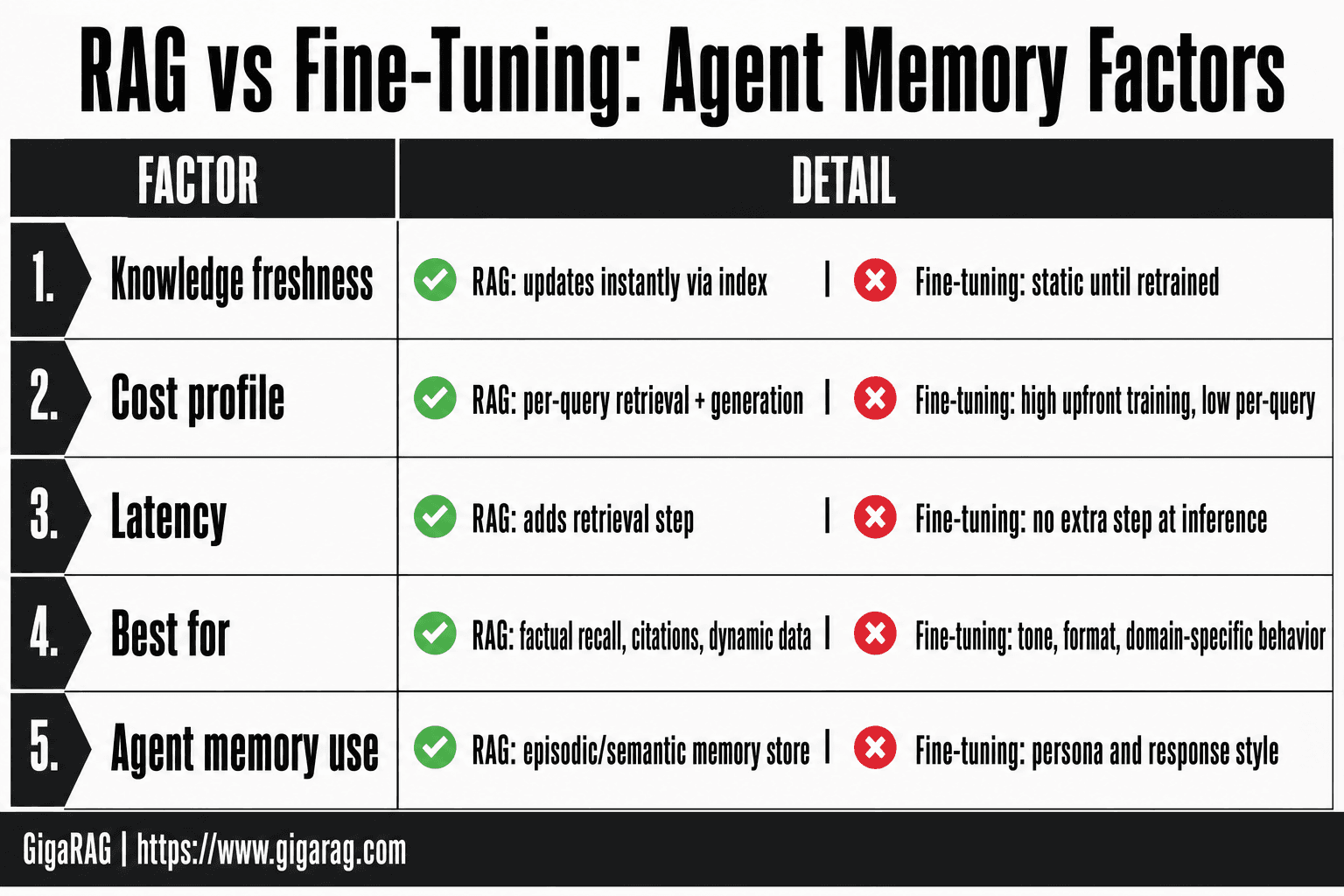
| Factor | RAG | Fine-Tuning |
|---|---|---|
| Knowledge freshness | Updates instantly via index | Static until retrained |
| Cost profile | Per-query retrieval + generation | High upfront training, low per-query |
| Latency | Adds retrieval step (tens to hundreds of ms) | No extra step at inference |
| Best for | Factual recall, citations, dynamic data | Tone, format, domain-specific behavior |
| Agent memory use | Episodic/semantic memory store | Persona and response style |
What Is Fine-Tuning? When You Should Actually Consider It
Fine-tuning means taking a pre-trained model and continuing training on a smaller, domain-specific dataset. You update the model weights themselves. The result is a model that behaves differently: it follows your format, matches your tone, and handles your edge cases without needing those instructions repeated in every prompt.
What fine-tuning changes (and what it doesn't)
Fine-tuning changes behavior, not knowledge. It teaches the model how to respond, not what to know. If you fine-tune on customer support transcripts, the model learns to match that style and follow those procedures. It does not learn new facts about your products unless those facts were already in the training data.
The honest answer is that fine-tuning is a poor tool for adding information. The knowledge cutoff stays roughly where it was. New facts get baked in weakly, if at all, and they go stale immediately. For fresh data, you still need RAG or long context.
What fine-tuning does well: it makes a model cheaper to run. A fine-tuned smaller model can match a larger general model on a narrow task. You trade upfront training cost for lower per-token inference cost.
Fine-tuning for agent behavior vs. agent knowledge
Agent builders hit this split constantly. You want your agent to call tools in a specific order, use a particular output schema, or stay within guardrails. That's behavior. Fine-tuning helps.
You want your agent to know yesterday's inventory or a customer's account history. That's knowledge. Fine-tuning doesn't help.
In practice, most agent teams fine-tune for tool-calling reliability and schema adherence, then use RAG for everything factual. The two approaches solve different problems.
[!tip] For agent memory, start with a RAG pipeline using a vector database and a small, fast embedding model. Only consider fine-tuning if your agent's tone or output format consistently fails after prompt engineering.
Rag Vs Llm Vs Fine-tuning Vs Long Context: A Step-by-Step Guide
- Map your memory types: separate factual (semantic), episodic, and procedural needs.
- Define latency budget: measure acceptable end-to-end response time for your agent.
- Estimate query volume and cost per query for each approach at your scale.
- Assess data freshness: how often does your knowledge change?
- Prototype with RAG for dynamic facts; add fine-tuning only if style/format fails.
- Test long context only for small, static, high-stakes context windows.
- Benchmark hybrid: RAG for facts + fine-tuned model for behavior.
What Is Long Context? The 1M-Token Window Reality Check
Long context means stuffing everything into the prompt. Instead of retrieving relevant chunks, you pass the entire document set, conversation history, or knowledge base to the model in one shot. Models like Gemini and Claude now advertise 1M-token windows, and the pitch is simple: skip the retrieval pipeline entirely.
The catch is that "can hold" is not the same as "can use well." Models lose track of details in the middle of very long prompts. And you pay for every token on every call, whether the model needed it or not.
How long context models handle agent memory
For agent memory, long context looks tempting. You keep the full conversation history and all retrieved context in the prompt, and the model has everything available. No chunking decisions, no embedding drift, no vector database to maintain.
What actually happens: the model attends to recent tokens far more reliably than tokens buried 800K positions back. Needle-in-a-haystack benchmarks show models can find a single fact in a long prompt, but real agent workflows need the model to reason across dozens of scattered facts simultaneously. That's a harder test, and long context models degrade on it.
The 24x cost problem: benchmark reality
The Towards AI benchmark tested all three approaches on the same documents. Long context was 24x more expensive than RAG on clean QA tasks, with no accuracy gain to justify it.
That number comes from the mechanics. RAG sends a few hundred tokens of retrieved context per query. Long context sends the entire corpus every time. At 1M tokens per call, even cheap models cost dollars per query. At agent scale, thousands of queries per day, that's thousands of dollars daily for context the model mostly ignores.
RAG vs Fine-Tuning vs Long Context: Cost and Performance Compared
The three approaches sit on different cost curves, and the differences compound at agent scale. RAG pays per query for retrieval plus a small prompt. Long context pays per token for the entire window, every call. Fine-tuning pays upfront for training, then per token at inference with no retrieval overhead.
Cost per query: RAG vs long context vs fine-tuning
RAG is the cheapest per query at scale. You pay for embedding storage, a vector search, and a few hundred tokens of retrieved context. The Towards AI benchmark put long context at 24x the cost of RAG on clean QA, with no accuracy gain.
Long context costs scale linearly with window size. A 1M-token call costs roughly 100x a 10K-token call, whether the model uses the extra context or not. That's the core problem: you pay for tokens the model mostly ignores.
Fine-tuning has a different shape. Training a 7B model on domain data runs hundreds to thousands of dollars depending on dataset size and epochs. After that, inference costs match the base model. No retrieval overhead, no long prompts. The breakeven point depends on query volume: at low volume, training costs dominate. At high volume, fine-tuning wins because each query is cheap.
Latency and data freshness tradeoffs
RAG adds latency from the retrieval step. Embedding the query, searching the vector database, and reranking results typically adds 50 to 300 milliseconds before generation starts. Long context skips retrieval but pays in prefill time: processing 1M tokens before the first output token can take seconds.
Data freshness is where the approaches diverge sharply. RAG reads from your vector database, so updating a document means re-embedding and upserting. New facts are available on the next query. Fine-tuning bakes knowledge into weights. New facts require retraining, which takes hours to days and costs money. Long context reads whatever you put in the prompt, so freshness is instant, but you pay the full token cost every time.
Maintenance burden: what breaks first
RAG breaks at retrieval quality. Chunking decisions, embedding model drift, and vector database staleness all degrade results silently. You'll spend time tuning retrieval before you trust the answers.
Fine-tuning breaks at data drift. The model's knowledge freezes at training time. When your domain changes, the model doesn't know it, and there's no cheap fix.
Long context breaks at cost. The first month looks fine. Then query volume grows, and the token bill grows with it. Nothing degrades in quality; the economics simply stop working.
What Each Approach Cannot Do: Honest Limitations
Every approach has a hard ceiling. The ceiling isn't a bug you can patch around; it's built into the architecture. Here's what you should not expect from each.
RAG limitations: retrieval quality is your ceiling
RAG cannot fix bad retrieval. If your embedding model misses the relevant chunk, the LLM generates a confident answer from the wrong context. You can't prompt your way out of a retrieval miss. The generator only knows what the retriever hands it.
Chunking is the other silent failure point. Split documents wrong, and the answer sits across two chunks, neither of which contains the full fact. RAG won't reassemble them. It retrieves chunks, not meaning.
Fine-tuning limitations: knowledge cutoff is permanent
Fine-tuning cannot add new facts. It changes how the model responds, not what it knows. Train on last month's data, and the model stays frozen there. No amount of fine-tuning fixes freshness.
It also can't unlearn a bad behavior reliably. You can push the model toward a style, but it will still drift under pressure. Fine-tuning shapes tendencies; it doesn't install rules.
Long context limitations: cost scales linearly with tokens
Long context cannot scale economically. Every query pays for the entire window, whether the model uses 5% or 95% of it. At 1M tokens per call, the bill grows with query volume, not with value delivered.
It also can't guarantee attention. Models attend unevenly to long inputs. The fact you put in the middle of a 500K-token prompt may simply not register. You paid for it anyway.
Choosing the Right Approach for Agent Memory
The honest answer is it depends on four things: statefulness, latency, cost, and freshness. Rank them before you pick an architecture.
Decision tree: statefulness, latency, cost, freshness
Start with statefulness. If your agent needs to remember a conversation across turns, RAG gives you a memory layer you can query. Long context holds everything in the prompt, but it resets when the window closes. Fine-tuning doesn't help here at all; it changes behavior, not memory.
Next, latency. RAG adds a retrieval step, typically 50 to 200 milliseconds on top of generation. Long context skips retrieval but pays in prefill time, which grows with every token you stuff in. Fine-tuning adds nothing to inference latency, which is why it wins when speed is the hard constraint.
Then cost. Long context is the most expensive per query because you pay for the entire window every call. RAG costs scale with retrieval volume, not prompt size. Fine-tuning has an upfront training cost but near-zero marginal cost per query.
Finally, freshness. If your data changes daily, RAG is the only option that keeps up. Fine-tuning freezes knowledge at training time. Long context is only as fresh as what you paste in.
When hybrid RAG + fine-tuning is the right call
Combine them when you need both fresh knowledge and a specific behavioral style. Fine-tune the model to follow your agent's tool-calling format, then use RAG to feed it current data. The fine-tuned model handles the how; RAG handles the what. This is the standard pattern for production agents that need consistent output formatting plus live retrieval.
The main catch is maintenance. You now have two systems to monitor: the fine-tuned weights and the retrieval pipeline. When one drifts, the other can't compensate.
When long context is actually worth the cost
Long context earns its price when the task requires reasoning across a document that can't be chunked cleanly. Legal contracts, full codebases, research papers with cross-references. If retrieval would split the critical fact across chunks, long context is the only option that works.
It's also worth it for low-volume, high-value queries. Ten calls a day at 1M tokens each is fine. Ten thousand calls a day is not.
RAG Pipeline Architecture for Agent Memory: What Builders Get Wrong
Most RAG failures aren't architecture choice failures. They're pipeline failures. You picked the right approach and built the retrieval wrong.
Chunking strategies for conversational agent memory
Conversations don't chunk like documents. A turn is not a paragraph. If you split agent dialogue by token count, you'll cut a user's question from the assistant's answer, and the embedding loses the relationship. Chunk by turn boundaries, not arbitrary length. Keep question-answer pairs together. For multi-turn threads, group turns that resolve the same intent into one chunk. The main catch is that turn-based chunks vary wildly in size, which breaks vector database assumptions about uniform chunk length. You'll need to handle that in your indexing logic.
Embedding models: what matters for retrieval quality
The embedding model matters less than most builders think. Retrieval quality gaps usually trace back to chunking and metadata, not the model. Pick a model that handles your content type well. For conversational memory, you need an embedding that captures intent, not just lexical overlap. Test on your actual agent transcripts, not a public benchmark. A model that scores 90 on MTEB can still miss the way your users phrase follow-up questions.
Evaluating retrieval: metrics that actually predict agent performance
Standard retrieval metrics mislead you. Recall@10 tells you the right chunk is somewhere in the top ten. Your agent doesn't get ten chances. It gets one, maybe two. Evaluate with recall@1 and mean reciprocal rank. Better yet, measure end-to-end: does the agent give the right answer with the retrieved context? That's the only metric that predicts user experience. Build a small eval set of real agent conversations, run it on every pipeline change, and watch recall@1. If it drops, your chunking or embedding change made things worse, no matter what the benchmark says.
Common Mistakes When Choosing RAG vs LLM vs Fine-Tuning vs Long Context
Builders pick the wrong approach for the same three reasons. None of them are technical failures. They're shortcuts.
Defaulting to long context because it's simpler
Long context looks like the easy path. No vector database, no chunking, no embedding pipeline. You stuff the conversation into the prompt and move on. The simplicity is real. The cost is not. At 1M tokens, you're paying for every token on every call, whether the model needs it or not. For an agent that runs hundreds of turns per session, that bill compounds fast. Simpler to build, brutal to operate.
Fine-tuning when you actually need fresh data
Fine-tuning changes how the model behaves. It does not change what the model knows. If your agent needs today's ticket status or this week's pricing, fine-tuning won't help. The weights were frozen at training time. You'll retrain constantly, and the data will still be stale by the time you deploy. Fresh data needs retrieval, not weight updates.
RAG when you actually need behavioral change
RAG adds context. It doesn't change how the model reasons over that context. If your agent retrieves the right chunk but still formats answers wrong, uses the wrong tone, or ignores tool-calling conventions, RAG won't fix it. That's a behavior problem. Fine-tuning is the tool for behavior. RAG is the tool for knowledge. Mixing them up is the most expensive mistake in the rag vs llm vs fine-tuning vs long context decision.
Frequently Asked Questions
Which is better for fine-tuning an LLM, RAG or fine-tuning?
They solve different problems. RAG is better for injecting up-to-date factual knowledge without retraining. Fine-tuning is better for teaching style, format, or domain-specific behavior. Many production agents use both: RAG for facts, fine-tuning for tone.
Is ChatGPT an LLM or generative AI?
ChatGPT is a product built on top of large language models (LLMs), which are a type of generative AI. The LLM is the underlying model; ChatGPT is the interface and system around it.
What are the top 5 LLM models?
As of 2026, commonly cited top LLMs include GPT-4 series, Claude 3 series, Gemini 1.5/2.0, Llama 3/4, and Mistral Large. Rankings shift quickly; evaluate based on your task, latency, and cost.
Is BERT an LLM or transformer?
BERT is a transformer-based language model, but it is not typically called an LLM in the generative sense because it is encoder-only and not designed for open-ended text generation. It is a transformer model used for understanding tasks.
RAG vs fine-tuning vs long context: which is cheapest at scale?
It depends on query volume and context size. RAG often has lower upfront cost but adds per-query retrieval and generation costs. Fine-tuning has high upfront training cost but low per-query cost. Long context can be expensive per query due to token usage. Model total cost of ownership for your expected volume.
Can I use RAG and fine-tuning together for agent memory?
Yes, and it is often the best approach. Use RAG to retrieve relevant facts and episodic memories, and fine-tune the model to follow your agent's persona, formatting rules, and tool-use patterns. This hybrid balances freshness, cost, and behavior.
What are the limitations of long context for agent memory?
Long context is limited by cost per token, latency, and the model's effective attention over very long inputs. It also does not persist across sessions unless you re-supply the context. For large or frequently changing memory, retrieval-based approaches are usually more practical.
About GigaRAG
GigaRAG helps GigaRAG is for agent memory and RAG pipeline builders. get this right. Whether you are working through rag vs llm vs fine-tuning vs long context or something adjacent, we publish what we have actually tested, including where it falls short.