RAG vs LLM vs Fine-Tuning vs Long Context: What Actually Works for Agent Memory
RAG vs LLM vs fine-tuning vs long context: four techniques, endless vendor claims, and no honest map for the builder who has to pick one. If you're designing agent memory or a RAG pipeline, you've probably heard that fine-tuning is dead, or that a 1M-token context window makes retrieval obsolete, or that RAG is just a stopgap until models get bigger. None of that is true, and all of it is expensive to believe.
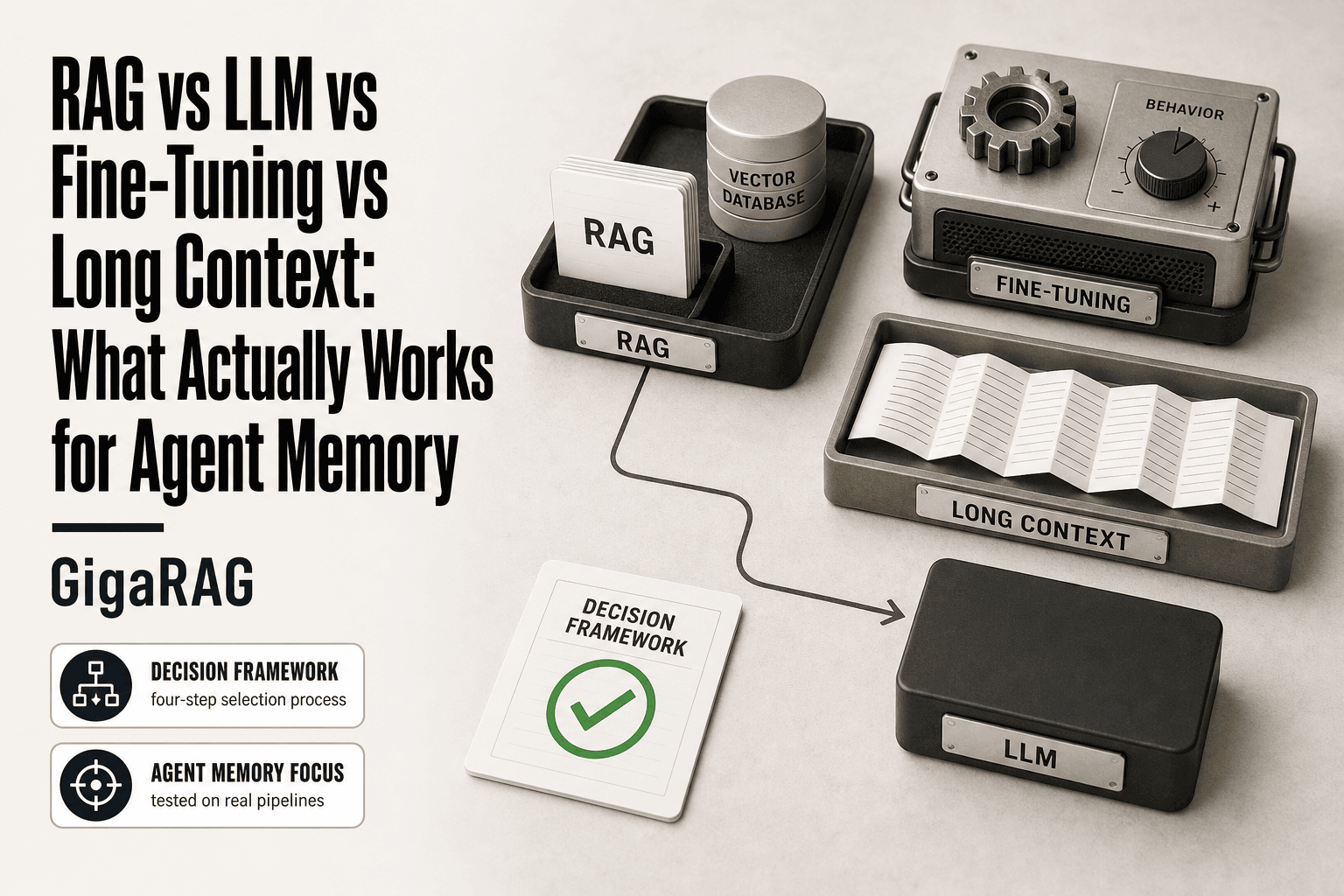
The four approaches solve different problems. RAG injects knowledge at inference time. Fine-tuning changes how the model behaves. Long context expands how much the model can see at once. A base LLM does none of these things without help. The confusion comes from treating them as competitors when they're really different tools for different jobs.
This guide reflects the lessons from building GigaRAG specifically for agent memory work. You'll get a plain-language definition of each approach, what each one cannot do, and a decision framework you can apply to your own latency, cost, and accuracy constraints.
| At a glance | Details |
|---|---|
| Core difference | Where knowledge lives: weights, prompt, or index |
| Best for fresh facts | RAG and long context |
| Best for behavior | Fine-tuning |
| Cost pattern | RAG: per-query; fine-tuning: upfront; long context: per-token |
| Latency pattern | Fine-tuning fastest; long context slowest |
| Agent memory pick | Usually RAG plus selective fine-tuning |
In This Guide
- What Is RAG vs LLM vs Fine-Tuning vs Long Context?
- RAG vs Fine-Tuning vs Long Context: Which Fits Your Agent Memory?
- RAG vs Fine-Tuning: The Core Tradeoff
- Rag Vs Llm Vs Fine-tuning Vs Long Context: A Step-by-Step Guide
- Long Context vs RAG: When the Context Window Is Enough
- Fine-Tuning vs Long Context: Behavior Change vs Knowledge Access
- What Each Approach Cannot Do
- A Decision Framework for Agent Memory and RAG Pipeline Builders
- Hybrid Approaches: Combining RAG, Fine-Tuning, and Long Context
- Cost Considerations for rag vs llm vs fine-tuning vs long context
What Is RAG vs LLM vs Fine-Tuning vs Long Context?
These four terms describe different architectural choices for getting knowledge into a model, not competing products. An LLM is the base model. RAG adds retrieval at inference time. Fine-tuning changes the model's weights through training. Long context expands how much input the model can see at once.
What is an LLM (the baseline)?
An LLM is a neural network trained on a large text corpus to predict the next token. It has fixed knowledge from training, a fixed context window, and fixed behavior. ChatGPT is an LLM wrapped in a product. Generative AI is the broader category: any system that produces text, images, or audio. So ChatGPT is both an LLM and generative AI.
The key constraint: an LLM knows only what it saw during training. Ask it about something after its cutoff, and it guesses or hallucinates.
What is RAG?
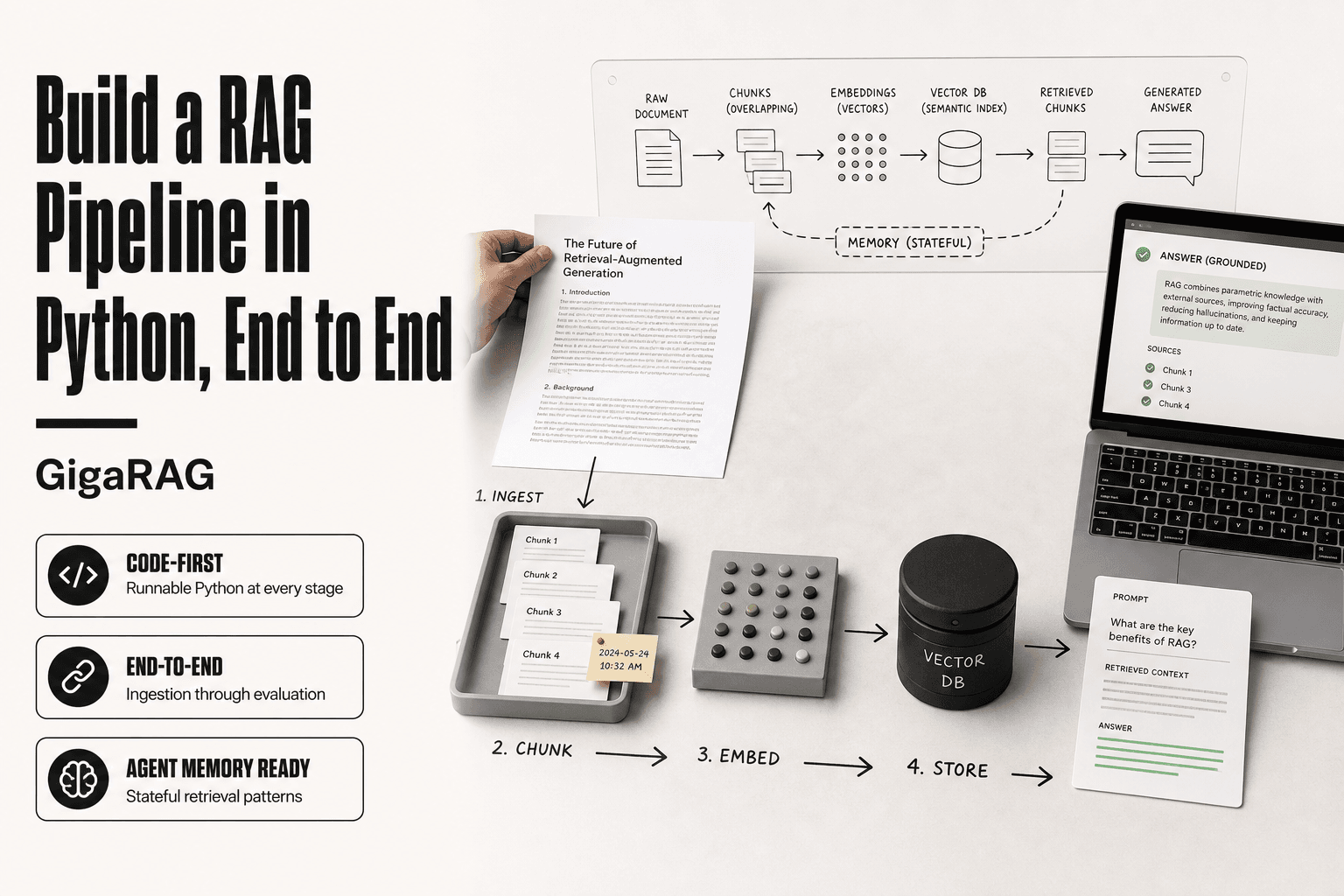
RAG adds a retrieval step before generation. Your query gets embedded, matched against a vector database, and the most relevant chunks get stuffed into the prompt alongside the question. The model answers using that retrieved context.
It's the cheapest way to add fresh, specific knowledge without retraining. The catch: retrieval quality caps answer quality. Bad embeddings or bad chunking mean bad answers, no matter how good the model is.
What is fine-tuning?
Fine-tuning continues training on a smaller, task-specific dataset. It changes how the model behaves: tone, format, instruction-following, domain style. It does not reliably add new facts. The model can memorize some training examples, but it won't generalize to unseen knowledge the way retrieval does.
Fine-tuning is for behavior change, not knowledge injection. Confusing the two is the most common mistake builders make.
What is long context?
Long context means the model can accept more tokens in a single prompt. Some models now handle 1M tokens or more. You can paste entire documents, codebases, or conversation histories directly.
The tradeoff: cost scales with token count, latency increases, and attention degrades over long inputs. The model doesn't read everything equally. It pays most attention to the beginning and end.
[!note] RAG, fine-tuning, and long context are not mutually exclusive; production agent memory systems often combine two or all three, using retrieval for facts, fine-tuning for behavior, and long context for tasks that need whole-document reasoning.
RAG vs Fine-Tuning vs Long Context: Which Fits Your Agent Memory?
| Factor | RAG | Fine-Tuning |
|---|---|---|
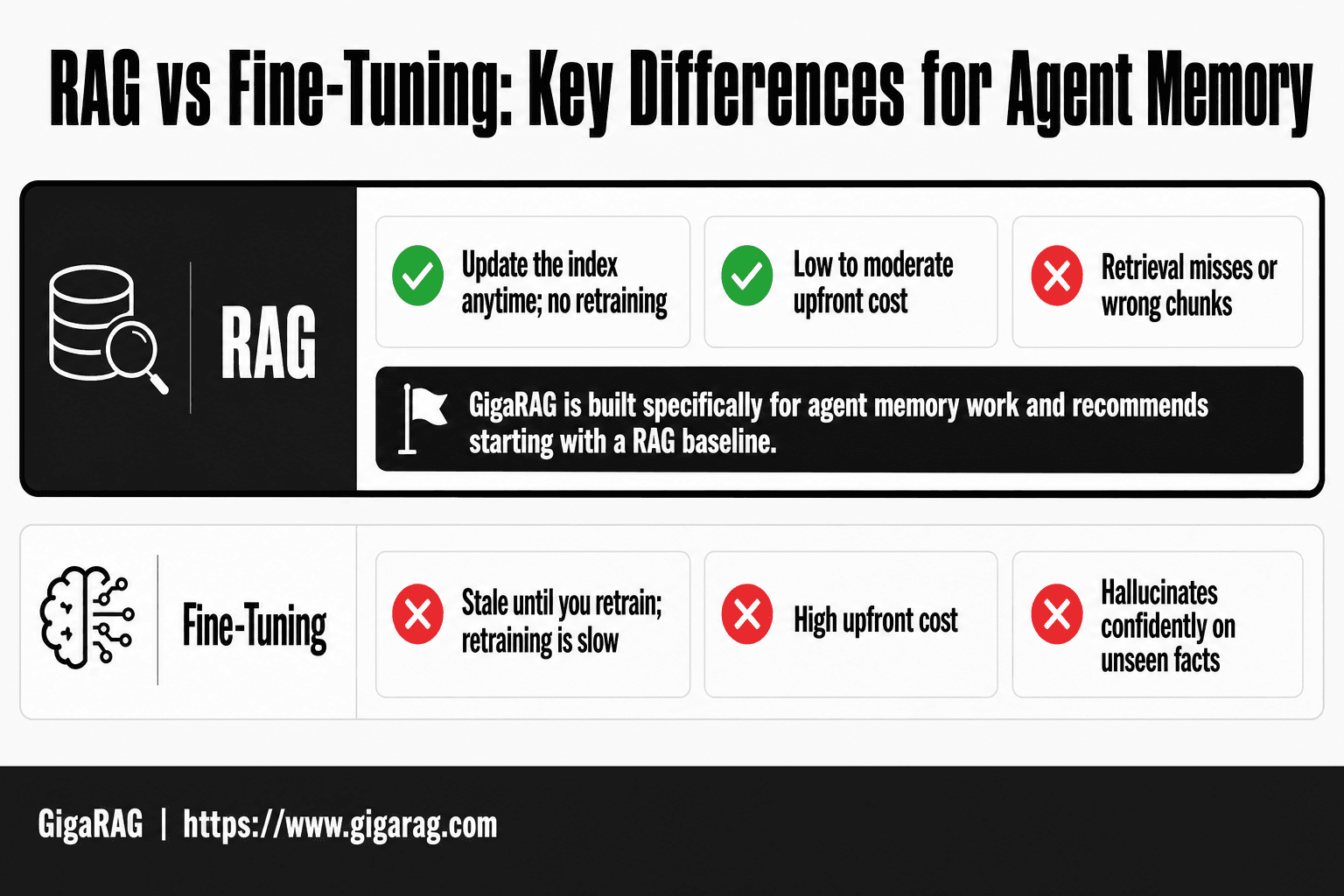
| Knowledge freshness | Update the index anytime; no retraining | Stale until you retrain; retraining is slow |
| Behavior and style | Limited; depends on prompt and model | Strong; bakes in tone, format, and skills |
| Upfront cost | Low to moderate; build and maintain a pipeline | High; data prep, GPU time, evaluation |
| Per-query cost | Retrieval plus generation tokens | Generation tokens only; no retrieval step |
| Failure mode | Retrieval misses or wrong chunks | Hallucinates confidently on unseen facts |
RAG vs Fine-Tuning: The Core Tradeoff
The honest answer is that RAG and fine-tuning solve different problems. RAG adds knowledge at inference time without touching model weights. Fine-tuning changes how the model behaves by continuing training on a task-specific dataset. If you need fresh facts, use RAG. If you need a different tone, format, or instruction style, fine-tune.
Knowledge injection vs behavior change
RAG injects knowledge by retrieving relevant chunks and stuffing them into the prompt. The model's weights stay frozen. Fine-tuning bakes patterns into the weights themselves through gradient updates. The distinction matters because retrieval can be updated instantly, while fine-tuning requires a new training run every time your data shifts.
Data freshness and update cadence
RAG wins on freshness. Update your vector database, and the next query sees the new data. No retraining, no redeployment. Fine-tuning lags: you collect new examples, retrain, evaluate, and redeploy. That cycle takes days at minimum. For a knowledge base that changes weekly, RAG is the only practical option.
Cost profile: inference vs training
RAG costs more per query because you pay for embedding, vector search, and extra prompt tokens. Fine-tuning costs more upfront: GPU hours, data prep, evaluation. The break-even depends on query volume. At low volume, RAG is cheaper. At high volume with stable knowledge, fine-tuning amortizes better.
[!tip] For agent memory builders: start with a RAG baseline and log every retrieval miss. Those misses tell you whether you need better chunking, a fine-tuned reranker, or long context for specific document types, so you invest only where the data proves it.
Rag Vs Llm Vs Fine-tuning Vs Long Context: A Step-by-Step Guide
- Define the task: is it knowledge recall, behavior shaping, or both?
- List hard constraints: latency budget, cost ceiling, and privacy rules.
- Prototype with RAG first; it is the fastest to test and iterate.
- Add long context only if documents fit and latency is acceptable.
- Fine-tune only after you have clean, labeled examples and a clear behavior gap.
- Measure retrieval hit rate, answer accuracy, latency, and cost per query.
- Combine approaches: RAG for facts, fine-tuning for format, long context for deep dives.
Long Context vs RAG: When the Context Window Is Enough
Long context looks like the simplest fix: skip retrieval, dump everything into the prompt, let the model sort it out. The honest answer is that it works, until it doesn't. A 1M-token window is not a substitute for retrieval. It's a different tool with a different failure mode.
What long context actually costs
Token costs scale linearly with context length. A 100K-token prompt costs roughly 100x more than a 1K-token prompt, every single query. You pay that cost whether the model uses the extra context or not. Latency climbs too: attention computation grows with sequence length, so a 1M-token prompt takes noticeably longer to process than a 10K-token one. For an agent making multiple calls per turn, that latency compounds fast.
Attention degradation and the needle-in-a-haystack problem
The bigger the context, the worse the model gets at finding specific facts inside it. This is the needle-in-a-haystack problem: researchers have shown that models reliably retrieve a single fact from short contexts, but accuracy drops as context grows past a certain point. The model doesn't "read" the whole window the way you would. It attends selectively, and the more tokens you stuff in, the more likely it is to miss the one chunk that matters. RAG solves this by retrieving first, so the model only sees the relevant few hundred tokens.
When long context beats RAG
Long context wins when the task requires holding a whole document in view at once: summarizing a 50-page contract, comparing clauses across a legal filing, or reasoning over a codebase where the relationships span many files. Retrieval breaks these tasks because chunking destroys the structure the model needs. Long context also wins for session state in agents: keeping the last 20 turns of conversation in the prompt is simpler than retrieving and re-ranking them every turn. The main catch is that you're trading retrieval quality for convenience, and the bill shows up on every call.
Fine-Tuning vs Long Context: Behavior Change vs Knowledge Access
Fine-tuning and long context get lumped together because both involve "giving the model more." They don't. Fine-tuning changes how the model behaves. Long context changes how much the model can see at once. Confusing the two leads to expensive mistakes: you fine-tune when you needed a bigger window, or you stuff a huge prompt when you needed a behavior change.
Fine-tuning changes behavior, not knowledge
Fine-tuning adjusts model weights on a dataset of examples. The result is a model that responds differently: it follows your format, adopts your tone, or learns to route queries a certain way. What it doesn't do is reliably store new facts. A fine-tuned model can recite training examples, but it won't generalize to fresh information. Knowledge injection is a side effect, not the point.
Long context expands input, not capability
Long context gives the model more tokens to read at inference time. The model's reasoning ability stays the same. A 1M-token window doesn't make the model smarter. It just lets the model see more of your data in one pass. The model still attends selectively, and it still misses things in a huge prompt.
Why this distinction matters for agents
Agent memory has two jobs: remembering what happened, and acting consistently. Long context handles the first job, holding recent turns in the prompt. Fine-tuning handles the second, keeping the agent's behavior stable across sessions. You need both, but for different reasons. Don't pick one when the problem is the other.
What Each Approach Cannot Do
Every approach has a failure mode. The honest answer is that none of these techniques is a complete memory system on its own. Here's what each one breaks on.
What RAG cannot do
RAG retrieves chunks and stuffs them into the prompt. It cannot change how the model reasons about what it retrieves. If the model doesn't know how to use a retrieved schema or a retrieved policy, RAG won't teach it. Retrieval quality is also a hard ceiling: if your embeddings don't surface the right chunk, the model never sees it. RAG cannot fix bad chunking, bad embeddings, or a query that doesn't match any stored document. For agent memory, RAG fails when the agent needs to synthesize across many retrieved fragments into a single coherent state. Retrieval gives you pieces. It doesn't assemble them.
What fine-tuning cannot do
Fine-tuning changes behavior on the distribution you trained on. It cannot keep up with data that changes daily. Every new fact requires a new training run, and even then the model may not retain it reliably. Fine-tuning also cannot guarantee the model will refuse to hallucinate outside its training distribution. A fine-tuned agent still invents plausible-sounding details when asked something it never saw. For memory, fine-tuning cannot store session-specific state. It has no notion of "this user" or "this conversation." It only knows patterns.
What long context cannot do
Long context lets the model see more tokens. It cannot make the model attend to all of them equally. Attention degrades as the prompt grows, and the model will miss details buried in the middle. Long context also cannot reduce cost: every token in the window is billed, every call. For agent memory, a huge context window is not a database. It's a scratchpad that gets resent on every turn. It cannot persist state between sessions unless you rebuild the prompt each time.
What a base LLM cannot do
A base LLM knows what it was trained on, up to its cutoff. It cannot access your private documents, your user's history, or anything that happened after training. It cannot update itself. It cannot tell you when it doesn't know. For agent memory, a base LLM has no memory at all. It's stateless. Every turn starts from zero unless you build memory around it.
A Decision Framework for Agent Memory and RAG Pipeline Builders
You've seen what each approach breaks on. Now you need a way to choose. The framework below is the one I use when scoping agent memory systems. It's four steps, and each step eliminates options.
Step 1: Identify the problem type
There are three problem types, and they map to different tools. Knowledge access means the agent needs facts it wasn't trained on: your docs, your user's history, your product catalog. That's RAG or long context. Behavior change means the agent needs to respond differently: follow your format, use your tone, respect your policies. That's fine-tuning. Input size means the agent needs to see a lot at once: a full codebase, a long transcript, a complete policy document. That's long context.
Most agent memory systems are knowledge access problems. Start there.
Step 2: Assess your constraints
Three constraints decide the rest. Latency: if the agent must respond in under 500ms, long context with a huge window will fail. Every token adds compute time. Cost: if you're serving thousands of requests a day, long context bills per token per call, and that compounds. Data freshness: if your knowledge changes hourly, fine-tuning is out. You can't retrain a model every hour.
Write these down before you pick anything. A constraint you ignore at design time becomes an outage at runtime.
Step 3: Map to the right approach
Here's the mapping. Knowledge access with fresh data and tight cost: RAG. Knowledge access with a small, stable corpus and low latency tolerance: long context. Behavior change on a stable task: fine-tuning. Input size that exceeds what RAG can chunk usefully: long context.
If you need two of these, you need a hybrid. That's the next section.
Step 4: Test before committing
Build a 50-example eval set from your real data. Run it against RAG first. It's the cheapest to stand up and the easiest to debug. If retrieval quality is the bottleneck, fix chunking or embeddings before reaching for fine-tuning. If the model retrieves the right chunk but still answers wrong, that's a behavior problem, and fine-tuning is the fix. If the eval shows you need more than 10k tokens of context per turn, test long context and measure the latency and cost directly.
Don't commit to an architecture on a whiteboard. Commit on eval numbers.
Hybrid Approaches: Combining RAG, Fine-Tuning, and Long Context
The honest answer is that production agent memory systems rarely use one approach alone. Each technique covers a different failure mode, and combining them closes gaps that any single method leaves open.
Fine-tuned embeddings + RAG
Fine-tuning the embedding model, not the LLM, is the cheapest hybrid win. Standard embeddings miss domain-specific similarity: "churn risk" and "renewal probability" may not cluster in a generic model. Fine-tune embeddings on your query-document pairs, and retrieval quality improves without touching the generator. The catch is you need labeled pairs, which means real user queries matched to the documents that actually answered them.
RAG + long context for session state
RAG handles the knowledge base. Long context handles the conversation. Keep the current session's turns, tool outputs, and intermediate reasoning in the context window. Retrieve from the vector store only when the agent needs something outside the session. This avoids re-retrieving the same context every turn and keeps the window from bloating with stale chunks.
Fine-tuned router + RAG
Fine-tune a small model to decide when to retrieve, what to retrieve, and when the context already has the answer. A router that skips retrieval when the session state is sufficient cuts latency and cost. The router doesn't answer questions. It just decides where the answer comes from. That's a behavior change problem, which is exactly what fine-tuning is for.
The main catch with any hybrid is debugging. When the system fails, you now have three places to look instead of one.
Cost Considerations for rag vs llm vs fine-tuning vs long context
Cost is where most comparisons fall apart. They quote per-token prices and ignore everything else.
Inference cost: RAG vs long context
RAG pays per query: embedding, retrieval, and a short prompt. Long context pays per token in the window, every turn. A 100k-token context costs roughly 10x a 10k-token RAG prompt on the same model. That gap widens as sessions grow.
Training cost: fine-tuning
Fine-tuning is a one-time cost: data prep, training runs, and evaluation. LoRA keeps it cheap. Full fine-tuning doesn't.
Hidden costs: maintenance and evaluation
RAG needs index updates and retrieval tuning. Fine-tuning needs retraining when behavior drifts. Long context needs prompt pruning. None of them are free after launch.
The honest answer: RAG is cheapest to start, long context is cheapest to build, fine-tuning is cheapest at scale if your data is stable. That's the real tradeoff behind rag vs llm vs fine-tuning vs long context.
Frequently Asked Questions
Which is better for fine-tuning an LLM, RAG or fine-tuning?
They solve different problems. RAG is better when the model needs fresh or private facts it was not trained on. Fine-tuning is better when you need consistent behavior, tone, or a specific output format. Many teams use both: RAG for knowledge, fine-tuning for style.
Is ChatGPT an LLM or generative AI?
ChatGPT is a product built on top of large language models, which are a type of generative AI. The LLM is the underlying model; ChatGPT is the interface and system around it. This distinction matters because RAG and fine-tuning apply to the model layer, not the chat product.
What are the top 5 LLM models?
The leaderboard changes frequently, so any fixed list goes stale quickly. Instead of chasing rankings, evaluate models on your own task using accuracy, latency, and cost per query. The best model for agent memory is the one that passes your evaluation, not the one at the top of a generic list.
Is BERT an LLM or transformer?
BERT is a transformer-based model, but it is an encoder-only model, not a generative LLM like GPT-style decoders. It is excellent for classification and embedding tasks, which is why it often appears in RAG pipelines as a retriever or reranker rather than as the generator.
RAG vs long context: which should I use for agent memory?
Use RAG when your knowledge base is large, changes often, or must be filtered by permissions. Use long context when the relevant documents are few and fit within the model's window, and you need whole-document reasoning. Long context costs more per query and adds latency, so it is rarely the default for high-volume agents.
Can I combine RAG, fine-tuning, and long context in one system?
Yes, and many production systems do. A common pattern is RAG for factual recall, a fine-tuned model for consistent formatting and tool use, and long context for tasks that need to read several full documents at once. Combine them only when measurement shows each one earns its place.
What is the biggest failure mode of each approach for agent memory?
RAG fails when retrieval misses the right chunk or returns stale content. Fine-tuning fails when the model confidently hallucinates facts it never saw in training. Long context fails when important details get lost in the middle of a very long prompt. Knowing these failure modes helps you design fallbacks and evaluations.
About GigaRAG
GigaRAG is for agent memory and RAG pipeline builders. get this right. Whether you are working through rag vs llm vs fine-tuning vs long context or something adjacent, we publish what we have actually tested, including where it falls short.