How to Use Retrieval When Your Knowledge Exceeds the Context Window
A coding agent works from a finite input for each generation. Repository history, prior notes, and decisions outside that input need deliberate retrieval and review.
Retrieval makes project knowledge searchable across sessions. For a coding task, use it to find candidate evidence, compare that evidence with the current repository, and give the agent a focused packet with sources, constraints, and open questions.
Process overview
Use the following controls to keep retrieval focused, traceable, and appropriate for a coding task:
- Define the project scope, source authority, and record status.
- Limit agent access to the project knowledge it is authorized to use.
- Retain source locations, dates, revisions, and unresolved disagreements.
- Compare candidate records with the current repository before relying on them.
- Keep the final task packet limited to evidence that is relevant and usable for the change.
Use retrieval when knowledge exceeds the context window
A context window is the finite token budget supplied to an AI for one generation. Retrieval can surface project knowledge beyond that budget, but the final prompt still needs selected, verified evidence. A larger evidence set can also introduce repetition, stale material, and competing constraints.
[!note] Retrieval narrows a larger body of material into the evidence supplied to the model. Preserve provenance, dates, qualifiers, and unresolved disagreements so the selected material can be checked in context.
The context window is a working budget, not persistent memory
For a current answer, the model receives a finite set of tokens. When project material is kept in a retrieval system, selected records can be added to that working context without placing the entire collection in the prompt.
A large window does not remove selection pressure. eduKate Singapore's guide to RAG context compression explains that retrieved evidence shares the available context with instructions, conversation history, query text, tool receipts, and output allowance; a long prompt can make the governing detail harder to use.
Retrieval finds candidates; it does not decide what the agent should trust
Search can place an old architecture note beside a newer one because both are topically relevant. Treat results as candidates: use source dates, provenance, record status, and current repository evidence to determine whether they belong in this task.
Here's why verification comes first: a relevant passage may carry a date, negation, or qualifier that changes its meaning. Check promising records against current code, tests, configuration, and contracts before treating them as task evidence.
What a bounded task packet should contain
Keep the packet small. Include the task goal, the exact files and tests that matter, validated project decisions with source locations, constraints, and open questions the agent must not guess at.
Leave out weak matches and unresolved conflicts. The model should receive evidence it can act on, not a repository-sized pile it must silently sort.
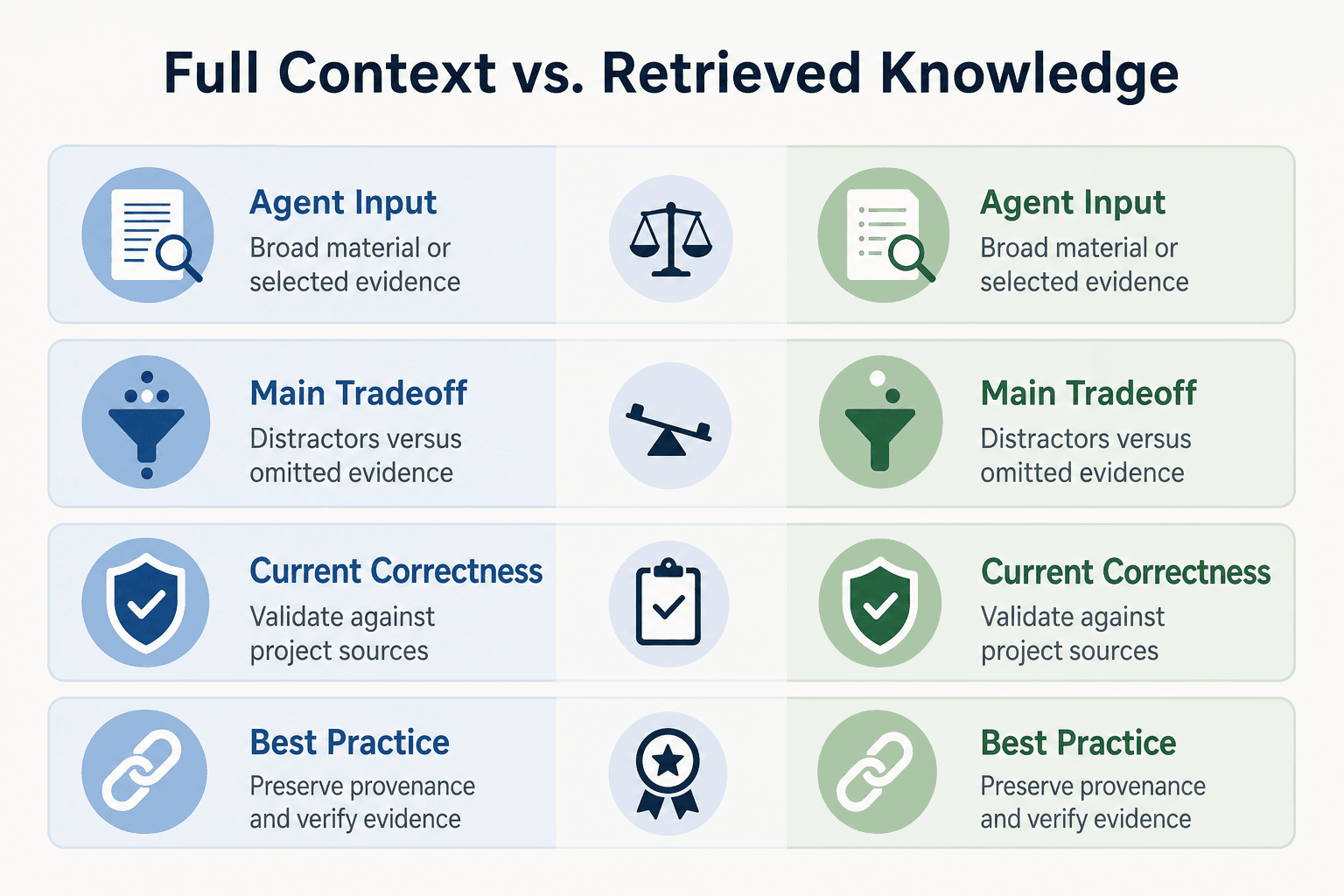
Full context vs. retrieved project knowledge
| Factor | Full context | Retrieved knowledge |
|---|---|---|
| What the agent receives | A broad set of material placed in the prompt | A selected set of evidence relevant to the task |
| Main tradeoff | Can retain more context when it fits, but may include distractors | Uses less context, but selection can omit useful evidence |
| Current correctness | Depends on the accuracy and freshness of included material | Needs validation against current project sources |
| Best practice | Use when the relevant corpus fits | Preserve provenance and check evidence before relying on it |
Set up the retrieval workflow and its guardrails
Before searching, define the change, the repository area the agent may inspect, and the prompt budget it can spend. Those boundaries make it easier to select evidence deliberately and compare it with current project sources.
Define the task, repository scope, and prompt budget before searching
Name the behavior to change, the likely service or package, and the files that can govern it. Keep an allowance for instructions, current code, tests, retrieved records, and the agent's output.
Set a scope that is appropriate for the task, then expand it when the change points to shared configuration, another service, or another dependency. Record the scope so reviewers can see which material was considered.
Define source authority for this repository
Set source authority according to the repository's governance and the task. For example, a team may designate current implementation, tests, configuration, API contracts, or maintained decision records as controlling for different questions. Treat chat notes and issue comments as context unless the team's policy gives them a stronger role.
Keep provenance, revision status, and unresolved conflicts visible
For every retained record, keep its source location, revision or effective date, and status. A useful evidence record includes the source ID, revision, passage, and citation locator, as Supermemory's lifecycle guidance recommends.
Don't flatten disagreement into one claim. Mark it unresolved.
Do not treat an old memory or semantic match as current repository truth
Keep source and revision status visible for persistent knowledge. Track revisions and decide which records are eligible for answers; retention or import status alone should not replace an explicit acceptance decision.
Semantic relevance alone does not establish a record's status. The OIDA paper on organizational epistemic infrastructure describes how relevant records can represent different states, including plans, hypotheses, decisions, contradictions, and unresolved questions. Check the record against the current branch before it enters your task packet.
Step-by-step: build a bounded coding-agent task packet
- Organize project knowledge into sources that can be retrieved for a specific task.
- Retrieve passages and records relevant to the task.
- Open the current repository files that bear on the retrieved claims.
- Compare the material with the repository and retain disagreements, dates, and uncertainty.
- Select only the validated evidence needed to guide the task.
- Give the agent the task, selected evidence, and source references.
- Check the result against the repository and evidence before accepting it.
Step 1: Organize project knowledge for targeted retrieval
Organize project knowledge so a reader can distinguish decisions, evidence, plans, hypotheses, and open questions. Record type and status make it possible to review each result in the right context.
Separate project knowledge and access boundaries
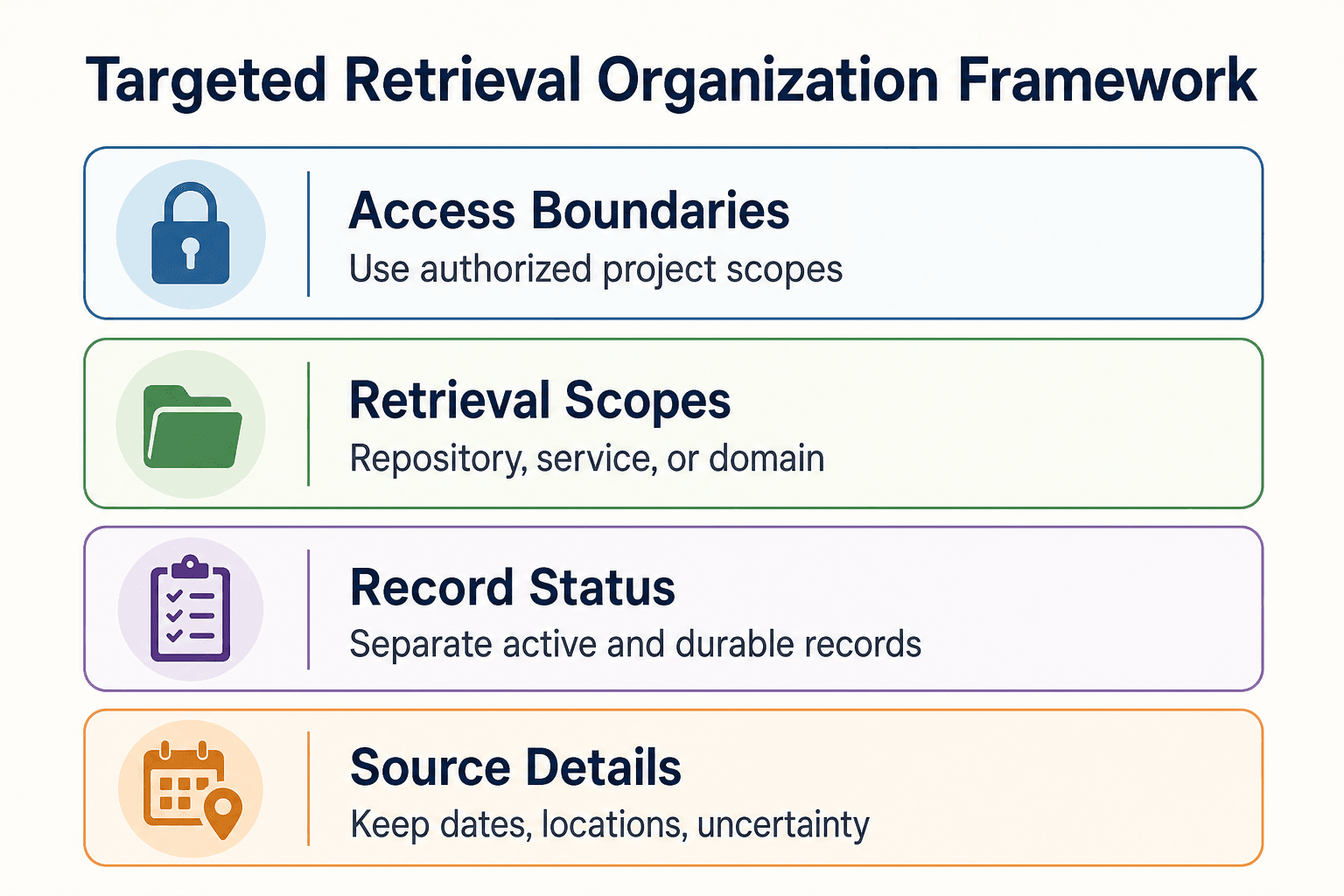
Keep project or client knowledge in clearly defined, authorized scopes. The scope should match the repository or environment relevant to the task, so reviewers can identify which records were considered and which access rules apply.
Apply access boundaries during retrieval as well as storage. A later agent session should receive only the project knowledge its current authorization permits.
Define retrieval scopes by repository, service, or domain
Define meaningful search boundaries, such as a repository, API service, infrastructure area, or product-policy domain. Start with the boundary most likely to contain the governing evidence, then broaden the search when the task points to a dependency outside it.
Scope is a tradeoff: a focused search can make review more practical, while a broader search may be necessary when the change crosses services or shared configuration.
Distinguish active work from durable project records
Label active investigations, migrations, and bug fixes as work in progress. Store accepted decisions, non-negotiable constraints, and handoff material as durable records, with a clear status and source reference.
Do not present a tentative proposal as a settled rule. Keep its status visible so retrieval can preserve the difference between an open question and an accepted decision.
Record dates, source locations, and uncertainty instead of flattening assumptions into facts
Attach a source ID, revision or effective date, location, and status to each memo. Keep conflicts visible. If records disagree, retain both dates and mark the open question rather than merging them into one confident claim.
Step 2: Connect an agent to GigaRAG through MCP or the API
GigaRAG is a shared memory platform for AI agents. Teams can connect agents to a central Hive Mind through MCP or the API, with access controls that manage what each agent can use.
Use the connection method available for your agent environment and GigaRAG deployment. Configure access controls for the project knowledge the agent is allowed to use, and keep the authorized scope identifiable for the task.
Keep connection details and authorized scope reviewable
Record whether the agent connects through MCP or the API, along with the project knowledge it is authorized to use. Before assigning repository work, use a limited authorized scope to confirm that retrieved records include source details for review.
npm install -g gigarag
gigarag login
gigarag connect
Keep the connection details, applicable access policy, and authorized scope available for review. A successful connection does not establish that retrieved material is current or applicable to the task.
Apply access controls before exposing project knowledge to an agent
Set access controls so each agent can use only the project knowledge appropriate to its task. Keep the applicable project scope identifiable in the task record and in any retrieved evidence.
https://mcp.gigarag.com/mcp
A connection is not a substitute for evidence review. Before relying on retrieved material, inspect its provenance, date or revision information, and relationship to the current repository.
Confirm the agent can retrieve only its authorized scope
Before assigning repository work, confirm that retrieval in the agent environment is limited to the project knowledge authorized for its task.
claude mcp add --transport http --scope user gigarag https://mcp.gigarag.com/mcp
Confirm that the agent receives only its authorized scope. Keep the integration configuration and access policy documented so a reviewer can determine what project knowledge the agent was allowed to use.
Keep authorized access identifiable
Record the access policy and project scope that apply to the agent's work.
claude mcp login gigarag
Check access in the same agent environment that will perform the work. If the permitted project scope is unclear, resolve that issue before using retrieved material in a coding task.
Test retrieval with a known, authorized record
Before assigning repository work, retrieve one known record from the authorized project scope and inspect its source details. This confirms that the integration can return evidence the agent may use; it does not establish that every retrieved record is current or applicable.
Keep the first test narrow. Use it to verify provenance and access boundaries, then move on to retrieval tailored to the task.
Step 3: Retrieve, verify, and build a bounded task packet
Retrieval gives you candidates, not instructions. For a change to an API client, the agent still needs to know which retry rules remain live, which error paths tests protect, and what evidence is too old to trust.
[!tip] Keep source references and qualifiers with decisions and conventions. That makes it easier to recheck retrieved knowledge against the repository instead of treating an old note as current fact.
Example task: change an API client without breaking an established retry and error-handling convention
State one bounded goal: "Add the new endpoint to the API client while keeping the existing retry and error-handling convention." Don't ask the agent to redesign the client, update every caller, and settle old architecture debates in one prompt.
That scope matters. A smaller task makes it easier to reject material that doesn't affect the implementation.
Search for task-specific candidate records
Search the authorized project scope with terms tied to the task, such as the client name, retry behavior, error class, endpoint, or HTTP library. Use the tools and query syntax documented for your configured integration.
Search results are leads, not instructions. Inspect each promising result's source, date, revision, and status before deciding whether it belongs in the task packet.
Inspect promising records and retain source identifiers
Open promising records through the supported integration and keep each record's identifier, source location, date, and revision detail with the extracted claim.
When a retrieved record summarizes a convention, trace the convention to its cited source before treating the summary as a task rule.
Check retrieved decisions and conventions against current code, tests, package configuration, and API contracts
Read the current API client and its tests first. Then check package configuration and the API contract, if one exists, for changes that make an older memo unsafe.
If a memo says retries stop on a certain error but current tests assert another behavior, don't make the model guess. Mark the conflict as open, or follow the current authoritative source your team has chosen.
Create the packet: task goal, current-file evidence, validated project knowledge, constraints, open questions, and an explicit token limit
Build a short packet with the task goal, file paths and relevant code facts, validated knowledge records with IDs, constraints, open questions, and a token limit. Keep dates, exceptions, and negations intact, because compression can remove the detail that makes evidence true.
Exclude stale, conflicting, weakly related, or unverified material
Keep the packet within its prompt budget and focused on validated task evidence. Exclude material that is weakly related, unverified, or outside the selected scope instead of asking the agent to sort it silently during generation.
Other methods and troubleshooting retrieval failures
Choose a retrieval approach that fits the task, and keep source, status, and revision information visible throughout selection and review.
When another retrieval method fits
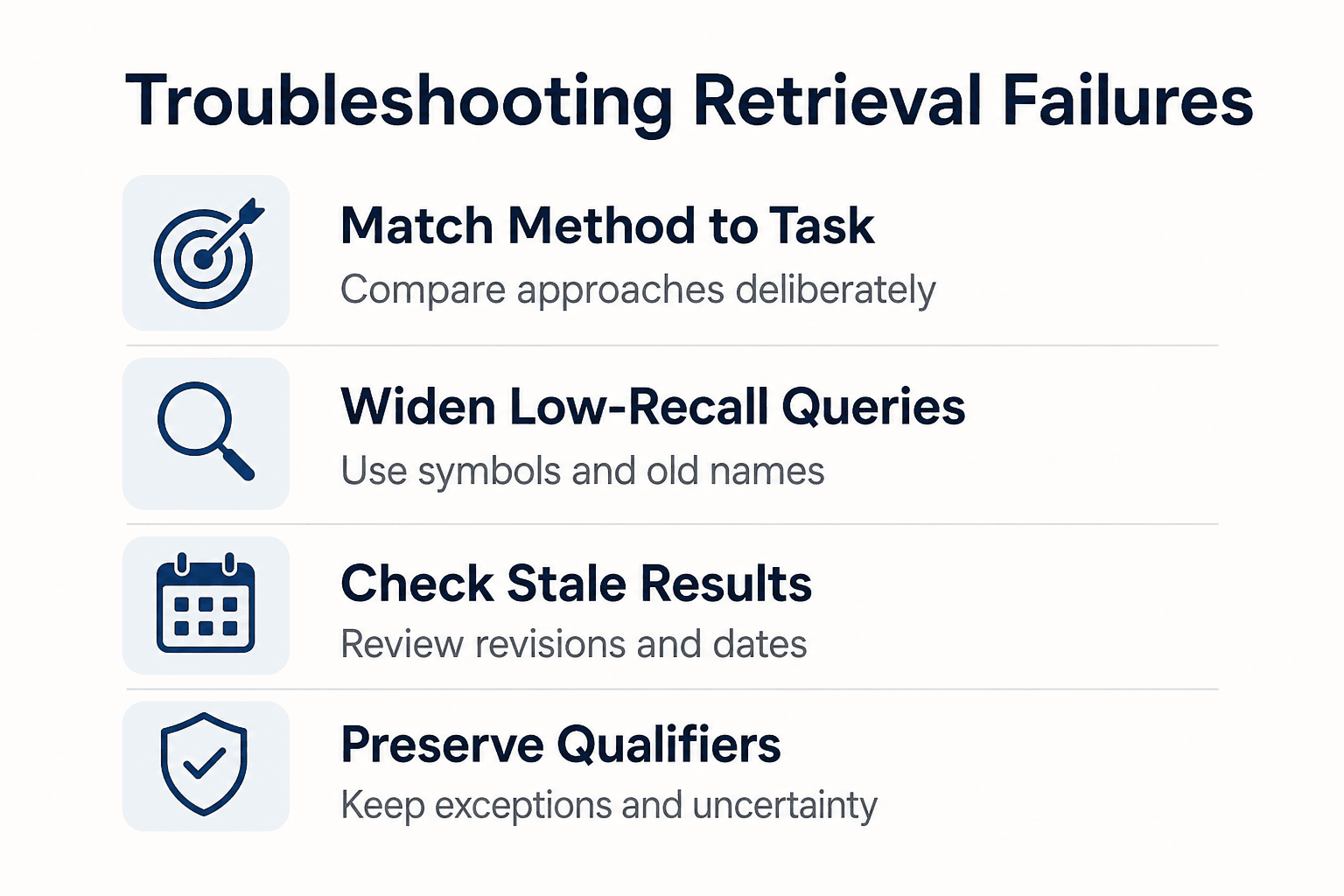
Compare approaches against the task rather than assuming one is universally best. A full-context baseline can be useful when the relevant corpus fits at acceptable cost. For larger collections, semantic search, reranking, and careful evidence selection can help narrow the material reviewed for a repository change.
Fix common retrieval failures
For low recall, widen the query with symbols, old names, and related terms. For stale results, check revisions and effective dates. Keep contradictions separate rather than merging them, and cut oversized packets by removing repeated or weakly related evidence.
Preserve qualifiers during compression
Compression is lossy. Keep negations, dates, exceptions, uncertainty, and source qualifiers with the claim, because removing a governing qualifier can make the shortened evidence less truthful.
Frequently asked questions
What is a context window in an AI conversation?
It is the finite amount of text the model can receive for a particular generation. Material in that window is not guaranteed to receive equal practical attention.
Does retrieval give an AI agent unlimited memory?
No. Retrieval can make external knowledge available beyond the current prompt, but the system still has to select what to include. That selection can omit relevant evidence, and retrieved material still needs checking.
What is the difference between the context window and the retrieval space?
The context window is the finite set of tokens supplied to the model for a current answer. A retrieval system may search a much larger body of documents or records, then select some material for that context. The selected material is not the same as the full retrieval space.
Why should retrieved knowledge be checked against current repository files?
Retrieved records provide context, but the current repository files may be the controlling source for the task. Compare a record with the applicable code, tests, configuration, and contracts, then retain any disagreement as an open issue or follow the source authority your team has defined.
What should be included in a bounded task packet for a coding agent?
Include the task and the selected evidence needed to complete it, with source references and important qualifiers. Keep uncertainty or conflicting evidence visible rather than collapsing it into a confident claim.
When should I add reranking or another retrieval stage?
Add a stage when the initial search does not surface evidence that is useful for the task. Reranking can help identify useful documents, but later selection should still preserve the passages and qualifiers that make the evidence relevant.
How can I organize project knowledge for retrieval?
Use authorized project scopes and clear record types. Identify whether a record is a decision, constraint, plan, hypothesis, evidence item, or open question, and retain its source, revision or effective date, and status. This helps reviewers assess retrieved material in the context of the task.
How should an agent retrieve project knowledge through GigaRAG?
Connect the agent to GigaRAG through MCP or the API and apply access controls to the knowledge it may use. Retrieve task-relevant records from the authorized scope, then retain source details with any claim that enters the task packet.
About GigaRAG
GigaRAG helps developers and teams keep project knowledge available as work moves across sessions and tools, giving agents a shared memory layer for retrieval.
Teams can connect agents to a central Hive Mind through MCP or the API. Access controls manage what each agent can use, so retrieval can be limited to the knowledge appropriate for its task.


