Writing a Retrieval Incident Postmortem for RAG Systems
Writing a retrieval incident postmortem matters when an assistant gives a confident, outdated answer even though the right document exists somewhere in your organization. A bad output alone can't prove retrieval failed: generation may have ignored good chunks, permissions may have excluded them, or agent memory may be wrong.
A retrieval incident is a failure to find, filter, rank, authorize, or preserve the evidence a query needs. The goal isn't to assign blame. It's to reconstruct what the system could retrieve at that moment, before source documents, indexes, logs, or memory state change. Save the query, retrieved chunks, ranks, scores, filters, access result, index and embedding versions, corpus freshness, and final response. That record can separate a stale index or metadata rule from a generation problem.
Writing a retrieval incident postmortem: process overview
A plausible but wrong answer does not, by itself, show whether retrieval or generation failed. Reconstruct what the system could retrieve at the time, then connect that evidence to impact and corrective actions.
[!tip] For suspected silent retrieval degradation, record the index and corpus state alongside the query, retrieved chunks, and active metadata filters. Otherwise, a later replay may not reflect what the system could retrieve at the time.
- Scope the incident and preserve the query, retrieved chunks, filters, index and corpus state, permissions, and generation behavior.
- Build a timeline from the first signal through mitigation and resolution.
- Compare evidence for retrieval, data, permission, and generation problems without treating a symptom as a root cause.
- Document impact, contributing conditions, and specific prevention actions.
What is a retrieval incident postmortem?
A retrieval incident postmortem is a blameless record of how a RAG or agent-memory system failed to find, filter, rank, authorize, or retain needed evidence, what users saw, and what will change. It cannot prove one cause from a wrong answer alone.
[!note] A bad output alone cannot prove a retrieval failure, a generation failure, or corruption of agent memory. A postmortem can only support conclusions justified by the evidence preserved for the incident.
What counts as a retrieval incident in RAG and agent memory
An obvious outage counts: queries error, the index is unavailable, or permission checks block access. So does a quiet failure, where the system returns plausible but stale or irrelevant chunks. For agent memory, missing, overwritten, or wrongly retrieved stored state can cause the same kind of incident.
Why silent degradation deserves a postmortem
Silent degradation is easy to miss. The assistant still answers. A document may exist in the corpus yet be absent from the active index, excluded by metadata filters, or pushed below the retrieval cutoff. The result can look like a model mistake, so preserve the retrieval record before blaming generation.
The minimum information a retrieval postmortem should contain
Start with the user query, expected source, answer, retrieved chunks, ranks or scores, filters, permission outcome, and corpus, index, and embedding state. Add a timeline, impact statement, mitigation, and owned actions. Label confirmed evidence separately from hypotheses.
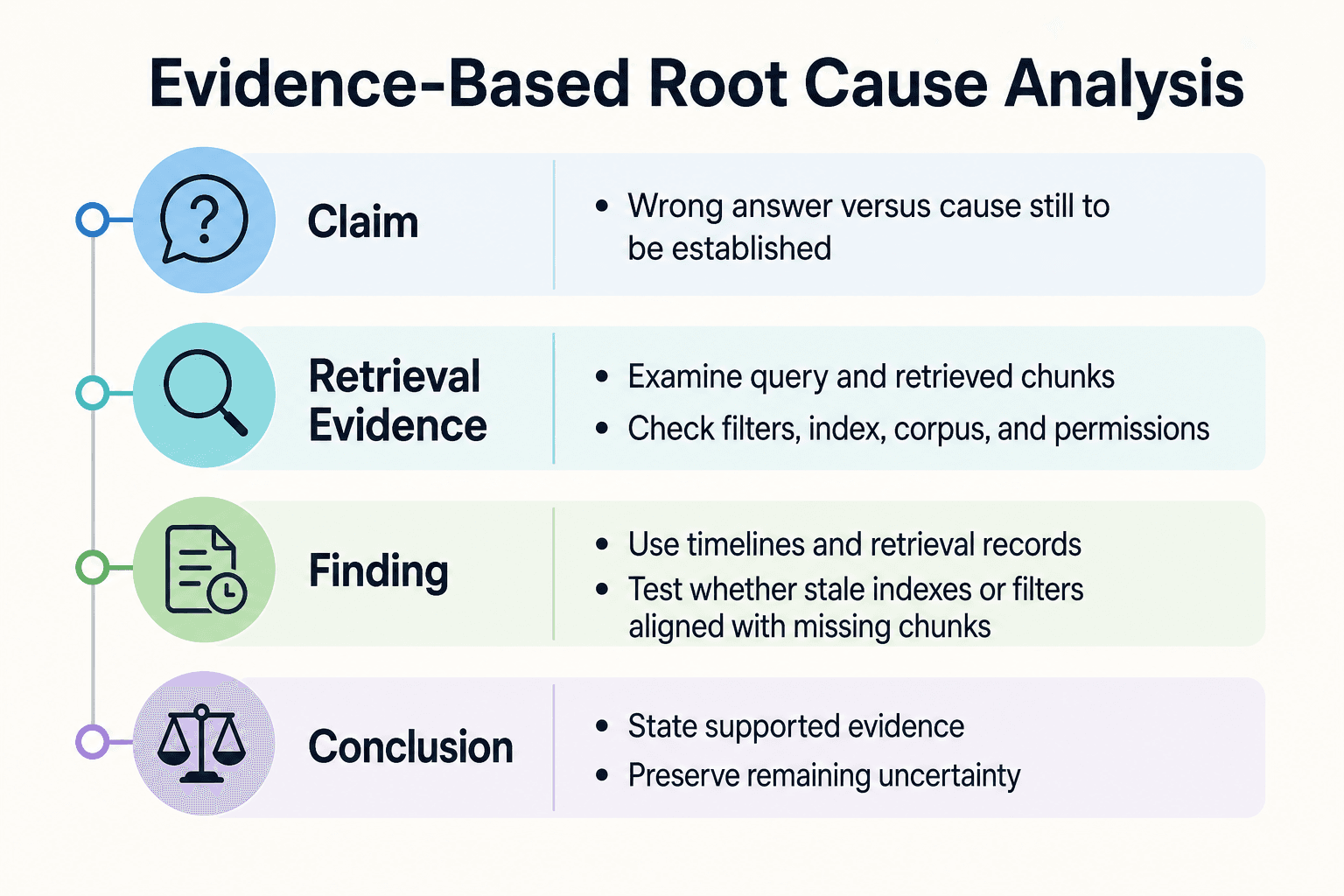
Symptom-based vs evidence-based root cause analysis
| Factor | Symptom-based | Evidence-based |
|---|---|---|
| Claim | The LLM gave a wrong answer. | The answer was wrong; the cause remains to be established. |
| Retrieval evidence | Not examined. | Compare the query and retrieved chunks with the filters, index, corpus, and permissions in effect. |
| Example finding | Retrieval must have failed. | A timeline and retrieval records show whether a stale index or filter coincided with missing relevant chunks. |
| Conclusion | Assigns a cause from the output alone. | States what the evidence supports and what remains uncertain. |
Step 1: Preserve retrieval evidence and scope the impact
Before logs roll over or someone rebuilds the index, freeze the evidence from the failing request. A bad answer alone can't show where the pipeline failed. You need the record of what the system had available, what it selected, and what it returned.
Capture the query, expected evidence, response, retrieved chunks, ranks, and scores
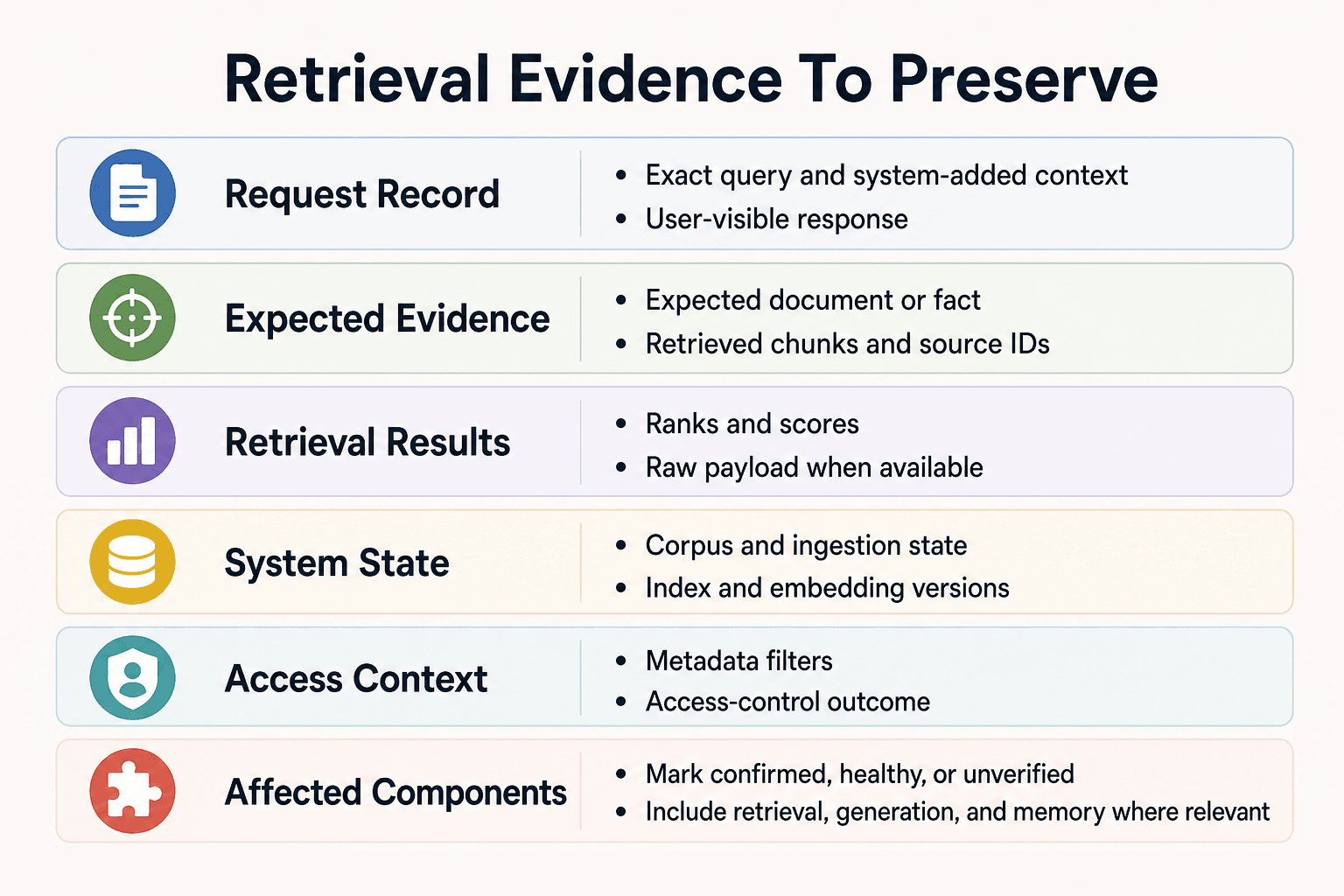
Save the exact query, including system-added context or rewritten search text. Record the expected document or fact, the user-visible response, each retrieved chunk, its source ID, rank, and score. Keep the raw payload if you can.
Don't rely on screenshots alone. They rarely show enough to reproduce the request.
Record filters, access-control outcome, corpus state, index version, and embedding version
Write down every metadata filter and whether access control allowed or denied the expected source. Capture the corpus state at the incident time: which documents existed, their update times, and whether ingestion had completed.
Also preserve the index version and embedding model version. If those details are missing, say so. That uncertainty limits what you can call a root cause.
Map affected components: ingestion, chunking, embedding, index, retrieval, reranking, generation, and persistent memory
List each component the request passed through, then mark it as confirmed affected, checked and healthy, or not yet verified. Include ingestion, chunking, embedding, indexing, retrieval, reranking, generation, and persistent memory where relevant.
This stops a suspected retrieval issue from becoming an unsupported claim about the whole system.
Measure user impact when exact counts are unavailable
Start with known reports, affected query types, and the time window the evidence supports. If you can't count affected users, don't estimate. State that impact is unconfirmed, then describe the plausible exposure, such as users searching documents updated after a particular ingestion run.
Step 2: Reconstruct the timeline and separate retrieval from generation
A timeline turns scattered logs into a sequence you can check. Use Asia/Kolkata as the project time for every entry, and retain the original source-system timezone in parentheses when logs came from elsewhere. Record the first bad result, detection, each investigation step, mitigation, and verification.
Build a timeline from first bad result through mitigation and verification
Write exact timestamps, observed facts, decisions, and changes. The timeline is often where the real root cause becomes visible. Don't write "index fixed." Write what changed, who changed it, and which failing query passed afterward.
Use one fixed query and expected source to test the retrieval path
Run the same query against the preserved index state where possible. Name the expected source, then check in order: did the document exist, did ingestion include it, did filters exclude it, did permissions block it, and did ranking place it below the cutoff?
Keep the query fixed. Changing it can hide the fault.
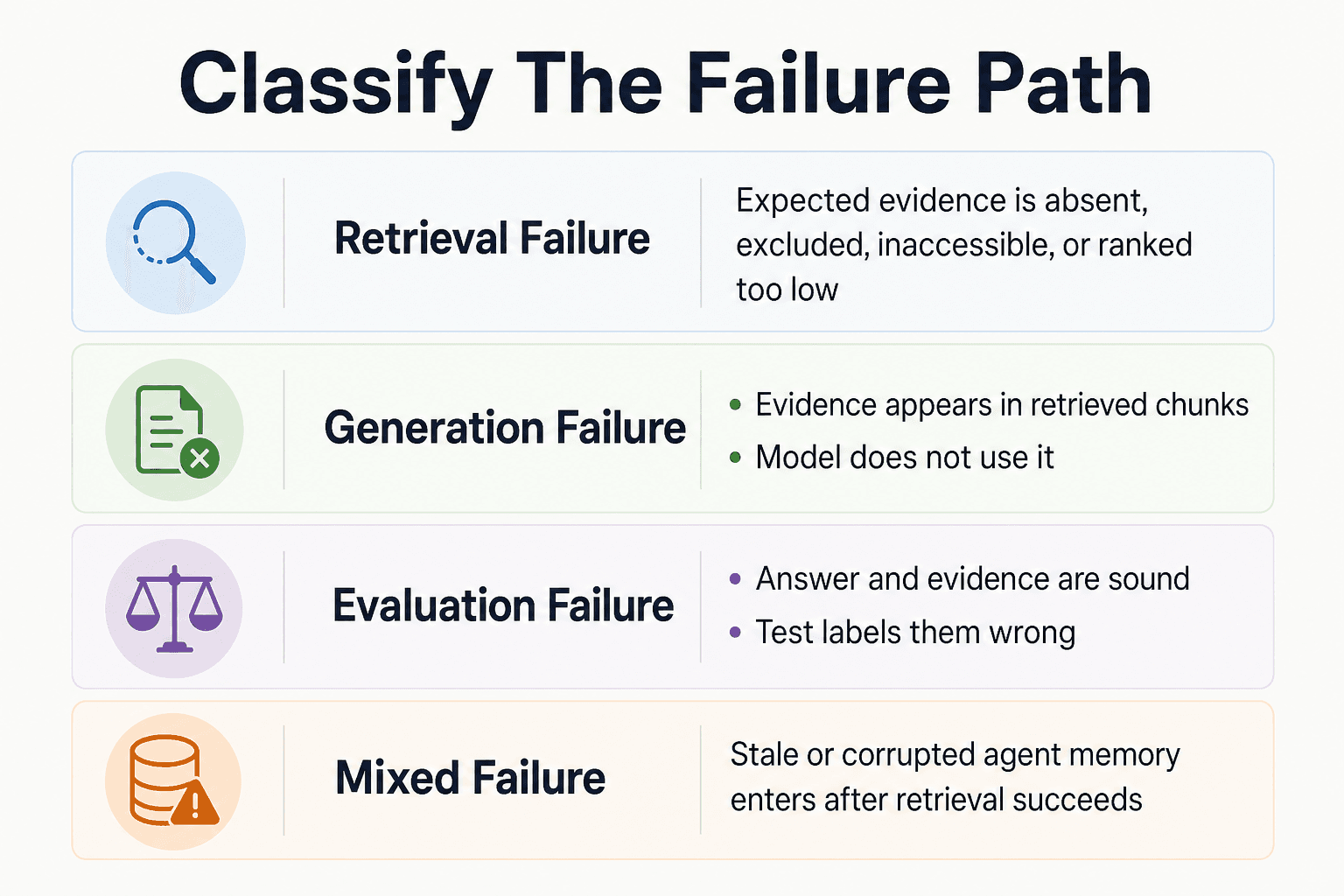
Retrieval failure, generation failure, evaluation failure, and mixed failure
If the expected evidence is absent, excluded, inaccessible, or ranked too low, retrieval failed. If the evidence appears in retrieved chunks but the model does not use it, generation failed. If the answer and evidence are sound but the test labels them wrong, the evaluation failed.
It can be mixed. Agent memory may inject stale or corrupted context after retrieval succeeds.
How incident-response steps feed the postmortem rather than replace it
Mitigation restores service. The postmortem explains why that mitigation was needed and what evidence supports the cause. Label unproven links as hypotheses, then attach an owner and verification method to each follow-up action.
Step 3: Write the root cause, resolution, and prevention plan
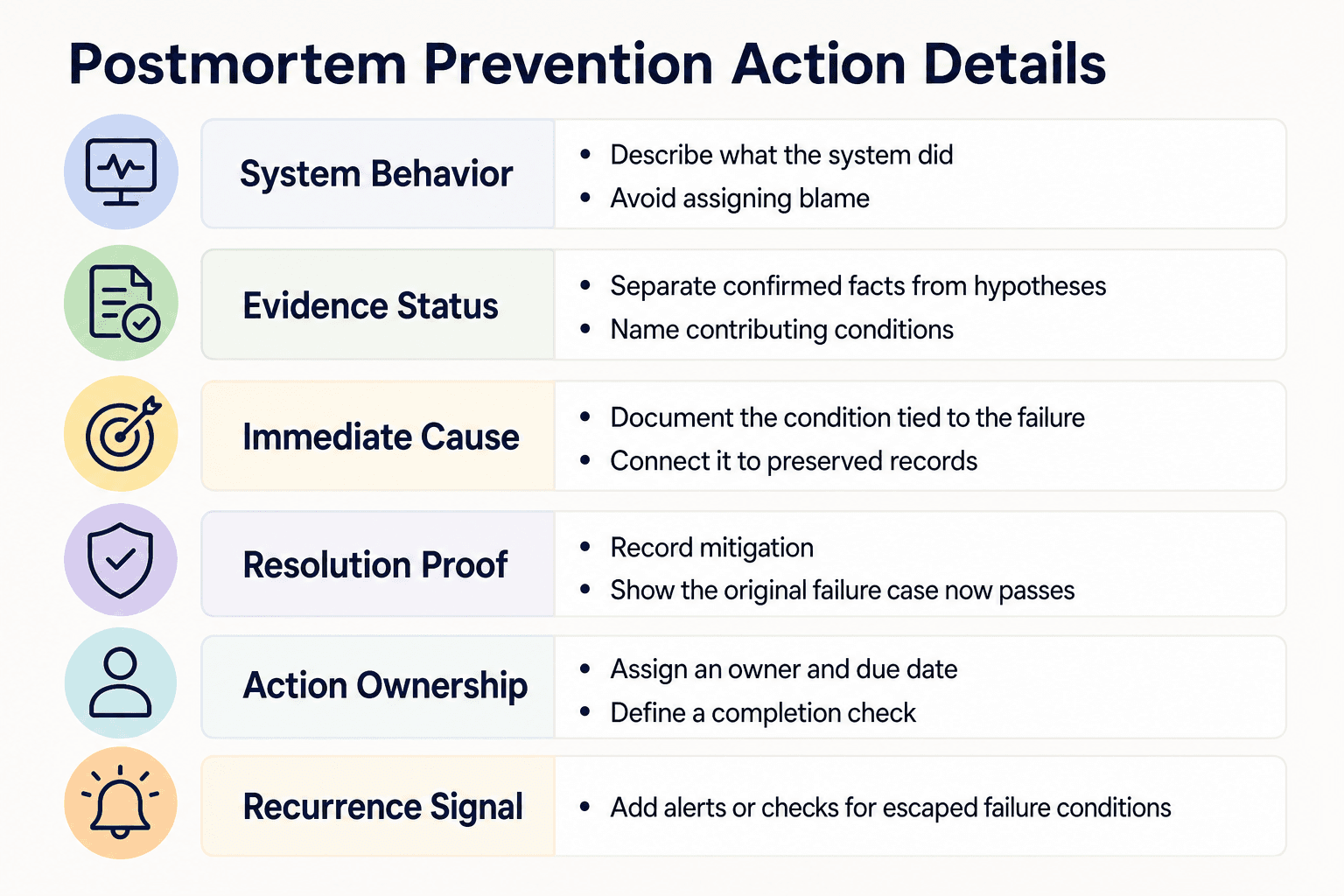
Write what the system did, not who to blame. A good postmortem separates confirmed facts from likely contributing conditions, because a plausible answer alone still can't prove that retrieval, generation, or memory caused the incident.
A realistic scenario: silent degradation after an index or metadata change
A policy assistant starts returning an outdated travel rule after a metadata change. The current policy document still exists in the corpus, but its region value no longer matches the filter used for Asia/Kolkata queries. The old document remains eligible and ranks highly.
Nothing crashed. Users just received stale guidance.
Good vs. bad root-cause analysis: symptom, immediate cause, contributing conditions, and evidence
Bad: "The assistant gave wrong answers because the index was stale."
Good: "The metadata migration changed the current policy's region value. The retrieval filter excluded that document, while the older version remained retrievable. Preserved query logs, filter values, retrieved chunks, and document metadata support this finding."
Then name contributing conditions: no metadata contract check, no alert for a sharp drop in current-document coverage, and no rollback test. If the evidence doesn't establish a link, call it a hypothesis.
Sample retrieval incident postmortem structure: summary, impact, timeline, evidence, components, cause, resolution, and actions
Keep the document short but complete:
- Summary and impact: What users saw, when it began, and what impact you can verify.
- Timeline and evidence: Timestamped events, fixed test query, chunks, scores, filters, permissions, index and embedding versions.
- Affected components: Ingestion, source documents, index, retrieval, reranking, generation, or agent memory.
- Cause and resolution: Immediate cause, contributing conditions, mitigation, and proof that the original failure case now passes.
- Actions: Preventive work with ownership and a way to check completion.
Incident Copilot's postmortem structure also treats timeline, root cause, impact, and action items as separate parts. That separation stops a fix from being mistaken for an explanation.
Write preventive actions with an owner, due date, verification method, and recurrence signal
Don't write "improve monitoring." Write: "Search team: add a pre-release check that runs known regional queries against changed metadata; verify that the expected current document passes the filter; alert when it fails."
Use the same pattern for stale indexes, embedding changes, missing documents, permission failures, and corrupted agent memory. A postmortem without action items is just documentation.
Detection gaps: alerts and checks for freshness, coverage, filtering, permissions, and memory integrity
Add checks where the failure escaped: corpus-to-index freshness, expected-document coverage, filter inclusion, permission outcomes, and memory records that are malformed, expired, or tied to the wrong user. Track the signal that would have exposed this incident earlier, so the next report begins with evidence rather than a bad answer.
Review the postmortem and close the loop
A postmortem isn't done when the document is approved. It's done when the evidence is clear, the uncertainty is visible, and the preventive work has either shipped or been consciously declined.
Before publishing: evidence, uncertainty, ownership, and validation
Run a final blameless review. Remove names where they stand in for a system condition, and replace "human error" with the missing check, unclear handoff, unsafe default, or absent rollback that made the error matter.
Label each finding: confirmed evidence, supported inference, or hypothesis. Don't turn a likely explanation into fact just because it sounds tidy.
Then replay the original query with the original filters, permissions, and expected source. Confirm that the right document is eligible, retrieved, and used in the response. Track every action to an owner, due date, and completion check. That's how writing a retrieval incident postmortem leads to fewer repeat failures.
Frequently asked questions
How do you write a postmortem report for a retrieval incident?
Record a plain-language summary, timeline, impact, evidence-based root cause analysis, and specific action items. For a retrieval incident, include the query and the retrieval context available at the time, such as retrieved chunks, filters, index and corpus state, and permissions.
What are the 7 steps of incident response, and where does the postmortem fit?
Incident-response step names and counts depend on the framework your team uses. The supplied reference does not establish one universal seven-step sequence. It describes the postmortem as a structured analysis after an incident, used to document what happened and identify preventive actions.
Is postmortem one word or hyphenated?
The supplied reference uses "postmortem" as one word. Use that spelling consistently in the report.
How do you write up a RAG incident report?
Summarize the observed failure and impact, then document the timeline, evidence, root cause or remaining uncertainty, and action items. Include retrieval and generation context so the report does not infer a cause from the answer alone.
How can you tell whether a RAG failure came from retrieval or generation?
Compare what the system retrieved with the answer it generated, using records from the incident time. If those records are missing or incomplete, a wrong answer alone cannot establish whether retrieval or generation failed.
What evidence should a retrieval incident postmortem include?
Preserve the query, retrieved chunks, active metadata filters, index and corpus state, and relevant permission context. Record downstream generation behavior and the incident timeline too, so findings can be tied to observed evidence rather than symptoms.
About GigaRAG
GigaRAG helps you share agent memory like you share Google Docs. It connects your AI agents to a central Hive Mind, with access controls for what each agent can use. Developers, vibe coders, and teams can keep project knowledge available across sessions and tools, so agents can pick up where work left off without rebuilding context or managing a full RAG stack.


